
FEDERALMINISTRY OF HEALTH National Malaria Elimination ProgrammeNMEP Seasonal
- Slides: 80
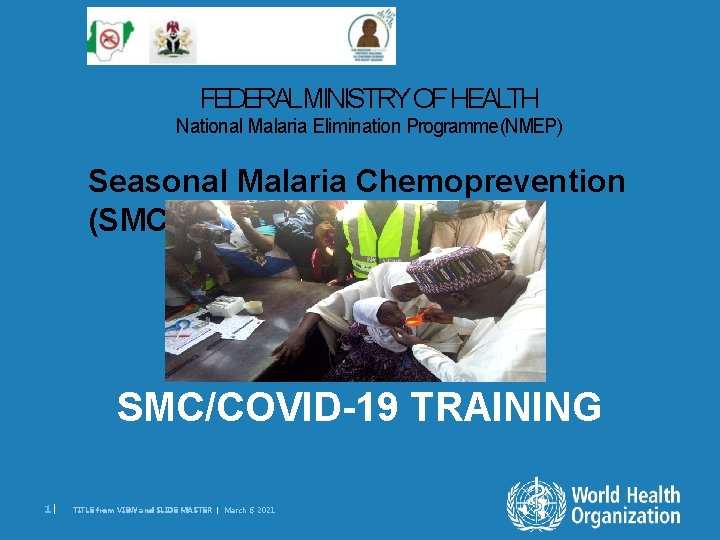
FEDERALMINISTRY OF HEALTH National Malaria Elimination Programme(NMEP) Seasonal Malaria Chemoprevention (SMC) SMC/COVID-19 TRAINING 1| TITLE from VIEW and SLIDE MASTER | March 6, 2021
Outline Purpose of SMC Training for CDDs Module 1 — Overview of COVID-19 Pandemic Module 2 — Introduction to SMC Module 3 — Children Eligible for SMC Module 4 — Referrals for Suspected Malaria and COVID-19 Module 5 — Administering and Recording SPAQ in Context of COVID-19 Module 6 — Interpersonal Communication and Key Messages for SMC and COVID-19 Module 7 — SMC Supervision during COVID-19 Module 8 —for. Commodity and Accountability forand was This SMC Training SMC Community Drug. Management Distributors was developed for Nigeria by Malaria Consortium made possible by the generous support from grants from Give. Well Directed Funds, the Global Fund, and USAIDs LMCU President’s Malaria Initiative. In Collaboration with WHO 1
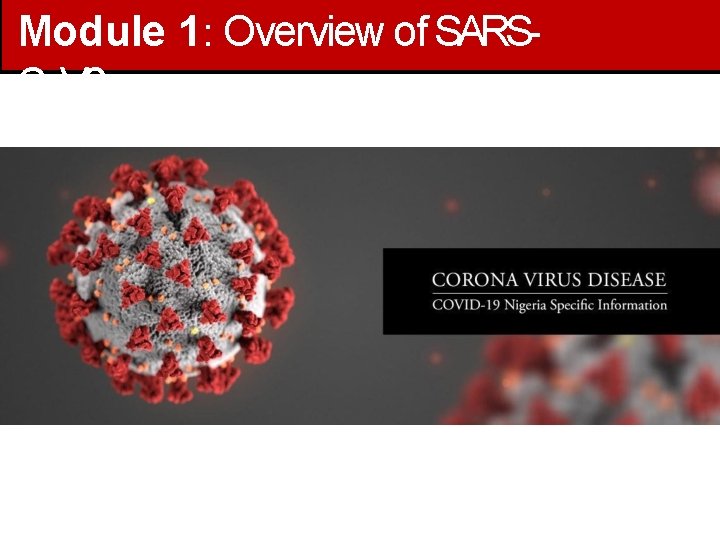
Module 1: Overview of SARSCo. V 2
Introduction to SMC-COVID-19 Training The Purpose of SMC training is to : Know how to deliver SMC safely during the COVID-19 pandemic. Identify children eligible for SMC Give SMC drugs (SPAQ) safely and correctly at 2 m distance Refer sick children to the health facility Refer community members with possible COVID -19 to the DSNO Record doses of SPAQ given to children on the SMC Tally Sheet and SMC Child Record Card Communicate at a 2 m distance with caregivers and explain how to complete the SPAQ blister packet at home and when to go to the health facility Give malaria and COVID-19 prevention messages
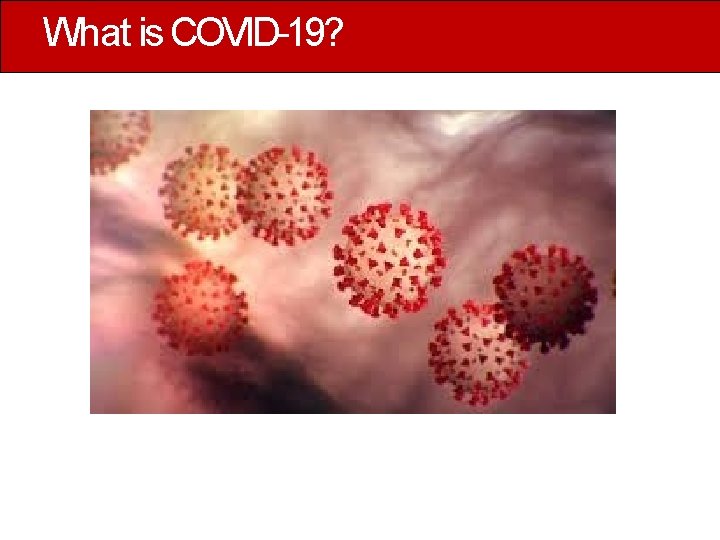
What is COVID-19?
What is COVID-19? COVID-19 is a new disease that is very contagious It is caused by a very small germ called a virus—a coronavirus The virus spreads from person to person Without people it can’t spread The virus infects all organs in the body, especially the lungs COVID-19 illness can have no symptoms, mild symptoms to very severe symptoms. It can be deadly in some people Anyone can get COVID-19. Children and adults Adults older than 45 years old, especially the elderly, and people with other illnesses are more at risk The virus has spread all over the world—this is called a pandemic. There is no treatment, cure, or vaccine now It is important to practice prevention behaviours to avoid
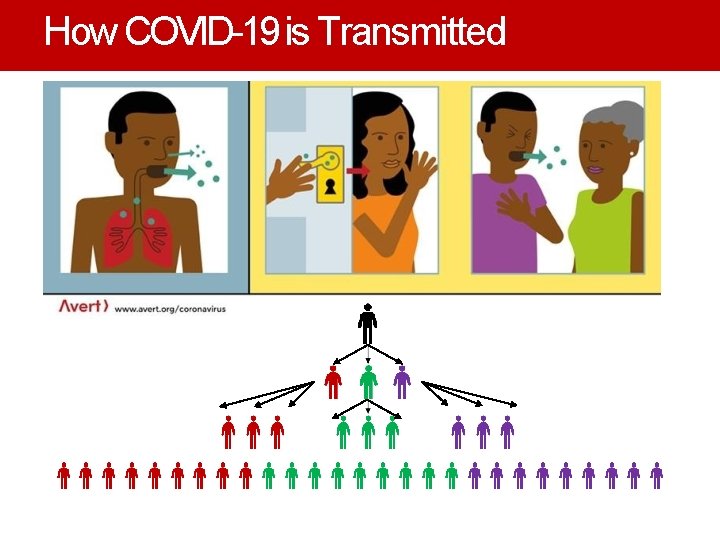
How COVID-19 is Transmitted
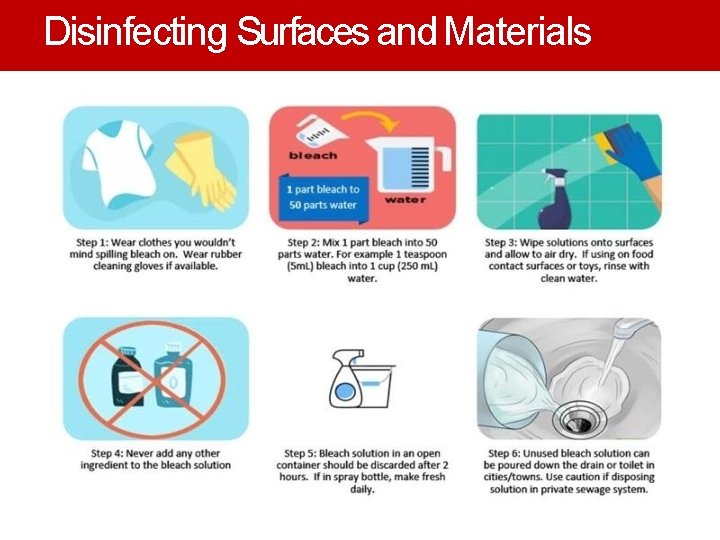
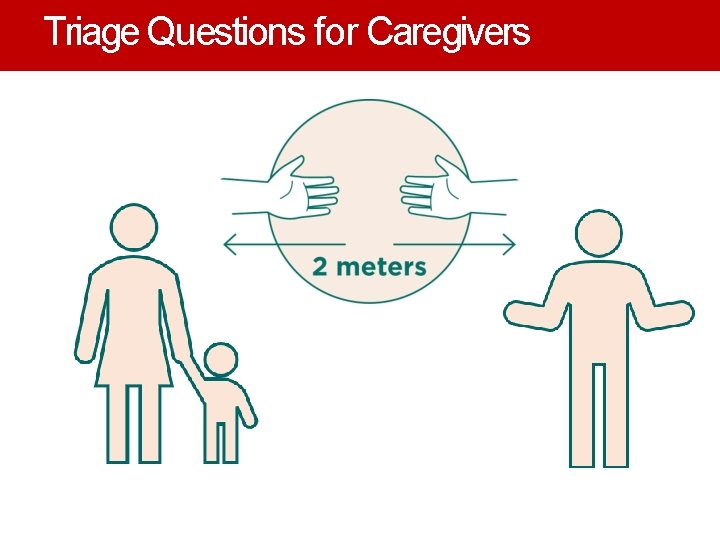
How COVID-19 is transmitted COVID-19 is spread by close contact with an infected person People get infected with COVID-19 when they breathe in the respiratory droplets of infected people after they cough, sneeze, shout, spit, sing, talk loudly, laugh or exhale heavily It is important to maintain a 2 meters distance from each other Droplets from infected persons can also land on objects and surfaces. The virus can live on some surfaces for up to 3 days People can also get infected by touching contaminated surfaces and then touching their mouth, nose or eyes with the same hand It is important to disinfect surfaces which many people touch such as tables, chairs, counters, mobile phones, door handles, doorknobs, touchpads, or pens One infected person can infect 3 other people each day, who will spread to 3 more and so on. It takes a few days for one person to spread to many people
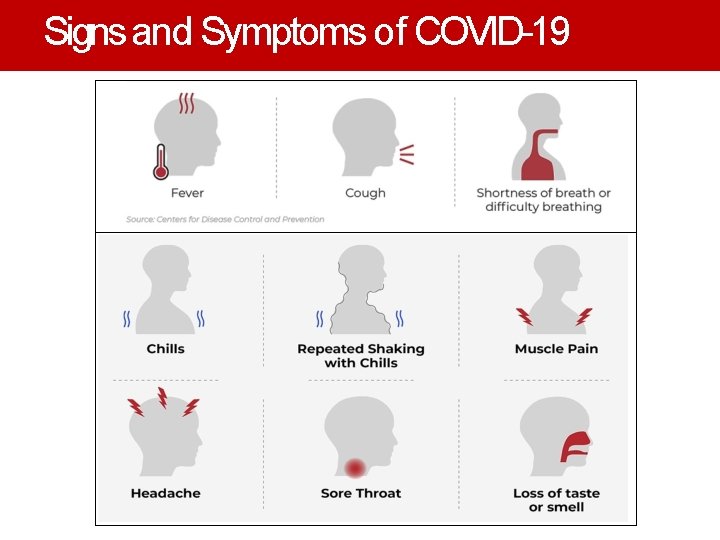
Signs and Symptoms of COVID-19
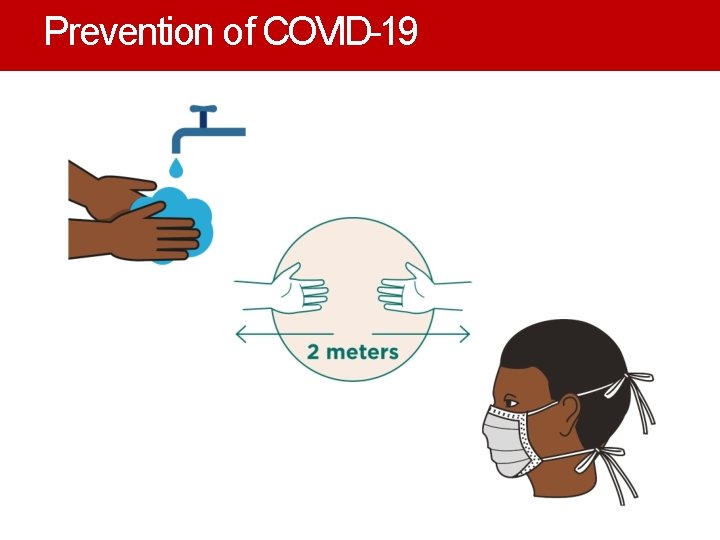
Prevention of COVID-19
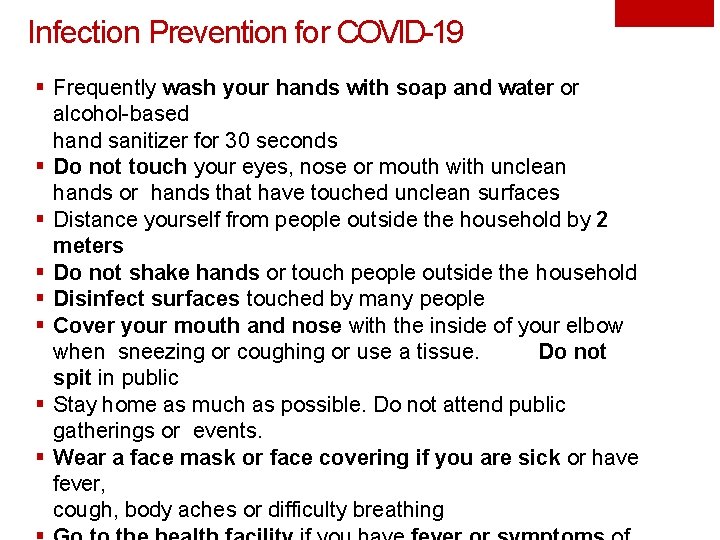
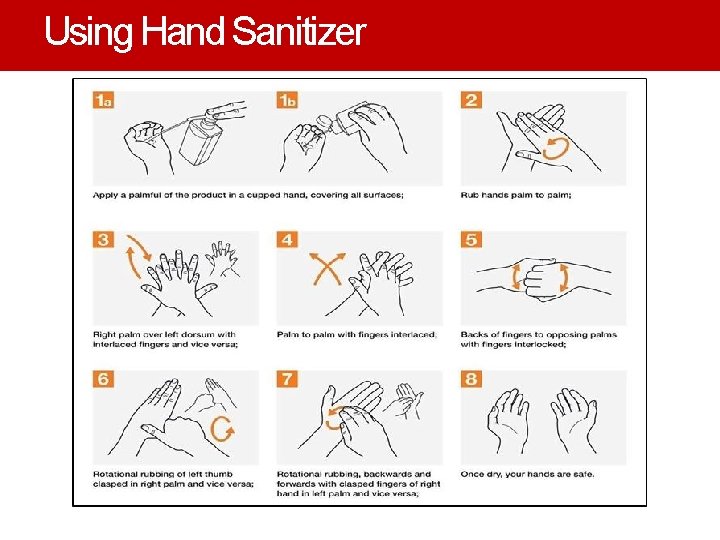
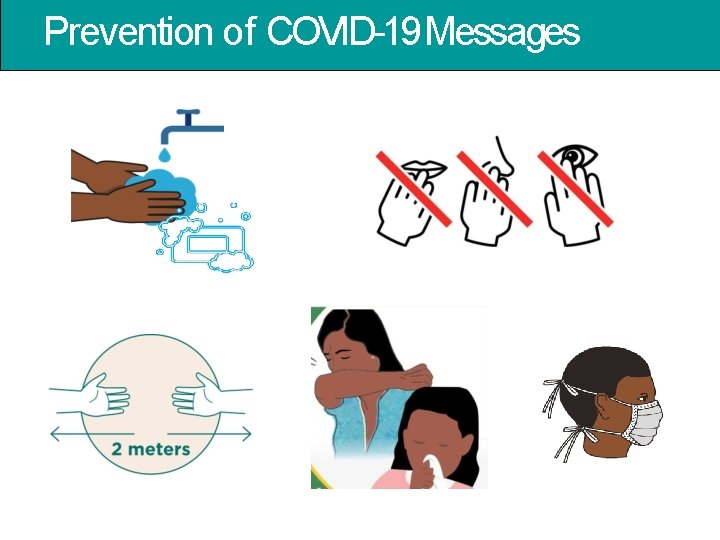
Infection Prevention for COVID-19 Frequently wash your hands with soap and water or alcohol-based hand sanitizer for 30 seconds Do not touch your eyes, nose or mouth with unclean hands or hands that have touched unclean surfaces Distance yourself from people outside the household by 2 meters Do not shake hands or touch people outside the household Disinfect surfaces touched by many people Cover your mouth and nose with the inside of your elbow when sneezing or coughing or use a tissue. Do not spit in public Stay home as much as possible. Do not attend public gatherings or events. Wear a face mask or face covering if you are sick or have fever, cough, body aches or difficulty breathing
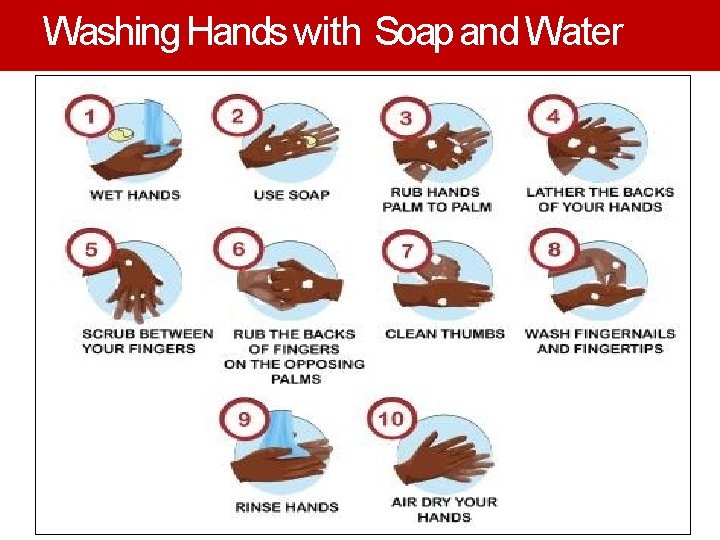
Washing Hands with Soap and Water
Using Hand Sanitizer
PPEfor SMC—How to Use a Face Mask
When to Wear a Face Mask for SMC
PPEfor SMC—Wearing Gloves
Disinfecting Surfaces and Materials
Facts and Rumors about COVID-19
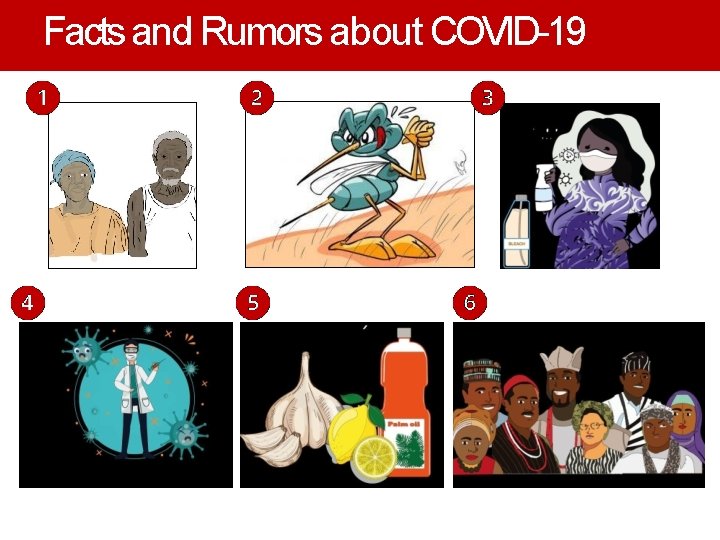
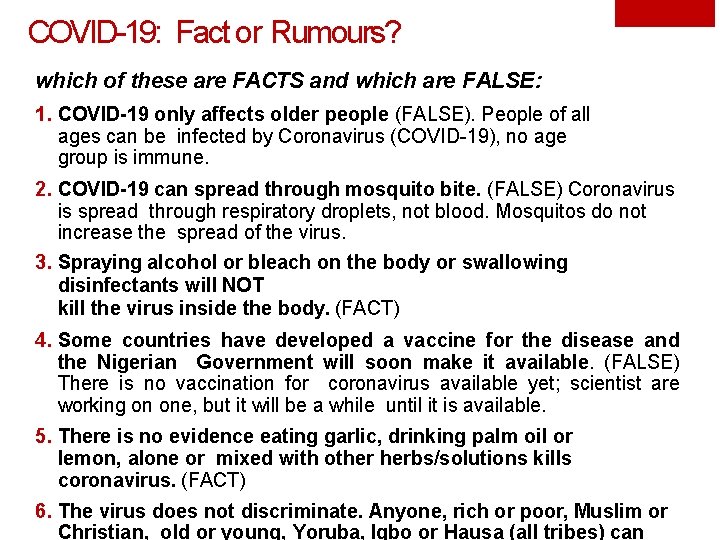
COVID-19: Fact or Rumours? which of these are FACTS and which are FALSE: 1. COVID-19 only affects older people (FALSE). People of all ages can be infected by Coronavirus (COVID-19), no age group is immune. 2. COVID-19 can spread through mosquito bite. (FALSE) Coronavirus is spread through respiratory droplets, not blood. Mosquitos do not increase the spread of the virus. 3. Spraying alcohol or bleach on the body or swallowing disinfectants will NOT kill the virus inside the body. (FACT) 4. Some countries have developed a vaccine for the disease and the Nigerian Government will soon make it available. (FALSE) There is no vaccination for coronavirus available yet; scientist are working on one, but it will be a while until it is available. 5. There is no evidence eating garlic, drinking palm oil or lemon, alone or mixed with other herbs/solutions kills coronavirus. (FACT) 6. The virus does not discriminate. Anyone, rich or poor, Muslim or Christian, old or young, Yoruba, Igbo or Hausa (all tribes) can
Prevention of COVID-19 during SMC
Triage Questions for Caregivers
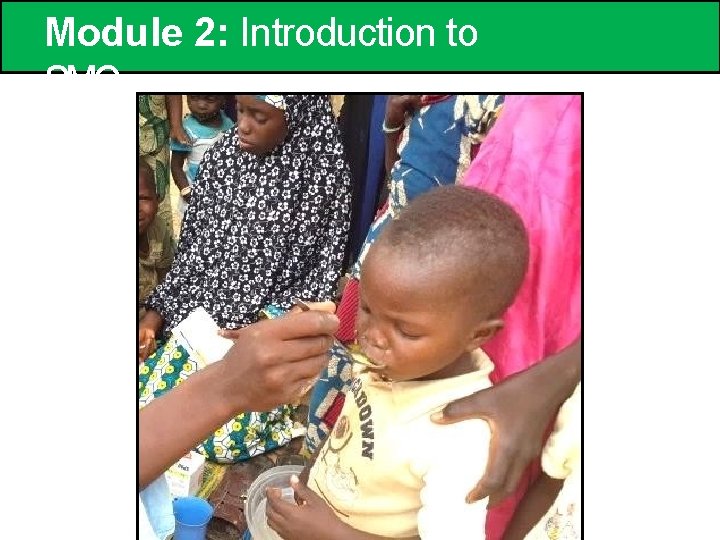
Module 2: Introduction to SMC
Module 2: Content and Tools Conten t: • What is SMC? • • • Why is SMC given to Children? When is SMC given? Names of SMC Drugs How is SMC delivered SMC Terminology How SMC will be affected by COVID-19
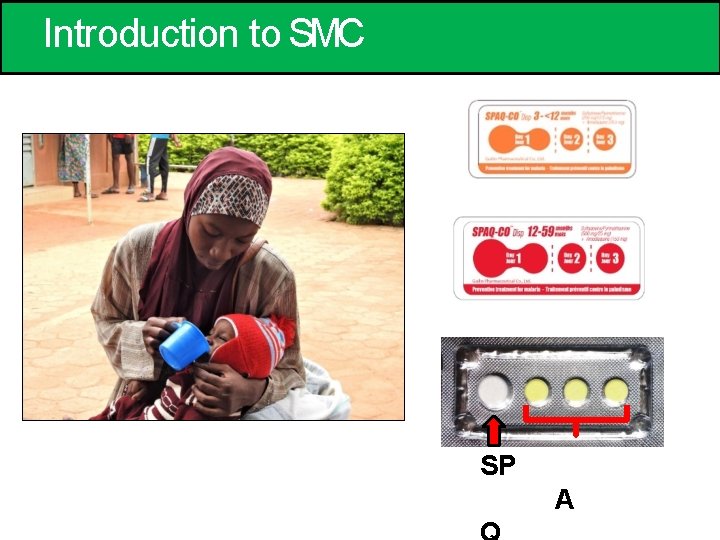
Introduction to SMC SP A
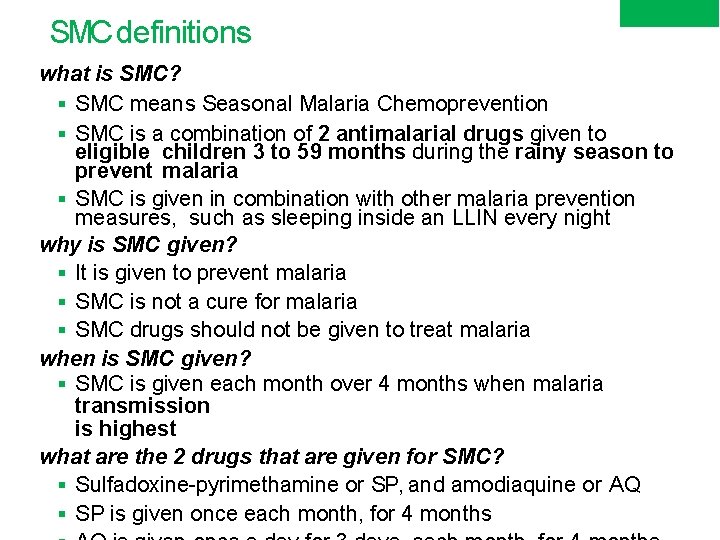
SMC definitions what is SMC? SMC means Seasonal Malaria Chemoprevention SMC is a combination of 2 antimalarial drugs given to eligible children 3 to 59 months during the rainy season to prevent malaria SMC is given in combination with other malaria prevention measures, such as sleeping inside an LLIN every night why is SMC given? It is given to prevent malaria SMC is not a cure for malaria SMC drugs should not be given to treat malaria when is SMC given? SMC is given each month over 4 months when malaria transmission is highest what are the 2 drugs that are given for SMC? Sulfadoxine-pyrimethamine or SP, and amodiaquine or AQ SP is given once each month, for 4 months
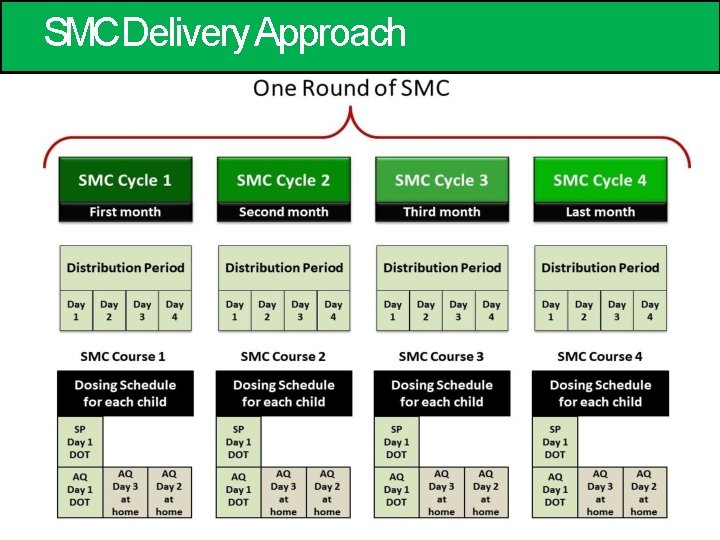
SMCDelivery Approach
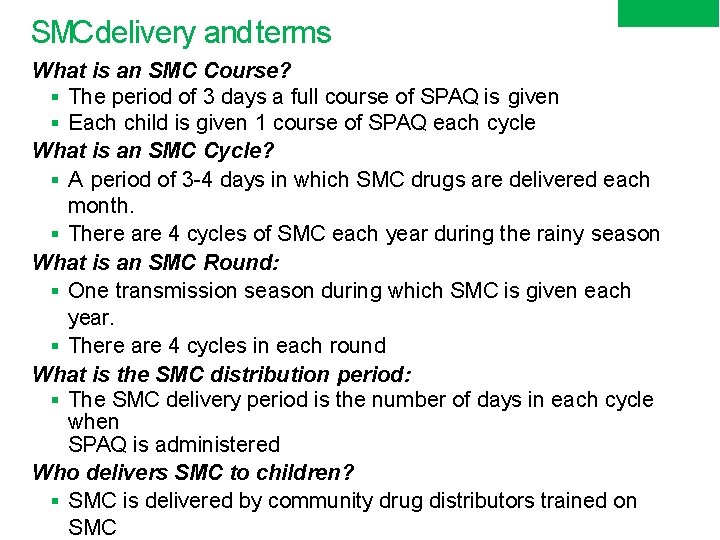
SMCdelivery and terms What is an SMC Course? The period of 3 days a full course of SPAQ is given Each child is given 1 course of SPAQ each cycle What is an SMC Cycle? A period of 3 -4 days in which SMC drugs are delivered each month. There are 4 cycles of SMC each year during the rainy season What is an SMC Round: One transmission season during which SMC is given each year. There are 4 cycles in each round What is the SMC distribution period: The SMC delivery period is the number of days in each cycle when SPAQ is administered Who delivers SMC to children? SMC is delivered by community drug distributors trained on SMC
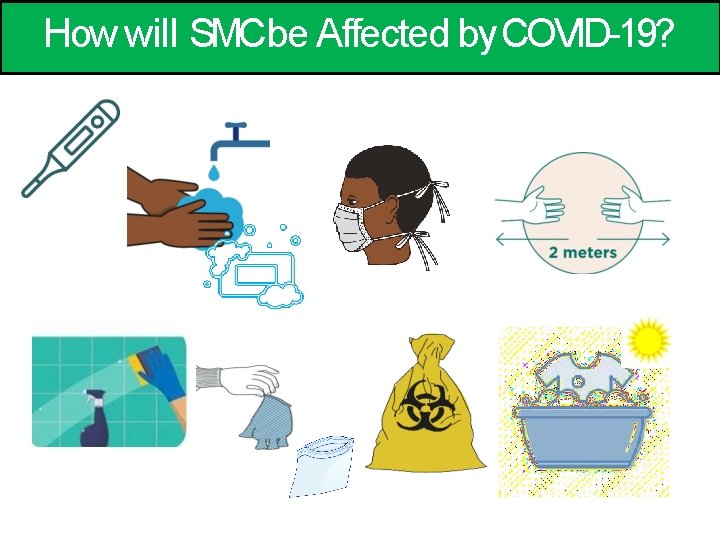
How will SMCbe Affected by COVID-19?
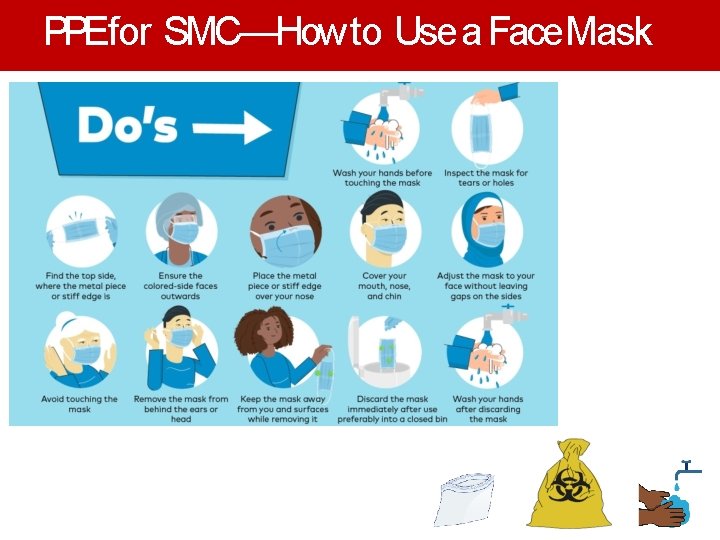
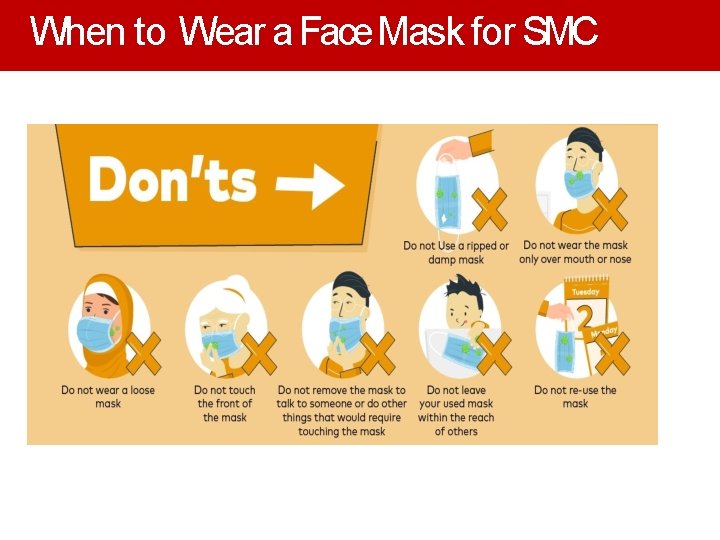
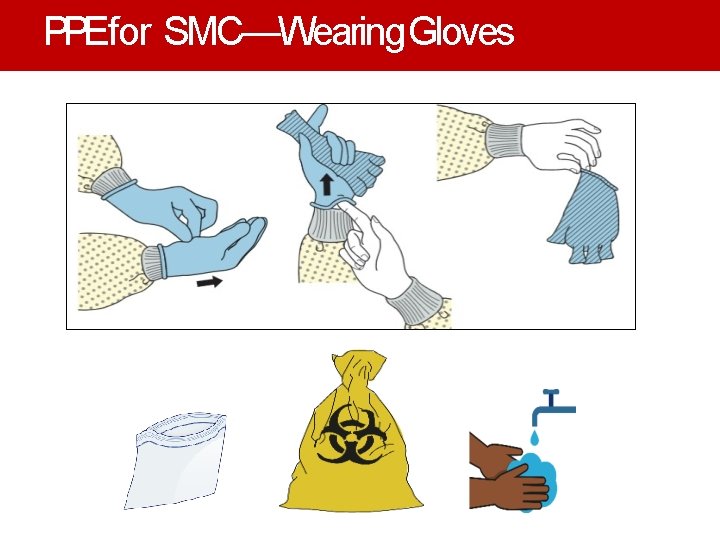
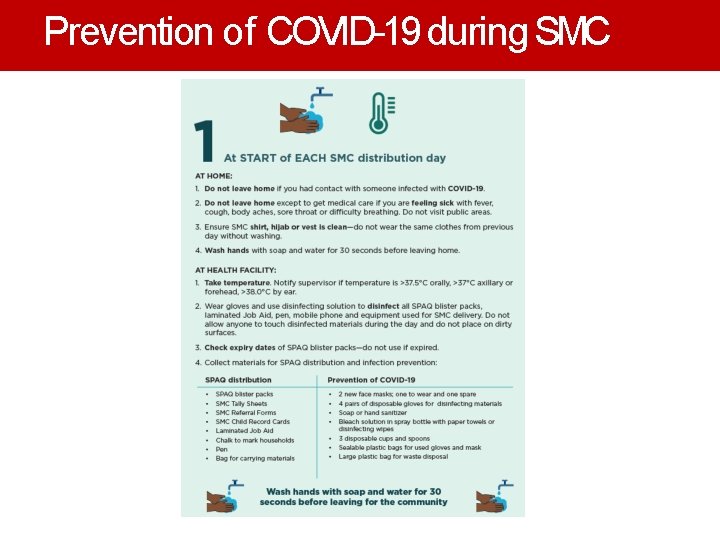
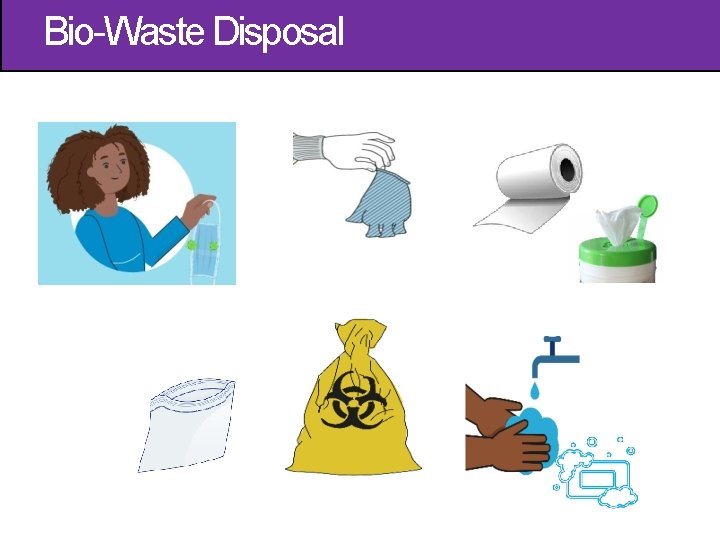
How SMCdelivery will be affected by COVID-19 how to keep SMC delivery safe: It is important to deliver SMC safely and not spread COVID-19 in the communities If SMC is not delivered many children will get sick with malaria and die what can CDDs do to prevent the spread of the virus? Wash hands frequently—CDDs will be given soap and should wash their hands immediately when entering a compound/household and between groups of children Wear a mask—CDDs will be given 1 mask and 1 spare each day. CDDs should war one mask all day Maintain a 2 metre distance at all times. How can you measure 2 metres? Use gloves and disinfecting solution to disinfect materials every 5 households Dispose of used gloves and mask in small bag then large bio waste bag Discard bio -waste bag at the health facility at the end of the day Take temperature in the morning before going into the community and
Module 3: Children Eligible for SMC
Module 3: Content and Tools Conten t: • Age eligibility for SMC • How to determine a child’s age • Children NOT eligible for SMC • SMC eligibility review Tools for each participant: • SMC-COVID-19 Job Aid
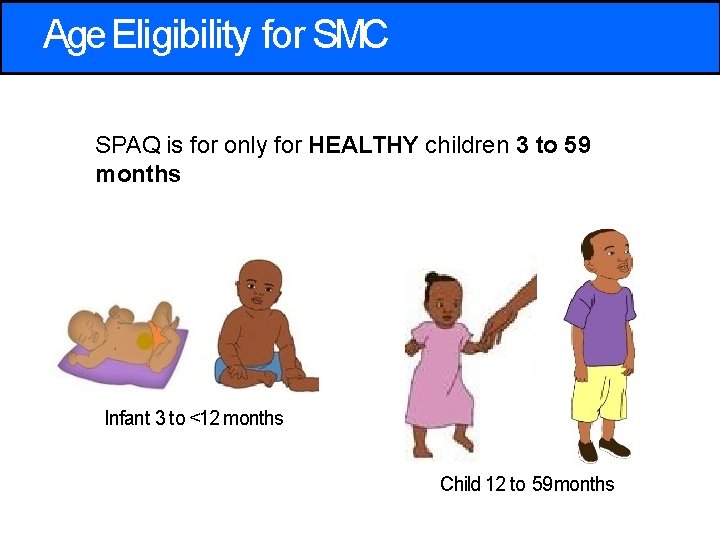
Age Eligibility for SMC SPAQ is for only for HEALTHY children 3 to 59 months Infant 3 to <12 months Child 12 to 59 months
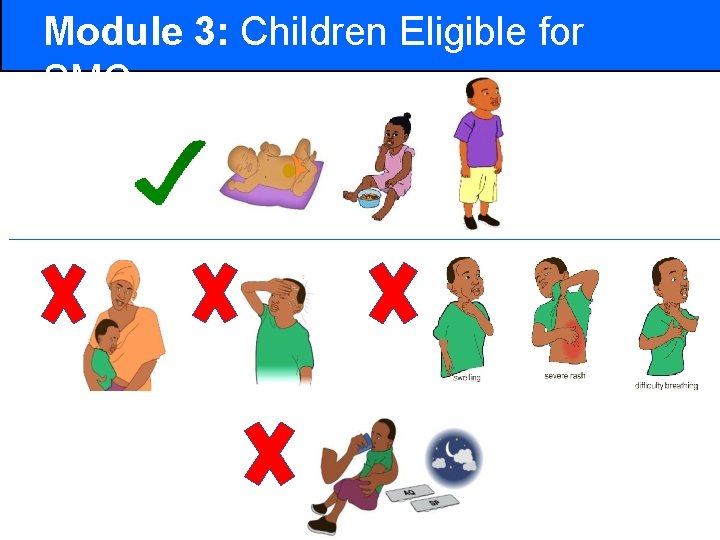
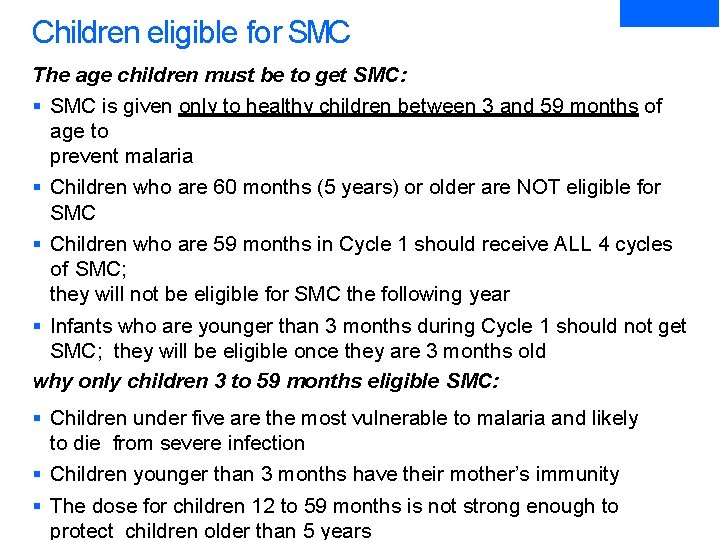
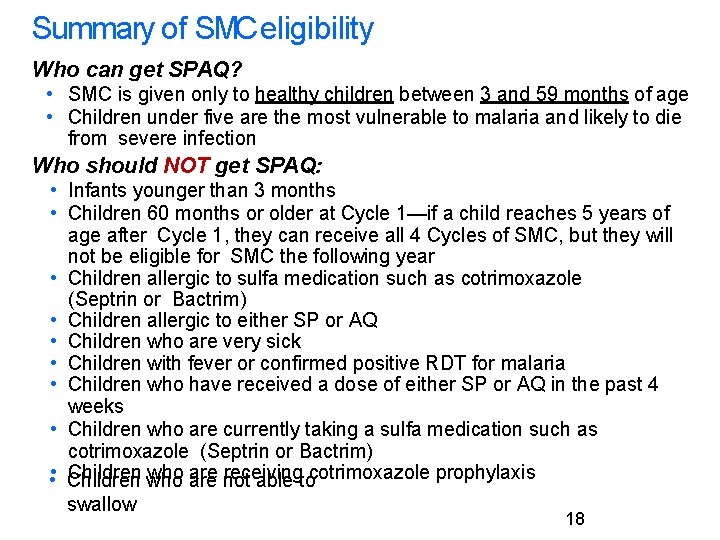
Children eligible for SMC The age children must be to get SMC: SMC is given only to healthy children between 3 and 59 months of age to prevent malaria Children who are 60 months (5 years) or older are NOT eligible for SMC Children who are 59 months in Cycle 1 should receive ALL 4 cycles of SMC; they will not be eligible for SMC the following year Infants who are younger than 3 months during Cycle 1 should not get SMC; they will be eligible once they are 3 months old why only children 3 to 59 months eligible SMC: Children under five are the most vulnerable to malaria and likely to die from severe infection Children younger than 3 months have their mother’s immunity The dose for children 12 to 59 months is not strong enough to protect children older than 5 years
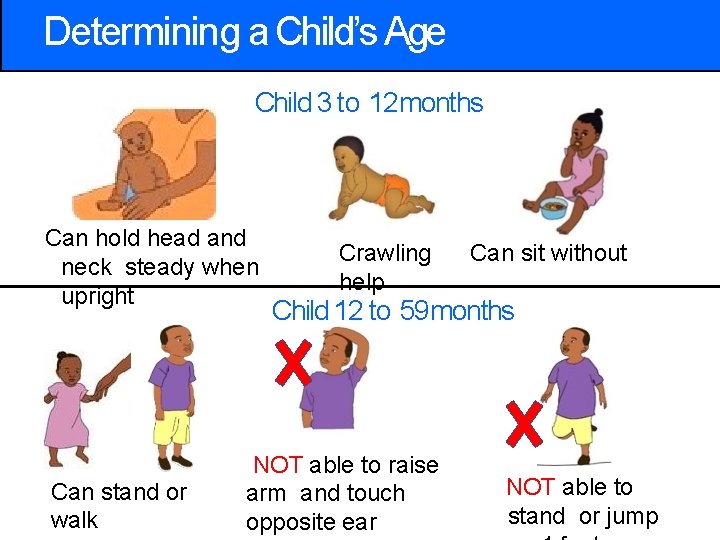
Determining a Child’s Age Child 3 to 12 months Can hold head and neck steady when upright Can stand or walk Crawling help Can sit without Child 12 to 59 months NOT able to raise arm and touch opposite ear NOT able to stand or jump
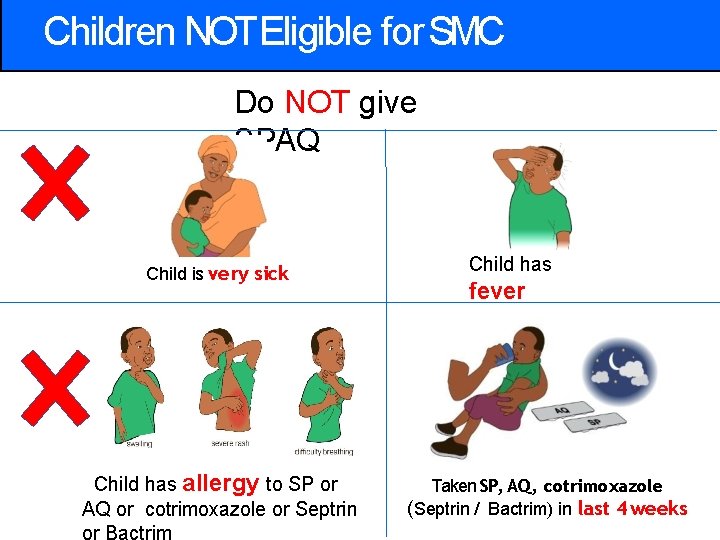
Children NOTEligible for SMC Do NOT give SPAQ Child is very sick Child has allergy to SP or AQ or cotrimoxazole or Septrin Child has fever Taken SP, AQ, cotrimoxazole (Septrin / Bactrim) in last 4 weeks
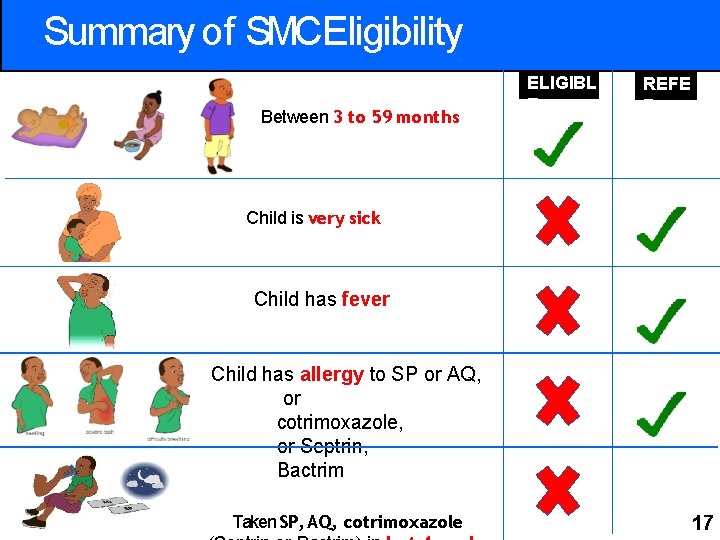
Summary of SMCEligibility Between 3 to 59 months ELIGIBL E REFE R Child is very sick Child has fever Child has allergy to SP or AQ, or cotrimoxazole, or Septrin, Bactrim Taken SP, AQ, cotrimoxazole 17
Trainer View Summary of SMC eligibility Who can get SPAQ? • SMC is given only to healthy children between 3 and 59 months of age • Children under five are the most vulnerable to malaria and likely to die from severe infection Who should NOT get SPAQ: • Infants younger than 3 months • Children 60 months or older at Cycle 1—if a child reaches 5 years of age after Cycle 1, they can receive all 4 Cycles of SMC, but they will not be eligible for SMC the following year • Children allergic to sulfa medication such as cotrimoxazole (Septrin or Bactrim) • Children allergic to either SP or AQ • Children who are very sick • Children with fever or confirmed positive RDT for malaria • Children who have received a dose of either SP or AQ in the past 4 weeks • Children who are currently taking a sulfa medication such as cotrimoxazole (Septrin or Bactrim) Children who are not receiving • • Children able tocotrimoxazole prophylaxis swallow 18
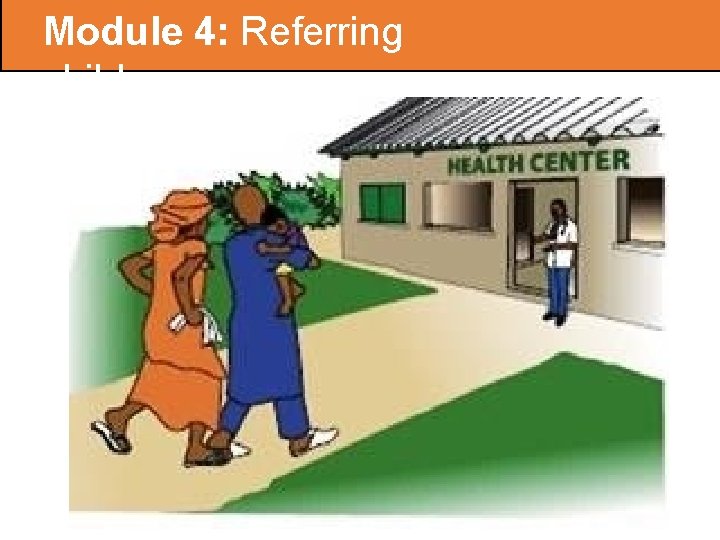
Module 4: Referring children
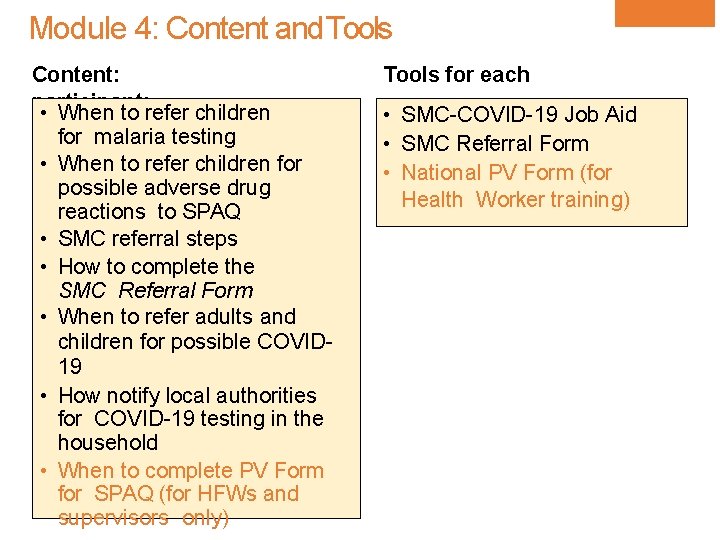
Module 4: Content and Tools Content: participant: • When to refer children for malaria testing • When to refer children for possible adverse drug reactions to SPAQ • SMC referral steps • How to complete the SMC Referral Form • When to refer adults and children for possible COVID 19 • How notify local authorities for COVID-19 testing in the household • When to complete PV Form for SPAQ (for HFWs and supervisors only) Tools for each • SMC-COVID-19 Job Aid • SMC Referral Form • National PV Form (for Health Worker training)
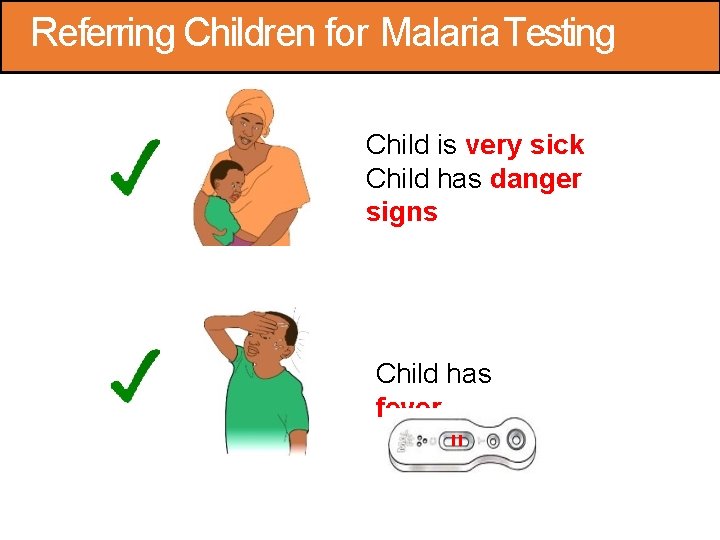
Referring Children for Malaria Testing Child is very sick Child has danger signs Child has fever
Referring children for malaria testing Trainer View what it means when a child is very sick or has a danger sign Convulsion Difficulty breathing Difficulty staying awake Vomiting everything Not able to drink or feed Severe pain or bleeding Neck pain or severe headache If a child under 5 years of age has fever, are they more likely to have malaria or COVID-19? A child living in Nigeria under 5 years of age is more likely to have malaria Malaria is the leading cause of death in children under 5 in Nigeria COVID-19 is rare and mild in children under 5 why children with fever needs to be referred to the health facility: Children with fever need to be tested for malaria with an RDT or with microscopy A child who has a fever must NOT get SP+AQ until it is determined that they do not have malaria If the child has malaria, he/she needs to be treated with an ACT
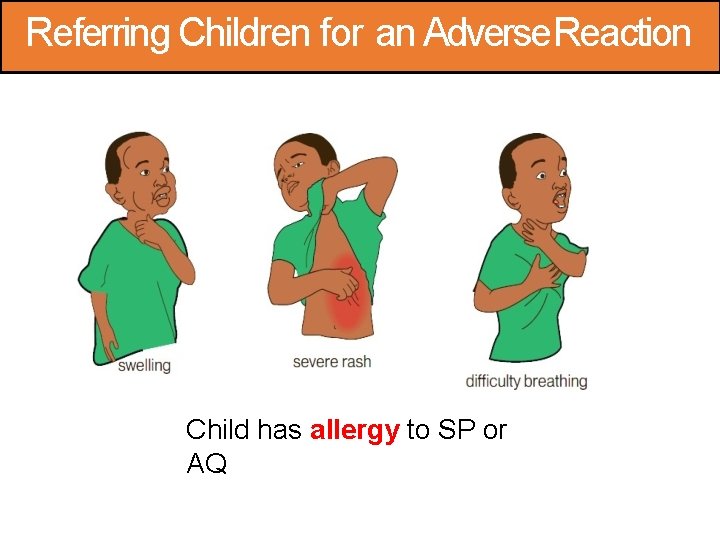
Referring Children for an Adverse. Reaction Child has allergy to SP or AQ
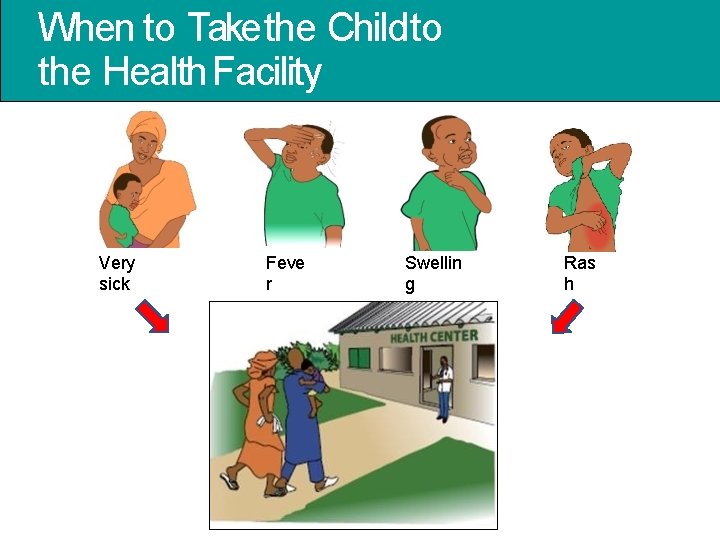
When to refer children to the health facility Some children may have an allergy to the medicines in SPAQ and nor know it: Allergies to SP or AQ are rare Children need to be immediately referred to the health facility if they have suspected adverse reaction to SP or AQ (during the current cycle or previous cycle): Some possible signs of an allergy to SPAQ: Swelling of the face, mouth, tongue or parts of the body Severe vomiting for more than 2 hours Skin rash or itching for more than 2 days Rash over the body or blistering of the skin Severe weakness Child moves strangely Yellow eyes How will the CDD know if the child has had an allergic reaction: Ask the caregiver Explain to the caregiver to notify the CDD if she notices any of the symptoms above
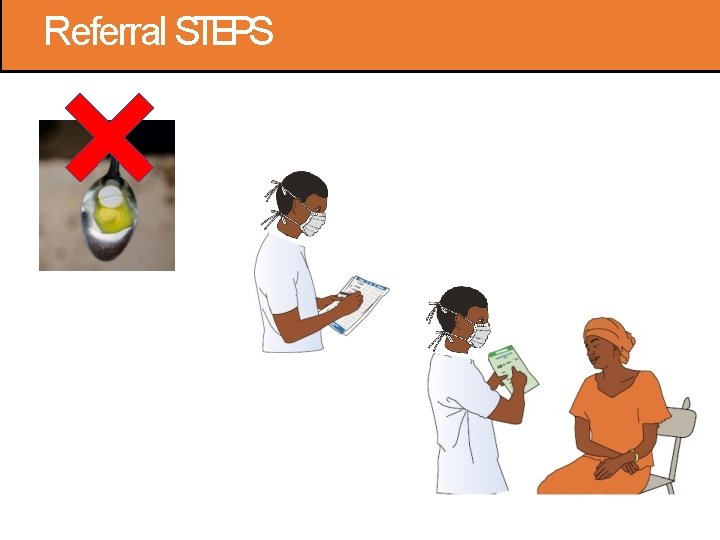
Referral STEPS
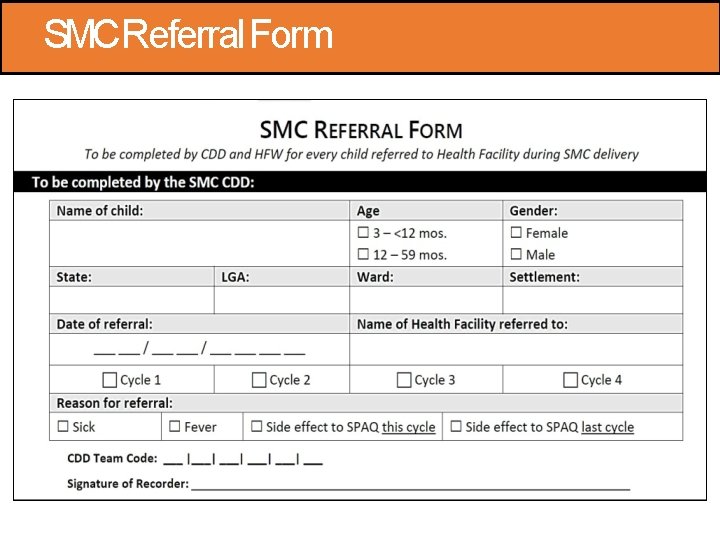
SMCReferral Form
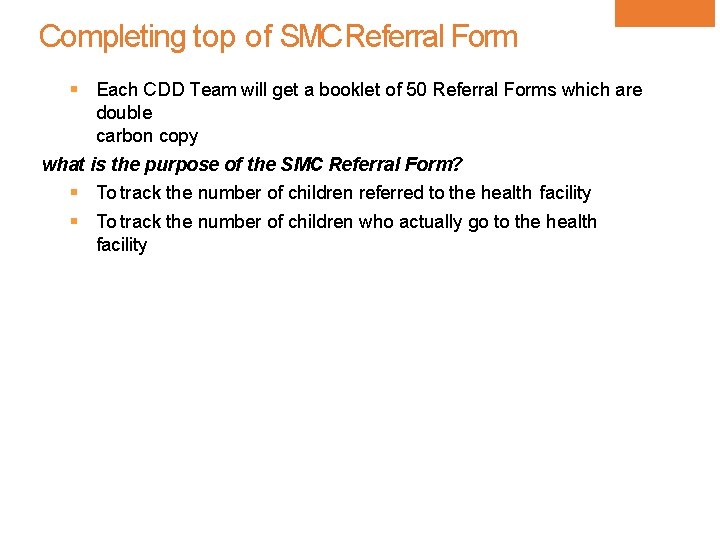
Completing top of SMCReferral Form Each CDD Team will get a booklet of 50 Referral Forms which are double carbon copy what is the purpose of the SMC Referral Form? To track the number of children referred to the health facility To track the number of children who actually go to the health facility
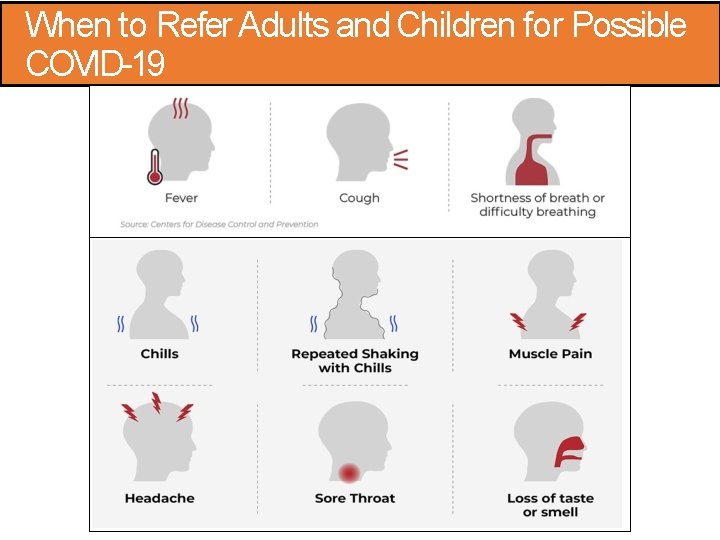
When to Refer Adults and Children for Possible COVID-19
Trainer View How to contact local authorities for suspected COVID-19 CDDs role in COVID-19: CDDs have regular contact with many households in community during SMC CDDs will ask caregivers triage questions during SMC CDDs will observe the health of members of the community and ask about signs and symptoms of COVID 19 People with possible COVID-19 need to be tested to prevent the spread in the community what to do if any of the responses to the triage questions is YES: Notify the DSNO or the Health Facility in Charge who will follow-up with necessary local COVID-19 response protocol
Module 5: Administering SPAQ in the Context of COVID-19
Module 5: Content and Tools Content: • Dispersible SPAQ blister packs • Administering a full 3 -day course pf SPAQ • Safe SPAQ administration • Steps to administering SPAQ to eligible children in the context of COVID-19 • Re-dosing SP and AQ • Giving 2 doses of AQ at home • Adherence to AQ at home • Completing the Child Record Card • Completing the SMC Tally Sheet • House marking
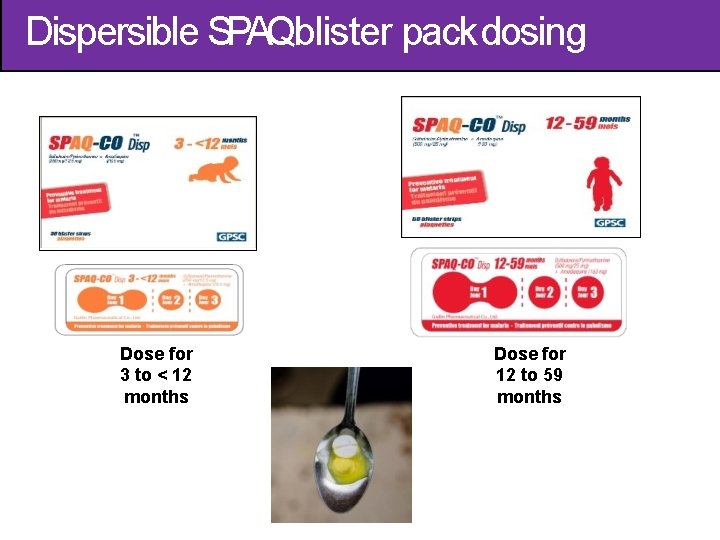
Dispersible SPAQblister pack dosing Dose for 3 to < 12 months Dose for 12 to 59 months
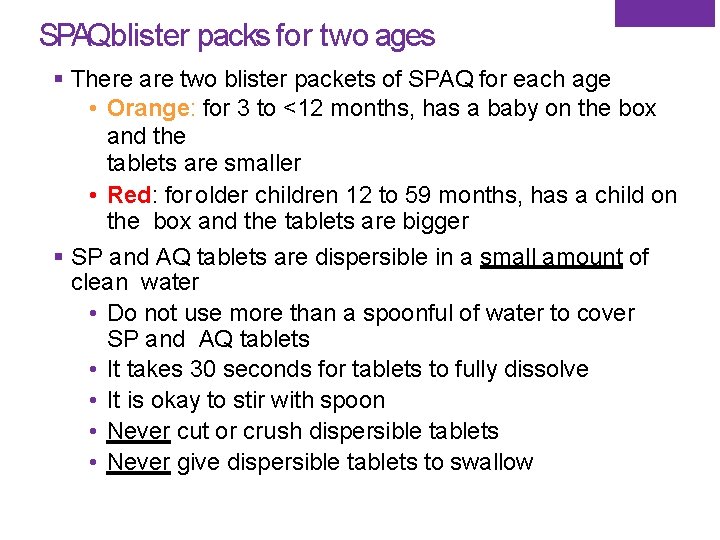
SPAQblister packs for two ages There are two blister packets of SPAQ for each age • Orange: for 3 to <12 months, has a baby on the box and the tablets are smaller • Red: for older children 12 to 59 months, has a child on the box and the tablets are bigger SP and AQ tablets are dispersible in a small amount of clean water • Do not use more than a spoonful of water to cover SP and AQ tablets • It takes 30 seconds for tablets to fully dissolve • It is okay to stir with spoon • Never cut or crush dispersible tablets • Never give dispersible tablets to swallow
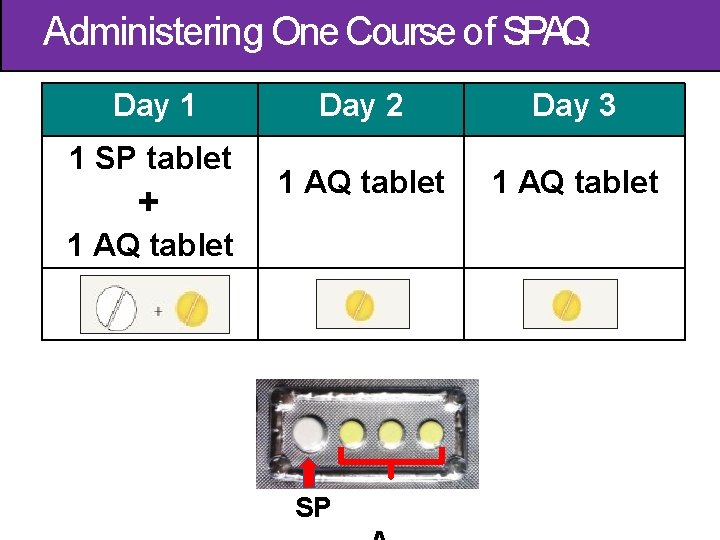
Administering One Course of SPAQ Day 1 1 SP tablet + Day 2 Day 3 1 AQ tablet SP
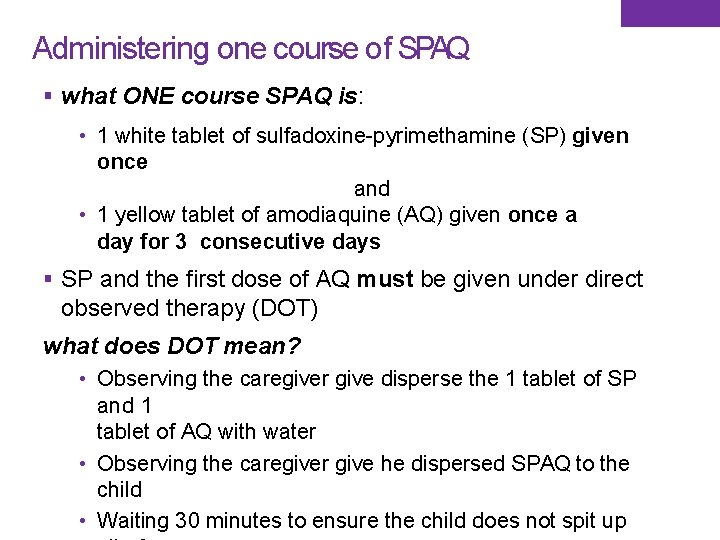
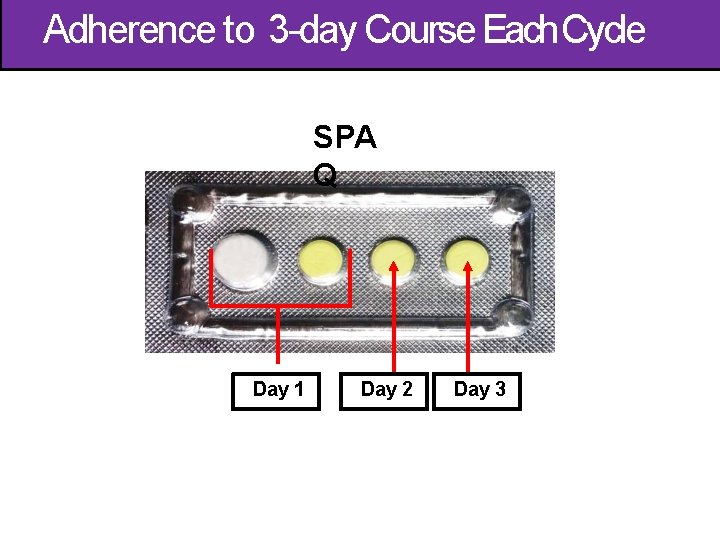
Administering one course of SPAQ what ONE course SPAQ is: • 1 white tablet of sulfadoxine-pyrimethamine (SP) given once and • 1 yellow tablet of amodiaquine (AQ) given once a day for 3 consecutive days SP and the first dose of AQ must be given under direct observed therapy (DOT) what does DOT mean? • Observing the caregiver give disperse the 1 tablet of SP and 1 tablet of AQ with water • Observing the caregiver give he dispersed SPAQ to the child • Waiting 30 minutes to ensure the child does not spit up
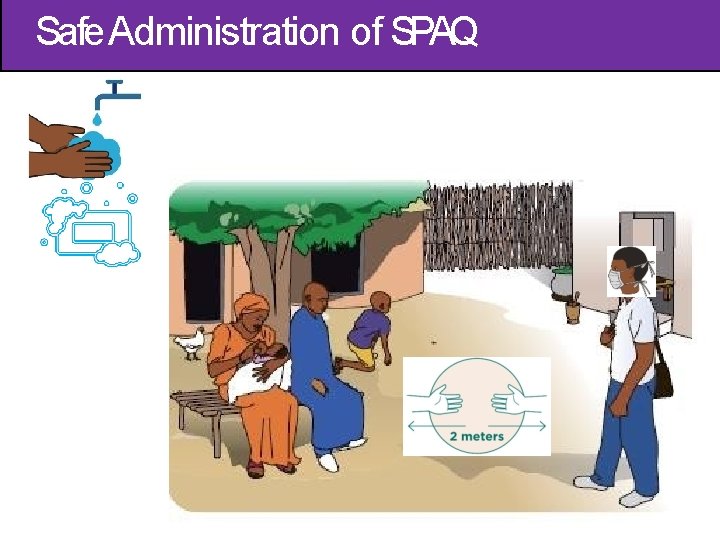
Safe Administration of SPAQ
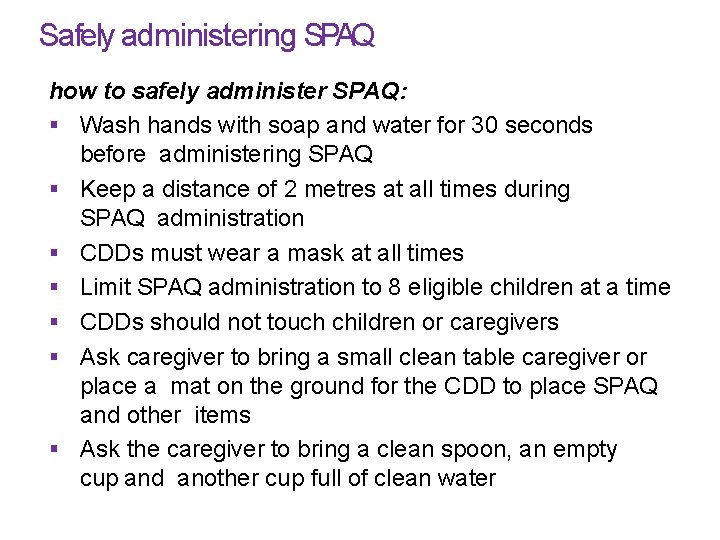
Safely administering SPAQ Trainer View how to safely administer SPAQ: Wash hands with soap and water for 30 seconds before administering SPAQ Keep a distance of 2 metres at all times during SPAQ administration CDDs must wear a mask at all times Limit SPAQ administration to 8 eligible children at a time CDDs should not touch children or caregivers Ask caregiver to bring a small clean table caregiver or place a mat on the ground for the CDD to place SPAQ and other items Ask the caregiver to bring a clean spoon, an empty cup and another cup full of clean water
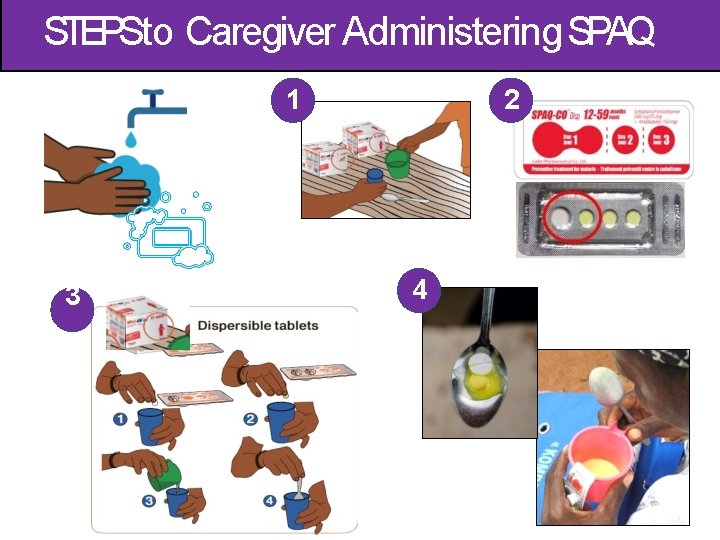
STEPSto Caregiver Administering SPAQ 1 3 2 4
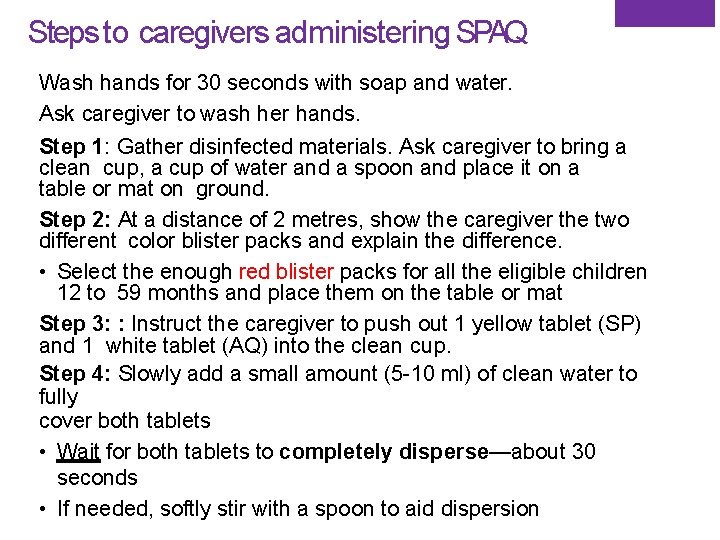
Steps to caregivers administering SPAQ Wash hands for 30 seconds with soap and water. Ask caregiver to wash her hands. Step 1: Gather disinfected materials. Ask caregiver to bring a clean cup, a cup of water and a spoon and place it on a table or mat on ground. Step 2: At a distance of 2 metres, show the caregiver the two different color blister packs and explain the difference. • Select the enough red blister packs for all the eligible children 12 to 59 months and place them on the table or mat Step 3: : Instruct the caregiver to push out 1 yellow tablet (SP) and 1 white tablet (AQ) into the clean cup. Step 4: Slowly add a small amount (5 -10 ml) of clean water to fully cover both tablets • Wait for both tablets to completely disperse—about 30 seconds • If needed, softly stir with a spoon to aid dispersion
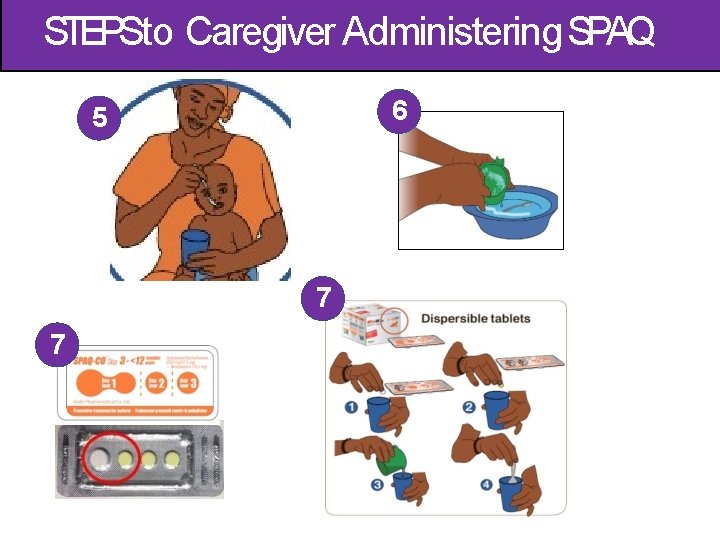
STEPSto Caregiver Administering SPAQ 6 5 7 7
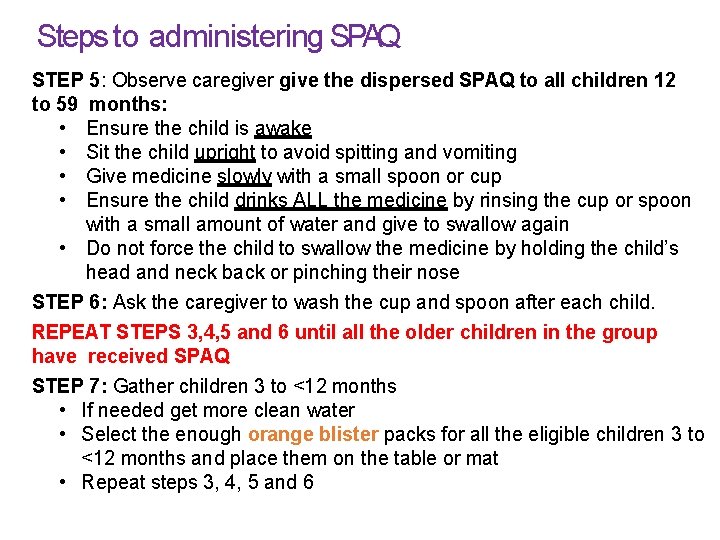
Steps to administering SPAQ Trainer View STEP 5: Observe caregiver give the dispersed SPAQ to all children 12 to 59 months: • Ensure the child is awake • Sit the child upright to avoid spitting and vomiting • Give medicine slowly with a small spoon or cup • Ensure the child drinks ALL the medicine by rinsing the cup or spoon with a small amount of water and give to swallow again • Do not force the child to swallow the medicine by holding the child’s head and neck back or pinching their nose STEP 6: Ask the caregiver to wash the cup and spoon after each child. REPEAT STEPS 3, 4, 5 and 6 until all the older children in the group have received SPAQ STEP 7: Gather children 3 to <12 months • If needed get more clean water • Select the enough orange blister packs for all the eligible children 3 to <12 months and place them on the table or mat • Repeat steps 3, 4, 5 and 6
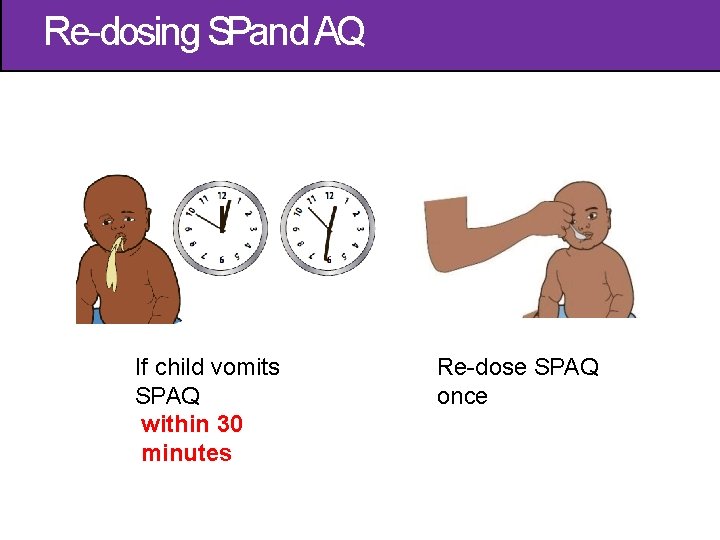
Re-dosing SPand AQ If child vomits SPAQ within 30 minutes Re-dose SPAQ once
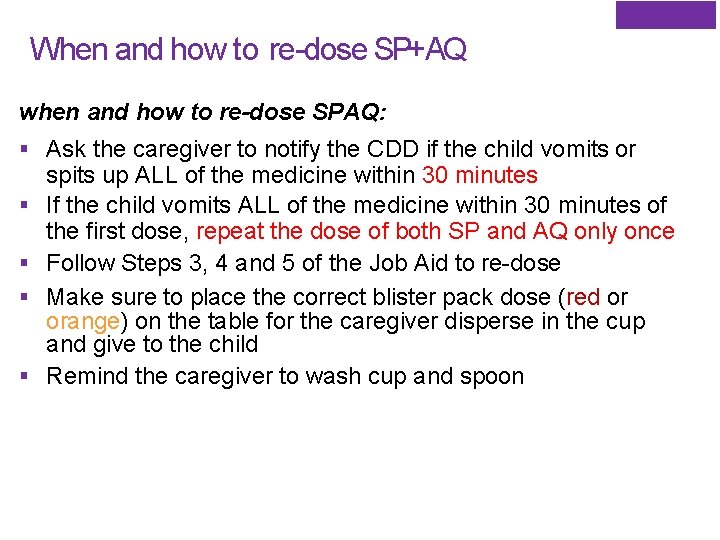
When and how to re-dose SP+AQ when and how to re-dose SPAQ: Ask the caregiver to notify the CDD if the child vomits or spits up ALL of the medicine within 30 minutes If the child vomits ALL of the medicine within 30 minutes of the first dose, repeat the dose of both SP and AQ only once Follow Steps 3, 4 and 5 of the Job Aid to re-dose Make sure to place the correct blister pack dose (red or orange) on the table for the caregiver disperse in the cup and give to the child Remind the caregiver to wash cup and spoon
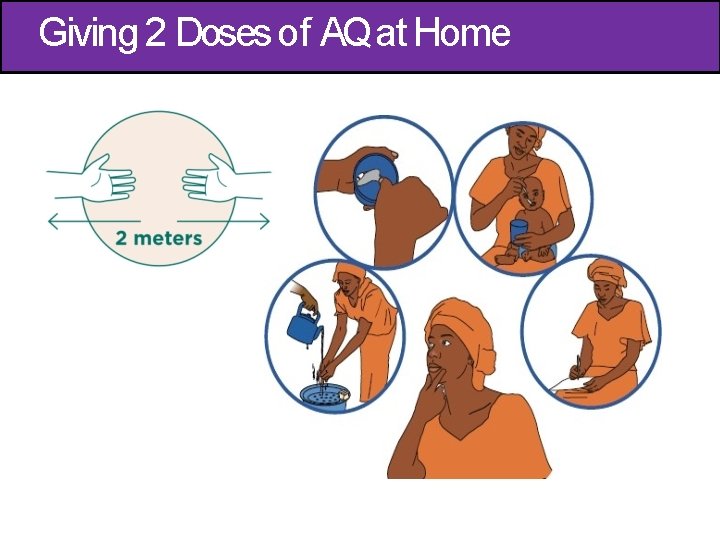
Giving 2 Doses of AQ at Home
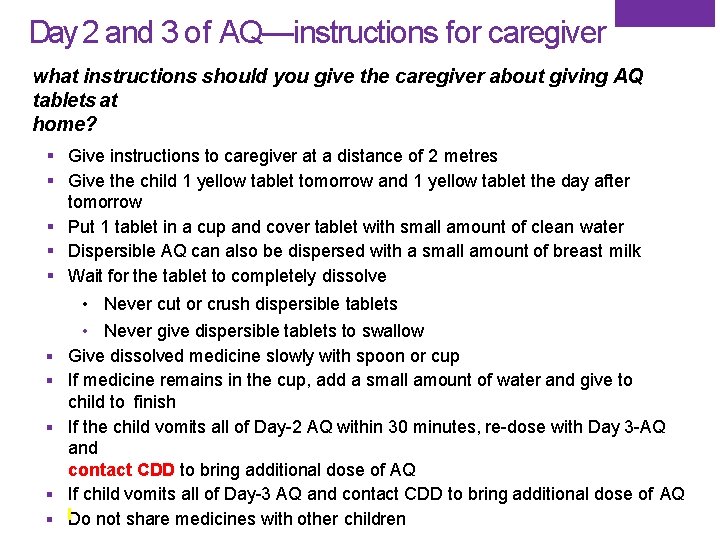
Day 2 and 3 of AQ—instructions for caregiver what instructions should you give the caregiver about giving AQ tablets at home? Give instructions to caregiver at a distance of 2 metres Give the child 1 yellow tablet tomorrow and 1 yellow tablet the day after tomorrow Put 1 tablet in a cup and cover tablet with small amount of clean water Dispersible AQ can also be dispersed with a small amount of breast milk Wait for the tablet to completely dissolve • Never cut or crush dispersible tablets • Never give dispersible tablets to swallow Give dissolved medicine slowly with spoon or cup If medicine remains in the cup, add a small amount of water and give to child to finish If the child vomits all of Day-2 AQ within 30 minutes, re-dose with Day 3 -AQ and contact CDD to bring additional dose of AQ If child vomits all of Day-3 AQ and contact CDD to bring additional dose of AQ Do not share medicines with other children
Adherence to 3 -day Course Each. Cycle SPA Q Day 1 Day 2 Day 3
Ways to encourage adherence for caregiver what are ways you can encourage caregivers to adhere to the full 3 day course of SPAQ each cycle? Ensure the caregiver understands how and when to give AQ on Day 2 and Day 3 and the full 3 days it is better for prevention of prevent malaria Ensure caregiver understands what to do if the child vomits AQ within 30 minutes Provide your mobile number so she can contact you if she needs another dose of AQ Ensure the caregiver keeps the empty blister pack to show at the next cycle Ensure the caregiver completes the Child Record Card and keeps it in a safe place Ensure the caregiver understands the importance of giving the
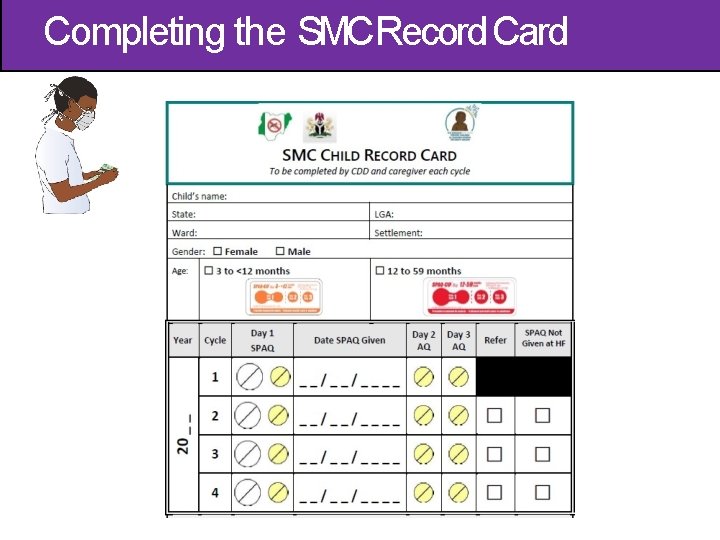
Completing the SMCRecord Card
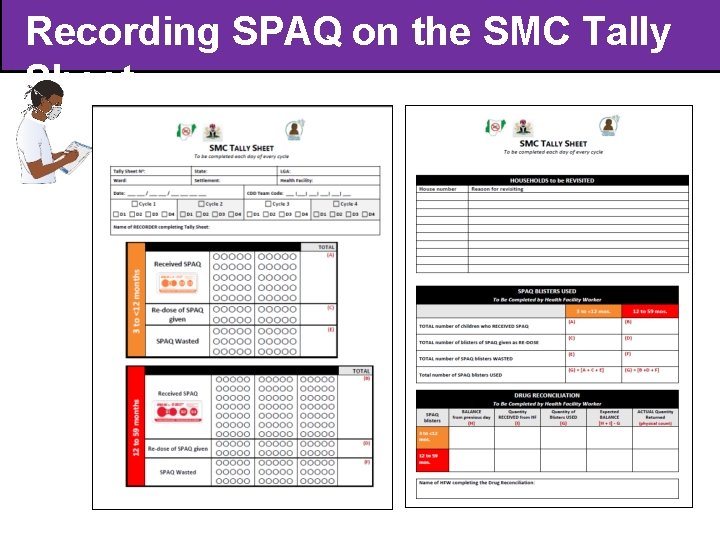
Recording SPAQ on the SMC Tally Sheet
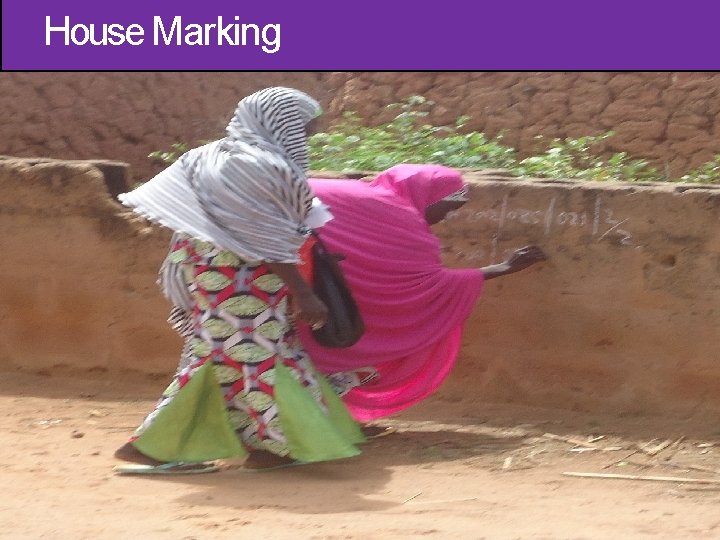
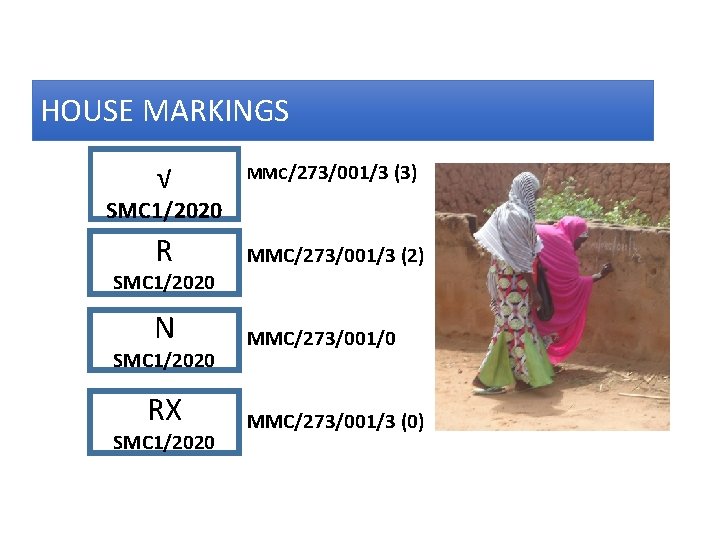
House Marking 9
HOUSE MARKINGS √ MMC/273/001/3 (3) R MMC/273/001/3 (2) N MMC/273/001/0 SMC 1/2020 RX SMC 1/2020 MMC/273/001/3 (0)
Bio-Waste Disposal
Module 6: Interpersonal communication
Module 6: Content and Tools Conten t: • What is good interpersonal communication • Benefits of SMC • Prevention of malaria messages for caregivers • When to take the child to the health facility • Prevention of COVID 19 messages for caregivers • FAQs about SMC Trainer View Tools for each participant: • SMC-COVID-19 Job Aid • SNC FAQs
Good Interpersonal Communication
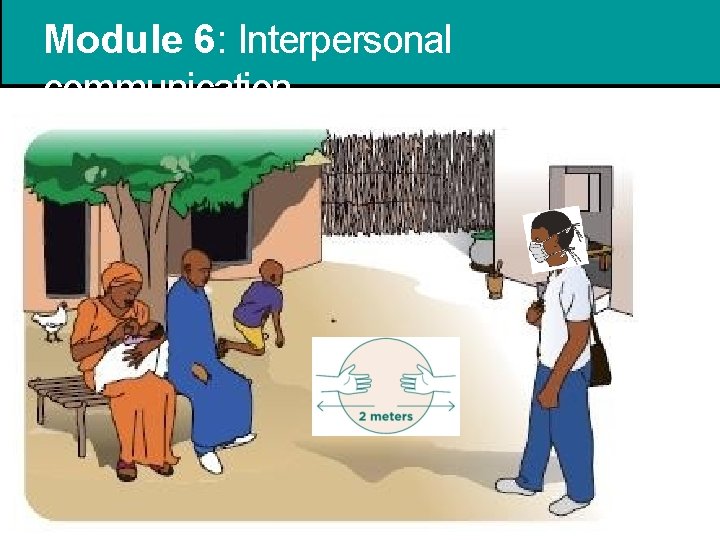
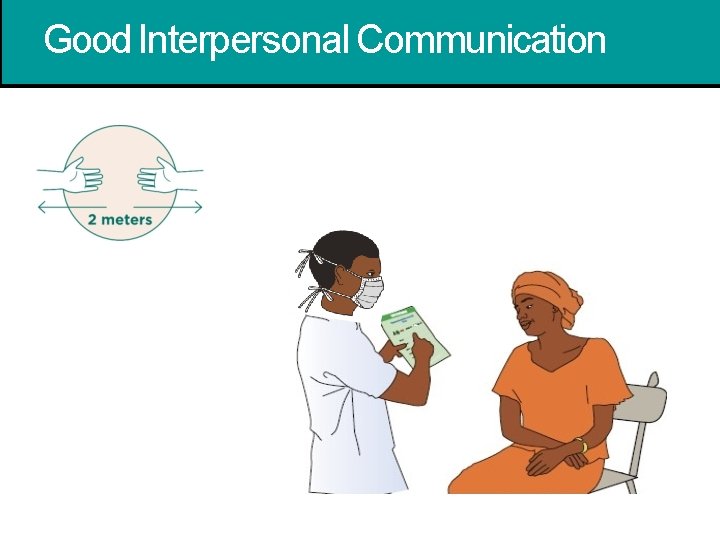
Good interpersonal communication what good IPC is in the context of COVID-19: Deliver all communication with caregivers and the community at a distance of 2 metres why you are wearing a mask Good communication helps to build trust and help to ensure SMC is given safely Respect cultural norms of the community Greet the head of household and caregivers with respect and show interest in their children Use words the caregiver will understand Use the pictures in the SMC Job Aid to communicate information Use open-ended questions to get more information Listen carefully to what the caregiver tells you Allow time for the caregiver to answer the question and show you are listening by nodding your head or saying you understand Stop from time to time and ask the caregiver if she understands or has any questions
Benefits of SMCand Prevention of Malaria Messages
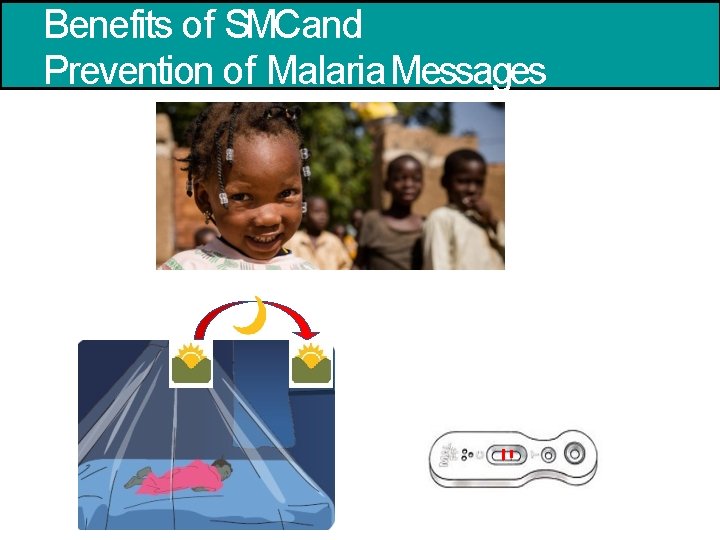
Benefits of SMCand prevention of malaria messages The benefits of SMC messages: SMC prevents malaria during the rainy season A full 3 -day course of SPAQ must be given EACH cycle for SMC to work and prevent malaria Children who do not get malaria grow and thrive Prevention of malaria messages • Mosquitoes that transmit malaria bite from sunset to sunrise All family members, especially children and pregnant women must sleep inside an insecticide treated bed net from sunset to sunrise, every night: all year All children with fever should be tested for malaria
When to Take the Child to the Health Facility Very sick Feve r Swellin g Ras h
Prevention of COVID-19 Messages
Thank you for your attention 80 | TITLE from VIEW and SLIDE MASTER | March 6, 2021