
Federalism The Division of Power The States and


- Slides: 48
Federalism • The Division of Power • The States and Interstate Relations
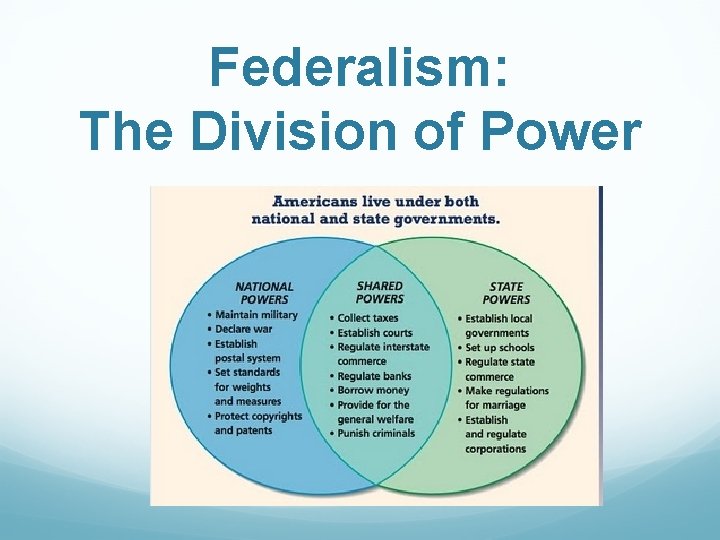
Federalism: The Division of Power
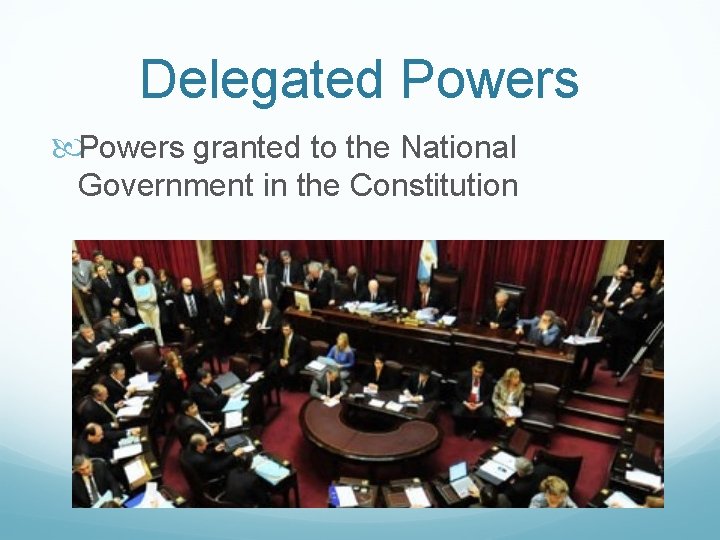
Delegated Powers granted to the National Government in the Constitution
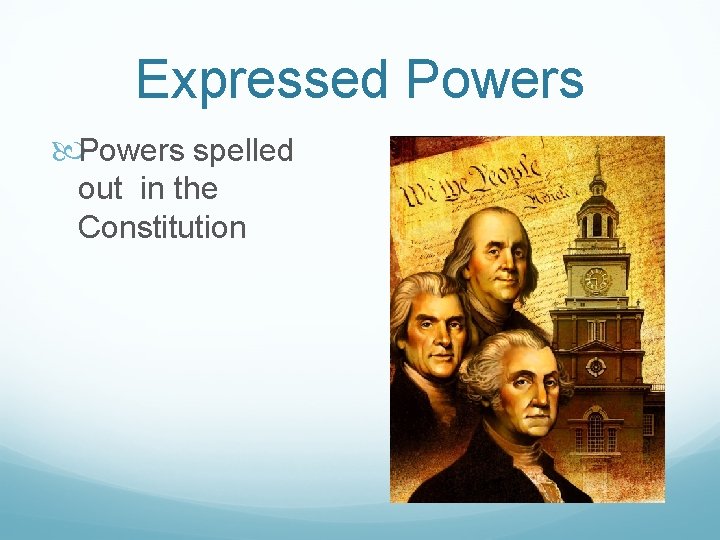
Expressed Powers spelled out in the Constitution
Implied Powers reasonably thought to be granted, but not spelled out specifically, in the Constitution
Inherent Powers that belong to the National Government because it is a sovereign state
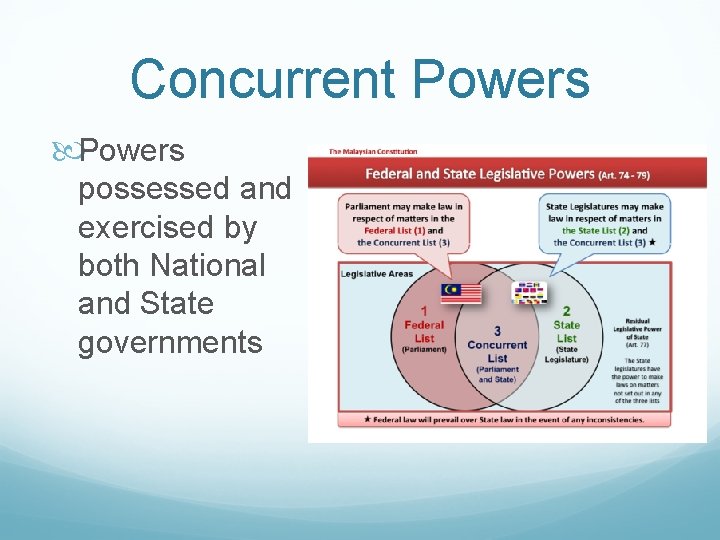
Concurrent Powers possessed and exercised by both National and State governments
Why does the United States have a federal system of government? The United States has a federal system of government because that system was implied in the Constitution and expressed in the 10 th Amendment.
Give an example of an expressed power The power to collect taxes The power to coin money The power to declare war
Give an example of an expressed power The power to collect taxes The power to coin money The power to declare war
Why is the Necessary and Proper Clause called the Elastic Clause? It is called the Elastic Clause because over time, it has stretched to cover so many implied powers.
According to the Supremacy Clause, what is the correct order of the “ladder of laws” in the United States? The U. S. Constitution, acts of Congress and treaties, State constitutions, State statutes, local laws
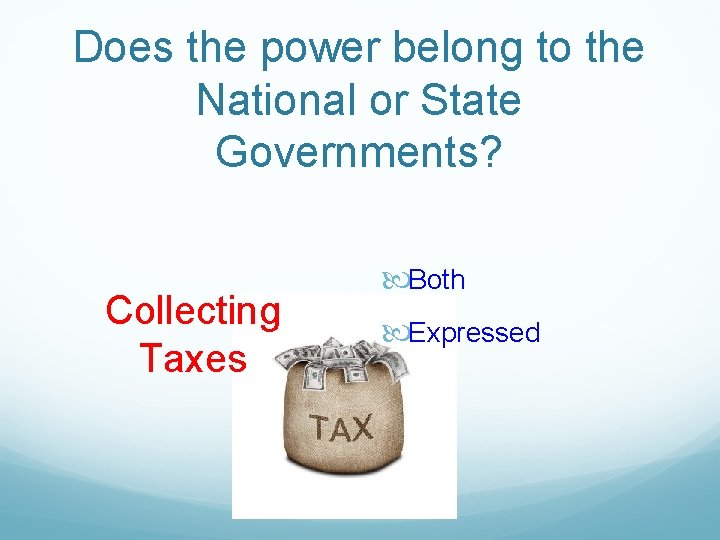
Does the power belong to the National or State Governments? Collecting Taxes Both Expressed
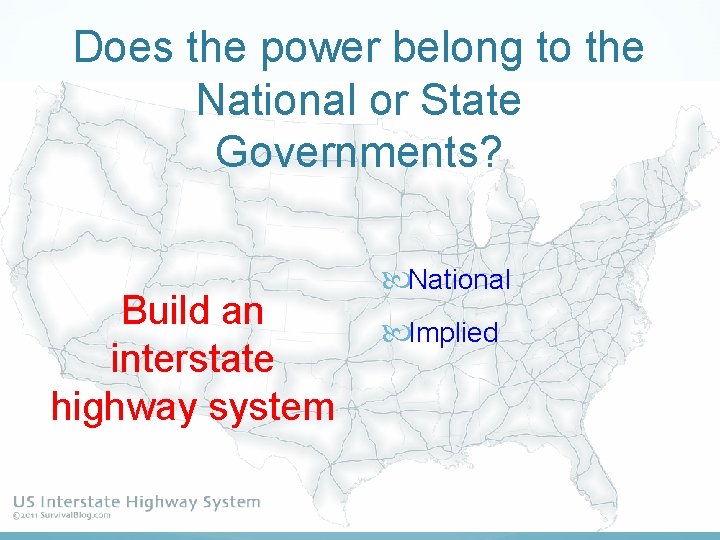
Does the power belong to the National or State Governments? Build an interstate highway system National Implied
Does the power belong to the National or State Governments? Regulate Immigration National Inherent
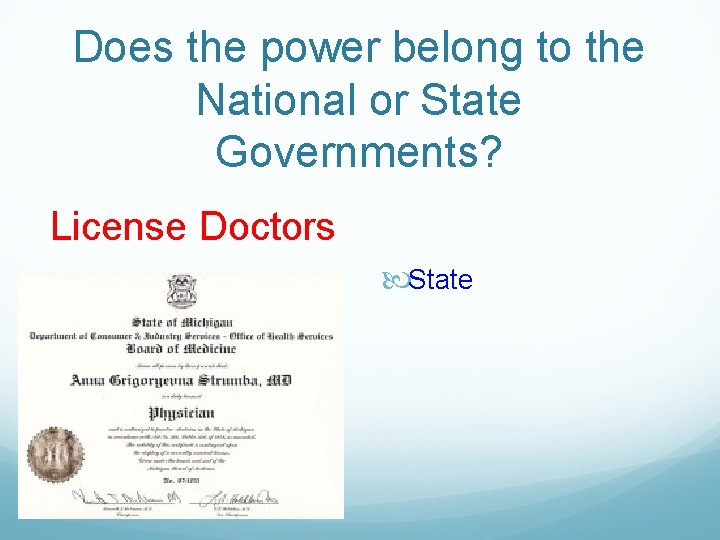
Does the power belong to the National or State Governments? License Doctors State
Does the power belong to the National or State Governments? Make Treaties National Expressed
Does the power belong to the National or State Governments? Maintain Armed Forces National Expressed
Does the power belong to the National or State Governments? Declare War National Expressed
Does the power belong to the National or State Governments? Deport Aliens National Inherent
Does the power belong to the National or State Governments? Prohibit racial discrimination in access to restaurants National Implied
Does the power belong to the National or State Governments? Set up public school system State
Does the power belong to the National or State Governments? Punish Crimes Both Implied
Does the power belong to the National or State Governments? Coin Money National Expressed
Does the power belong to the National or State Governments? Regulate the sale of liquor State
Does the power belong to the National or State Governments? Regulate Interstate Commerce National Expressed
Federalism: The States and Interstate Relations
What is generally understood when the Constitution requires the National Government to “guarantee to every State in this Union a Republican Form of Government?
This term is generally understood to mean a “representative government. It is one to be decided by political branches of the government – the President and Congress – and not by the courts.
What is the Major Disaster Process?
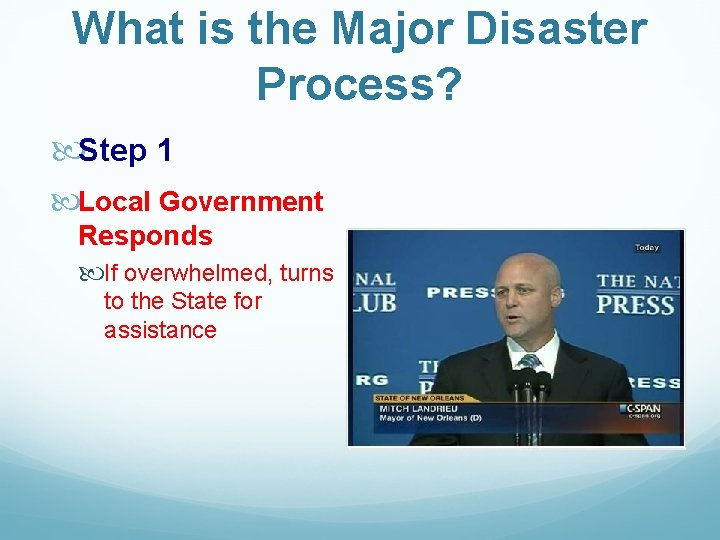
What is the Major Disaster Process? Step 1 Local Government Responds If overwhelmed, turns to the State for assistance
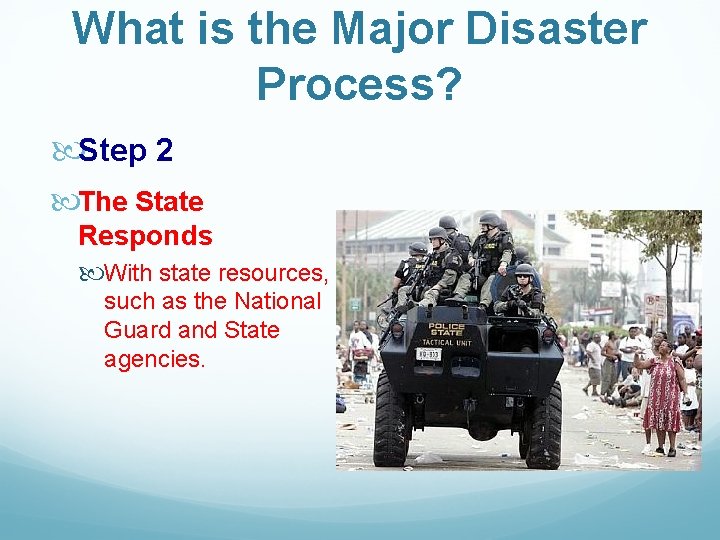
What is the Major Disaster Process? Step 2 The State Responds With state resources, such as the National Guard and State agencies.
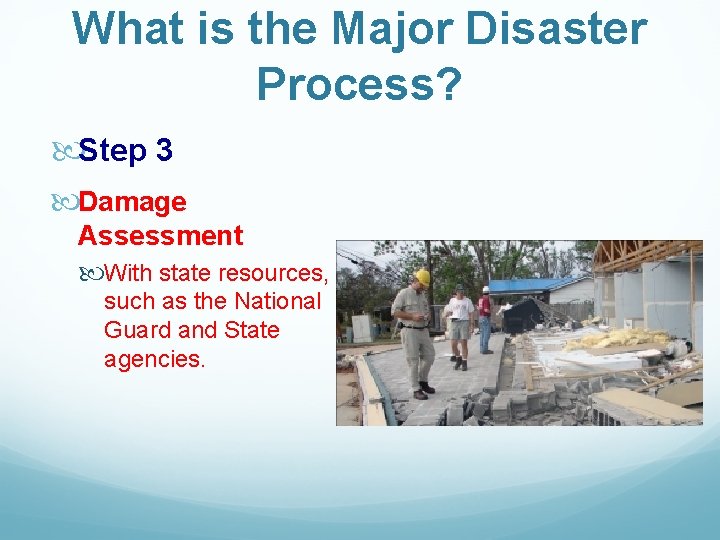
What is the Major Disaster Process? Step 3 Damage Assessment With state resources, such as the National Guard and State agencies.
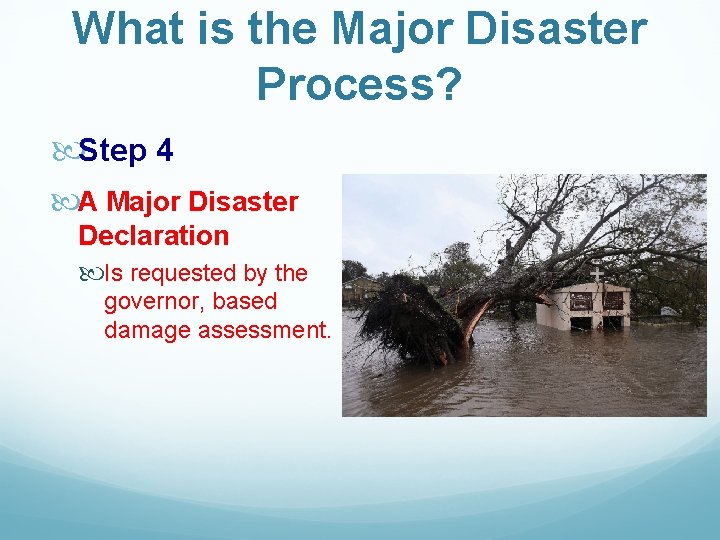
What is the Major Disaster Process? Step 4 A Major Disaster Declaration Is requested by the governor, based damage assessment.
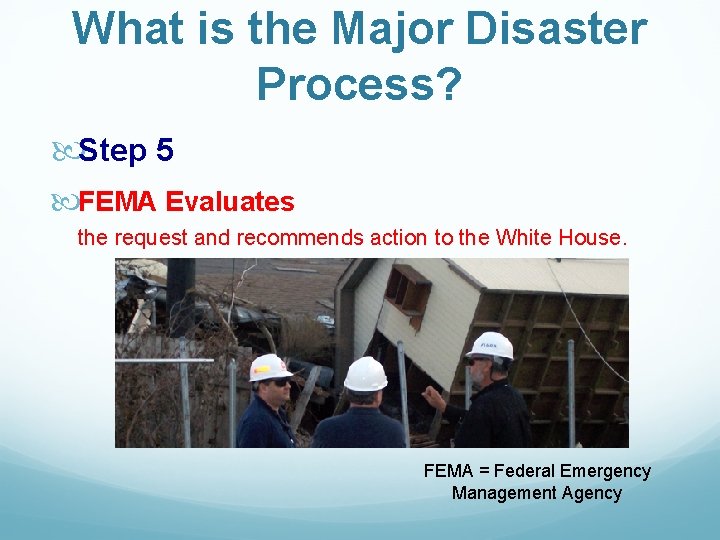
What is the Major Disaster Process? Step 5 FEMA Evaluates the request and recommends action to the White House. FEMA = Federal Emergency Management Agency
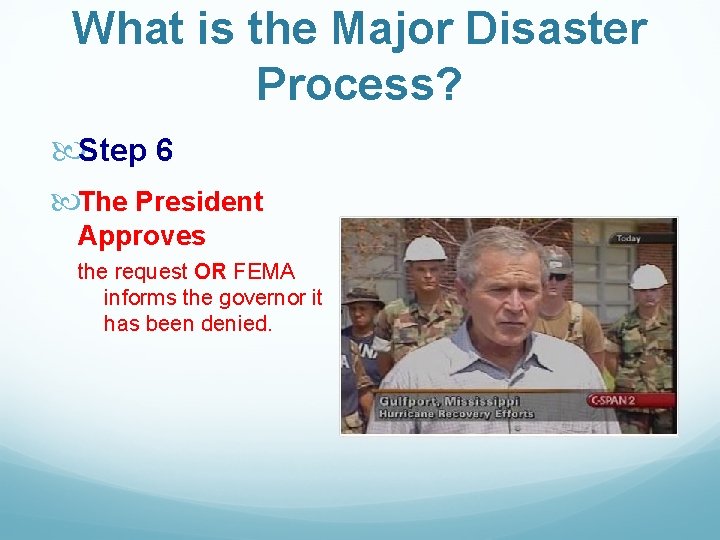
What is the Major Disaster Process? Step 6 The President Approves the request OR FEMA informs the governor it has been denied.
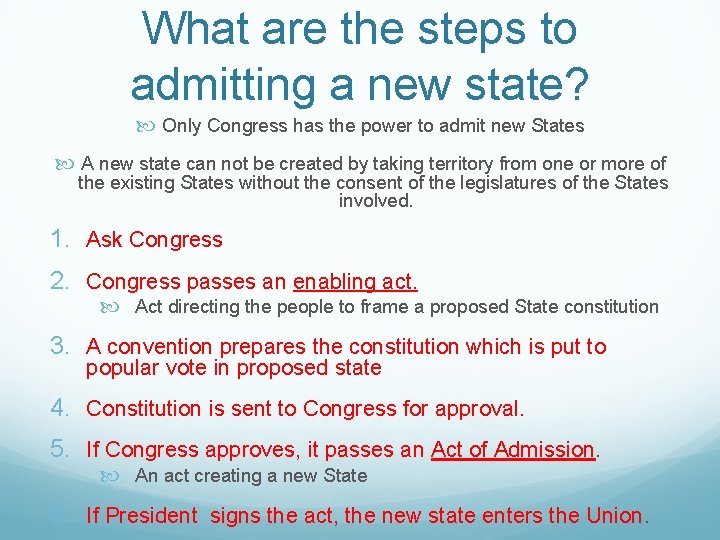
What are the steps to admitting a new state? Only Congress has the power to admit new States A new state can not be created by taking territory from one or more of the existing States without the consent of the legislatures of the States involved. 1. Ask Congress 2. Congress passes an enabling act. Act directing the people to frame a proposed State constitution 3. A convention prepares the constitution which is put to popular vote in proposed state 4. Constitution is sent to Congress for approval. 5. If Congress approves, it passes an Act of Admission. An act creating a new State 6. If President signs the act, the new state enters the Union.
What is an enabling act? Act directing the people to frame a proposed State constitution
What is an act of admission? An act creating a new State
What is a grant-in-aid program? Grants of federal money or other resources to the States and/or their cities, counties, and other local units.
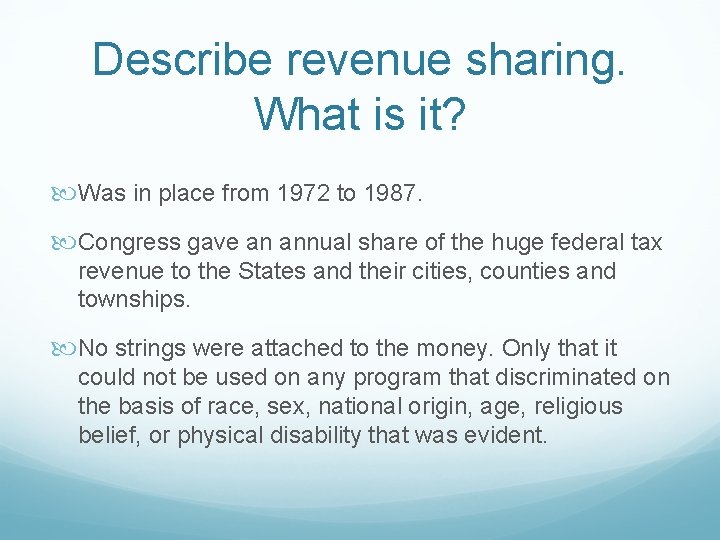
Describe revenue sharing. What is it? Was in place from 1972 to 1987. Congress gave an annual share of the huge federal tax revenue to the States and their cities, counties and townships. No strings were attached to the money. Only that it could not be used on any program that discriminated on the basis of race, sex, national origin, age, religious belief, or physical disability that was evident.
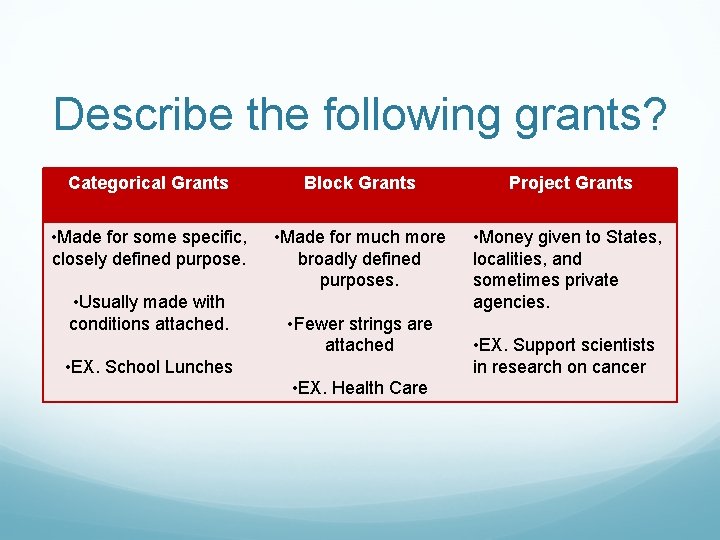
Describe the following grants? Categorical Grants Block Grants Project Grants • Made for some specific, closely defined purpose. • Made for much more broadly defined purposes. • Money given to States, localities, and sometimes private agencies. • Usually made with conditions attached. • Fewer strings are attached • EX. School Lunches • EX. Health Care • EX. Support scientists in research on cancer
What are examples of state aid to the National Government? State and Local units of government finance national elections. Local law enforcement agencies allowing the FBI to use their facilities.
What is an interstate compact? Give an example. Agreements in the states and with other states. Ex. Port of New York Authority
What is the Full Faith and Credit Clause? Give an example To recognize and respect the validity of the judgment made by another state’s court.
What are some exceptions to the Full Faith and Credit Clause? 1. It applies only to civil, not criminal, matters. One state cannot enforce another State’s criminal law. 2. Certain divorces need not be granted by one State to residents of another State. Was the person who obtained the divorce in fact a resident of the State that granted it. If not, then the State granting the divorce did not have the authority to do so, and another State can refuse to recognize it.
What is extradition? A legal process by which a fugitive from justice in one State is returned to that State. It is designed to prevent a person from escaping justice by fleeing a State.
What is the Privileges and Immunities Clause? It means that no State can draw unreasonable distinctions between its own residents and those persons who happen to live in other States. Each State must recognize the right of any American to travel in or become a resident of that State, It must also allow any citizen, no matter where he/she lives, to use its courts and make contracts; buy, own, rent, or sell property; or marry within its borders.