
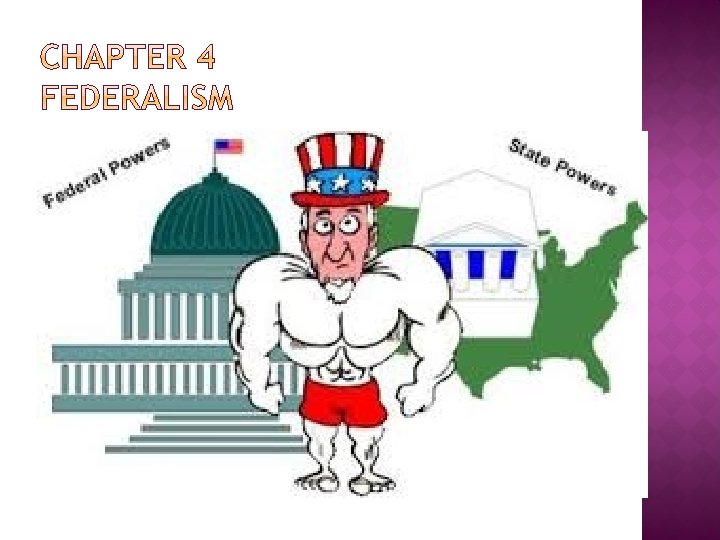
Federalism powers divided between federal and local level
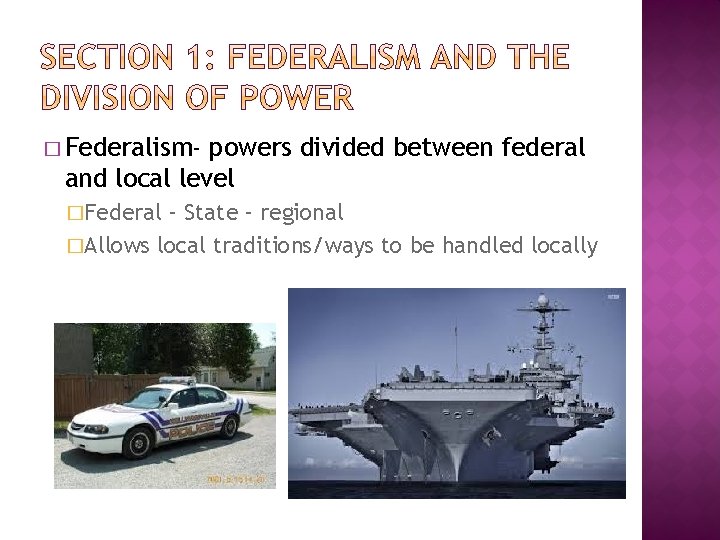
� Federalism- powers divided between federal and local level �Federal – State – regional �Allows local traditions/ways to be handled locally
� Our national government is a government of delegated powers �Has only the powers granted to it through the Const.
� The Expressed Powers �Expressed, written powers �“enumerated powers” �Art. I Sec. 8 spells out 27 powers of Congress �Ex: Power to tax, regulate commerce, set up post offices, etc.
� Implied Powers �Not expressly stated in the Const. but suggested by the expressed powers �Art. 1, Sec. 8, Clause 18 What is proper and necessary for Congress to do Elastic Clause – Stretch their powers Ex. Racial discrimination, building interstate system, etc.
� Inherent �Powers powers that governments have historically possessed because they are a sovereign nation in the world. �Ex. Regulate immigration, acquire territory, recognize other nations
� Three ways the Const. denies power �Expressly: Specifically written: No export tax �Silence of the Const. : Some powers are given to other branches: No uniform marriage laws, divorce laws, local governments �Federal system: States have some powers : Congress can not tax local governments
� 10 th Amendment declares the state governments as the reserved powers �Powers the Const. does not grant to fed. Gov’t but does not deny them to the states �Outlaw activities, marriage, licenses, schools, etc. �Power to protect and promote public health �Most government comes from the states
� Powers �Make denied to the state (Expressed) treaties or alliance �Print or coin money �Deny life, liberty, or property without due process
� Exclusive Powers – powers given only to the fed. gov’t. , not the states �Expressively denied to the states �Non-exclusive- regulate interstate commerce � Concurrent Powers- Powers that both the fed. Gov’t and the states possess. �Collect taxes, define crimes, set punishments, claim private property for public use
� Local governments are sub-units of state governments �Can provide services, regulate activities, collect taxes �Powers given to them by the state
� Supremacy Clause- “The Constitution and the Laws of the U. S. … shall be the supreme law of the land” �Includes treaties �Included to avoid conflict between state and fed. governments
� Supreme �Supreme Court and Federalism Court is the umpire between state and federal laws �Mc. Culloch v. Maryland
� 2 nd Bank of the U. S �Held federal deposits �Privileged position for loans to U. S. State banks at disadvantage Started to fail Maryland taxes the Baltimore branch
� Constitution requires the Government to guarantee certain things to the states � Makes it possible for the National Government to do certain things for the states
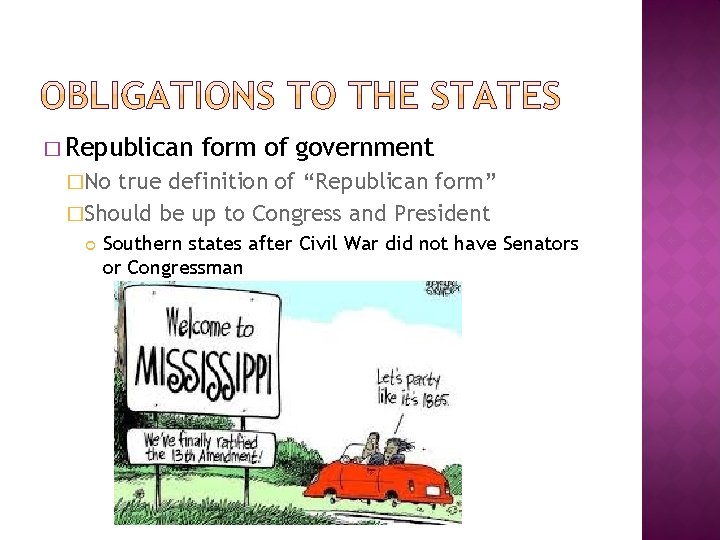
� Republican form of government �No true definition of “Republican form” �Should be up to Congress and President Southern states after Civil War did not have Senators or Congressman
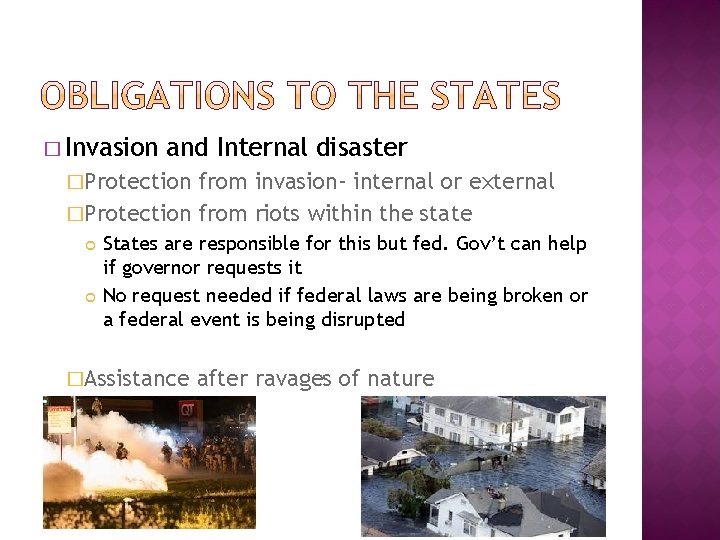
� Invasion and Internal disaster �Protection from invasion- internal or external �Protection from riots within the state States are responsible for this but fed. Gov’t can help if governor requests it No request needed if federal laws are being broken or a federal event is being disrupted �Assistance after ravages of nature
� Respect for Territorial Integrity �Recognize the legal existence and physical boundaries of each state �Representation and equal representation in the Senate
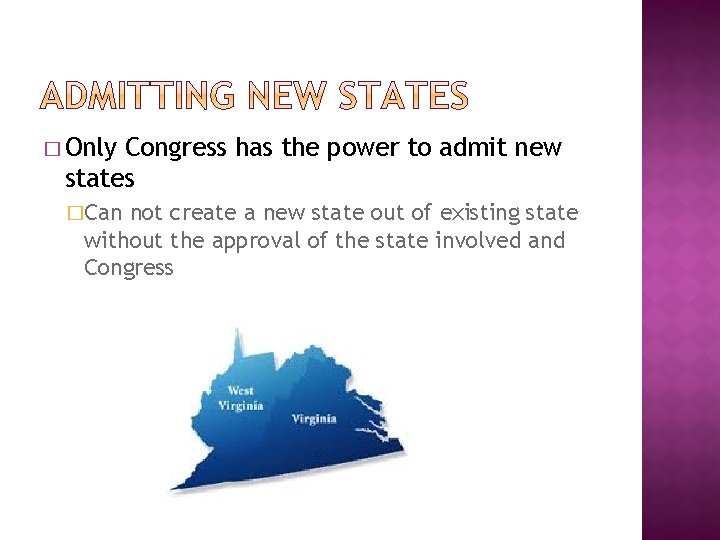
� Only Congress has the power to admit new states �Can not create a new state out of existing state without the approval of the state involved and Congress
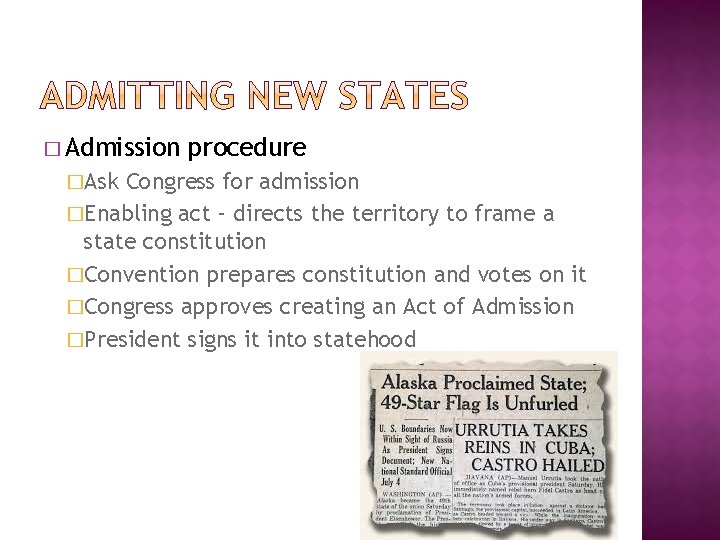
� Admission �Ask procedure Congress for admission �Enabling act – directs the territory to frame a state constitution �Convention prepares constitution and votes on it �Congress approves creating an Act of Admission �President signs it into statehood
� Conditions �Congress can set certain provisions Ex. Outlaw polygamy in Utah �Equal for admission footing with existing states Can not impose conditions of political nature � Ex. Telling state where their capital has to be
� Shared powers � Funds provided to the states � Services provided to the states
� Federal Grants-in-Aid �Grants of fed. money or other resources to the states and their sub-units Roads, schools/universities, drainage, canals etc. Over 500 programs are active today Blurs the lines of the division of power
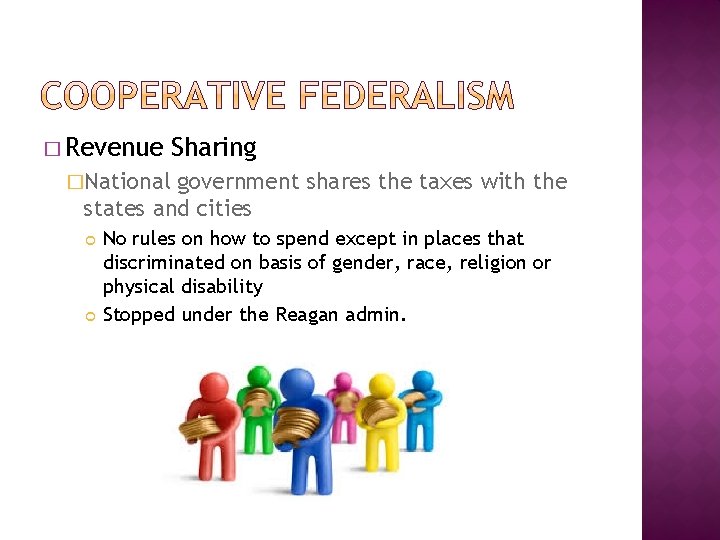
� Revenue Sharing �National government shares the taxes with the states and cities No rules on how to spend except in places that discriminated on basis of gender, race, religion or physical disability Stopped under the Reagan admin.
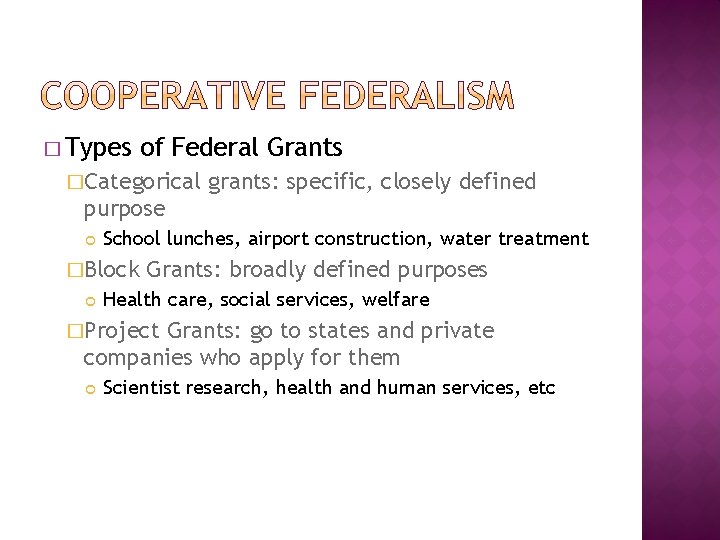
� Types of Federal Grants �Categorical grants: specific, closely defined purpose School lunches, airport construction, water treatment �Block Grants: broadly defined purposes Health care, social services, welfare �Project Grants: go to states and private companies who apply for them Scientist research, health and human services, etc
� Other �FBI forms of Federal Aid helps state and local police �Army helps with militia �Census Bureau
� State Aid to National Government �Elections Officials Paid for by state funds State laws for voting �Naturalization �State/local police help catch criminals
Interstate Relations 4. 3
Objectives 1. Students will understand interstate compacts 2. Students will be able to explain the Full Faith and Credit Clause 3. Students will be able to explain the Privileges and Immunities Clause 4. Students will be able to explain extradition.
Interstate Compacts • No State can enter into any treaty, alliance, or confederation Interstate compacts • Agreements among one state and other states • Generally require Congressional approval
Interstate Compacts • Examples – New York Port Authority – Compact for Supervision of Parolees and Probationers – Compact on Juveniles – In general, conservation of natural resources – Prevent pollution – Motor vehicle safety
Full Faith and Credit • “Full Faith and Credit shall be given in each State to the public Acts, Records, and judicial Proceedings of every other State. ” – Article IV, Section 1 • Public acts – laws of the state • Records – birth certificates, marriage licenses, deeds, car registrations, etc. • Judicial proceedings – court decisions, damage awards, wills, divorces, etc.
Exceptions • Criminal cases – One State cannot enforce another State’s criminal law • Certain divorces – Only divorces granted by the State of residence must be given full faith and credit
Privileges and Immunities “The Citizens of each State shall be entitled to all Privileges and Immunities of Citizens in the several States. ” - Article IV, Section 2, Clause 1 • No state can draw unreasonable distinctions between its own residents and those persons who happen to live in other States. • Examples: – right to travel in or become a resident – use the court or make contracts – buy, own, rent, or sell property – marry
Privileges and Immunities • CANNOT require employers to give hiring preferences to in-State residents • CANNOT award different welfare benefits based on how long one has been a resident • CAN draw reasonable distinctions – Require residence restrictions to vote or hold office – Can require residence requirements to practice law, medicine, dentistry
Extradition “A Person charged in any State with Treason, Felony, or other Crime, who shall flee from Justice, and be found in another State, shall on Demand of the executive Authority of the State from which he fled, be delivered up, to be removed to the State having Jurisdiction of the Crime. ” – Article IV, Section 2, Clause 2 • Governors responsible for demanding and returning fugitives • Kentucky v Dennison, 1861 • Puerto Rico v Branstad, 1987
- Slides: 36