
FEDERALISM POLITICAL SYSTEM IN WHICH POWER IS DIVIDED
- Slides: 22
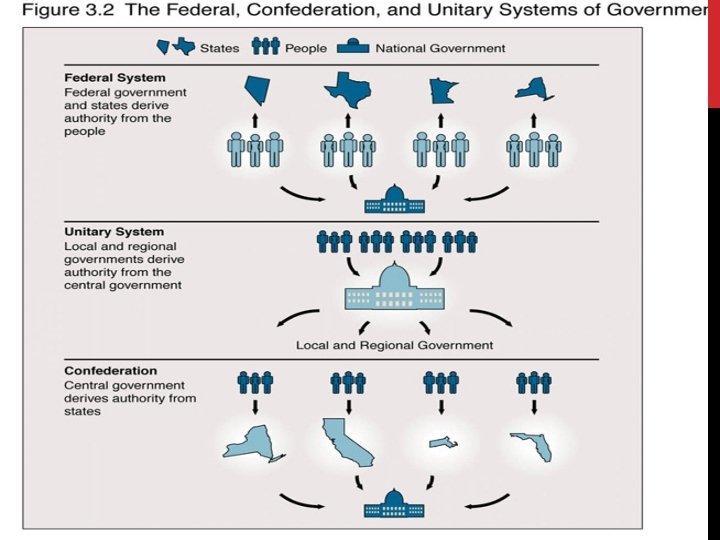
FEDERALISM POLITICAL SYSTEM IN WHICH POWER IS DIVIDED AND SHARED BETWEEN THE NATIONAL/CENTRAL GOVERNMENT AND THE STATES (REGIONAL UNITS) IN ORDER TO LIMIT THE POWER OF GOVERNMENT.
IMPLIED POWERS The central government may make all laws which shall be necessary and proper for carrying into execution the enumerated powers. The necessary and proper clause has often been used to expand the powers of the national government (elastic clause).
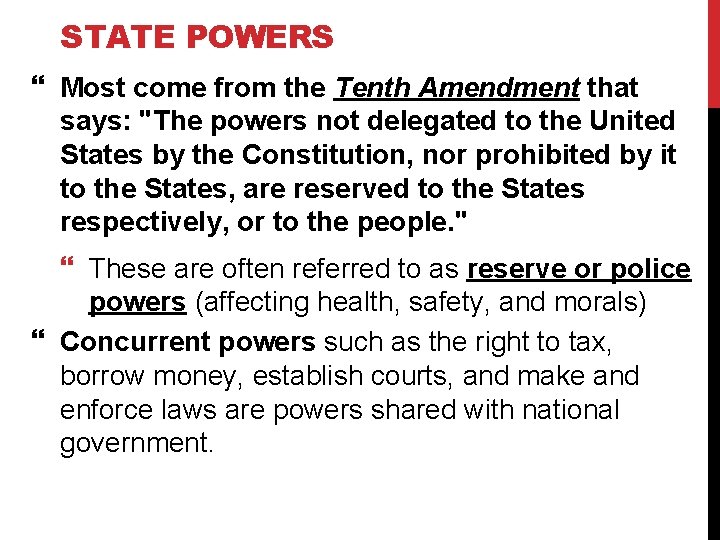
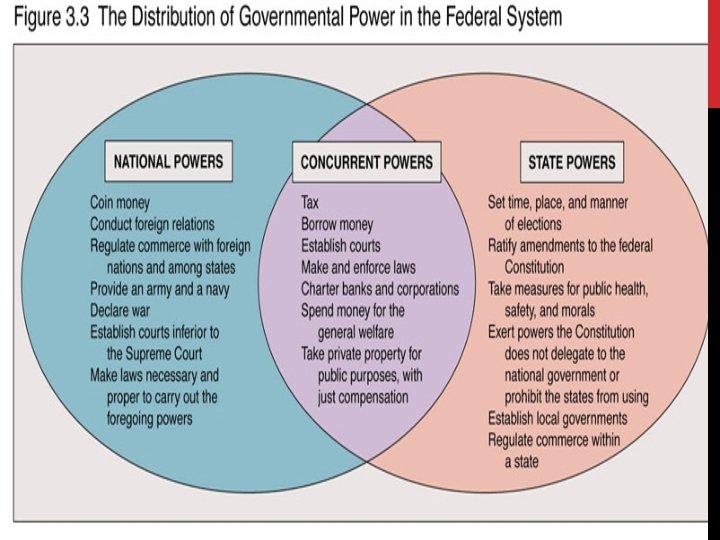
STATE POWERS Most come from the Tenth Amendment that says: "The powers not delegated to the United States by the Constitution, nor prohibited by it to the States, are reserved to the States respectively, or to the people. " These are often referred to as reserve or police powers (affecting health, safety, and morals) Concurrent powers such as the right to tax, borrow money, establish courts, and make and enforce laws are powers shared with national government.
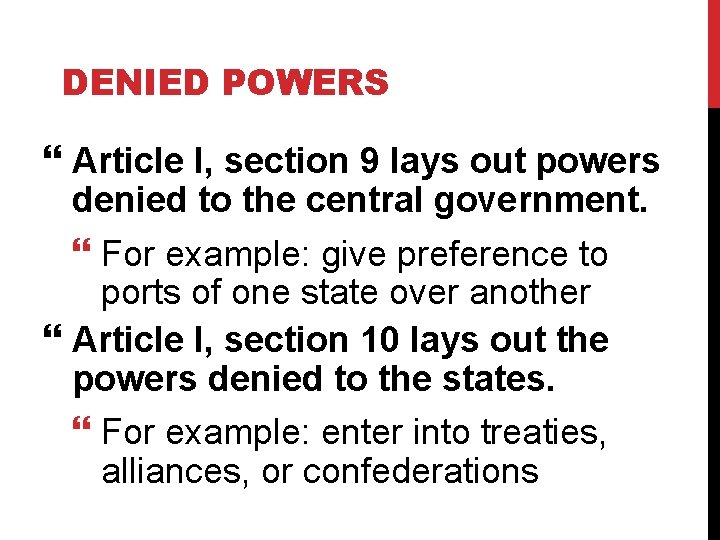
DENIED POWERS Article I, section 9 lays out powers denied to the central government. For example: give preference to ports of one state over another Article I, section 10 lays out the powers denied to the states. For example: enter into treaties, alliances, or confederations
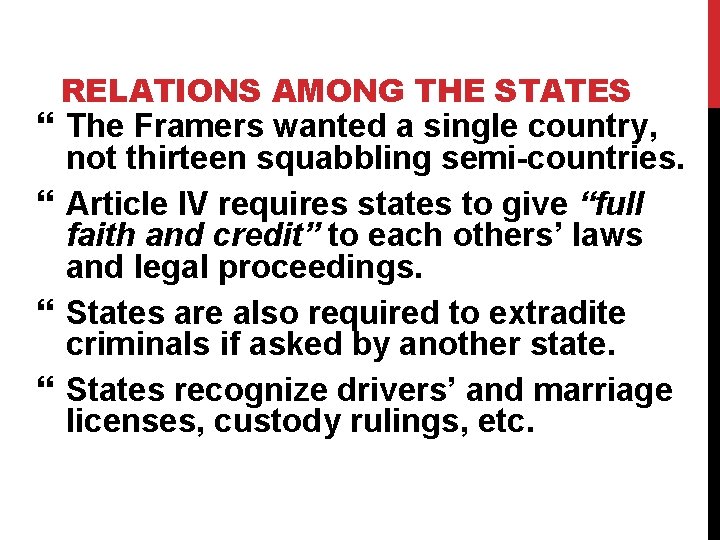
RELATIONS AMONG THE STATES The Framers wanted a single country, not thirteen squabbling semi-countries. Article IV requires states to give “full faith and credit” to each others’ laws and legal proceedings. States are also required to extradite criminals if asked by another state. States recognize drivers’ and marriage licenses, custody rulings, etc.
3. THE EVOLUTION AND DEVELOPMENT OF FEDERALISM The Supreme Court in its role as interpreter of constitution has been a major player in the redefinition of our Federal system. Mc. Culloch v. Maryland (1819) Gibbons v. Ogden (1824) Dred Scott v. Sandford (1857)
MCCULLOCH V. MARYLAND (1819) Mc. Culloch was the first major decision by the Supreme Court under Chief Justice John Marshall about the relationship between the states and the national government. The Court’s broad interpretation of the necessary and proper clause paved the way for later rulings upholding expansive federal powers.
GIBBONS V. OGDEN (1824) The Gibbons case centered on the conflict between the states and the powers of Congress. Could New York grant a monopoly concession on the navigation of the Hudson River? The Hudson River forms part of the border between New York and New Jersey and the U. S. Congress also licensed a ship to sail the Hudson. The main constitutional question in Gibbons was about the scope of Congress' authority under the Commerce Clause (Article I, sec. 8: “to regulate commerce with foreign nations, and among the several states, and with the Indian tribes”) In Gibbons, the Court upheld broad congressional power over interstate commerce.
DRED SCOTT V. SANDFORD (1857) The Supreme Court articulated the idea of dual federalism in which separate but equally powerful levels of government is preferable, and the national government should not exceed its enumerated powers. The Taney Court held that Mr. Scott was not a U. S. citizen and therefore not entitled to sue in federal court. The case was dismissed and Scott remained a slave. Chief Justice Roger Taney further wrote that Congress had no power to abolish slavery in the territories and slaves were private property protected by the Constitution. MO Compromise was unconstitutional.
THE CIVIL WAR AND BEYOND Dual federalism remained the Supreme Court's framework for federalism and the prevailing notion in the Reconstruction and Progressive Eras. Dual federalism finally ended in the 1930 s, when the crisis of the Great Depression demanded powerful actions from the national government.
COOPERATIVE FEDERALISM 1930’S-50’S By the New Deal, the analogy of a marble cake seemed more appropriate because the lines of authority were much more mixed. National government becomes major player in domestic policy. There is major shift in money from federal government to state/local governments. Marble cake federalism is often called cooperative federalism and has a much more powerful national government. States have a cooperative role, as did cities. Grants-in-aid monies flooded states for public works projects, work programs, relief agencies“
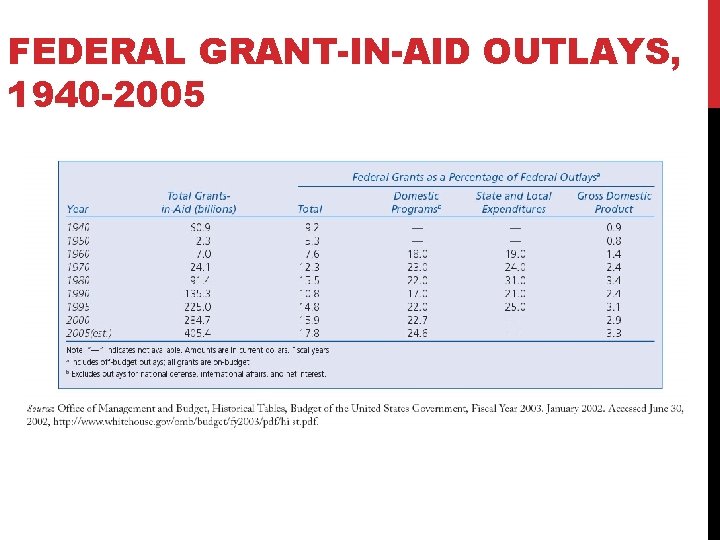
FEDERAL GRANT-IN-AID OUTLAYS, 1940 -2005
CREATIVE (REGULATED) FEDERALISM 1960’S-70’S Increase in Categorical Grants: allocation of federal money to the states for a specific purpose (e. g. , poverty programs, welfare, environment) Federal leadership saw these grants as a way to compel individual states to behave in ways desired by the national government.
NEW FEDERALISM: REAGAN REVOLUTION 1980’S-90’S Drastic cuts in federal domestic programs and income taxes in an attempt to reestablish the primacy of the states. For the first time in thirty years, federal aid to state and local governments declined.
ISSUES DURING 1980’S-90’S Revenue sharing & matching funds Block grants: monies allocated to states for broad purpose, such as education or poverty, with few regulations on administering funds Unfunded mandates: laws that direct states & localities to comply with federal regulations, e. g. , clean air laws & public access for disabled State budgetary constraints: recession, constitutional requirement for balanced budget
THE DEVOLUTION REVOLUTION Devolution = delegation of power & responsibility Clinton Era reaction to growth in power of the national government due to Republican majority in both houses of Congress President Clinton: responsibility to administer federal programs as chief executive SOH Gingrich: roll back scope of federal government and give back of power to the states Contract with America: shift responsibilities to states; Unfunded Mandate Reform Act of 1995 Gore’s Presidental Task Force on Reinventing Government traditional Republican issue
4. FEDERALISM AND THE SUPREME COURT Poll after poll showed that Americans began to think that the national government was too big, too strong, and too distant to understand their concerns. U. S. Supreme Court, once again, played a role in interpreting this new form of federalism. Cases involving abortion, gun control, environment, use of commerce clause, right to sue.
REHNQUIST COURT REINTERPRETING FEDERALISM Generally handing back power to the states Majority pro-states’ rights; 5 -4 decisions Webster v. Reproductive Health Services (1989) and Casey v. Planned Parenthood (1992): states can restrict abortion laws U. S. v. Lopez (1995): federal law cannot regulate guns within 1000 of a school BUT Bush v. Gore (2000): upheld deadline for selection of electors; struck down FL SC
SUMMARY – KEY POINTS TO REMEMBER Federalism is an important concept of the American system of government meant to limit the power of the national government. The notion of Federalism has changed drastically since the New Deal in the 1930’s. In the 1960’s and 1970’s the scope of federal domestic policies and programs increased steadily. In the 1980’s Reagan began a rollback of federal funding for programs and funding to states. In the mid-1990’s Republican Congress promised to reduce the size and scope of the national government and “return power to the states. ”