
Federalism defined A system of government in which

- Slides: 13
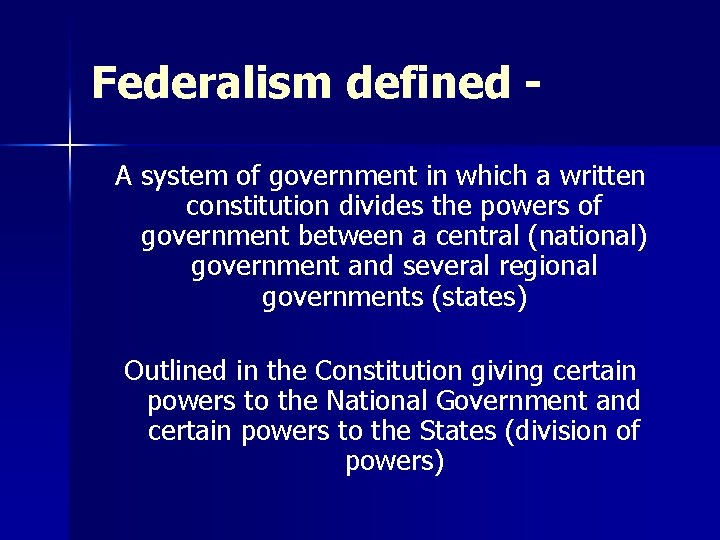
Federalism defined A system of government in which a written constitution divides the powers of government between a central (national) government and several regional governments (states) Outlined in the Constitution giving certain powers to the National Government and certain powers to the States (division of powers)
Why Federalism? *Framers dedication to the concept of limited government. *Framers convinced governmental power poses a threat to individual liberty exercise of governmental power must be restrained division of governmental power will prevent abuse of power
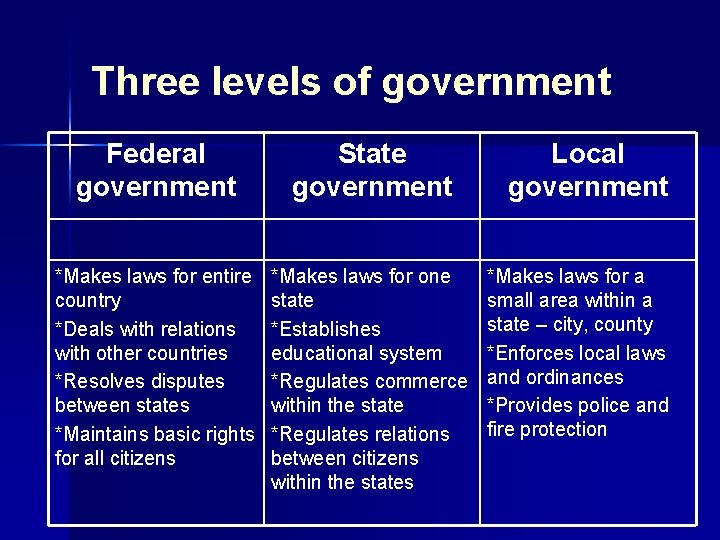
Three levels of government Federal government State government *Makes laws for entire country *Deals with relations with other countries *Resolves disputes between states *Maintains basic rights for all citizens *Makes laws for one state *Establishes educational system *Regulates commerce within the state *Regulates relations between citizens within the states Local government *Makes laws for a small area within a state – city, county *Enforces local laws and ordinances *Provides police and fire protection
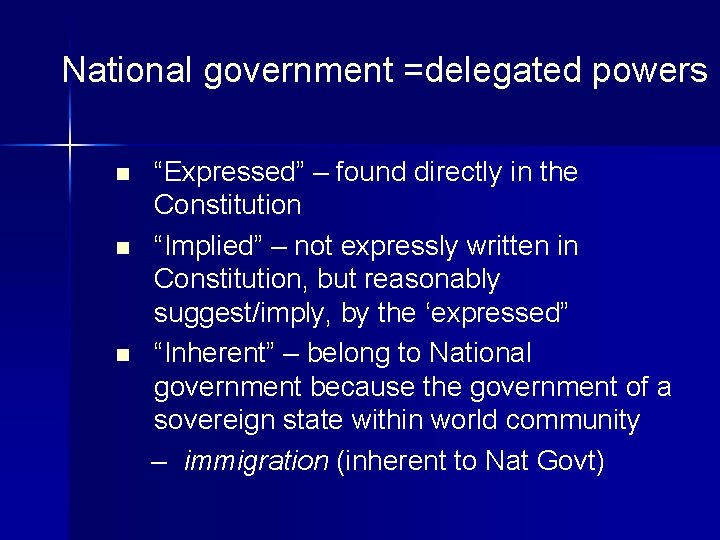
National government =delegated powers n n n “Expressed” – found directly in the Constitution “Implied” – not expressly written in Constitution, but reasonably suggest/imply, by the ‘expressed” “Inherent” – belong to National government because the government of a sovereign state within world community – immigration (inherent to Nat Govt)
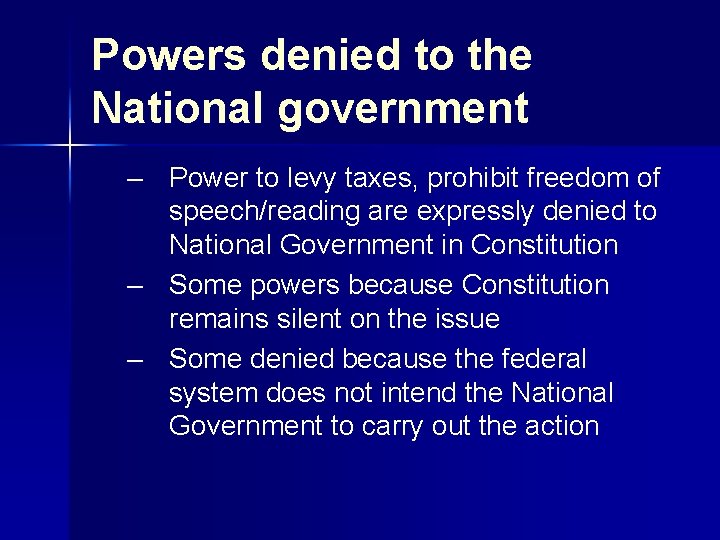
Powers denied to the National government – Power to levy taxes, prohibit freedom of speech/reading are expressly denied to National Government in Constitution – Some powers because Constitution remains silent on the issue – Some denied because the federal system does not intend the National Government to carry out the action
Powers for the state “reserved powers” – Constitution does not grant to the National Government on does not, at the same time, deny it to the States n Age limit for alcohol, marriage with consent, pornography, gambling, license for doctors and lawyers
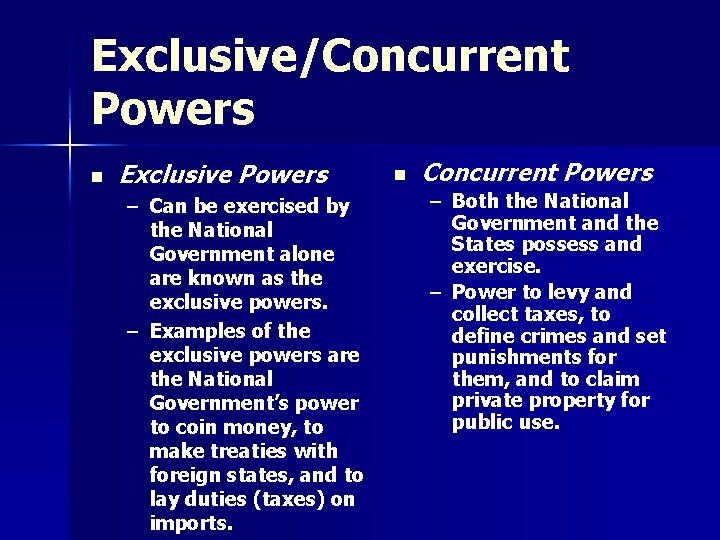
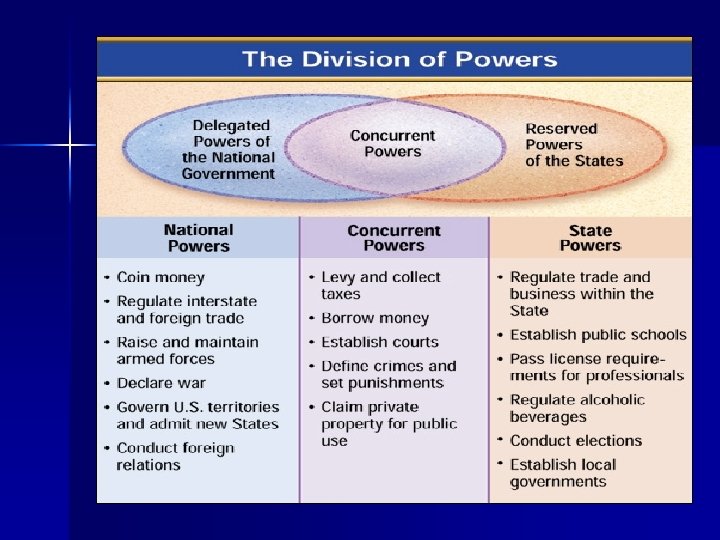
Exclusive/Concurrent Powers n Exclusive Powers – Can be exercised by the National Government alone are known as the exclusive powers. – Examples of the exclusive powers are the National Government’s power to coin money, to make treaties with foreign states, and to lay duties (taxes) on imports. n Concurrent Powers – Both the National Government and the States possess and exercise. – Power to levy and collect taxes, to define crimes and set punishments for them, and to claim private property for public use.
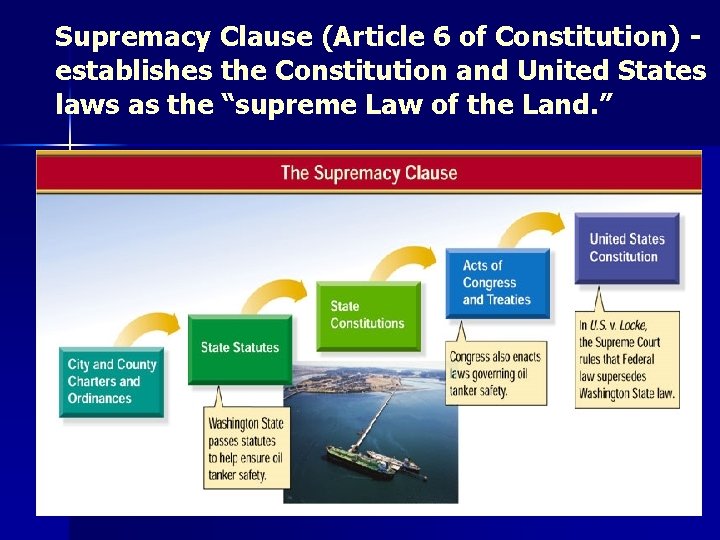
Supremacy Clause (Article 6 of Constitution) establishes the Constitution and United States laws as the “supreme Law of the Land. ”
National Government and the 50 States – what’s the obligation? ? Republican Form of Government n The Constitution requires the National Government to “guarantee to every State in this Union a Republican Form of Government. ” Invasion and Internal Disorder n The National Government is also required to provide defense of the States from foreign invasion, and aid in protecting against “domestic Violence” in the States. Respect for Territorial Integrity n The National Government is constitutionally bound to respect the territorial integrity of each of the States
Cooperative Federalism (ever paddled a canoe with someone = cooperation essential to success) n Grants-in-aid programs - grants (give) of federal money or other resources to the States and/or their cities, counties, and other local units. – Education – land-grant colleges, school lunch programs – Any other thing you can think of there is probably a grant out there for it or you could apply for one n Different types for different issues
Interstate relations (compacts) n Constitution states =can’t enter into a treaty/alliance/confederation but they (States) can make compacts with consent of Congress – variety of uses = sharing law-enforcement data to resource development and conservation
Full Faith and Credit Clause *ensures that States recognize the laws and, documents, and court proceedings of the other States Two exceptions: (1) One State cannot enforce another State’s criminal laws (2) Doesn’t need to be given to certain divorces granted by one State to residents of another State