
FEDERALISM Define Federalism and explain why the Framers
- Slides: 10
FEDERALISM Define Federalism and explain why the Framers chose this system of government.
REVIEW Constitution Federalist Anti-Federalist Bill of Rights
TELEPHONISM How does Federalism compare. Round 1 � The objective of today's lesson is to learn about the Federal system of government which runs our country Round 2 � The objective from last session was to break down the Federalist and the Anti-Federalist beliefs and see that all it took was the Bill of right being added.
FEDERALISM System of government in which a written constitution divides the powers of the gov’t on a territorial basis between Central and Several Regions A government that facilitates power down from the central government to the states Draw the United States
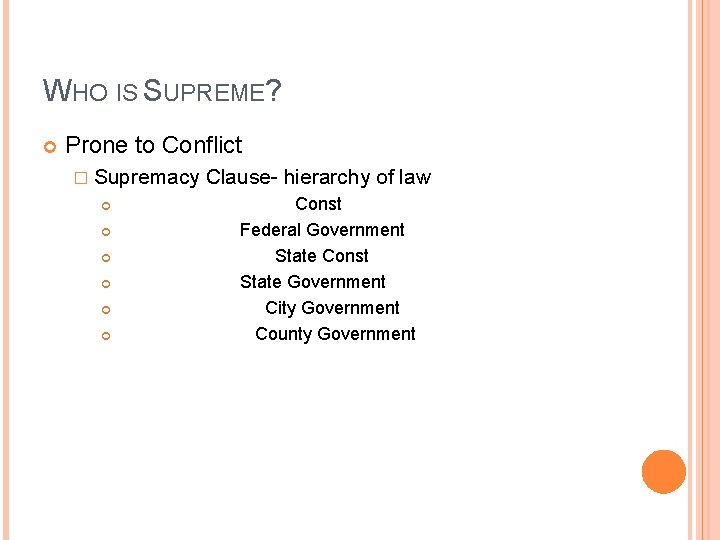
WHO IS SUPREME? Prone to Conflict � Supremacy Clause- hierarchy of law Const Federal Government State Const State Government City Government County Government
SUPREME WILL DECIDE HIERARCHY Mc. Cullough v. Maryland 1816 2 nd bank of U. S. was the National Bank in Maryland Taxed from the state James Mc. Cullough (No against Supremacy Clause)
FEDERALISM Dual System- certain powers to Federal and certain to state Strengths- Local matters are local concern, National takes care of big problems
POWERS OF THE STATE Reserved – granted to federal but not denied to states Exclusive – powers only the national government (money, trade, treaties) Concurrent- both state and national (taxes, punishments, condem property)
POWERS DENIED Exports Schools Cant threaten the system- tax to get what they want
DELEGATED POWERS By the Constitution � Expressed Powers “Enumerated Powers”- written down � Implied Powers- reasonable suggested in Const Necessary and Proper Clause- Convenient and Useful � Inherent Powers- power they have always had, inherited (exist because people allow them to)