
Federalism Americas pragmatic contribution to political theory Political
Federalism America’s pragmatic contribution to political theory
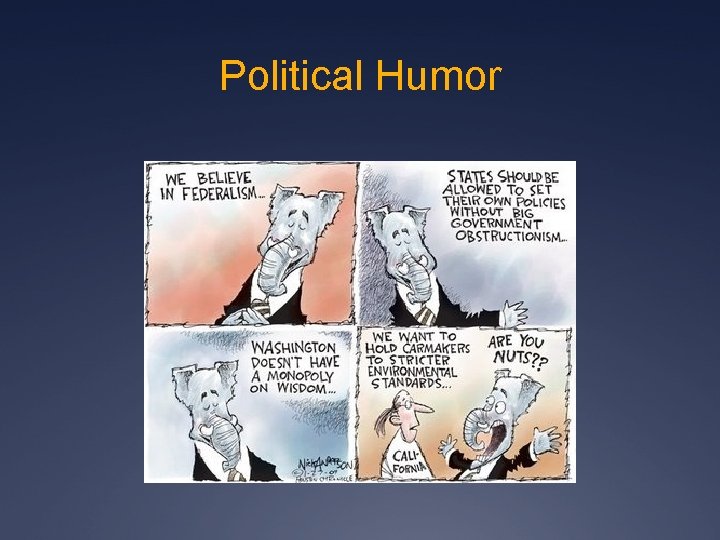
Political Humor
Student Learning Objectives Ü What is federalism? Ü How did federalism historically develop and what is its likely future?
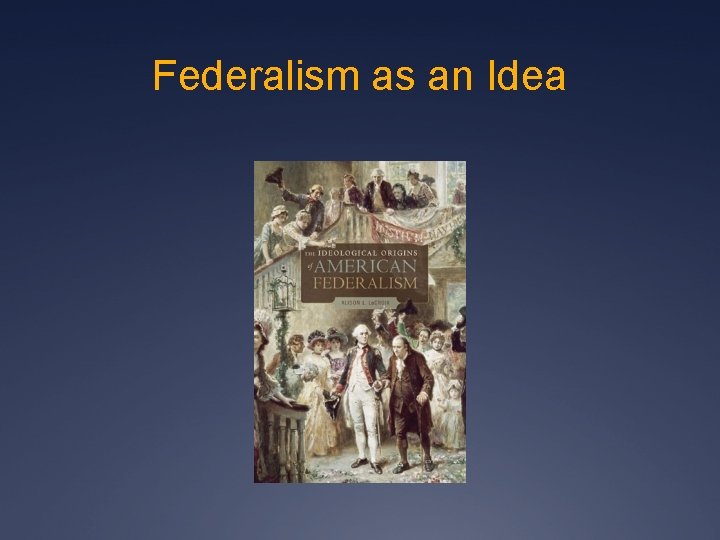
Federalism as an Idea
What Is Federalism? Ü Federalism is an intermediary form of government standing between a unitary state such as France and a confederation of states such as the United Nations. Ü In a federal system, sovereignty is shared between a national government and local governments. The national government may have sole authority in managing trade, diplomacy, and defense and local governments may have sole authority in dealing with civil and criminal law. The national and local governments may share authority in areas such as taxing. Ü Federalism is a child of necessity, but it may have some characteristics that give it the resilience of a decentralized system and the efficiency of a unitary system. Some believe it to be an ideal solution for governing diverse states such as Iraq and India.
Constitutional Architecture of Federalism Ü Article I, Section 8 includes 17 enumerated powers granted to the national government as well as the powers necessary and proper for executing those enumerated powers. Ü 10 th amendment reserves powers not granted to the national government for the states or the people. Ü Article VI, Clause 2 established the U. S. Constitution, federal statutes, and U. S. treaties as the supreme law of the land.
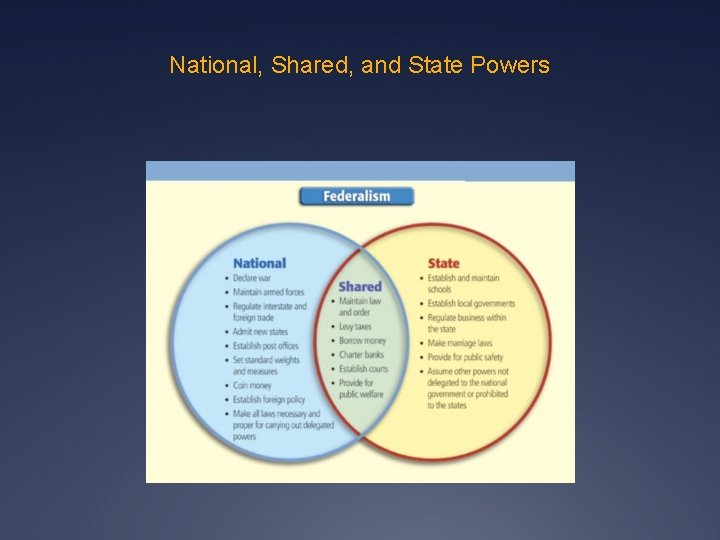
National, Shared, and State Powers
Federalism’s Beginnings Ü Articles of Confederation 1777 laid foundation for initial resistance to Britain but weaknesses in addressing security concerns after the war led to the adoption of the Constitution of 1787 that strengthened the sovereignty of national government while respecting state sovereignty and prerogatives. Ü The national government established its authority through cases such as Mc. Culloch versus Maryland 1819 but the concept of nullification and court decisions such as Dred Scott versus Sanford 1857 shifted legal authority towards states culminating in secession and the Civil War.
Federalism Stabilized and Challenged Ü Dual federalism emerged as a doctrine after the Civil War restricting both the state and national governments to narrow definitions of their powers. Plessy versus Ferguson 1896 showed how far regional variations could exist under such an interpretation of Federalism. Economic concerns emerging from the great Depression led to a new interpretation of the government’s powers in such cases as the National Labor Relations Board versus Jones and Laughlin Steel 1937.
New Federalism and the Future Ü FDR’s presidency initiated cooperative federalism that would eventually involve the national government in a wide range of areas including civil rights that would expand the scope of powers of the national government at the expense of state governments. Ü New Federalism emerged as part of a conservative strategy to reduce the growing power of a central government. The Supreme Court’s decision in U. S. versus Lopez 1995 was the first case to place limits on Congress’s commerce powers since the New Deal. The Presidency of George W. Bush seemed to be more results oriented and somewhat incentive to concerns about federalism in such national intrusions into state prerogatives such the No Child Left Behind Act 2001. The Obama administration supports states rights in the arena of marriage but is more hesitant with regards to drug law.
Case Study and Game Ü Is the Defense of Marriage Act 1996 constitutional? United States versus Windsor 2013 Ü Is it in accord with the Controlled Substance Act of 1970 for businesses to distribute marijuana for medical use? United States versus Oakland Cannabis Buyers Cooperative 2001
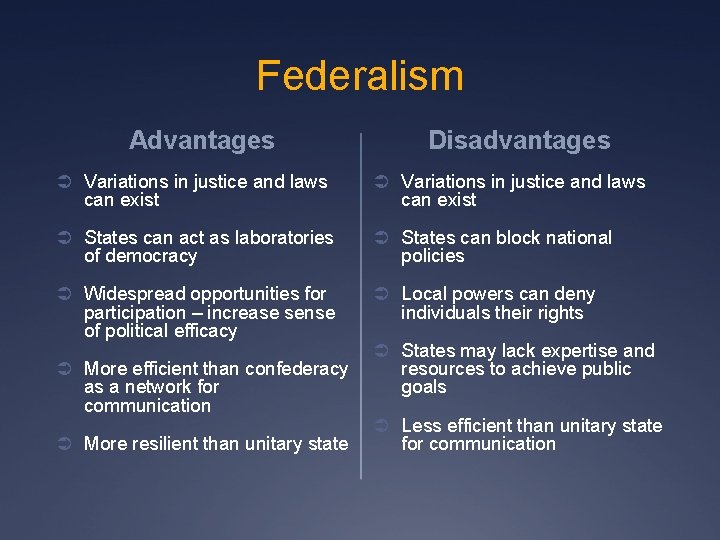
Federalism Advantages Disadvantages Ü Variations in justice and laws Ü States can act as laboratories Ü States can block national Ü Widespread opportunities for Ü Local powers can deny can exist of democracy participation – increase sense of political efficacy Ü More efficient than confederacy as a network for communication Ü More resilient than unitary state can exist policies individuals their rights Ü States may lack expertise and resources to achieve public goals Ü Less efficient than unitary state for communication
- Slides: 12