
Federal Transit Resources for Tribes and Title VI
Federal Transit Resources for Tribes and Title VI Recipients July 8 th, 2020 Amy Fong Tribal Transit Program Manager Section 5310 Program Manager (Interim) 1

Agenda • Overview of FTA funding programs • Tribal Transit Program FY 2020 funding opportunity • Federal resources for coordination of transportation services Photo Credit: NADTC/Capacity Builders, Farmington NM 2

FTA Funding Overview FTA Grant Program Eligible Entities How to Access Funding • Private, non-profit organizations (as subrecipient) Enhanced Mobility • Indian Tribes (if certified that for Seniors and Individuals with no non-profits available; as subrecipient through Disabilities (Section 5310) designated agency or direct FTA recipient) Designated agencies act as pass-through entities and have discretion to allocate formula funding to subrecipients Formula Grants for • Indian Tribes (as subrecipient Rural Areas through designated agency or (Section 5311) direct FTA recipient) Designated agencies act as pass-through entities and have discretion to allocate formula funding to subrecipients Tribal Transit Program (Section 5311(c)) Apply directly for competitive funds; Report to National Transit Database formula funds • Indian Tribes (as direct FTA recipient) 3
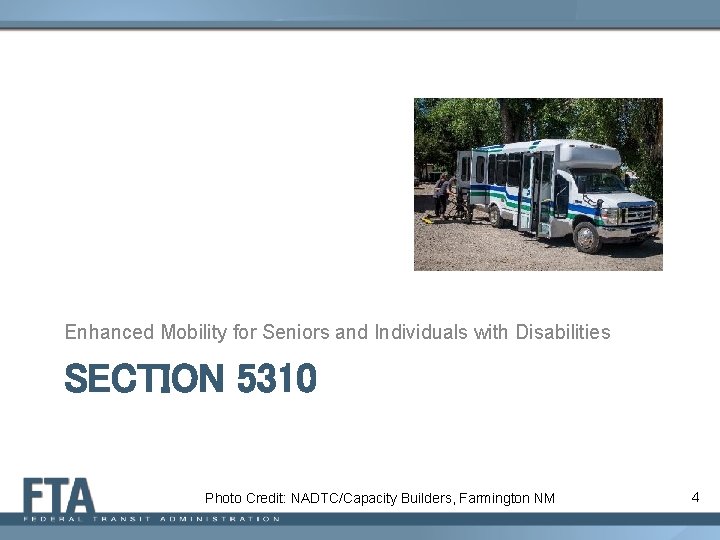
Enhanced Mobility for Seniors and Individuals with Disabilities SECTION 5310 Photo Credit: NADTC/Capacity Builders, Farmington NM 4
Who is eligible for 5310 funding? In 2020, FTA apportioned $228 M to direct and designated recipients… • States are recipients for rural and small urban areas • Designated recipients for large urban areas are chosen by state governors …to sub-allocate to eligible subrecipients: • State or local governmental authority • Private nonprofit organizations • Operators of public transportation • Taxi Operators who provided Shared ride services • Federally recognized Tribes
Eligible Section 5310 Projects Most projects are intended to meet the special needs of seniors and individuals with disabilities when public transportation is insufficient, unavailable, or inappropriate: • Vehicles (i. e. , buses, vans, or accessible taxis), Vehicle Rehabilitation, and Equipment (i. e. , lifts, ramps, securement devices; etc. ) • Other Capital Equipment Purchases (i. e. , communications equipment; security equipment; fare collection systems; etc. ) • Mobility Management • Cost of Leased or Contracted Services • Operation of Transportation Brokerages to Coordinate Providers, Funding Agencies, and Passengers • Development and Operation of One-Call/One-Click Call Centers 6
Eligible Section 5310 Projects Some projects may also provide public transportation alternatives that assist seniors and individuals with disabilities with transportation beyond minimum ADA complementary transportation service: • Volunteer Driver Programs (Mileage Reimbursement) • Administration and expenses related to voucher programs for transportation services offered by human service providers • vehicles to support accessible taxi, ride-sharing, and/or vanpooling programs 7
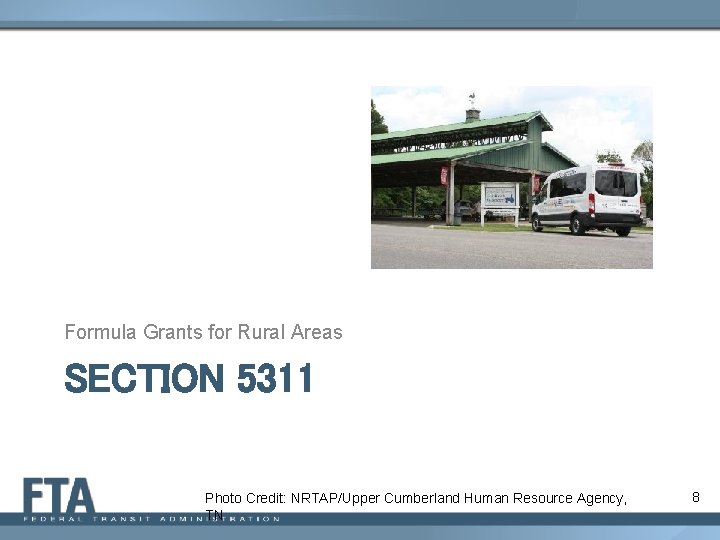
Formula Grants for Rural Areas SECTION 5311 Photo Credit: NRTAP/Upper Cumberland Human Resource Agency, TN 8
Who is eligible for 5311 funding? In 2020, FTA apportioned $727 M apportioned to States… • Typically the State DOT is the designated 5311 agency …to sub-allocate to eligible subrecipients: • State or local governmental authority • Operators of public transportation • Federally recognized Tribes
Eligible Section 5311 Projects Capital Purchases: • Vehicles (i. e. , buses, vans, or accessible taxis) • Approved Vehicle Rehabilitation or Overhaul • Related Vehicle Equipment (i. e. , lifts, ramps, securement devices; etc. ) • Other Capital Equipment Purchases (i. e. , communications equipment such as Mobile Data Terminals or Computers; security equipment such as camera systems for vehicles; fare collection systems; etc. ) • Mobility Management • Cost of Leased or Contracted Services 10

Eligible Section 5311 Projects Operating expenses: • Vehicle fuel or oil • Drivers’ salaries and fringe benefits • Dispatcher salaries and fringe benefits • Vehicle licenses. 11
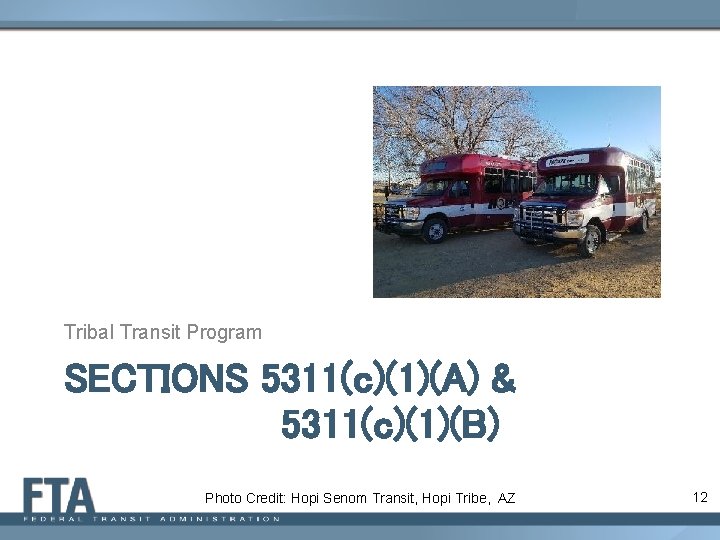
Tribal Transit Program SECTIONS 5311(c)(1)(A) & 5311(c)(1)(B) Photo Credit: Hopi Senom Transit, Hopi Tribe, AZ 12

Tribal Transit Program • Provides direct funding to federally recognized Indian tribes to provide public transportation service on and around Indian reservations or tribal land in rural areas • Two separate funding opportunities under current transportation authorization: – Formula Program: $30 Million per year – Discretionary Program: $5 Million per year 13
Tribal Formula Program • Distributed to 130+ tribes that reported transit service to the National Transit Database in the most recent reporting cycle (2018) • Formula based on vehicle revenue miles and low-income population served • No minimum local share • All 5311 projects are eligible (capital, operating, planning) 14
Tribal Competitive Program • May 2020: FTA published a Notice of Funding Opportunity (NOFO) • Eligible applicants: Federally recognized Indian tribes or Alaska Native villages, groups, or communities as identified by the US Dept. of Interior in rural areas with a population of less than 50, 000 • Available Funding: $5 million in FY 2020 funds • Applications are due August 24 th, 2020 at 11: 59 PM ET! 15
Eligible Tribal Transit Projects Capital Purchases (up to 90% federal share): • Vehicles (i. e. , buses, vans, or accessible taxis) • Approved Vehicle Rehabilitation or Overhaul • Related Vehicle Equipment (i. e. , lifts, ramps, securement devices; etc. ) • Other Capital Equipment Purchases (i. e. , communications equipment such as Mobile Data Terminals or Computers; security equipment such as camera systems for vehicles; fare collection systems; etc. ) • Mobility Management • Cost of Leased or Contracted Services 16
Eligible Tribal Transit Projects Operating expenses (up to 90% federal share): • Vehicle fuel or oil • Drivers’ salaries and fringe benefits • Dispatcher salaries and fringe benefits • Vehicle licenses • Service start-up – operating a new transit service Planning projects (up to 100% federal share, capped at $25, 000): • Feasibility studies for a new transit service or expansion • Transportation plan updates 17
Recent Tribal Transit Projects… • funding for transit planning that will meet increasing demand from elderly and tribal members with disabilities • funding for capital expansion of elder transportation services by buying a wheelchair-accessible van to replace a non-accessible vehicle. • funding for operating expenses to initiate transit service on tribal land 18
Evaluation Criteria • Capital/operating projects: – – – Planning and Local/Regional Prioritization Project Readiness Demonstration of Need Demonstration of Benefits Financial Commitment and Operating Capacity • Planning projects: – describe the need for and a general scope of the proposed study 2020 Tribal NOFO Recording (June 25, 2020) 19
Federal interagency collaboration and resources for… COORDINATED TRANSPORTATION 20
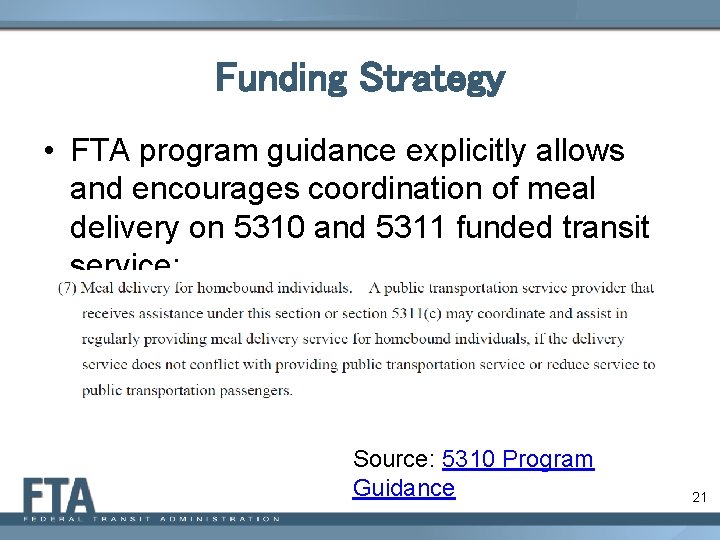
Funding Strategy • FTA program guidance explicitly allows and encourages coordination of meal delivery on 5310 and 5311 funded transit service: Source: 5310 Program Guidance 21
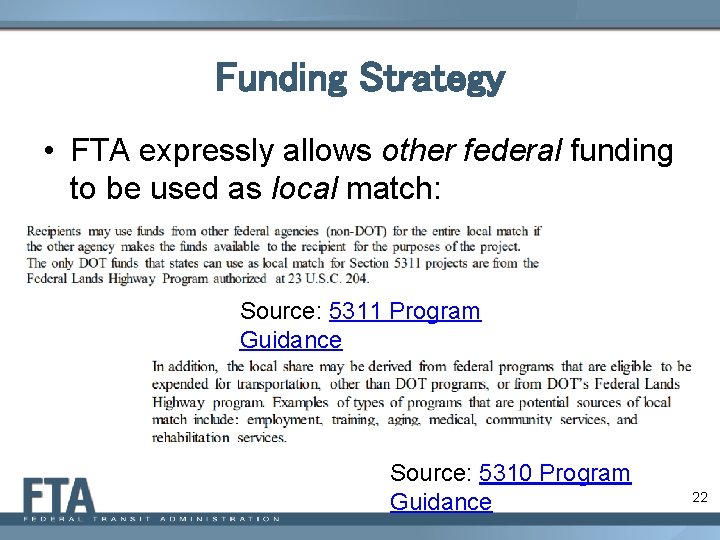
Funding Strategy • FTA expressly allows other federal funding to be used as local match: Source: 5311 Program Guidance Source: 5310 Program Guidance 22
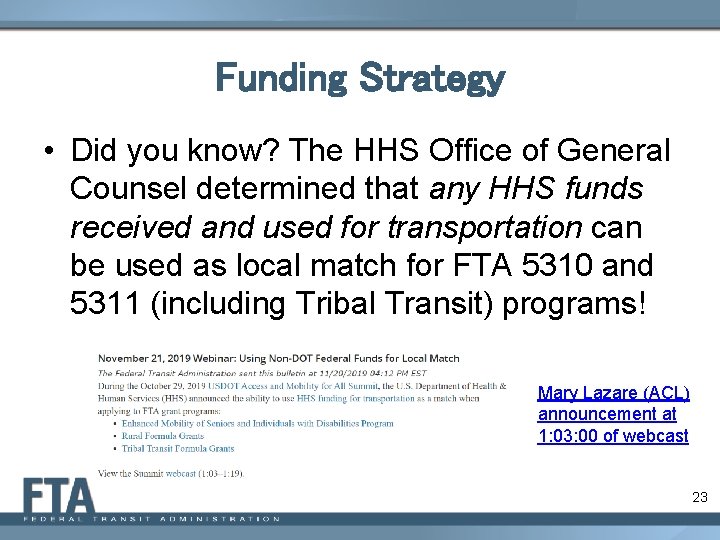
Funding Strategy • Did you know? The HHS Office of General Counsel determined that any HHS funds received and used for transportation can be used as local match for FTA 5310 and 5311 (including Tribal Transit) programs! Mary Lazare (ACL) announcement at 1: 03: 00 of webcast 23
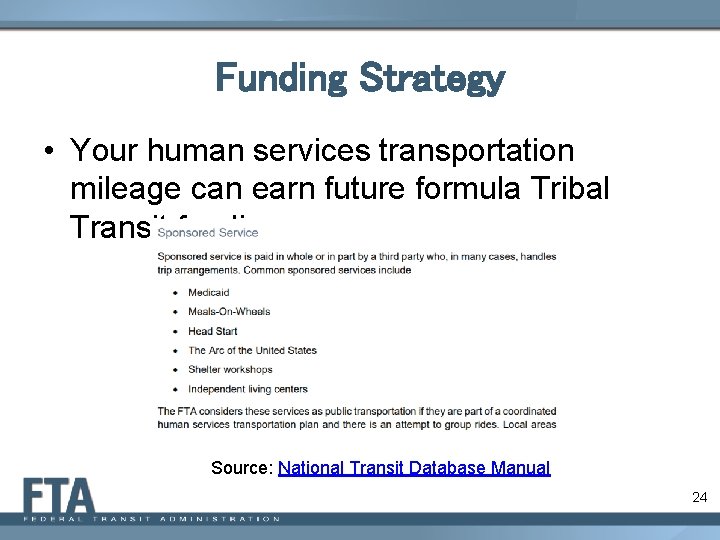
Funding Strategy • Your human services transportation mileage can earn future formula Tribal Transit funding Source: National Transit Database Manual 24
Coordinated Council on Access and Mobility • CCAM is: – an interagency partnership (120+ federal programs) – that issues policy recommendations and implements activities that improve the availability, accessibility, and efficiency of transportation for: older adults, people with disabilities, and individuals of low income 25
CCAM Resources: • Mobility Federal Fund Braiding Guide: how to combine federal funds to coordinate human services transportation • Program Inventory: summary of eligible uses of the 122 federal programs under CCAM – Sort by Primary Recipients / Indian Tribes 26
Technical Assistance Centers National Center for Mobility Management www. nc 4 mm. org 1 -866 -846 -6400 email: info@nc 4 mm. org Annual Community Grants National Aging and Disability Transportation Center www. nadtc. org 1 -866 -983 -3222 email: contact@nadtc. org Annual Community Grants Rural Transit Assistance Program www. nationalrtap. org 1 -888 -589 -6821 email: info@nationalrtap. org National Center for Applied Transit Technology www. n-catt. org Contact: grossglaser@ctaa. org 27
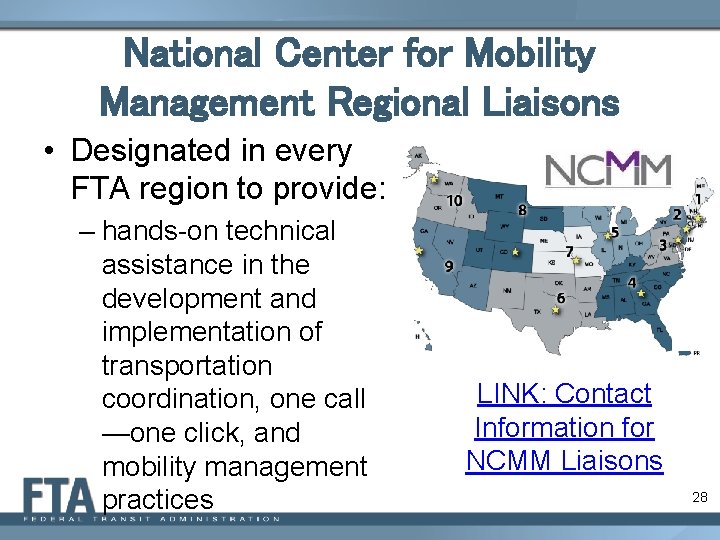
National Center for Mobility Management Regional Liaisons • Designated in every FTA region to provide: – hands-on technical assistance in the development and implementation of transportation coordination, one call —one click, and mobility management practices LINK: Contact Information for NCMM Liaisons 28
National Transit Institute (NTI) • provides training, education, and clearinghouse services in support of public transportation Registration for all – Short-form webinars – Multi-day in-person courses • Some In-person courses: NTI courses and events is free to government and transportation agency employees – Advancing Mobility Management – Grow Your Ridership by Welcoming Older Riders – Understanding ADA 29
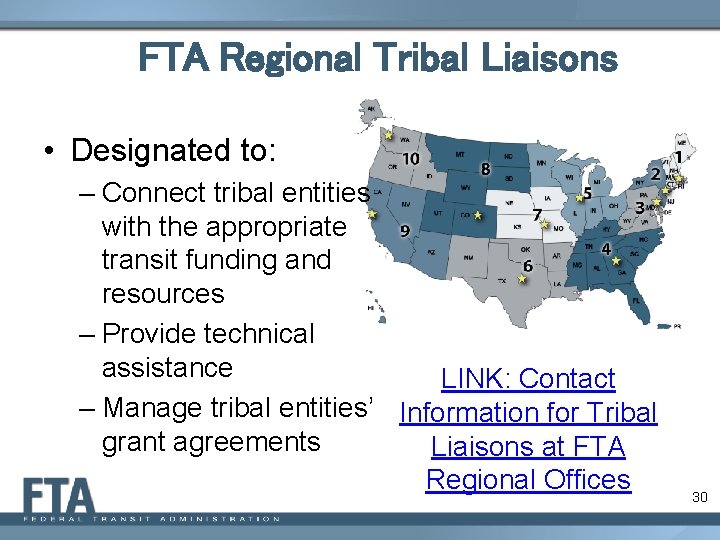
FTA Regional Tribal Liaisons • Designated to: – Connect tribal entities with the appropriate transit funding and resources – Provide technical assistance LINK: Contact – Manage tribal entities’ Information for Tribal grant agreements Liaisons at FTA Regional Offices 30
Contact Information Amy Fong Tribal Transit Program Manager 5310 Program Manager (Interim) Amy. Fong@dot. gov (202)-366 -0876 31
Important Links • 2020 Tribal Transit Program NOFO • 2020 Tribal NOFO Recording (June 25, 2020) • FY 2020 Tribal Transit Program on Grants. gov • Tribal Transit Program Webpage • FTA Tribal Entities Landing Page • FTA Section 5310 Program Page • FTA CCAM Page 32
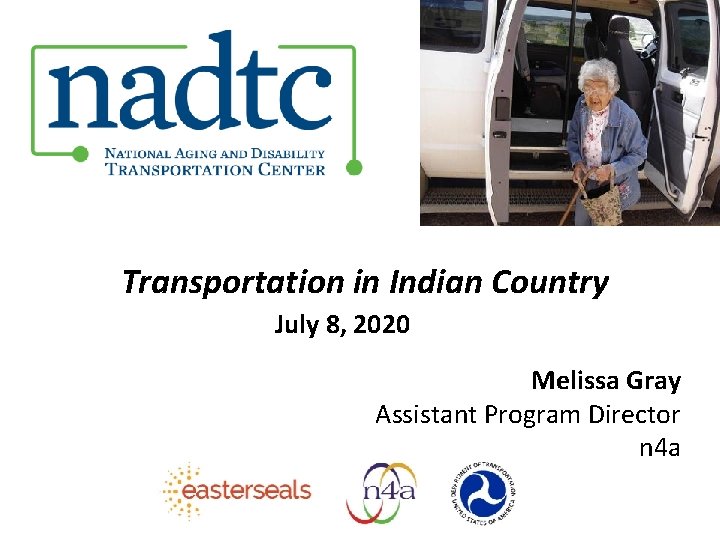
Transportation in Indian Country July 8, 2020 Melissa Gray Assistant Program Director n 4 a
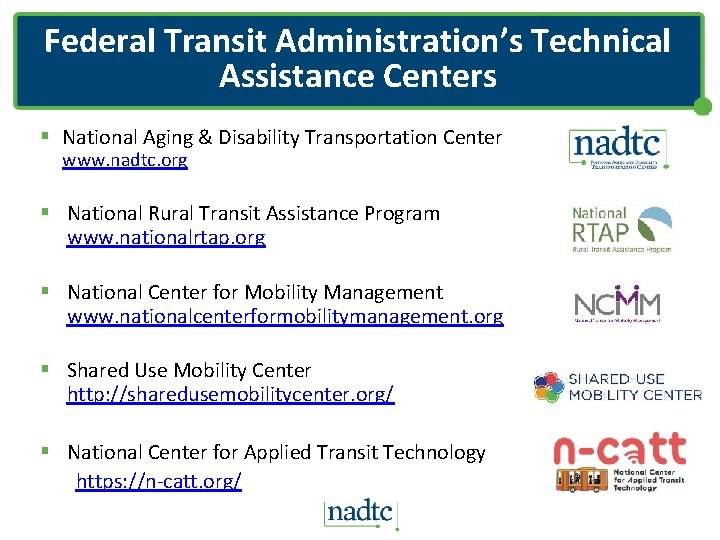
Federal Transit Administration’s Technical Assistance Centers § National Aging & Disability Transportation Center www. nadtc. org § National Rural Transit Assistance Program www. nationalrtap. org § National Center for Mobility Management www. nationalcenterformobilitymanagement. org § Shared Use Mobility Center http: //sharedusemobilitycenter. org/ § National Center for Applied Transit Technology https: //n-catt. org/
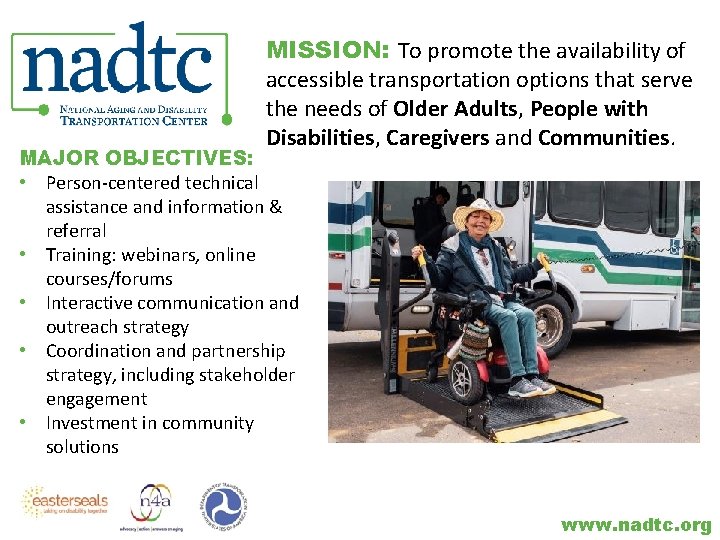
MISSION: To promote the availability of accessible transportation options that serve the needs of Older Adults, People with Disabilities, Caregivers and Communities. MAJOR OBJECTIVES: • Person-centered technical assistance and information & referral • Training: webinars, online courses/forums • Interactive communication and outreach strategy • Coordination and partnership strategy, including stakeholder engagement • Investment in community solutions www. nadtc. org
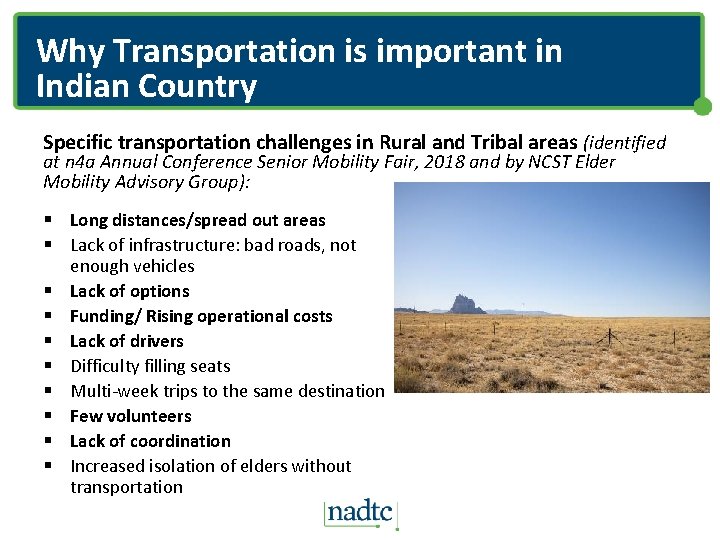
Why Transportation is important in Indian Country Specific transportation challenges in Rural and Tribal areas (identified at n 4 a Annual Conference Senior Mobility Fair, 2018 and by NCST Elder Mobility Advisory Group): § Long distances/spread out areas § Lack of infrastructure: bad roads, not enough vehicles § Lack of options § Funding/ Rising operational costs § Lack of drivers § Difficulty filling seats § Multi-week trips to the same destination § Few volunteers § Lack of coordination § Increased isolation of elders without transportation
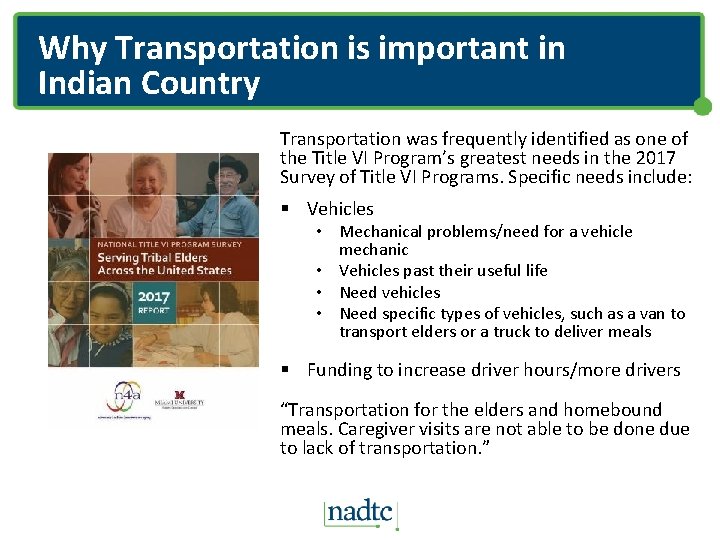
Why Transportation is important in Indian Country Transportation was frequently identified as one of the Title VI Program’s greatest needs in the 2017 Survey of Title VI Programs. Specific needs include: § Vehicles • Mechanical problems/need for a vehicle mechanic • Vehicles past their useful life • Need vehicles • Need specific types of vehicles, such as a van to transport elders or a truck to deliver meals § Funding to increase driver hours/more drivers “Transportation for the elders and homebound meals. Caregiver visits are not able to be done due to lack of transportation. ”
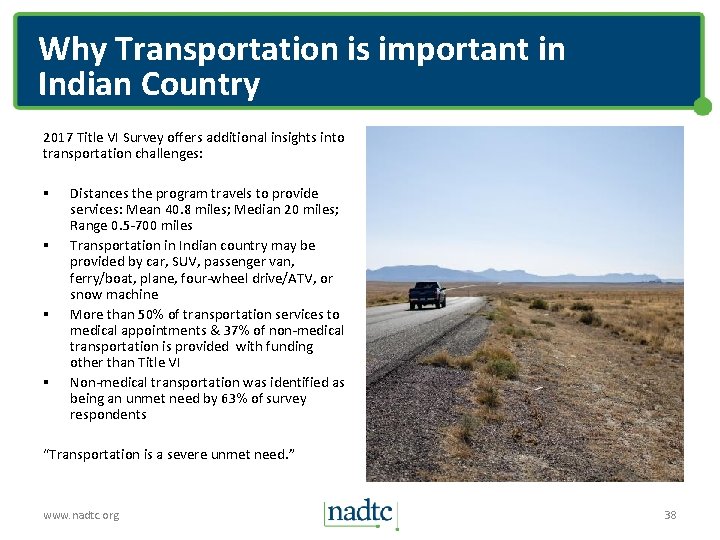
Why Transportation is important in Indian Country 2017 Title VI Survey offers additional insights into transportation challenges: § § Distances the program travels to provide services: Mean 40. 8 miles; Median 20 miles; Range 0. 5 -700 miles Transportation in Indian country may be provided by car, SUV, passenger van, ferry/boat, plane, four-wheel drive/ATV, or snow machine More than 50% of transportation services to medical appointments & 37% of non-medical transportation is provided with funding other than Title VI Non-medical transportation was identified as being an unmet need by 63% of survey respondents “Transportation is a severe unmet need. ” www. nadtc. org 38
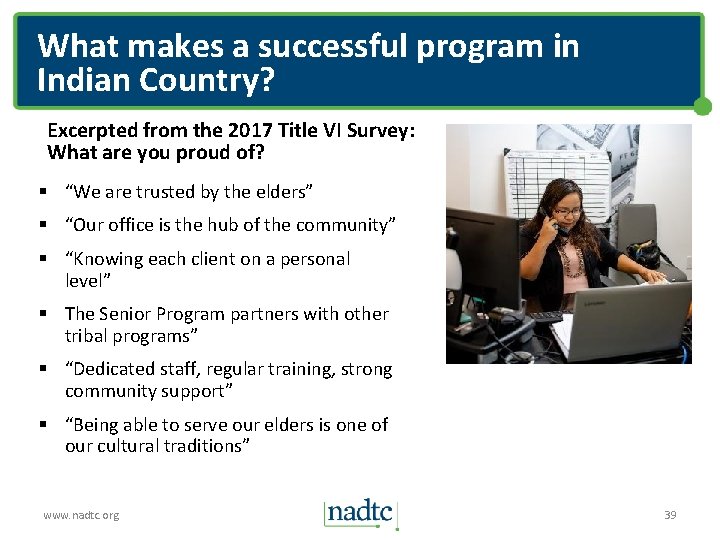
What makes a successful program in Indian Country? Excerpted from the 2017 Title VI Survey: What are you proud of? § “We are trusted by the elders” § “Our office is the hub of the community” § “Knowing each client on a personal level” § The Senior Program partners with other tribal programs” § “Dedicated staff, regular training, strong community support” § “Being able to serve our elders is one of our cultural traditions” www. nadtc. org 39
NADTC Community Transportation Innovations Grants Innovations in Accessible Mobility Grant program goals: • Enable innovations designed to solve local transportation issues and create models of excellence for potential replication • Strengthen the connections between transit and human services • Build bridges between transportation and community programs that support community living www. nadtc. org 40
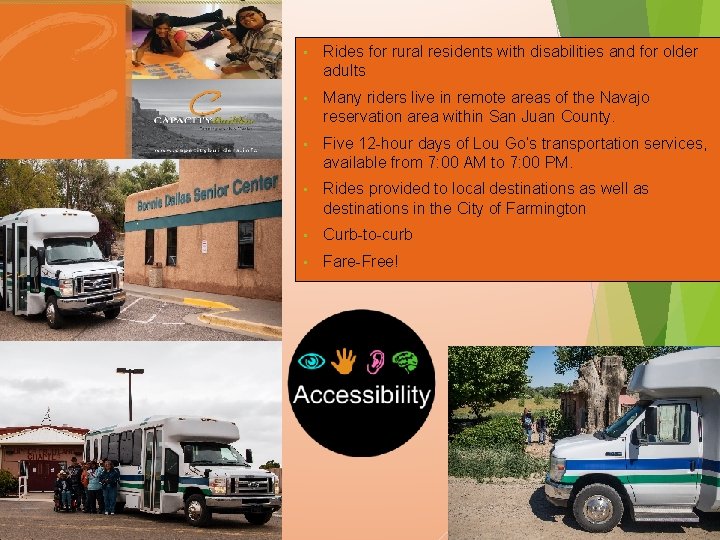
• Rides for rural residents with disabilities and for older adults • Many riders live in remote areas of the Navajo reservation area within San Juan County. • Five 12 -hour days of Lou Go’s transportation services, available from 7: 00 AM to 7: 00 PM. • Rides provided to local destinations as well as destinations in the City of Farmington • Curb-to-curb • Fare-Free!
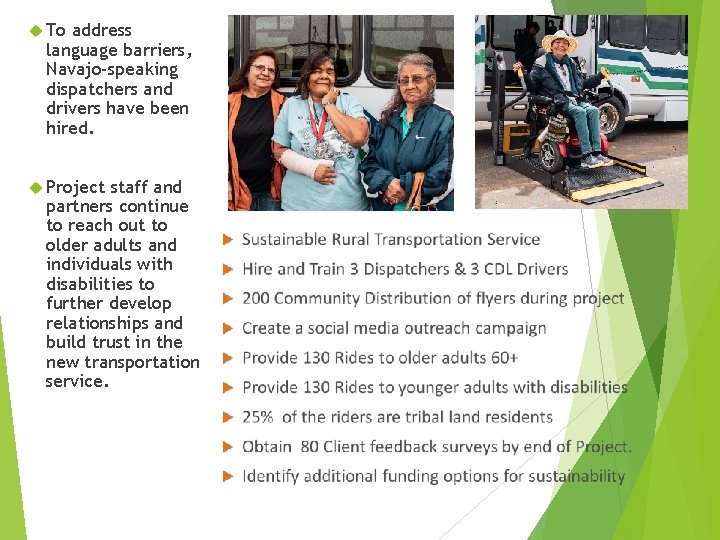
To address language barriers, Navajo-speaking dispatchers and drivers have been hired. Project staff and partners continue to reach out to older adults and individuals with disabilities to further develop relationships and build trust in the new transportation service.
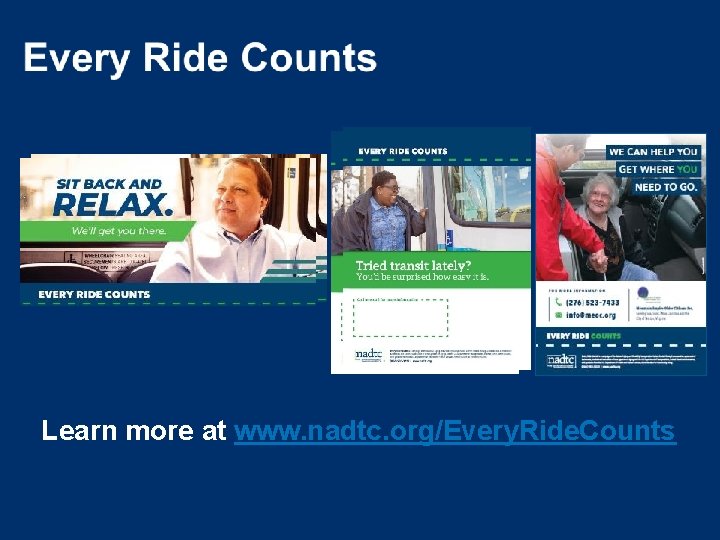
Learn more at www. nadtc. org/Every. Ride. Counts
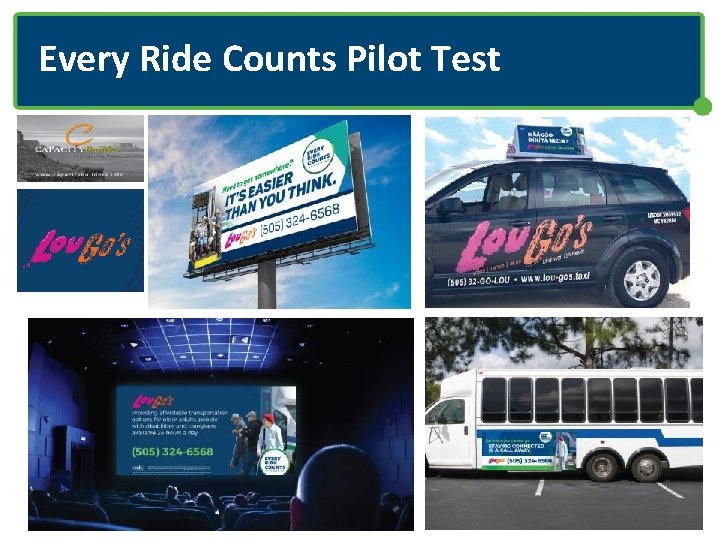
Every Ride Counts Pilot Test www. nadtc. org 44
Are You Mobility Minded? § Are you working with the Community Health Representative (CHR) to coordinate transportation services? § Are there other partnerships that your programs have been able to develop that help with the transportation options for elders? § Have you developed rules and responsibilities for both drivers and riders to follow? What has been your experience in drivers and riders following the rules and expectations?
Are You Mobility Minded? § What complications or issues have you experienced in providing transportation to elders? § What funding have you been able to access for your transportation programs? § Have you implemented any creative or innovative solutions to address transportation challenges? § Are the Title VI program and Tribal Transit in your area working together?
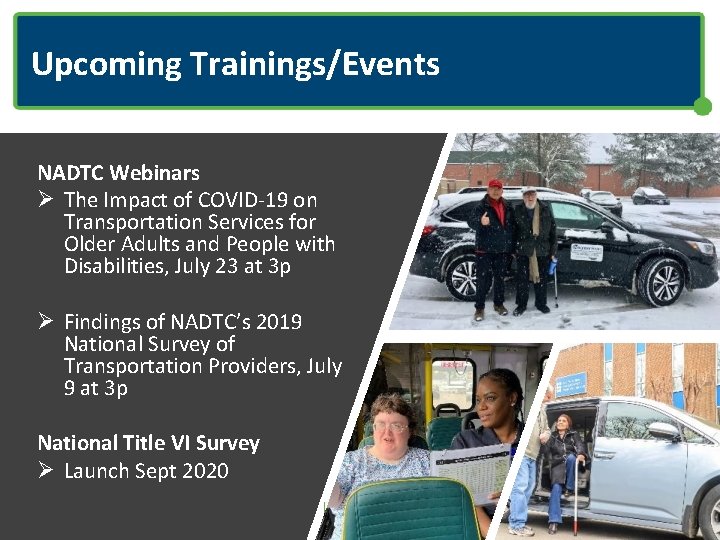
Upcoming Trainings/Events NADTC Webinars Ø The Impact of COVID-19 on Transportation Services for Older Adults and People with Disabilities, July 23 at 3 p Ø Findings of NADTC’s 2019 National Survey of Transportation Providers, July 9 at 3 p National Title VI Survey Ø Launch Sept 2020
Other Training Opportunities • Title VI Webinar Aug 12, 2020 https: //olderindians. acl. gov/u pcoming-events • 23 rd National Indian Council on Aging’s (NICOA) Conference Aug 1 -6, 2021, Reno, NV
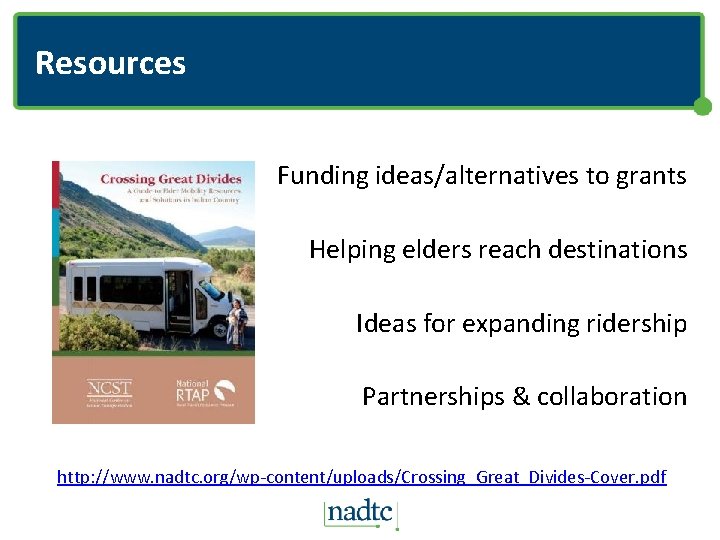
Resources Funding ideas/alternatives to grants Helping elders reach destinations Ideas for expanding ridership Partnerships & collaboration http: //www. nadtc. org/wp-content/uploads/Crossing_Great_Divides-Cover. pdf
Additional Resources 2017 National Title VI Program Survey: Serving Tribal Elders Across the United States https: //www. n 4 a. org/Files/Title%20 VI%20 Survey/Title%20 VI%20 Program% 20 Survey_508. pdf Accessible Transportation in Rural Areas https: //www. nadtc. org/wp-content/uploads/NADTC-Accessible. Transportation-in-Rural-Areas. pdf 2017 Trends Report: Rural Travel Training https: //www. nadtc. org/resources-publications/2017 -trends-report-topicspotlight-rural-travel-training/ Strategies for Enhancing Rural Transit Operations Mini-Course https: //www. nadtc. org/event/strategies-for-enhancing-rural-transitoperations-mini-course/
Melissa Gray Senior Program Manager, NADTC 202. 872. 0888 | mgray@n 4 a. org contact@nadtc. org 866 -983 -3222 www. nadtc. org
- Slides: 51