
FEDERAL SENTENCING GUIDELINES Chapter Eight Sentencing of Organization




- Slides: 66
FEDERAL SENTENCING GUIDELINES Chapter Eight – Sentencing of Organization
Guideline pertains to convicted defendants when they are an organization INTRODUCT ORY COMMENTA RY Organization acts as agents – vicariously liable for offenses carried out by their agents Individuals can also be responsible for their own criminal misconduct Federal prosecution frequently involve both individual and organization
§ General Principles of Ch. 8 – Sentencing of Organization § Court must, whenever practicable, order the INTRODUCT ORY COMMENTA RY organization to remedy any harm caused by the offense. The resources expended to remedy the harm should not be viewed as punishment, but rather as a means of making victims whole for the harm caused. § Second, if the organization operated primarily for a criminal purpose or primarily by criminal means, the fine should be set sufficiently high to divest the organization of all its assets. § Third, the fine range for any other organization should be based on the seriousness of the offense and the culpability of the organization.
§ General Principles of Ch. 8 – Sentencing of Organization INTRODUCT ORY COMMENTA RY § Fourth, probation is an appropriate sentence for an organizational defendant when needed to ensure that another sanction will be fully implemented, or to ensure that steps will be taken within the organization to reduce the likelihood of future criminal conduct. § Incentives to organizations to reduce and ultimately eliminate criminal conduct by providing a structural foundation from which an organization may self-police its own
§ Culpability Score - six factors that the sentencing court that can affect punishment severity. § The four factors that increase the ultimate INTRODUCT ORY COMMENTA RY punishment of an organization are: § (i) the involvement in or tolerance of criminal activity; § (ii) the prior history of the organization; § (iii) the violation of an order; and § (iv) the obstruction of justice. § The two factors that mitigate the ultimate punishment of an organization are: § (i) The existence of an effective compliance and ethics program; and § (ii) Self-reporting, § (iii) Co- operation, or § (IV) Acceptance of responsibility.
§ § 8 A 1. 1. Applicability of Chapter Eight § This chapter applies to the sentencing of all organizations for felony and Class A misdemeanor offenses. § “Organization” means “a person other than an individual. ” 18 U. S. C. § 18. The term includes corporations, partnerships, associations, joint-stock companies, unions, trusts, pension funds, unincorporated organizations, governments and political subdivisions thereof, and non-profit organizations.
§ § 8 A 1. 2. Application Instructions ― Organizations § Determinations under this chapter are to be based upon the facts and information specified in the applicable guideline
§ Definitions: § “Offense” means the offense of conviction and all relevant conduct under § 1 B 1. 3 (Relevant Conduct) unless a different meaning is specified or is otherwise clear from the context. § “High-level personnel of the organization” means individuals who have substantial control over the organization or who have a substantial role in the making of policy within the organization. § “Substantial authority personnel” means individuals who within the scope of their authority exercise a substantial measure of discretion in acting on behalf of an organization. Whether an individual falls within this cate- gory must be determined on a case-by-case basis. § “Agent” means any individual, including a director, an officer, an employee, or an independent contractor, authorized to act on behalf of the organization.
§ Definitions: § An individual “condoned” an offense if the individual knew of § § § the offense and did not take reasonable steps to prevent or terminate the offense. “Similar misconduct” means prior conduct that is similar in nature to the conduct under- lying the instant offense, without regard to whether or not such conduct violated the same statutory provision. “Prior criminal adjudication” means conviction by trial, plea of guilty (including an Al- ford plea), or plea of nolo contendere. “Pecuniary gain” is derived from 18 U. S. C. § 3571(d) and means the additional before-tax profit to the defendant resulting from the relevant conduct of the offense. “Pecuniary loss” is derived from 18 U. S. C. § 3571(d) and is equivalent to the term “loss An individual was “willfully ignorant of the offense” if the individual did not investigate the possible occurrence of unlawful conduct despite knowledge of circumstances that would lead a reasonable person to investigate whether unlawful conduct had occurred.
§ § 8 B 1. 1 - Restitution ― Organizations PART B REMEDYING HARM FROM CRIMINAL CONDUCT, AND EFFECTIVE COMPLIANCE AND ETHICS PROGRAM § In the case of an identifiable victim, the court shall – § enter a restitution order for the full amount of the victim’s loss, § impose a term of probation or supervised release with a condition re- quiring restitution for the full amount of the victim’s loss, § Before identifiable victim is paid, the court shall order that any money paid be use to satisfy order of restitution § A restitution order may direct the defendant to make nominal periodic payments if the court finds f
§ § 8 B 1. 2. Remedial Orders ― Organizations (Policy PART B REMEDYING HARM FROM CRIMINAL CONDUCT, AND EFFECTIVE COMPLIANCE AND ETHICS PROGRAM Statement) § (a) To the extent not addressed under § 8 B 1. 1 (Restitution ― Organizations), a remedial order imposed as a condition of probation may require the organization to remedy the harm caused by the offense and to eliminate or reduce the risk that the instant offense will cause future harm. § (b) If the magnitude of expected future harm can be reasonably estimated, the court may require the organization to create a trust fund sufficient to address that expected harm. § COMMENTARY: The purposes of a remedial order are to remedy harm that has already occurred and to prevent future harm. A remedial order requiring corrective action by the organization may be necessary to prevent future injury from the instant offense, e. g. , a product recall for a food and drug violation or a clean-up order for an environmental violation
PART B REMEDYING HARM FROM CRIMINAL CONDUCT, AND EFFECTIVE COMPLIANCE AND ETHICS PROGRAM § § 8 B 1. 3. Community Service ― Organizations (Policy Statement) § Community service may be ordered as a condition of probation where such com- munity service is reasonably designed to repair the harm caused by the offense. § COMMENTARY: An organization can perform community service only by employing its resources or paying its employees or others to do so. Consequently, an order that an organization perform community service is essentially an indirect monetary sanction, and therefore generally less desirable than a direct monetary sanction.
PART B REMEDYING HARM FROM CRIMINAL CONDUCT, AND EFFECTIVE COMPLIANCE AND ETHICS PROGRAM § § 8 B 1. 4. Order of Notice to Victims ― Organizations
PART B REMEDYING HARM FROM CRIMINAL CONDUCT, AND EFFECTIVE COMPLIANCE AND ETHICS PROGRAM § § 8 B 2. 1. Effective Compliance and Ethics Program § Effective Compliance Program, organization shall: § (1) exercise due diligence to prevent and detect criminal conduct; and § (2) otherwise promote an organizational culture that encourages ethical conduct and a commitment to compliance with the law.
PART B REMEDYING HARM FROM CRIMINAL CONDUCT, AND EFFECTIVE COMPLIANCE AND ETHICS PROGRAM § Due diligence and promotion of organization culture of compliance and ethics: § (1) The organization shall establish standards and procedures to prevent and detect criminal conduct. § (2) (A) The organization’s governing authority shall be knowledgeable about the content and operation of the compliance and ethics pro- gram and shall exercise reasonable oversight with respect to the implementation and effectiveness of the compliance and ethics program. § (B) High-level personnel of the organization shall ensure that the organization has an effective compliance and ethics program, as described in this guideline. Specific individual(s) within high- level personnel shall be assigned overall responsibility for the compliance and ethics program. § (C) Specific individual(s) within the organization shall be delegated day-to-day operational responsibility for the compliance and ethics program. Individual(s) with operational responsibility shall report periodically to high-level personnel and, as appropriate, to the governing authority, or an appropriate subgroup of the governing authority, on the effectiveness of the compliance and ethics program. To carry out such operational responsibility, such individual(s) shall be given adequate resources, appropriate authority, and direct access to the governing authority or an appropriate subgroup of the governing authority.
§ The organization shall use reasonable efforts not to PART B REMEDYING HARM FROM CRIMINAL CONDUCT, AND EFFECTIVE COMPLIANCE AND ETHICS PROGRAM include within the substantial authority personnel of the organization any individual whom the organization knew, or should have known through the exercise of due diligence, has engaged in illegal activities or other conduct inconsistent with an effective compliance and ethics program. § (A) The organization shall take reasonable steps to communicate periodically and in a practical manner its standards and procedures, and other aspects of the compliance and ethics program, to the individuals referred to in subparagraph (B) by conducting effective training programs and otherwise disseminating information appropriate to such individuals’ respective roles and responsibilities. § (B) The individuals referred to in subparagraph (A) are the members of the governing authority, high-level personnel, substantial authority personnel, the organization’s employees, and, as appropriate, the organization’s agents.
§ The organization shall take reasonable steps PART B REMEDYING HARM FROM CRIMINAL CONDUCT, AND EFFECTIVE COMPLIANCE AND ETHICS PROGRAM — § (A) to ensure that the organization’s compliance and ethics program is followed, including monitoring and auditing to detect criminal conduct; § (B) to evaluate periodically the effectiveness of the organization’s compliance and ethics program; and § (C) to have and publicize a system, which may include mechanisms that allow for anonymity or confidentiality, whereby the organization’s employees and agents may report or seek guidance regarding potential or actual criminal conduct without fear of retaliation.
§ The organization’s compliance and ethics PART B REMEDYING HARM FROM CRIMINAL CONDUCT, AND EFFECTIVE COMPLIANCE AND ETHICS PROGRAM program shall be promoted and enforced consistently throughout the organization through § (A) appropriate incentives to perform in accordance with the compliance and ethics program; and § (B) appropriate disciplinary measures for engaging in criminal conduct and for failing to take reasonable steps to pre- vent or detect criminal conduct. § After criminal conduct has been detected, the organization shall take reasonable steps to respond appropriately to the criminal conduct and to prevent further similar criminal conduct, including making any necessary modifications to the organization’s compliance and ethics program.
PART B REMEDYING HARM FROM CRIMINAL CONDUCT, AND EFFECTIVE COMPLIANCE AND ETHICS PROGRAM § The organization shall periodically assess the risk of criminal conduct and shall take appropriate steps to design, implement, or modify each requirement set forth in subsection (b) to reduce the risk of criminal conduct identified through this process.
§ § 8 C 1. 1. Determining the Fine ― Criminal Purpose Organizations § If, upon consideration of the nature and PART C ― FINES circumstances of the offense and the history and characteristics of the organization, the court determines that the organization operated primarily for a criminal purpose or primarily by criminal means, the fine shall be set at an amount (subject to the statutory maximum) sufficient to divest the organization of all its net assets. § Maximum fines and penalties if “scheme” was designed to commit fraud, participate in the illegal manufacture, importation, or distribution of a controlled substance) or operated primarily by criminal means (e. g. , a hazardous waste disposal business that had no legitimate means of disposing of hazardous waste)
PART C ― FINES § § 8 C 2. 1. Applicability of Fine Guidelines § The fine guidelines of this subpart apply only to offenses covered by the guideline sections set forth in subsection (a) above. For example, the provisions of §§ 8 C 2. 2 through 8 C 2. 9 do not apply to counts for which the applicable guideline offense level is determined under Chapter Two, Part Q (Offenses Involving the Environment). For such cases, § 8 C 2. 10 (Determining the Fine for Other Counts) is applicable.
§ § 8 C 2. 2. Preliminary Determination of Inability to Pay Fine § Where it is readily ascertainable that the organization PART C ― FINES cannot and is not likely to become able (even on an installment schedule) to pay restitution required under § 8 B 1. 1 (Restitution ― Organizations), a determination of the guideline fine range is unnecessary because, pursuant to § 8 C 3. 3(a), no fine would be imposed. § Where it is readily ascertainable through a preliminary determination of the minimum of the guideline fine range (see §§ 8 C 2. 3 through 8 C 2. 7) that the organization cannot and is not likely to become able (even on an installment schedule) to pay such minimum guideline fine, a further determination of the guideline fine range is unnecessary. Instead, the court may use the preliminary determination and impose the fine that would result from the application of § 8 C 3. 3 (Reduction of Fine Based on Inability to Pay).
PART C ― FINES § § 8 C 2. 3. Offense Level § For each count covered by § 8 C 2. 1 (Applicability of Fine Guidelines), use the applicable Chapter Two guideline to determine the base offense level and apply, in the order listed, any appropriate adjustments contained in that guideline. § Where there is more than one such count, apply Chapter Three, Part D (Multiple Counts) to determine the combined offense level. § In determining the offense level under this section, “defendant, ” as used in Chapter Two, includes any agent of the organization for whose conduct the organization is criminally responsible.
§ § 8 C 2. 4. Base Fine § The base fine is the greatest of: § the amount from the table in subsection (d) below corresponding PART C ― FINES to the offense level determined under § 8 C 2. 3 (Offense Level); or § the pecuniary gain to the organization from the offense; or § the pecuniary loss from the offense caused by the organization, to the extent the loss was caused intentionally, knowingly, or recklessly. § Provided, that if the applicable offense guideline in Chapter Two includes a special instruction for organizational fines, that special instruction shall be applied, as appropriate. § Provided, further, that to the extent the calculation of either pecuniary gain or pecuniary loss would unduly complicate or prolong the sentencing process, that amount, i. e. , gain or loss as appropriate, shall not be used for the determination of the base fine.
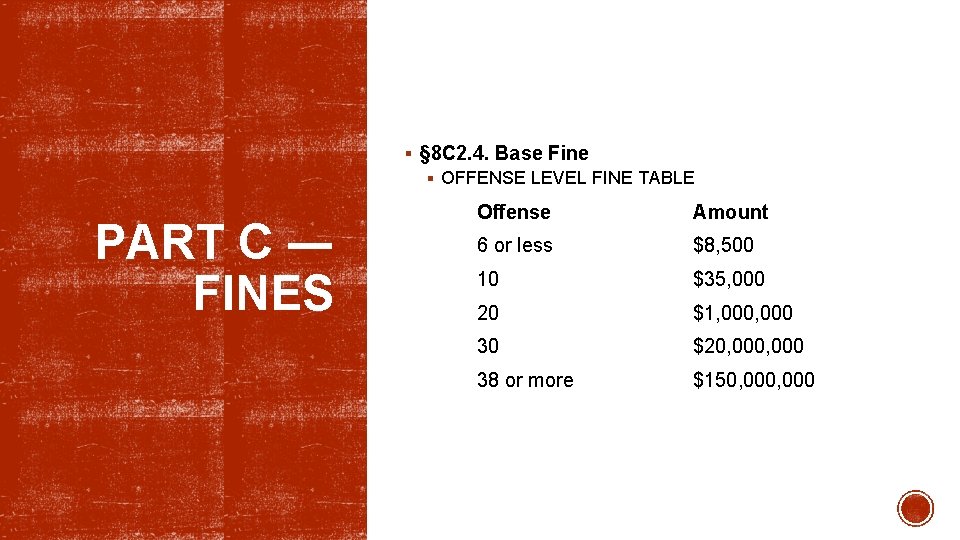
§ § 8 C 2. 4. Base Fine § OFFENSE LEVEL FINE TABLE PART C ― FINES Offense Amount 6 or less $8, 500 10 $35, 000 20 $1, 000 30 $20, 000 38 or more $150, 000
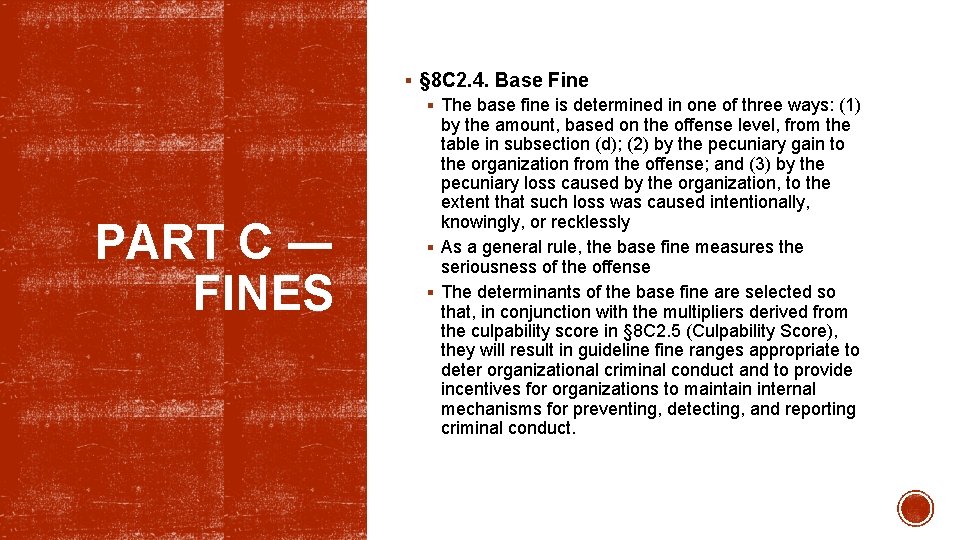
PART C ― FINES § § 8 C 2. 4. Base Fine § The base fine is determined in one of three ways: (1) by the amount, based on the offense level, from the table in subsection (d); (2) by the pecuniary gain to the organization from the offense; and (3) by the pecuniary loss caused by the organization, to the extent that such loss was caused intentionally, knowingly, or recklessly § As a general rule, the base fine measures the seriousness of the offense § The determinants of the base fine are selected so that, in conjunction with the multipliers derived from the culpability score in § 8 C 2. 5 (Culpability Score), they will result in guideline fine ranges appropriate to deter organizational criminal conduct and to provide incentives for organizations to maintain internal mechanisms for preventing, detecting, and reporting criminal conduct.
PART C ― FINES § § 8 C 2. 5. Culpability Score § The base fine is determined in one of three ways: (1) by the amount, based on the offense level, from the table in subsection (d); (2) by the pecuniary gain to the organization from the offense; and (3) by the pecuniary loss caused by the organization, to the extent that such loss was caused intentionally, knowingly, or recklessly § As a general rule, the base fine measures the seriousness of the offense § The determinants of the base fine are selected so that, in conjunction with the multipliers derived from the culpability score in § 8 C 2. 5 (Culpability Score), they will result in guideline fine ranges appropriate to deter organizational criminal conduct and to provide incentives for organizations to maintain internal mechanisms for preventing, detecting, and reporting criminal conduct.
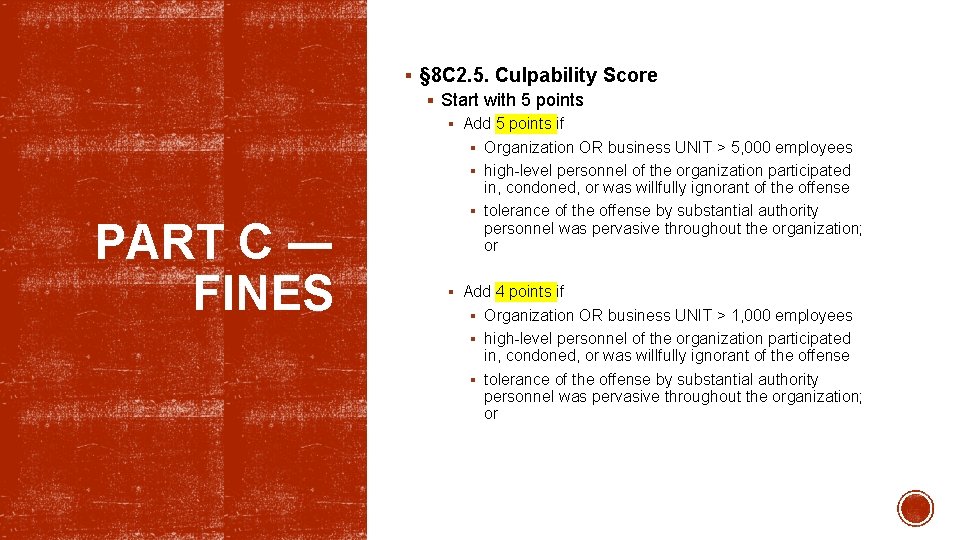
§ § 8 C 2. 5. Culpability Score § Start with 5 points § Add 5 points if § Organization OR business UNIT > 5, 000 employees § high-level personnel of the organization participated PART C ― FINES in, condoned, or was willfully ignorant of the offense § tolerance of the offense by substantial authority personnel was pervasive throughout the organization; or § Add 4 points if § Organization OR business UNIT > 1, 000 employees § high-level personnel of the organization participated in, condoned, or was willfully ignorant of the offense § tolerance of the offense by substantial authority personnel was pervasive throughout the organization; or
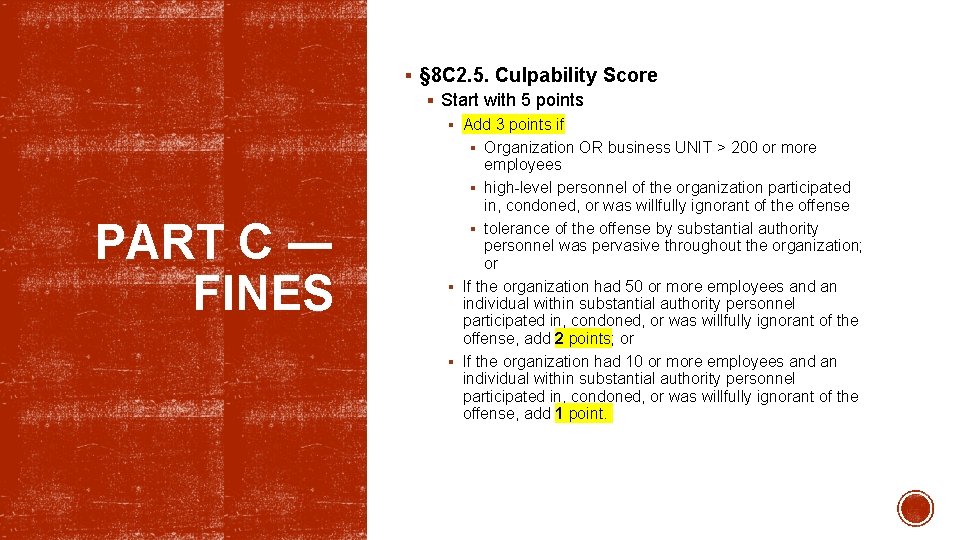
§ § 8 C 2. 5. Culpability Score § Start with 5 points § Add 3 points if § Organization OR business UNIT > 200 or more PART C ― FINES employees § high-level personnel of the organization participated in, condoned, or was willfully ignorant of the offense § tolerance of the offense by substantial authority personnel was pervasive throughout the organization; or § If the organization had 50 or more employees and an individual within substantial authority personnel participated in, condoned, or was willfully ignorant of the offense, add 2 points; or § If the organization had 10 or more employees and an individual within substantial authority personnel participated in, condoned, or was willfully ignorant of the offense, add 1 point.
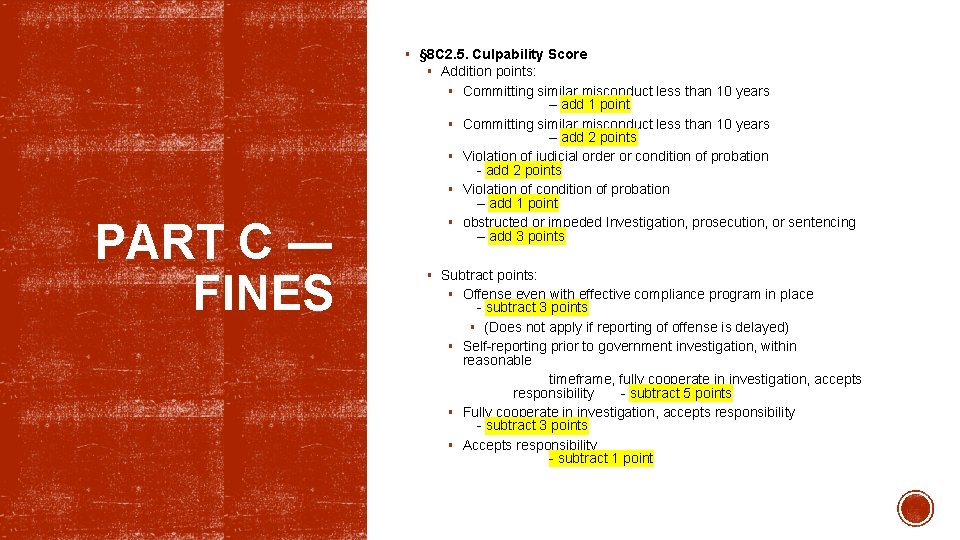
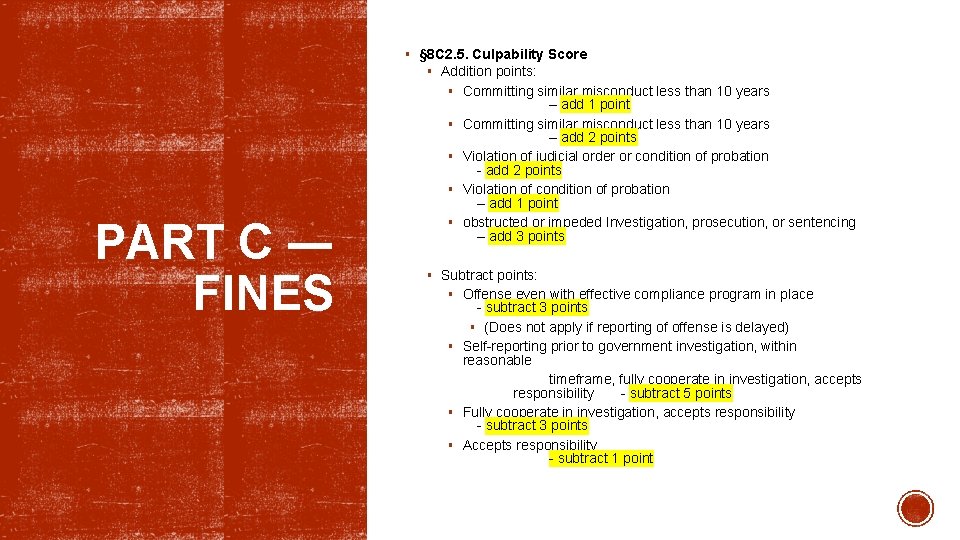
§ § 8 C 2. 5. Culpability Score § Addition points: § Committing similar misconduct less than 10 years § § § PART C ― FINES § – add 1 point Committing similar misconduct less than 10 years – add 2 points Violation of judicial order or condition of probation - add 2 points Violation of condition of probation – add 1 point obstructed or impeded Investigation, prosecution, or sentencing – add 3 points § Subtract points: § Offense even with effective compliance program in place - subtract 3 points § (Does not apply if reporting of offense is delayed) § Self-reporting prior to government investigation, within reasonable timeframe, fully cooperate in investigation, accepts responsibility - subtract 5 points § Fully cooperate in investigation, accepts responsibility - subtract 3 points § Accepts responsibility - subtract 1 point
§ § 8 C 2. 5. Culpability Score § Addition points: § Committing similar misconduct less than 10 years § § § PART C ― FINES § – add 1 point Committing similar misconduct less than 10 years – add 2 points Violation of judicial order or condition of probation - add 2 points Violation of condition of probation – add 1 point obstructed or impeded Investigation, prosecution, or sentencing – add 3 points § Subtract points: § Offense even with effective compliance program in place - subtract 3 points § (Does not apply if reporting of offense is delayed) § Self-reporting prior to government investigation, within reasonable timeframe, fully cooperate in investigation, accepts responsibility - subtract 5 points § Fully cooperate in investigation, accepts responsibility - subtract 3 points § Accepts responsibility - subtract 1 point
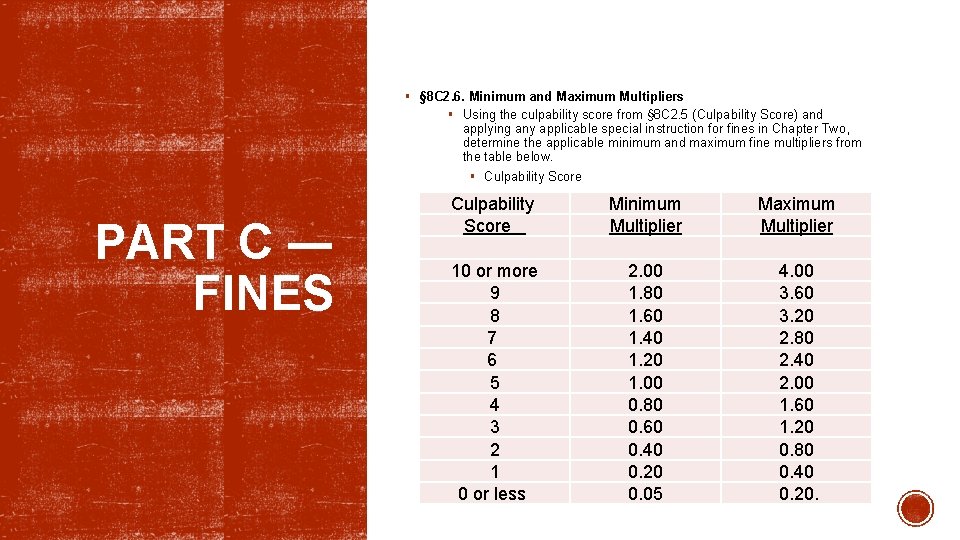
§ § 8 C 2. 6. Minimum and Maximum Multipliers § Using the culpability score from § 8 C 2. 5 (Culpability Score) and applying any applicable special instruction for fines in Chapter Two, determine the applicable minimum and maximum fine multipliers from the table below. § Culpability Score PART C ― FINES Culpability Score Minimum Multiplier Maximum Multiplier 10 or more 9 8 7 6 5 4 § 3 2 1 0 or less 2. 00 1. 80 1. 60 1. 40 1. 20 1. 00 0. 80 0. 60 0. 40 0. 20 0. 05 4. 00 3. 60 3. 20 2. 80 2. 40 2. 00 1. 60 1. 20 0. 80 0. 40 0. 20.
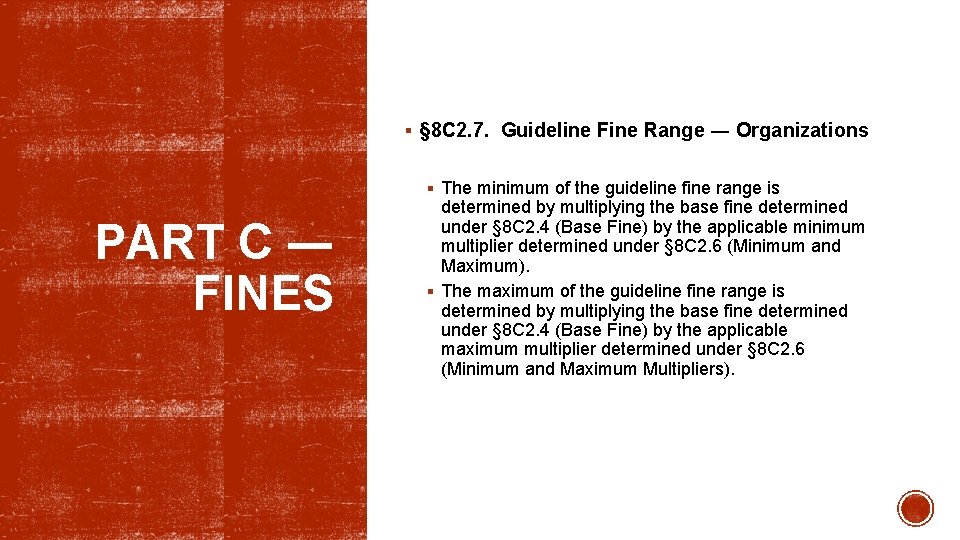
§ § 8 C 2. 7. Guideline Fine Range ― Organizations § The minimum of the guideline fine range is PART C ― FINES determined by multiplying the base fine determined under § 8 C 2. 4 (Base Fine) by the applicable minimum multiplier determined under § 8 C 2. 6 (Minimum and Maximum). § The maximum of the guideline fine range is determined by multiplying the base fine determined under § 8 C 2. 4 (Base Fine) by the applicable maximum multiplier determined under § 8 C 2. 6 (Minimum and Maximum Multipliers).
§ § 8 C 2. 8. Determining the Fine Within the Range (Policy Statement) § In determining the amount of the fine within the PART C ― FINES § § applicable guideline range, the court should consider: Seriousness of offense Organization’s role in the offense Collateral consequences of conviction, including civil arising from obligations arising from the organization’s conduct; Any nonpecuniary loss caused or threatened by the offense;
§ § 8 C 2. 8. Determining the Fine Within the Range (Policy Statement) § whether the offense involved a vulnerable victim; § High level personnel who participated in, condoned, PART C ― FINES § § § or was willfully ignorant of the criminal conduct any prior civil or criminal misconduct any culpability score under higher than 10 or lower than 0; partial but incomplete satisfaction of the conditions for one or more of the mitigating or aggravating factors set forth in § 8 C 2. 5 (Culpability Score); any factor listed in 18 U. S. C. § 3572(a); and whether the organization failed to have, at the time of the instant offense, an effective compliance and ethics program within the meaning of § 8 B 2. 1 (Effective Compliance and Ethics Program).
§ § 8 C 2. 9. Disgorgement PART C ― FINES § The court shall add to the fine determined under § 8 C 2. 8 (Determining the Fine Within the Range) any gain to the organization from the offense that has not and will not be paid as restitution or by way of other remedial measures.
§ § 8 C 2. 10. Determining the Fine for Other Counts PART C ― FINES § For any count or counts not covered under § 8 C 2. 1 (Applicability of Fine Guide- lines), the court should determine an appropriate fine by applying the provisions of 18 U. S. C. §§ 3553 and 3572. The court should determine the appropriate fine amount, if any, to be imposed in addition to any fine determined under § 8 C 2. 8 (Determining the Fine Within the Range) and § 8 C 2. 9 (Disgorgement).
§ § 8 C 3. 1. Imposing a Fine § Except to the extent restricted by the maximum fine PART C ― FINES authorized by statute or any minimum fine required by statute, the fine or fine range shall be that determined under § 8 C 1. 1 (Determining the Fine ― Criminal Purpose Organizations); § 8 C 2. 7 (Guideline Fine Range ― Organizations) and § 8 C 2. 9 (Disgorgement); or § 8 C 2. 10 (Determining the Fine for Other Counts), as appropriate. § Where the minimum guideline fine is greater than the maximum fine authorized by statute, the maximum fine authorized by statute shall be the guideline fine. § Where the maximum guideline fine is less than a minimum fine required by statute, the minimum fine required by statute shall be the guideline fine.
§ § 8 C 3. 2. Payment of the Fine ― Organizations § If the defendant operated primarily for a criminal purpose or primarily by criminal means, immediate payment of the fine shall be required. PART C ― FINES § In any other case, immediate payment of the fine shall be required unless the court finds that the organization is financially unable to make immediate payment or that such payment would pose an undue burden on the organization. If the court permits other than immediate payment, it shall require full payment at the earliest possible date, either by requiring payment on a date certain or by establishing an installment schedule.
§ § 8 C 3. 3. Reduction of Fine Based on Inability to Pay § The court shall reduce the fine below that otherwise required by PART C ― FINES § 8 C 1. 1 (Determining the Fine ― Criminal Purpose Organizations), or § 8 C 2. 7 (Guideline Fine Range ― Organizations) and § 8 C 2. 9 (Disgorgement), to the extent that imposition of such fine would impair its ability to make restitution to victims. § The court may impose a fine below that otherwise required by § 8 C 2. 7 (Guideline Fine Range ― Organizations) and § 8 C 2. 9 (Disgorgement) if the court finds that the organization is not able and, even with the use of a reasonable installment schedule, is not likely to become able to pay the minimum fine required by § 8 C 2. 7 (Guideline Fine Range ― Organizations) and § 8 C 2. 9 (Disgorgement). § Provided, that the reduction under this subsection shall not be more than necessary to avoid substantially jeopardizing the continued viability of the organization.
§ § 8 C 3. 4. Fines Paid by Owners of Closely Held Organizations § The court may offset the fine imposed upon a PART C ― FINES closely held organization when one or more individuals, each of whom owns at least a 5 percent interest in the organization, has been fined in a federal criminal proceeding for the same offense conduct for which the organization is being sentenced. The amount of such offset shall not exceed the amount resulting from multiplying the total fines imposed on those individuals by those individuals’ total percentage interest in the organization.
§ § 8 C 4. 1. Substantial Assistance to Authorities ― Organizations (Policy Statement) § Upon motion of the government stating that the PART C ― FINES defendant has provided substantial assistance in the investigation or prosecution of another organization that has committed an offense, or in the investigation or prosecution of an individual not directly affiliated with the defendant who has committed an offense, the court may depart from the guidelines. § The appropriate reduction shall be determined by the court for reasons stated on the record that may include, but are not limited to, consideration of the following: § (1) the court’s evaluation of the significance and usefulness of the organization’s assistance, taking into consideration the government’s evaluation of the assistance rendered; § (2) the nature and extent of the organization’s assistance; and § (3) the timeliness of the organization’s assistance.
§ § 8 C 4. 2. Risk of Death or Bodily Injury (Policy Statement) PART C ― FINES § If the offense resulted in death or bodily injury, or involved a foreseeable risk of death or bodily injury, an upward departure may be warranted. The extent of any such departure should depend, among other factors, on the nature of the harm and the extent to which the harm was intended or knowingly risked, and the extent to which such harm or risk is taken into account within the applicable guideline fine range.
§ § 8 C 4. 3. Threat to National Security (Policy PART C ― FINES Statement) § If the offense constituted a threat to national security, an upward departure may be warranted.
§ § 8 C 4. 4. Threat to the Environment (Policy PART C ― FINES Statement) § If the offense presented a threat to the environment, an upward departure may be warranted.
§ § 8 C 4. 5. Threat to a Market (Policy Statement) PART C ― FINES § If the offense presented a risk to the integrity or continued existence of a market, an upward departure may be warranted. This section is applicable to both private markets (e. g. , a financial market, a commodities market, or a market for consumer goods) and public markets (e. g. , government contracting).
§ § 8 C 4. 6. Official Corruption (Policy Statement) PART C ― FINES § If the organization, in connection with the offense, bribed or unlawfully gave a gratuity to a public official, or attempted or conspired to bribe or unlawfully give a gratuity to a public official, an upward departure may be warranted.
PART C ― FINES § § 8 C 4. 7. Public Entity (Policy Statement) § If the organization is a public entity, a downward departure may be warranted.
§ § 8 C 4. 8. Members or Beneficiaries of the Organization as Victims (Policy Statement) § If the members or beneficiaries, other than PART C ― FINES shareholders, of the organization are direct victims of the offense, a downward departure may be warranted. If the members or beneficiaries of an organization are direct victims of the offense, imposing a fine upon the organization may increase the burden upon the victims of the offense without achieving a deterrent effect. In such cases, a fine may not be appropriate. For example, departure may be appropriate if a labor union is convicted of embezzlement of pension funds.
§ § 8 C 4. 9. Remedial Costs that Greatly Exceed Gain (Policy Statement) § If the organization has paid or has agreed to pay remedial PART C ― FINES costs arising from the offense that greatly exceed the gain that the organization received from the offense, a downward departure may be warranted. In such a case, a substantial fine may not be necessary in order to achieve adequate punishment and deterrence. In deciding whether departure is appropriate, the court should consider the level and extent of substantial authority personnel involvement in the offense and the degree to which the loss exceeds the gain. If an individual within high-level personnel was involved in the offense, a departure would not be appropriate under this section. The lower the level and the more limited the ex- tent of substantial authority personnel involvement in the offense, and the greater the degree to which remedial costs exceeded or will exceed gain, the less will be the need for a substantial fine to achieve adequate punishment and deterrence.
§ § 8 C 4. 10. Mandatory Programs to Prevent and Detect Violations of Law (Policy Statement) § If the organization’s culpability score is reduced PART C ― FINES under § 8 C 2. 5(f) (Effective Compliance and Ethics Program) and the organization had implemented its pro- gram in response to a court order or administrative order specifically directed at the organization, an upward departure may be warranted to offset, in part or in whole, such reduction. § Similarly, if, at the time of the instant offense, the organization was required by law to have an effective compliance and ethics program, but the organization did not have such a program, an upward departure may be warranted.
§ § 8 C 4. 11. Exceptional Organizational Culpability (Policy Statement) § If the organization’s culpability score is greater than 10, an upward departure may be appropriate. PART C ― FINES § If no individual within substantial authority personnel participated in, condoned, or was willfully ignorant of the offense; the organization at the time of the offense had an effective program to prevent and detect violations of law; and the base fine is determined under § 8 C 2. 4(a)(1), § 8 C 2. 4(a)(3), or a special instruction for fines in Chapter Two (Offense Conduct), a downward departure may be warranted. In a case meeting these criteria, the court may find that the organization had exceptionally low culpability and therefore a fine based on loss, offense level, or a special Chapter Two instruction results in a guideline fine range higher than necessary to achieve the purposes of sentencing. Nevertheless, such fine should not be lower than if determined under § 8 C 2. 4(a)(2).
§ § 8 D 1. 1. Imposition of Probation ― Organizations § The court shall order a term of probation: § (1) if such sentence is necessary to secure payment of restitution (§ 8 B 1. 1), enforce a remedial order (§ 8 B 1. 2), or ensure completion of community service (§ 8 B 1. 3); PART D ― ORGANIZATIO NAL PROBATION § (2) if the organization is sentenced to pay a monetary penalty (e. g. , restitution, fine, or special assessment), the penalty is not paid in full at the time of sentencing, and restrictions are necessary to safeguard the organization’s ability to make payments; § (3) if, at the time of sentencing, (A) the organization (i) has 50 or more employees, or (ii) was otherwise required under law to have an effective compliance and ethics program; and (B) the organization does not have such a program; § (4) if the organization within five years prior to sentencing engaged in similar misconduct, as determined by a prior criminal adjudication, and any part of the misconduct underlying the instant offense occurred after that adjudication;
§ § 8 D 1. 1. Imposition of Probation ― Organizations § The court shall order a term of probation: § if an individual within high-level personnel of PART D ― ORGANIZATIO NAL PROBATION the organization or the unit of the organization within which the instant offense was committed participated in the misconduct underlying the instant offense and that individual within five years prior to sentencing engaged in similar misconduct, as determined by a prior criminal adjudication, and any part of the misconduct underlying the instant offense occurred after that adjudication; § if such sentence is necessary to ensure that changes are made within the organization to reduce the likelihood of future criminal conduct; § if the sentence imposed upon the organization does not include a fine; or § if necessary to accomplish one or more of the purposes of sentencing set forth in 18 U. S. C. § 3553(a)(2).
§ § 8 D 1. 2. Term of Probation ― Organizations PART D ― ORGANIZATIO NAL PROBATION § When a sentence of probation is imposed— § In the case of a felony, the term of probation shall be at least one year but not more than five years. § In any other case, the term of probation shall be not more than five years.
§ § 8 D 1. 3. Conditions of Probation ― Organizations § Pursuant to 18 U. S. C. § 3563(a)(1), any sentence of probation shall include the condition that the organization not commit another federal, state, or local crime during the term of probation. § Pursuant to 18 U. S. C. § 3563(a)(2), if a sentence PART D ― ORGANIZATIO NAL PROBATION of probation is imposed for a felony, the court shall impose as a condition of probation at least one of the following: (1) restitution or (2) community service, unless the court has imposed a fine, or unless the court finds on the record that extraordinary circumstances exist that would make such condition plainly unreasonable, in which event the court shall impose one or more other conditions set forth in 18 U. S. C. § 3563(b). § (c) The court may impose other conditions that (1) are reasonably related to the nature and circumstances of the offense or the history and characteristics of the organization; and (2) involve only such deprivations of liberty or property as are necessary to effect the purposes of sentencing.
§ § 8 D 1. 4. Recommended Conditions of Probation ― Organizations (Policy Statement) § The court may order the organization, at its PART D ― ORGANIZATIO NAL PROBATION expense and in the format and media specified by the court, to publicize the nature of the offense commit- ted, the fact of conviction, the nature of the punishment imposed, and the steps that will be taken to prevent the recurrence of similar offenses. § If probation is imposed under § 8 D 1. 1, the following conditions may be ap- propriate: § (1) The organization shall develop and submit to the court an effective compliance and ethics program consistent with § 8 B 2. 1 (Effective Compliance and Ethics Program). The organization shall include in its submission a schedule for implementation of the compliance and ethics program.
§ § 8 D 1. 4. Recommended Conditions of Probation ― Organizations (Policy Statement) § Upon approval by the court of a program referred to in paragraph (1), the organization shall notify its employees and shareholders of its criminal behavior and its program referred to in paragraph (1). Such notice shall be in a form prescribed by the court. PART D ― ORGANIZATIO NAL PROBATION § The organization shall make periodic submissions to the court or probation officer, at intervals specified by the court, (A) reporting on the organization’s financial condition and results of business operations, and accounting for the disposition of all funds received, and (B) reporting on the organization’s progress in implementing the program referred to in paragraph (1). Among other things, reports under sub- paragraph (B) shall disclose any criminal prosecution, civil litigation, or administrative proceeding commenced against the organization, or any investigation or formal inquiry by governmental authorities of which the organization learned since its last report.
§ § 8 D 1. 4. Recommended Conditions of Probation ― Organizations (Policy Statement) § The organization shall notify the court PART D ― ORGANIZATIO NAL PROBATION or probation officer immediately upon learning of (A) any material adverse change in its business or financial condition or prospects, or (B) the commencement of any bankruptcy proceeding, major civil litigation, criminal prosecution, or administrative proceeding against the organization, or any investigation or formal inquiry by governmental authorities regarding the organization.
§ § 8 D 1. 4. Recommended Conditions of PART D ― ORGANIZATIO NAL PROBATION Probation ― Organizations (Policy Statement) § The organization shall submit to: (A) a reasonable number of regular or unannounced examinations of its books and records at appropriate business premises by the probation officer or experts engaged by the court; and (B) interrogation of knowledgeable individuals within the organization. Compensation to and costs of any experts engaged by the court shall be paid by the organization. § The organization shall make periodic payments, as specified by the court, in the following priority: (A) restitution; (B) fine; and (C) any other monetary sanction.
§ § 8 E 1. 1. Special Assessments ― Organizations § A special assessment must be imposed on an organization in the amount prescribed by statute. § FOR OFFENSES COMMITTED BY ORGANIZATIONS ON OR AFTER APRIL 24, 1996: § (A) $400, if convicted of a felony; § (B) $125, if convicted of a Class A misdemeanor; § (C) $50, if convicted of a Class B misdemeanor; or § (D) $25, if convicted of a Class C misdemeanor or an infraction.
§ § 8 E 1. 1. Special Assessments ― Organizations § A special assessment must be imposed on an organization in the amount pre- scribed by statute. § FOR OFFENSES COMMITTED BY ORGANIZATIONS ON OR AFTER NOVEMBER 18, 1988 BUT PRIOR TO APRIL 24, 1996: § (E) $200, if convicted of a felony; § (F) $125, if convicted of a Class A misdemeanor; § (G) $50, if convicted of a Class B misdemeanor; or § (H) $25, if convicted of a Class C misdemeanor or an infraction.
§ § 8 E 1. 1. Special Assessments ― Organizations § A special assessment must be imposed on an organization in the amount prescribed by statute. § FOR OFFENSES COMMITTED BY ORGANIZATIONS PRIOR TO NOVEMBER 18, 1988: § (I) $200, if convicted of a felony; § (J) $100, if convicted of a misdemeanor. § A special assessment is required by statute for each count of conviction.
§ § 8 E 1. 2. Forfeiture ― Organizations § Apply § 5 E 1. 4 (Forfeiture).
§ § 8 E 1. 3. Assessment of Costs ― Organizations § As provided in 28 U. S. C. § 1918, the court may order the organization to pay the costs of prosecution. In addition, specific statutory provisions mandate assessment of costs.
§ § 8 F 1. 1. Violations of Conditions of Probation ― Organizations (Policy Statement) § Upon a finding of a violation of a condition of probation, the court may extend the term of probation, impose more restrictive conditions of probation, or revoke probation and resentence the organization.