
FEDERAL RESERVE SYSTEM Chair nanke r e B
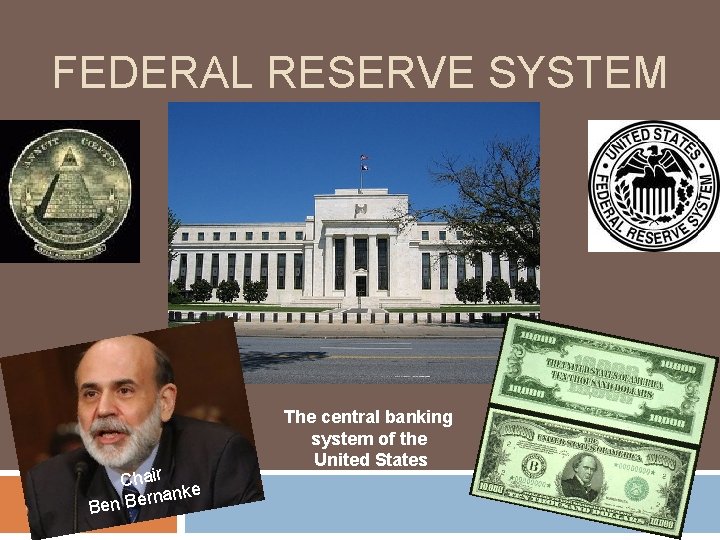
FEDERAL RESERVE SYSTEM Chair nanke r e B n Be The central banking system of the United States
Purpose Address the problem of banking panics Balance private interests and Government responsibility Supervise and regulate banking institutions Protect the credit rights of consumers Manage nation's money supply through monetary policy Maximize employment Stabilize – inflation, deflation and Interest Rates Provide financial services to the U. S. government, &foreign institutions Facilitate the exchange of payments among regions in the US
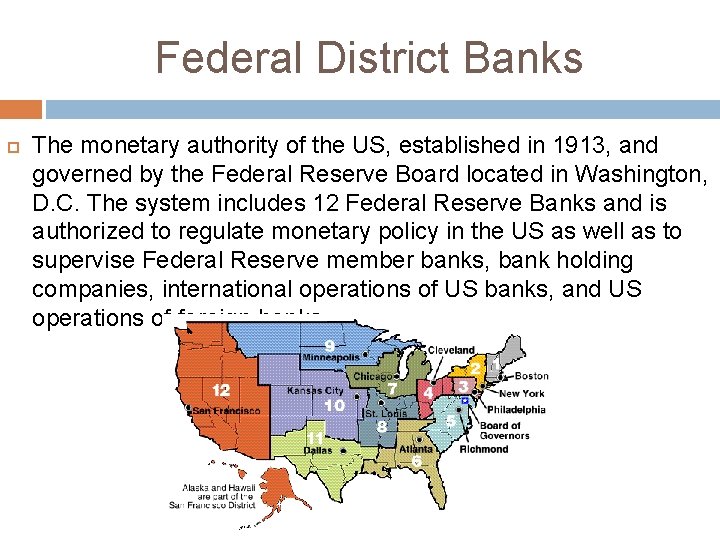
Federal District Banks The monetary authority of the US, established in 1913, and governed by the Federal Reserve Board located in Washington, D. C. The system includes 12 Federal Reserve Banks and is authorized to regulate monetary policy in the US as well as to supervise Federal Reserve member banks, bank holding companies, international operations of US banks, and US operations of foreign banks
Federal Advisory Committee The Federal Advisory Committee Act was enacted in 1972 to ensure that advice by the various advisory committees formed over the years is objective and accessible to the public. The Act formalized a process for establishing, operating, overseeing, and terminating these advisory bodies and created the Committee Management Secretariat to monitor compliance with the Act.
Check Clearing The process in which a bank collects the funds on a check deposit from the issuing institution. Check clearing involves the bank in which the check was deposited mailing the check to the issuing bank. The issuing bank then credits the deposit bank the funds on the check, assuming the check writer had the funds in his/her account. The deposit bank in turn credits the individual account into which the check was deposited. In the United States, the Federal Reserve operates a national check clearing

Fractional Reserve Banking The banking practice in which only a fraction of a bank's deposits are kept as reserves (cash and other highly liquid assets) available for withdrawal

Discount Rate The annual effective discount rate, which is the annual interest divided by the capital including that interest; this rate is lower than the interest rate; it corresponds to using the value after a year as the nominal value, and seeing the initial value as the nominal value minus a discount; it is used for Treasury Bills and similar financial instruments
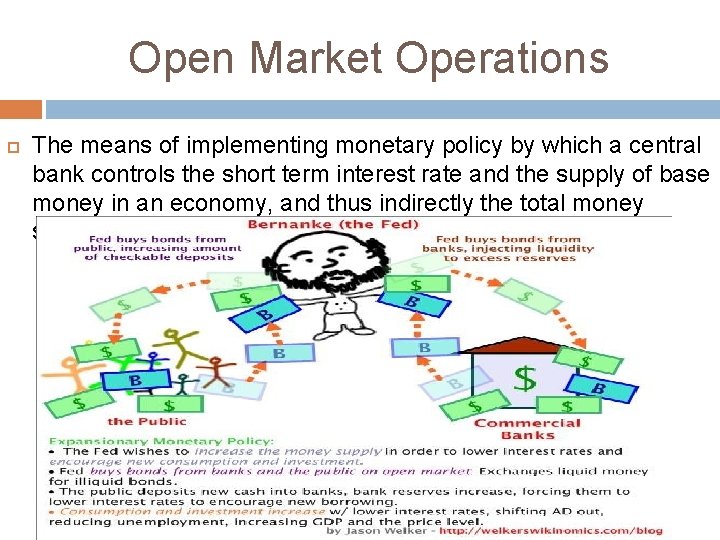
Open Market Operations The means of implementing monetary policy by which a central bank controls the short term interest rate and the supply of base money in an economy, and thus indirectly the total money supply.
- Slides: 8