
Federal Regulatory Update October 2018 Nancy Foster Vice
Federal Regulatory Update October 2018 Nancy Foster, Vice President, Quality Policy Diane Jones, Director, Policy
Agenda § Washington Update § Burden Reduction rule § FY Final and CY Proposed Rule Recaps § Health IT § CAHPS § Accrediting Organizations § Behavioral Health § Opioids § Rural Hospitals § Looking Ahead
Individual Market Developments § Expanded access to association health plans § 11 states and DC suing the Administration over this rule § Expanded availability of short-term, limited-duration health plans § Consumers will now be able to renew short-term coverage for up to three years § States retain authority to regulate (and even ban) these plans § Decreased funding for the navigator program for the second year § Texas lawsuit against the ACA continues § A coalition of state attorneys general are defending the law § Amicus brief filed by AHA and other national hospital associations
Reducing Burden: Potential Progress • CMS RFI on Stark and HHS OIG RFI on Anti-Kickback Statute (AKS) • Stark RFI released June 25; comment period closed Aug. 24 • AKS RFI released Aug. 24; comments due Oct. 26 • CMS forthcoming guidance • Ligature risk • Co-location • EMTALA issues
Calendar Year (CY) Proposed Rules § Burden Reduction § Outpatient/ASC § Home Health § Medicare Shared Savings Program Fiscal Year (CY) Final Rules § Inpatient § Physician Fee Schedule (PFS)/MACRA Quality Payment Program § Inpatient Psychiatric Facility § Post-acute Care § Inpatient Psych § Long-term Care Hospitals § Skilled Nursing Facilities
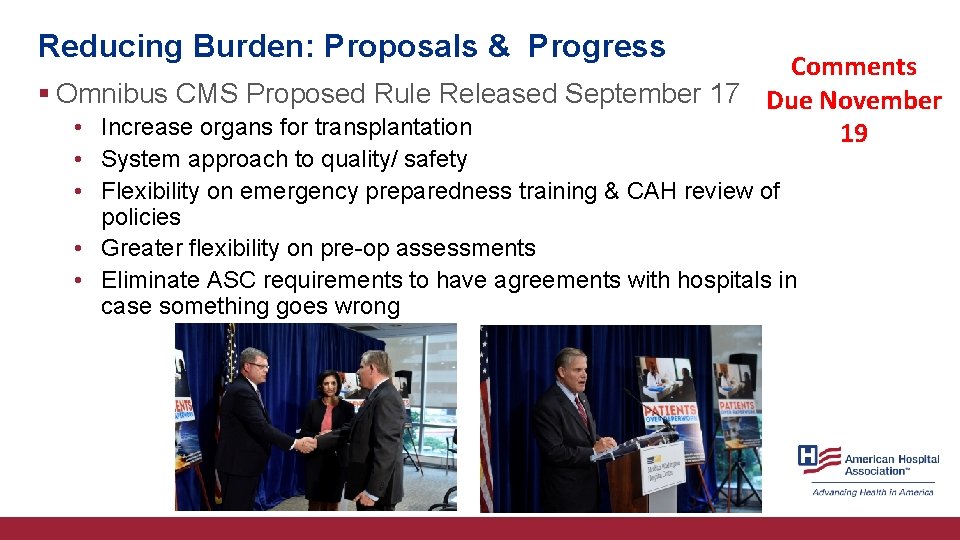
Reducing Burden: Proposals & Progress Comments § Omnibus CMS Proposed Rule Released September 17 Due November • Increase organs for transplantation 19 • System approach to quality/ safety • Flexibility on emergency preparedness training & CAH review of policies • Greater flexibility on pre-op assessments • Eliminate ASC requirements to have agreements with hospitals in case something goes wrong
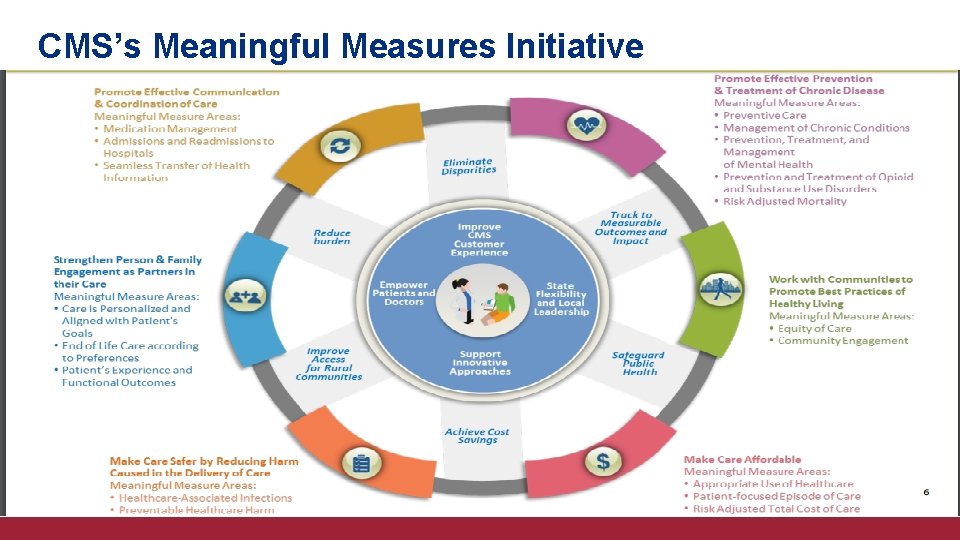
CMS’s Meaningful Measures Initiative
Progress on “Measures that Matter” § AHA influenced CMS’s “Meaningful Measures” § 16 out of 19 CMS meaningful measure areas align with AHA measure priority list (other 3 reflect AHA cross-org priorities) § FY / CY 2019 CMS policies by the numbers: § 29 percent reduction in inpatient hospital measures § 28 percent reduction in inpatient psychiatric measures § 55 percent reduction in outpatient hospital measures (proposed) § 34 measures removed from MIPS (proposed) § 10 measures removed from various post-acute care programs (final) § AHA-facilitated collaborative effort for public / private measure alignment underway
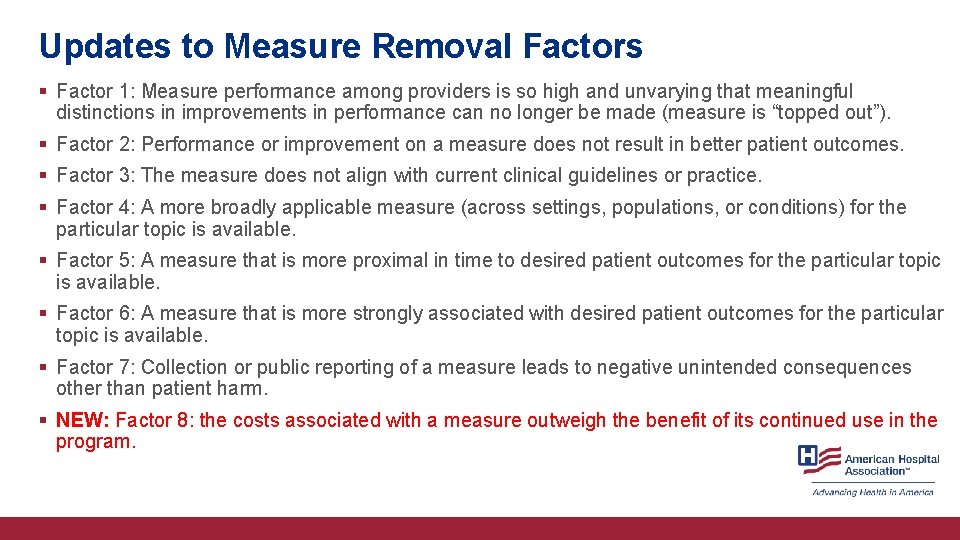
Updates to Measure Removal Factors § Factor 1: Measure performance among providers is so high and unvarying that meaningful distinctions in improvements in performance can no longer be made (measure is “topped out”). § Factor 2: Performance or improvement on a measure does not result in better patient outcomes. § Factor 3: The measure does not align with current clinical guidelines or practice. § Factor 4: A more broadly applicable measure (across settings, populations, or conditions) for the particular topic is available. § Factor 5: A measure that is more proximal in time to desired patient outcomes for the particular topic is available. § Factor 6: A measure that is more strongly associated with desired patient outcomes for the particular topic is available. § Factor 7: Collection or public reporting of a measure leads to negative unintended consequences other than patient harm. § NEW: Factor 8: the costs associated with a measure outweigh the benefit of its continued use in the program.
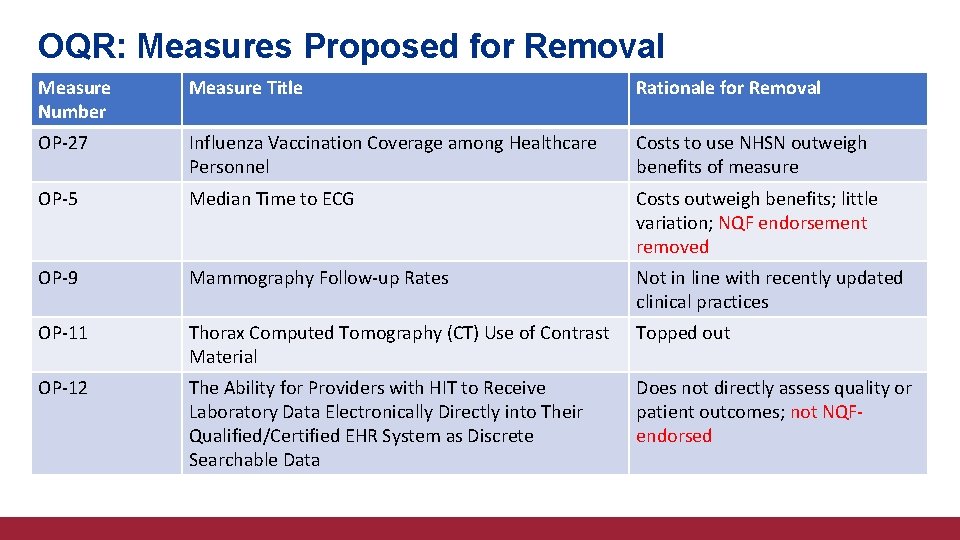
OQR: Measures Proposed for Removal Measure Number Measure Title Rationale for Removal OP-27 Influenza Vaccination Coverage among Healthcare Personnel Costs to use NHSN outweigh benefits of measure OP-5 Median Time to ECG Costs outweigh benefits; little variation; NQF endorsement removed OP-9 Mammography Follow-up Rates Not in line with recently updated clinical practices OP-11 Thorax Computed Tomography (CT) Use of Contrast Material Topped out OP-12 The Ability for Providers with HIT to Receive Laboratory Data Electronically Directly into Their Qualified/Certified EHR System as Discrete Searchable Data Does not directly assess quality or patient outcomes; not NQFendorsed
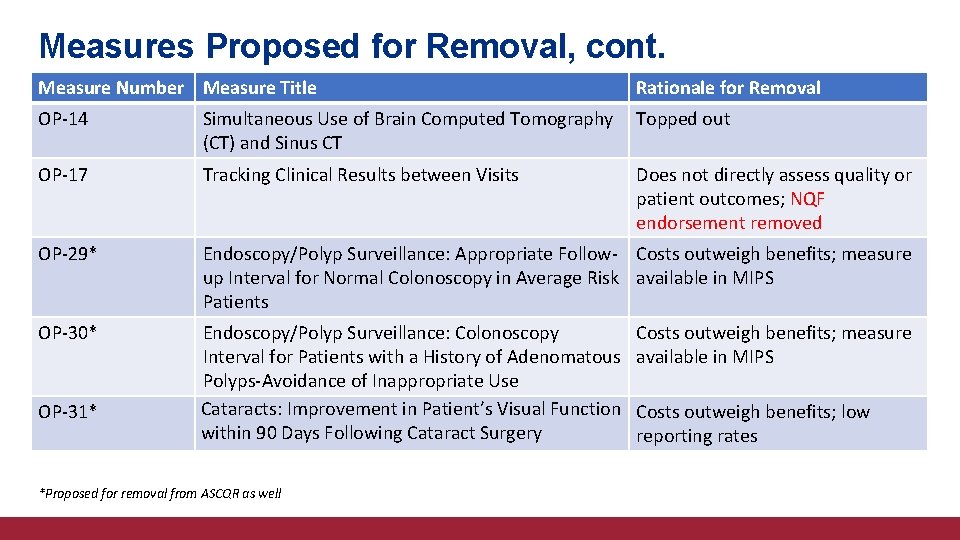
Measures Proposed for Removal, cont. Measure Number Measure Title Rationale for Removal OP-14 Simultaneous Use of Brain Computed Tomography (CT) and Sinus CT Topped out OP-17 Tracking Clinical Results between Visits Does not directly assess quality or patient outcomes; NQF endorsement removed OP-29* Endoscopy/Polyp Surveillance: Appropriate Follow- Costs outweigh benefits; measure up Interval for Normal Colonoscopy in Average Risk available in MIPS Patients OP-30* Endoscopy/Polyp Surveillance: Colonoscopy Interval for Patients with a History of Adenomatous Polyps-Avoidance of Inappropriate Use Cataracts: Improvement in Patient’s Visual Function within 90 Days Following Cataract Surgery OP-31* *Proposed for removal from ASCQR as well Costs outweigh benefits; measure available in MIPS Costs outweigh benefits; low reporting rates
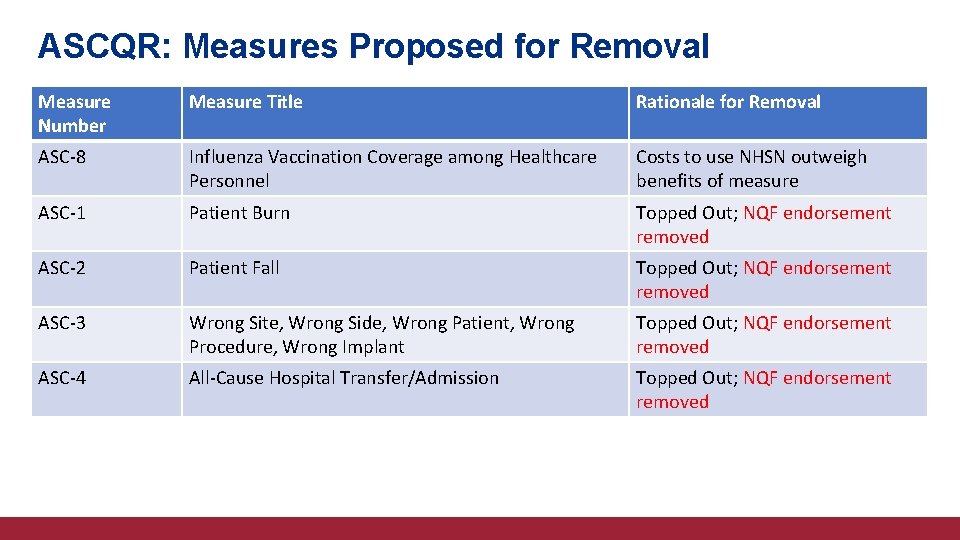
ASCQR: Measures Proposed for Removal Measure Number Measure Title Rationale for Removal ASC-8 Influenza Vaccination Coverage among Healthcare Personnel Costs to use NHSN outweigh benefits of measure ASC-1 Patient Burn Topped Out; NQF endorsement removed ASC-2 Patient Fall Topped Out; NQF endorsement removed ASC-3 Wrong Site, Wrong Side, Wrong Patient, Wrong Procedure, Wrong Implant Topped Out; NQF endorsement removed ASC-4 All-Cause Hospital Transfer/Admission Topped Out; NQF endorsement removed
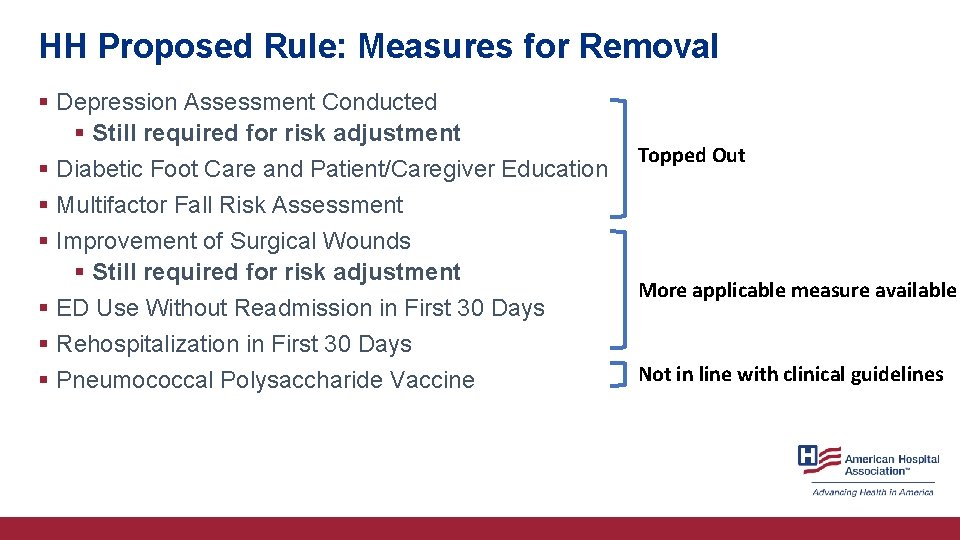
HH Proposed Rule: Measures for Removal § Depression Assessment Conducted § Still required for risk adjustment § Diabetic Foot Care and Patient/Caregiver Education § Multifactor Fall Risk Assessment § Improvement of Surgical Wounds § Still required for risk adjustment § ED Use Without Readmission in First 30 Days § Rehospitalization in First 30 Days § Pneumococcal Polysaccharide Vaccine Topped Out More applicable measure available Not in line with clinical guidelines
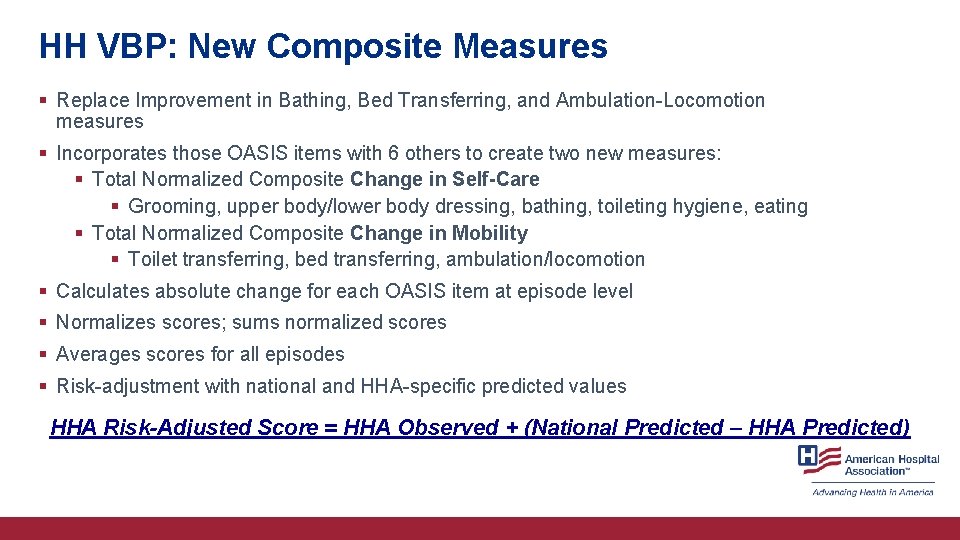
HH VBP: New Composite Measures § Replace Improvement in Bathing, Bed Transferring, and Ambulation-Locomotion measures § Incorporates those OASIS items with 6 others to create two new measures: § Total Normalized Composite Change in Self-Care § Grooming, upper body/lower body dressing, bathing, toileting hygiene, eating § Total Normalized Composite Change in Mobility § Toilet transferring, bed transferring, ambulation/locomotion § Calculates absolute change for each OASIS item at episode level § Normalizes scores; sums normalized scores § Averages scores for all episodes § Risk-adjustment with national and HHA-specific predicted values HHA Risk-Adjusted Score = HHA Observed + (National Predicted – HHA Predicted)
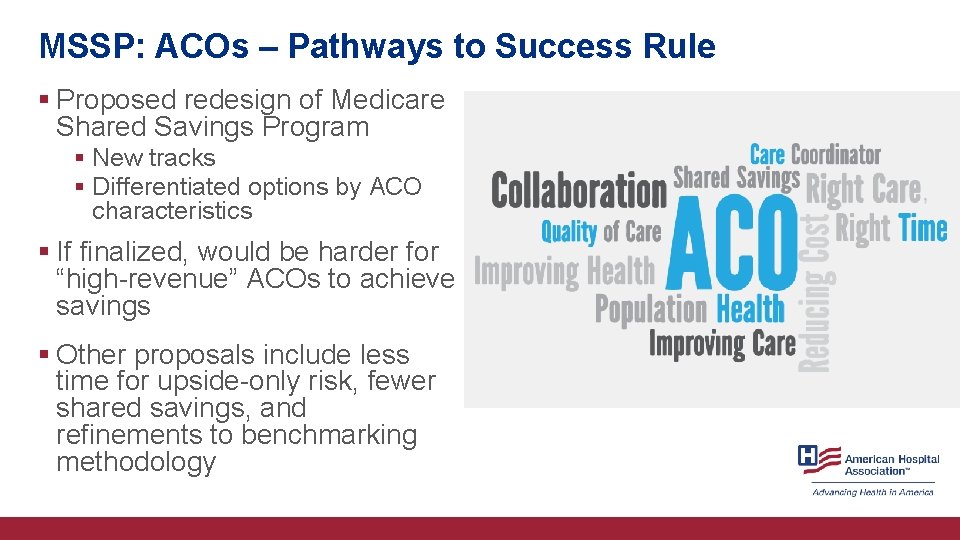
MSSP: ACOs – Pathways to Success Rule § Proposed redesign of Medicare Shared Savings Program § New tracks § Differentiated options by ACO characteristics § If finalized, would be harder for “high-revenue” ACOs to achieve savings § Other proposals include less time for upside-only risk, fewer shared savings, and refinements to benchmarking methodology
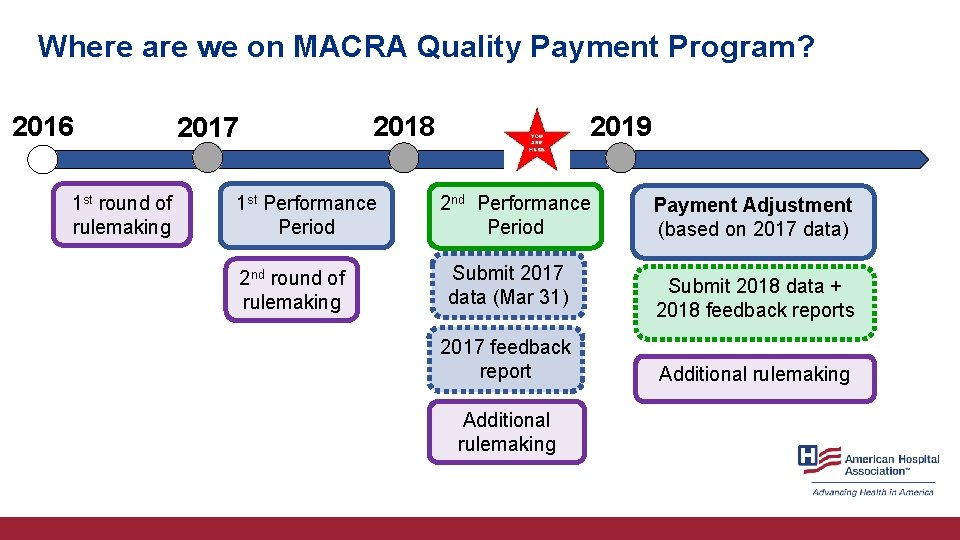
Where are we on MACRA Quality Payment Program? 2016 1 st round of rulemaking 2019 2018 2017 1 st Performance Period 2 nd round of rulemaking 2 nd Performance Period Submit 2017 data (Mar 31) 2017 feedback report Additional rulemaking Payment Adjustment (based on 2017 data) Submit 2018 data + 2018 feedback reports Additional rulemaking
2019 QPP Proposals – Key Takeaways § Gradual implementation of MIPS continues § § Low-volume threshold still excludes large number of clinicians (590, 000) MIPS opt-in available Carry over of most 2018 quality reporting requirements Expansion to new clinician types (PT, OT, social work, psychologists) § Impact of MIPS cost measurement grows § Increased category weight to 15 percent, and new episode-based measures § MIPS Advancing Care Information (ACI) category renamed and revamped § Now “Promoting Interoperability”, with greater alignment with hospital program § CMS staying the course on MIPS facility-based measurement § Available in 2019, with minor proposed expansions § Changes to advanced APM track are quite minor § Excluded clinicians have more time to prepare…but stakes are rising!
IPPS: Impact of CMS Meaningful Measure Policies IQR VBP HAC HRRP Number of measures in FY 2019 Program 62 18 6 6 Number of Measures Removed, FY 2019 – FY 2023 39 4 0 0 Number of Measures in FY 2023 23 14 6 6 § IQR: § 18 measures removed from ALL CMS hospital quality reporting and value programs because they are topped out, don’t lead to better quality, or have costs outweighing their benefit § 21 measures “de-duplicated” (that is, removed from IQR, but retained for only one CMS hospital program) § VBP § 4 measures removed to “de-duplicate” with IQR § CMS did NOT finalize proposal to remove 6 safety measures from VBP
Hospital VBP § Funded by reducing base inpatient PPS operating payments by 2. 0 percent to create incentive pool -- $1. 9 billion for FY 2019 § Budget neutral – all funds must go back to hospitals (not a lever for Medicare savings) § “De-Duplication” of four measures § Remove PC-01 (Early Elective Deliveries) § PC-01 retained in IQR § Remove 3 condition-specific payment measures from VBP (retained in IQR) § CMS retains safety measures (PSI and infection measures), and will not change domain weights § AHA remains concerned by use of these measures in both VBP and HAC Reduction programs (i. e. , potential for double penalties and misaligned performance incentives)
Hospital Readmissions Reduction Program § Program began in FY 2013 (Oct. 1, 2012) § Hospitals with “excess” readmissions have their base inpatient Medicare payments reduced by: § 1 percent in FY 2013 § 2 percent in FY 2014 § 3 percent in FY 2015 and beyond § Uses 30 -day readmissions measures for a total of six conditions: § FY 2013: AMI, HF, PN § FY 2015: Elective hip/knee, COPD § FY 2017: CABG
Hospital Readmissions Reduction Program § FY 2019 Performance Period § Jul. 1, 2014 – Jun. 30, 2017 § Socioeconomic adjustment will start with FY 2019 penalties § Mandated by 21 st Century Cures Act of 2016 § Statutory Requirements: § “Transitional adjustment” (FYs 2019 and 2020) in which hospitals assessed relative to other hospitals with similar proportions of dual eligible patients § CMS may implement different approach in future § Budget neutral (that is, aggregate penalties must be same as non-SES adjusted approach)
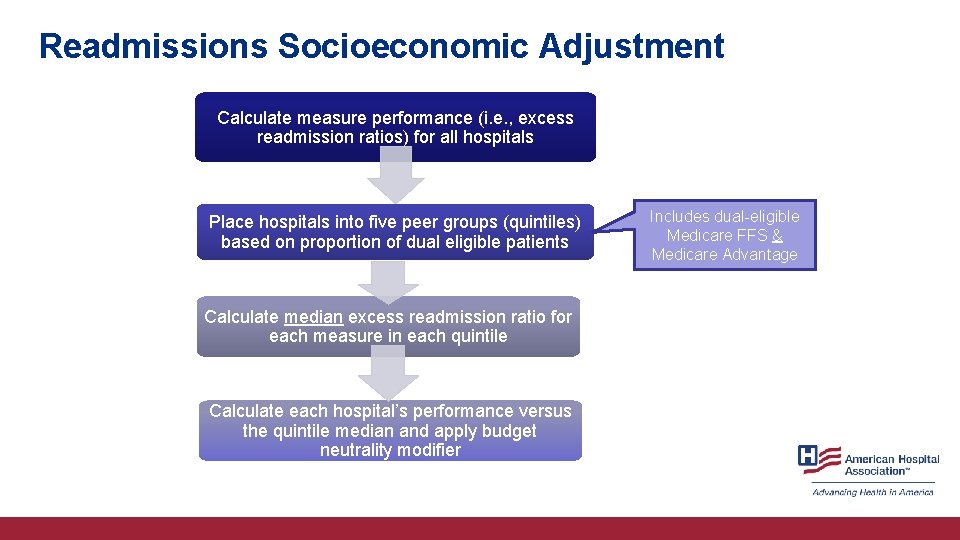
Readmissions Socioeconomic Adjustment Calculate measure performance (i. e. , excess readmission ratios) for all hospitals Place hospitals into five peer groups (quintiles) based on proportion of dual eligible patients Calculate median excess readmission ratio for each measure in each quintile Calculate each hospital’s performance versus the quintile median and apply budget neutrality modifier Includes dual-eligible Medicare FFS & Medicare Advantage
HAC Reduction Program § Beginning in FY 2015, 1 -percent reduction to total inpatient PPS payments for hospitals in worst-performing quartile of HAC rates § HAC Measures: § Patient Safety Indicator 90 (claims-based) § Healthcare-Associated Infections (HAIs) § § § CAUTI CLABSI Surgical Site Infection MRSA C Difficile
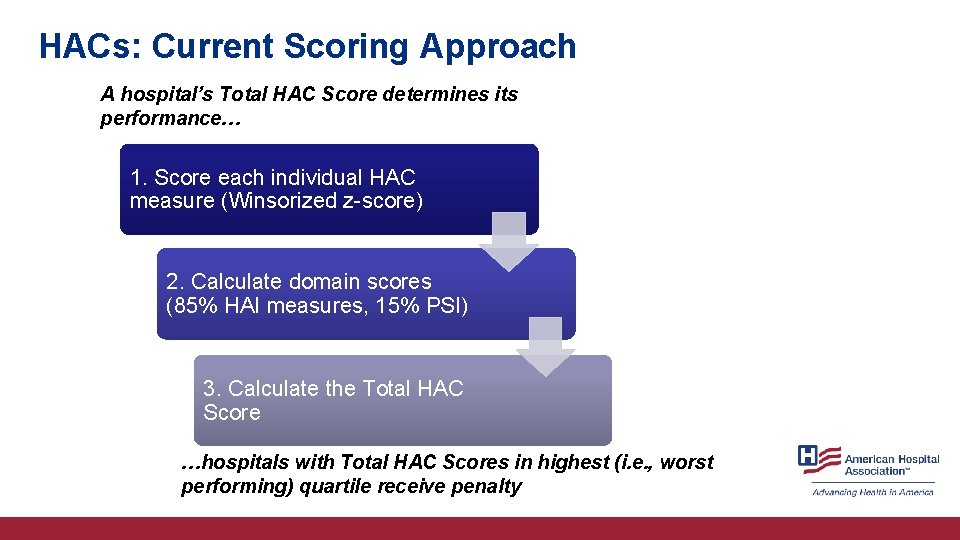
HACs: Current Scoring Approach A hospital’s Total HAC Score determines its performance… 1. Score each individual HAC measure (Winsorized z-score) 2. Calculate domain scores (85% HAI measures, 15% PSI) 3. Calculate the Total HAC Score …hospitals with Total HAC Scores in highest (i. e. , worst performing) quartile receive penalty
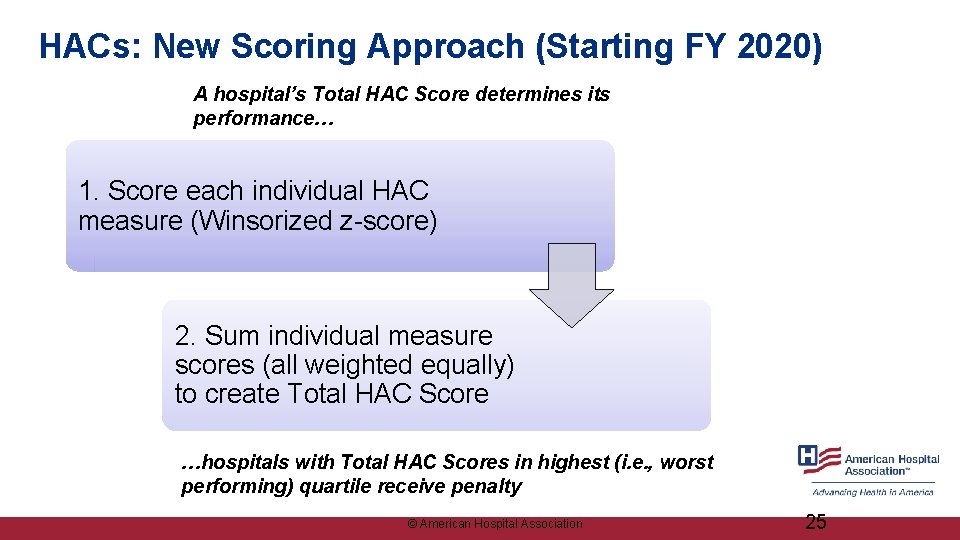
HACs: New Scoring Approach (Starting FY 2020) A hospital’s Total HAC Score determines its performance… 1. Score each individual HAC measure (Winsorized z-score) 2. Sum individual measure scores (all weighted equally) to create Total HAC Score …hospitals with Total HAC Scores in highest (i. e. , worst performing) quartile receive penalty © American Hospital Association 25
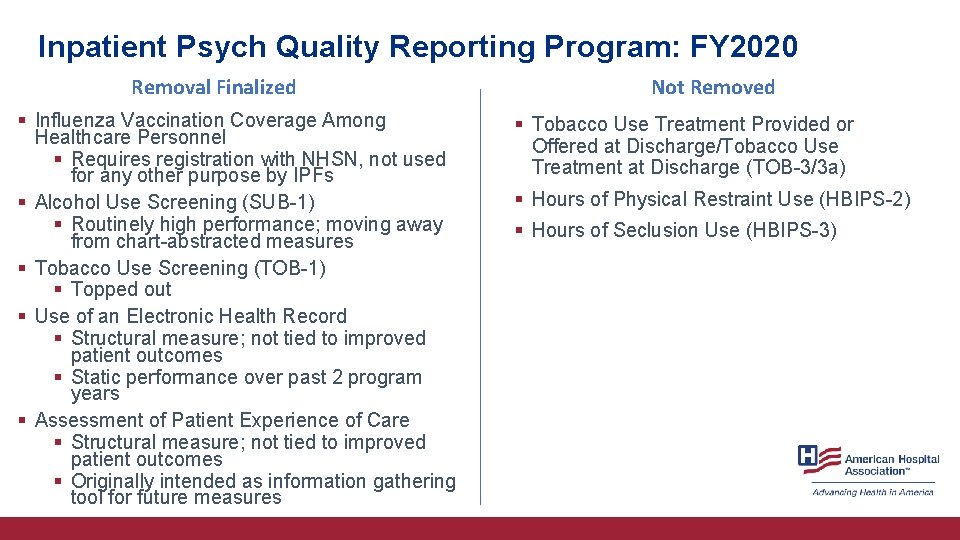
Inpatient Psych Quality Reporting Program: FY 2020 Removal Finalized § Influenza Vaccination Coverage Among Healthcare Personnel § Requires registration with NHSN, not used for any other purpose by IPFs § Alcohol Use Screening (SUB-1) § Routinely high performance; moving away from chart-abstracted measures § Tobacco Use Screening (TOB-1) § Topped out § Use of an Electronic Health Record § Structural measure; not tied to improved patient outcomes § Static performance over past 2 program years § Assessment of Patient Experience of Care § Structural measure; not tied to improved patient outcomes § Originally intended as information gathering tool for future measures Not Removed § Tobacco Use Treatment Provided or Offered at Discharge/Tobacco Use Treatment at Discharge (TOB-3/3 a) § Hours of Physical Restraint Use (HBIPS-2) § Hours of Seclusion Use (HBIPS-3)
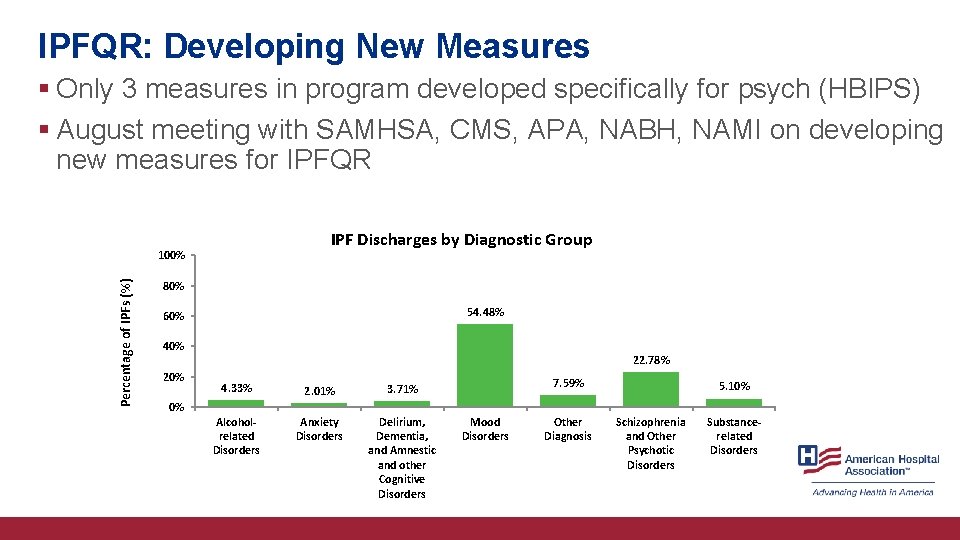
IPFQR: Developing New Measures § Only 3 measures in program developed specifically for psych (HBIPS) § August meeting with SAMHSA, CMS, APA, NABH, NAMI on developing new measures for IPFQR IPF Discharges by Diagnostic Group Percentage of IPFs (%) 100% 80% 54. 48% 60% 40% 22. 78% 4. 33% 2. 01% 3. 71% Alcoholrelated Disorders Anxiety Disorders Delirium, Dementia, and Amnestic and other Cognitive Disorders 7. 59% 5. 10% 0% Mood Disorders Other Diagnosis Schizophrenia and Other Psychotic Disorders Substancerelated Disorders
IQR e. CQM Reporting Changes for FY 2021 § Report on at least 4 of the e. CQMs available in the CY 2019 reporting year § Report one, self-selected quarter from 2019 § Hospital required to use the 2015 edition of certified EHR technology § Changes aligned with e. CQM policies in the “Promoting Interoperability” program (formerly known as the Medicare EHR Incentive Program) § Looking Ahead: § Seven e. CQMs removed from IQR for CY 2020 reporting year § CMS received feedback on future development and use of e. CQMs and hybrid measures
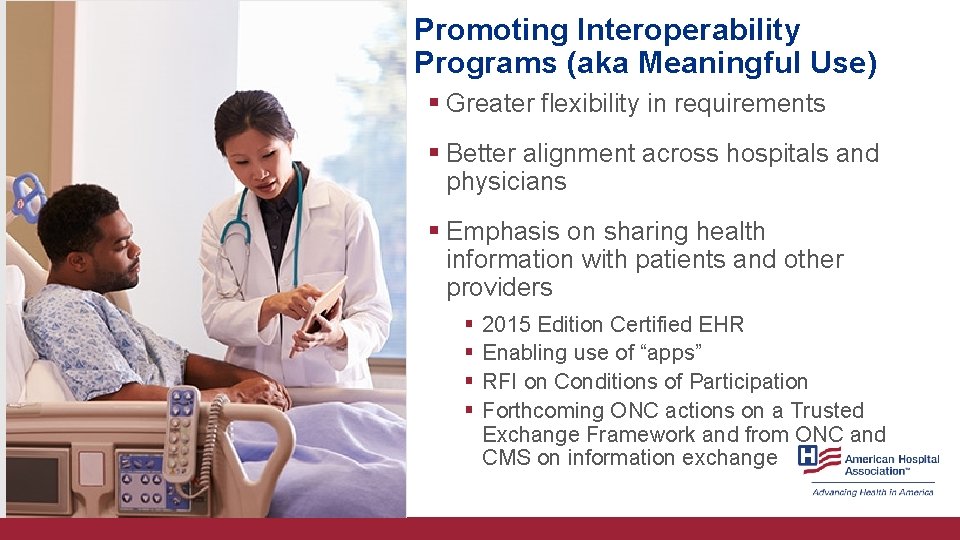
Promoting Interoperability Programs (aka Meaningful Use) § Greater flexibility in requirements § Better alignment across hospitals and physicians Image § Emphasis on sharing health information with patients and other providers § § 2015 Edition Certified EHR Enabling use of “apps” RFI on Conditions of Participation Forthcoming ONC actions on a Trusted Exchange Framework and from ONC and CMS on information exchange
IQR HCAHPS Pain Questions § CMS previously replaced pain management questions in HCAHPS with “Communication about Pain” questions § Stakeholders continue to voice concerns regarding inadvertent pressure to prescribe opioids for pain § CMS proposes to remove questions beginning with Jan. 2022 discharges § Can’t do it earlier: agency needs time to make “necessary updates” § Still wants to collect data on impact of questions to inform future program changes
CAHPS Survey Developments § Wide range of surveys available, some used in CMS program § Limited survey administration modes permitted in CMS programs (mail, phone) § CAHPS Consortium exploring ways to enhance response rates and refine surveys § Web and app-based survey modes § Survey length CAHPS Survey Family Used in CMS Programs - Hospital CAHPS - CG CAHPS - MIPS - ACOs - Home Health CAHPS - CAHPS for Health Plans - Medicare Advantage - Part D Drug Plans - Medicaid - ICH CAHPS (ESRD) - Outpatient and ASC CAHPS (indefinitely suspended) Other CAHPS Surveys - Surgical CAHPS - Dental CAHPS - Nursing Home CAHPS - ED CAHPS (under development)
AOs: Proposed Requirements (HH P Rule) § Honoring term of accreditation § AOs would have to provide written agreement to sustain accreditation for facilities that voluntarily withdraw from program until original end of accreditation or date of facility’s choosing § Surveyor training requirements § Would require all surveyors to take CMS program-specific training § AOs would have to provide documentation that all surveyors completed training
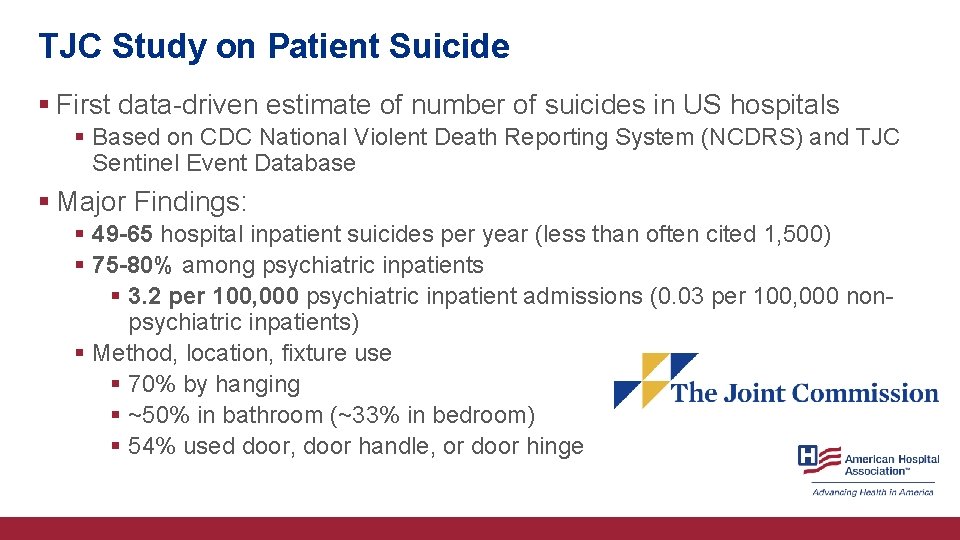
TJC Study on Patient Suicide § First data-driven estimate of number of suicides in US hospitals § Based on CDC National Violent Death Reporting System (NCDRS) and TJC Sentinel Event Database § Major Findings: § 49 -65 hospital inpatient suicides per year (less than often cited 1, 500) § 75 -80% among psychiatric inpatients § 3. 2 per 100, 000 psychiatric inpatient admissions (0. 03 per 100, 000 nonpsychiatric inpatients) § Method, location, fixture use § 70% by hanging § ~50% in bathroom (~33% in bedroom) § 54% used door, door handle, or door hinge
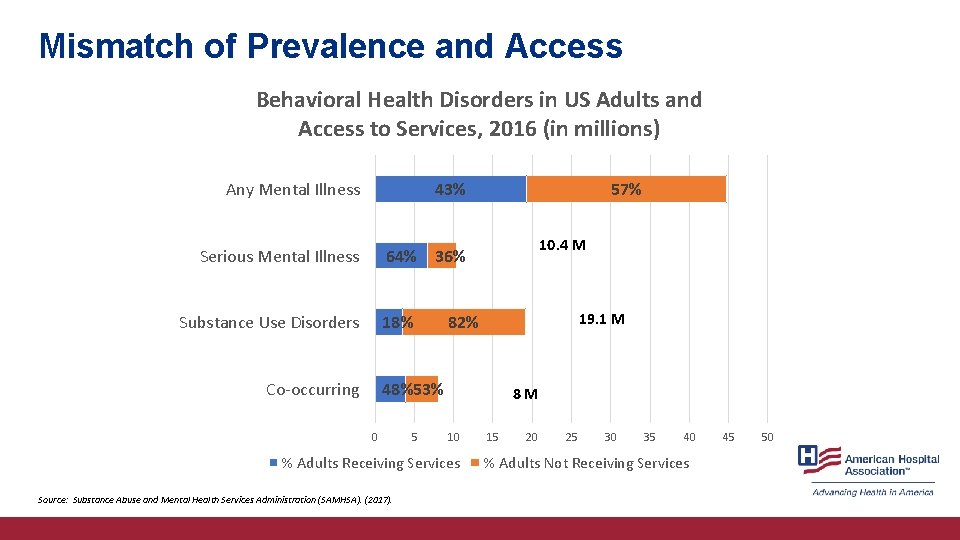
Mismatch of Prevalence and Access Behavioral Health Disorders in US Adults and Access to Services, 2016 (in millions) Any Mental Illness 43% Serious Mental Illness 64% 36% Substance Use Disorders 18% Co-occurring 57% 10. 4 M 19. 1 M 82% 48%53% 0 5 8 M 10 % Adults Receiving Services Source: Substance Abuse and Mental Health Services Administration (SAMHSA). (2017). 15 20 25 30 35 40 % Adults Not Receiving Services 45 50
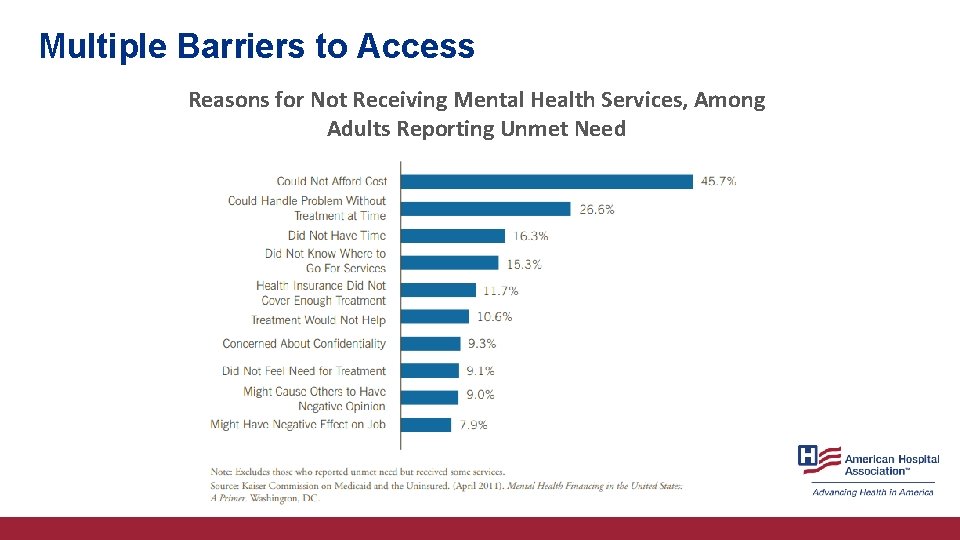
Multiple Barriers to Access Reasons for Not Receiving Mental Health Services, Among Adults Reporting Unmet Need
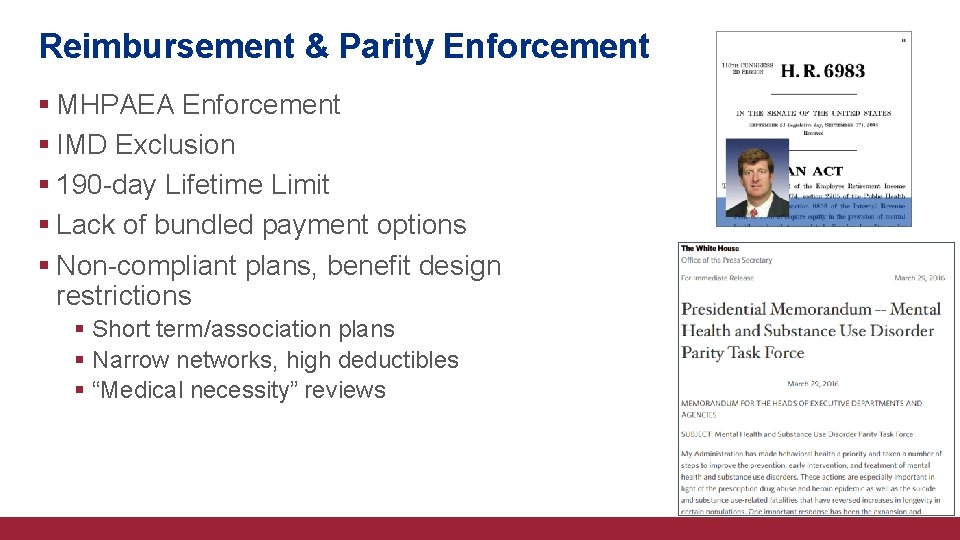
Reimbursement & Parity Enforcement § MHPAEA Enforcement § IMD Exclusion § 190 -day Lifetime Limit § Lack of bundled payment options § Non-compliant plans, benefit design restrictions § Short term/association plans § Narrow networks, high deductibles § “Medical necessity” reviews
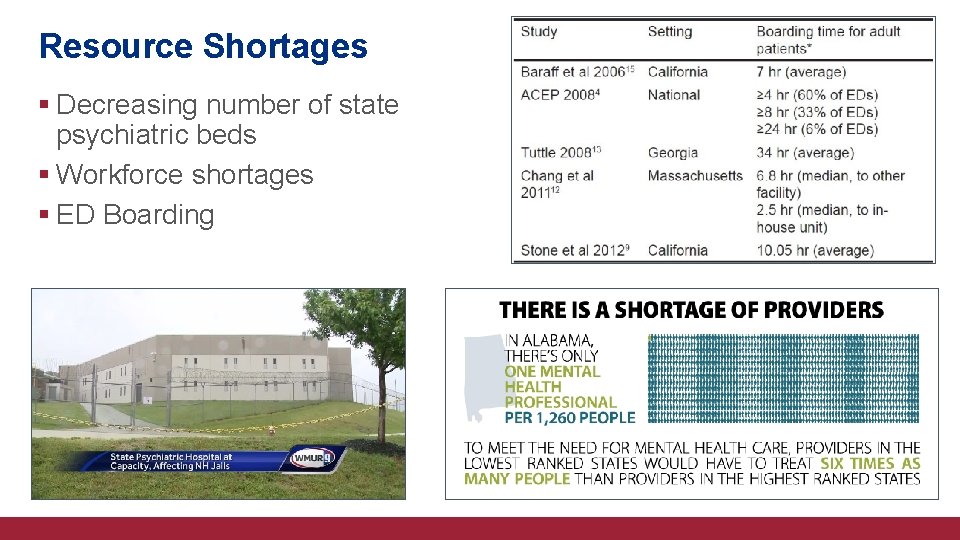
Resource Shortages § Decreasing number of state psychiatric beds § Workforce shortages § ED Boarding
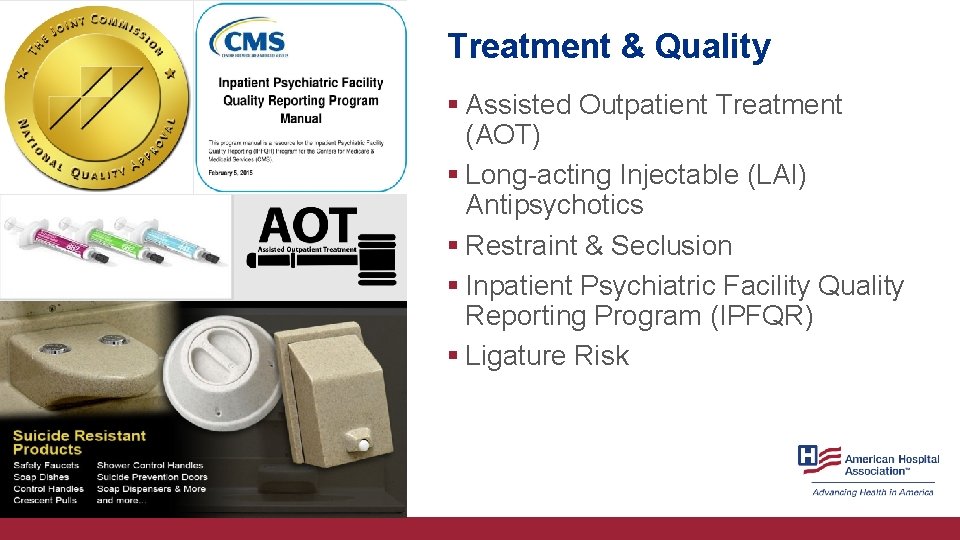
Treatment & Quality § Assisted Outpatient Treatment (AOT) § Long-acting Injectable (LAI) Antipsychotics § Restraint & Seclusion § Inpatient Psychiatric Facility Quality Reporting Program (IPFQR) § Ligature Risk
Overarching Issues § Stigma § Integration of Behavioral Health with Physical Health
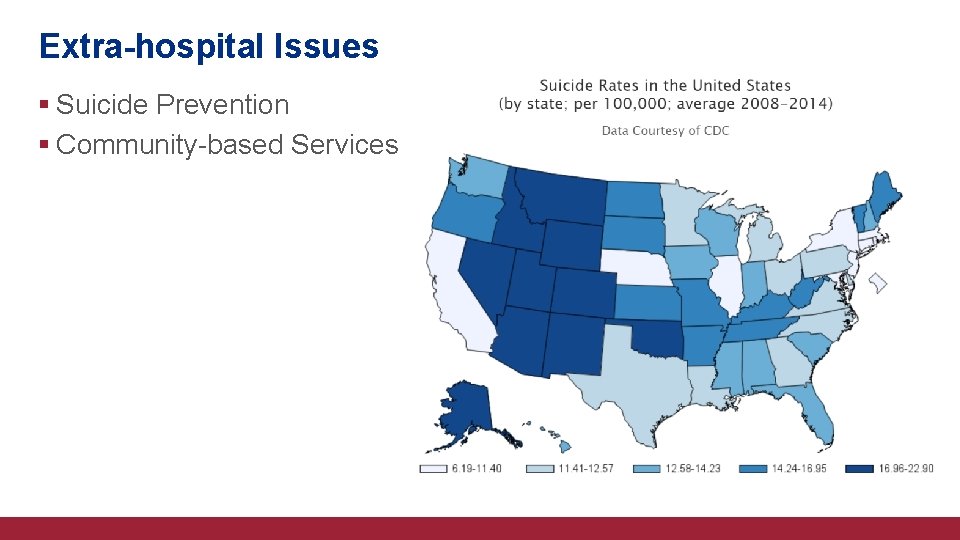
Extra-hospital Issues § Suicide Prevention § Community-based Services
Opioid Action in Congress § H. R. 6, the SUPPORT for Patients and Communities Act of 2018 • Increases funding and flexibility for existing SAMHSA grants to states • Gives other federal agencies (CDC, FDA, NIH) more authority to address crisis • Demo to promote follow-up to ED care of overdose patients • Targets Medicare, Medicaid and CHIP programs’ ability to address crisis § The House and Senate passed the bill and it is going to the President for signature AHA Priorities: IMD included in Conference Package
42 CFR Part 2 Reform § H. R. 6082, the Overdose Prevention and Patient Safety Act § Delayed Action in Energy and Commerce § Passed House 357 -57 § S. 1850, the Protecting Jessica Grubb’s Legacy Act § Cosponsors: Manchin (WV), Capito (WV), Feinstein (CA), King (ME), Harris (CA), Klobuchar (MN), Rounds (SD), Tillis (NC), Donnelly (IN), Whitehouse (RI), Collins (ME) § Jessie’s Law (Manchin)
More Federal Efforts on Opioids § CMS Roadmap: Prevention, Treatment, Data § FDA MAT: approving generic versions, new dosages of Suboxone § DEA Production Quotas: FY 19 quotas § National Academy of Medicine Action Collaborative
Addiction Recovery Medical Home APM § Announced publicly Sept. 7 § Five Elements to ARMH: § Payment in 3 phases: pre-recovery and stabilization (<30 days), recovery initiation and active treatment (0 -12 months), and communitybased recovery management (0 -5 years) § Quality metrics developed by National Committee for Quality Assurance § Integrated treatment and recovery network § Care recovery team § Treatment and recovery plan § Looking for additional organizations to pilot model § Partners from Facing Addiction with National Council on Alcoholism and Drug Dependence have offered to provide live webinars with our members, interested providers
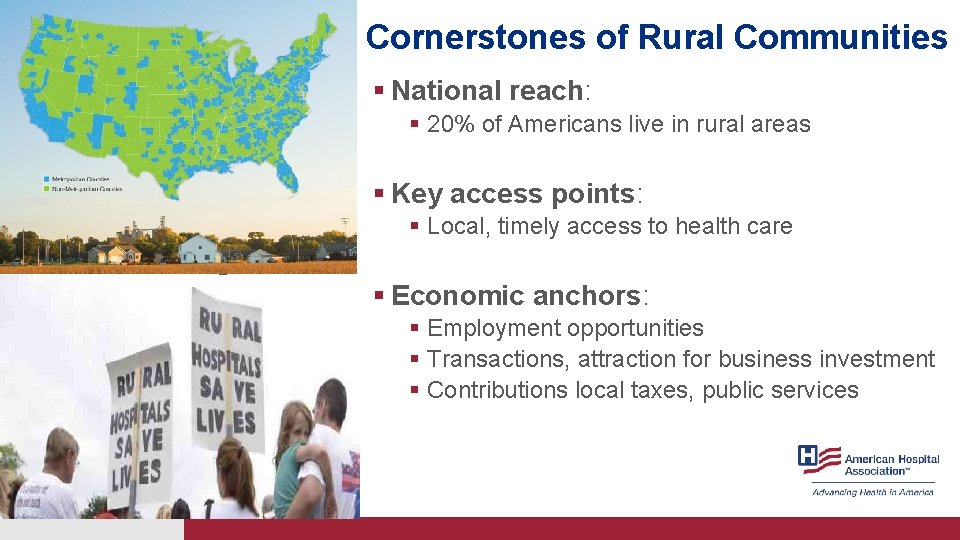
Cornerstones of Rural Communities § National reach: § 20% of Americans live in rural areas § Key access points: Image § Local, timely access to health care § Economic anchors: § Employment opportunities § Transactions, attraction for business investment § Contributions local taxes, public services
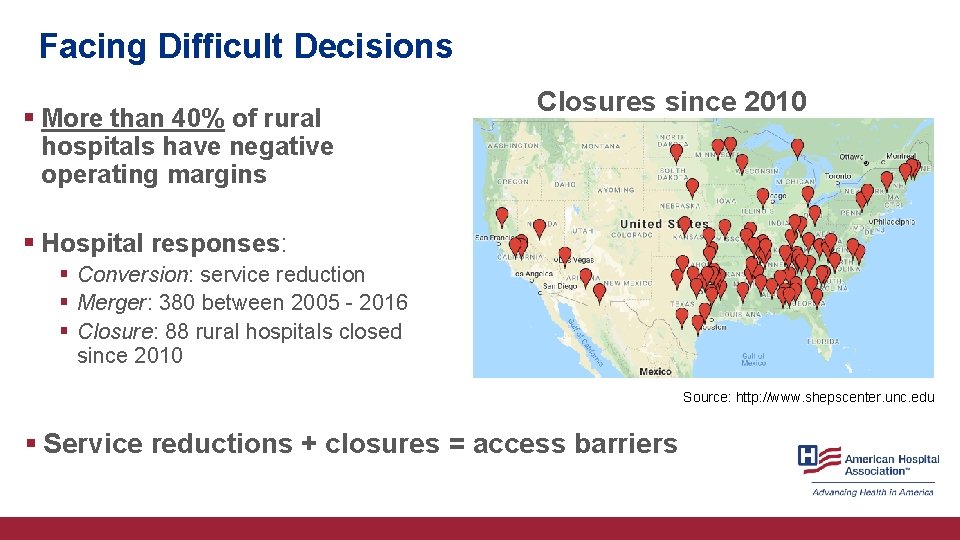
Facing Difficult Decisions § More than 40% of rural hospitals have negative operating margins Closures since 2010 § Hospital responses: § Conversion: service reduction § Merger: 380 between 2005 - 2016 § Closure: 88 rural hospitals closed since 2010 Source: http: //www. shepscenter. unc. edu § Service reductions + closures = access barriers
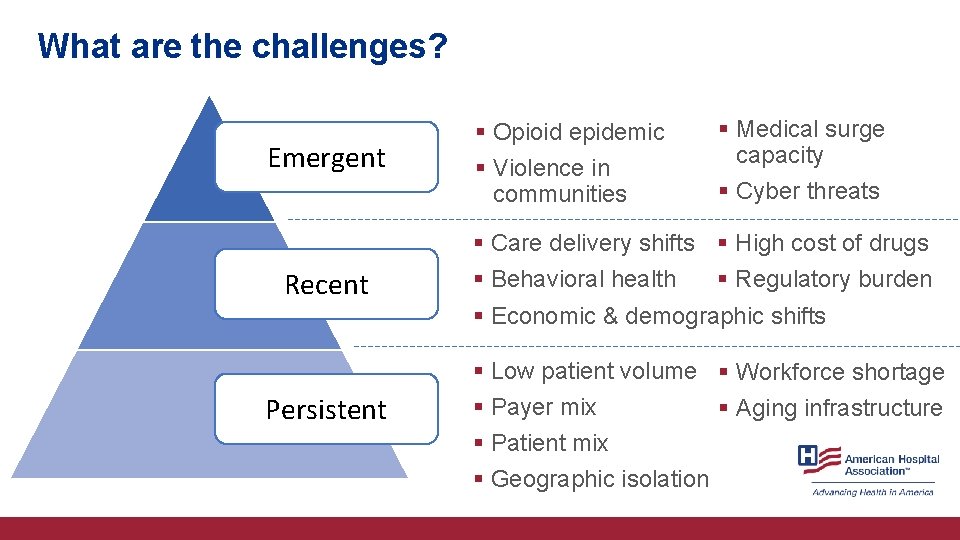
What are the challenges? Emergent Recent Persistent § Opioid epidemic § Violence in communities § Medical surge capacity § Cyber threats § Care delivery shifts § High cost of drugs § Behavioral health § Regulatory burden § Economic & demographic shifts § Low patient volume § Workforce shortage § Payer mix § Aging infrastructure § Patient mix § Geographic isolation
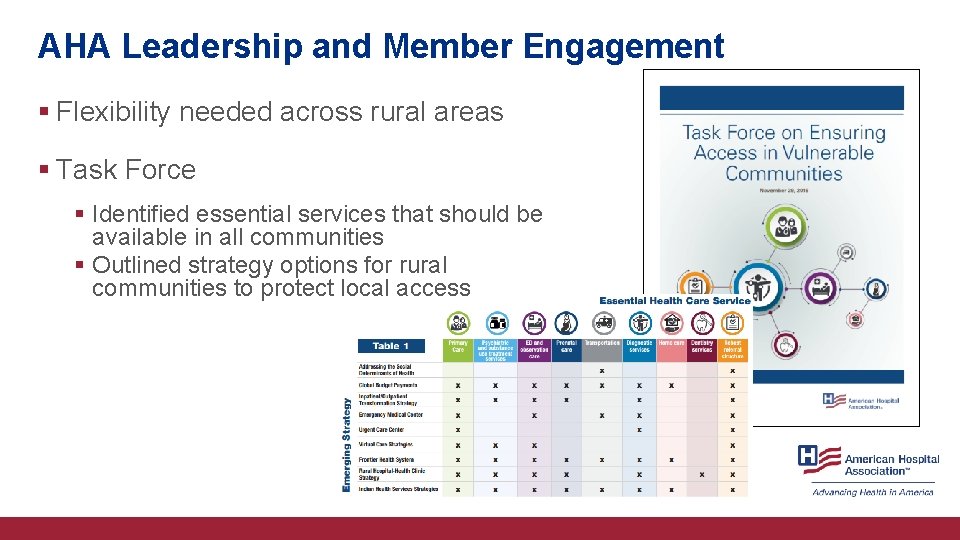
AHA Leadership and Member Engagement § Flexibility needed across rural areas § Task Force § Identified essential services that should be available in all communities § Outlined strategy options for rural communities to protect local access
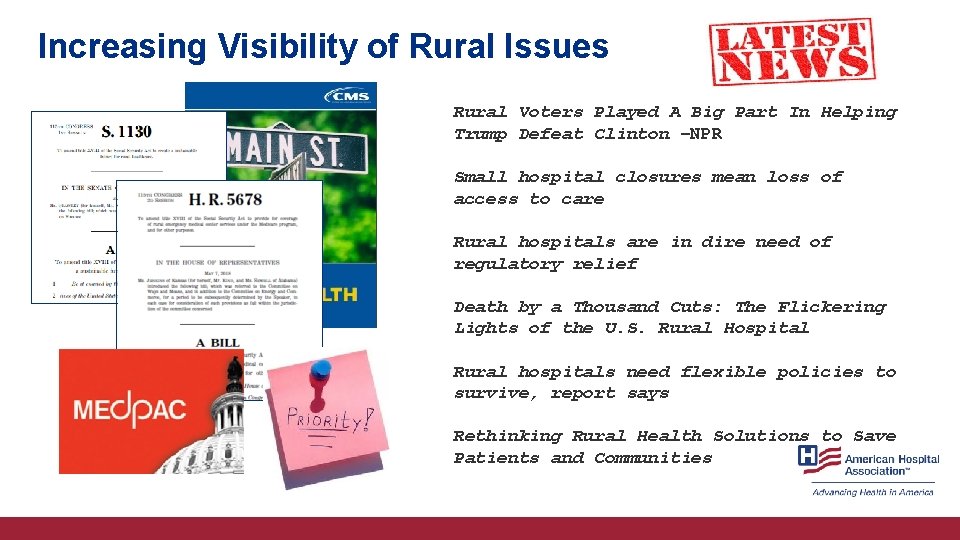
Increasing Visibility of Rural Issues Rural Voters Played A Big Part In Helping Trump Defeat Clinton –NPR Small hospital closures mean loss of access to care Rural hospitals are in dire need of regulatory relief Death by a Thousand Cuts: The Flickering Lights of the U. S. Rural Hospital Rural hospitals need flexible policies to survive, report says Rethinking Rural Health Solutions to Save Patients and Communities
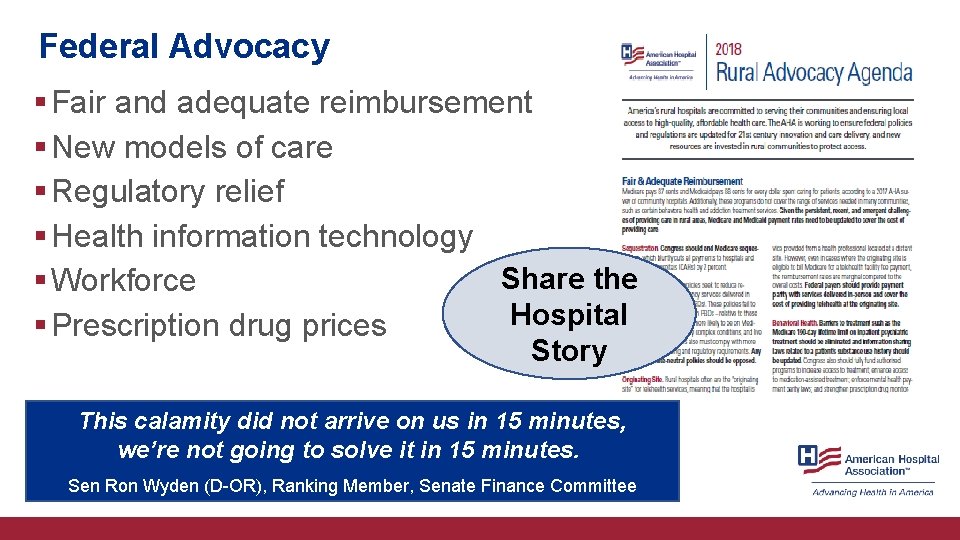
Federal Advocacy § Fair and adequate reimbursement § New models of care § Regulatory relief § Health information technology Share the § Workforce Hospital § Prescription drug prices Story This calamity did not arrive on us in 15 minutes, we’re not going to solve it in 15 minutes. Sen Ron Wyden (D-OR), Ranking Member, Senate Finance Committee
AHA’s Quality Trend. Watch § Highlights progress in quality improvement § Explains various QI programs, infrastructure needed § Outlines quality and value-based purchasing programs § Details challenges to quality improvement: § Lack of meaningful measurement § Unintended consequences of measurement programs § Lack of useful, accurate comparisons § Challenges with e. CQMs § Outdated, unclear Co. Ps, standards § Recommendations
LOOKING AHEAD § Measures that Matter § Hospital Pay-for-Performance programs § Med. PAC’s HVIP § Including rural hospitals in quality reporting programs § More work on Co. Ps; right-sizing regulation § 20 th Anniversary of To Err is Human: Telling the story of quality improvement § Innovative care/payment models § Advanced Payment Model for Advanced Illness Management § Progress (or not? ) on the opioid epidemic § How will efforts affect patients with other disorders? § Interoperability § Progress on e. CQM?
- Slides: 52