
Federal Flood Risk Management Standard FFRMS Impetus Past
- Slides: 15
Federal Flood Risk Management Standard FFRMS
Impetus
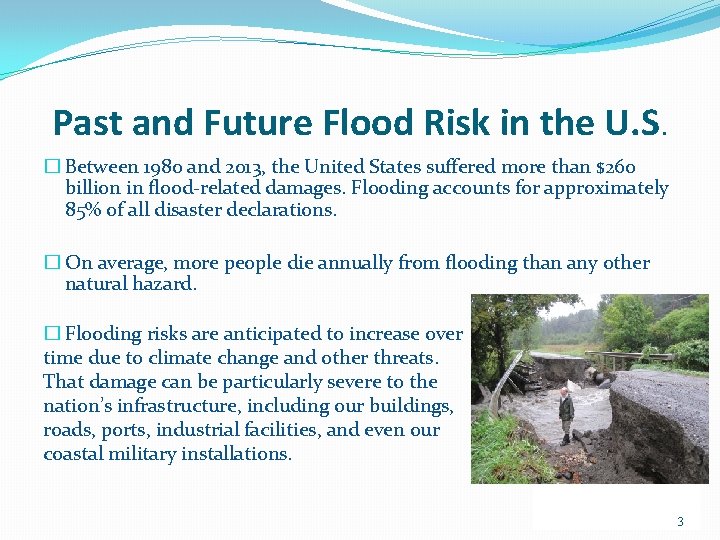
Past and Future Flood Risk in the U. S. � Between 1980 and 2013, the United States suffered more than $260 billion in flood-related damages. Flooding accounts for approximately 85% of all disaster declarations. � On average, more people die annually from flooding than any other natural hazard. � Flooding risks are anticipated to increase over time due to climate change and other threats. That damage can be particularly severe to the nation’s infrastructure, including our buildings, roads, ports, industrial facilities, and even our coastal military installations. 3
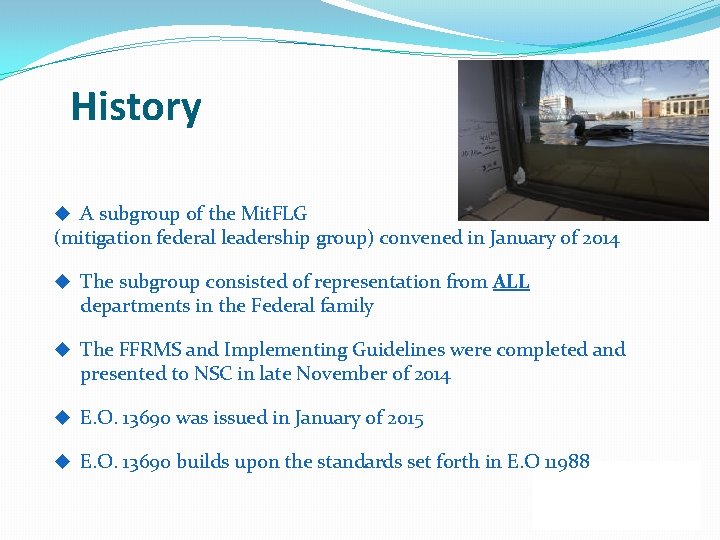
History u A subgroup of the Mit. FLG (mitigation federal leadership group) convened in January of 2014 u The subgroup consisted of representation from ALL departments in the Federal family u The FFRMS and Implementing Guidelines were completed and presented to NSC in late November of 2014 u E. O. 13690 was issued in January of 2015 u E. O. 13690 builds upon the standards set forth in E. O 11988
Executive Order 11988 � Issued May 1977 governing federal actions in the floodplain � Each agency shall provide leadership and shall take action to reduce the risk of flood loss, to minimize the impact of floods on human safety, health and welfare, and to restore and preserve the natural and beneficial values served by floodplains in carrying out its responsibilities for (1) acquiring, managing, and disposing of federal lands, and facilities; (2) providing federally undertaken, financed, or assisted construction and improvements; (3) conducting federal activities and programs affecting land use, including but not limited to water and related land resources planning, regulating, and licensing activities. 5
Executive Order 11988 Implementing Guidelines � In February 1978, the Water Resources Council (WRC) issued Floodplain Management Guidelines (Implementing Guidelines or Guidelines) which contained broad instructions for federal agencies to implement the Executive Order including: � Directed federal agencies to evaluate practicable alternatives to locating an action in a floodplain and � Established an 8 -step decision making process. 6
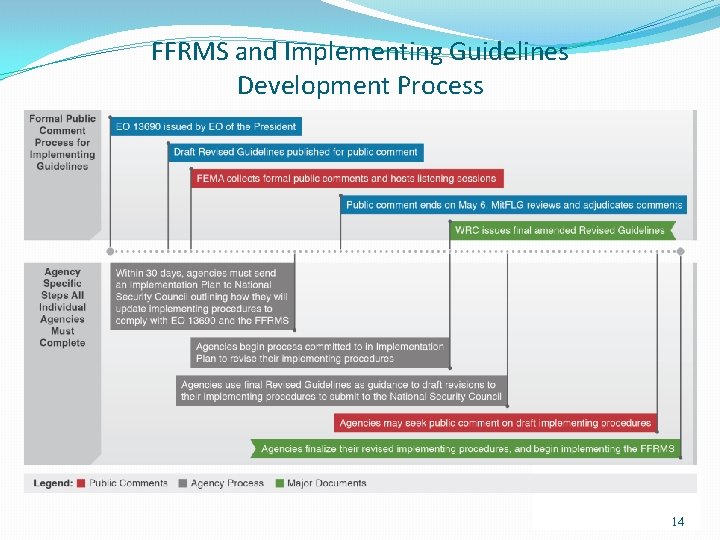
Executive Order 13690 � On January 30 th, the President signed Executive Order 13690, which amends Executive Order 11988 and establishes the Federal Flood Risk Management Standard (FFRMS or Standard). � On February 5 th, FEMA, on behalf of the Mitigation Federal Leadership Group (Mit. FLG), published in the Federal Register for notice and comment a draft of revisions to the 1978 Floodplain Management Guidelines. The draft Guidelines contain the basic interpretation of Executive Order 11988, as amended by the Executive Order 13690 and the FFRMS. � Executive Order 13690 also requires agencies to develop Implementation Plans describing how each agency will update its existing policies, procedures and/or regulations to comply with the new requirements. 7
Goal to Increase Resilience to Flooding � The FFRMS and Executive Order 13690 ensure that agencies expand management from the current base flood level to a higher vertical elevation and corresponding horizontal floodplain to address current and future flood risk and ensure that projects funded with taxpayer dollars last as long as intended. 8
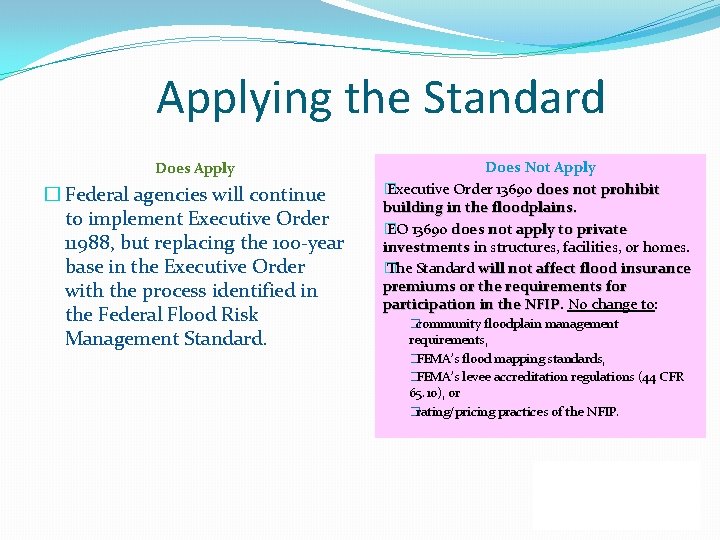
Applying the Standard Does Apply � Federal agencies will continue to implement Executive Order 11988, but replacing the 100 -year base in the Executive Order with the process identified in the Federal Flood Risk Management Standard. Does Not Apply � Executive Order 13690 does not prohibit building in the floodplains. � EO 13690 does not apply to private investments in structures, facilities, or homes. � The Standard will not affect flood insurance premiums or the requirements for participation in the NFIP. No change to: NFIP � community floodplain management requirements, � FEMA’s flood mapping standards, � FEMA’s levee accreditation regulations (44 CFR 65. 10), or � rating/pricing practices of the NFIP.
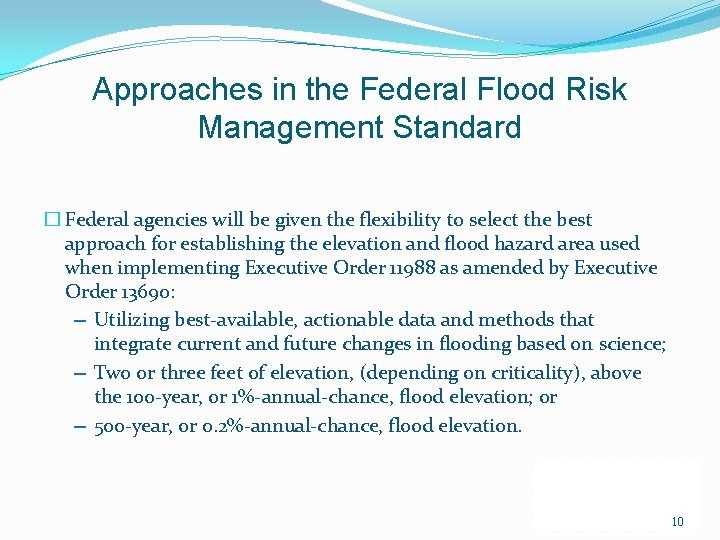
Approaches in the Federal Flood Risk Management Standard � Federal agencies will be given the flexibility to select the best approach for establishing the elevation and flood hazard area used when implementing Executive Order 11988 as amended by Executive Order 13690: ─ Utilizing best-available, actionable data and methods that integrate current and future changes in flooding based on science; ─ Two or three feet of elevation, (depending on criticality), above the 100 -year, or 1%-annual-chance, flood elevation; or ─ 500 -year, or 0. 2%-annual-chance, flood elevation. 10
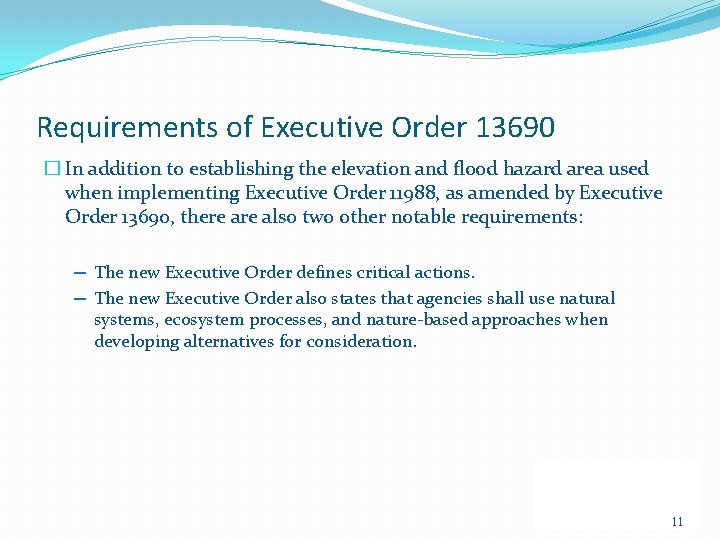
Requirements of Executive Order 13690 � In addition to establishing the elevation and flood hazard area used when implementing Executive Order 11988, as amended by Executive Order 13690, there also two other notable requirements: ─ The new Executive Order defines critical actions. ─ The new Executive Order also states that agencies shall use natural systems, ecosystem processes, and nature-based approaches when developing alternatives for consideration. 11
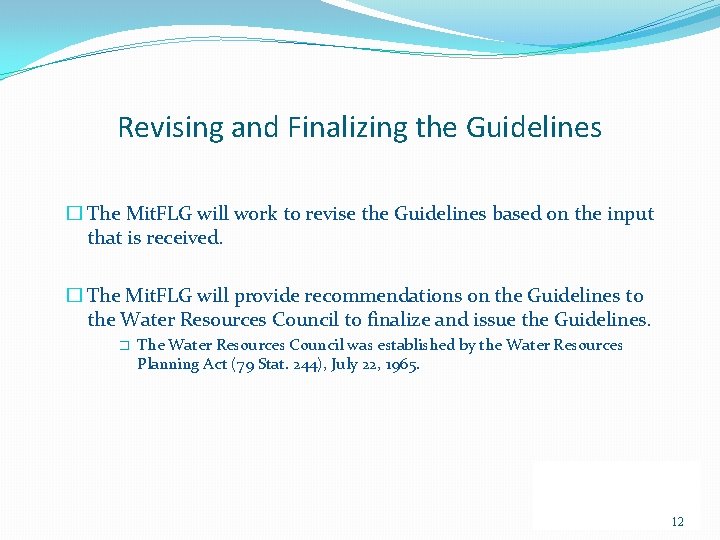
Revising and Finalizing the Guidelines � The Mit. FLG will work to revise the Guidelines based on the input that is received. � The Mit. FLG will provide recommendations on the Guidelines to the Water Resources Council to finalize and issue the Guidelines. � The Water Resources Council was established by the Water Resources Planning Act (79 Stat. 244), July 22, 1965. 12
Water Resources Council � The President convenes the Water Resources Council for matters affecting multiple agencies responsibilities and designates a Chairman of the Council who shall request the heads of other federal agencies to participate with the Council when matters affecting their responsibilities are considered by the Council. � Water Resources Council is composed of the: � Secretary of the Interior � Secretary of Agriculture � Secretary of the Army � Secretary of Commerce � Secretary of Housing and Urban Development � Secretary of Transportation � Administrator of the Environmental Protection Agency � Secretary of Energy 13
FFRMS and Implementing Guidelines Development Process 14
Thank You “It is the policy of the United States to improve the resilience of communities and federal assets against the impacts of flooding. These impacts are anticipated to increase over time due to the effects of climate change and other threats. Losses caused by flooding affect the environment, our economic prosperity, and public health and safety, each of which affects our national security. ” - Executive Order 13690 15