
Federal Enterprise Architecture An Overview Creative Commons License
- Slides: 56
Federal Enterprise Architecture An Overview Creative Commons License – Curt Hill.
Introduction • The Federal Government is the largest organization in the world – Clearly an enterprise • Not a profit corporation • Has different viewpoint • Actually it is a monopoly Creative Commons License – Curt Hill.
Same and different • Like a profit company the government is interested in: – Reducing inefficiency – Pleasing stockholders – Keeping the CEO happy • Different: – Not interested in rapidly exploiting new market – Less concerned about losing a job Creative Commons License – Curt Hill.
Mission and Vision • Everything must have a vision and mission • Mission: To develop and use the FEA to improve government efficiency and effectiveness. • Vision: To be the cornerstone for the design, development and implementation of information resources government-wide. Creative Commons License – Curt Hill.
Goals • Improve utilization of government information resources to focus on core agency mission and service delivery to citizens by using the FEA. • Increase cross-agency and intergovernment collaboration to streamline business processes, eliminate redundancies and realize cost efficiencies. • Enhance cost savings and cost avoidance through a mature FEA government-wide. Creative Commons License – Curt Hill.
Guiding Principles I • Promote and enable business driven architectures: • Align agency architectures to associated missions, strategic plans, and presidential management directives. • Encourage and facilitate proactive collaboration across the Federal government: • Assess potential for data sharing and reuse of services and technologies across government to promote cost savings and economies of scale. Creative Commons License – Curt Hill.
Guiding Principles II • Leverage architecture to improve the effectiveness and efficiency of government information resources: • Ensure all IT investments are consistent with business approved architectures and addressed in associated target architectures and transition plans. Creative Commons License – Curt Hill.
EA Roles • Generally the Chief Executive Officer has control of the organizational structure • Any manager may have some discretion within organizational policy • As the organization gets larger these managers have more power within their department Creative Commons License – Curt Hill.
Authority • A little different situation here • Congress and the President both have organizational power – The courts arbitrate disputes • Usually the organizational structure is not the prime concern of either – Sometimes this does need attention – Which yields various legislative initiatives and executive orders, Cohen Clinger is an example Creative Commons License – Curt Hill.
Two Positions • CIO usually exists in organizations – Who holds this position here? • Chief Enterprise Architect – Establishes the as-is architecture – Proposes the to-be architecture • Clinger Cohen made the CIO responsible – Since they have plenty of duties, this mandates the CEA • The to-be architecture and actions must be approved by highest level Creative Commons License – Curt Hill.
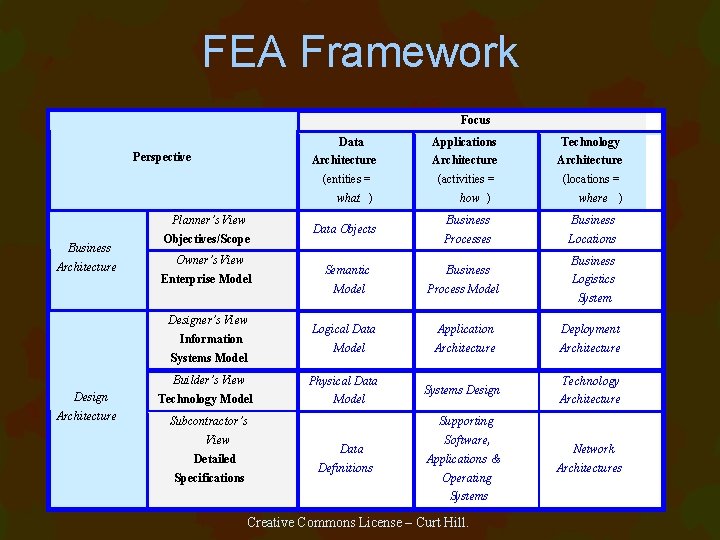
FEA Framework Focus Data Perspective Planner’s View Business Architecture Objectives/Scope Owner’s View Enterprise Model Designer’s View Information Systems Model Builder’s View Design Architecture Applications Technology Architecture (entities = (activities = (locations = what ) how ) where ) Data Objects Semantic Model Logical Data Model Physical Data Technology Model Subcontractor’s View Detailed Specifications Business Processes Locations Business Process Model Business Logistics System Application Deployment Architecture Systems Design Technology Architecture Supporting Data Definitions Software, Applications & Operating Systems Creative Commons License – Curt Hill. Network Architectures
FEAF • Design goals: – Identify opportunities to simplify process and unify work across government agencies and within the lines of business of the Federal government – To provide for a more citizen –centered, customer-focused government that maximizes technology investments to better achieve mission outcomes. Creative Commons License – Curt Hill.
FEAF Models • Inside the FEAF there are some interrelated models • Business Reference Model (BRM) • Performance Reference Model (PRM) • Service Component Reference Model (SRM) • Technical Reference Model (TRM) • Data Reference Model (DRM) Creative Commons License – Curt Hill.
Purpose of the models • To give a common method for the analysis and description of any department, agency or bureau • This allows cross-agency analysis • The identification of duplicate investments, gaps and opportunities for collaboration within and across agencies • Foundation of the FEAF Creative Commons License – Curt Hill.
Business Reference Model • The BRM examines the function of the agency – What is this group supposed to accomplish • In a large organization it is easy to look at the organizational chart and conclude that the pieces are interchangeable • BRM looks at purpose rather than organization Creative Commons License – Curt Hill.
BRM • • Creates a taxonomy of function Highest level: Business Area Middle: Line of Business Lowest: Sub-function Creative Commons License – Curt Hill.
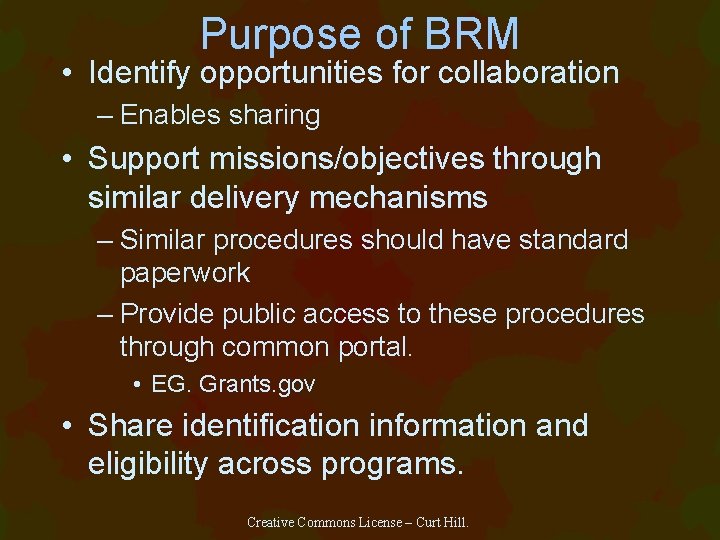
Purpose of BRM • Identify opportunities for collaboration – Enables sharing • Support missions/objectives through similar delivery mechanisms – Similar procedures should have standard paperwork – Provide public access to these procedures through common portal. • EG. Grants. gov • Share identification information and eligibility across programs. Creative Commons License – Curt Hill.
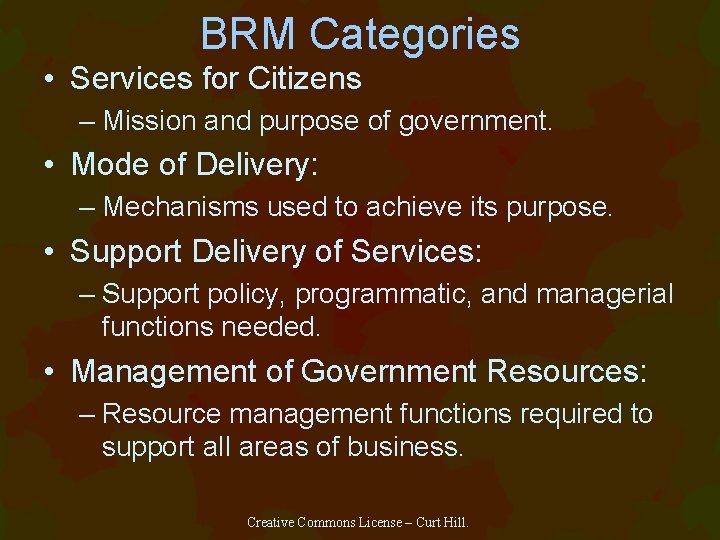
BRM Categories • Services for Citizens – Mission and purpose of government. • Mode of Delivery: – Mechanisms used to achieve its purpose. • Support Delivery of Services: – Support policy, programmatic, and managerial functions needed. • Management of Government Resources: – Resource management functions required to support all areas of business. Creative Commons License – Curt Hill.
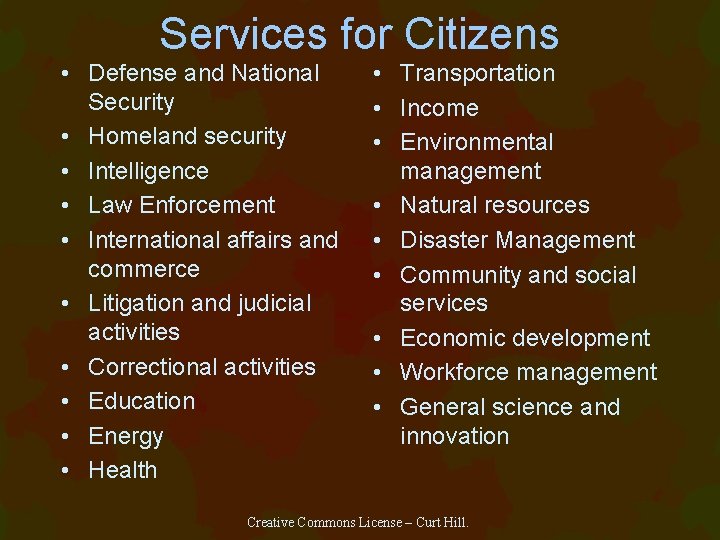
Services for Citizens • Defense and National Security • Homeland security • Intelligence • Law Enforcement • International affairs and commerce • Litigation and judicial activities • Correctional activities • Education • Energy • Health • Transportation • Income • Environmental management • Natural resources • Disaster Management • Community and social services • Economic development • Workforce management • General science and innovation Creative Commons License – Curt Hill.
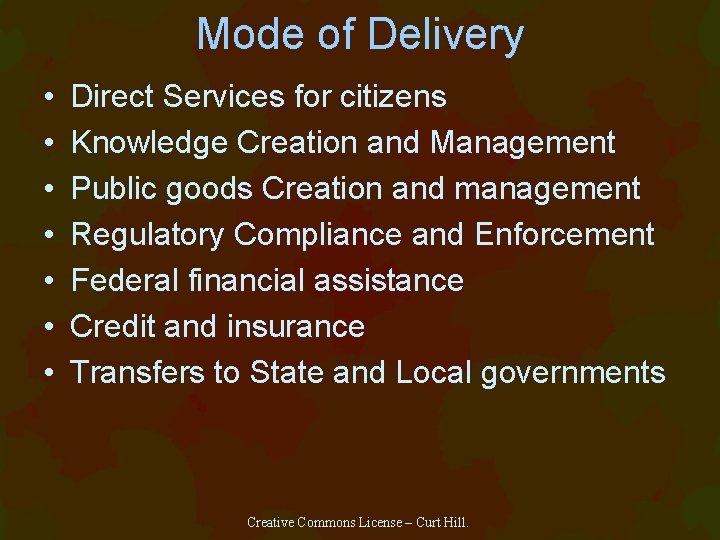
Mode of Delivery • • Direct Services for citizens Knowledge Creation and Management Public goods Creation and management Regulatory Compliance and Enforcement Federal financial assistance Credit and insurance Transfers to State and Local governments Creative Commons License – Curt Hill.
Support Services • • Legislative relations Public affairs Regulatory development Planning and budgeting Controls and oversight Revenue collection Internal risk management General government Creative Commons License – Curt Hill.
Management of Government Resources • • • Supply chain management Human resources management Financial management Administrative management Information and technology management Creative Commons License – Curt Hill.
Service Component Reference Model (SRM) • Model that classifies service components • How do these components support business objectives • Services are derived from business requirements • Components are a method of providing the service Creative Commons License – Curt Hill.
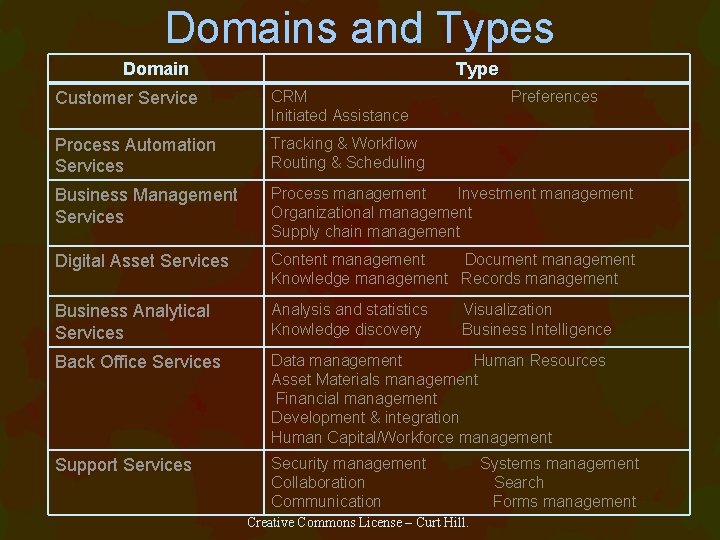
SRM Taxonomy • • Three pieces to classify Service Domain Service Type Service Component Creative Commons License – Curt Hill.
Domains and Types Domain Type Customer Service CRM Initiated Assistance Preferences Process Automation Services Tracking & Workflow Routing & Scheduling Business Management Services Process management Investment management Organizational management Supply chain management Digital Asset Services Content management Document management Knowledge management Records management Business Analytical Services Analysis and statistics Knowledge discovery Back Office Services Data management Human Resources Asset Materials management Financial management Development & integration Human Capital/Workforce management Support Services Security management Collaboration Communication Visualization Business Intelligence Creative Commons License – Curt Hill. Systems management Search Forms management
Technical Reference Model (TRM) • Technical framework for categorizing standards and technologies • Intended to promote platform interoperability • Facilitates data sharing among units in government Creative Commons License – Curt Hill.
Taxonomy • Like the SRM there is a three piece classification • Service area • Service category • Service standard Creative Commons License – Curt Hill.
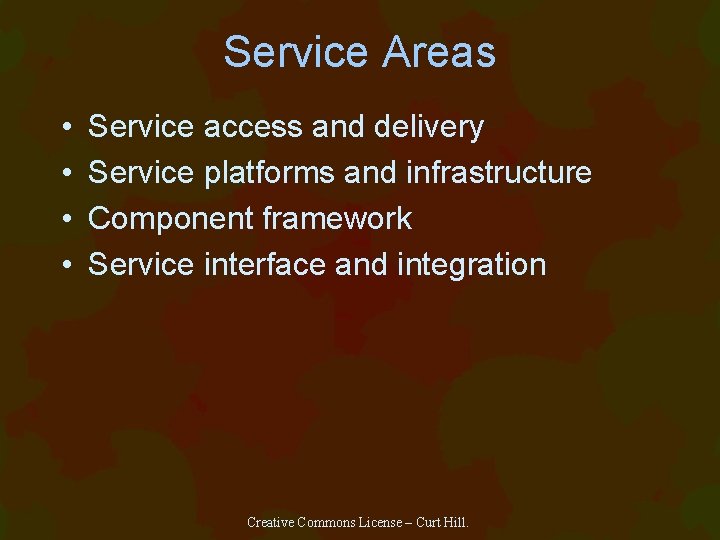
Service Areas • • Service access and delivery Service platforms and infrastructure Component framework Service interface and integration Creative Commons License – Curt Hill.
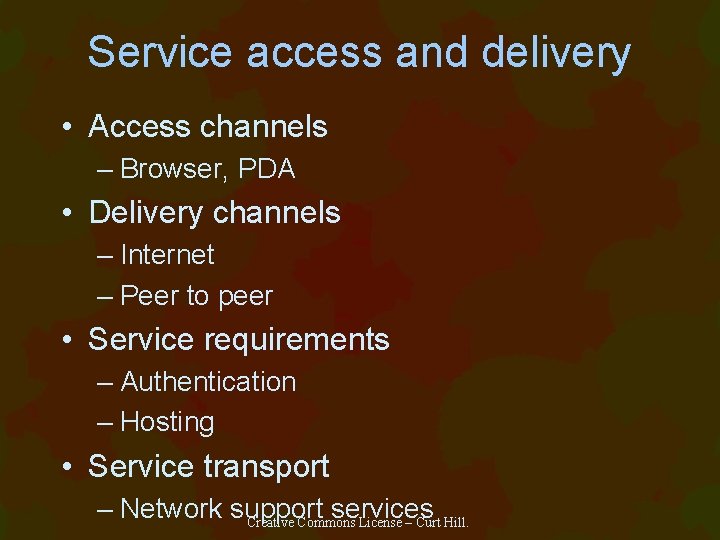
Service access and delivery • Access channels – Browser, PDA • Delivery channels – Internet – Peer to peer • Service requirements – Authentication – Hosting • Service transport – Network support services Creative Commons License – Curt Hill.
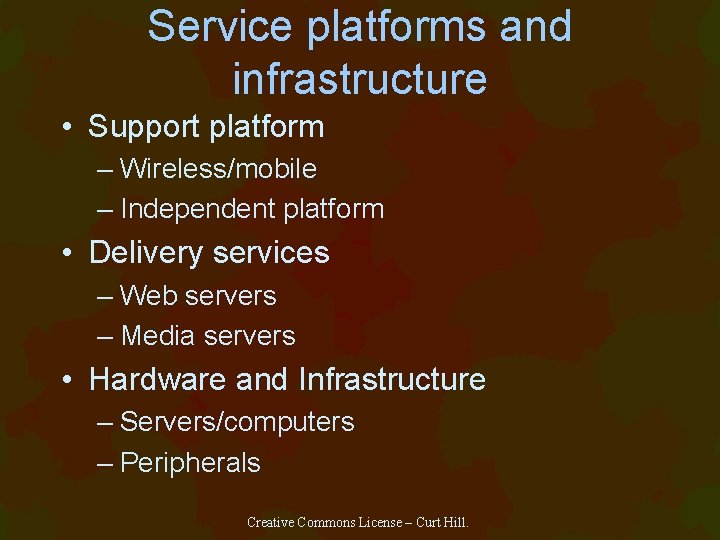
Service platforms and infrastructure • Support platform – Wireless/mobile – Independent platform • Delivery services – Web servers – Media servers • Hardware and Infrastructure – Servers/computers – Peripherals Creative Commons License – Curt Hill.
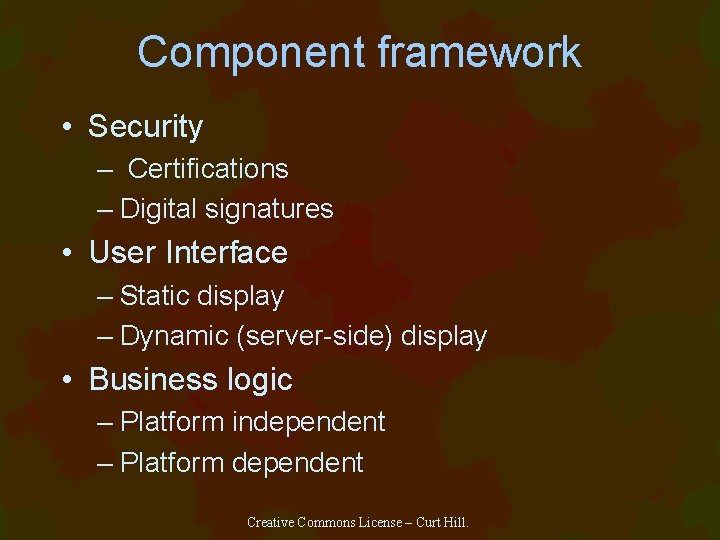
Component framework • Security – Certifications – Digital signatures • User Interface – Static display – Dynamic (server-side) display • Business logic – Platform independent – Platform dependent Creative Commons License – Curt Hill.
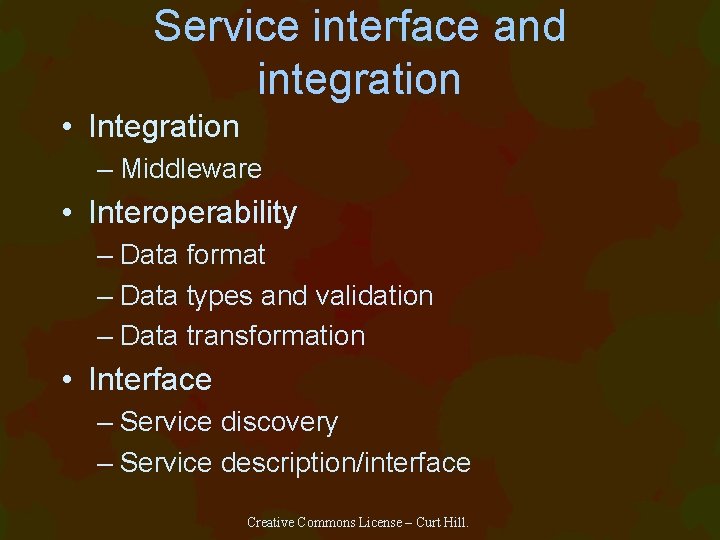
Service interface and integration • Integration – Middleware • Interoperability – Data format – Data types and validation – Data transformation • Interface – Service discovery – Service description/interface Creative Commons License – Curt Hill.
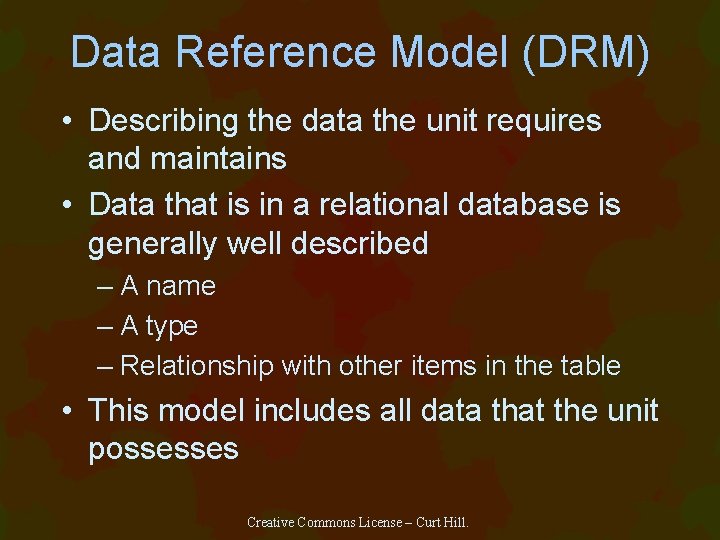
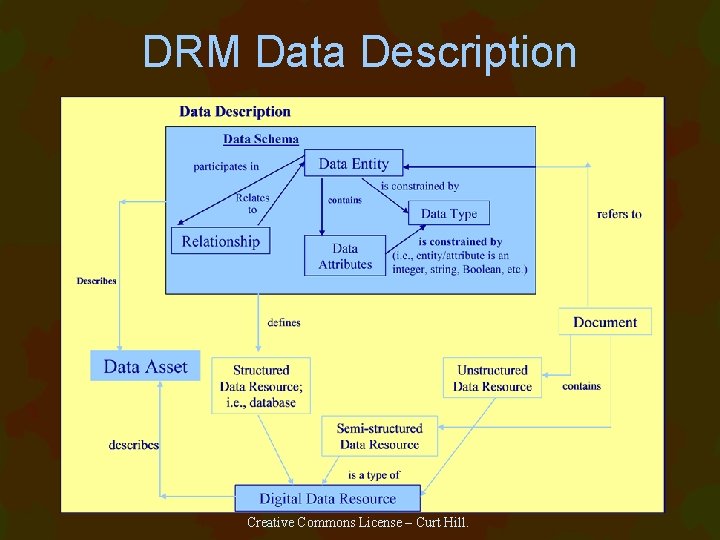
Data Reference Model (DRM) • Describing the data the unit requires and maintains • Data that is in a relational database is generally well described – A name – A type – Relationship with other items in the table • This model includes all data that the unit possesses Creative Commons License – Curt Hill.
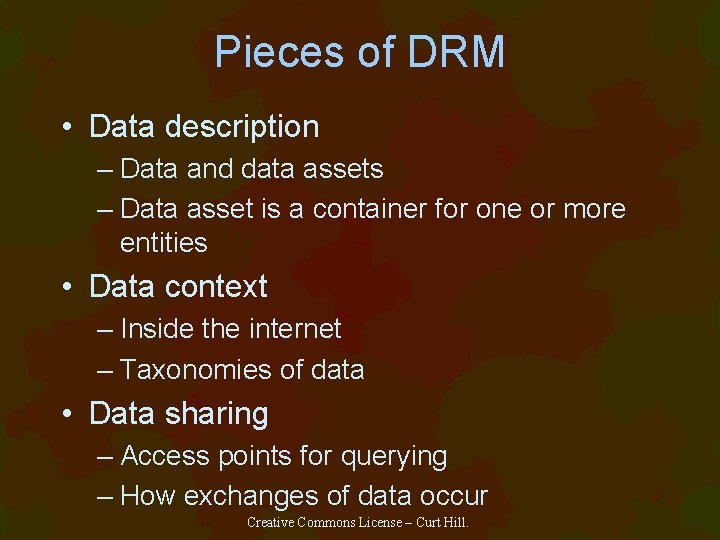
Pieces of DRM • Data description – Data and data assets – Data asset is a container for one or more entities • Data context – Inside the internet – Taxonomies of data • Data sharing – Access points for querying – How exchanges of data occur Creative Commons License – Curt Hill.
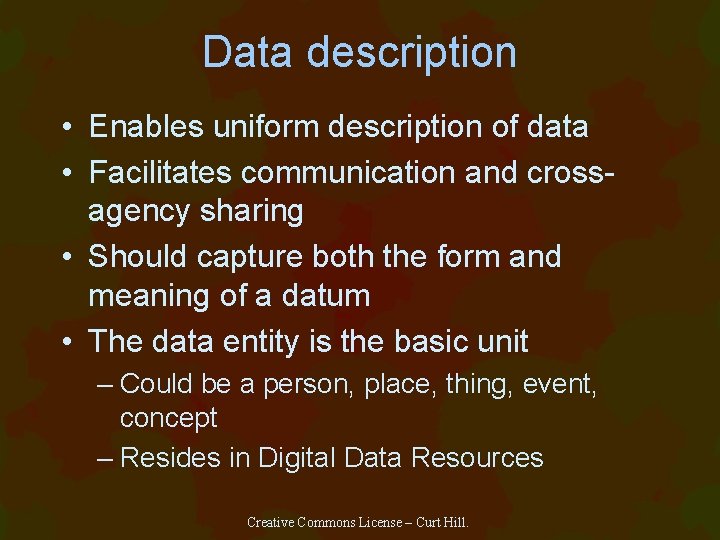
Data description • Enables uniform description of data • Facilitates communication and crossagency sharing • Should capture both the form and meaning of a datum • The data entity is the basic unit – Could be a person, place, thing, event, concept – Resides in Digital Data Resources Creative Commons License – Curt Hill.
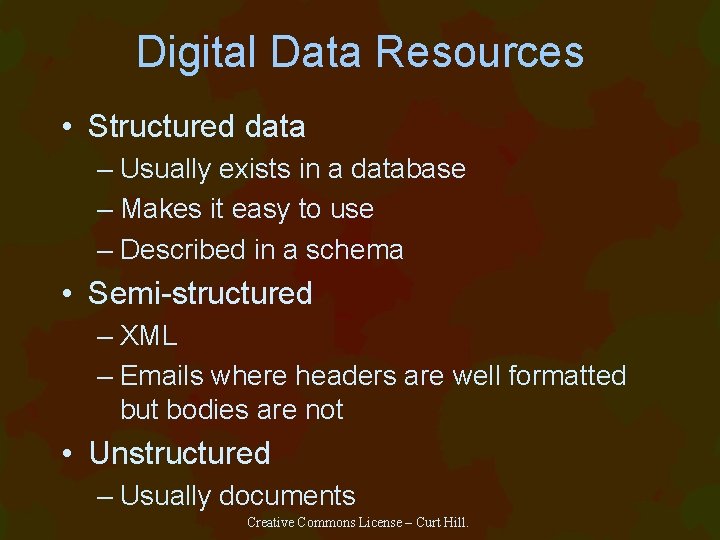
Digital Data Resources • Structured data – Usually exists in a database – Makes it easy to use – Described in a schema • Semi-structured – XML – Emails where headers are well formatted but bodies are not • Unstructured – Usually documents Creative Commons License – Curt Hill.
DRM Data Description Creative Commons License – Curt Hill.
Data Context • Enable identification and discovery of data • Link to other pieces of the Data Reference Model • Should give indication why the data was created or obtained – How is it being used • Data steward is person/committee that controls the data asset Creative Commons License – Curt Hill.
Data Sharing • One of the purposes of FEA is sharing data among agencies • There must be rules concerning how the data is shared • Data exchange – Fixed and recurring transactions between parties • Data access – Requests for data services Creative Commons License – Curt Hill.
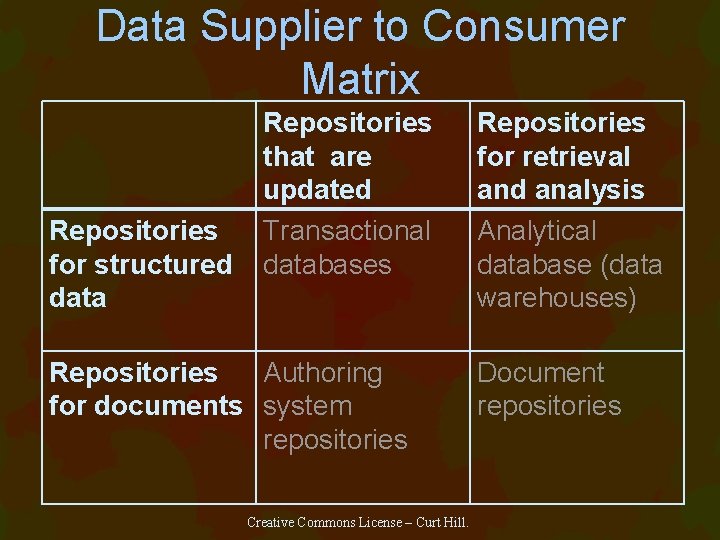
Data Supplier to Consumer Matrix Repositories for structured data Repositories that are updated Transactional databases Repositories Authoring for documents system repositories Creative Commons License – Curt Hill. Repositories for retrieval and analysis Analytical database (data warehouses) Document repositories
Exchange Package • Means of data exchange among agencies • Contains metadata about the exchange – Supplier and Consumer – Time for finding material – Content required for the exchange • Accesses a Data Asset (the source) at a specified Query Point Creative Commons License – Curt Hill.
Models? • Are these models or descriptions or standards? • The BRM, DRM, SRM, TRM look like prescriptive taxonomies • Put everything into a standard classification scheme so that everyone is speaking the same language • Reduce items to a three piece number so they are comparable Creative Commons License – Curt Hill.
Performance Reference Model (PRM) • Describes the cause and effect relationship between inputs, outputs and outcomes • Enhance performance information to improve daily and strategic decisions • Identify performance improvement opportunities – Especially those that span organizational boundaries Creative Commons License – Curt Hill.
Inputs Outcomes • Inputs – Those items that contribute to the production of the desired results • Outputs – Direct effects of day to day activities – Should align with Line of Business of BRM • Outcomes – Results aligned with Business Area and Sub-function of BRM – Customer perspective of agency’s work Creative Commons License – Curt Hill.
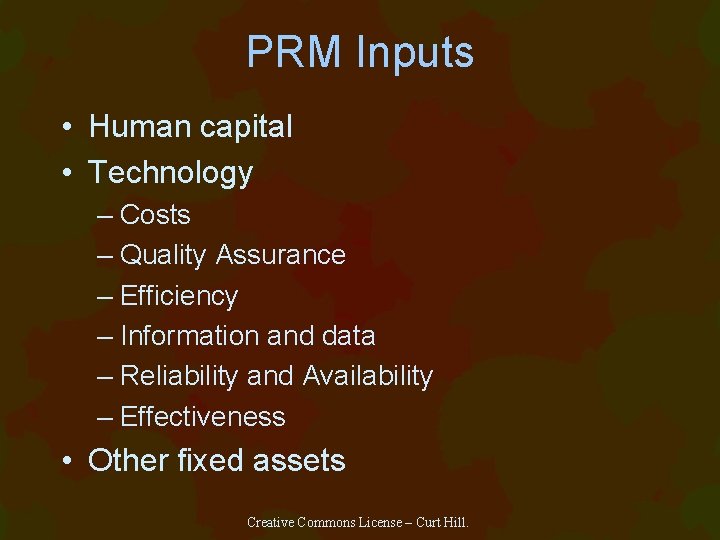
PRM Inputs • Human capital • Technology – Costs – Quality Assurance – Efficiency – Information and data – Reliability and Availability – Effectiveness • Other fixed assets Creative Commons License – Curt Hill.
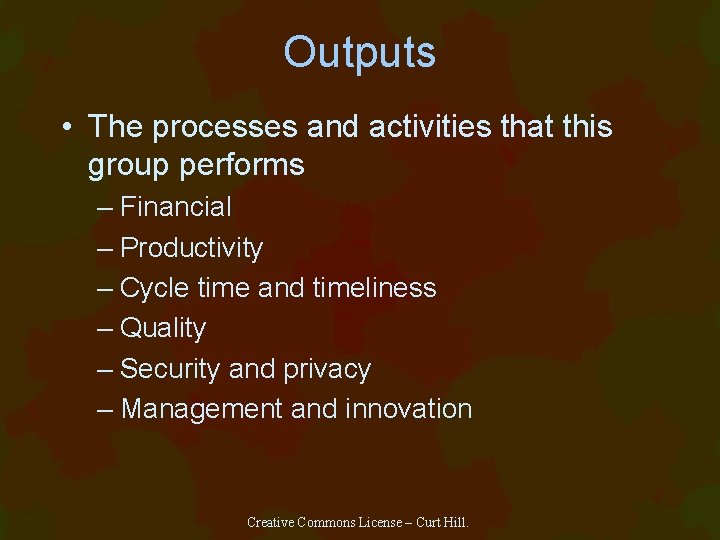
Outputs • The processes and activities that this group performs – Financial – Productivity – Cycle time and timeliness – Quality – Security and privacy – Management and innovation Creative Commons License – Curt Hill.
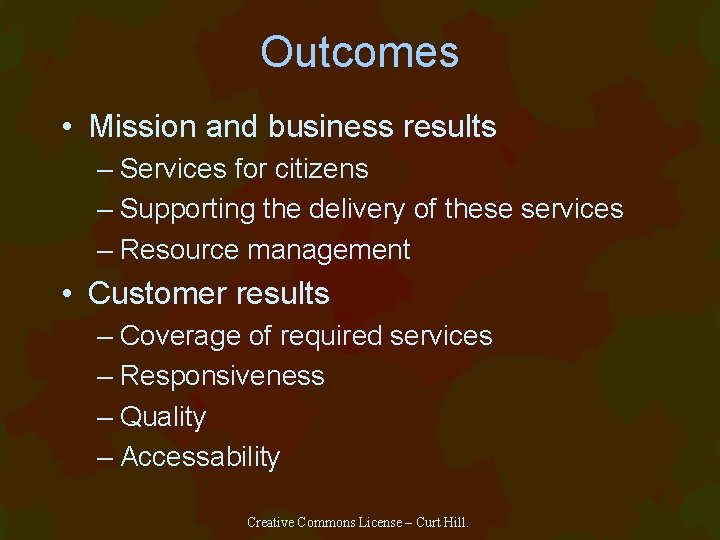
Outcomes • Mission and business results – Services for citizens – Supporting the delivery of these services – Resource management • Customer results – Coverage of required services – Responsiveness – Quality – Accessability Creative Commons License – Curt Hill.
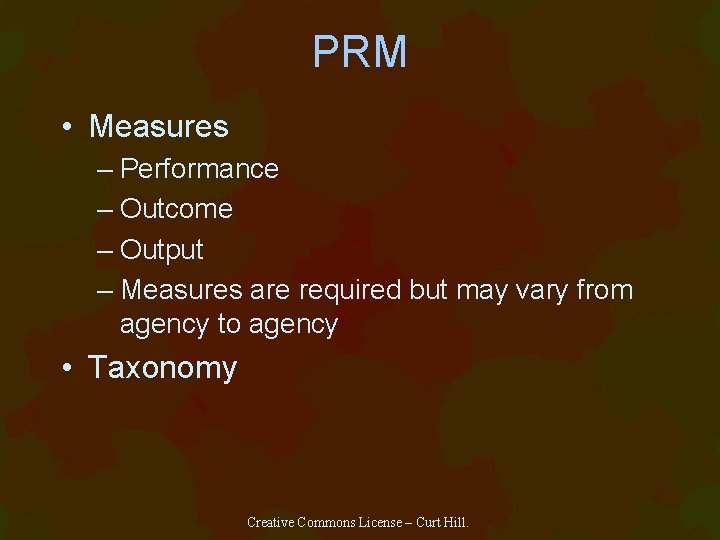
PRM • Measures – Performance – Outcome – Output – Measures are required but may vary from agency to agency • Taxonomy Creative Commons License – Curt Hill.
Performance Measures • Evaluate efficiency, effectiveness and results • Program outputs – Has the quantity of services or products met expectations? • Program outcomes – Has this program met the mission objectives? • These results should be quantitative – Statistics and other numerical indicators Creative Commons License – Curt Hill.
Outcome Measures • Describe the intended results of some activity • The outcome is external to the agency – Benefit may be to another government agency, external agency or citizens • There is a difference between outputs and outcomes – The contribution of outputs to outcomes must be shown Creative Commons License – Curt Hill.
Output Measures • Describe activity over a period of time • Describe the characteristics and compare these with the standards for them • Outputs are internal results that support external outcomes Creative Commons License – Curt Hill.
PRM Taxonomy • Four levels: • Measurement area – Mission and business results – Customer results – Processes and activities – Technology • Measurement category • Measurement grouping • Measurement indicator Creative Commons License – Curt Hill.
Taxonomy Example • In technology are the following categories – – – Technology costs Quality assurance Efficiency Information and data Reliability and availability Effectiveness • Inside quality assurance are the following groupings – Functionality – IT composition – Standard compliance and deviations • Many others Creative Commons License – Curt Hill.
Recall Roger Sessions • He rated the FEA highly in several areas – Reference model guidance – Partitioning guidance – Prescriptive catalog • No other framework got more 3 and 4 ratings Creative Commons License – Curt Hill.
Two Obvious Statements • No two entities in Federal Government overlap completely – That is have exactly the same purposes • For every entity there must be some other entity that has some common functions • FEA provides a very good way of direct comparison Creative Commons License – Curt Hill.
Finally • The FEA does not prescribe the organization of the group – That is usually done by Congress or the President • They establish a common language to compare workings of the groups • They are also a management tool to evaluate the functioning of the group • It may be the least general – It focuses on just government Creative Commons License – Curt Hill.