
Federal Coaching Network WHO A network to support
- Slides: 10
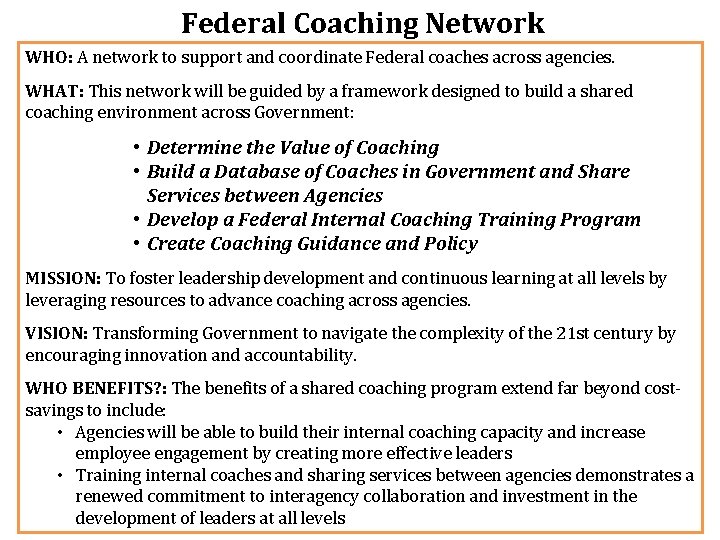
Federal Coaching Network WHO: A network to support and coordinate Federal coaches across agencies. WHAT: This network will be guided by a framework designed to build a shared coaching environment across Government: • Determine the Value of Coaching • Build a Database of Coaches in Government and Share Services between Agencies • Develop a Federal Internal Coaching Training Program • Create Coaching Guidance and Policy MISSION: To foster leadership development and continuous learning at all levels by leveraging resources to advance coaching across agencies. VISION: Transforming Government to navigate the complexity of the 21 st century by encouraging innovation and accountability. WHO BENEFITS? : The benefits of a shared coaching program extend far beyond costsavings to include: • Agencies will be able to build their internal coaching capacity and increase employee engagement by creating more effective leaders • Training internal coaches and sharing services between agencies demonstrates a renewed commitment to interagency collaboration and investment in the development of leaders at all levels
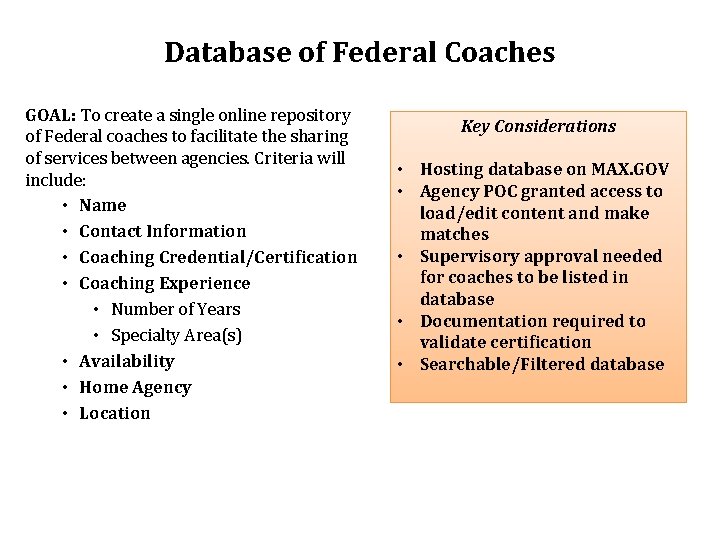
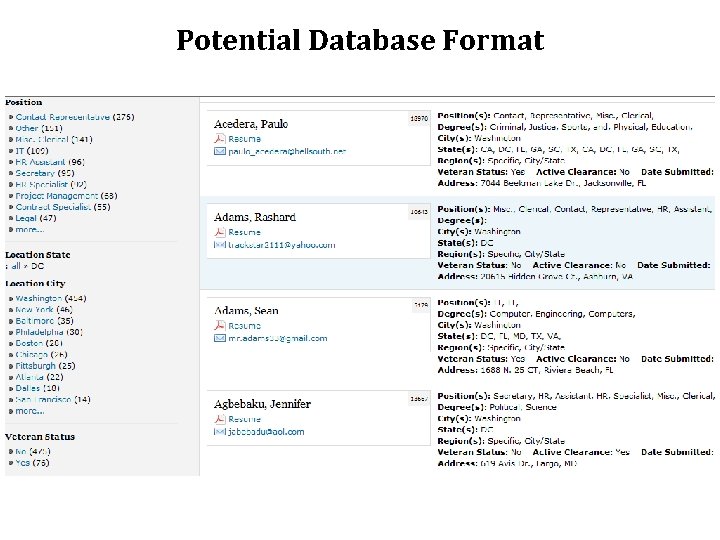
Database of Federal Coaches GOAL: To create a single online repository of Federal coaches to facilitate the sharing of services between agencies. Criteria will include: • Name • Contact Information • Coaching Credential/Certification • Coaching Experience • Number of Years • Specialty Area(s) • Availability • Home Agency • Location Key Considerations • Hosting database on MAX. GOV • Agency POC granted access to load/edit content and make matches • Supervisory approval needed for coaches to be listed in database • Documentation required to validate certification • Searchable/Filtered database
Potential Database Format
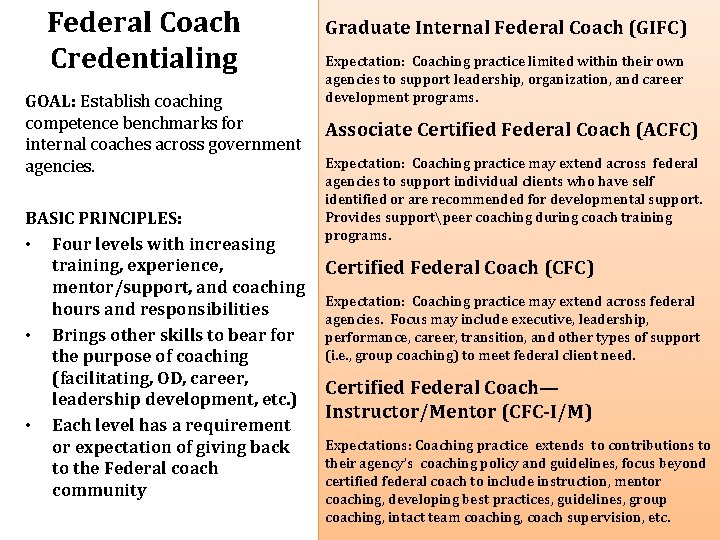
Federal Coach Credentialing GOAL: Establish coaching competence benchmarks for internal coaches across government agencies. BASIC PRINCIPLES: • Four levels with increasing training, experience, mentor/support, and coaching hours and responsibilities • Brings other skills to bear for the purpose of coaching (facilitating, OD, career, leadership development, etc. ) • Each level has a requirement or expectation of giving back to the Federal coach community Graduate Internal Federal Coach (GIFC) Expectation: Coaching practice limited within their own agencies to support leadership, organization, and career development programs. Associate Certified Federal Coach (ACFC) Expectation: Coaching practice may extend across federal agencies to support individual clients who have self identified or are recommended for developmental support. Provides supportpeer coaching during coach training programs. Certified Federal Coach (CFC) Expectation: Coaching practice may extend across federal agencies. Focus may include executive, leadership, performance, career, transition, and other types of support (i. e. , group coaching) to meet federal client need. Certified Federal Coach— Instructor/Mentor (CFC-I/M) Expectations: Coaching practice extends to contributions to their agency’s coaching policy and guidelines, focus beyond certified federal coach to include instruction, mentor coaching, developing best practices, guidelines, group coaching, intact team coaching, coach supervision, etc.
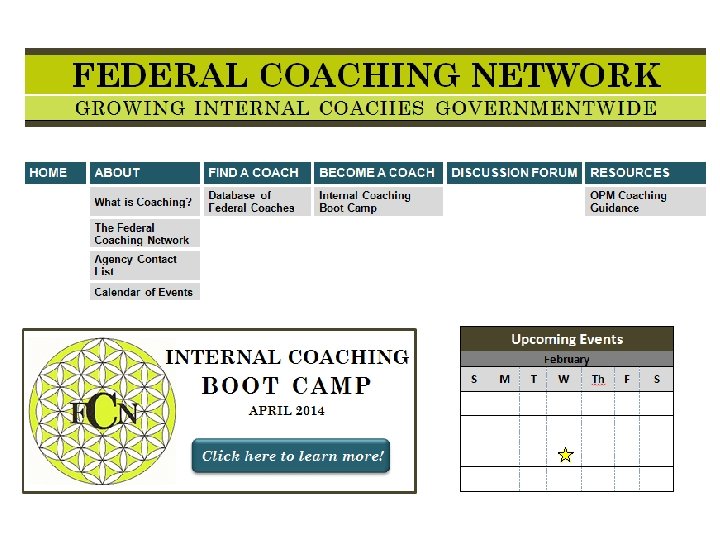
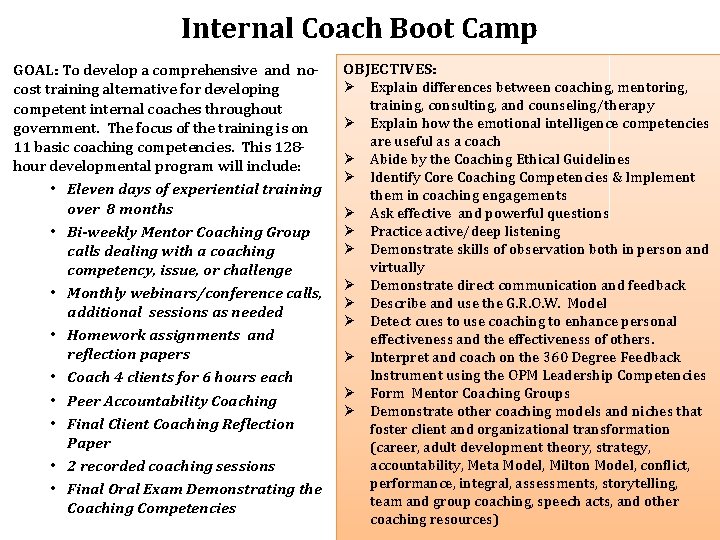
Internal Coach Boot Camp GOAL: To develop a comprehensive and nocost training alternative for developing competent internal coaches throughout government. The focus of the training is on 11 basic coaching competencies. This 128 hour developmental program will include: • Eleven days of experiential training over 8 months • Bi-weekly Mentor Coaching Group calls dealing with a coaching competency, issue, or challenge • Monthly webinars/conference calls, additional sessions as needed • Homework assignments and reflection papers • Coach 4 clients for 6 hours each • Peer Accountability Coaching • Final Client Coaching Reflection Paper • 2 recorded coaching sessions • Final Oral Exam Demonstrating the Coaching Competencies OBJECTIVES: Explain differences between coaching, mentoring, training, consulting, and counseling/therapy Explain how the emotional intelligence competencies are useful as a coach Abide by the Coaching Ethical Guidelines Identify Core Coaching Competencies & Implement them in coaching engagements Ask effective and powerful questions Practice active/deep listening Demonstrate skills of observation both in person and virtually Demonstrate direct communication and feedback Describe and use the G. R. O. W. Model Detect cues to use coaching to enhance personal effectiveness and the effectiveness of others. Interpret and coach on the 360 Degree Feedback Instrument using the OPM Leadership Competencies Form Mentor Coaching Groups Demonstrate other coaching models and niches that foster client and organizational transformation (career, adult development theory, strategy, accountability, Meta Model, Milton Model, conflict, performance, integral, assessments, storytelling, team and group coaching, speech acts, and other coaching resources)
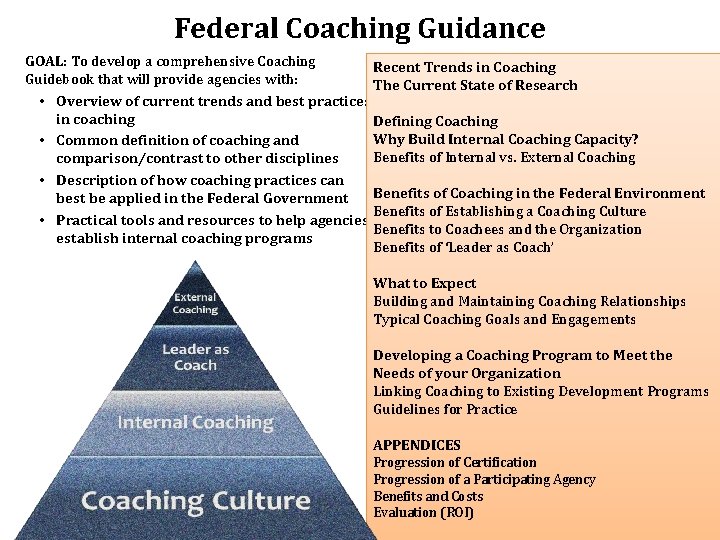
Federal Coaching Guidance GOAL: To develop a comprehensive Coaching Recent Trends in Coaching Guidebook that will provide agencies with: The Current State of Research • Overview of current trends and best practices in coaching Defining Coaching Why Build Internal Coaching Capacity? • Common definition of coaching and Benefits of Internal vs. External Coaching comparison/contrast to other disciplines • Description of how coaching practices can Benefits of Coaching in the Federal Environment best be applied in the Federal Government Benefits of Establishing a Coaching Culture • Practical tools and resources to help agencies Benefits to Coachees and the Organization establish internal coaching programs Benefits of ‘Leader as Coach’ What to Expect Building and Maintaining Coaching Relationships Typical Coaching Goals and Engagements Developing a Coaching Program to Meet the Needs of your Organization Linking Coaching to Existing Development Programs Guidelines for Practice APPENDICES Progression of Certification Progression of a Participating Agency Benefits and Costs Evaluation (ROI)
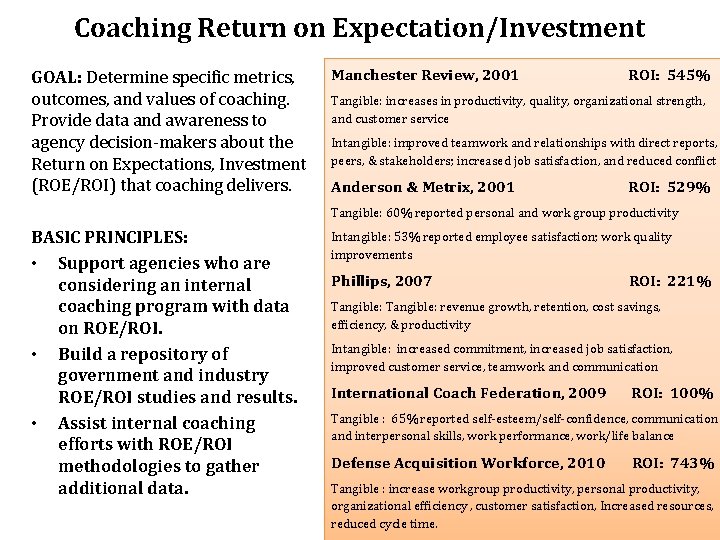
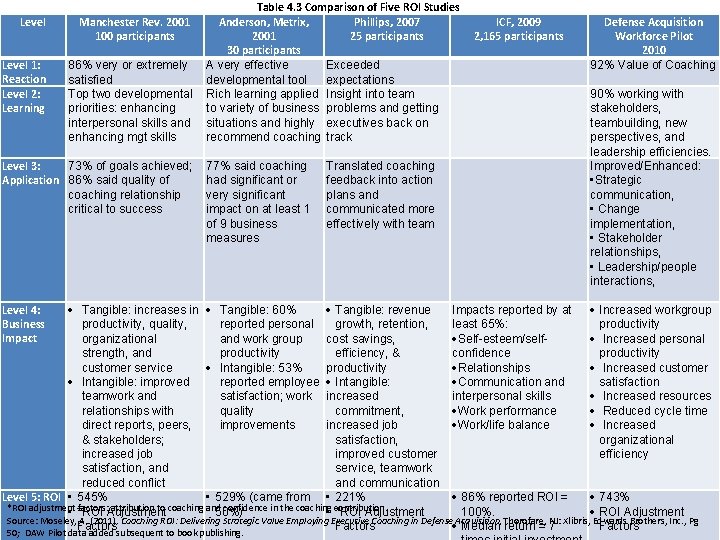
Coaching Return on Expectation/Investment GOAL: Determine specific metrics, outcomes, and values of coaching. Provide data and awareness to agency decision-makers about the Return on Expectations, Investment (ROE/ROI) that coaching delivers. Manchester Review, 2001 ROI: 545% Tangible: increases in productivity, quality, organizational strength, and customer service Intangible: improved teamwork and relationships with direct reports, peers, & stakeholders; increased job satisfaction, and reduced conflict Anderson & Metrix, 2001 ROI: 529% Tangible: 60% reported personal and work group productivity BASIC PRINCIPLES: • Support agencies who are considering an internal coaching program with data on ROE/ROI. • Build a repository of government and industry ROE/ROI studies and results. • Assist internal coaching efforts with ROE/ROI methodologies to gather additional data. Intangible: 53% reported employee satisfaction; work quality improvements Phillips, 2007 ROI: 221% Tangible: revenue growth, retention, cost savings, efficiency, & productivity Intangible: increased commitment, increased job satisfaction, improved customer service, teamwork and communication International Coach Federation, 2009 ROI: 100% Tangible : 65% reported self-esteem/self-confidence, communication and interpersonal skills, work performance, work/life balance Defense Acquisition Workforce, 2010 ROI: 743% Tangible : increase workgroup productivity, personal productivity, organizational efficiency , customer satisfaction, Increased resources, reduced cycle time.
Level 1: Reaction Level 2: Learning Table 4. 3 Comparison of Five ROI Studies Manchester Rev. 2001 Anderson, Metrix, Phillips, 2007 100 participants 2001 25 participants 30 participants 86% very or extremely A very effective Exceeded satisfied developmental tool expectations Top two developmental Rich learning applied Insight into team priorities: enhancing to variety of business problems and getting interpersonal skills and situations and highly executives back on enhancing mgt skills recommend coaching track Level 3: 73% of goals achieved; 77% said coaching Application 86% said quality of had significant or coaching relationship very significant critical to success impact on at least 1 of 9 business measures Translated coaching feedback into action plans and communicated more effectively with team ICF, 2009 2, 165 participants Defense Acquisition Workforce Pilot 2010 92% Value of Coaching 90% working with stakeholders, teambuilding, new perspectives, and leadership efficiencies. Improved/Enhanced: • Strategic communication, • Change implementation, • Stakeholder relationships, • Leadership/people interactions, Tangible: increases in Tangible: 60% Tangible: revenue Impacts reported by at Increased workgroup productivity, quality, reported personal growth, retention, least 65%: productivity organizational and work group cost savings, Self-esteem/self Increased personal strength, and productivity efficiency, & confidence productivity customer service Intangible: 53% productivity Relationships Increased customer Intangible: improved reported employee Intangible: Communication and satisfaction teamwork and satisfaction; work increased interpersonal skills Increased resources relationships with quality commitment, Work performance Reduced cycle time direct reports, peers, improvements increased job Work/life balance Increased & stakeholders; satisfaction, organizational increased job improved customer efficiency satisfaction, and service, teamwork reduced conflict and communication Level 5: ROI • 545% • 529% (came from • 221% 86% reported ROI = 743% *ROI adjustment factors: attribution to coaching and confidence in the coaching • *ROI Adjustment 50%) • contribution. *ROI Adjustment 100%. ROI Adjustment Source: Moseley, A. (2011). Coaching ROI: Delivering Strategic Value Employing Executive Coaching in Defense Acquisition, Thorofare, NJ: Xlibris, Edwards Brothers, Inc. , Pg Factors Median return = 7 Factors 50; DAW Pilot data added subsequent to book publishing. Level 4: Business Impact
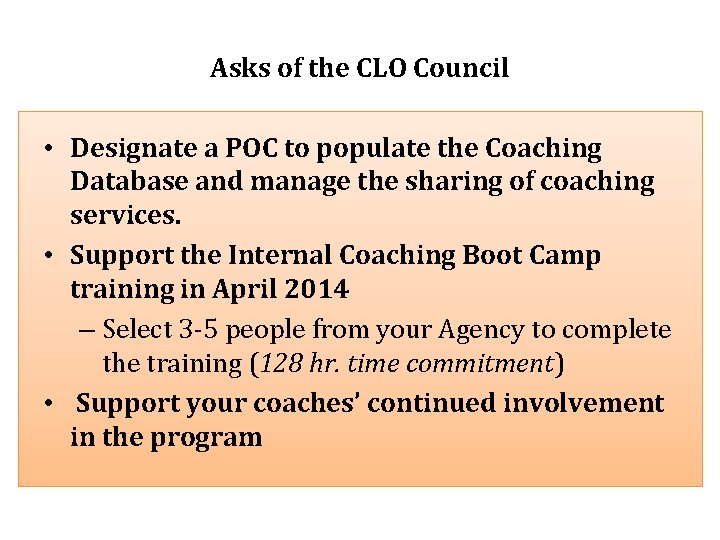
Asks of the CLO Council • Designate a POC to populate the Coaching Database and manage the sharing of coaching services. • Support the Internal Coaching Boot Camp training in April 2014 – Select 3 -5 people from your Agency to complete the training (128 hr. time commitment) • Support your coaches’ continued involvement in the program