
Federal Aviation Administration Draft Halon 1211 ASTM Standard
- Slides: 17
Federal Aviation Administration Draft Halon 1211 ASTM Standard Louise Speitel Fire Safety Branch FAA Wm. J. Hughes Technical Center Atlantic City International Airport, NJ 08405 International Aircraft Systems Fire Protection Working Group May 18, 2010 London, UK
Outline • Scope • Referenced Documents • Material Requirements • Sampling • Test Methods • Container, Packaging, and Package Marking Halon 1211 ASTM Standard Federal Aviation Administration 2 2
Scope of Halon 1211 Specification • Requirements for Halon 1211 as a Firefighting Medium. • Does not Address the Fire Fighting Equipment • Does not Address Storage or Transportation • Modeled after Halon 1301 Specification Halon 1211 ASTM Standard Federal Aviation Administration 3 3
Referenced Documents • ISO 3427 Gaseous Halogenated Hydrocarbons: Taking a Sample • ARI Standard 700 -2006 : Analytical Procedures • US Government Standards. ØCode of Federal Regulations (CFR) Title 49, Part 172. 101, Tables of Hazardous Materials and Special Provisions Ø Code of Federal Regulations (CFR) Title 49, Part 172 Subpart D, Marking Requirements of Packaging for Transportation Halon 1211 ASTM Standard Federal Aviation Administration 4 4
Material Requirements • Type 1: Mixed with Nitrogen Ø Nitrogen Partial Pressure and Fill Density: Safe working pressure of the receiving vessel shall not be exceeded at the maximum envisioned storage temperature: Ø Purity Requirements and Method of Analysis Ø When Material Analysis is Required: Partial pressure of nitrogen and Halon 1211 fill density within the container, and the maximum safe storage temperature shall be a part of the material Analysis Halon 1211 ASTM Standard Federal Aviation Administration 5 5
Material Requirements (Cont. ) • Type 2: Ø Halon 1211 shall conform to the requirements of Type 1. Ø Halon 1211 shall contain no more than 1. 5% by volume fixed gases in the vapor phase expressed as air when tested by the appropriate method listed in section 6. Ø By agreement with the purchaser and the supplier, analysis may be required and limits established for elements or compounds not specified in Table 1. Ø Unless otherwise specified, Type 1 is assumed. Halon 1211 ASTM Standard Federal Aviation Administration 6 6
Sampling • Samples Shall be Taken from the Liquid or Vapor Phase as Appropriate • Liquid Phase Sampling Ø Per ISO 3427 or Ø ARI 2008 Standard 700 -2006, part 7, Appendix C Ø The sampling vessel shall be capable of safely resisting the vapor pressure of the sample at the highest temperature that could be encountered during handling, storage, or transport. Halon 1211 ASTM Standard Federal Aviation Administration 7 7
Test Methods • Purity by Gas Chromatography/ Mass Spectroscopy (GC/MS) • Acidity per ARI Standard 700 -2006 • Water Content per ARI Standard 700 -2006 • Nonvolatile Residue per ARI Standard 700 -2006 • Non-condensable Gases per ARI Standard 700 -2006 • Suspended Matter and Sediment Observation of any suspended matter or sediment in the nonvolatile residue test shall constitute failure of this test. Halon 1211 ASTM Standard Federal Aviation Administration 8 8
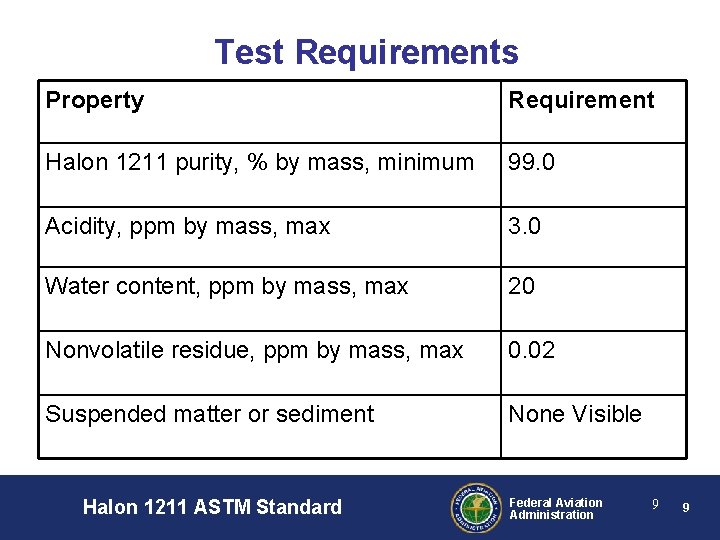
Test Requirements Property Requirement Halon 1211 purity, % by mass, minimum 99. 0 Acidity, ppm by mass, max 3. 0 Water content, ppm by mass, max 20 Nonvolatile residue, ppm by mass, max 0. 02 Suspended matter or sediment None Visible Halon 1211 ASTM Standard Federal Aviation Administration 9 9
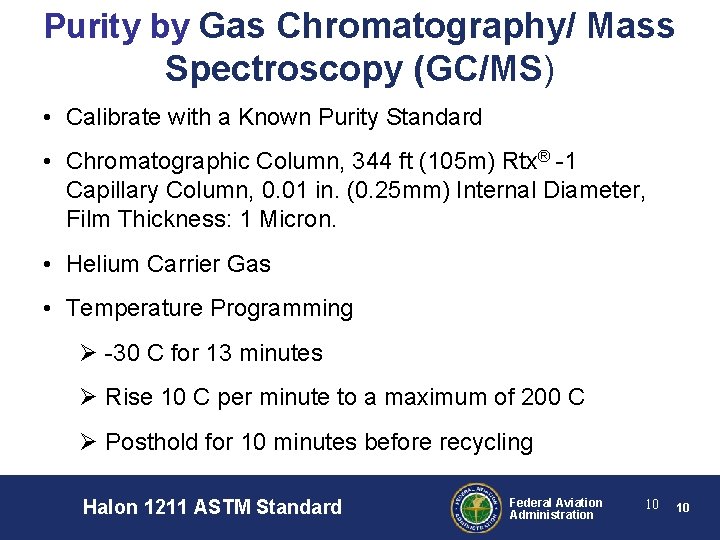
Purity by Gas Chromatography/ Mass Spectroscopy (GC/MS) • Calibrate with a Known Purity Standard • Chromatographic Column, 344 ft (105 m) Rtx® -1 Capillary Column, 0. 01 in. (0. 25 mm) Internal Diameter, Film Thickness: 1 Micron. • Helium Carrier Gas • Temperature Programming Ø -30 C for 13 minutes Ø Rise 10 C per minute to a maximum of 200 C Ø Posthold for 10 minutes before recycling Halon 1211 ASTM Standard Federal Aviation Administration 10 10
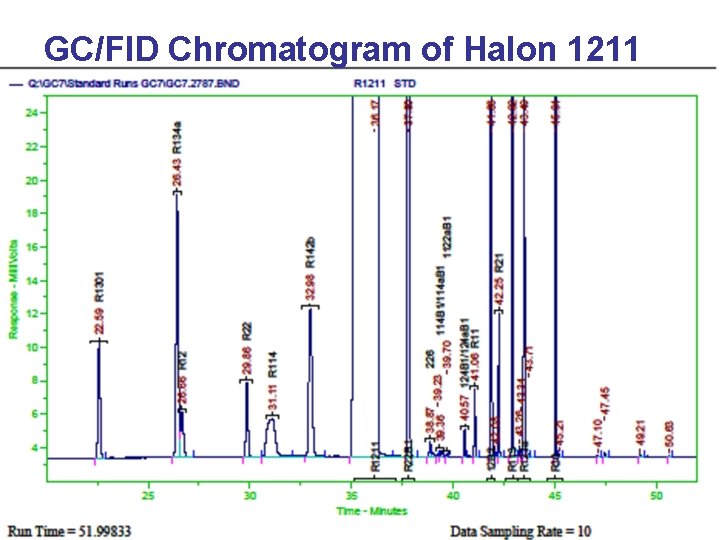
GC/FIDChromatogramofof. Halon 1211 ASTM Standard Federal Aviation Administration 11 11
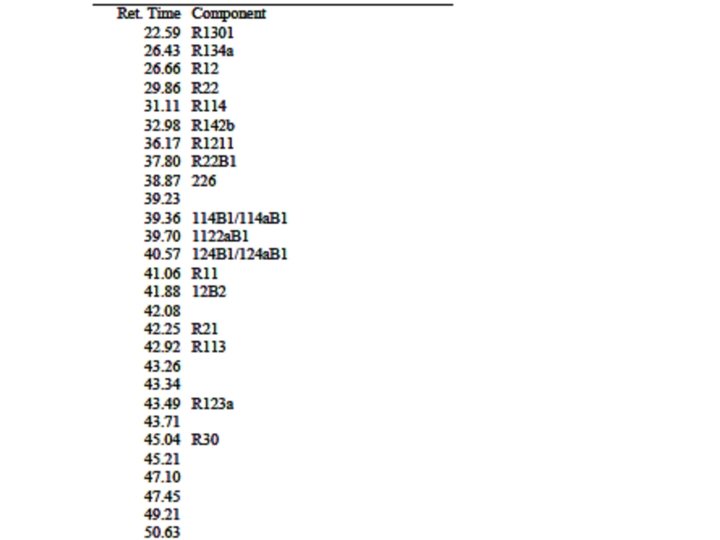
GC/FID Chromatogram of Halon 1211 ASTM Standard Federal Aviation Administration 12 12
Lingering Concerns • Purity by Gas Chromatography/ Mass Spectroscopy (GC/MS) vs. GC/FID Ø The current GC/FID testing methodology would have failed for the contaminated Halon 1211 samples. Ø GC/MS: $80 K – 150 K vs. GC/FID: $15 K- 25 K Ø GC/MS Much higher cost for chemist/analyst Ø MS detector requires more maintenance than flame ionization detector (FID) Halon 1211 ASTM Standard Federal Aviation Administration 13 13
Solutions to Consider: • ASTM may be able to specify a reporting format that will enable detection of alterations after it leaves the test lab. • IF GC/FID is used: Ø ASTM can build into the test methods detection means for contaminates that are not calibrated in the purity methods. Ø Using the FID detector creates a severe penalty for any hydrocarbons present. Since the hydrocarbons have response factors at least 10 times higher than an average fully halogenated fluorocarbon, their amounts are exaggerated in the GC purity test. Ø The response factors for unknowns can be set to exaggerate the amount of material present, so there is a severe penalty for having unknowns in the sample Ø When a significant unknown is observed, a GC/MS analysis can be performed to positively identify the unknown. If it appears on a consistent basis, add it to the standard and calibrate for it (and it stops being an unknown). Halon 1211 ASTM Standard Federal Aviation Administration 14 14
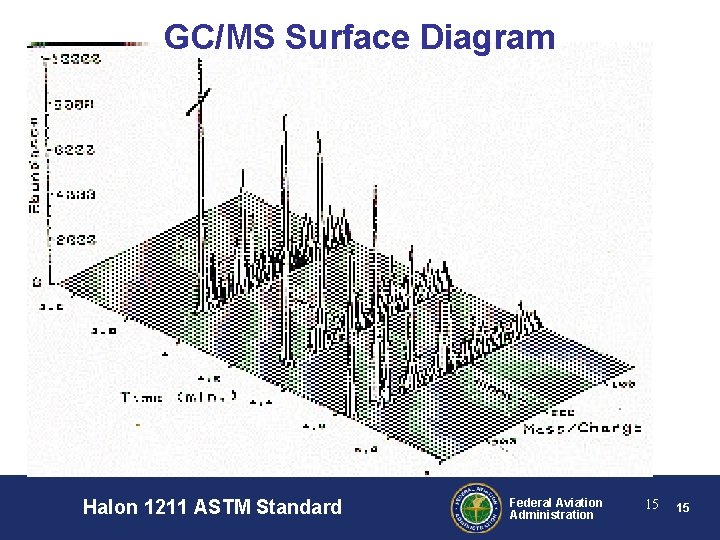
GC/MS Surface Diagram Halon 1211 ASTM Standard Federal Aviation Administration 15 15
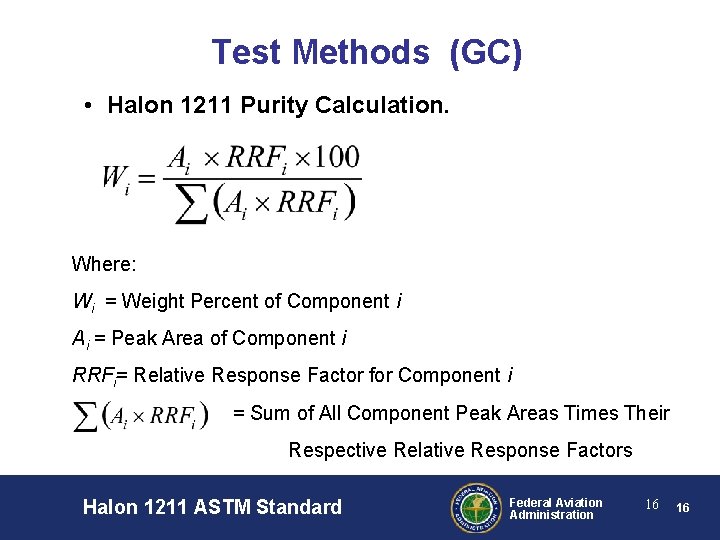
Test Methods (GC) • Halon 1211 Purity Calculation. Where: Wi = Weight Percent of Component i Ai = Peak Area of Component i RRFi= Relative Response Factor for Component i = Sum of All Component Peak Areas Times Their Respective Relative Response Factors Halon 1211 ASTM Standard Federal Aviation Administration 16 16
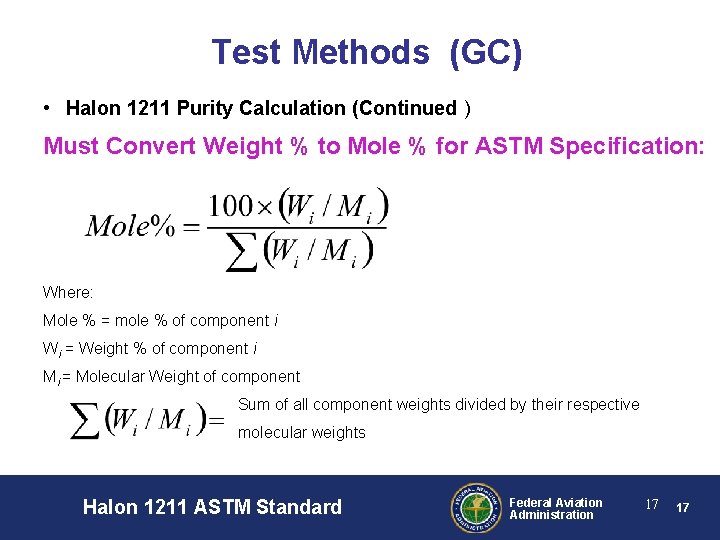
Test Methods (GC) • Halon 1211 Purity Calculation (Continued ) Must Convert Weight % to Mole % for ASTM Specification: Where: Mole % = mole % of component i Wi = Weight % of component i Mi = Molecular Weight of component Sum of all component weights divided by their respective molecular weights Halon 1211 ASTM Standard Federal Aviation Administration 17 17