
Federal Aviation Administration ADSB Regulations Standards and Guidance
Federal Aviation Administration ADS-B Regulations, Standards and Guidance Presented by: Don Walker FAA (AIR-130) Presented to: ICAO ADS-B Seminar
Overview • US ADS-B Final Rule • ADS-B Published Standards – Flight Standards – ADS-B Out – ABS-B In • ADS-B Applications Currently in Development • TCAS II Future Activities ADS-B Standards and Guidance Federal Aviation Administration 2
US ADS-B Final Rule: Overview • On May 27, 2010, the FAA published the Final Rule for ADS-B Out equipage – Mandates performance requirements for ADS-B avionics that will be required to fly in certain airspace by 1 -Jan-2020 – ADS-B Out transmits location information received from a Global Navigation Satellite System out of the aircraft to ADS-B ground stations and to other aircraft equipped to receive ADSB broadcasts. The rule does not preclude other navigation source methods. – This rule does not mandate ADS-B In • A new Aviation Rulemaking Committee (ARC) was chartered in June 2010 to address ADS-B In strategy Surveillance and Broadcast Services ADS-B Standards and Guidance Federal Aviation Administration 3
ADS-B Final Rule: Dual Frequencies • Two frequencies have been designated for ADS-B transmissions in the National Airspace System: 1. 1090 Extended Squitter MHz (1090 ES) for commercial aircraft 2. Universal Access Transceiver 978 MHz (UAT) for general aviation and airport vehicles. This frequency is needed because of the high-bandwidth required to transmit the weather data that is most beneficial for general aviation aircraft. • The rule requires all aircraft flying in Class A airspace (Flight Level 180 and above) to transmit on the 1090 ES MHz link • The rule does not preclude aircraft from equipping with both the 1090 ES MHz and 978 MHz or general aviation equipping with 1090 ES MHz Surveillance and Broadcast Services ADS-B Standards and Guidance Federal Aviation Administration 4
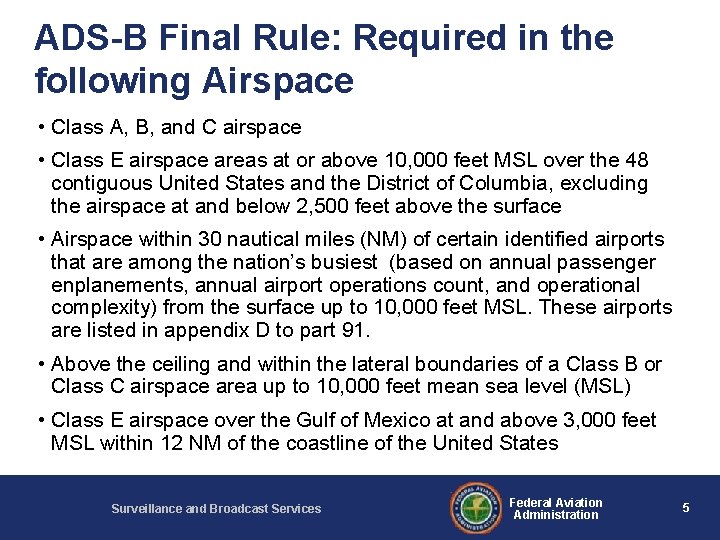
ADS-B Final Rule: Required in the following Airspace • Class A, B, and C airspace • Class E airspace areas at or above 10, 000 feet MSL over the 48 contiguous United States and the District of Columbia, excluding the airspace at and below 2, 500 feet above the surface • Airspace within 30 nautical miles (NM) of certain identified airports that are among the nation’s busiest (based on annual passenger enplanements, annual airport operations count, and operational complexity) from the surface up to 10, 000 feet MSL. These airports are listed in appendix D to part 91. • Above the ceiling and within the lateral boundaries of a Class B or Class C airspace area up to 10, 000 feet mean sea level (MSL) • Class E airspace over the Gulf of Mexico at and above 3, 000 feet MSL within 12 NM of the coastline of the United States Surveillance and Broadcast Services ADS-B Standards and Guidance Federal Aviation Administration 5
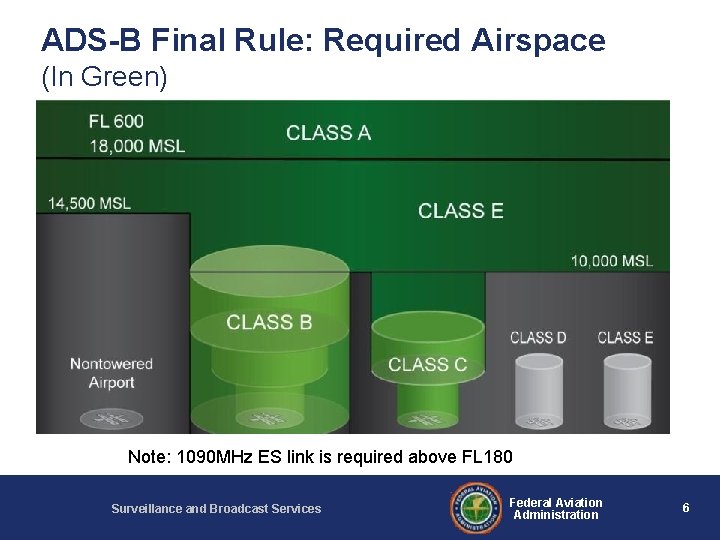
ADS-B Final Rule: Required Airspace (In Green) Note: 1090 MHz ES link is required above FL 180 Surveillance and Broadcast Services ADS-B Standards and Guidance Federal Aviation Administration 6
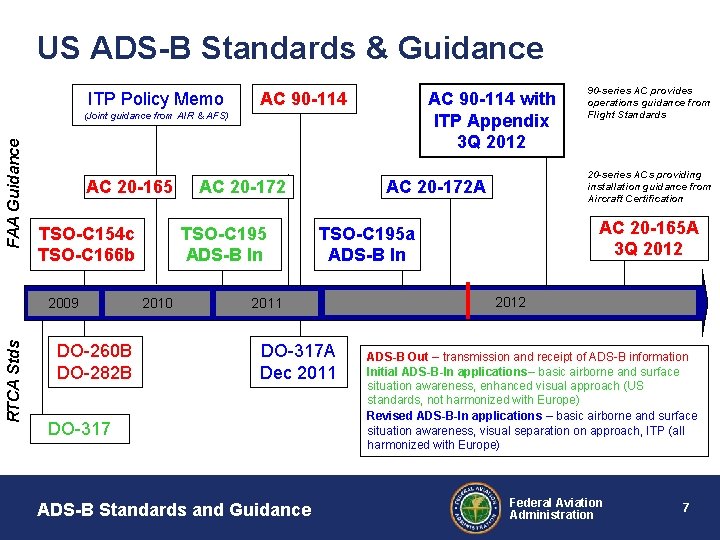
US ADS-B Standards & Guidance ITP Policy Memo AC 90 -114 with ITP Appendix 3 Q 2012 FAA Guidance (Joint guidance from AIR & AFS) AC 20 -165 TSO-C 154 c TSO-C 166 b RTCA Stds 2009 DO-260 B DO-282 B AC 20 -172 TSO-C 195 ADS-B In 2010 ADS-B Standards and Guidance AC 20 -165 A 3 Q 2012 TSO-C 195 a ADS-B In DO-317 A Dec 2011 DO-317 20 -series ACs providing installation guidance from Aircraft Certification AC 20 -172 A 2011 90 -series AC provides operations guidance from Flight Standards 2012 ADS-B Out – transmission and receipt of ADS-B information Initial ADS-B-In applications– basic airborne and surface situation awareness, enhanced visual approach (US standards, not harmonized with Europe) Revised ADS-B-In applications – basic airborne and surface situation awareness, visual separation on approach, ITP (all harmonized with Europe) Federal Aviation Administration 7
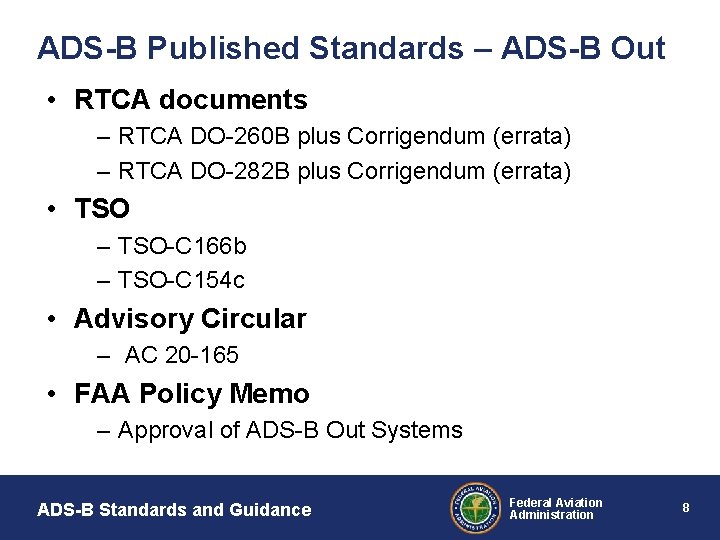
ADS-B Published Standards – ADS-B Out • RTCA documents – RTCA DO-260 B plus Corrigendum (errata) – RTCA DO-282 B plus Corrigendum (errata) • TSO – TSO-C 166 b – TSO-C 154 c • Advisory Circular – AC 20 -165 • FAA Policy Memo – Approval of ADS-B Out Systems ADS-B Standards and Guidance Federal Aviation Administration 8
Operational Approval Strategy • No authorization required for ADS-B Out in US – Requires Version 2 avionics to be visible to ATC (DO-260 B, DO-282 B) • Authorization for ADS-B Out where required by other States – Example A 353 for Canada, Australia or others which reference AMC 20 -24 • Authorization required for ADS-B In applications – For other than situational awareness ADS-B Standards and Guidance Federal Aviation Administration 9
Operational Approval Strategy • Initial authorizations requires headquarters review/approval – – For duration of operational evaluation Based on existing standards, policy For specific airlines Example A 354, for ITP • Ultimately authorization to be approved by Regional/Local authority – Once operational requirements are understood – With published guidance ADS-B Standards and Guidance Federal Aviation Administration 10
Cert and Ops Approval Basis – ITP example • Policy Memorandum (May 2010) – Clarifies and amends DO-312 (ITP SPR) • • • Requires conformance monitoring throughout procedure Requires graphical display to monitor relative position of A/C Requires DCPC, recommended CPDLC – Requires TCAS Validation of Version 0 and 1 Traffic – Requires velocity validation ADS-B Standards and Guidance Federal Aviation Administration 11
Cert and Ops Approval Basis – ITP example • Policy Memorandum (May 2010) – Interim Policy and Guidance for ADS-B ASA Systems Supporting Oceanic In-Trail Procedures (ITP) – Between Flight Standards and Aircraft Certification Services – Forms airworthiness and operational approval basis • Until Technical Standards Order (TSO) and ITP AC published ADS-B Standards and Guidance Federal Aviation Administration 12
Op. Spec A 354 Highlights – ITP example • Airworthiness requirements – Must be installed by TC or STC – Must have an approved maintenance program with instructions for continued airworthiness (ICA) • ITP Equipment specific requirements – CDTI may be hosted on EFB (Auxiliary Display) – EFB must be Class 3, with type C software • Airplane flight manual – Must incorporate ADS-B and ITP subject matter ADS-B Standards and Guidance Federal Aviation Administration 13
Op. Spec A 354 Highlights – ITP example • Required flight crew/dispatch training – Must complete approved training – ITP specific operating procedures and limitations – MEL considerations, flight planning and ITP communications • Aircraft authorization – Specifies each aircraft by serial number – Specifies ITP configuration • Surveillance processor, transponder and display by part number ADS-B Standards and Guidance Federal Aviation Administration 14
ADS-B Guidance • AC 90 -114, Automatic Dependent Surveillance – Broadcast (ADS-B) Operations – General ADS-B guidance – Appendix for A 353, ADS-B OUT OPERATIONS OUTSIDE OF U. S. -DESIGNATED AIRSPACE – Appendix for ITP by end of September 2012 • • Incorporates lessons learned from Operational Trials Will supersede ITP Policy Memo – Appendices for other ADS-B In operations will come • As the operational and training issues are understood ADS-B Standards and Guidance Federal Aviation Administration 15
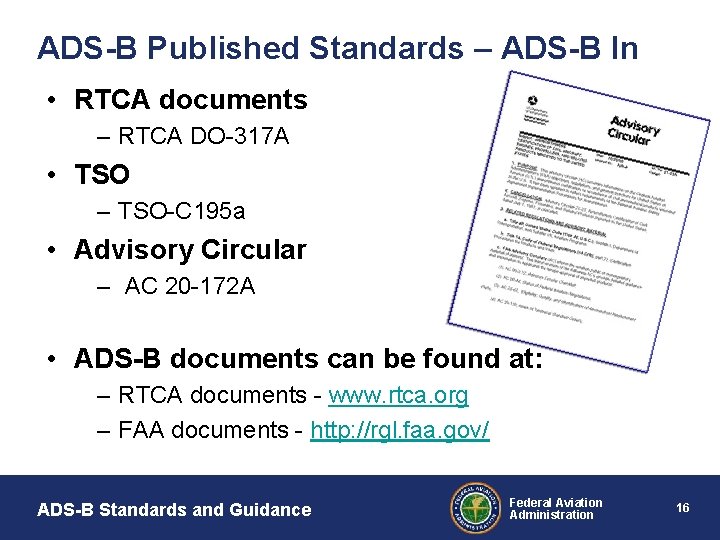
ADS-B Published Standards – ADS-B In • RTCA documents – RTCA DO-317 A • TSO – TSO-C 195 a • Advisory Circular – AC 20 -172 A • ADS-B documents can be found at: – RTCA documents - www. rtca. org – FAA documents - http: //rgl. faa. gov/ ADS-B Standards and Guidance Federal Aviation Administration 16
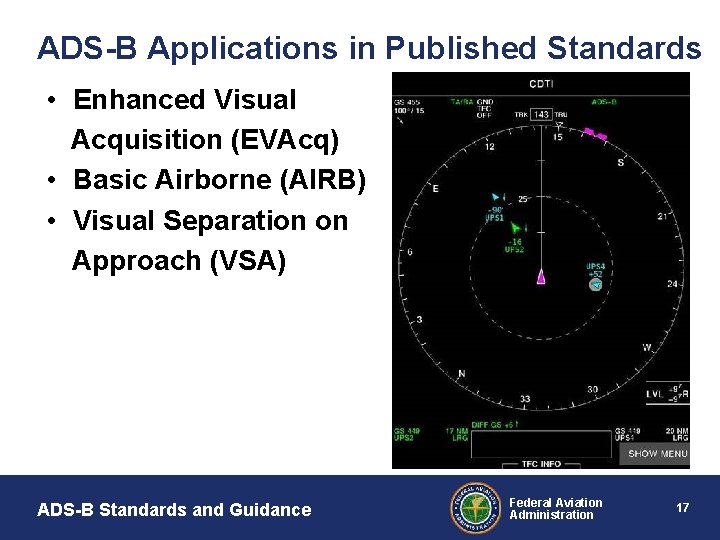
ADS-B Applications in Published Standards • Enhanced Visual Acquisition (EVAcq) • Basic Airborne (AIRB) • Visual Separation on Approach (VSA) ADS-B Standards and Guidance Federal Aviation Administration 17
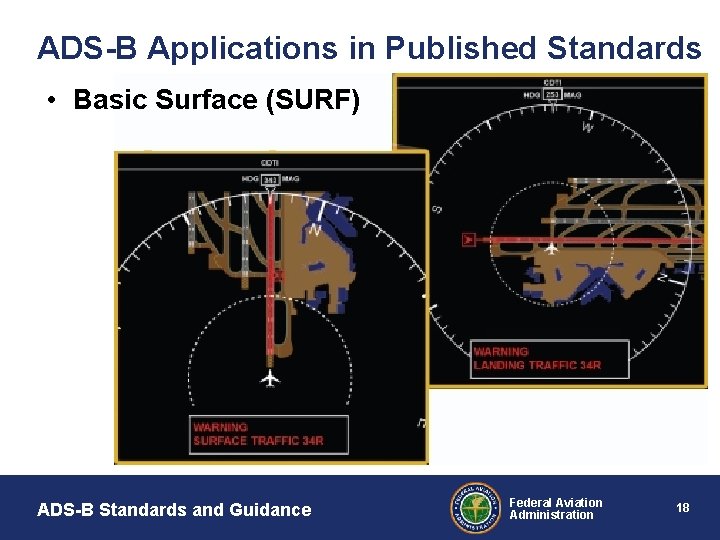
ADS-B Applications in Published Standards • Basic Surface (SURF) ADS-B Standards and Guidance Federal Aviation Administration 18
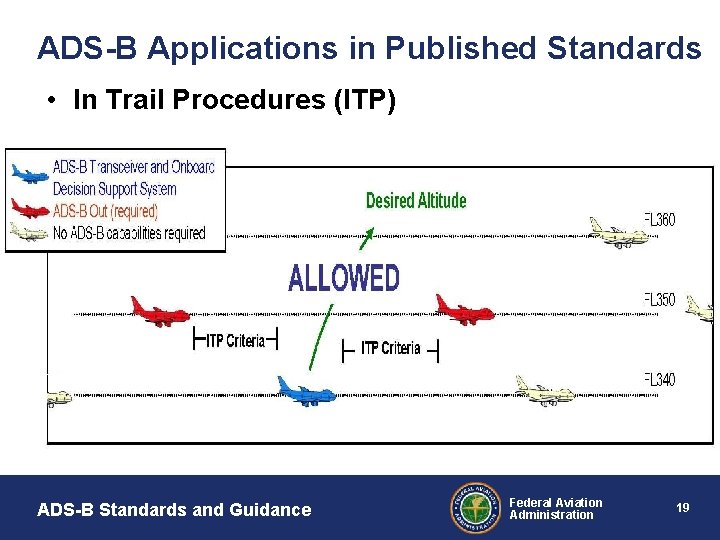
ADS-B Applications in Published Standards • In Trail Procedures (ITP) ADS-B Standards and Guidance Federal Aviation Administration 19
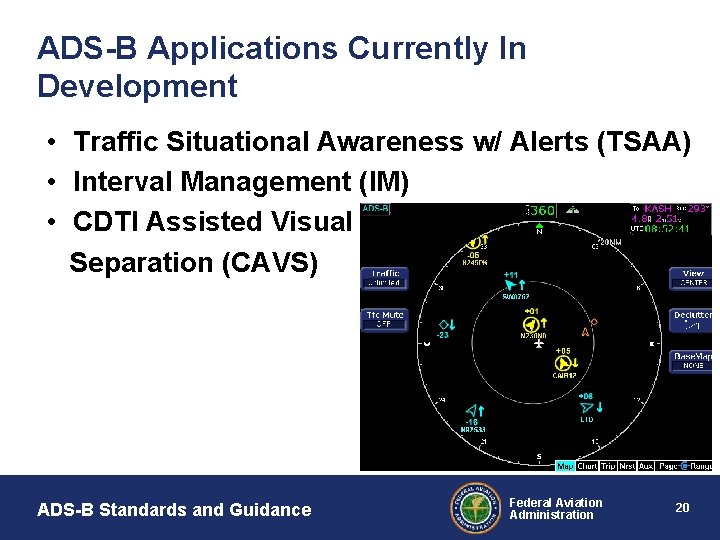
ADS-B Applications Currently In Development • Traffic Situational Awareness w/ Alerts (TSAA) • Interval Management (IM) • CDTI Assisted Visual Separation (CAVS) ADS-B Standards and Guidance Federal Aviation Administration 20
TCAS Activities • Revised TCAS standards – Modification to the TCAS II MOPS In-Band Acceptance requirements to document TCAS and ADS-B combined receiver – Improving spectrum efficiency of Hybrid surveillance • Published a report of recommendations for future collision avoidance systems • Research commencing on next generation of TCAS – called “ACAS X” ADS-B Standards and Guidance Federal Aviation Administration 21
Don Walker FAA AIR-130 Surveillance Team Lead don. walker@faa. gov Phone: 202 -385 -4821 ADS-B Standards and Guidance Federal Aviation Administration 22
- Slides: 22