
Federal Acquisition Certification for Program and Project Managers


- Slides: 36
Federal Acquisition Certification for Program and Project Managers Jeff Surprenant , Team Lead, Curriculum Development Peter Schmidt, PMP, Director Client Engagements ESI International www. esi-intl. com
Agenda The PM “Course of Study” October 14, 2009 FAC-P/PM: Back to Basics Updates and Next Steps building talent. driving results.
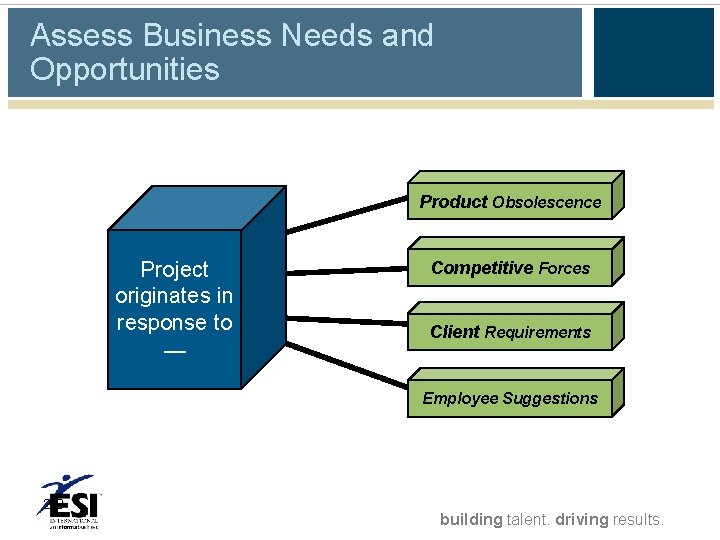
Assess Business Needs and Opportunities Product Obsolescence Project originates in response to — Competitive Forces Client Requirements Employee Suggestions 2 -3 building talent. driving results.
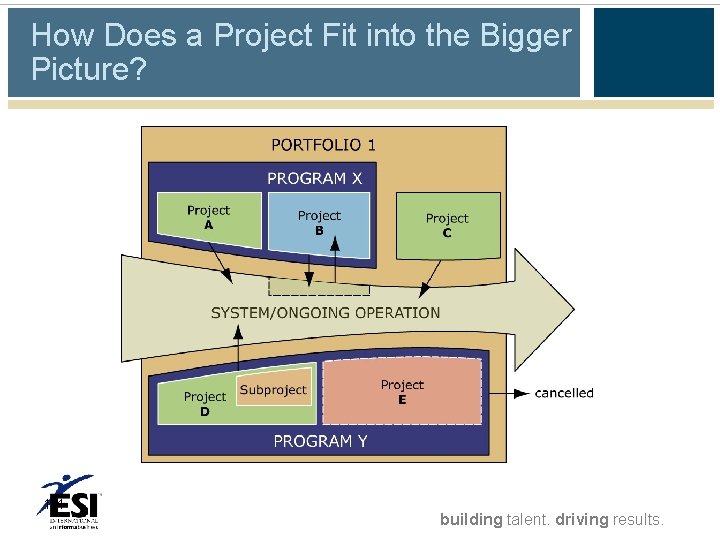
How Does a Project Fit into the Bigger Picture? 1 -4 building talent. driving results.
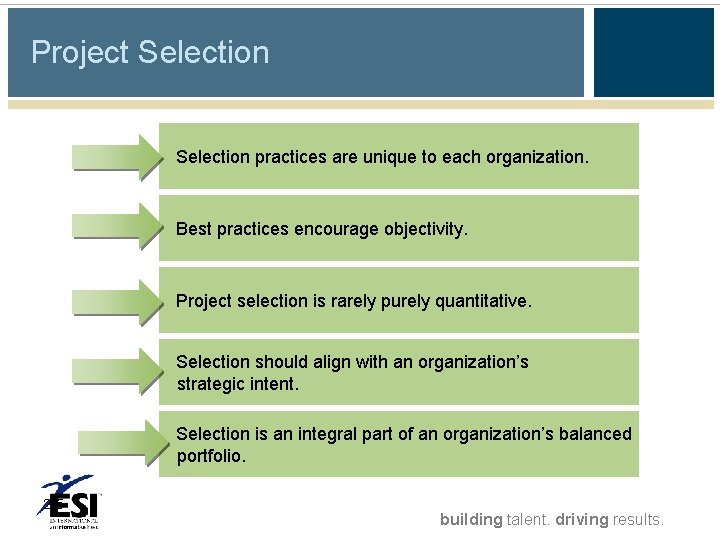
Project Selection practices are unique to each organization. Best practices encourage objectivity. Project selection is rarely purely quantitative. Selection should align with an organization’s strategic intent. Selection is an integral part of an organization’s balanced portfolio. 2 -5 building talent. driving results.
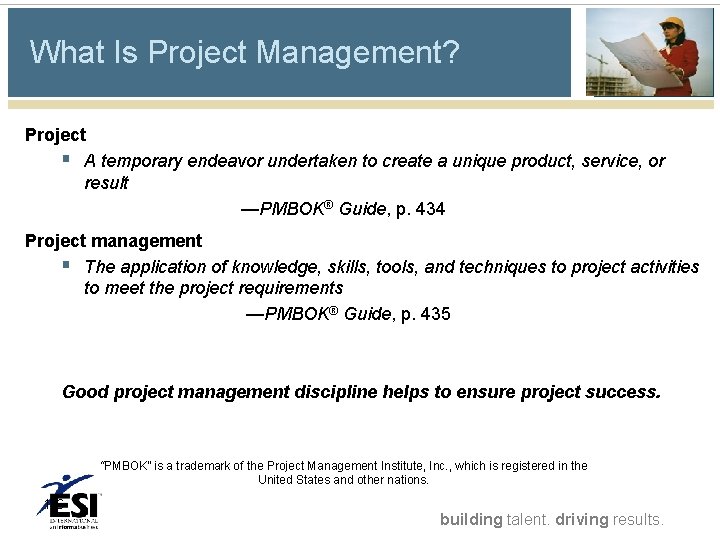
What Is Project Management? Project § A temporary endeavor undertaken to create a unique product, service, or result —PMBOK® Guide, p. 434 Project management § The application of knowledge, skills, tools, and techniques to project activities to meet the project requirements —PMBOK® Guide, p. 435 Good project management discipline helps to ensure project success. “PMBOK” is a trademark of the Project Management Institute, Inc. , which is registered in the United States and other nations. 1 -6 building talent. driving results.
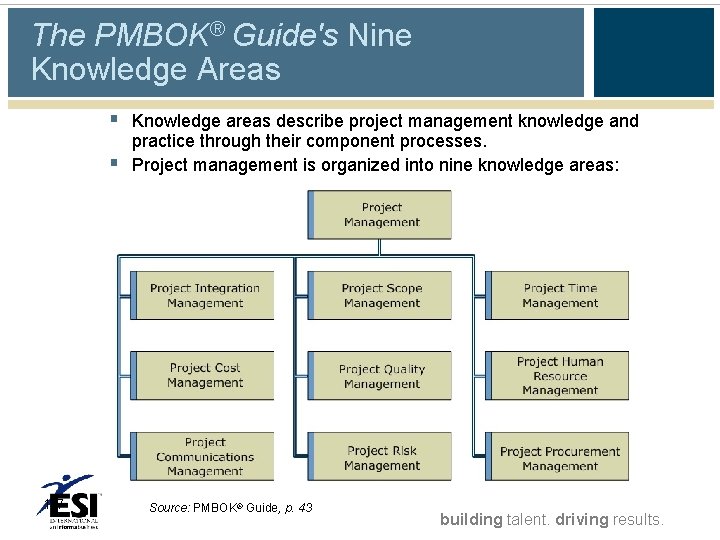
The PMBOK® Guide's Nine Knowledge Areas § Knowledge areas describe project management knowledge and § 1 -7 practice through their component processes. Project management is organized into nine knowledge areas: Source: PMBOK® Guide, p. 43 building talent. driving results.
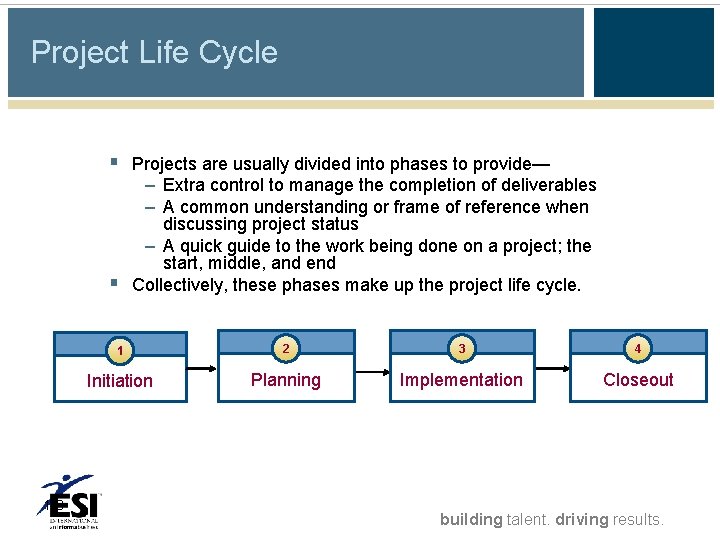
Project Life Cycle § Projects are usually divided into phases to provide— – Extra control to manage the completion of deliverables – A common understanding or frame of reference when discussing project status – A quick guide to the work being done on a project; the start, middle, and end § Collectively, these phases make up the project life cycle. 1 -8 1 2 3 4 Initiation Planning Implementation Closeout building talent. driving results.
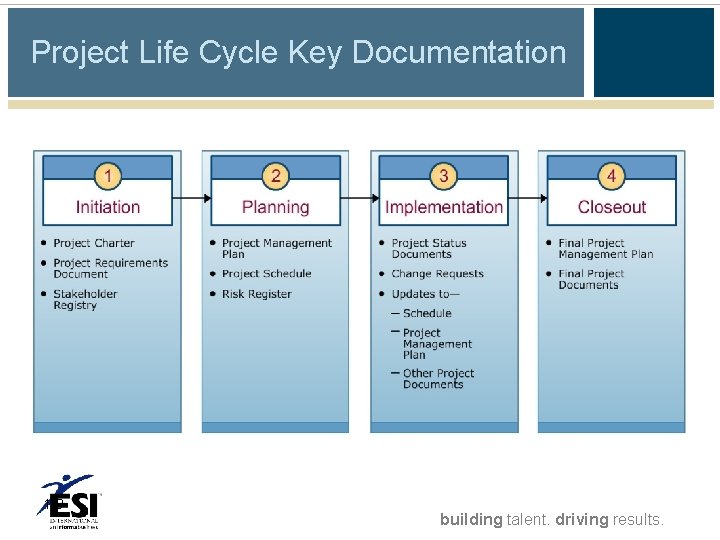
Project Life Cycle Key Documentation 1 -9 building talent. driving results.
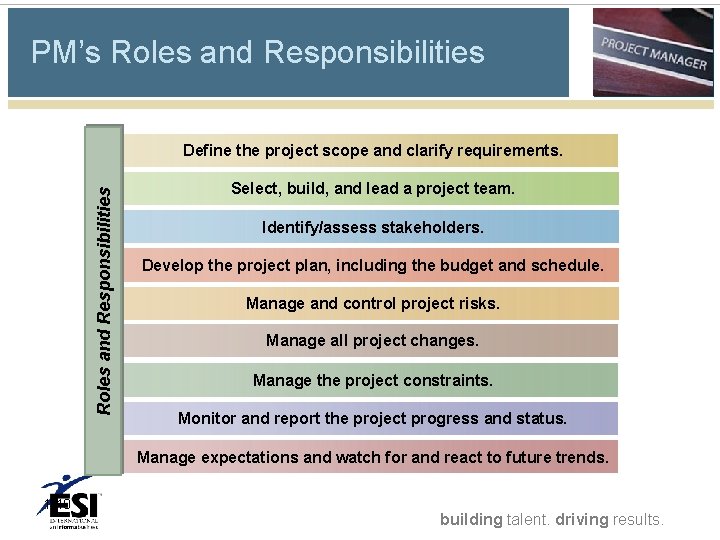
PM’s Roles and Responsibilities Define the project scope and clarify requirements. Select, build, and lead a project team. Identify/assess stakeholders. Develop the project plan, including the budget and schedule. Manage and control project risks. Manage all project changes. Manage the project constraints. Monitor and report the project progress and status. Manage expectations and watch for and react to future trends. 1 -10 building talent. driving results.
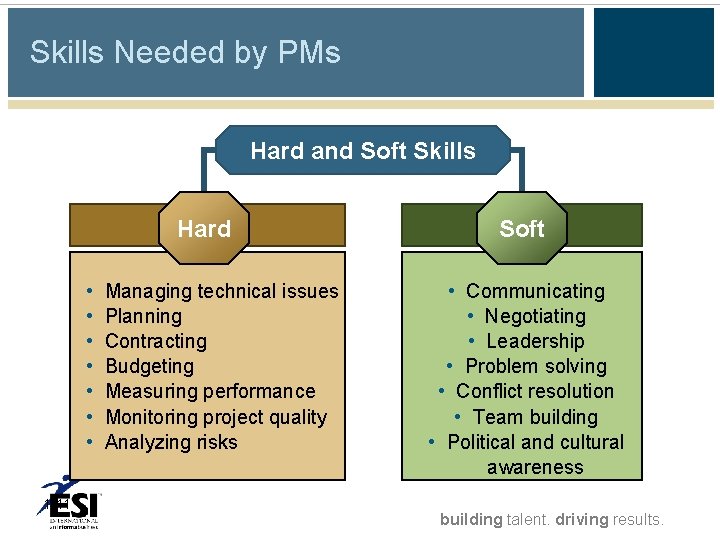
Skills Needed by PMs Hard and Soft Skills Hard • • 1 -11 Managing technical issues Planning Contracting Budgeting Measuring performance Monitoring project quality Analyzing risks Soft • Communicating • Negotiating • Leadership • Problem solving • Conflict resolution • Team building • Political and cultural awareness building talent. driving results.
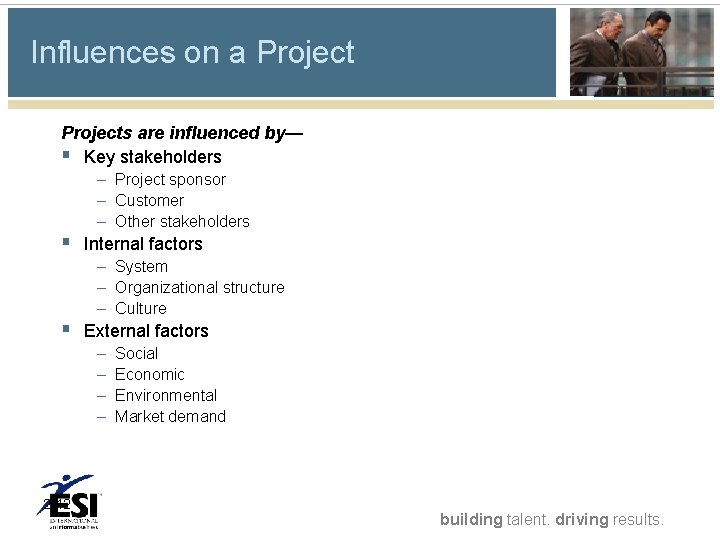
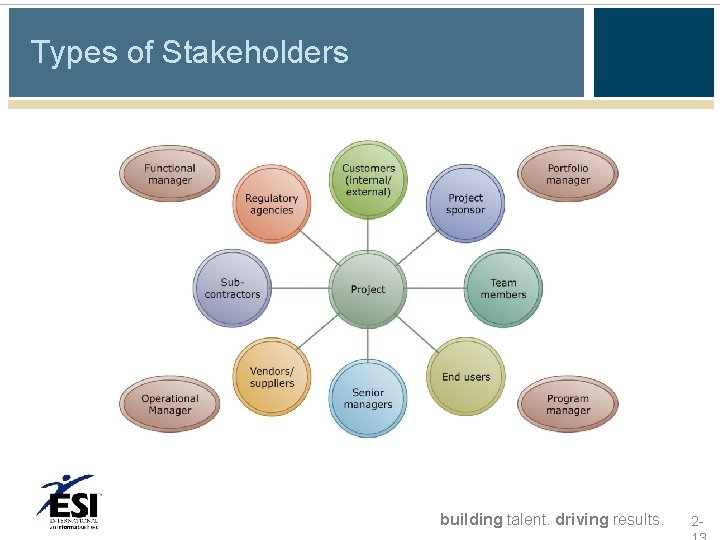
Influences on a Projects are influenced by— § Key stakeholders – Project sponsor – Customer – Other stakeholders § Internal factors – System – Organizational structure – Culture § External factors – – 2 -12 Social Economic Environmental Market demand building talent. driving results.
Types of Stakeholders building talent. driving results. 2 -
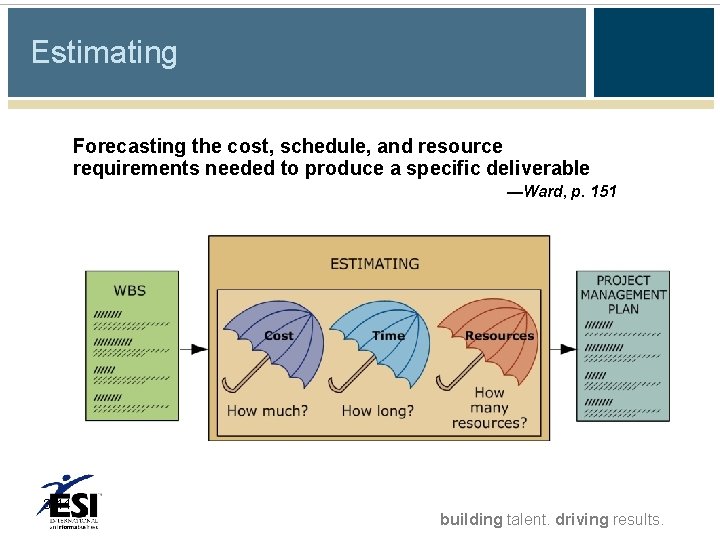
Estimating Forecasting the cost, schedule, and resource requirements needed to produce a specific deliverable —Ward, p. 151 3 -14 building talent. driving results.
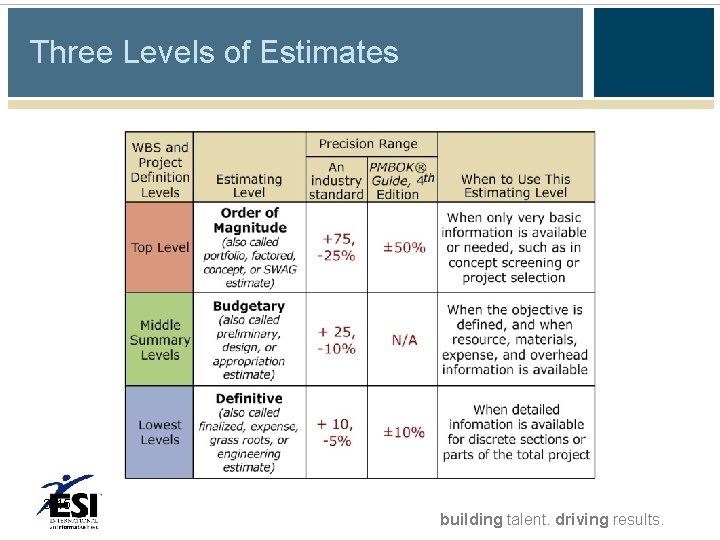
Three Levels of Estimates 3 -15 building talent. driving results.
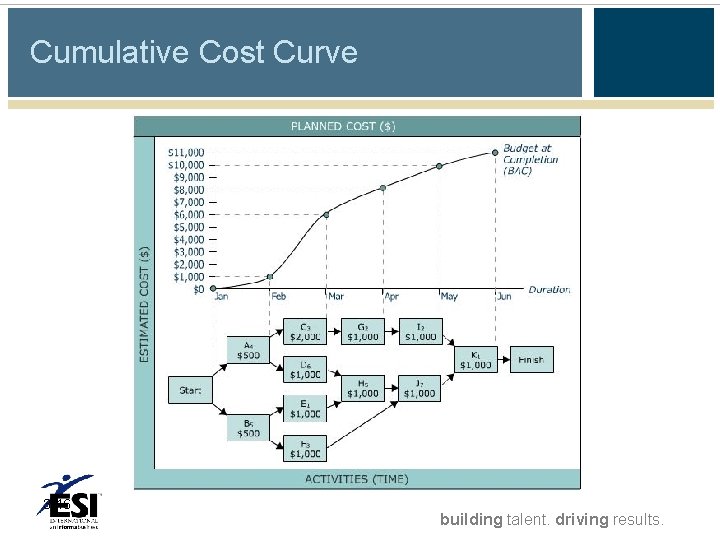
Cumulative Cost Curve 3 -16 building talent. driving results.
Risk § Project risk – Uncertain event or condition that, if it occurs, has a positive or negative effect on a project’s objectives —PMBOK® Guide, p. 438 – Probability of the risk event occurring – Impact (consequence) of that risk event’s occurrence § Based on the assessment of probability and impact, you should prioritize the risk by— – Best utilizing the available resources – Addressing the highest impacting events first, then address the remaining lower impacting events as time and resources allow building talent. driving results. 3 -
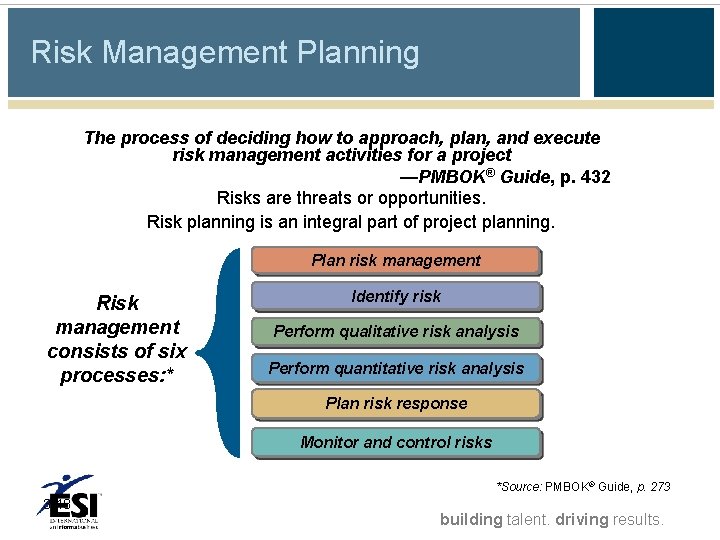
Risk Management Planning The process of deciding how to approach, plan, and execute risk management activities for a project —PMBOK® Guide, p. 432 Risks are threats or opportunities. Risk planning is an integral part of project planning. Plan risk management Risk management consists of six processes: * Identify risk Perform qualitative risk analysis Perform quantitative risk analysis Plan risk response Monitor and control risks *Source: PMBOK® Guide, p. 273 3 -18 building talent. driving results.
Procurement Planning § Going “outside the team” to purchase or acquire— – Materials – Services – People § Project manager becomes the customer – Selecting contract type – Preparing procurement documents – Selecting the contractor (vendor) 3 -19 building talent. driving results.
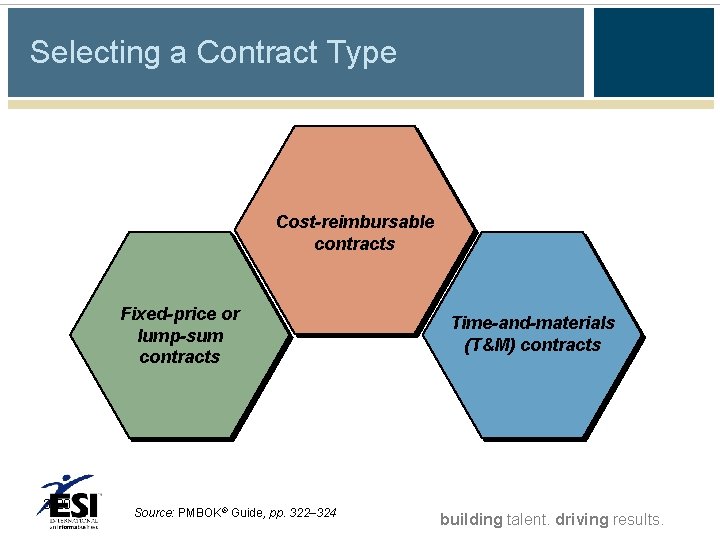
Selecting a Contract Type Cost-reimbursable contracts Fixed-price or lump-sum contracts 3 -20 Source: PMBOK® Guide, pp. 322– 324 Time-and-materials (T&M) contracts building talent. driving results.
Preparing Procurement Documents Procurement documents are used to solicit proposals from sellers. Some of the most common ones are— Request for information (RFI) 3 -21 Request for proposal (RFP) Request for quotation (RFQ) building talent. driving results.
Selecting a Contractor* § Evaluate and choose the best proposal or bid: – Technical – Business fit – Cost § Negotiate and award the contract. *Also may be referred to as seller or vendor 3 -22 building talent. driving results.
FAC-P/PM: Back to Basics
FAC-P/PM: Back to Basics OFPP Policy Memo (April 25, 2007) The purpose of the Federal Acquisition Certification for Program and Project Managers (FAC-P/PM) is to establish general training and experience requirements for program and project managers in civilian agencies. § It is mandatory to any project and/or program manager assigned to programs considered major acquisitions as defined by OMB’s Circular A-11, Part 7, Exhibit 300 to be certified at the “Senior/Expert” level. § Certification is expected to be achieved within one year from the date of assignment to the project and/or program. § Certification is based on attaining competencies and experience associated with each of three levels and ensuring 80 hours of continuous learning is achieved every two years. building talent. driving results.
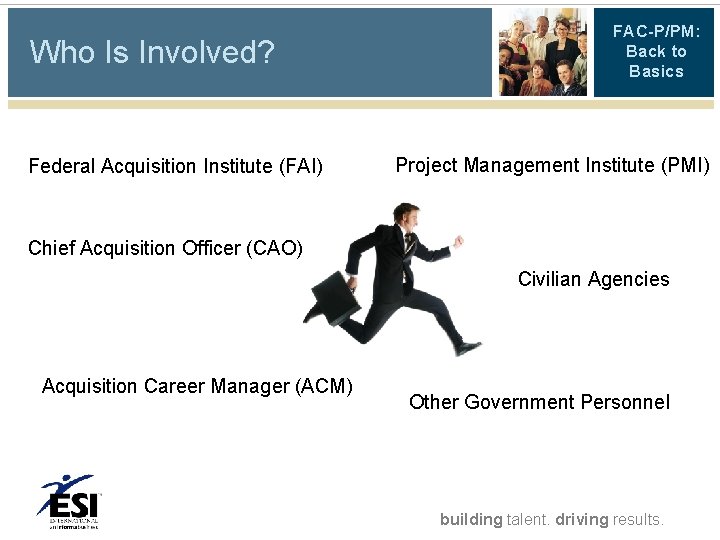
Who Is Involved? Federal Acquisition Institute (FAI) FAC-P/PM: Back to Basics Project Management Institute (PMI) Chief Acquisition Officer (CAO) Civilian Agencies Acquisition Career Manager (ACM) Other Government Personnel building talent. driving results.
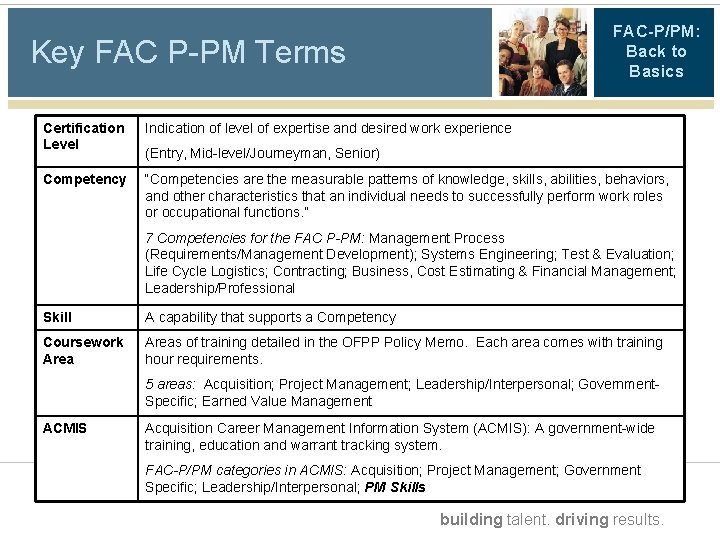
FAC-P/PM: Back to Basics Key FAC P-PM Terms Certification Level Indication of level of expertise and desired work experience Competency “Competencies are the measurable patterns of knowledge, skills, abilities, behaviors, and other characteristics that an individual needs to successfully perform work roles or occupational functions. ” (Entry, Mid-level/Journeyman, Senior) 7 Competencies for the FAC P-PM: Management Process (Requirements/Management Development); Systems Engineering; Test & Evaluation; Life Cycle Logistics; Contracting; Business, Cost Estimating & Financial Management; Leadership/Professional Skill A capability that supports a Competency Coursework Areas of training detailed in the OFPP Policy Memo. Each area comes with training hour requirements. 5 areas: Acquisition; Project Management; Leadership/Interpersonal; Government. Specific; Earned Value Management ACMIS Acquisition Career Management Information System (ACMIS): A government-wide training, education and warrant tracking system. FAC-P/PM categories in ACMIS: Acquisition; Project Management; Government Specific; Leadership/Interpersonal; PM Skills building talent. driving results.
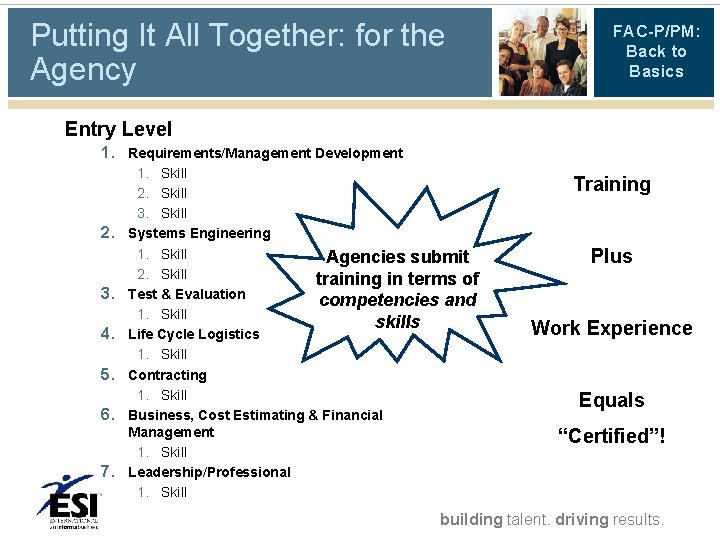
Putting It All Together: for the Agency FAC-P/PM: Back to Basics Entry Level 1. Requirements/Management Development 2. 3. 4. 5. 6. 7. 1. Skill 2. Skill 3. Skill Systems Engineering 1. Skill Agencies submit 2. Skill training in terms of Test & Evaluation competencies and 1. Skill skills Life Cycle Logistics 1. Skill Contracting 1. Skill Business, Cost Estimating & Financial Management 1. Skill Leadership/Professional 1. Skill Training Plus Work Experience Equals “Certified”! building talent. driving results.
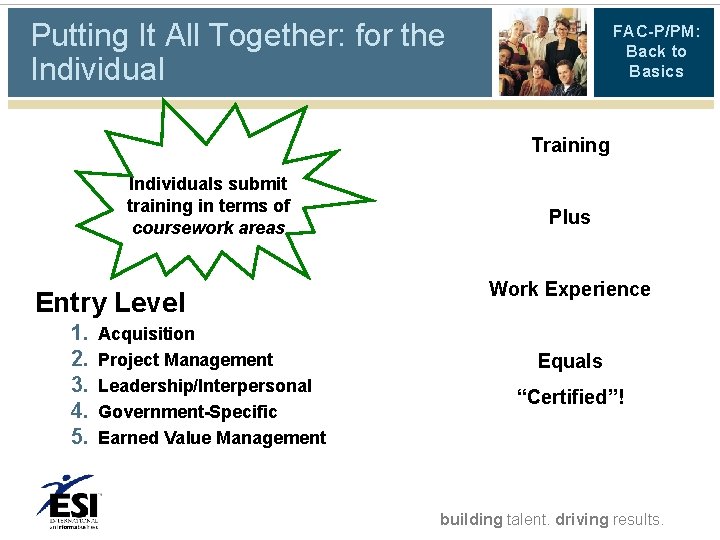
Putting It All Together: for the Individual FAC-P/PM: Back to Basics Training Individuals submit training in terms of coursework areas Entry Level 1. 2. 3. 4. 5. Acquisition Project Management Leadership/Interpersonal Government-Specific Earned Value Management Plus Work Experience Equals “Certified”! building talent. driving results.
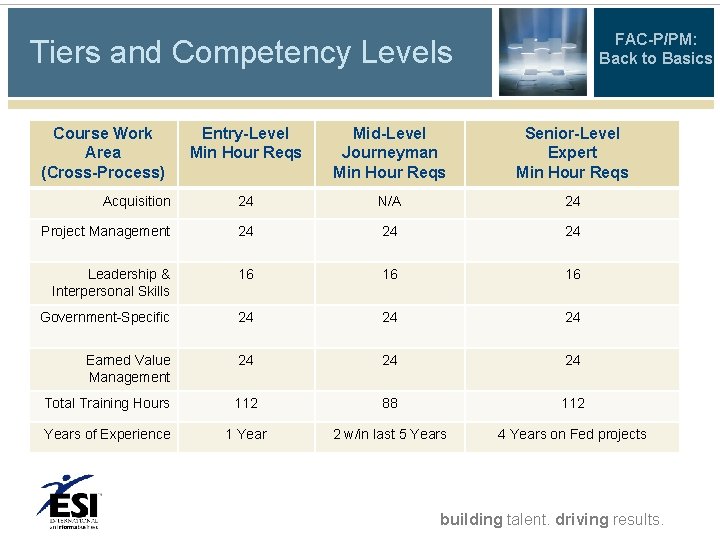
FAC-P/PM: Back to Basics Tiers and Competency Levels Course Work Area (Cross-Process) Entry-Level Min Hour Reqs Mid-Level Journeyman Min Hour Reqs Senior-Level Expert Min Hour Reqs Acquisition 24 N/A 24 Project Management 24 24 24 Leadership & Interpersonal Skills 16 16 16 Government-Specific 24 24 24 Earned Value Management 24 24 24 Total Training Hours 112 88 112 Years of Experience 1 Year 2 w/in last 5 Years 4 Years on Fed projects building talent. driving results.
Continuous Learning Points (CLP) FAC-P/PM: Back to Basics 80 hours of CLP are required every two years in order to maintain the certification. CLP requirements must be job-related and include: § § Training Professional Activities Education Experience building talent. driving results.
Updates to Curriculum
Updates and Next Steps FAI and Bearing Point § FAI has contracted with Bearing Point for the management of their certifications § Key Contacts: § Linda Ott (FAI) §Project Director, FAI Human Capital Management § Andrea Nagy (Bearing Point) §Lead, FAI Certification Management § Michael Camburn (Bearing Point) §Lead, Logistics and Communications building talent. driving results.
Updates and Next Steps Agency Response § Agencies are responsible for their own programs § Very few Agencies have submitted FAC P-PM programs to FAI for review (example: DHS) § Some Agencies are: § Going “above and beyond” FAC P-PM’s competencies (example: Veteran’s Affairs) § Making executive decisions about what they feel qualifies and doesn’t (example: Treasury) § Granting waivers in the short term Note: FAI will not be able to review or “audit” any Agency FAC P-PM Programs for at least 2 years due to workload building talent. driving results.
Who Can Help You? Updates and Next Steps ESI International Government and Professional Curriculum Development FAC-P/PM COI § Carla Tucker (Treasury) § Barbara Clay (PBGC) § Sandra Valencia (NRC) § Jeff Surprenant Account Support § Maria Kelly § Nikki Redfearn FAI § Andrea Nagy building talent. driving results.
Questions? Thank you! www. esi-intl. com
To submit for PDU credit, please visit PMI’s Web site. PDU Credits: 1 credit Category: 3 Option: 1 Provider ID: 1038 Program ID: PGM 5000 Thank you for your attention! www. esi-intl. com