
February 28 March 1 2012 OVM UVM Techniques
February 28 – March 1, 2012 OVM & UVM Techniques for On-the-fly Reset By Muralidhara Ramalingaiah Boobalan Anantharaman Design Engineer Staff Sr. Design Engineer Sr. Cypress Semiconductors
Agenda • • On-The-Fly Reset What should happen? OVM Reset Techniques Issues with OVM Reset Techniques Solutions for OVM Reset Technique Issues UVM Reset Techniques OVM to UVM migration – Tips for reset Conclusion Muralidhara Ramalingaiah, Boobalan Anantharaman, Cypress Semiconductors 2 of 32

On-The-Fly Reset • When the DUT is reset during normal operation, the testbench must accordingly and must not behave abnormally or give ambiguous results. • Hard Reset – Reset through External Reset I/O • Soft Reset – Reset through Firmware Register Write Muralidhara Ramalingaiah, Boobalan Anantharaman, Cypress Semiconductors 3 of 32
What should happen? • Following things should happen in Test bench – Scoreboard variables should get reset – Monitor should recognize it and qualify the transactions – Coverage update logic should not trigger any transition coverage except reset coverage – Driver should recognize it and stop transaction at right time – Data Checkers should delete the transactions which are collected in FIFOs or QUEUEs – Protocol Checkers should recognize On-the-fly reset Muralidhara Ramalingaiah, Boobalan Anantharaman, Cypress Semiconductors 4 of 32
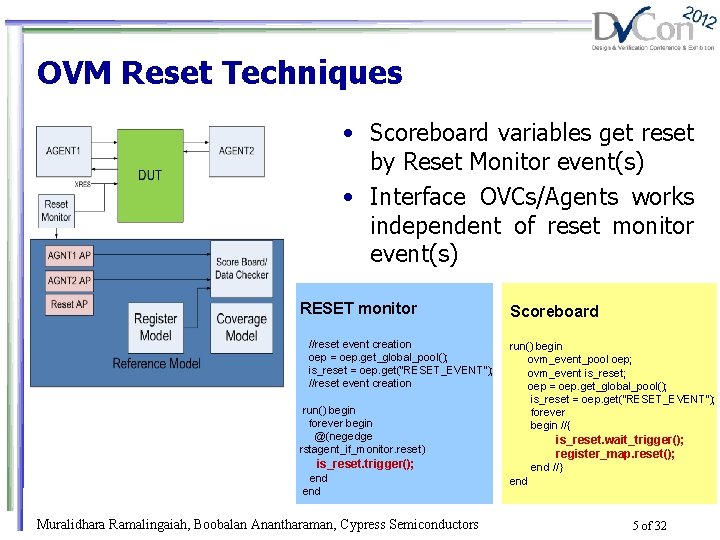
OVM Reset Techniques • Scoreboard variables get reset by Reset Monitor event(s) • Interface OVCs/Agents works independent of reset monitor event(s) RESET monitor //reset event creation oep = oep. get_global_pool(); is_reset = oep. get("RESET_EVENT"); //reset event creation run() begin forever begin @(negedge rstagent_if_monitor. reset) run() begin ovm_event_pool oep; ovm_event is_reset; oep = oep. get_global_pool(); is_reset = oep. get("RESET_EVENT"); forever begin //{ is_reset. trigger(); end //} end Muralidhara Ramalingaiah, Boobalan Anantharaman, Cypress Semiconductors Scoreboard is_reset. wait_trigger(); register_map. reset(); 5 of 32
Issues with OVM Reset Techniques • Issue 1 – Drivers don’t recognize the on-the-fly reset in between transactions • Issue 2 – Irrespective of the on-the-fly reset, monitor will send data to scoreboard/coverage • Issue 3 – During on-the-fly reset, it is difficult control the sequencers of the sub-sequences from the virtual_sequence Muralidhara Ramalingaiah, Boobalan Anantharaman, Cypress Semiconductors 6 of 32
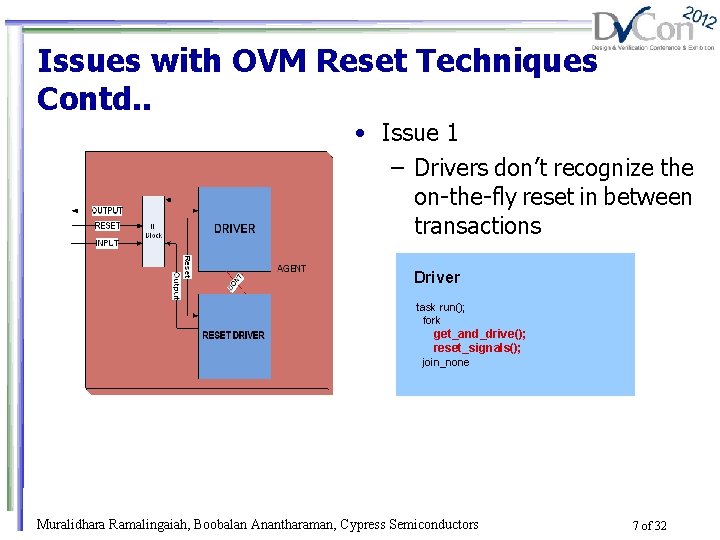
Issues with OVM Reset Techniques Contd. . • Issue 1 – Drivers don’t recognize the on-the-fly reset in between transactions Driver task run(); fork get_and_drive(); reset_signals(); join_none Muralidhara Ramalingaiah, Boobalan Anantharaman, Cypress Semiconductors 7 of 32
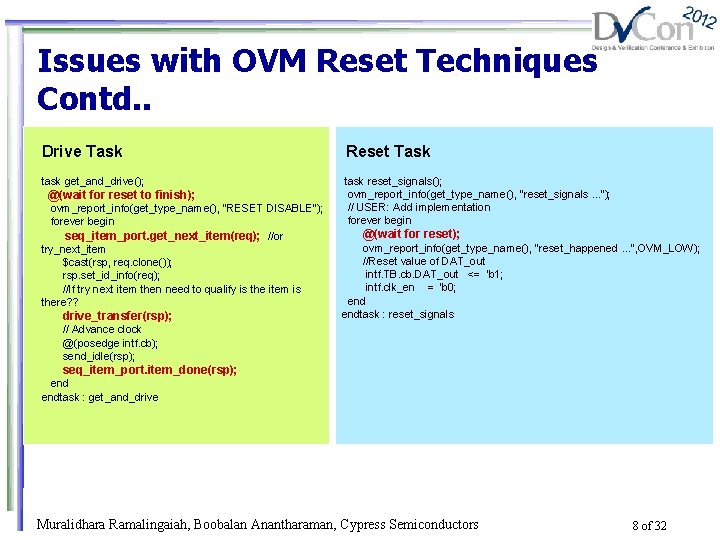
Issues with OVM Reset Techniques Contd. . Drive Task task get_and_drive(); @(wait for reset to finish); ovm_report_info(get_type_name(), "RESET DISABLE"); forever begin seq_item_port. get_next_item(req); //or try_next_item $cast(rsp, req. clone()); rsp. set_id_info(req); //If try next item then need to qualify is the item is there? ? drive_transfer(rsp); // Advance clock @(posedge intf. cb); send_idle(rsp); seq_item_port. item_done(rsp); endtask : get_and_drive Reset Task task reset_signals(); ovm_report_info(get_type_name(), "reset_signals. . . "); // USER: Add implementation forever begin @(wait for reset); ovm_report_info(get_type_name(), "reset_happened. . . ", OVM_LOW); //Reset value of DAT_out intf. TB. cb. DAT_out <= 'b 1; intf. clk_en = 'b 0; endtask : reset_signals Muralidhara Ramalingaiah, Boobalan Anantharaman, Cypress Semiconductors 8 of 32
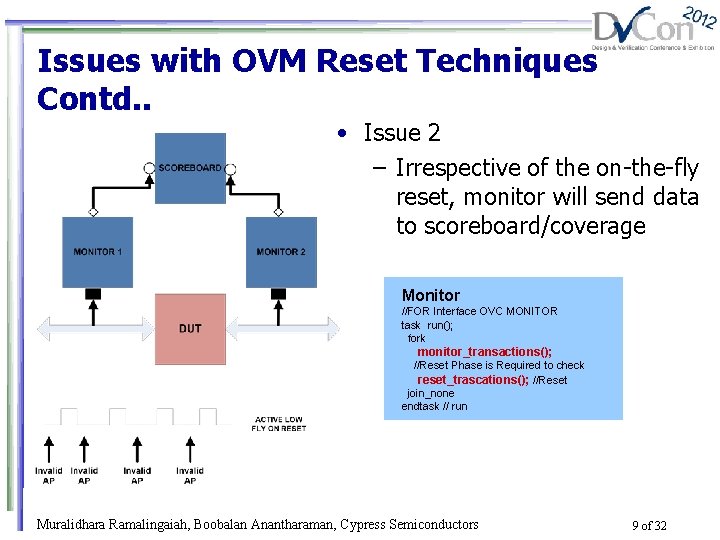
Issues with OVM Reset Techniques Contd. . • Issue 2 – Irrespective of the on-the-fly reset, monitor will send data to scoreboard/coverage Monitor //FOR Interface OVC MONITOR task run(); fork monitor_transactions(); //Reset Phase is Required to check reset_trascations(); //Reset join_none endtask // run Muralidhara Ramalingaiah, Boobalan Anantharaman, Cypress Semiconductors 9 of 32
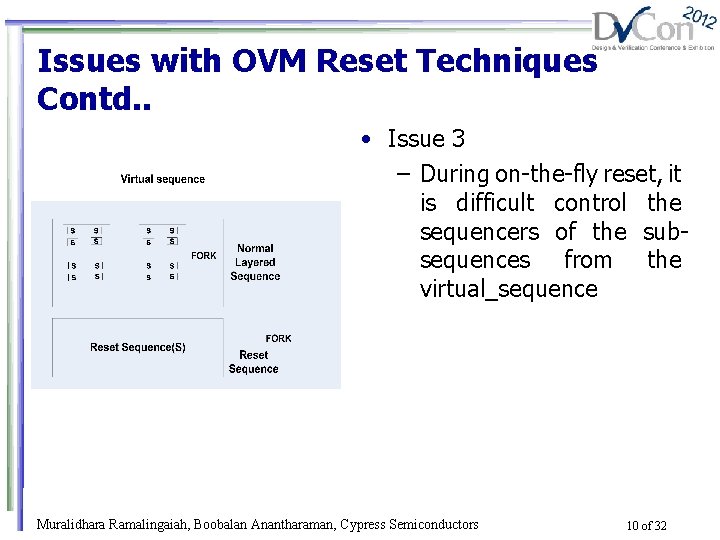
Issues with OVM Reset Techniques Contd. . • Issue 3 – During on-the-fly reset, it is difficult control the sequencers of the subsequences from the virtual_sequence Muralidhara Ramalingaiah, Boobalan Anantharaman, Cypress Semiconductors 10 of 32

Solutions for OVM Reset Technique Issues • Solution 1 – Agent with qualified clock approach – Qualified data from monitor to Scoreboard/Coverage • Solution 2 – Stopping the sequencer from the sequence • Solution 3 – State Machine approach Muralidhara Ramalingaiah, Boobalan Anantharaman, Cypress Semiconductors 11 of 32

Solutions for OVM Reset Technique Issues Contd. . • Solution 1 – Agent with qualified clock approach along with stopping the driver – Qualified data from monitor to Scoreboard/Coverage IF block DRIVER assign qclk = (sig_reset==1) ? clk: 0; // Actual Signals // USER: Add interface signals task run(); fork //Variable or event to say reset is there clocking cb @(posedge qclk); reset_t = RESET_DE; get_and_drive(); reset_signals(); join_none Muralidhara Ramalingaiah, Boobalan Anantharaman, Cypress Semiconductors 12 of 32
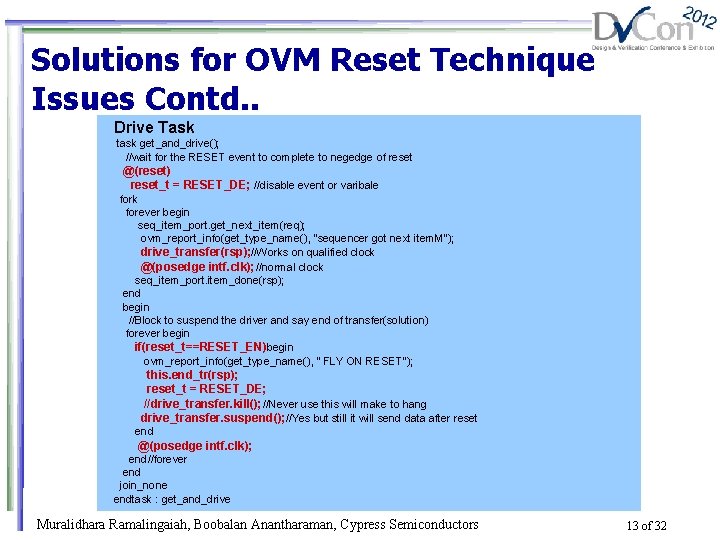
Solutions for OVM Reset Technique Issues Contd. . Drive Task task get_and_drive(); //wait for the RESET event to complete to negedge of reset @(reset) reset_t = RESET_DE; //disable event or varibale fork forever begin seq_item_port. get_next_item(req); ovm_report_info(get_type_name(), "sequencer got next item. M"); drive_transfer(rsp); //Works on qualified clock @(posedge intf. clk); //normal clock seq_item_port. item_done(rsp); end begin //Block to suspend the driver and say end of transfer(solution) forever begin if(reset_t==RESET_EN)begin ovm_report_info(get_type_name(), " FLY ON RESET"); this. end_tr(rsp); reset_t = RESET_DE; //drive_transfer. kill(); //Never use this will make to hang drive_transfer. suspend(); //Yes but still it will send data after reset end @(posedge intf. clk); end//forever end join_none endtask : get_and_drive Muralidhara Ramalingaiah, Boobalan Anantharaman, Cypress Semiconductors 13 of 32
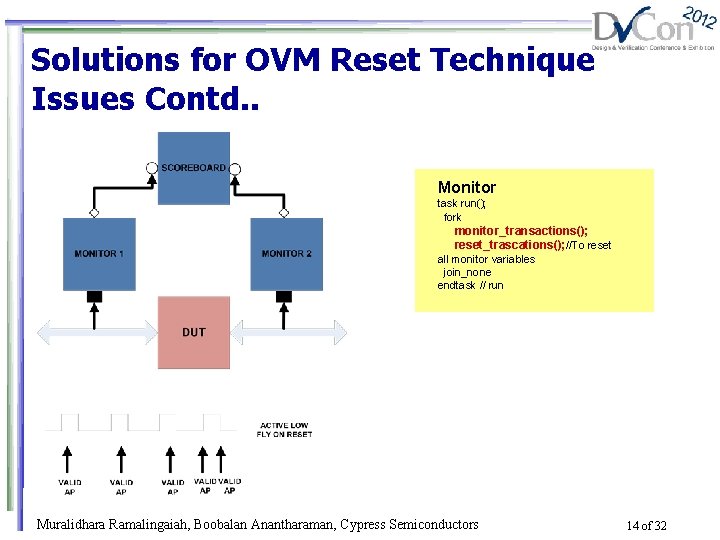
Solutions for OVM Reset Technique Issues Contd. . Monitor task run(); fork monitor_transactions(); reset_trascations(); //To reset all monitor variables join_none endtask // run Muralidhara Ramalingaiah, Boobalan Anantharaman, Cypress Semiconductors 14 of 32
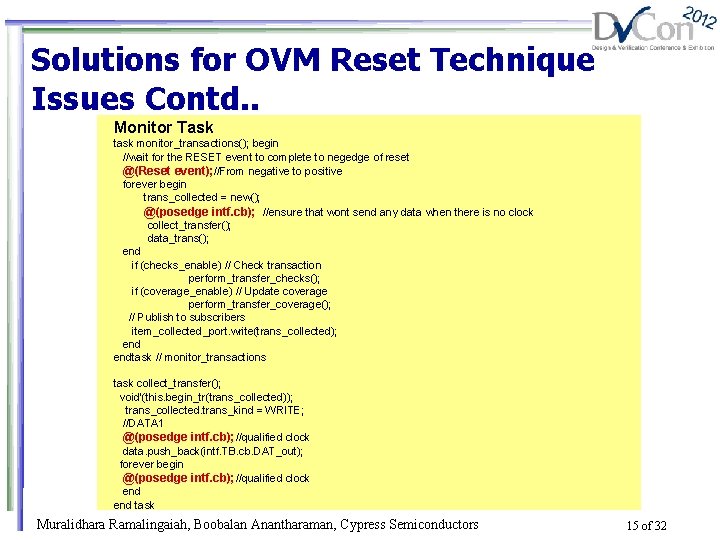
Solutions for OVM Reset Technique Issues Contd. . Monitor Task task monitor_transactions(); begin //wait for the RESET event to complete to negedge of reset @(Reset event); //From negative to positive forever begin trans_collected = new(); @(posedge intf. cb); //ensure that wont send any data when there is no clock collect_transfer(); data_trans(); end if (checks_enable) // Check transaction perform_transfer_checks(); if (coverage_enable) // Update coverage perform_transfer_coverage(); // Publish to subscribers item_collected_port. write(trans_collected); endtask // monitor_transactions task collect_transfer(); void'(this. begin_tr(trans_collected)); trans_collected. trans_kind = WRITE; //DATA 1 @(posedge intf. cb); //qualified clock data. push_back(intf. TB. cb. DAT_out); forever begin @(posedge intf. cb); //qualified clock end task Muralidhara Ramalingaiah, Boobalan Anantharaman, Cypress Semiconductors 15 of 32
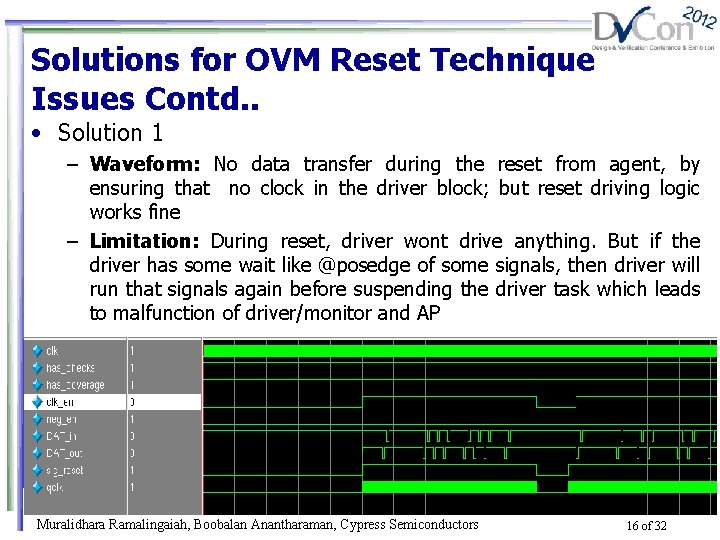
Solutions for OVM Reset Technique Issues Contd. . • Solution 1 – Waveform: No data transfer during the reset from agent, by ensuring that no clock in the driver block; but reset driving logic works fine – Limitation: During reset, driver wont drive anything. But if the driver has some wait like @posedge of some signals, then driver will run that signals again before suspending the driver task which leads to malfunction of driver/monitor and AP Muralidhara Ramalingaiah, Boobalan Anantharaman, Cypress Semiconductors 16 of 32
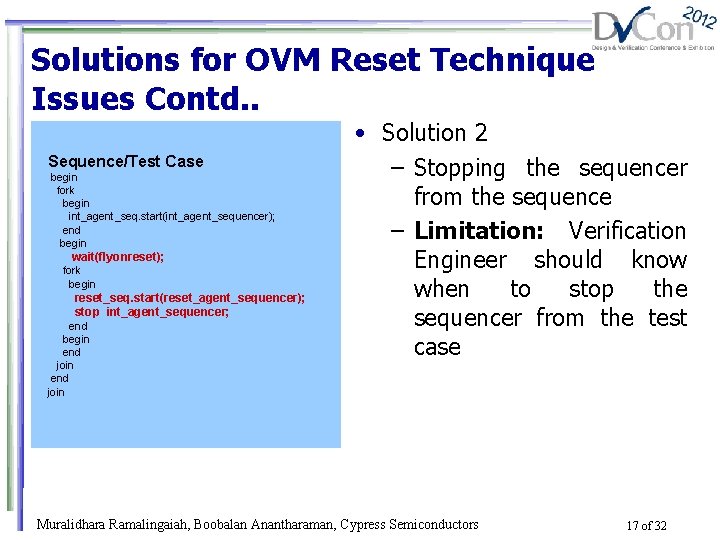
Solutions for OVM Reset Technique Issues Contd. . Driver Sequence/Test Case begin task Uart_Irdi_master_driver: : run(); fork begin get_and_drive(); int_agent_seq. start(int_agent_sequencer); reset_signals(); end join_none begin wait(flyonreset); fork begin reset_seq. start(reset_agent_sequencer); stop int_agent_sequencer; end begin end join end join • Solution 2 – Stopping the sequencer from the sequence – Limitation: Verification Engineer should know when to stop the sequencer from the test case Muralidhara Ramalingaiah, Boobalan Anantharaman, Cypress Semiconductors 17 of 32
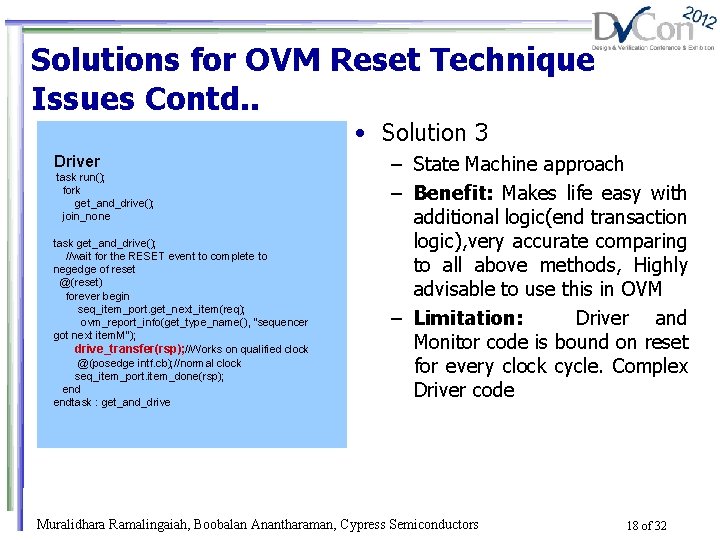
Solutions for OVM Reset Technique Issues Contd. . • Solution 3 Driver task run(); task Uart_Irdi_master_driver: : run(); fork get_and_drive(); join_none reset_signals(); join_none task get_and_drive(); //wait for the RESET event to complete to negedge of reset @(reset) forever begin seq_item_port. get_next_item(req); ovm_report_info(get_type_name(), "sequencer got next item. M"); drive_transfer(rsp); //Works on qualified clock @(posedge intf. cb); //normal clock seq_item_port. item_done(rsp); endtask : get_and_drive – State Machine approach – Benefit: Makes life easy with additional logic(end transaction logic), very accurate comparing to all above methods, Highly advisable to use this in OVM – Limitation: Driver and Monitor code is bound on reset for every clock cycle. Complex Driver code Muralidhara Ramalingaiah, Boobalan Anantharaman, Cypress Semiconductors 18 of 32
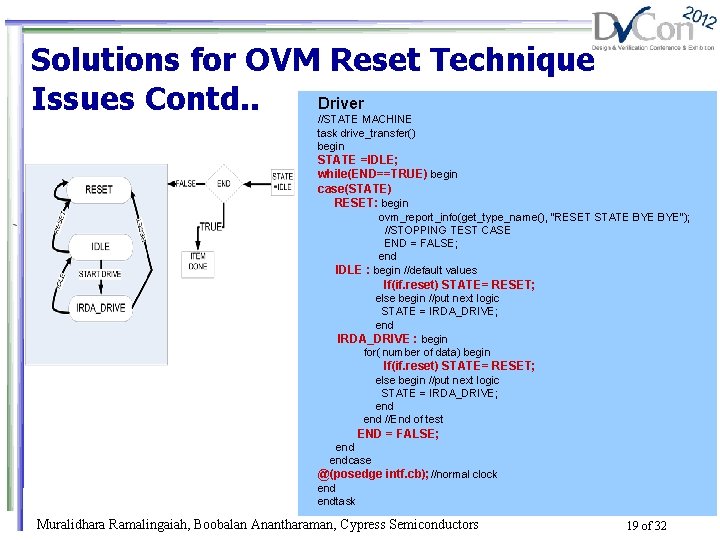
Solutions for OVM Reset Technique Driver Issues Contd. . //STATE MACHINE task drive_transfer() begin STATE =IDLE; while(END==TRUE) begin case(STATE) RESET: begin ovm_report_info(get_type_name(), "RESET STATE BYE"); //STOPPING TEST CASE END = FALSE; end IDLE : begin //default values If(if. reset) STATE= RESET; else begin //put next logic STATE = IRDA_DRIVE; end IRDA_DRIVE : begin for( number of data) begin If(if. reset) STATE= RESET; else begin //put next logic STATE = IRDA_DRIVE; end //End of test END = FALSE; endcase @(posedge intf. cb); //normal clock endtask Muralidhara Ramalingaiah, Boobalan Anantharaman, Cypress Semiconductors 19 of 32
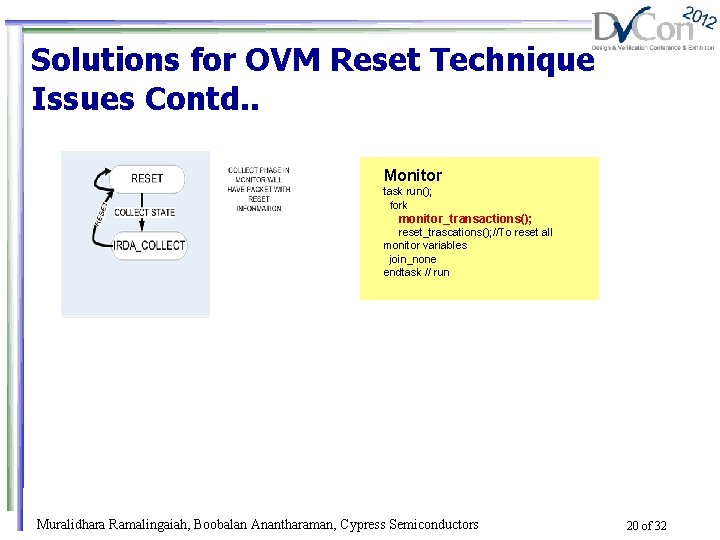
Solutions for OVM Reset Technique Issues Contd. . Monitor task run(); fork monitor_transactions(); reset_trascations(); //To reset all monitor variables join_none endtask // run Muralidhara Ramalingaiah, Boobalan Anantharaman, Cypress Semiconductors 20 of 32
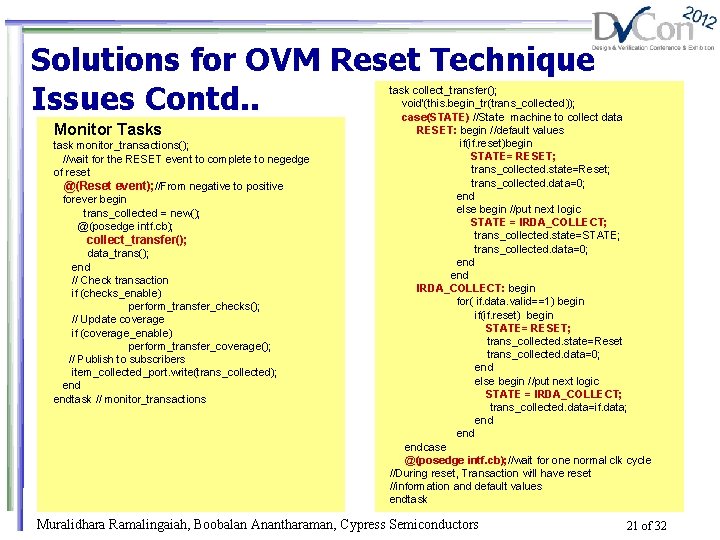
Solutions for OVM Reset Technique Issues Contd. . Monitor Tasks task monitor_transactions(); //wait for the RESET event to complete to negedge of reset @(Reset event); //From negative to positive forever begin trans_collected = new(); @(posedge intf. cb); collect_transfer(); data_trans(); end // Check transaction if (checks_enable) perform_transfer_checks(); // Update coverage if (coverage_enable) perform_transfer_coverage(); // Publish to subscribers item_collected_port. write(trans_collected); endtask // monitor_transactions task collect_transfer(); void'(this. begin_tr(trans_collected)); case(STATE) //State machine to collect data RESET: begin //default values if(if. reset)begin STATE= RESET; trans_collected. state=Reset; trans_collected. data=0; end else begin //put next logic STATE = IRDA_COLLECT; trans_collected. state=STATE; trans_collected. data=0; end IRDA_COLLECT: begin for( if. data. valid==1) begin if(if. reset) begin STATE= RESET; trans_collected. state=Reset trans_collected. data=0; end else begin //put next logic STATE = IRDA_COLLECT; trans_collected. data=if. data; end endcase @(posedge intf. cb); //wait for one normal clk cycle //During reset, Transaction will have reset //information and default values endtask Muralidhara Ramalingaiah, Boobalan Anantharaman, Cypress Semiconductors 21 of 32
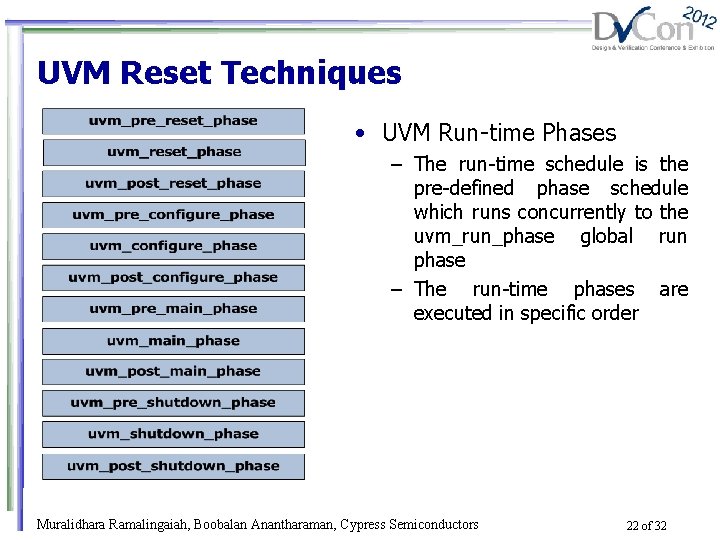
UVM Reset Techniques • UVM Run-time Phases – The run-time schedule is the pre-defined phase schedule which runs concurrently to the uvm_run_phase global run phase – The run-time phases are executed in specific order Muralidhara Ramalingaiah, Boobalan Anantharaman, Cypress Semiconductors 22 of 32
Pre Reset Phase • Typical Uses – Wait for power good – Components connected to Virtual interfaces should initialize their o/p to X’s or Z’s – Initialize the clock signals to a valid value – Assign reset signals to X (power-on reset) – Wait for reset signal to be asserted if not driven by the Verification environment Muralidhara Ramalingaiah, Boobalan Anantharaman, Cypress Semiconductors 23 of 32
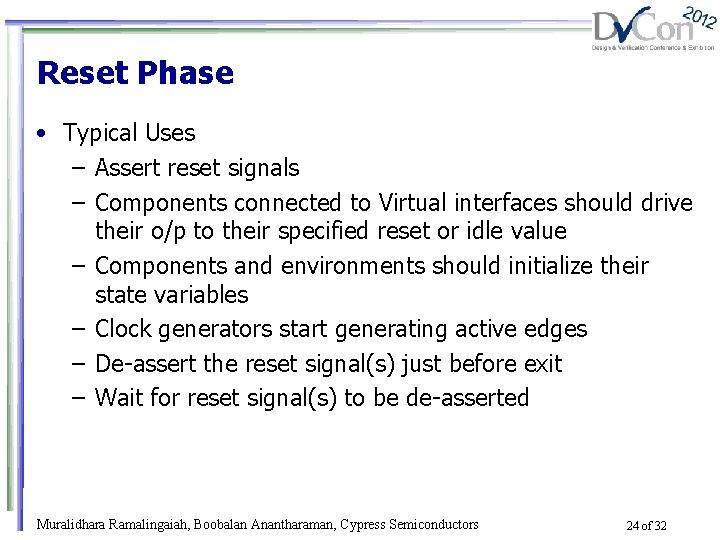
Reset Phase • Typical Uses – Assert reset signals – Components connected to Virtual interfaces should drive their o/p to their specified reset or idle value – Components and environments should initialize their state variables – Clock generators start generating active edges – De-assert the reset signal(s) just before exit – Wait for reset signal(s) to be de-asserted Muralidhara Ramalingaiah, Boobalan Anantharaman, Cypress Semiconductors 24 of 32
Post Reset Phase • Typical Uses – Components should start behavior appropriate for reset being inactive. • For example, components may start to transmit idle transactions Muralidhara Ramalingaiah, Boobalan Anantharaman, Cypress Semiconductors 25 of 32
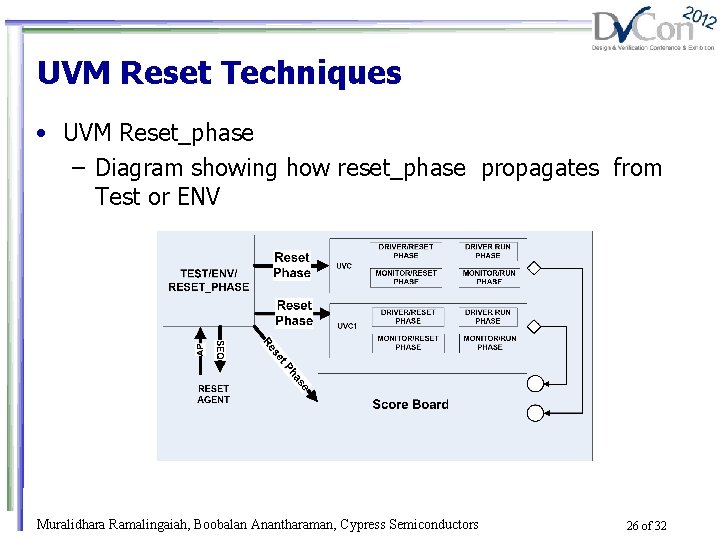
UVM Reset Techniques • UVM Reset_phase – Diagram showing how reset_phase propagates from Test or ENV Muralidhara Ramalingaiah, Boobalan Anantharaman, Cypress Semiconductors 26 of 32
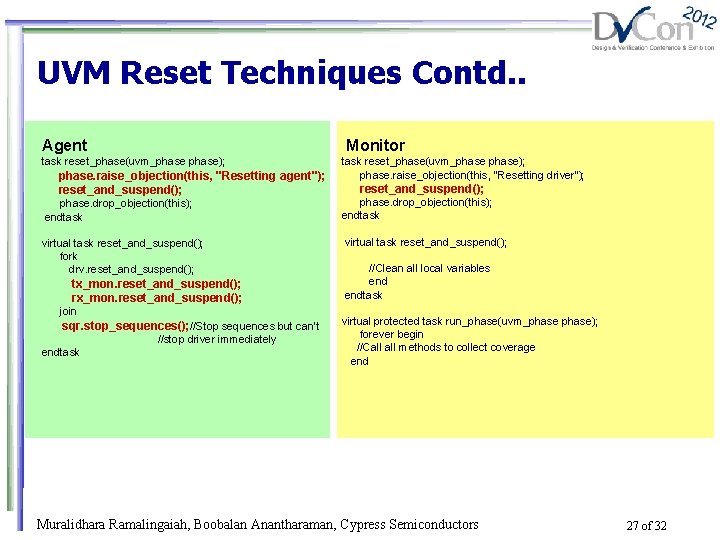
UVM Reset Techniques Contd. . Agent Monitor task reset_phase(uvm_phase); phase. raise_objection(this, "Resetting driver"); reset_and_suspend(); phase. drop_objection(this); endtask virtual task reset_and_suspend(); fork //Clean all local variables drv. reset_and_suspend(); end tx_mon. reset_and_suspend(); endtask rx_mon. reset_and_suspend(); join virtual protected task run_phase(uvm_phase); sqr. stop_sequences(); //Stop sequences but can’t forever begin //stop driver immediately //Call methods to collect coverage endtask end phase. raise_objection(this, "Resetting agent"); reset_and_suspend(); Muralidhara Ramalingaiah, Boobalan Anantharaman, Cypress Semiconductors 27 of 32
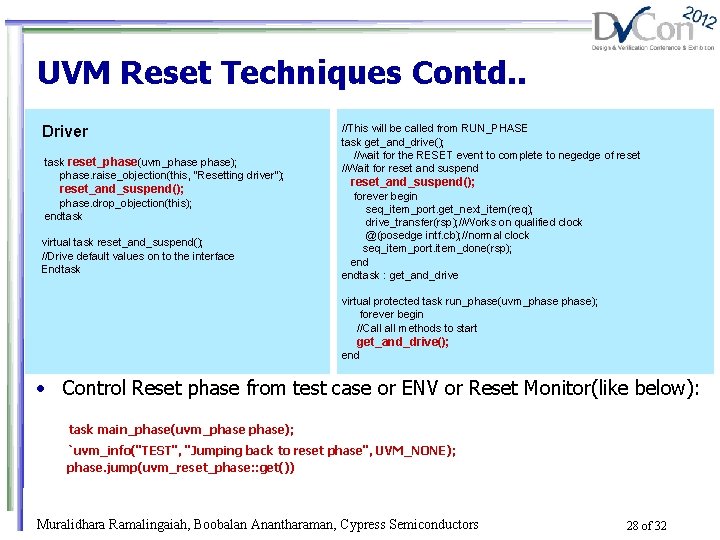
UVM Reset Techniques Contd. . Driver task reset_phase(uvm_phase); phase. raise_objection(this, "Resetting driver"); reset_and_suspend(); phase. drop_objection(this); endtask virtual task reset_and_suspend(); //Drive default values on to the interface Endtask //This will be called from RUN_PHASE task get_and_drive(); //wait for the RESET event to complete to negedge of reset //Wait for reset and suspend reset_and_suspend(); forever begin seq_item_port. get_next_item(req); drive_transfer(rsp); //Works on qualified clock @(posedge intf. cb); //normal clock seq_item_port. item_done(rsp); endtask : get_and_drive virtual protected task run_phase(uvm_phase); forever begin //Call methods to start get_and_drive(); end • Control Reset phase from test case or ENV or Reset Monitor(like below): task main_phase(uvm_phase); `uvm_info("TEST", "Jumping back to reset phase", UVM_NONE); phase. jump(uvm_reset_phase: : get()) Muralidhara Ramalingaiah, Boobalan Anantharaman, Cypress Semiconductors 28 of 32
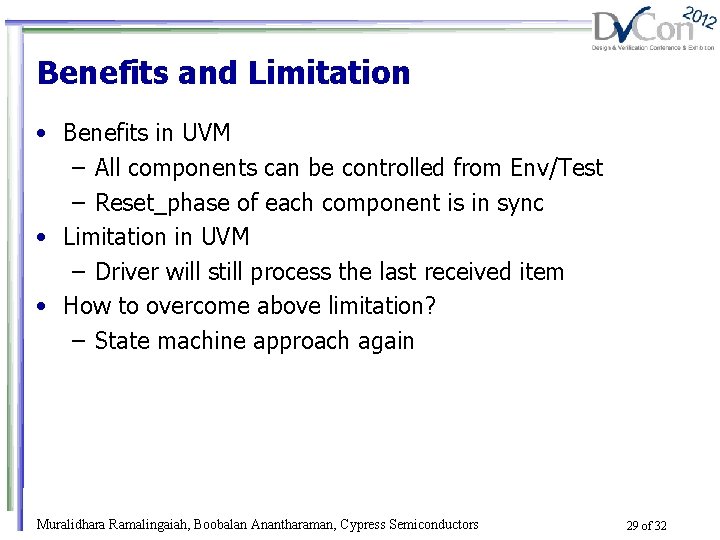
Benefits and Limitation • Benefits in UVM – All components can be controlled from Env/Test – Reset_phase of each component is in sync • Limitation in UVM – Driver will still process the last received item • How to overcome above limitation? – State machine approach again Muralidhara Ramalingaiah, Boobalan Anantharaman, Cypress Semiconductors 29 of 32
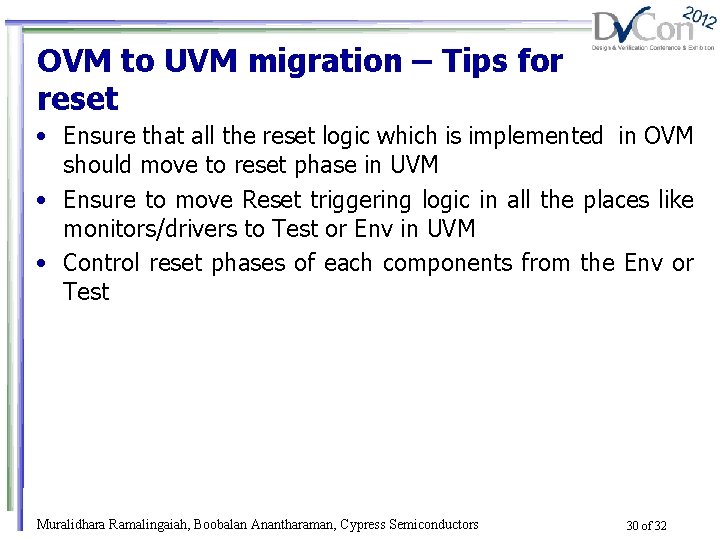
OVM to UVM migration – Tips for reset • Ensure that all the reset logic which is implemented in OVM should move to reset phase in UVM • Ensure to move Reset triggering logic in all the places like monitors/drivers to Test or Env in UVM • Control reset phases of each components from the Env or Test Muralidhara Ramalingaiah, Boobalan Anantharaman, Cypress Semiconductors 30 of 32

Conclusion • State Machine approach is a better one to follow in OVM Test benches comparing to other approaches • UVM has the Reset_Phase with which reset logic of all the components can be controlled from Test or Env. To avoid the Driver limitation specified, State Machine approach should be followed in UVM Test benches Muralidhara Ramalingaiah, Boobalan Anantharaman, Cypress Semiconductors 31 of 32
Questions? Muralidhara Ramalingaiah, Boobalan Anantharaman, Cypress Semiconductors 32 of 32
- Slides: 32