
February 2022 Inverse Normal calculations to find the
February 2022 Inverse Normal calculations to find the mean and the standard deviation LO: Given the percentage area under the curve, find the mean and the standard deviation. www. mathssupport. org

Inverse normal calculations Sometimes you are given the percentage area under the curve, i. e. the probability or the proportion, and you are asked to find the mean or the standard deviation of the distribution. This is called an inverse normal calculation. Always make a sketch to illustrate the information given. You must always remember to use the area to the left when using your GDC. If you are given the area to the right of the value, you must subtract this from 1 (or 100%) before using your GDC. 95% 5% 40 For example, an area of 5% above a certain value means there is an area of 95% below it. You can use the GDC to find this value. The calculator has a function called inverse Normal which will do this. www. mathssupport. org
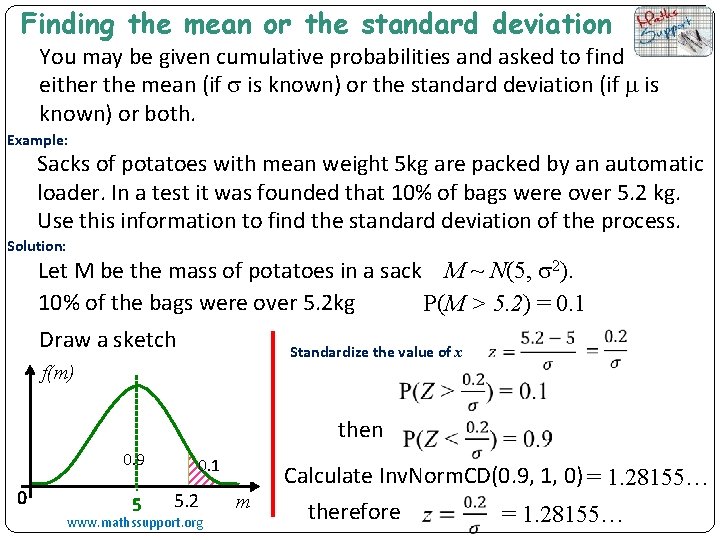
Finding the mean or the standard deviation You may be given cumulative probabilities and asked to find either the mean (if s is known) or the standard deviation (if m is known) or both. Example: Sacks of potatoes with mean weight 5 kg are packed by an automatic loader. In a test it was founded that 10% of bags were over 5. 2 kg. Use this information to find the standard deviation of the process. Solution: Let M be the mass of potatoes in a sack M ~ N(5, s 2). 10% of the bags were over 5. 2 kg P(M > 5. 2) = 0. 1 Draw a sketch Standardize the value of x f(m) then 0. 9 0 5 0. 1 5. 2 www. mathssupport. org m Calculate Inv. Norm. CD(0. 9, 1, 0) = 1. 28155… therefore = 1. 28155…
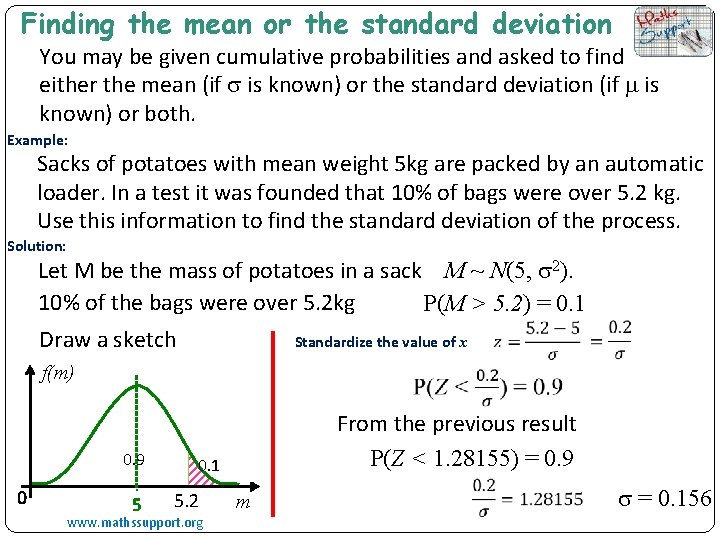
Finding the mean or the standard deviation You may be given cumulative probabilities and asked to find either the mean (if s is known) or the standard deviation (if m is known) or both. Example: Sacks of potatoes with mean weight 5 kg are packed by an automatic loader. In a test it was founded that 10% of bags were over 5. 2 kg. Use this information to find the standard deviation of the process. Solution: Let M be the mass of potatoes in a sack M ~ N(5, s 2). 10% of the bags were over 5. 2 kg P(M > 5. 2) = 0. 1 Draw a sketch Standardize the value of x f(m) 0. 9 0 5 From the previous result P(Z < 1. 28155) = 0. 9 0. 1 5. 2 www. mathssupport. org m s = 0. 156
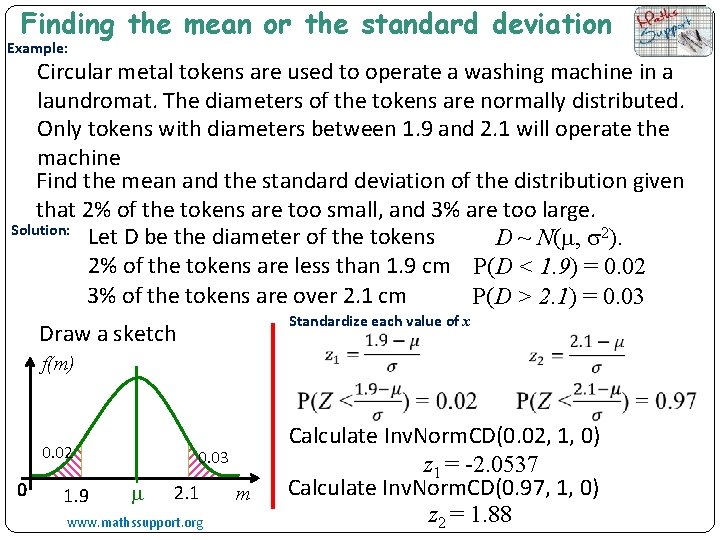
Finding the mean or the standard deviation Example: Circular metal tokens are used to operate a washing machine in a laundromat. The diameters of the tokens are normally distributed. Only tokens with diameters between 1. 9 and 2. 1 will operate the machine Find the mean and the standard deviation of the distribution given that 2% of the tokens are too small, and 3% are too large. Solution: Let D be the diameter of the tokens D ~ N(m, s 2). 2% of the tokens are less than 1. 9 cm P(D < 1. 9) = 0. 02 3% of the tokens are over 2. 1 cm P(D > 2. 1) = 0. 03 Standardize each value of x Draw a sketch f(m) 0. 02 0 1. 9 0. 03 m 2. 1 www. mathssupport. org m Calculate Inv. Norm. CD(0. 02, 1, 0) z 1 = -2. 0537 Calculate Inv. Norm. CD(0. 97, 1, 0) z 2 = 1. 88

Finding the mean or the standard deviation Example: Circular metal tokens are used to operate a washing machine in a laundromat. The diameters of the tokens are normally distributed. Only tokens with diameters between 1. 9 and 2. 1 will operate the machine Find the mean and the standard deviation of the distribution given that 2% of the tokens are too small, and 3% are too large. Solution: Let D be the diameter of the tokens D ~ N(m, s 2). 2% of the tokens are less than 1. 9 cm P(D < 1. 9) = 0. 02 3% of the tokens are over 2. 1 cm P(D > 2. 1) = 0. 03 Using the Standardized values Draw a sketch z 1 = -2. 0537 z 2 = 1. 88 f(m) 0. 02 0 1. 9 Rearranging both 0. 03 m 2. 1 www. mathssupport. org m -2. 0537 s + m = 1. 9 Solving simultaneously 1. 88 s + m = 2. 1 s = 0. 0508 m = 2. 00

Thank you for using resources from For more resources visit our website https: //www. mathssupport. org If you have a special request, drop us an email info@mathssupport. org www. mathssupport. org
- Slides: 7