
February 2021 Starter Task Test Nutrition healthy eating
February 2021 Starter Task: Ø Test – Nutrition, healthy eating and special diets ØExam conditions *SILENCE* ØPens down at 9. 40 Easy answers (state). . will be made of flour, butter, eggs and milk. Clever answers. . . could be made of flour, butter, eggs (apply) and milk because flour is a cheap commodity… and easy to work with. Genius answers (justify) . . . . could be made of flour, butter, eggs and milk because they are locally sourced ingredients minimising air miles…, therefore. . .
Lesson Objectives Health, safety and hygiene ØDiscuss food safety ØExplain the different types of food poisoning ØDescribe preventative measures Ø What is food poisoning? ØIllness when consuming contaminated food, e. g. bacteria and other microbes (viruses, moulds) ØEating foods that contain metals and chemicals ØEating poisonous plants
Health, safety and hygiene Ø What is a high risk food? ØMeat, poultry, eggs, stocks, shellfish, cooked rice, fish, dairy, gravies, sauces and seafood Ø Why will it make us ill? ØWhen bacteria attacks the body it can release toxin Ø How does bacteria multiply? ØRapidly! By dividing into 2 (binary fission) ØEach needing only 10 -20 minutes to multiply Ø 1 bacterium = millions in a few hours
Health, safety and hygiene Ø What are the ideal conditions for growth? ØFood, moisture, warmth and time Ø What are the critical temperatures? Ø 5 -63°C Ø Name some types of food poisoning?
Types of food poisoning Ø Campylobacter - Raw poultry and meat ØIllnesses = small numbers of bacteria, can last for 10 days ØSymptoms: fever, headache, ab pain, diarrhoea Ø Salmonella – Raw meat, unwashed vegetables, poultry and eggs ØSurvives refrigeration ØIllnesses = large number of bacteria, can last for 3 weeks ØSymptoms: fever, death, diarrhoea, ab pain, vomiting
Types of food poisoning Ø E Coli 0157 – Gut of animals and humans, raw and uncooked meats, raw vegetables ØIllness = small number of bacteria ØSurvive refrigeration and freezing ØSymptoms: diarrhoea, death (after 5 days) Ø Clostridium Perfringens – Raw meat and poultry, animal faeces ØProduces spores that may not be killed by cooking ØSymptoms: diarrhoea, nausea, ab pain and death (after 8 -18 hours)
Types of food poisoning Ø Listeria – Soil, vegetation, meat, poultry and soft cheese, salad vegetables, can grow at low temperatures ØSymptoms: flu like, low immunity (pregnant, small children OAPs) are at more risk Ø Bacillus Cereus – rice, sauces, cooked food left out ØIllness = small number of bacteria and can survive refrigeration and freezing
Types of food poisoning Ø Staphylococcus Aureus – Skin, cuts, boils and up the nose ØLarge numbers needed to cause illness, survives fridge ØSymptoms: vomiting, ab pains, diarrhoea, can last upto 2 days
Lesson Objectives 1995 Food Safety Regulations ØExplain the purpose of Food Safety Regulations ØEvaluate their function ØDiscuss personal, food and kitchen hygiene, food handling and accident prevention Ø Why do we have food regulations? Ø To prevent outbreaks of food poisoning, supported by Environmental Health Officers Ø Safer Food Better Business 2006 introduced by FSA Ø Main requirements: Food premises, Personal hygiene, Food Safety, Kitchen hygiene and Accident prevention
Food premises Ø Food premises must have/be: ØWell maintained ØRegularly cleaned ØLockers for employers Øhand-wash facilities ØClean cloakroom and toilet facilities ØFirst aid available ØClean storage ØTemperature controlled fridges and freezers ØClean equipment in good working order ØPet free
Personal hygiene Ø Food handlers must have: ØRegular training in food safety ØClean ‘whites’ or other uniform ØHair tied up (ideally wear a hat) ØShort clean nails (unvarnished) ØGood health ØGood habits ØClean hands especially after blowing nose
Personal hygiene Ø What do we mean by personal hygiene? Ø High standards Ø Basically ensuring germs on the body do not transfer to food
Personal hygiene Ø Food handlers should: ØWash hands before handling food and in between foods ØWash hands after going to the toilet, blowing nose, smoking, handling waste ØHave short nails ØCover cuts and sores ØBe in good health ØTie hair back ØDressed appropriately
Personal hygiene Ø Food handlers should NOT: ØWear outdoor coats in the kitchen ØWear nail varnish ØWork when ill ØSmoke, eat or drink around food ØCough or sneeze overfood
Food Safety Ø Food deliveries should be checked Ø Food should be labelled and stored correctly Ø Food should be rotated Ø Temperature control monitored Ø Food should be prepared quickly close to cooking time Ø Hot food maintained at 63°C Ø Core temperature must be 75°C Ø Chilled food stored below 5°C Ø Washing up done in hot soapy water Ø Waste disposed of safely
Food Safety Ø Task: give 5 reasons why safer food leads to better business Ø Task: find out what qualifications are available in food safety Ø Task: Find out what the EHO is responsible for and what his role involves
Food Safety Ø Food handlers should: ØStore foods at the correct temperature (chilled under 5°C, frozen under-18°C) ØDefrost frozen foods thoroughly ØKeep food cool, clean and covered ØPrepare food close to cooking/service time ØPrevent cross contamination ØUse colour coded boards/knives ØSeparate food on clean work surfaces ØSanitise work surfaces and equipment regularly
Food Safety ØCook food thoroughly ØUse a temperature probe ØWash fruit and veg ØCheck ‘use by’ and ‘best before’ dates ØClean all equipment in food prep area ØDispose of waste hygienically ØCool or chill food rapidly ØReheat food thoroughly ØKeep food covered at all times
Kitchen Hygiene Ø Ensuring kitchens are clean and well organised, kitchens should have: ØA cleaning schedule ØGood ventilation, lighting and extraction fans ØClean well ventilated food stores ØStock rotation ØClean and maintained freezers and fridges ØDirty pans, cutlery and crockery quickly washed ØDesignated hand wash areas

Kitchen Hygiene ØMop up spillages immediately ØWipe down surfaces regularly ØHave high standards of waste disposal ØEnsure all bins are covered ØHave good pest control ØReport cases of infestations Ø Task: Create a cleaning schedule for a Mcdonalds restaurant
Accident prevention Ø Floors ØMop up spills quickly ØKeep floors clean and grease free ØNo equipment in pathways ØNo damaged floor surfaces Ø Knives ØUse the correct knife ØKeep handles clean and grease free ØKeep them sharp ØDo not put knives in washing bowls ØDo not try to catch a falling knife
Accident prevention Ø Electrical equipment ØGood working order ØNo fraying wires ØDo not handle with wet hands ØCheck safety notices ØAssemble with guards before use Ø Saucepans ØSprinkle hot flour on hot handles ØTake care when moving heavy hot pans ØUse oven gloves ØPan handles should face the work surface
Accident prevention Ø Fryers ØFill to level indicated ØDo not put wet foods into fryers ØLower food carefully ØChange fat regularly Ø Foods ØBe aware fish and meat bones can cut ØBe aware frozen foods can burn ØDispose cans and jars safely ØStore raw and cooked foods separately
Accident prevention Ø Storing equipment ØStore equipment safely ØUnplug electrical items when not in use ØReplace safety guards on electrical equipment Ø Fires ØDo not have flames larger than the pan ØDo not leave clothes or oven gloves over cookers ØTime cooking accurately ØTake care when cooking in fat
Accident prevention Ø Clothing ØWhere appropriate clothing in the kitchen ØWear non slip shoes ØDo not wear jewellery ØTie long hair back and cover with a hat Ø Behaviour ØDo not run ØListen to instructions ØConcentrate on the job ØMake sure that workers are supervised
Accident prevention Ø Cleaning ØClean as you go ØKeep cleaning materials and equipment away from food areas ØUse the right cleaning material ØDo not mix cleaning materials ØUse cleaning materials at the right strength ØStore cleaning materials and equipment safely
Lesson Objectives Hazard analysis Critical control points (HACCP) ØDiscuss different types of hazards ØExplain critical control points ØSuggest preventative measures Ø Physical and chemical damage can often be seen, food contaminated with bacteria can however look, smell and taste perfectly normal Ø Types of hazard: ØBiological – salmonella in chicken ØChemical – contaminated from bleach ØPhysical – damaged packaging or glass found in food
Hazard analysis Critical control points (HACCP) Ø Food hygiene means all businesses must have a HACCP system Food producers need to understand how why and where food could become contaminated to prevent it from happening Ø Food producers must: Ø Have a HACCP system Ø Draw a flow chart of each step in the preparation of each dish Ø Analyse each step to see what could go wrong Ø Identify what could be done to control the hazards Ø Set standards for each control point to state what must be met Ø Review HACCP when there is a change to a recipe or new dish on the menu Ø
Hazard analysis Critical control points (HACCP) Ø Critical control points where hazards and action points must be completed: ØPurchase/Receipt ØStorage ØPreparation ØCooking ØCooling ØHot holding ØReheating ØChilling ØServing
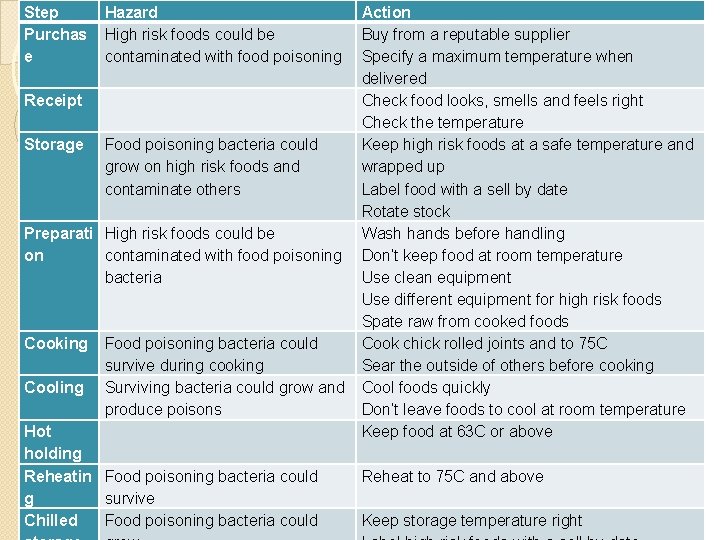
Step Purchas e Hazard Action High risk foods could be Buy from a reputable supplier contaminated with food poisoning Specify a maximum temperature when delivered Receipt Check food looks, smells and feels right Check the temperature Storage Food poisoning bacteria could Keep high risk foods at a safe temperature and grow on high risk foods and wrapped up contaminate others Label food with a sell by date Rotate stock Preparati High risk foods could be Wash hands before handling on contaminated with food poisoning Don’t keep food at room temperature bacteria Use clean equipment Use different equipment for high risk foods Spate raw from cooked foods Cooking Food poisoning bacteria could Cook chick rolled joints and to 75 C survive during cooking Sear the outside of others before cooking Cooling Surviving bacteria could grow and Cool foods quickly produce poisons Don’t leave foods to cool at room temperature Hot Keep food at 63 C or above holding Reheatin Food poisoning bacteria could Reheat to 75 C and above g survive Chilled Food poisoning bacteria could Keep storage temperature right
First Aid Ø First aid is based on 3 principles: ØPromote recovery ØPrevent further injury ØProtect the patent Ø Legislation: Ø 1 x first aid box for every 150 people Ø 1 named first aider for every 150 people Ø 1 x responsible person in charge of first aid ØFirst aid boxes must be regularly checked ØFirst aid boxes must be easily accessible
First Aid Ø First aid box must contain: ØSterile dressings ØWound dressings ØAdhesive plasters ØSterile cotton wool ØPressure bandages ØSafety pins, scissors, eye bath and tweezers ØRubber/latex gloves ØTriangular bandage
First Aid Ø Burns and scalds: ØBurn - caused by dry heat, e. g. pan or cooker ØScald - caused by moist heat, e. g. steam ØTreatment – place under cold running water for 10 minutes until the stinging sensation stops, do not apply cream because this will seal it, if larger than a 10 p piece seek medical advice
First Aid Ø Cuts: ØWash, dry and apply a blue plaster, if bleeding does not stop hold above heart and squeeze Ø Blue plasters are used because they are easily detectable and have a thin metal strip in for manufacturing x-ray detection Ø Homework: Complete revision material/revise for test
- Slides: 34