
February 2 Take Out Paper or notebook for
February 2 Take Out: • Paper or notebook for lecture notes We will continue the Essay Conferences on Monday Learning Objective: • I will be able to make the connection from the Industrial Revolution to WWI. • I will be able to understand key concepts & terms relating to this time period.
Where we left off… Industrial Revolution ▪ Starts in Britain ▪ Rapidly changes Britain and West (Europe/America) ▪ Pros: Modernization, new inventions, more manufactured goods, booming economy, more wealth ▪ Cons: working class had terrible existence, poor treatment of workers, child labor, large wealth gap between rich and poor ▪ New ideas rose out of this era in response to industrialization
Ideas (“—ism”) & movements that came as a response to industrialization ▪ Capitalism ▪ Socialism ▪ Communism ▪ Utilitarianism ▪ Suffrage Movements ▪ Labor Reform Movements
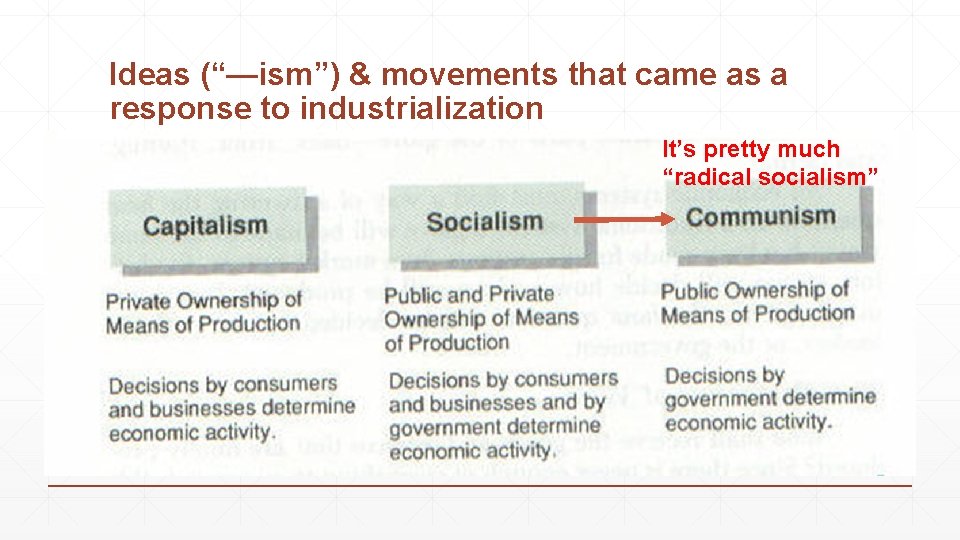
Ideas (“—ism”) & movements that came as a response to industrialization It’s pretty much “radical socialism”
Why Marx’s revolution didn’t happen in Britain? ▪ Thinks that the proletariats will rise up and lead a revolution to overthrow the bourgeoisie does not happen in Britain WHY? ▪ Britain government makes major reform ▪ Pass labor laws to protect workers & child labor laws ▪ Government intervention/regulations in businesses
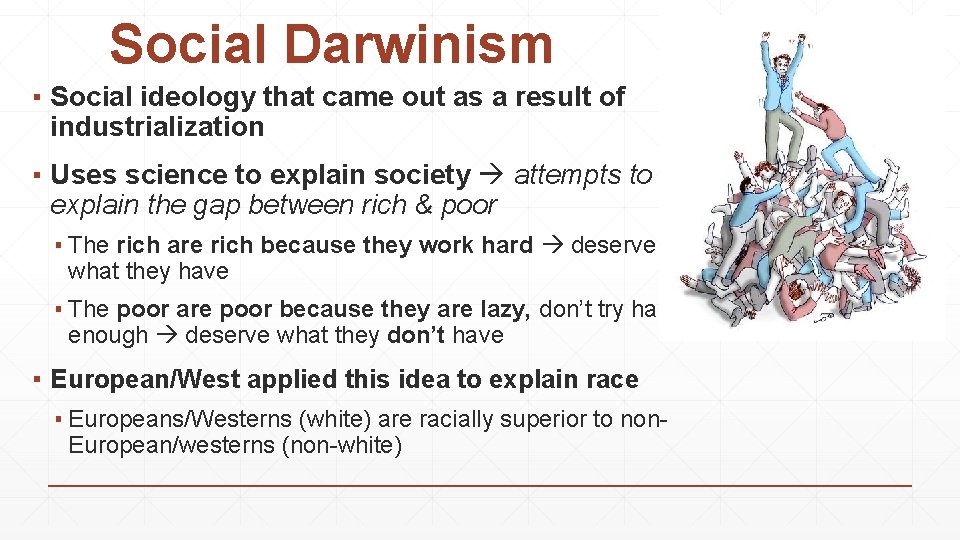
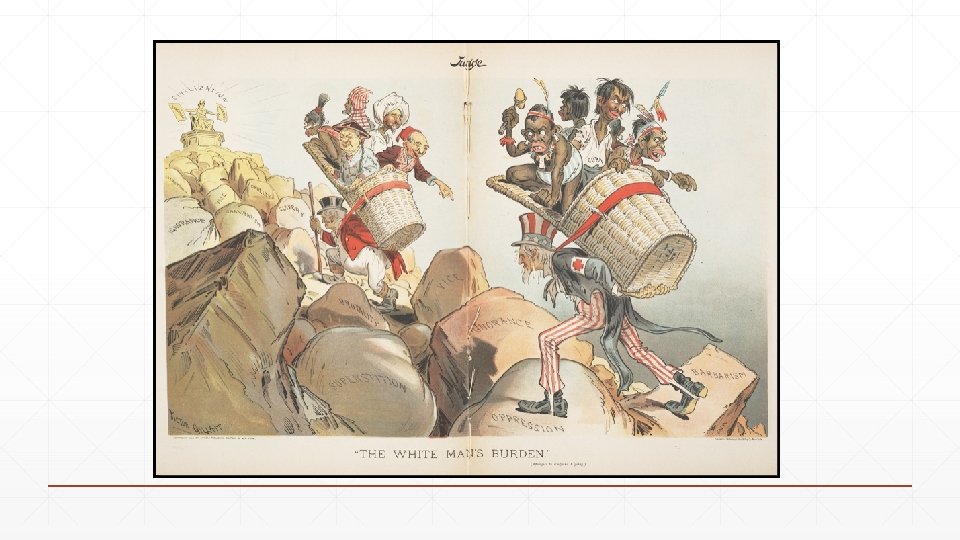
Social Darwinism ▪ Social ideology that came out as a result of industrialization ▪ Uses science to explain society attempts to explain the gap between rich & poor ▪ The rich are rich because they work hard deserve what they have ▪ The poor are poor because they are lazy, don’t try hard enough deserve what they don’t have ▪ European/West applied this idea to explain race ▪ Europeans/Westerns (white) are racially superior to non. European/westerns (non-white)
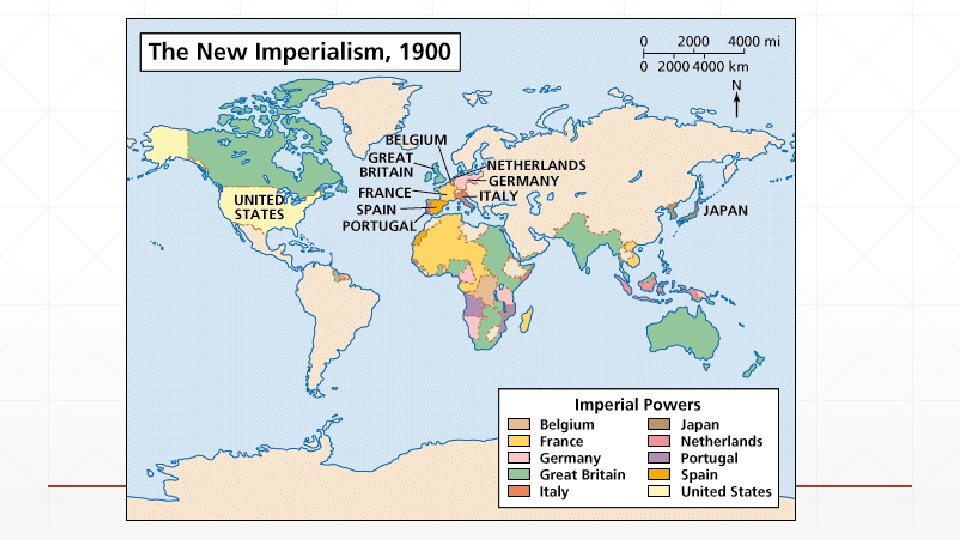
This all leads to… ▪ Competition for materials and markets ▪ Competing for raw resources & new people to sell products to ▪ Territorial dispute within Europe ▪ Imperialism ▪ Militarism ▪ Philosophy that puts strong emphasis on military power ▪ That a country needs to have strong military to aggressively expand or promote their national interest Rise of nationalism
Political Spectrum 3 School of Political Thought in Europe 1800 s Conservative • Usually wealthy property owners & nobility • Argued for protecting the traditional monarchies of Europe Liberal • Mostly middle-class business leaders and merchants • Wanted to give more money to elected parliaments, but only the educated & landowners would vote Radical • Favored drastic change to extend democracy to all people • Believed that gov’t should practice the ideals of the French Revolution liberty, equality, and brotherhood
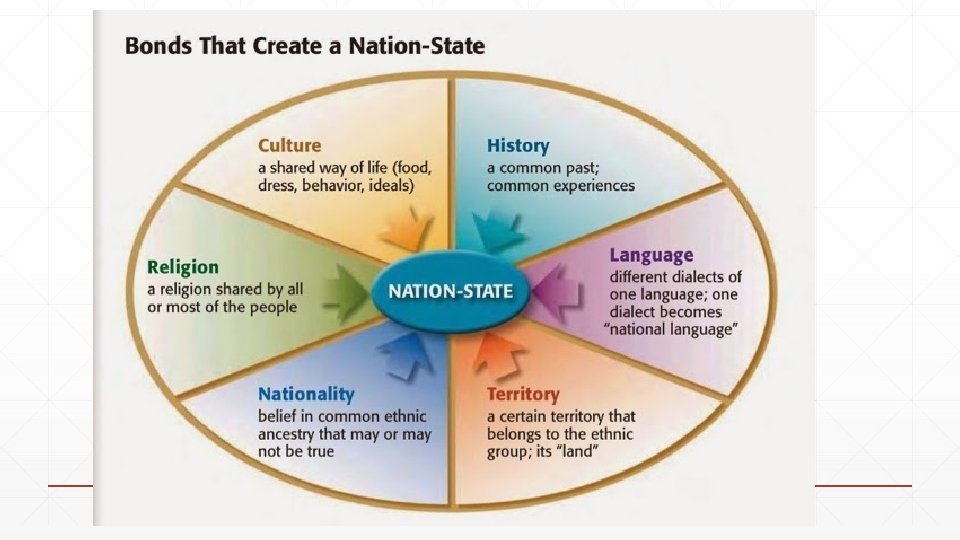
Nationalism… ▪ Nationalism blurs the lines of the political spectrum (conservative, liberal, radical) ▪ Appeals to all parts of life: Culture, History, Language, Territory, Nationality, Religion ▪ Inspired ideas of nationalism self-determinism
National self-determination… ▪ from German: Selbstbestimmungsrecht der Völker ▪ A principle whereby a nation has the right to freely choose its political allegiance or form of government
Nation-States ▪ When a nation (a group of people with a common culture or history) has it’s own independent government, it is called a nation-state ▪ In 1815, only three nation-states existed in Europe. ▪ Britain, France and Spain
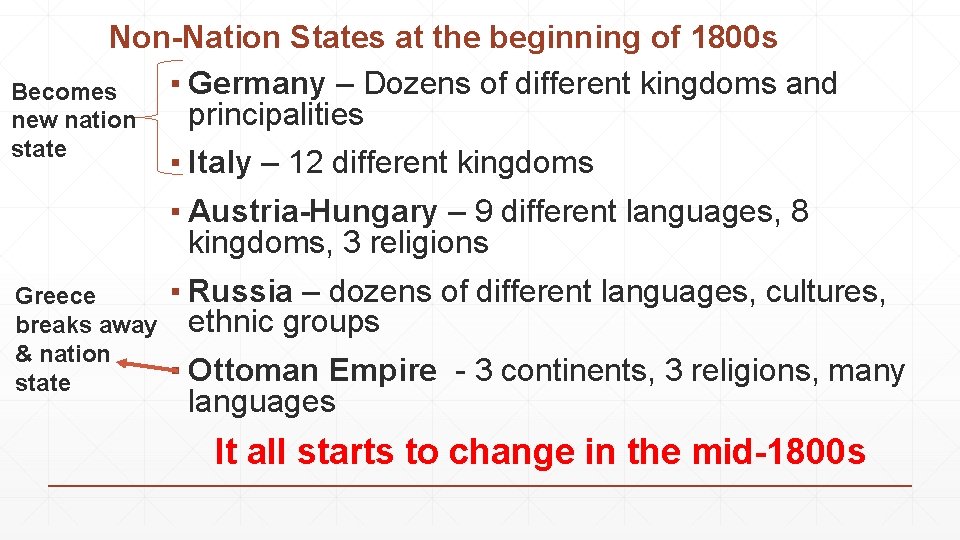
Non-Nation States at the beginning of 1800 s ▪ Germany – Dozens of different kingdoms and Becomes principalities new nation state Greece breaks away & nation state ▪ Italy – 12 different kingdoms ▪ Austria-Hungary – 9 different languages, 8 kingdoms, 3 religions ▪ Russia – dozens of different languages, cultures, ethnic groups ▪ Ottoman Empire - 3 continents, 3 religions, many languages It all starts to change in the mid-1800 s
Positives and Negatives ▪ Positive: Nationalism can serve as a unifying force within a country ▪ Negative: Nationalism can cause intense competition among nations
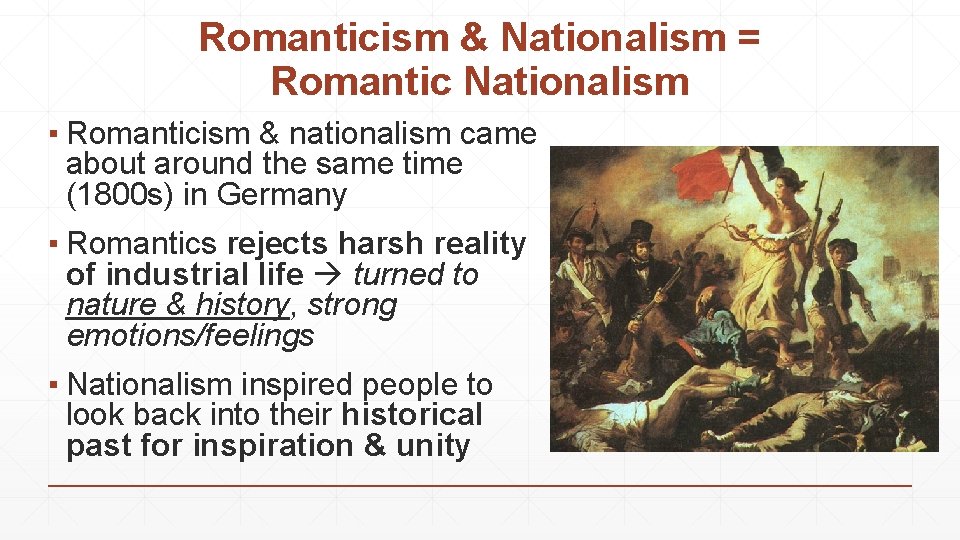
Romanticism & Nationalism = Romantic Nationalism ▪ Romanticism & nationalism came about around the same time (1800 s) in Germany ▪ Romantics rejects harsh reality of industrial life turned to nature & history, strong emotions/feelings ▪ Nationalism inspired people to look back into their historical past for inspiration & unity
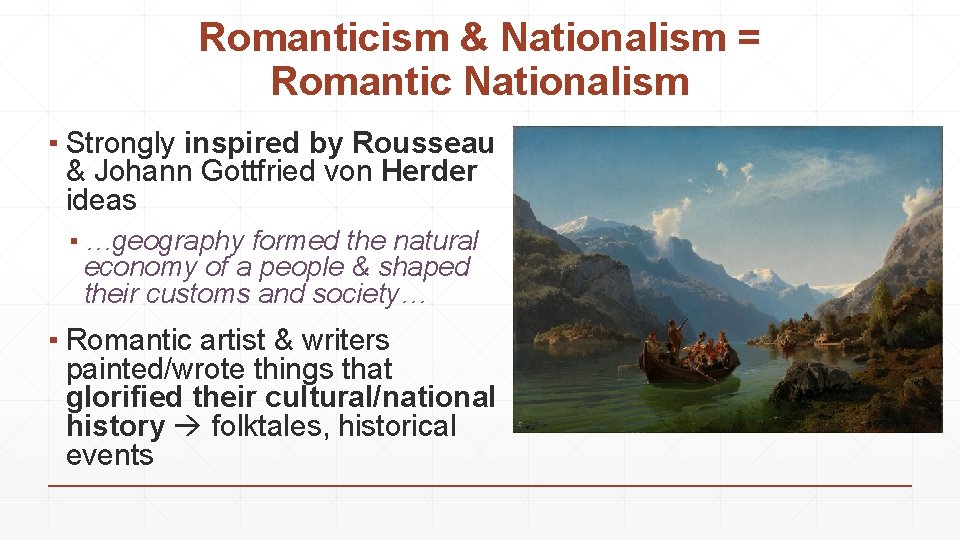
Romanticism & Nationalism = Romantic Nationalism ▪ Strongly inspired by Rousseau & Johann Gottfried von Herder ideas ▪ …geography formed the natural economy of a people & shaped their customs and society… ▪ Romantic artist & writers painted/wrote things that glorified their cultural/national history folktales, historical events
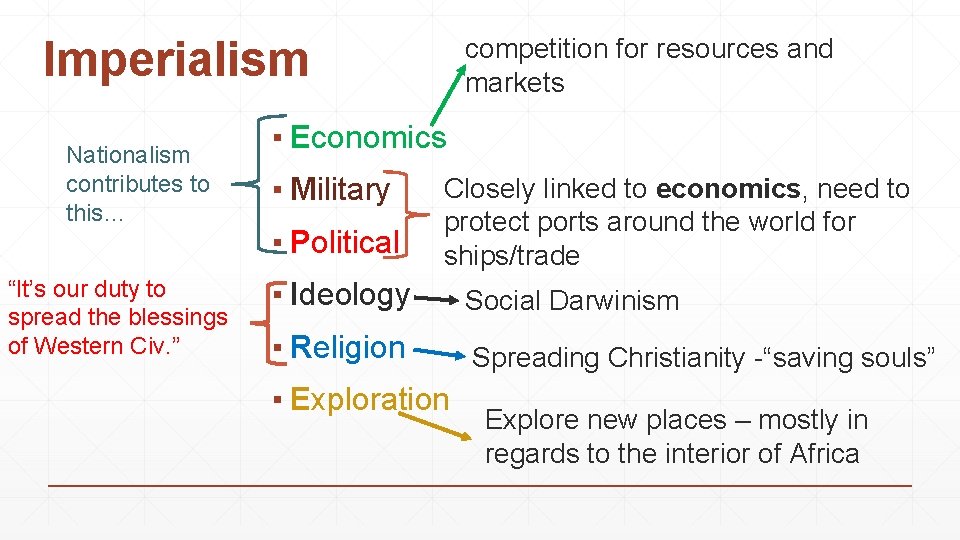
Imperialism Nationalism contributes to this… “It’s our duty to spread the blessings of Western Civ. ” competition for resources and markets ▪ Economics ▪ Military ▪ Political Closely linked to economics, need to protect ports around the world for ships/trade ▪ Ideology Social Darwinism ▪ Religion Spreading Christianity -“saving souls” ▪ Exploration Explore new places – mostly in regards to the interior of Africa
MIND MAP ▪ Directions: ▪ You are creating a Mind Map with the terms on the right. ▪ Each term must have: ▪ Definition ▪ Have a connection to either the Industrial Revolution OR WWI (it can connect to both) with a clear explanation. ▪ You must also make 3 connection between terms with an explanation. ▪ Extra points for creativity and use of drawings/pictures/color (dependent on quality) • • • • Terms: Capitalism Socialism Communism Romanticism Nationalism Nation-state(s) National selfdeterminism Imperialism Militarism Alliances Propaganda Technology Total War
- Slides: 20