
FEBIAD ion source development at ISOLDE efficiency improvement
FEBIAD ion source development at ISOLDE: efficiency improvement for all the elements L. Penescu, R. Catherall, J. Lettry, T. Stora CERN, AB-ATB-IF (ISOLDE) ISOLDE Workshop, 17 -19 November 2008
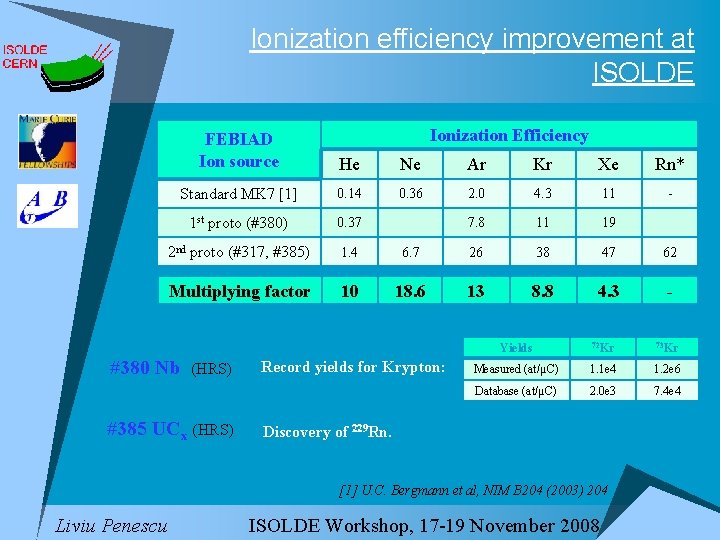
Ionization efficiency improvement at ISOLDE Ionization Efficiency FEBIAD Ion source He Ne Ar Kr Xe Rn* Standard MK 7 [1] 0. 14 0. 36 2. 0 4. 3 11 - 1 st proto (#380) 0. 37 7. 8 11 19 2 nd proto (#317, #385) 1. 4 6. 7 26 38 47 62 Multiplying factor 10 18. 6 13 8. 8 4. 3 - #380 Nb (HRS) #385 UCx (HRS) Record yields for Krypton: Yields 72 Kr 73 Kr Measured (at/µC) 1. 1 e 4 1. 2 e 6 Database (at/µC) 2. 0 e 3 7. 4 e 4 Discovery of 229 Rn. [1] U. C. Bergmann et al, NIM B 204 (2003) 204 Liviu Penescu ISOLDE Workshop, 17 -19 November 2008
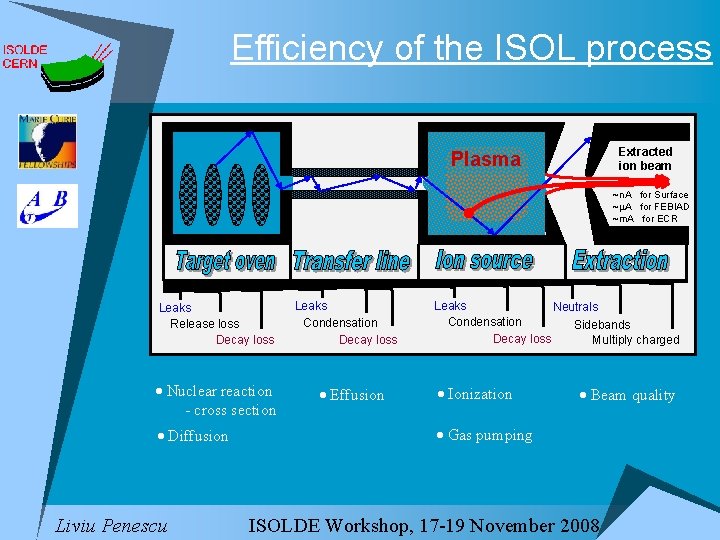
Efficiency of the ISOL process Extracted ion beam Plasma ~n. A for Surface ~ A for FEBIAD ~m. A for ECR Leaks Release loss Decay loss Nuclear reaction - cross section Diffusion Liviu Penescu Leaks Condensation Decay loss Effusion Leaks Neutrals Condensation Sidebands Decay loss Multiply charged Ionization Beam quality Gas pumping ISOLDE Workshop, 17 -19 November 2008
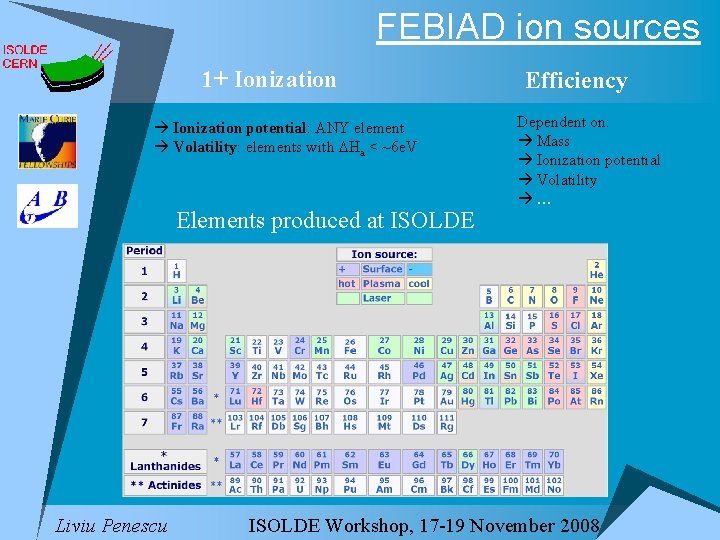
FEBIAD ion sources 1+ Ionization potential: ANY element Volatility: elements with Ha < ~6 e. V Elements produced at ISOLDE Liviu Penescu Efficiency Dependent on: Mass Ionization potential Volatility … ISOLDE Workshop, 17 -19 November 2008
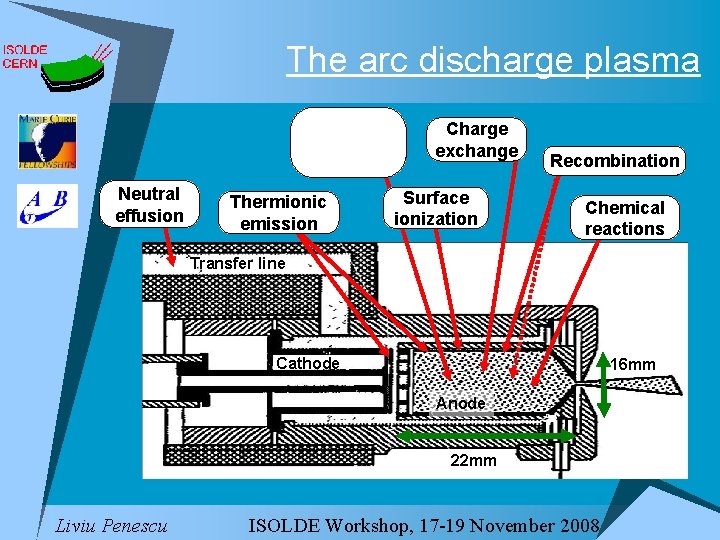
The arc discharge plasma Electron impact ionization Neutral effusion Thermionic emission Charge exchange Surface ionization Recombination Chemical reactions Transfer line Cathode 16 mm Anode 22 mm Liviu Penescu ISOLDE Workshop, 17 -19 November 2008
![Theoretical models for FEBIAD ionization Best approximation: empirical equation [2] Model parameters (FEBIAD): k.](http://slidetodoc.com/presentation_image_h2/6f98fe6fe7d0795380a2c108d8ce5684/image-6.jpg "Theoretical models for FEBIAD ionization Best approximation: empirical equation [2] Model parameters (FEBIAD): k.")
Theoretical models for FEBIAD ionization Best approximation: empirical equation [2] Model parameters (FEBIAD): k. Te = 3. 029 e. V; Ti = 2273 K; 4 l D 0/A 0 = 5. 39 105 cm/s Implications… Fitted results: FEBIAD (Kirchner) and EBGP (Nitschke) sources Where: • l = average path length for a particle in the plasma; • D 0 = constant (cm 2/s); • Sout = emission area of the source; • Ti = ion temperature; • Te = electron temperature; • Ip = ionization potential; • le = number of electrons in the valence shell of the atom with a given I p; • Mi = mass of the species. Not useful for: Comprehension of IS internal parameters: Deducing: - response time; - emittance; - collective behavior (=>selectivity) [2] G. D. Alton, NIM A 382 (1996) 207 Liviu Penescu ISOLDE Workshop, 17 -19 November 2008
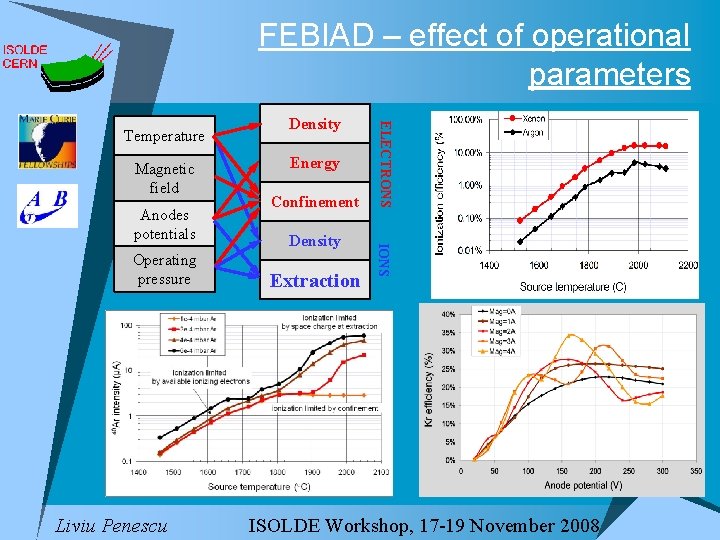
FEBIAD – effect of operational parameters Magnetic field Anodes potentials Liviu Penescu Energy Confinement Density Extraction IONS Operating pressure Density ELECTRONS Temperature ISOLDE Workshop, 17 -19 November 2008
![FEBIAD - a parameter-oriented model Model frame Inferred from experimental study; Introduced in [3].](http://slidetodoc.com/presentation_image_h2/6f98fe6fe7d0795380a2c108d8ce5684/image-8.jpg "FEBIAD - a parameter-oriented model Model frame Inferred from experimental study; Introduced in [3].")
FEBIAD - a parameter-oriented model Model frame Inferred from experimental study; Introduced in [3]. • No plasma confinement; • Mainly direct electron beam ionization; • No ion heating. Equivalent with: Buffer gas not required for ionization; Emittance defined mainly by the extraction geometry; Fast ionization. T = cathode temperature = gas & ion temperature; A, W = cathode parameters (Richardson constant & work function); Eelec = ionizing electrons energy; Eioniz, le, Mi = element parameters (ionization energy; available electrons; mass) Vsource = source volume; Sout = emission area of the source. [3] L. Penescu et al, NIM B 266, 4415 (2008) Liviu Penescu ISOLDE Workshop, 17 -19 November 2008
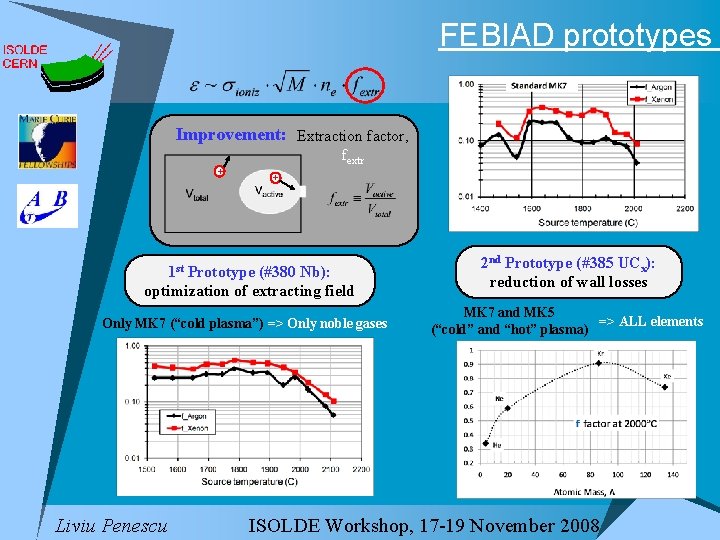
FEBIAD prototypes Improvement: Extraction factor, fextr + + 1 st Prototype (#380 Nb): optimization of extracting field Only MK 7 (“cold plasma”) => Only noble gases Liviu Penescu 2 nd Prototype (#385 UCx): reduction of wall losses MK 7 and MK 5 => ALL elements (“cold” and “hot” plasma) ISOLDE Workshop, 17 -19 November 2008
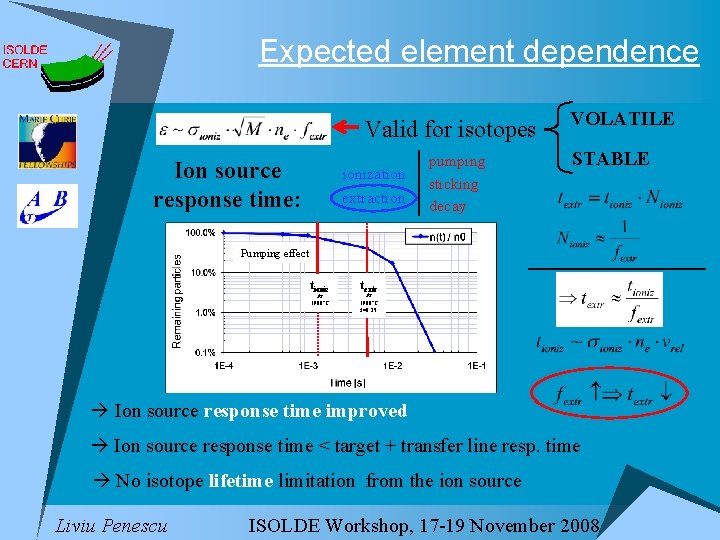
Expected element dependence Valid for isotopes Ion source response time: ionization extraction pumping sticking decay VOLATILE STABLE Pumping effect tioniz Ar 1900 C textr Ar 1900 C f=0. 25 Ion source response time improved Ion source response time < target + transfer line resp. time No isotope lifetime limitation from the ion source Liviu Penescu ISOLDE Workshop, 17 -19 November 2008
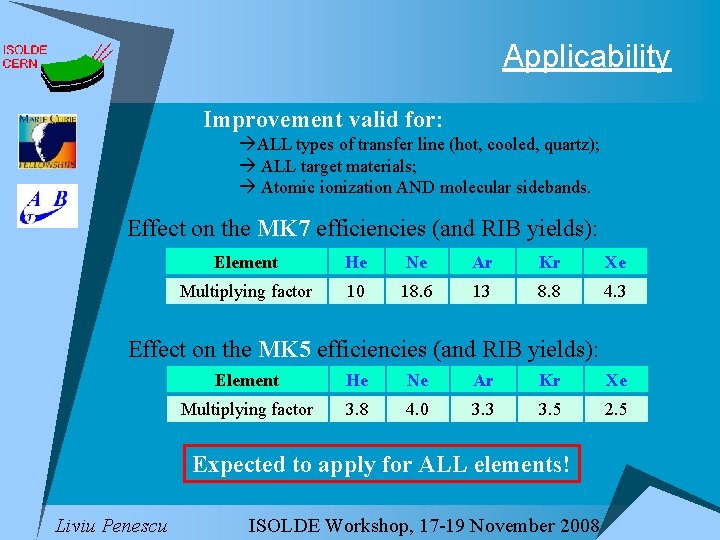
Applicability Improvement valid for: ALL types of transfer line (hot, cooled, quartz); ALL target materials; Atomic ionization AND molecular sidebands. Effect on the MK 7 efficiencies (and RIB yields): Element He Ne Ar Kr Xe Multiplying factor 10 18. 6 13 8. 8 4. 3 Effect on the MK 5 efficiencies (and RIB yields): Element He Ne Ar Kr Xe Multiplying factor 3. 8 4. 0 3. 3 3. 5 2. 5 Expected to apply for ALL elements! Liviu Penescu ISOLDE Workshop, 17 -19 November 2008

Thank you for your attention! Liviu. Penescu@cern. ch
- Slides: 12