
Feb 2 The ultimate projectile Putting an object
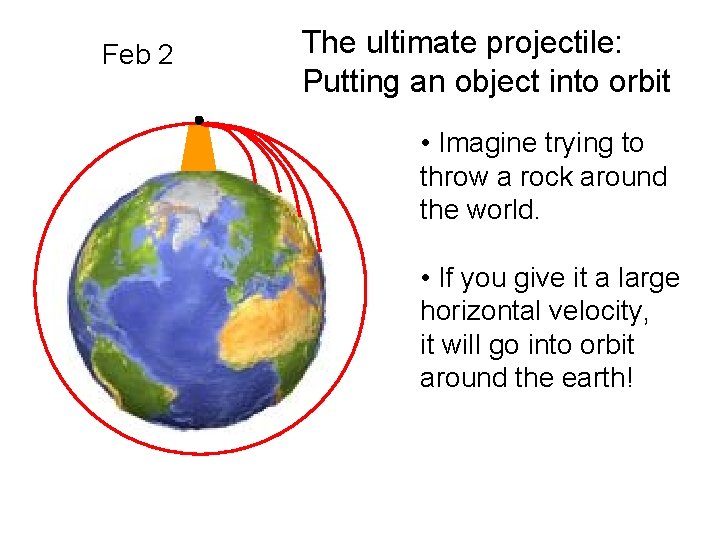
Feb 2 The ultimate projectile: Putting an object into orbit • Imagine trying to throw a rock around the world. • If you give it a large horizontal velocity, it will go into orbit around the earth!
Lec. 6 – The Laws of Motion • Objects have a property called inertia which causes them to resist changes in their motion (Newton’s 1 st Law or Galileo’s law of inertia) if it is at rest, it stays at rest if it is moving, it keeps moving • forces overcome inertia to produce acceleration (2 nd Law) change in velocity
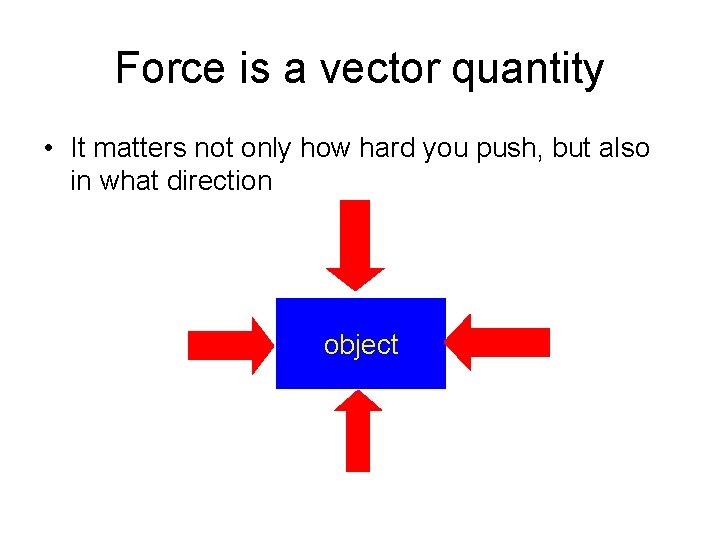
Force is a vector quantity • It matters not only how hard you push, but also in what direction object
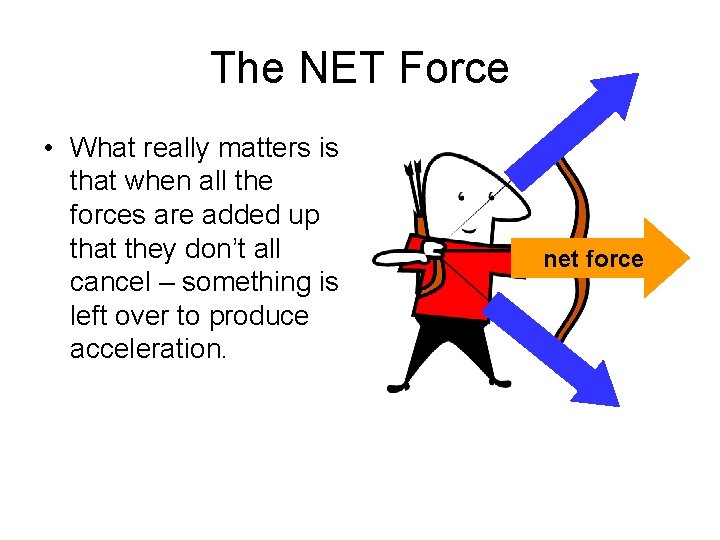
The NET Force • What really matters is that when all the forces are added up that they don’t all cancel – something is left over to produce acceleration. net force
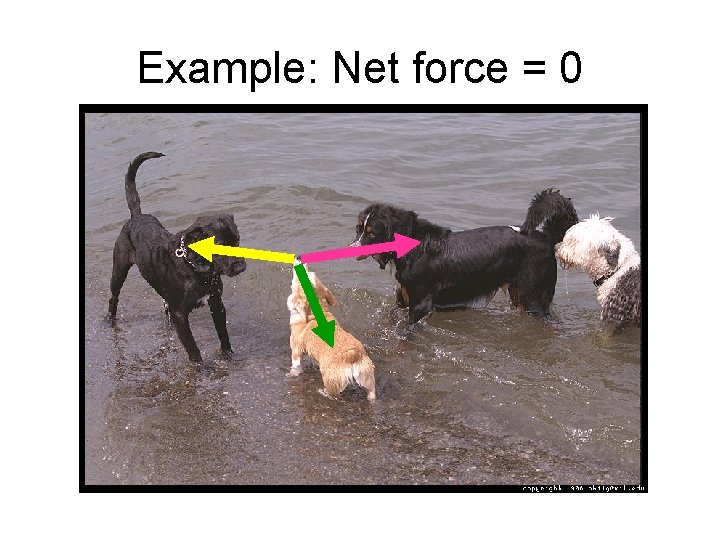
Example: Net force = 0
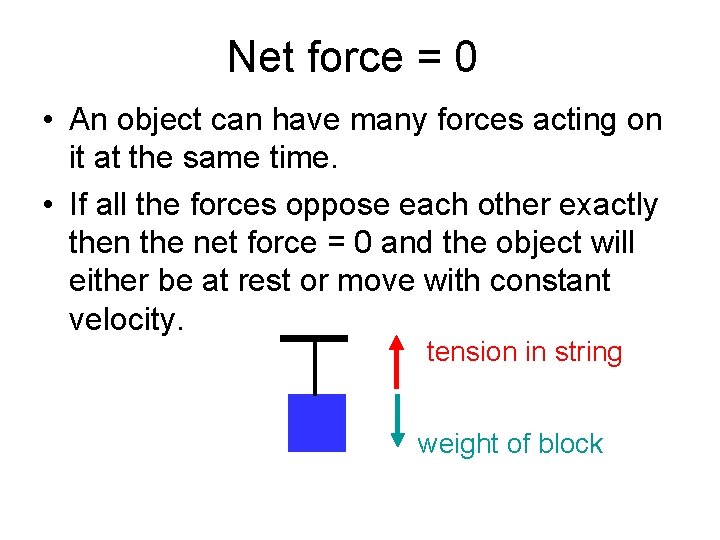
Net force = 0 • An object can have many forces acting on it at the same time. • If all the forces oppose each other exactly then the net force = 0 and the object will either be at rest or move with constant velocity. tension in string weight of block
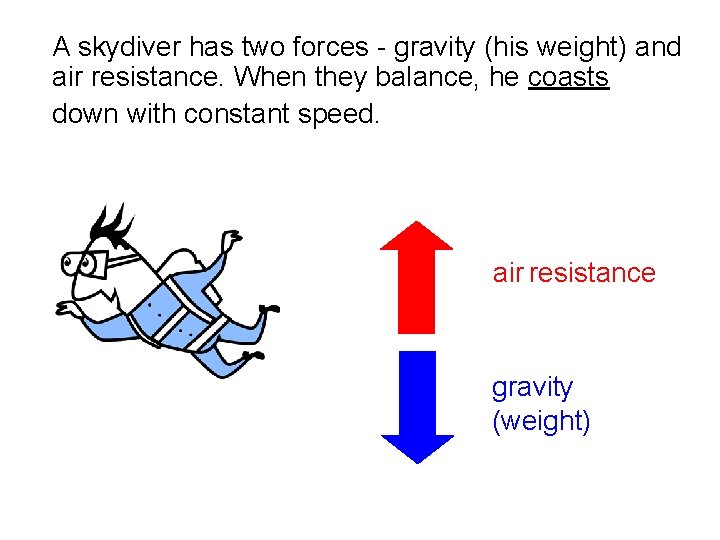
A skydiver has two forces - gravity (his weight) and air resistance. When they balance, he coasts down with constant speed. air resistance gravity (weight)
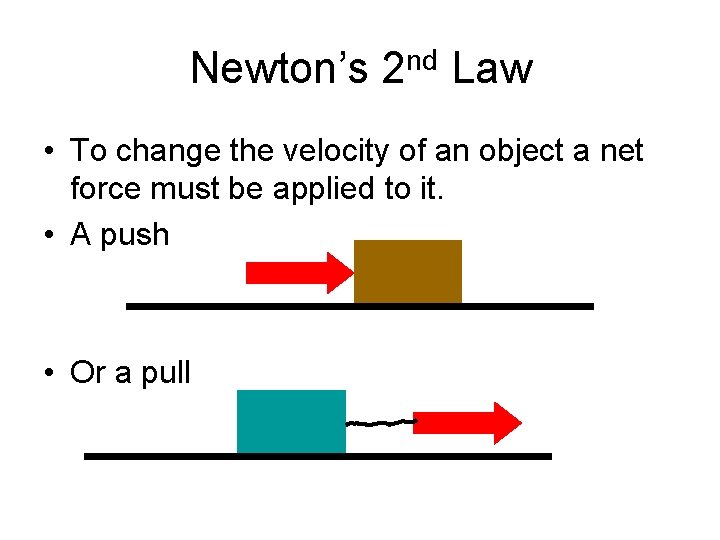
Newton’s 2 nd Law • To change the velocity of an object a net force must be applied to it. • A push • Or a pull
Contact and non-contact forces • Pushes, pulls, friction, and tension are contact forces- whatever exerts the force actually touches the object • Non-contact forces: Forces that act without contact between objects a) electric forces b) magnetic forces c) gravity
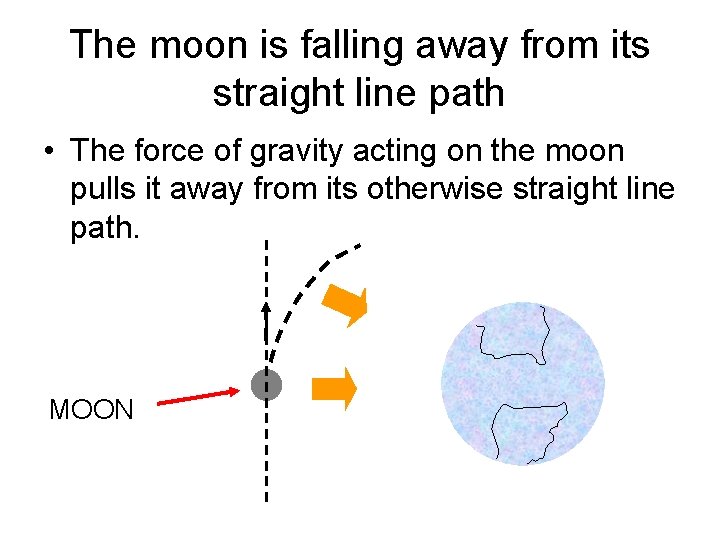
The moon is falling away from its straight line path • The force of gravity acting on the moon pulls it away from its otherwise straight line path. MOON
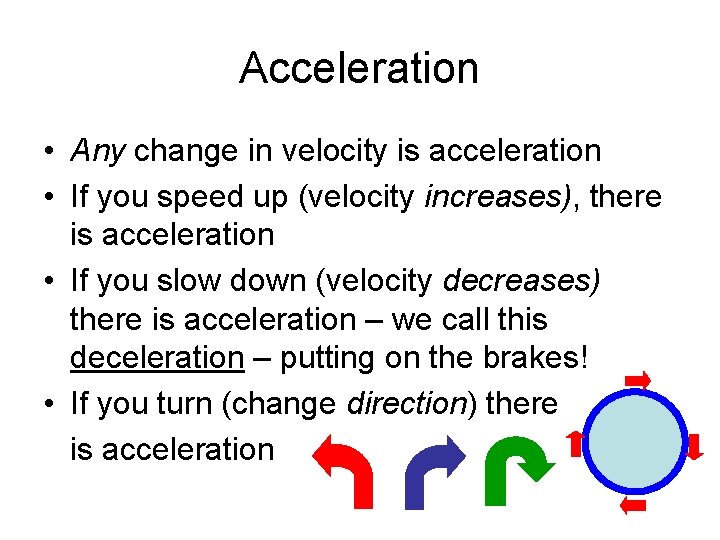
Acceleration • Any change in velocity is acceleration • If you speed up (velocity increases), there is acceleration • If you slow down (velocity decreases) there is acceleration – we call this deceleration – putting on the brakes! • If you turn (change direction) there is acceleration
You are NOT accelerating if • You are riding your bike up a hill at constant speed ( v = a constant) • You are in a parked car (v = 0) • You are in an elevator that is going up with constant speed. ( v = a constant) • You are in an elevator that is going down with constant speed. ( v = a constant)
You are accelerating if • You are going down a steep hill on rollerblades (your velocity increases) • In an elevator when it starts to go up (you are at rest then start moving) • In a car going around a curve at constant speed (the direction of your velocity changes) • You are on a bus that is slowing down (your velocity decreases)
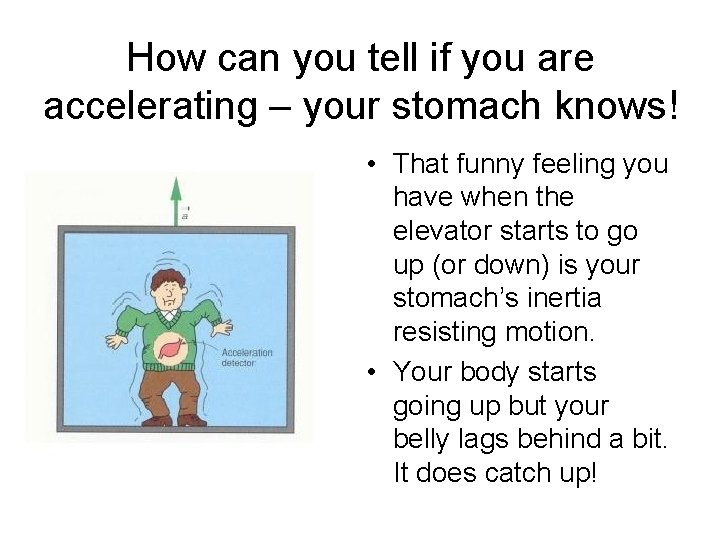
How can you tell if you are accelerating – your stomach knows! • That funny feeling you have when the elevator starts to go up (or down) is your stomach’s inertia resisting motion. • Your body starts going up but your belly lags behind a bit. It does catch up!
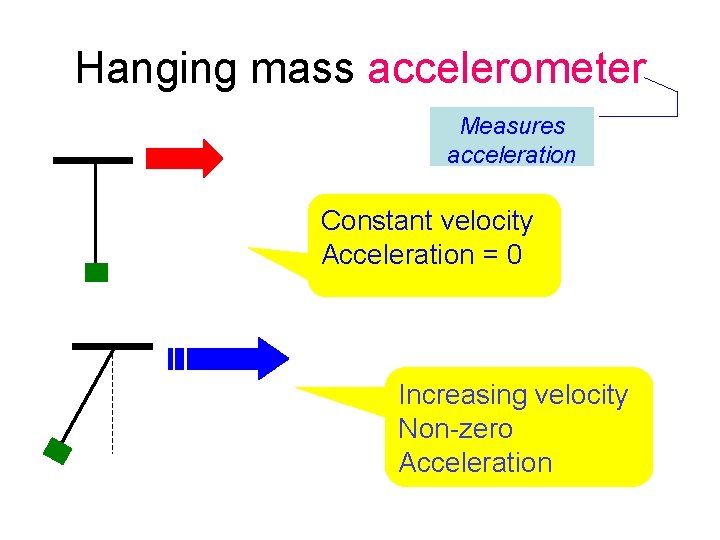
Hanging mass accelerometer Measures acceleration Constant velocity Acceleration = 0 Increasing velocity Non-zero Acceleration
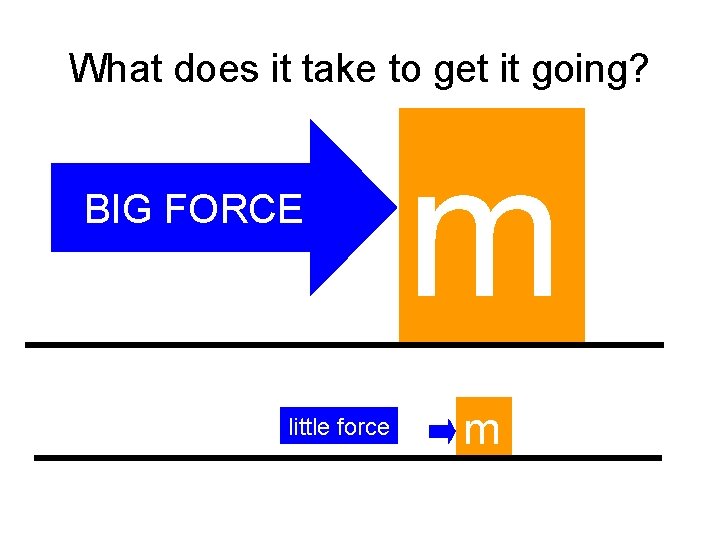
What does it take to get it going? BIG FORCE little force m m
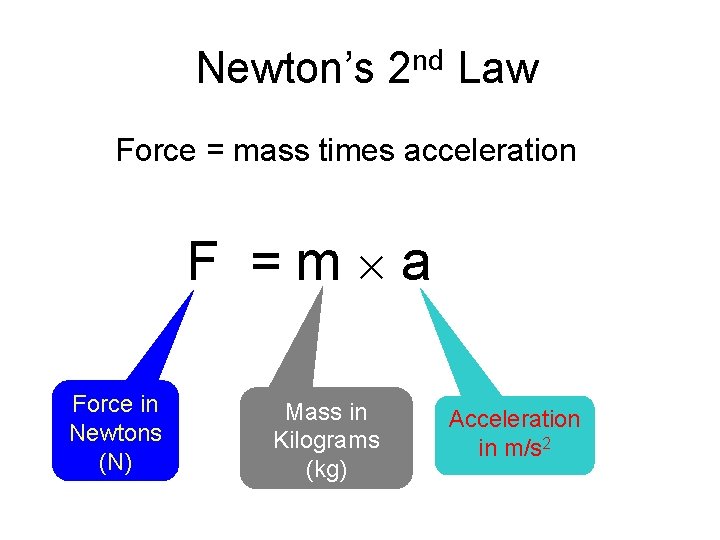
Newton’s 2 nd Law Force = mass times acceleration F =m a Force in Newtons (N) Mass in Kilograms (kg) Acceleration in m/s 2
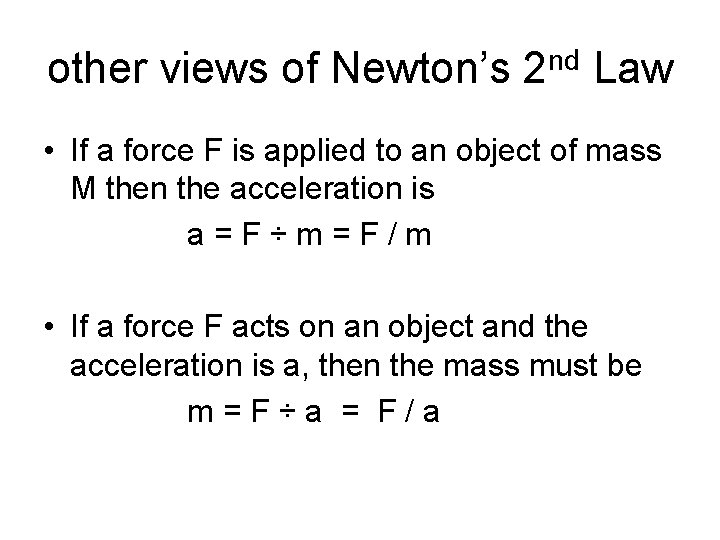
other views of Newton’s 2 nd Law • If a force F is applied to an object of mass M then the acceleration is a=F÷m=F/m • If a force F acts on an object and the acceleration is a, then the mass must be m=F÷a = F/a
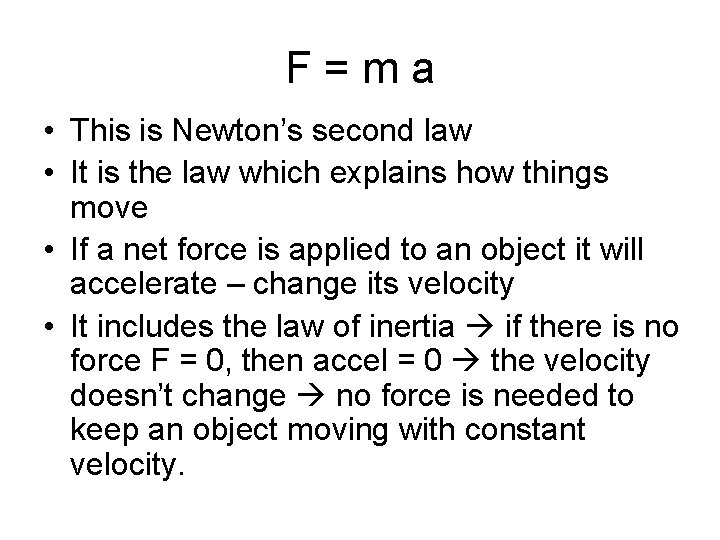
F=ma • This is Newton’s second law • It is the law which explains how things move • If a net force is applied to an object it will accelerate – change its velocity • It includes the law of inertia if there is no force F = 0, then accel = 0 the velocity doesn’t change no force is needed to keep an object moving with constant velocity.
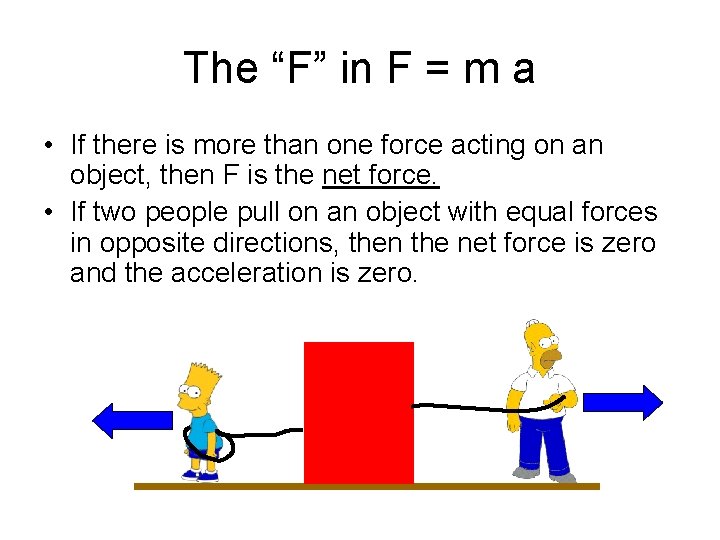
The “F” in F = m a • If there is more than one force acting on an object, then F is the net force. • If two people pull on an object with equal forces in opposite directions, then the net force is zero and the acceleration is zero.
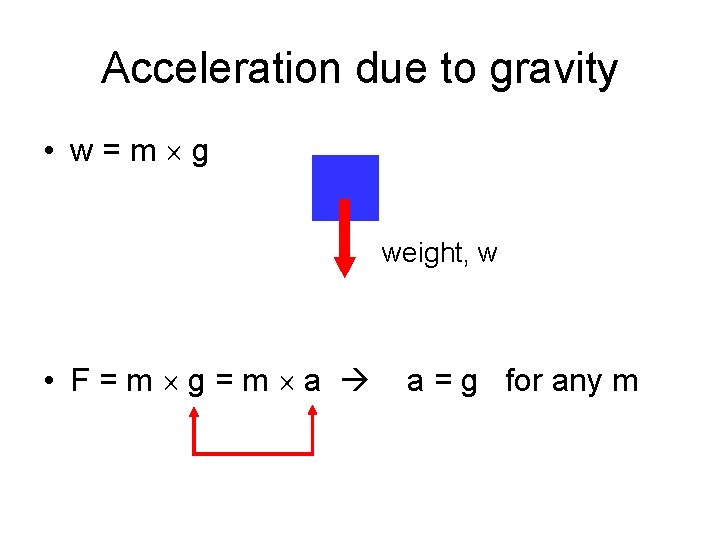
Acceleration due to gravity • w=m g weight, w • F=m g=m a a = g for any m
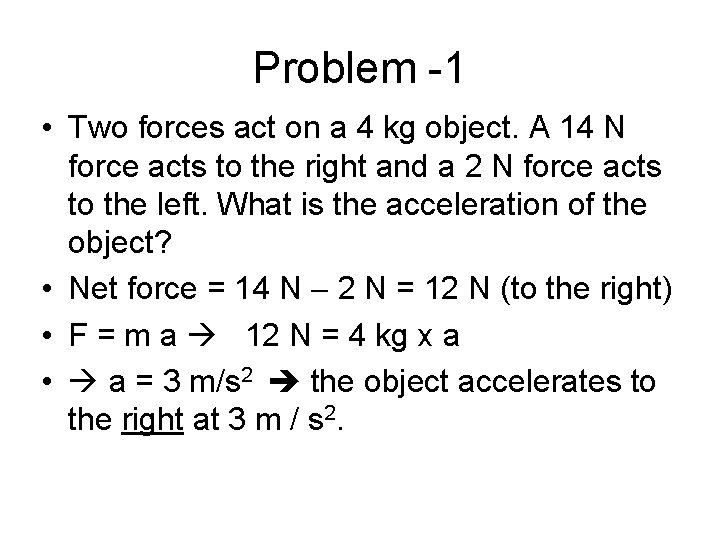
Problem -1 • Two forces act on a 4 kg object. A 14 N force acts to the right and a 2 N force acts to the left. What is the acceleration of the object? • Net force = 14 N 2 N = 12 N (to the right) • F = m a 12 N = 4 kg x a • a = 3 m/s 2 the object accelerates to the right at 3 m / s 2.
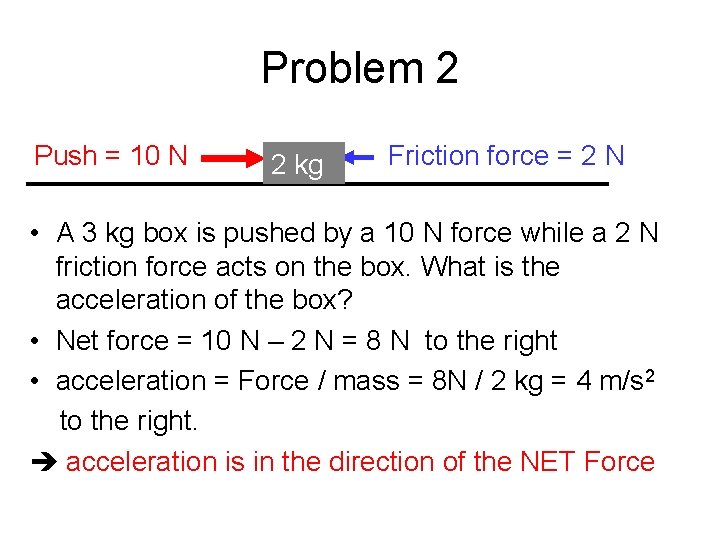
Problem 2 Push = 10 N 2 kg Friction force = 2 N • A 3 kg box is pushed by a 10 N force while a 2 N friction force acts on the box. What is the acceleration of the box? • Net force = 10 N – 2 N = 8 N to the right • acceleration = Force / mass = 8 N / 2 kg = 4 m/s 2 to the right. acceleration is in the direction of the NET Force
- Slides: 23