
Features of spoken texts Subtitle Planned and unplanned
Features of spoken texts Subtitle
Planned and unplanned scripts • Unplanned/unscriped • Planned/scripted • The unpreparedness of a speech • The preparedness of speech • Characterised by fillers, pauses and repairs • Fewer fillers, unplanned pauses and repairs • Often more formal in nature • Often informal Scripts can be a combination of unplanned and planned – a rough outline of ideas
What do we look at when analysing a spoken text/transcript? • Sociolinguistic features (MRS FAT CDS) – what’s going on behind the text? • Prosodic Features (VIP ST) – helps us to analyse the tone and reception of the speech • Paralinguistic Features – features marginal to language, but which help us to analyse the tone and emotion
Phonetics and Phonology in spoken texts • Prosodic features – rising/falling pitch, volume, pauses, volume, tempo, stress • Paralinguistic features such as gasping, laugher, booing etc. • Features of connected speech – elision, ellipsis, assimilation etc.
Morphology and Lexicology in spoken texts • Colloquialism (servo, arvo, footy) • Jargon (the mitochondria is the powerhouse of the cell) • Terms of address (Dear ladies and gentlemen, shush you guys) • Contractions • Shortenings or reductions • Acronyms (NATO) • Initialisms (MCG) • Paratactic style (I went to the shops and bought and apple and a banana and went to the park and played on the swings but then it rained and we walked home and…) – This style is often used by young children – they haven’t learned to separate ideas yet – word vomit
Syntax in spoken texts • Sentence types • Sentence structures • Active voice (subject before verb) • Passive voice (subject after verb) – Shows interest in the object rather than the subject (The house was built in 1654) – Shows that we might not know who performed the action (All the cookies have been eaten) • Phatic expressions (hello, how are you? Nice day isn’t it? ) – Used for the purposes of social interaction – including someone else
Semantics in spoken texts • Colloquialism/jargon – do you have to have specific cultural or social understanding in order to get it? – The Logies, Bradman • Connotation – the emotional meaning behind the word – Does the speech invoke emotion? Is it a sensitive subject (e. g. terrorist attacks, closure of Hazelwood) • Denotation – the dictionary meaning of a word – Does your connotation of the word school match its denotation?
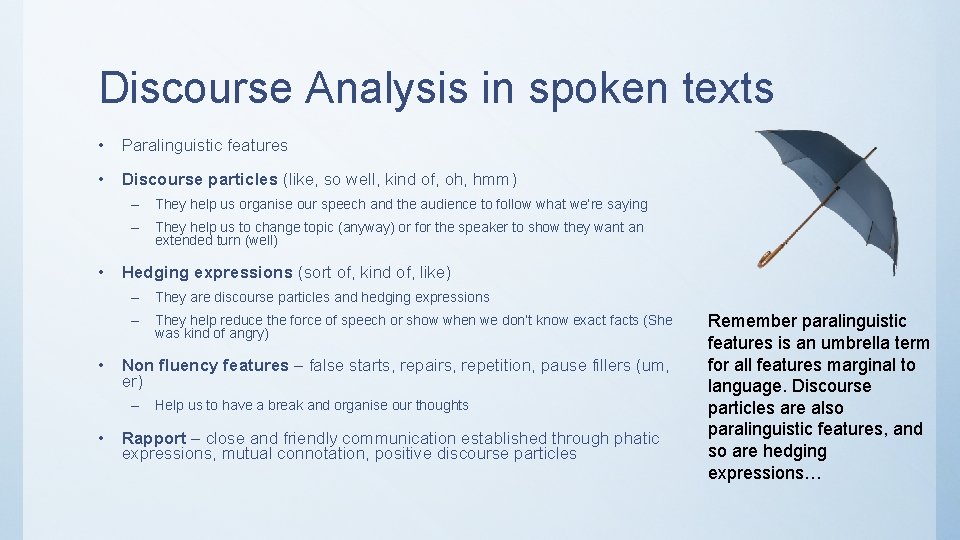
Discourse Analysis in spoken texts • Paralinguistic features • Discourse particles (like, so well, kind of, oh, hmm) • • – They help us organise our speech and the audience to follow what we’re saying – They help us to change topic (anyway) or for the speaker to show they want an extended turn (well) Hedging expressions (sort of, kind of, like) – They are discourse particles and hedging expressions – They help reduce the force of speech or show when we don’t know exact facts (She was kind of angry) Non fluency features – false starts, repairs, repetition, pause fillers (um, er) – • Help us to have a break and organise our thoughts Rapport – close and friendly communication established through phatic expressions, mutual connotation, positive discourse particles Remember paralinguistic features is an umbrella term for all features marginal to language. Discourse particles are also paralinguistic features, and so are hedging expressions…
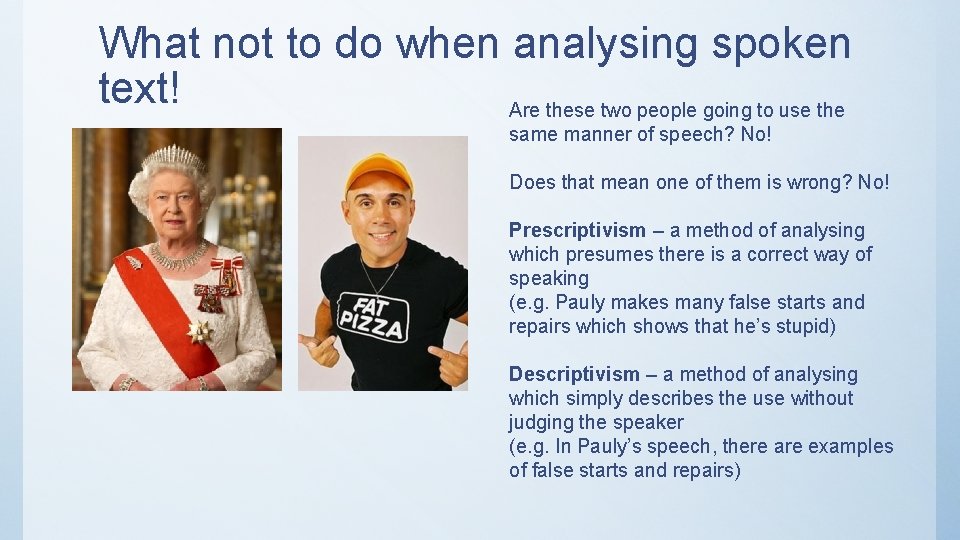
What not to do when analysing spoken text! Are these two people going to use the same manner of speech? No! Does that mean one of them is wrong? No! Prescriptivism – a method of analysing which presumes there is a correct way of speaking (e. g. Pauly makes many false starts and repairs which shows that he’s stupid) Descriptivism – a method of analysing which simply describes the use without judging the speaker (e. g. In Pauly’s speech, there are examples of false starts and repairs)
- Slides: 9