
Features of a Text Lesson 2 NonFiction Quick

- Slides: 8
Features of a Text Lesson 2 - Non-Fiction Quick recap. . . Last lesson, we looked at features of fictional writing: first/third person, description, problem and solution. Today we are going to look at non-fiction. Can you remember the analogy used last time when describing these lessons? There’s a clue in the picture. . . What would you expect to see in a piece of nonfiction writing?
Features of a Text Lesson 2 - Non-Fiction What would we expect in a non-fiction piece of writing? ● ● ● Title Subheadings Technical vocabulary Quotes Pictures/Diagrams Imagine your favourite hobby. Now imagine writing a non-chronological report about that hobby. Now look to see how those features would fit into your report. . .
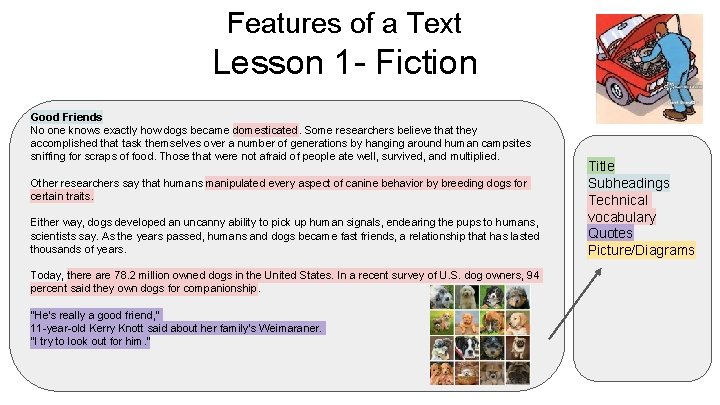
Features of a Text Lesson 1 - Fiction The Wolf Within We love dogs, all types of dogs: small dogs, big dogs, yappy dogs, lap dogs. Each year we spend billions of dollars on our canine pals, making sure our lovable mutts have enough to eat and lots of toys to play with. For their part, dogs love us. They lick our faces, protect our homes, and come when we call them (sometimes). But where did our favorite four-legged companions come from? How and when did dogs get to be our best friends? Some scientists believe they have found some of the answers. From Wolf to Woof Scientists have long known that dogs evolved from wolves. Just when the transformation from wolf to dog actually took place, however, remained a mystery. Some said dogs evolved as a separate species 135, 000 years ago in two parts of the world. One group of dogs developed in Europe and Asia from Asian wolves. Another group evolved in North, Central, and South America from American wolves. Now, researchers say, those theories are wrong. New studies suggest that domesticated, or tamed, dogs first appeared 15, 000 years ago in eastern Asia. They also say that every modern dog, from the Taco Bell Chihuahua to Frank, the adorable pug in the movie Men in Black II, descended from approximately five female Asian wolves, the mothers of all modern dogs. Title Subheadings Technical vocabulary Quotes Picture/Diagrams
Features of a Text Lesson 1 - Fiction Old Bones How did scientists come to those conclusions? Scientist Jennifer Leonard and a team of researchers began investigating the origins of dogs by collecting the bones of canines that once lived in North, Central, and South America before Christopher Columbus arrived in 1492. Researchers then extracted a bit of DNA from the cells in those bones. DNA is the substance that makes up the genes of living things. Genes determine a dog's inherited characteristics, such as eye and fur colour. The scientists then compared the DNA samples to the DNA of modern dogs and wolves not only in North and South America, but also in Europe and Asia. Scientists found that the genes of the ancient American dogs were similar to the genes of dogs born in Europe and Asia. Scientists also concluded that every breed of dog, from English setters to Labrador retrievers, descended from wolves that lived in Europe and Asia and migrated to North and South America. Land Bridge Scientists suspect dogs first set paw in North America by following settlers across a land bridge that once linked northern Asia and North America. "We can't say in detail how [the dogs got to America]; that's something for the future, " said Peter Savolainen, a scientist in Sweden. "But what's certain is that by 9, 000 years ago, [dogs] were in America and all over Europe and Asia. " Title Subheadings Technical vocabulary Quotes Picture/Diagrams
Features of a Text Lesson 1 - Fiction Good Friends No one knows exactly how dogs became domesticated. Some researchers believe that they accomplished that task themselves over a number of generations by hanging around human campsites sniffing for scraps of food. Those that were not afraid of people ate well, survived, and multiplied. Other researchers say that humans manipulated every aspect of canine behavior by breeding dogs for certain traits. Either way, dogs developed an uncanny ability to pick up human signals, endearing the pups to humans, scientists say. As the years passed, humans and dogs became fast friends, a relationship that has lasted thousands of years. Today, there are 78. 2 million owned dogs in the United States. In a recent survey of U. S. dog owners, 94 percent said they own dogs for companionship. "He's really a good friend, " 11 -year-old Kerry Knott said about her family's Weimaraner. "I try to look out for him. " Title Subheadings Technical vocabulary Quotes Picture/Diagrams
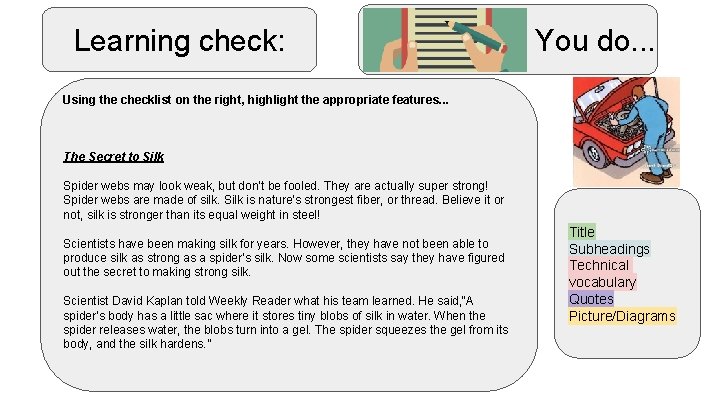
Learning check: You do. . . Using the checklist on the right, highlight the appropriate features. . . The Secret to Silk Spider webs may look weak, but don’t be fooled. They are actually super strong! Spider webs are made of silk. Silk is nature’s strongest fiber, or thread. Believe it or not, silk is stronger than its equal weight in steel! Scientists have been making silk for years. However, they have not been able to produce silk as strong as a spider’s silk. Now some scientists say they have figured out the secret to making strong silk. Scientist David Kaplan told Weekly Reader what his team learned. He said, “A spider’s body has a little sac where it stores tiny blobs of silk in water. When the spider releases water, the blobs turn into a gel. The spider squeezes the gel from its body, and the silk hardens. ” Title Subheadings Technical vocabulary Quotes Picture/Diagrams
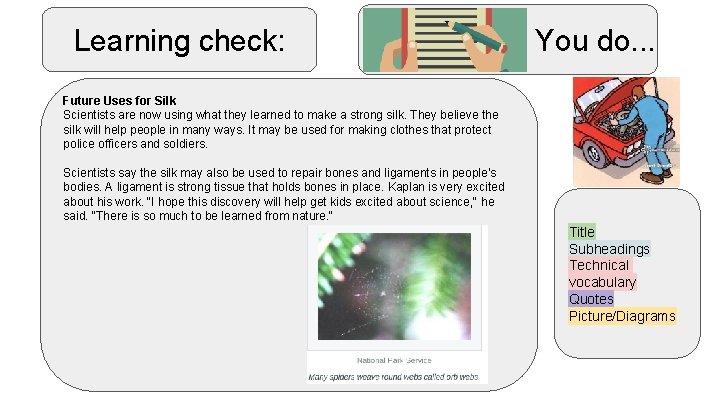
Learning check: You do. . . Future Uses for Silk Scientists are now using what they learned to make a strong silk. They believe the silk will help people in many ways. It may be used for making clothes that protect police officers and soldiers. Scientists say the silk may also be used to repair bones and ligaments in people’s bodies. A ligament is strong tissue that holds bones in place. Kaplan is very excited about his work. "I hope this discovery will help get kids excited about science, " he said. "There is so much to be learned from nature. " Title Subheadings Technical vocabulary Quotes Picture/Diagrams
Well done! Now send your answers to your teacher.