
Features of a DBMS CSE 3180 Summer 2005
Features of a DBMS CSE 3180 Summer 2005 Lect 06 / 1
Lecture 6 This lecture will cover many of the functions required of a Database Management System. It is a good opportunity to review much of the material covered to date, and will also open the way to other topics such as Data Dictionary, Integrity, Recovery, Concurrency considerations and Business Rules. We will be moving from the Logical Design, through the Implementation Planning stage to the Physical Design stage of database design. CSE 3180 Summer 2005 Lect 06 / 2
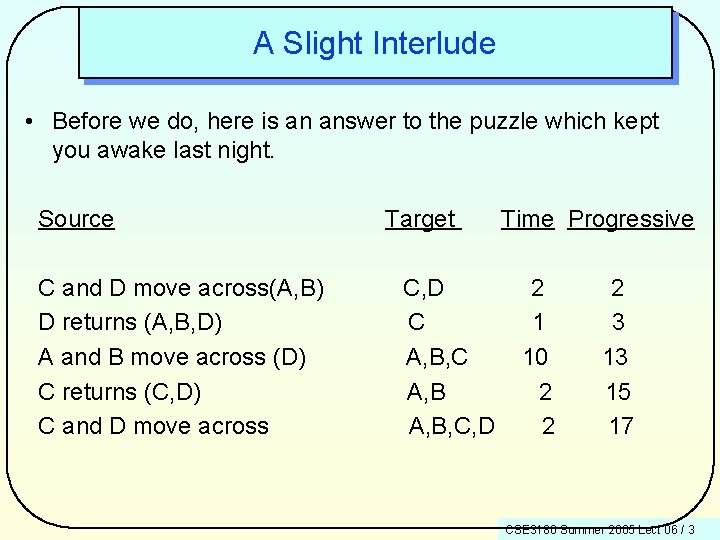
A Slight Interlude • Before we do, here is an answer to the puzzle which kept you awake last night. Source C and D move across(A, B) D returns (A, B, D) A and B move across (D) C returns (C, D) C and D move across Target C, D C A, B, C, D Time Progressive 2 1 10 2 2 2 3 13 15 17 CSE 3180 Summer 2005 Lect 06 / 3
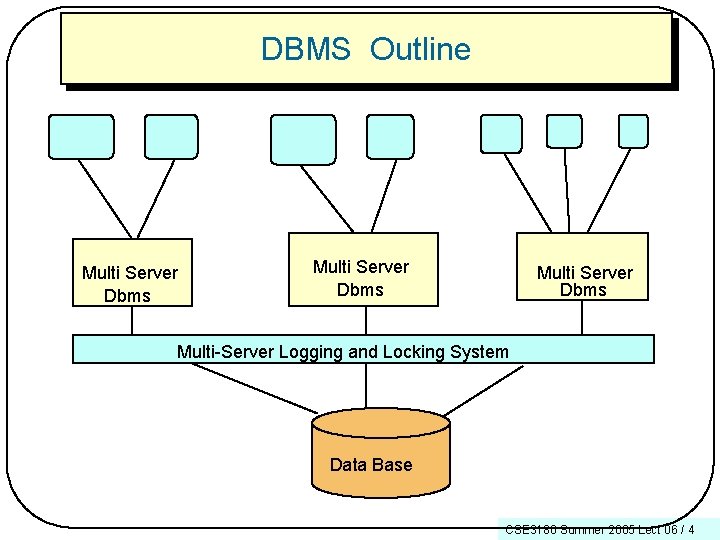
DBMS Outline Multi Server Dbms Multi-Server Logging and Locking System Data Base CSE 3180 Summer 2005 Lect 06 / 4
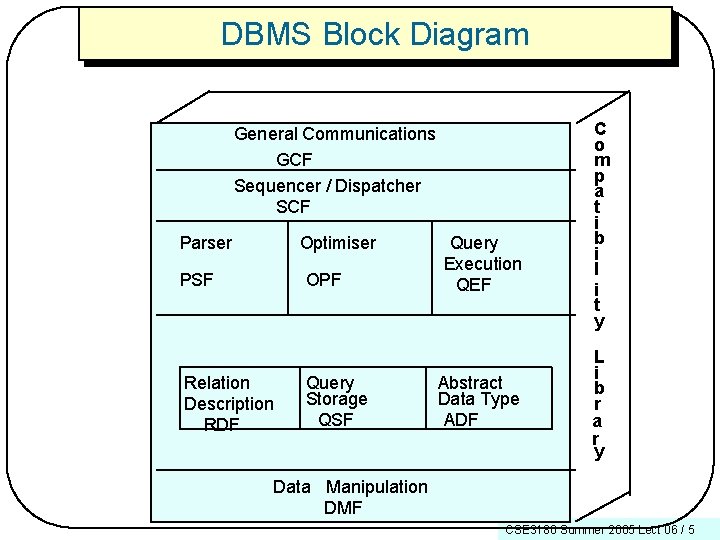
DBMS Block Diagram General Communications GCF Sequencer / Dispatcher SCF Parser Optimiser PSF OPF Relation Description RDF Query Storage QSF Query Execution QEF Abstract Data Type ADF C o m p a t i b i l i t y L i b r a r y Data Manipulation DMF CSE 3180 Summer 2005 Lect 06 / 5
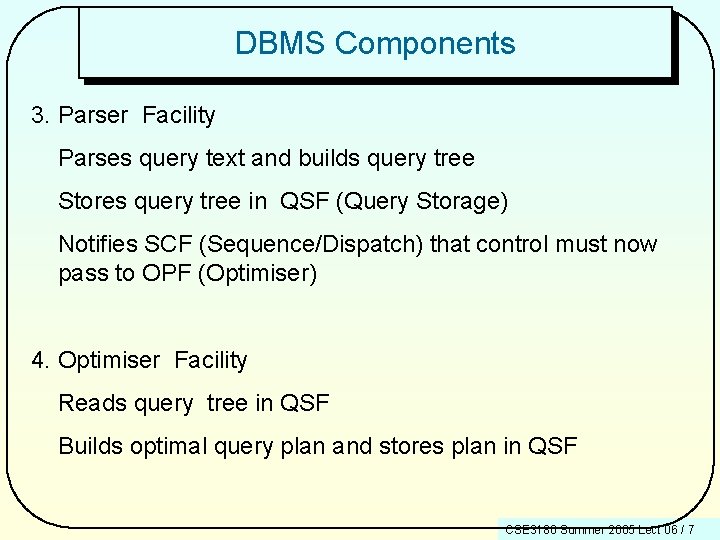
DBMS Components 3. Parser Facility Parses query text and builds query tree Stores query tree in QSF (Query Storage) Notifies SCF (Sequence/Dispatch) that control must now pass to OPF (Optimiser) 4. Optimiser Facility Reads query tree in QSF Builds optimal query plan and stores plan in QSF CSE 3180 Summer 2005 Lect 06 / 7
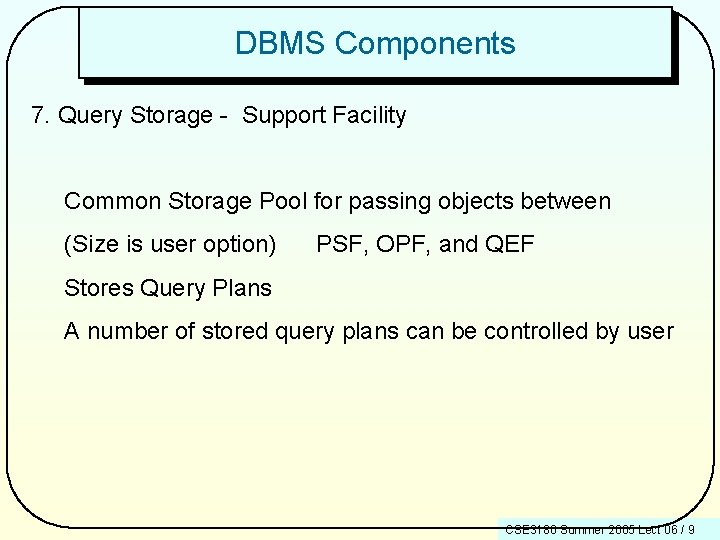
DBMS Components 7. Query Storage - Support Facility Common Storage Pool for passing objects between (Size is user option) PSF, OPF, and QEF Stores Query Plans A number of stored query plans can be controlled by user CSE 3180 Summer 2005 Lect 06 / 9
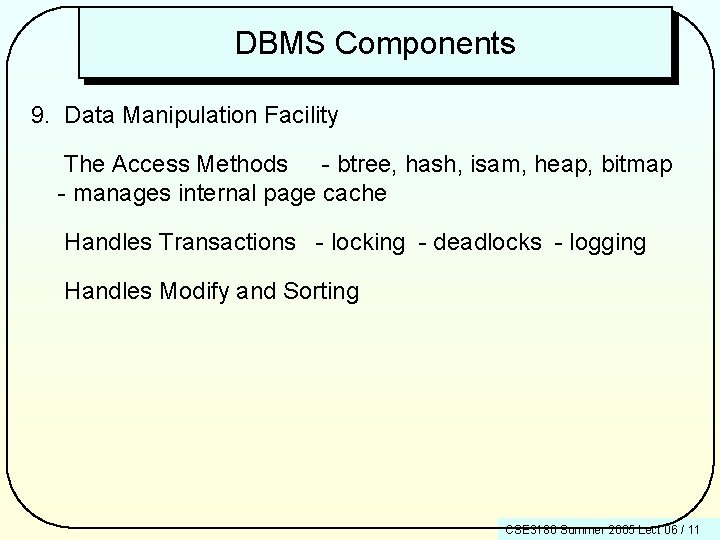
DBMS Components 9. Data Manipulation Facility The Access Methods - btree, hash, isam, heap, bitmap - manages internal page cache Handles Transactions - locking - deadlocks - logging Handles Modify and Sorting CSE 3180 Summer 2005 Lect 06 / 11
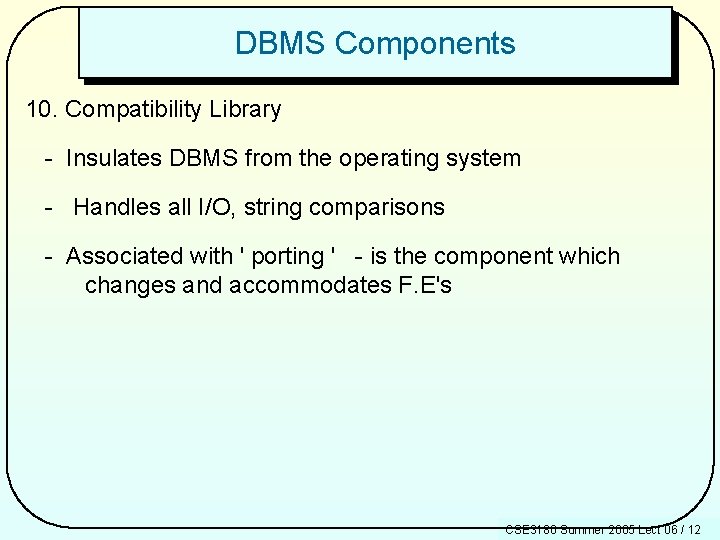
DBMS Components 10. Compatibility Library - Insulates DBMS from the operating system - Handles all I/O, string comparisons - Associated with ' porting ' - is the component which changes and accommodates F. E's CSE 3180 Summer 2005 Lect 06 / 12
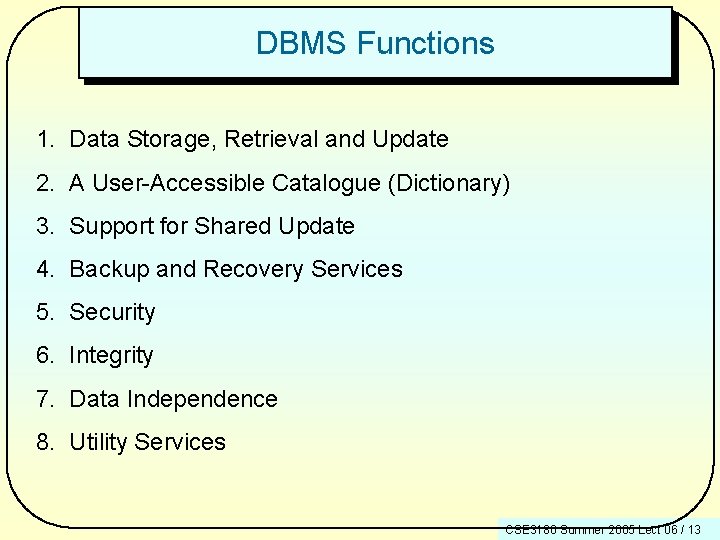
DBMS Functions 1. Data Storage, Retrieval and Update 2. A User-Accessible Catalogue (Dictionary) 3. Support for Shared Update 4. Backup and Recovery Services 5. Security 6. Integrity 7. Data Independence 8. Utility Services CSE 3180 Summer 2005 Lect 06 / 13
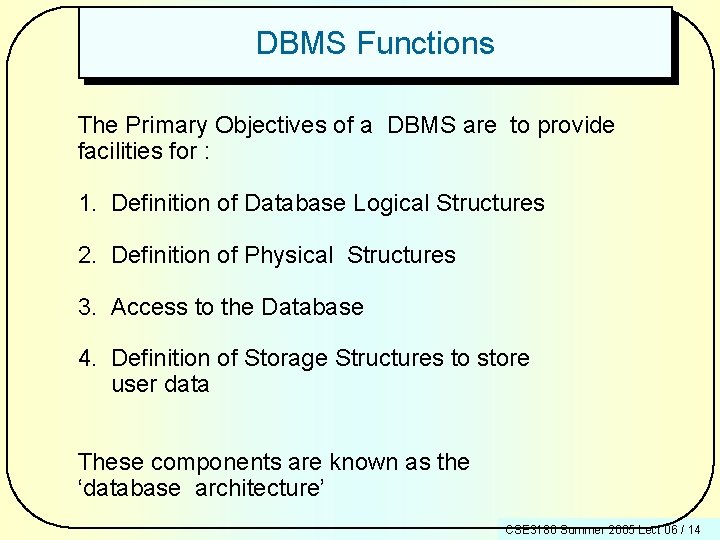
DBMS Functions The Primary Objectives of a DBMS are to provide facilities for : 1. Definition of Database Logical Structures 2. Definition of Physical Structures 3. Access to the Database 4. Definition of Storage Structures to store user data These components are known as the ‘database architecture’ CSE 3180 Summer 2005 Lect 06 / 14
Data Dictionary - Also known as the Catalog (ue) CSE 3180 Summer 2005 Lect 06 / 15
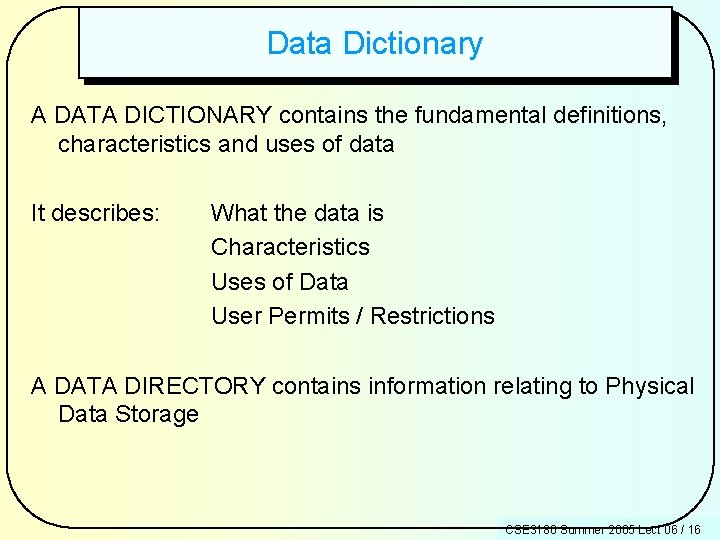
Data Dictionary A DATA DICTIONARY contains the fundamental definitions, characteristics and uses of data It describes: What the data is Characteristics Uses of Data User Permits / Restrictions A DATA DIRECTORY contains information relating to Physical Data Storage CSE 3180 Summer 2005 Lect 06 / 16
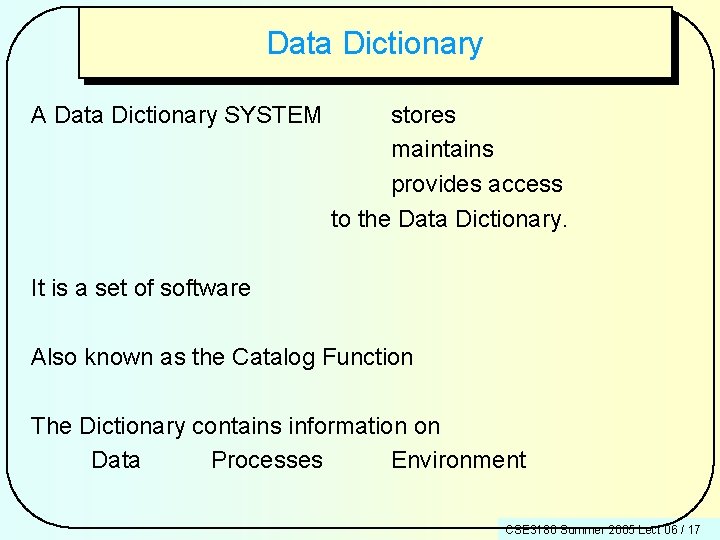
Data Dictionary A Data Dictionary SYSTEM stores maintains provides access to the Data Dictionary. It is a set of software Also known as the Catalog Function The Dictionary contains information on Data Processes Environment CSE 3180 Summer 2005 Lect 06 / 17
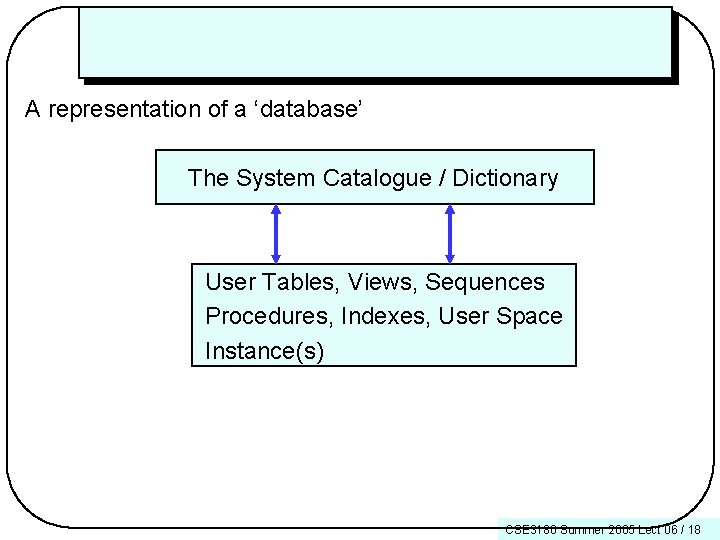
A representation of a ‘database’ The System Catalogue / Dictionary User Tables, Views, Sequences Procedures, Indexes, User Space Instance(s) CSE 3180 Summer 2005 Lect 06 / 18
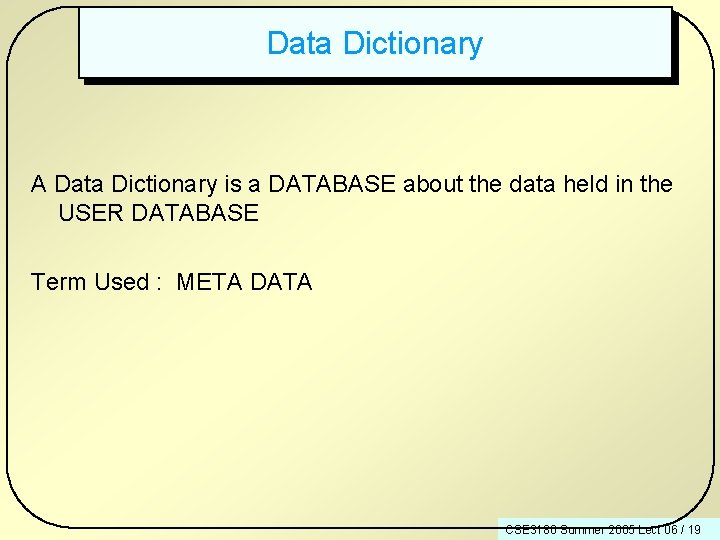
Data Dictionary A Data Dictionary is a DATABASE about the data held in the USER DATABASE Term Used : META DATA CSE 3180 Summer 2005 Lect 06 / 19
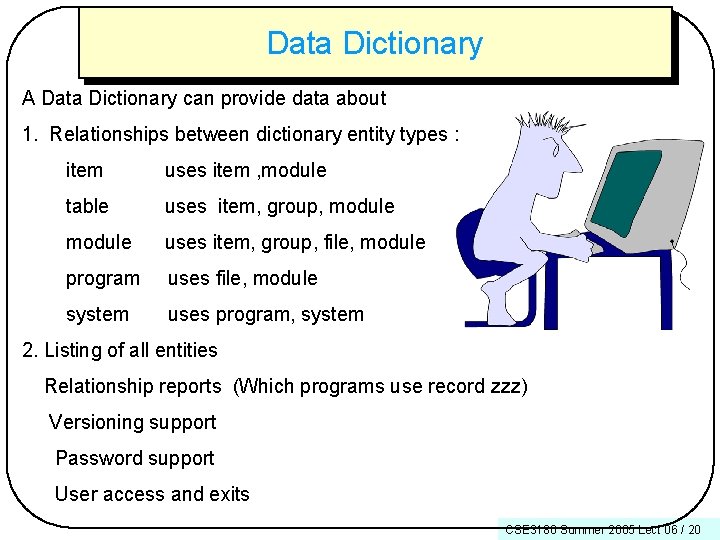
Data Dictionary A Data Dictionary can provide data about 1. Relationships between dictionary entity types : item uses item , module table uses item, group, module uses item, group, file, module program uses file, module system uses program, system 2. Listing of all entities Relationship reports (Which programs use record zzz) Versioning support Password support User access and exits CSE 3180 Summer 2005 Lect 06 / 20
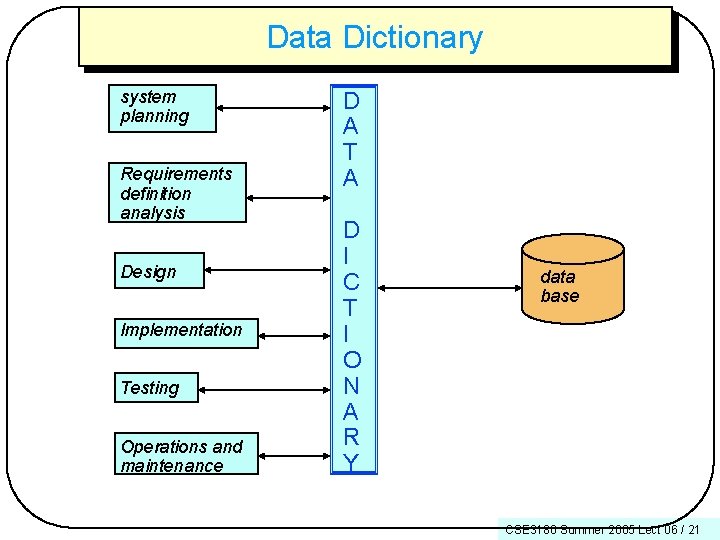
Data Dictionary system planning Requirements definition analysis Design Implementation Testing Operations and maintenance D A T A D I C T I O N A R Y data base CSE 3180 Summer 2005 Lect 06 / 21
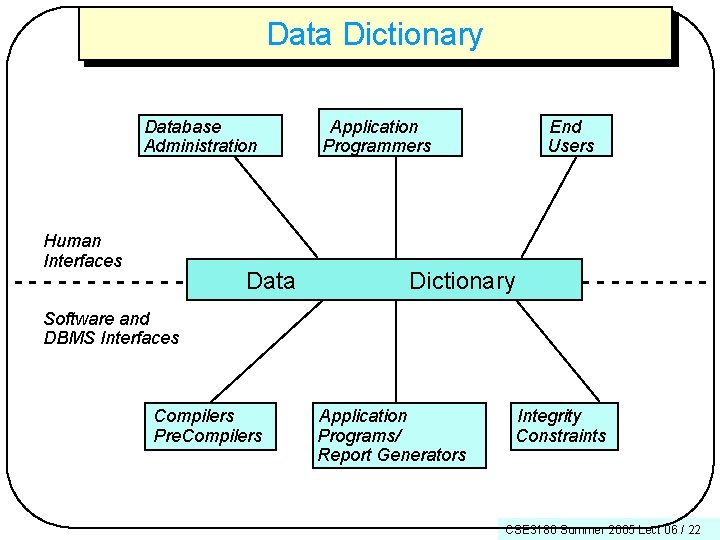
Data Dictionary Database Administration Human Interfaces ------ Data Application Programmers End Users Dictionary ----- Software and DBMS Interfaces Compilers Pre. Compilers Application Programs/ Report Generators Integrity Constraints CSE 3180 Summer 2005 Lect 06 / 22
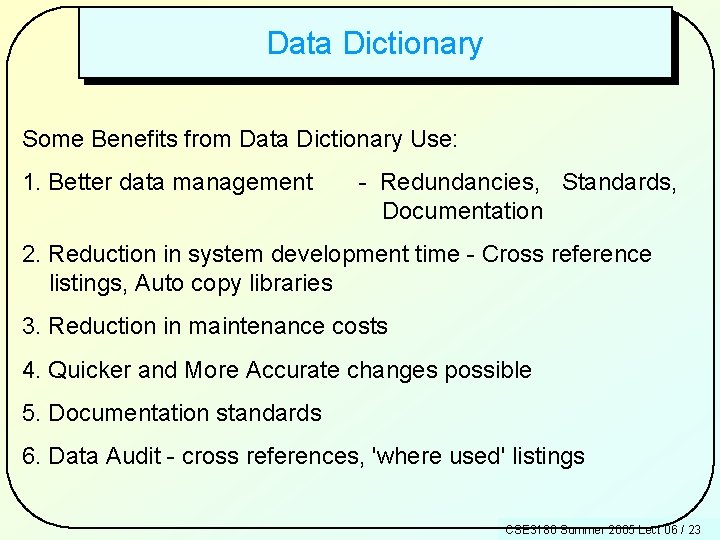
Data Dictionary Some Benefits from Data Dictionary Use: 1. Better data management - Redundancies, Standards, Documentation 2. Reduction in system development time - Cross reference listings, Auto copy libraries 3. Reduction in maintenance costs 4. Quicker and More Accurate changes possible 5. Documentation standards 6. Data Audit - cross references, 'where used' listings CSE 3180 Summer 2005 Lect 06 / 23
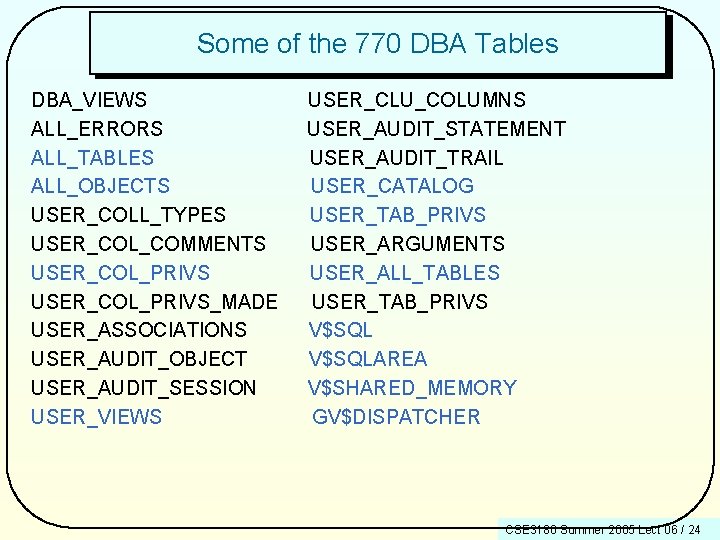
Some of the 770 DBA Tables DBA_VIEWS ALL_ERRORS ALL_TABLES ALL_OBJECTS USER_COLL_TYPES USER_COL_COMMENTS USER_COL_PRIVS_MADE USER_ASSOCIATIONS USER_AUDIT_OBJECT USER_AUDIT_SESSION USER_VIEWS USER_CLU_COLUMNS USER_AUDIT_STATEMENT USER_AUDIT_TRAIL USER_CATALOG USER_TAB_PRIVS USER_ARGUMENTS USER_ALL_TABLES USER_TAB_PRIVS V$SQLAREA V$SHARED_MEMORY GV$DISPATCHER CSE 3180 Summer 2005 Lect 06 / 24
Integrity CSE 3180 Summer 2005 Lect 06 / 25
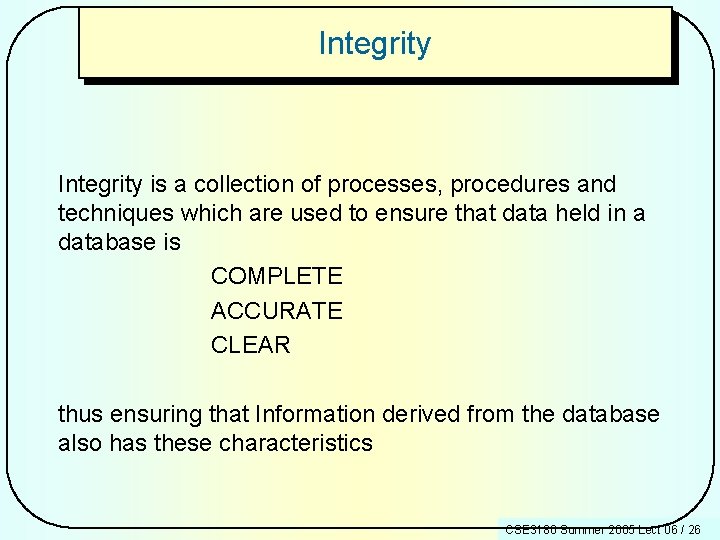
Integrity is a collection of processes, procedures and techniques which are used to ensure that data held in a database is COMPLETE ACCURATE CLEAR thus ensuring that Information derived from the database also has these characteristics CSE 3180 Summer 2005 Lect 06 / 26
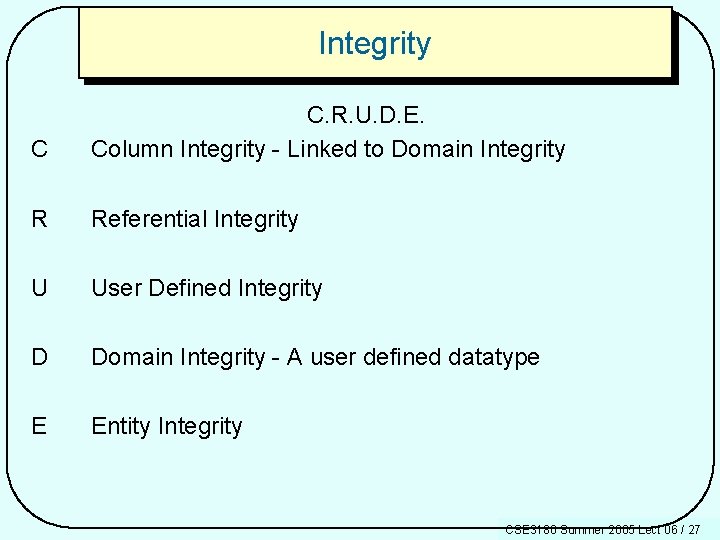
Integrity C C. R. U. D. E. Column Integrity - Linked to Domain Integrity R Referential Integrity U User Defined Integrity D Domain Integrity - A user defined datatype E Entity Integrity CSE 3180 Summer 2005 Lect 06 / 27
Database Integrity Some terms you will encounter: Entity Integrity Referential Integrity Functional Dependency (constraints between determinants and attributes. For each value of the determinant there is only one value for each of the attributes it determines) Multivalued Dependency Join Dependency Domain Constraints Cardinality Constraint User Defined Constraints CSE 3180 Summer 2005 Lect 06 / 28
Data Integrity General Principle: Data compliance with a set of rules Rules Location: Best embodied in the DBMS If they are contained in an application, there is the danger of saturating a network and causing degraded performance. This is particularly so in client / server computing CONSTRAINTS: Declarative approach where integrity constraints are ‘declared’ as part of a table specification. ANSI SQL-99 standards include specifications for integrity constrains syntax and behaviour CSE 3180 Summer 2005 Lect 06 / 29
INTEGRITY CONSTRAINTS DATABASE INTEGRITY Refers to correctness and consistency of data Quality Assurance Usually expressed in terms of CONSTRAINTS - consistency rules which must not be subverted CSE 3180 Summer 2005 Lect 06 / 30
Forms of Constraints 1. ENTITY INTEGRITY - Primary Key Value NO attribute of a primary key value may be NULL 2. REFERENTIAL INTEGRITY - Foreign Key Values If a FOREIGN KEY exists in a relation, then either (1) the foreign key value MUST match the Primary Key value of some row in its home (or Primary) relation OR (2) the FOREIGN KEY must be NULL 3. FUNCTIONAL DEPENDENCY - Determinant For each value of the DETERMINANT, there must be only ONE value for each of the attributes which it determines CSE 3180 Summer 2005 Lect 06 / 31
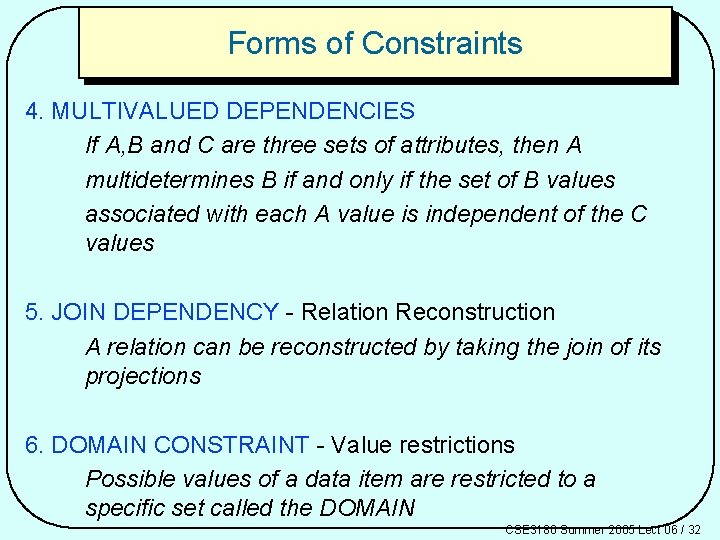
Forms of Constraints 4. MULTIVALUED DEPENDENCIES If A, B and C are three sets of attributes, then A multidetermines B if and only if the set of B values associated with each A value is independent of the C values 5. JOIN DEPENDENCY - Relation Reconstruction A relation can be reconstructed by taking the join of its projections 6. DOMAIN CONSTRAINT - Value restrictions Possible values of a data item are restricted to a specific set called the DOMAIN CSE 3180 Summer 2005 Lect 06 / 32
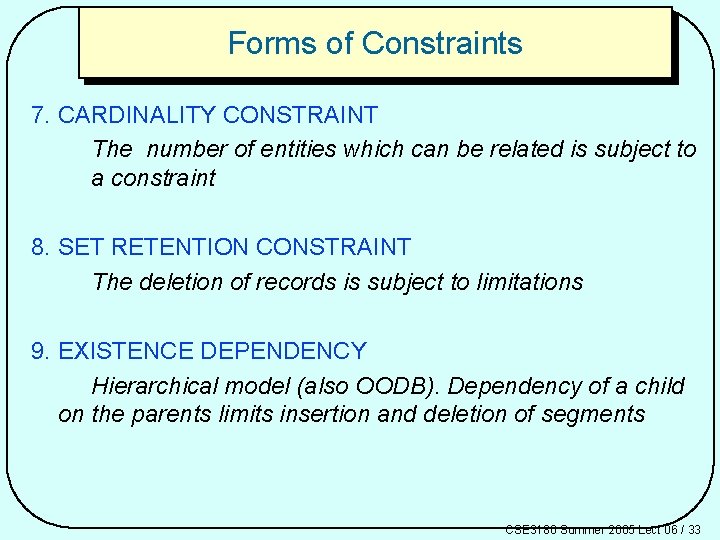
Forms of Constraints 7. CARDINALITY CONSTRAINT The number of entities which can be related is subject to a constraint 8. SET RETENTION CONSTRAINT The deletion of records is subject to limitations 9. EXISTENCE DEPENDENCY Hierarchical model (also OODB). Dependency of a child on the parents limits insertion and deletion of segments CSE 3180 Summer 2005 Lect 06 / 33
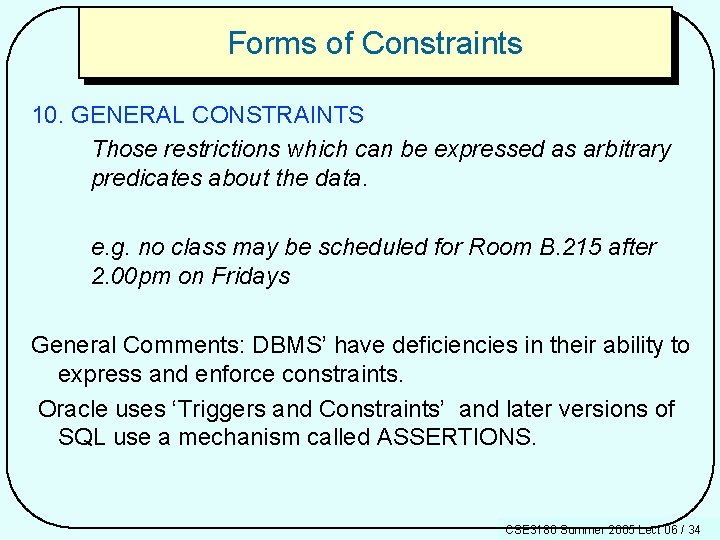
Forms of Constraints 10. GENERAL CONSTRAINTS Those restrictions which can be expressed as arbitrary predicates about the data. e. g. no class may be scheduled for Room B. 215 after 2. 00 pm on Fridays General Comments: DBMS’ have deficiencies in their ability to express and enforce constraints. Oracle uses ‘Triggers and Constraints’ and later versions of SQL use a mechanism called ASSERTIONS. CSE 3180 Summer 2005 Lect 06 / 34
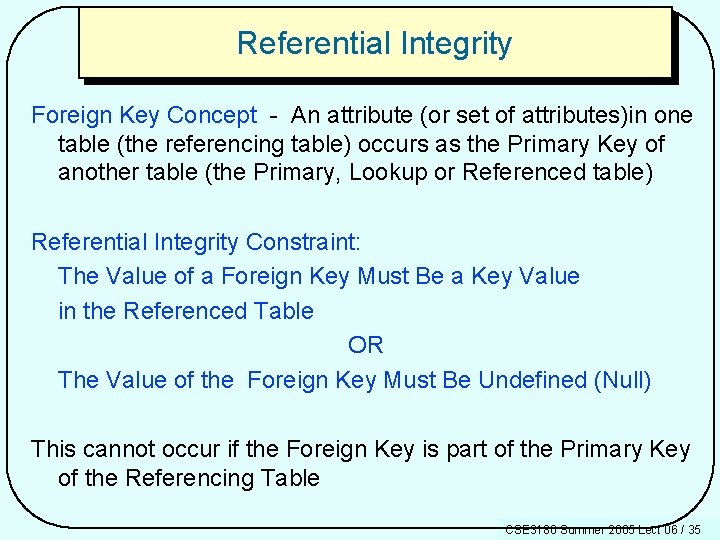
Referential Integrity Foreign Key Concept - An attribute (or set of attributes)in one table (the referencing table) occurs as the Primary Key of another table (the Primary, Lookup or Referenced table) Referential Integrity Constraint: The Value of a Foreign Key Must Be a Key Value in the Referenced Table OR The Value of the Foreign Key Must Be Undefined (Null) This cannot occur if the Foreign Key is part of the Primary Key of the Referencing Table CSE 3180 Summer 2005 Lect 06 / 35
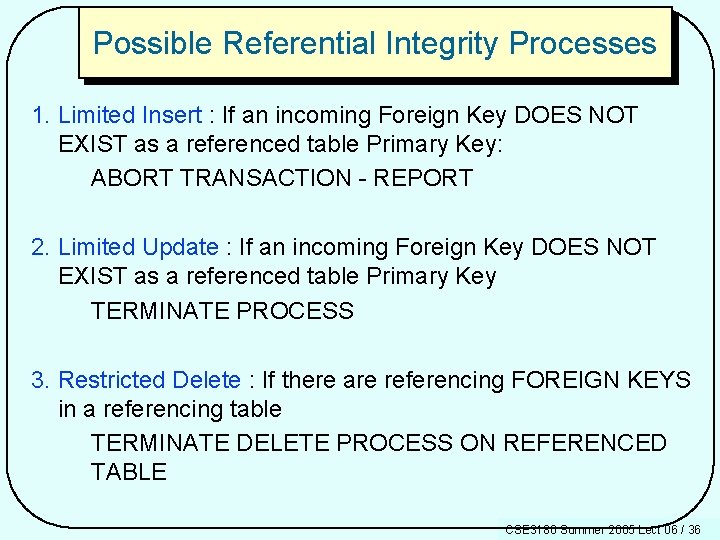
Possible Referential Integrity Processes 1. Limited Insert : If an incoming Foreign Key DOES NOT EXIST as a referenced table Primary Key: ABORT TRANSACTION - REPORT 2. Limited Update : If an incoming Foreign Key DOES NOT EXIST as a referenced table Primary Key TERMINATE PROCESS 3. Restricted Delete : If there are referencing FOREIGN KEYS in a referencing table TERMINATE DELETE PROCESS ON REFERENCED TABLE CSE 3180 Summer 2005 Lect 06 / 36
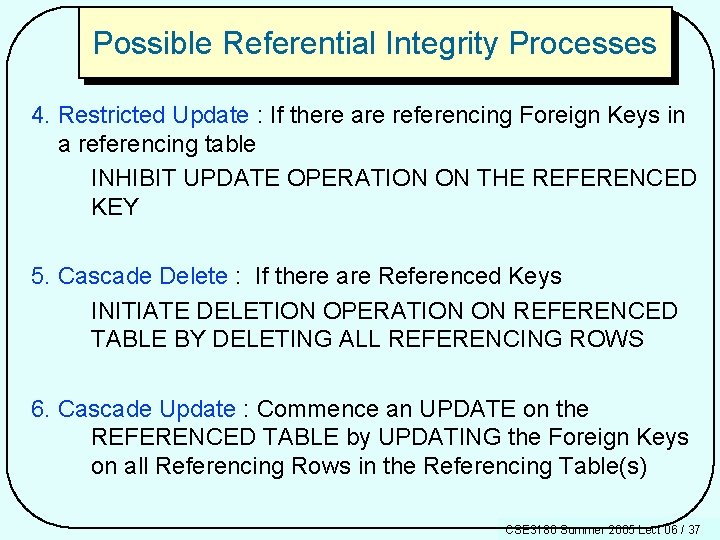
Possible Referential Integrity Processes 4. Restricted Update : If there are referencing Foreign Keys in a referencing table INHIBIT UPDATE OPERATION ON THE REFERENCED KEY 5. Cascade Delete : If there are Referenced Keys INITIATE DELETION OPERATION ON REFERENCED TABLE BY DELETING ALL REFERENCING ROWS 6. Cascade Update : Commence an UPDATE on the REFERENCED TABLE by UPDATING the Foreign Keys on all Referencing Rows in the Referencing Table(s) CSE 3180 Summer 2005 Lect 06 / 37
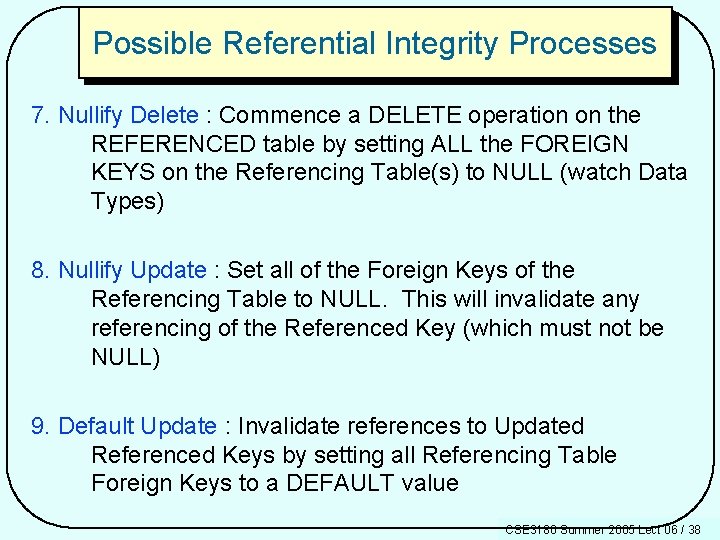
Possible Referential Integrity Processes 7. Nullify Delete : Commence a DELETE operation on the REFERENCED table by setting ALL the FOREIGN KEYS on the Referencing Table(s) to NULL (watch Data Types) 8. Nullify Update : Set all of the Foreign Keys of the Referencing Table to NULL. This will invalidate any referencing of the Referenced Key (which must not be NULL) 9. Default Update : Invalidate references to Updated Referenced Keys by setting all Referencing Table Foreign Keys to a DEFAULT value CSE 3180 Summer 2005 Lect 06 / 38
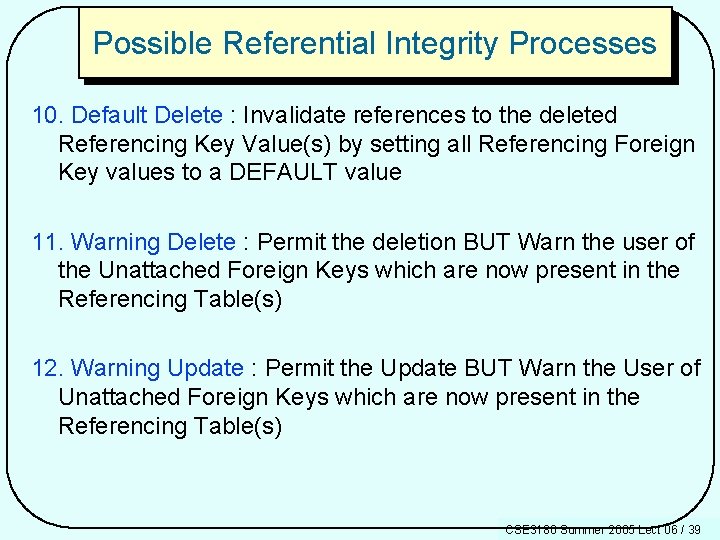
Possible Referential Integrity Processes 10. Default Delete : Invalidate references to the deleted Referencing Key Value(s) by setting all Referencing Foreign Key values to a DEFAULT value 11. Warning Delete : Permit the deletion BUT Warn the user of the Unattached Foreign Keys which are now present in the Referencing Table(s) 12. Warning Update : Permit the Update BUT Warn the User of Unattached Foreign Keys which are now present in the Referencing Table(s) CSE 3180 Summer 2005 Lect 06 / 39
A Deeper Look into a DBMS CSE 3180 Summer 2005 Lect 06 / 40
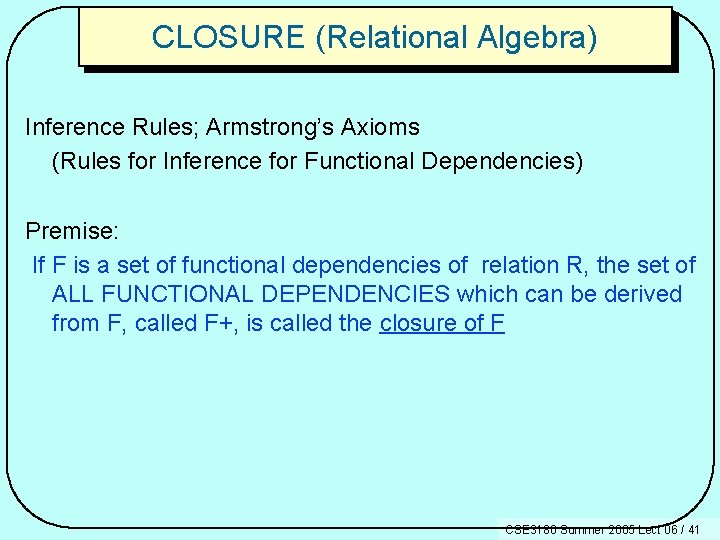
CLOSURE (Relational Algebra) Inference Rules; Armstrong’s Axioms (Rules for Inference for Functional Dependencies) Premise: If F is a set of functional dependencies of relation R, the set of ALL FUNCTIONAL DEPENDENCIES which can be derived from F, called F+, is called the closure of F CSE 3180 Summer 2005 Lect 06 / 41
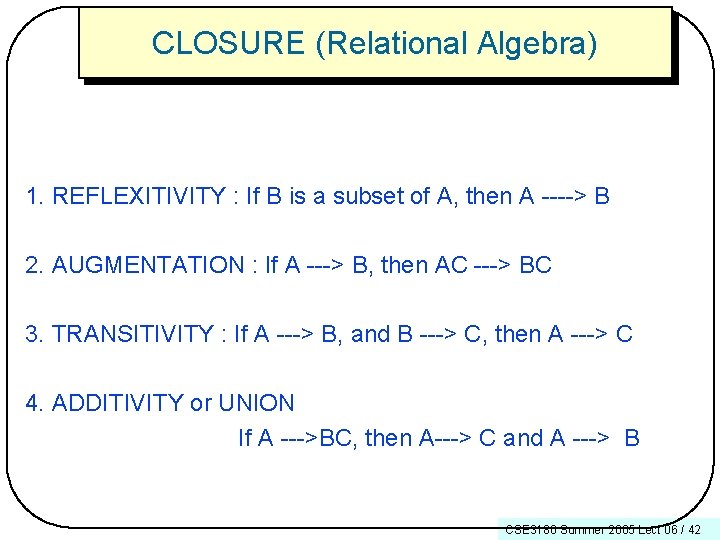
CLOSURE (Relational Algebra) 1. REFLEXITIVITY : If B is a subset of A, then A ----> B 2. AUGMENTATION : If A ---> B, then AC ---> BC 3. TRANSITIVITY : If A ---> B, and B ---> C, then A ---> C 4. ADDITIVITY or UNION If A --->BC, then A---> C and A ---> B CSE 3180 Summer 2005 Lect 06 / 42
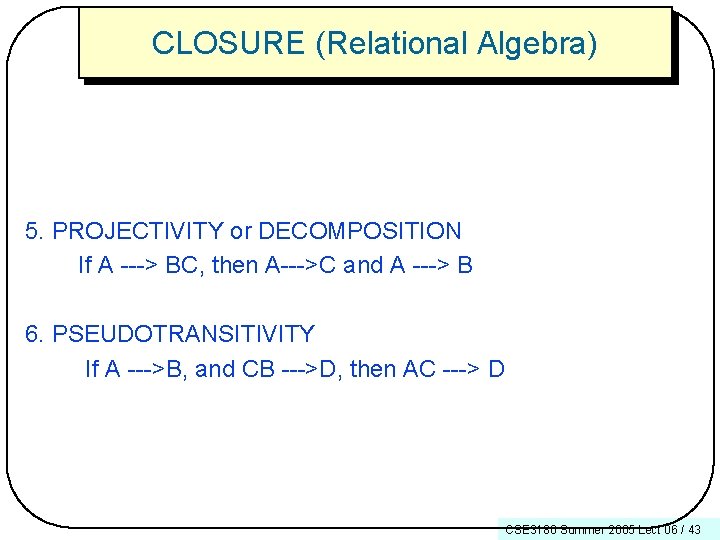
CLOSURE (Relational Algebra) 5. PROJECTIVITY or DECOMPOSITION If A ---> BC, then A--->C and A ---> B 6. PSEUDOTRANSITIVITY If A --->B, and CB --->D, then AC ---> D CSE 3180 Summer 2005 Lect 06 / 43
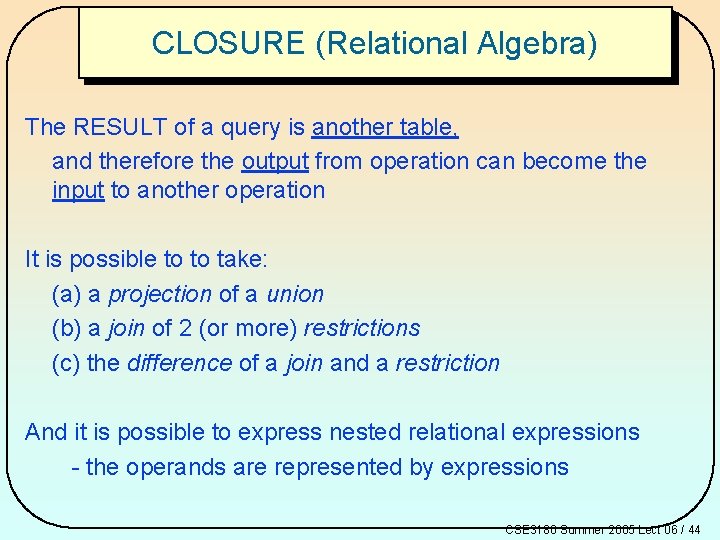
CLOSURE (Relational Algebra) The RESULT of a query is another table, and therefore the output from operation can become the input to another operation It is possible to to take: (a) a projection of a union (b) a join of 2 (or more) restrictions (c) the difference of a join and a restriction And it is possible to express nested relational expressions - the operands are represented by expressions CSE 3180 Summer 2005 Lect 06 / 44
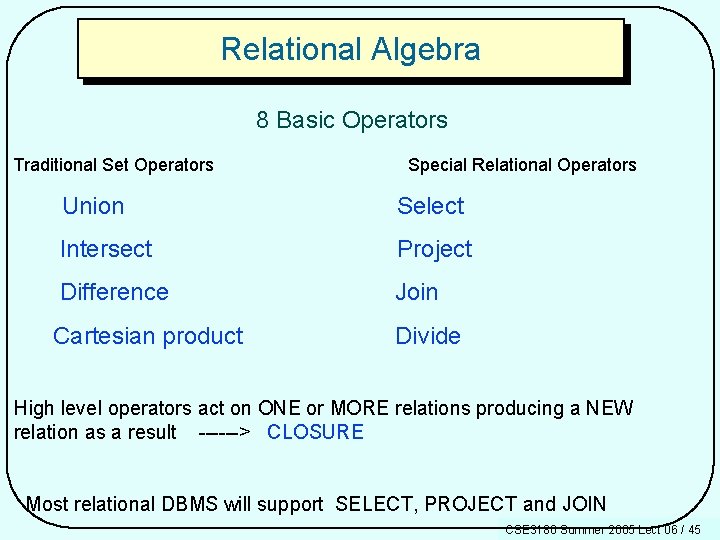
Relational Algebra 8 Basic Operators Traditional Set Operators Special Relational Operators Union Select Intersect Project Difference Join Cartesian product Divide High level operators act on ONE or MORE relations producing a NEW relation as a result ------> CLOSURE Most relational DBMS will support SELECT, PROJECT and JOIN CSE 3180 Summer 2005 Lect 06 / 45
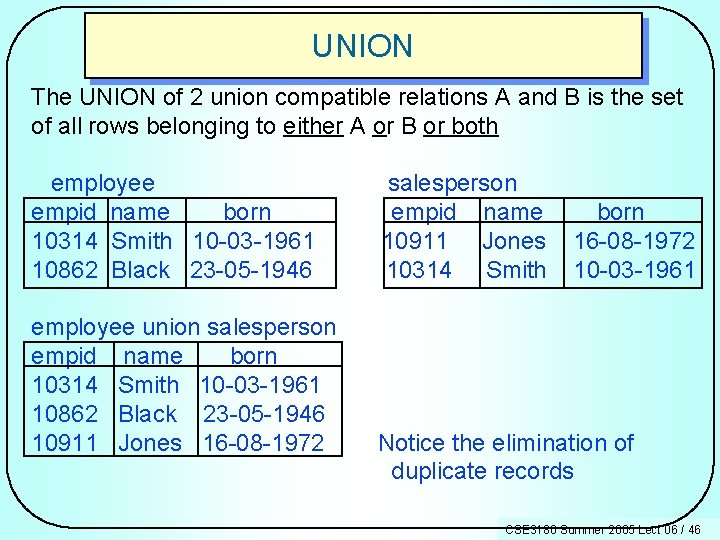
UNION The UNION of 2 union compatible relations A and B is the set of all rows belonging to either A or B or both employee empid name born 10314 Smith 10 -03 -1961 10862 Black 23 -05 -1946 employee union salesperson empid name born 10314 Smith 10 -03 -1961 10862 Black 23 -05 -1946 10911 Jones 16 -08 -1972 salesperson empid name 10911 Jones 10314 Smith born 16 -08 -1972 10 -03 -1961 Notice the elimination of duplicate records CSE 3180 Summer 2005 Lect 06 / 46
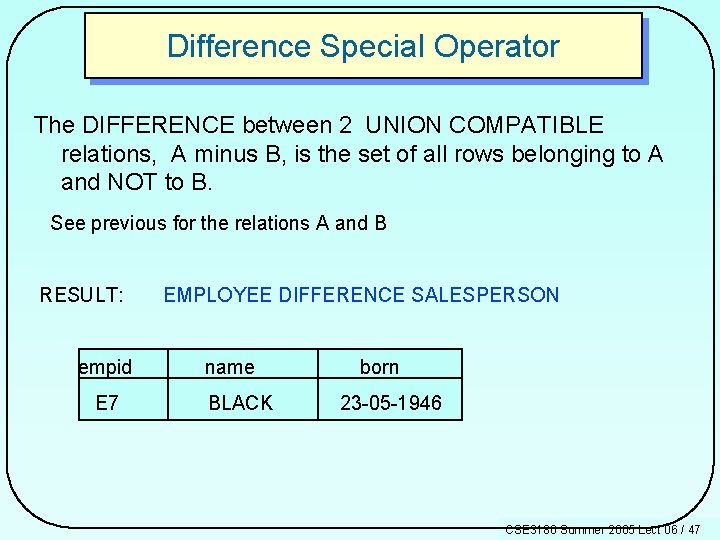
Difference Special Operator The DIFFERENCE between 2 UNION COMPATIBLE relations, A minus B, is the set of all rows belonging to A and NOT to B. See previous for the relations A and B RESULT: empid E 7 EMPLOYEE DIFFERENCE SALESPERSON name BLACK born 23 -05 -1946 CSE 3180 Summer 2005 Lect 06 / 47
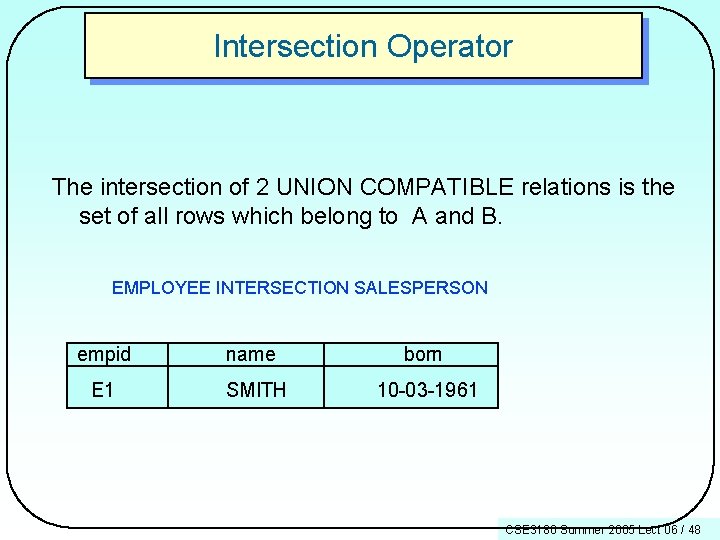
Intersection Operator The intersection of 2 UNION COMPATIBLE relations is the set of all rows which belong to A and B. EMPLOYEE INTERSECTION SALESPERSON empid E 1 name SMITH born 10 -03 -1961 CSE 3180 Summer 2005 Lect 06 / 48
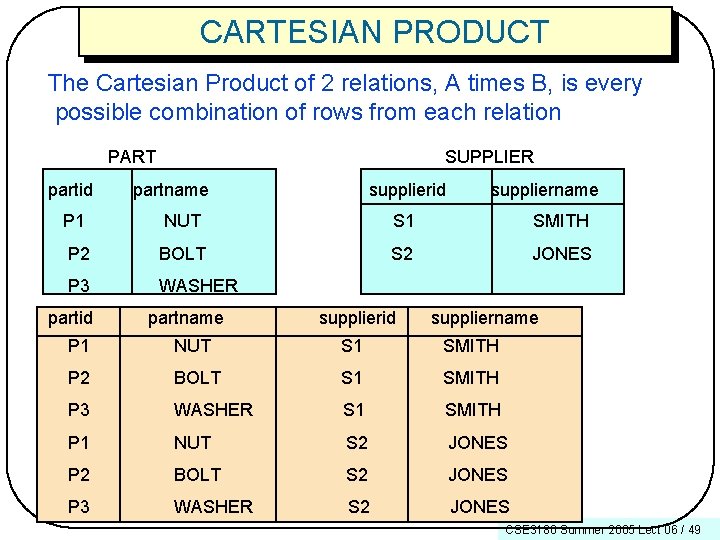
CARTESIAN PRODUCT The Cartesian Product of 2 relations, A times B, is every possible combination of rows from each relation PART partid SUPPLIER partname supplierid suppliername P 1 NUT S 1 SMITH P 2 BOLT S 2 JONES P 3 WASHER partid partname supplierid suppliername P 1 NUT S 1 SMITH P 2 BOLT S 1 SMITH P 3 WASHER S 1 SMITH P 1 NUT S 2 JONES P 2 BOLT S 2 JONES P 3 WASHER S 2 JONES CSE 3180 Summer 2005 Lect 06 / 49
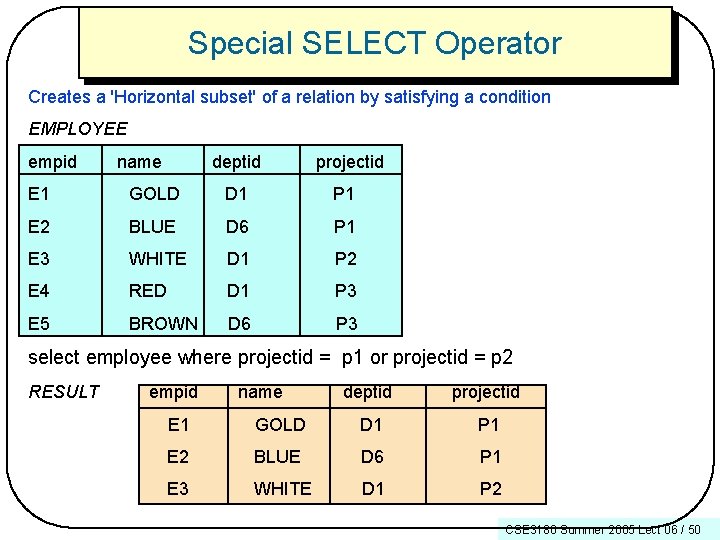
Special SELECT Operator Creates a 'Horizontal subset' of a relation by satisfying a condition EMPLOYEE empid name deptid projectid E 1 GOLD D 1 P 1 E 2 BLUE D 6 P 1 E 3 WHITE D 1 P 2 E 4 RED D 1 P 3 E 5 BROWN D 6 P 3 select employee where projectid = p 1 or projectid = p 2 RESULT empid name deptid projectid E 1 GOLD D 1 P 1 E 2 BLUE D 6 P 1 E 3 WHITE D 1 P 2 CSE 3180 Summer 2005 Lect 06 / 50
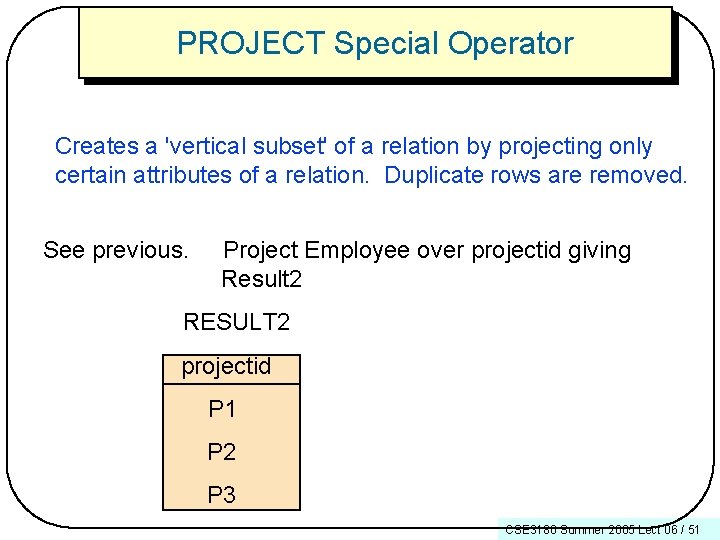
PROJECT Special Operator Creates a 'vertical subset' of a relation by projecting only certain attributes of a relation. Duplicate rows are removed. See previous. Project Employee over projectid giving Result 2 RESULT 2 projectid P 1 P 2 P 3 CSE 3180 Summer 2005 Lect 06 / 51
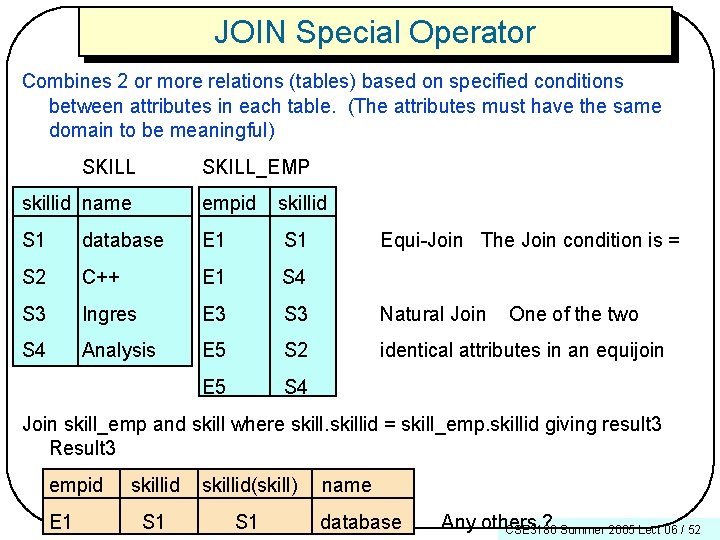
JOIN Special Operator Combines 2 or more relations (tables) based on specified conditions between attributes in each table. (The attributes must have the same domain to be meaningful) SKILL_EMP skillid name empid skillid S 1 database E 1 S 2 C++ E 1 S 4 S 3 Ingres E 3 S 3 Natural Join S 4 Analysis E 5 S 2 identical attributes in an equijoin E 5 S 4 Equi-Join The Join condition is = One of the two Join skill_emp and skill where skillid = skill_emp. skillid giving result 3 Result 3 empid E 1 skillid(skill) S 1 name database Any others ? Summer 2005 Lect 06 / 52 CSE 3180
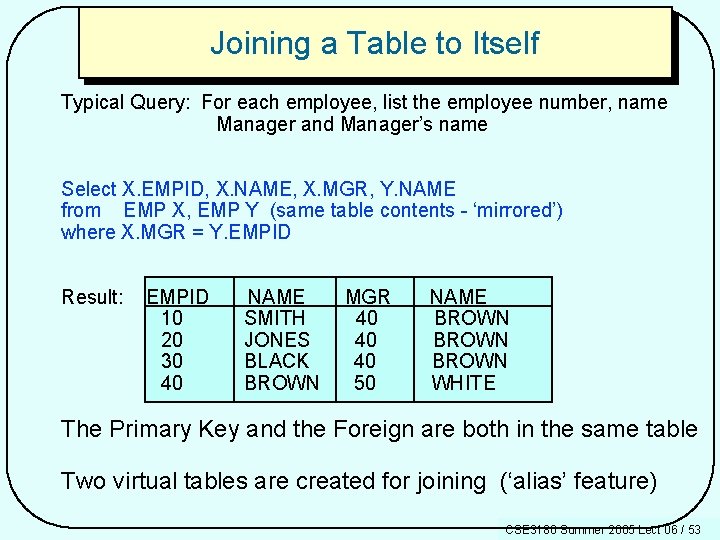
Joining a Table to Itself Typical Query: For each employee, list the employee number, name Manager and Manager’s name Select X. EMPID, X. NAME, X. MGR, Y. NAME from EMP X, EMP Y (same table contents - ‘mirrored’) where X. MGR = Y. EMPID Result: EMPID 10 20 30 40 NAME SMITH JONES BLACK BROWN MGR 40 40 40 50 NAME BROWN WHITE The Primary Key and the Foreign are both in the same table Two virtual tables are created for joining (‘alias’ feature) CSE 3180 Summer 2005 Lect 06 / 53
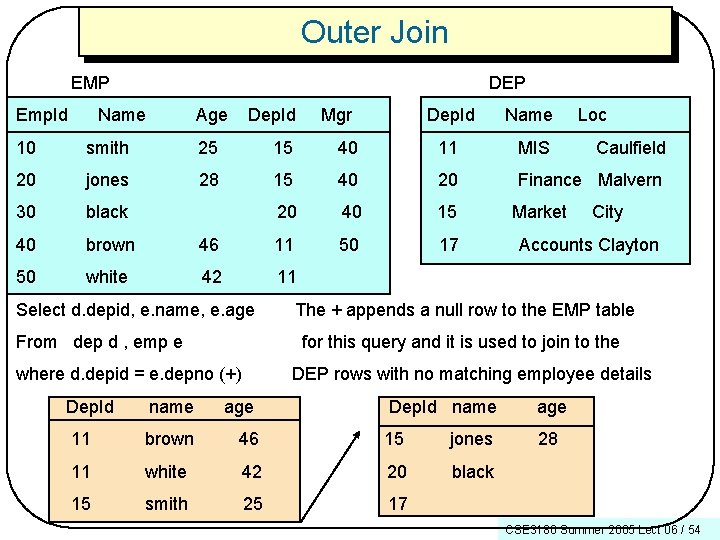
Outer Join EMP Emp. Id DEP Name Age Dep. Id Mgr Dep. Id Name Loc 10 smith 25 15 40 11 MIS 20 jones 28 15 40 20 Finance Malvern 30 black 20 40 15 40 brown 46 11 50 17 50 white 42 11 Select d. depid, e. name, e. age From dep d , emp e name 11 brown 11 15 City Accounts Clayton The + appends a null row to the EMP table for this query and it is used to join to the where d. depid = e. depno (+) Dep. Id Market Caulfield DEP rows with no matching employee details age Dep. Id name age 46 15 jones 28 white 42 20 black smith 25 17 CSE 3180 Summer 2005 Lect 06 / 54
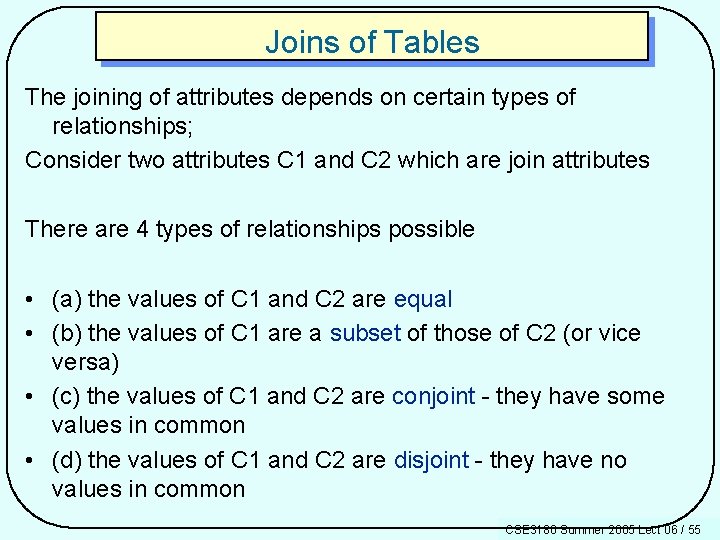
Joins of Tables The joining of attributes depends on certain types of relationships; Consider two attributes C 1 and C 2 which are join attributes There are 4 types of relationships possible • (a) the values of C 1 and C 2 are equal • (b) the values of C 1 are a subset of those of C 2 (or vice versa) • (c) the values of C 1 and C 2 are conjoint - they have some values in common • (d) the values of C 1 and C 2 are disjoint - they have no values in common CSE 3180 Summer 2005 Lect 06 / 55
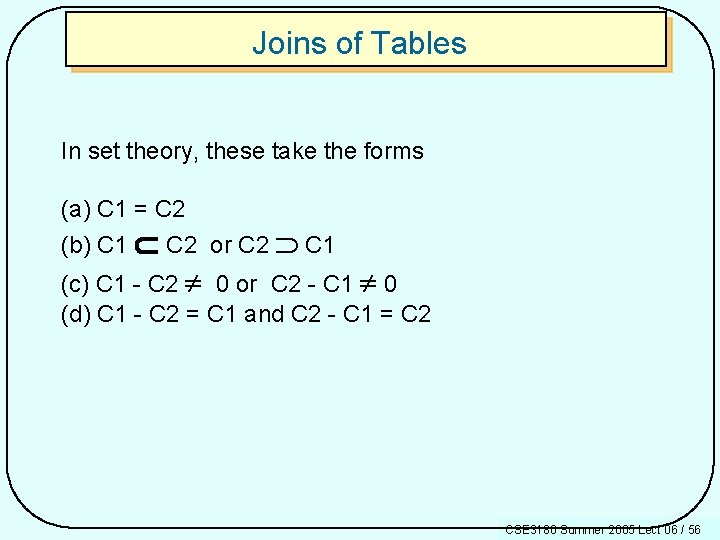
Joins of Tables In set theory, these take the forms (a) C 1 = C 2 (b) C 1 C 2 or C 2 C 1 (c) C 1 - C 2 0 or C 2 - C 1 0 (d) C 1 - C 2 = C 1 and C 2 - C 1 = C 2 CSE 3180 Summer 2005 Lect 06 / 56
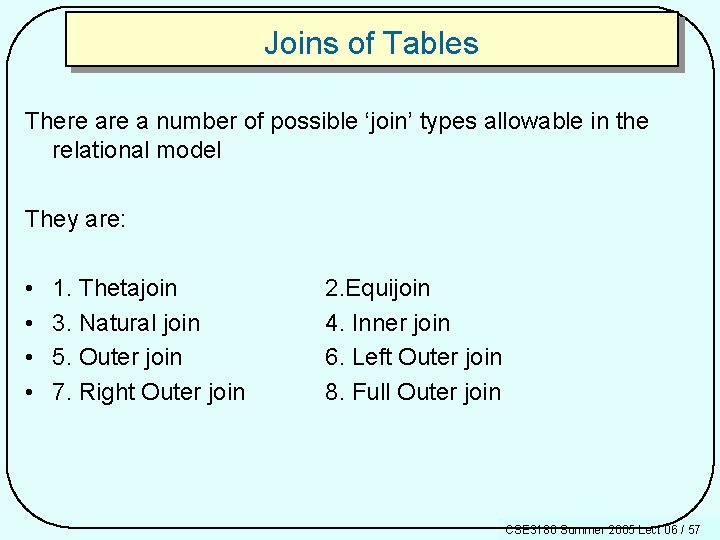
Joins of Tables There a number of possible ‘join’ types allowable in the relational model They are: • • 1. Thetajoin 3. Natural join 5. Outer join 7. Right Outer join 2. Equijoin 4. Inner join 6. Left Outer join 8. Full Outer join CSE 3180 Summer 2005 Lect 06 / 57
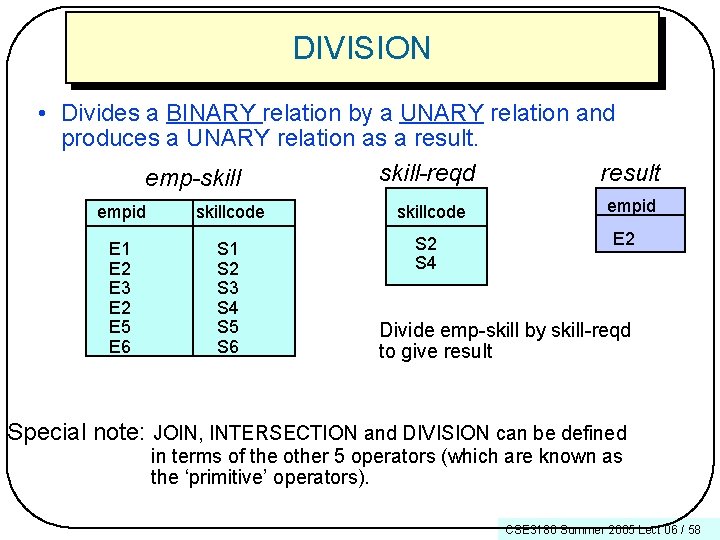
DIVISION • Divides a BINARY relation by a UNARY relation and produces a UNARY relation as a result. skill-reqd result emp-skill empid skillcode E 1 E 2 E 3 E 2 E 5 E 6 S 1 S 2 S 3 S 4 S 5 S 6 skillcode S 2 S 4 empid E 2 Divide emp-skill by skill-reqd to give result Special note: JOIN, INTERSECTION and DIVISION can be defined in terms of the other 5 operators (which are known as the ‘primitive’ operators). CSE 3180 Summer 2005 Lect 06 / 58
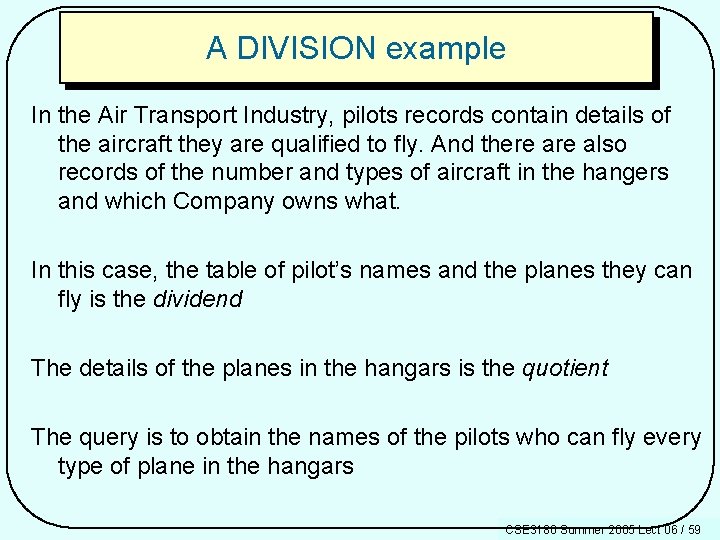
A DIVISION example In the Air Transport Industry, pilots records contain details of the aircraft they are qualified to fly. And there also records of the number and types of aircraft in the hangers and which Company owns what. In this case, the table of pilot’s names and the planes they can fly is the dividend The details of the planes in the hangars is the quotient The query is to obtain the names of the pilots who can fly every type of plane in the hangars CSE 3180 Summer 2005 Lect 06 / 59
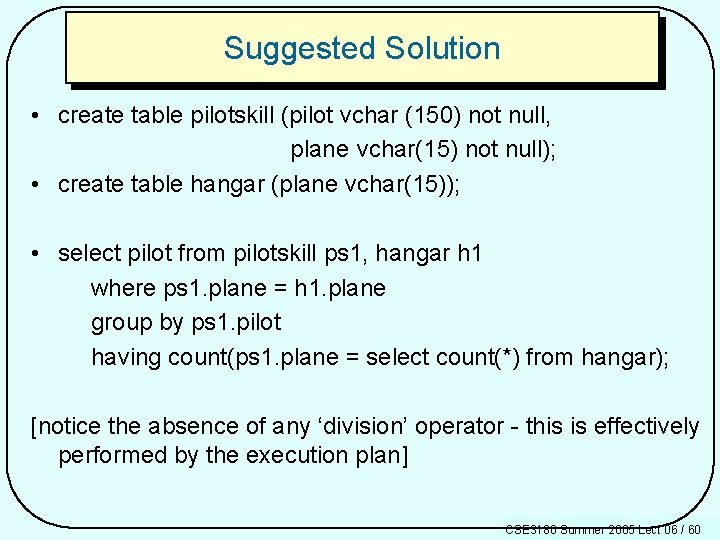
Suggested Solution • create table pilotskill (pilot vchar (150) not null, plane vchar(15) not null); • create table hangar (plane vchar(15)); • select pilot from pilotskill ps 1, hangar h 1 where ps 1. plane = h 1. plane group by ps 1. pilot having count(ps 1. plane = select count(*) from hangar); [notice the absence of any ‘division’ operator - this is effectively performed by the execution plan] CSE 3180 Summer 2005 Lect 06 / 60
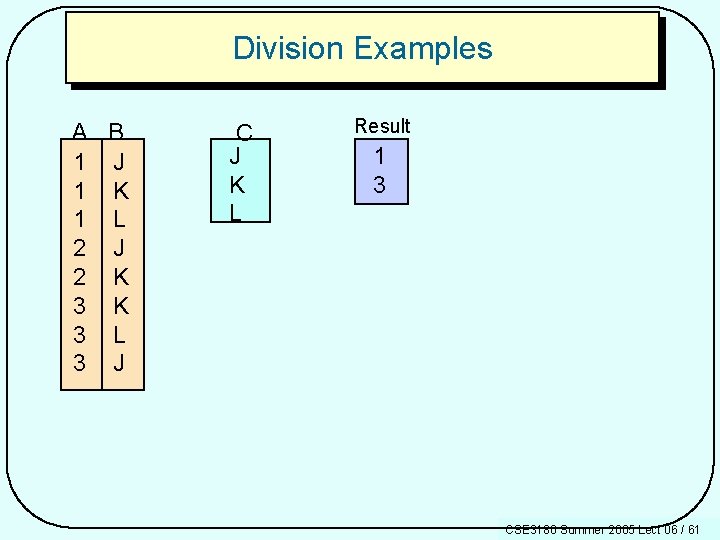
Division Examples A B 1 J 1 K 1 L 2 J 2 K 3 L 3 J C J K L Result 1 3 CSE 3180 Summer 2005 Lect 06 / 61
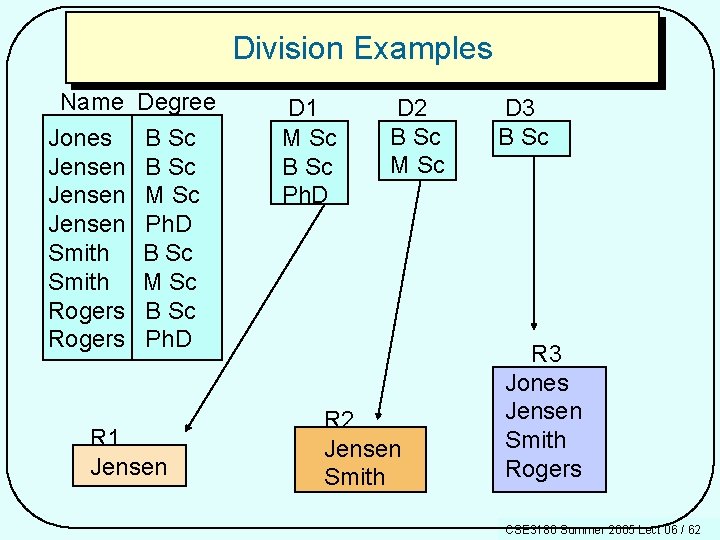
Division Examples Name Jones Jensen Smith Rogers Degree B Sc M Sc Ph. D B Sc M Sc B Sc Ph. D R 1 Jensen D 1 M Sc B Sc Ph. D D 2 B Sc M Sc R 2 Jensen Smith D 3 B Sc R 3 Jones Jensen Smith Rogers CSE 3180 Summer 2005 Lect 06 / 62
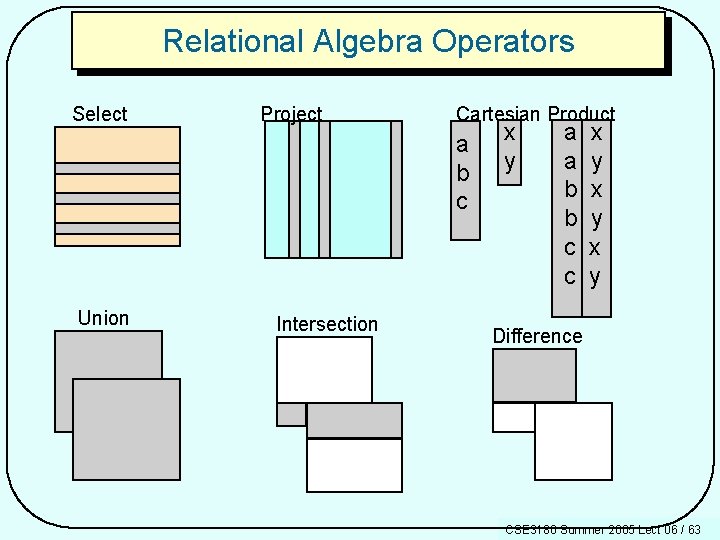
Relational Algebra Operators Select Project Cartesian Product a b c Union Intersection x y a a b b c c x y x y Difference CSE 3180 Summer 2005 Lect 06 / 63
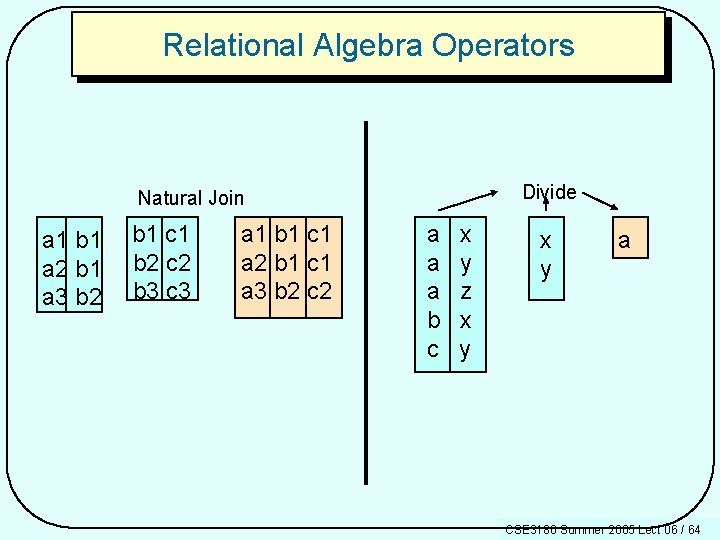
Relational Algebra Operators Divide Natural Join a 1 b 1 a 2 b 1 a 3 b 2 b 1 c 1 b 2 c 2 b 3 c 3 a 1 b 1 c 1 a 2 b 1 c 1 a 3 b 2 c 2 a a a b c x y z x y a CSE 3180 Summer 2005 Lect 06 / 64
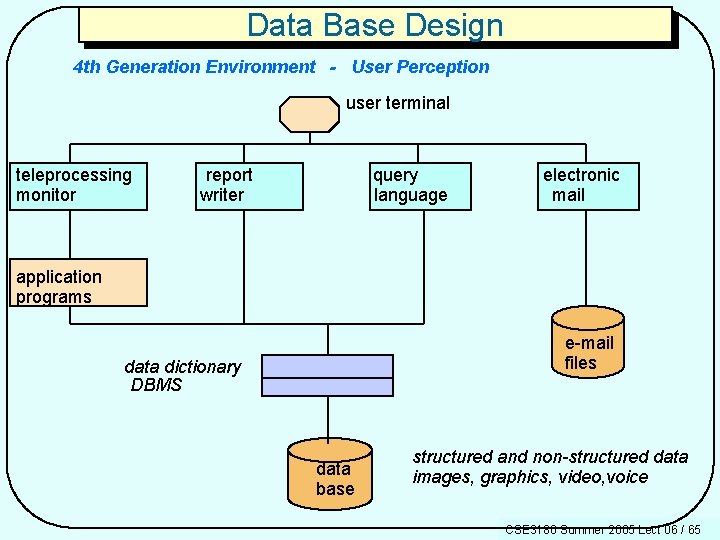
Data Base Design 4 th Generation Environment - User Perception user terminal teleprocessing monitor report writer query language electronic mail application programs e-mail files data dictionary DBMS data base structured and non-structured data images, graphics, video, voice CSE 3180 Summer 2005 Lect 06 / 65
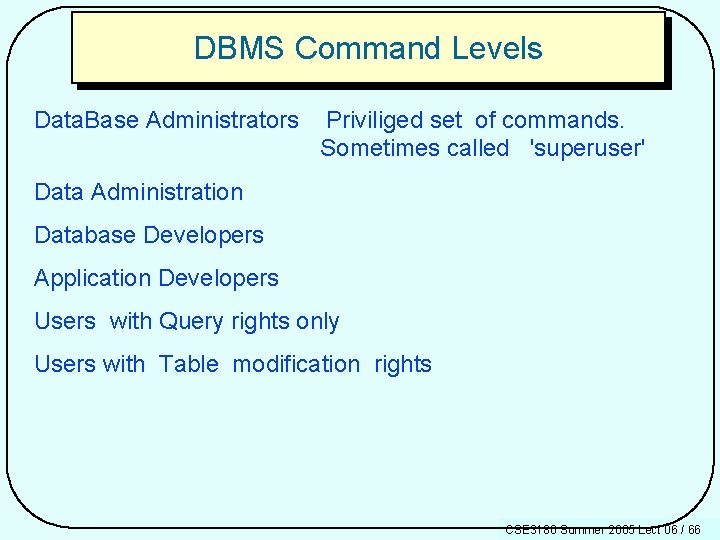
DBMS Command Levels Data. Base Administrators Priviliged set of commands. Sometimes called 'superuser' Data Administration Database Developers Application Developers Users with Query rights only Users with Table modification rights CSE 3180 Summer 2005 Lect 06 / 66
- Slides: 63