
Feature Writing Mekuria Mekasha AAU Training for Press
- Slides: 55
Feature Writing Mekuria Mekasha, AAU Training for Press Journalists 3/5/2021 Prepared by Mekuria Mekasha, AAU 1
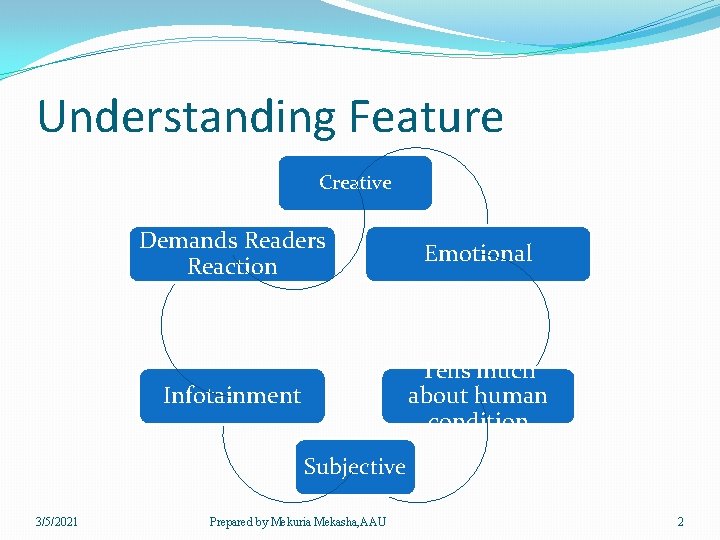
Understanding Feature Creative Demands Readers Reaction Emotional Infotainment Tells much about human condition Subjective 3/5/2021 Prepared by Mekuria Mekasha, AAU 2
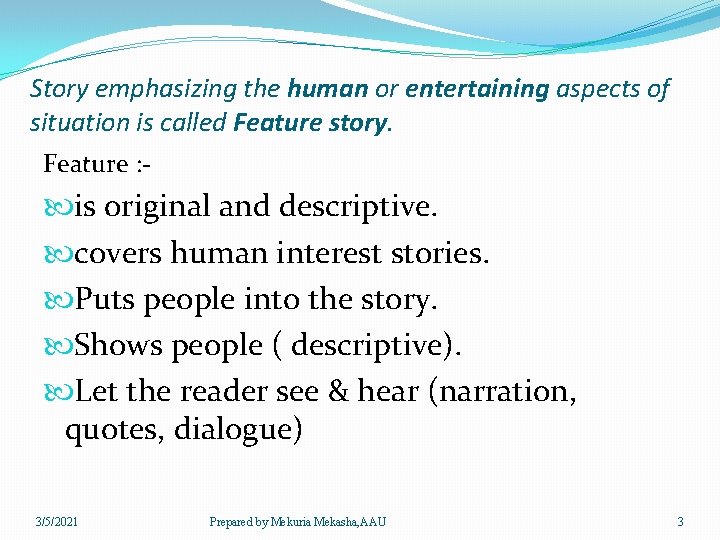
Story emphasizing the human or entertaining aspects of situation is called Feature story. Feature : - is original and descriptive. covers human interest stories. Puts people into the story. Shows people ( descriptive). Let the reader see & hear (narration, quotes, dialogue) 3/5/2021 Prepared by Mekuria Mekasha, AAU 3
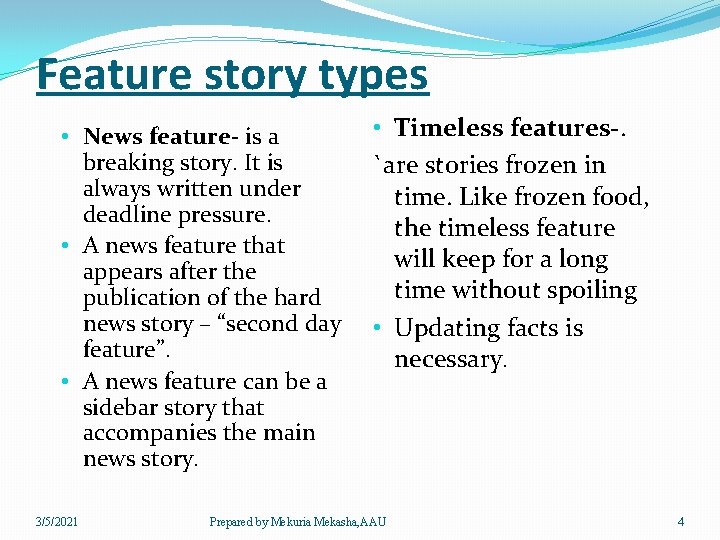
Feature story types • News feature- is a breaking story. It is always written under deadline pressure. • A news feature that appears after the publication of the hard news story – “second day feature”. • A news feature can be a sidebar story that accompanies the main news story. 3/5/2021 • Timeless features-. `are stories frozen in time. Like frozen food, the timeless feature will keep for a long time without spoiling • Updating facts is necessary. Prepared by Mekuria Mekasha, AAU 4
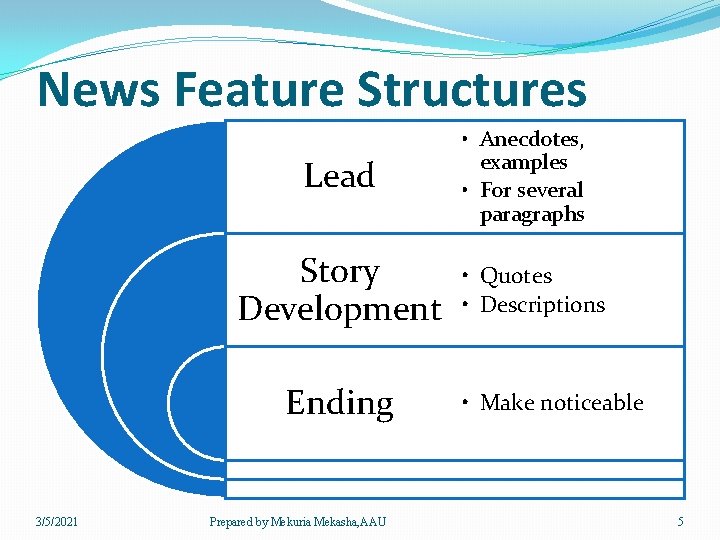
News Feature Structures Lead Story Development Ending 3/5/2021 Prepared by Mekuria Mekasha, AAU • Anecdotes, examples • For several paragraphs • Quotes • Descriptions • Make noticeable 5
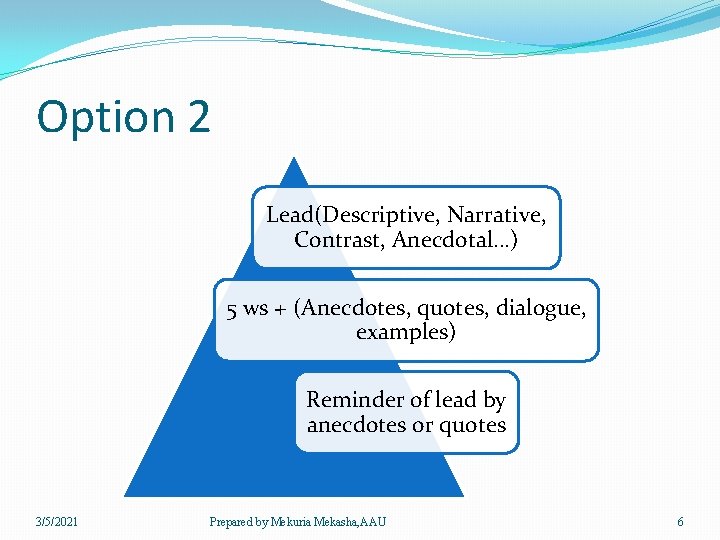
Option 2 Lead(Descriptive, Narrative, Contrast, Anecdotal…) 5 ws + (Anecdotes, quotes, dialogue, examples) Reminder of lead by anecdotes or quotes 3/5/2021 Prepared by Mekuria Mekasha, AAU 6
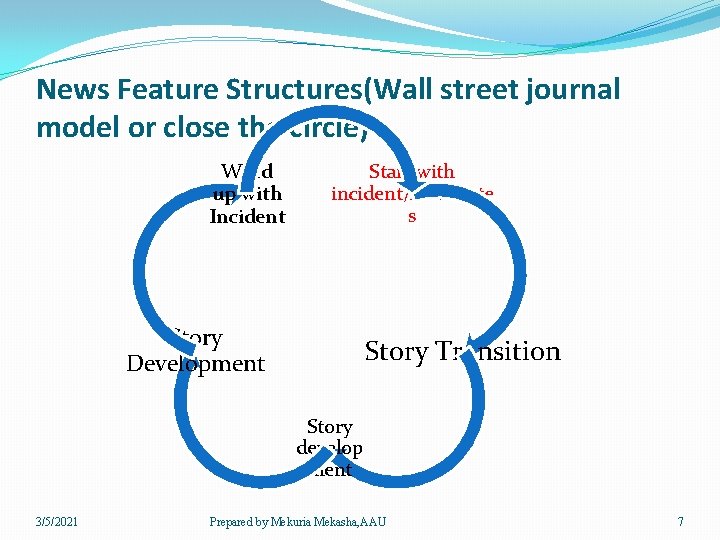
News Feature Structures(Wall street journal model or close the circle) Wind up with Incident Start with incident/Anecdote s Story Development Story Transition Story develop ment 3/5/2021 Prepared by Mekuria Mekasha, AAU 7
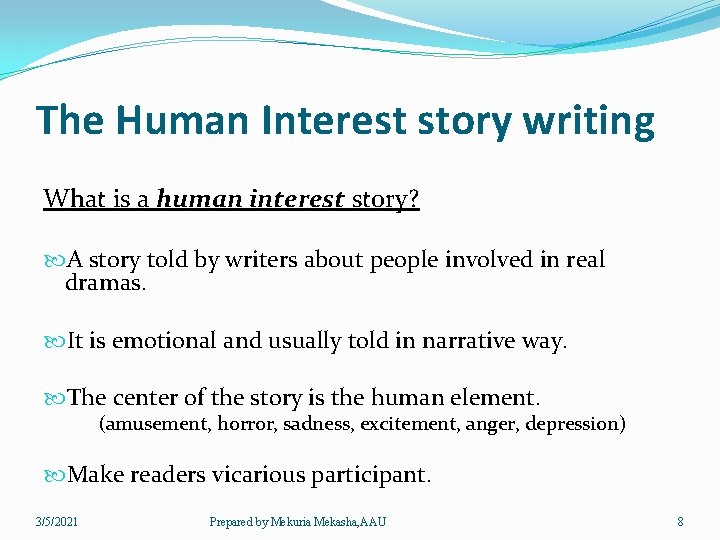
The Human Interest story writing What is a human interest story? A story told by writers about people involved in real dramas. It is emotional and usually told in narrative way. The center of the story is the human element. (amusement, horror, sadness, excitement, anger, depression) Make readers vicarious participant. 3/5/2021 Prepared by Mekuria Mekasha, AAU 8
Types of a Human Interest Stories 1. A Common Problem 2. An Extraordinary Experience 3. A National Issue The Elements of HI stories: The Emotion Element Finding Unique People stories The Motivational Element. 3/5/2021 Prepared by Mekuria Mekasha, AAU 9
Approaches to write HI • • • The Suspended Interest Approach Chronological order Narrative organization Sources of Features: • • • 3/5/2021 The Unusual. [ oddities, freaks, coincidences, unusual personalities] The Usual. [Familiar persons, places, things, landmarks. ex. a handcaped boy who sells newspaper for in front of the parliament for PMs] Dramatic situations. Sudden riches, the prize winner, the abandoned baby. . ] Guidance. Advice to the throubled, recipes, health, flower arranging, stamp coolecting. . ] Information. Statistics, studies, records, analogies, biographies… Prepared by Mekuria Mekasha, AAU 10
Group assignment - 1. Read the story written Liz Balasmeda and Give your comments 3/5/2021 Prepared by Mekuria Mekasha, AAU 11
Structuring Feature Facts • Chose your Style • Give a special attention for a lead. • Construct the Body (don’t overwhelm with details). • Focus on a theme. • Accentuate the Ending (use strong ending) How to get started -Preparation /Backgrounding -Interviewing -Observing. 3/5/2021 Prepared by Mekuria Mekasha, AAU 12
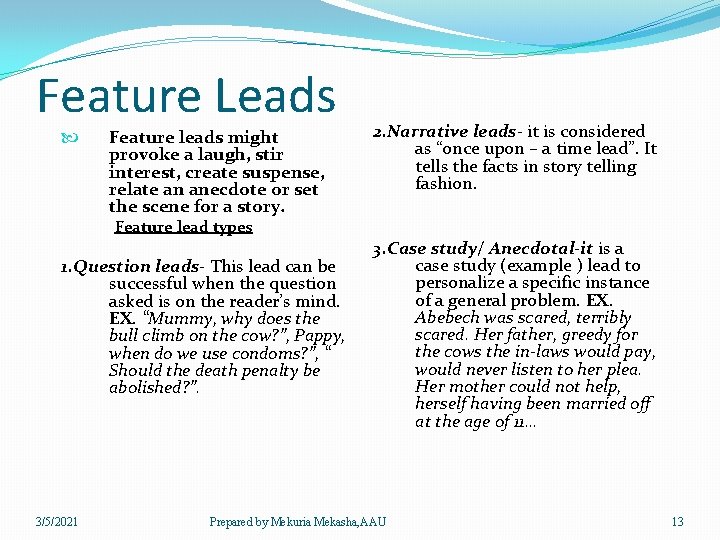
Feature Leads Feature leads might provoke a laugh, stir interest, create suspense, relate an anecdote or set the scene for a story. 2. Narrative leads- it is considered as “once upon – a time lead”. It tells the facts in story telling fashion. Feature lead types 1. Question leads- This lead can be successful when the question asked is on the reader’s mind. EX. “Mummy, why does the bull climb on the cow? ”, Pappy, when do we use condoms? ”, “ Should the death penalty be abolished? ”. 3/5/2021 3. Case study/ Anecdotal-it is a case study (example ) lead to personalize a specific instance of a general problem. EX. Abebech was scared, terribly scared. Her father, greedy for the cows the in-laws would pay, would never listen to her plea. Her mother could not help, herself having been married off at the age of 11… Prepared by Mekuria Mekasha, AAU 13
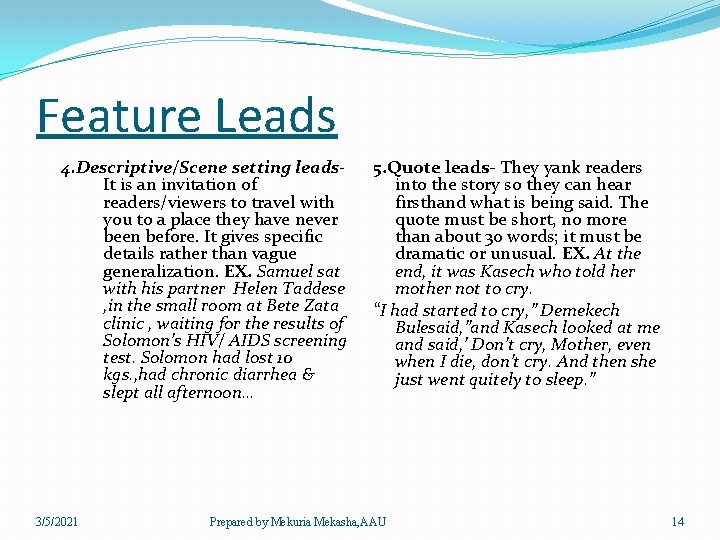
Feature Leads 4. Descriptive/Scene setting leads. It is an invitation of readers/viewers to travel with you to a place they have never been before. It gives specific details rather than vague generalization. EX. Samuel sat with his partner Helen Taddese , in the small room at Bete Zata clinic , waiting for the results of Solomon’s HIV/ AIDS screening test. Solomon had lost 10 kgs. , had chronic diarrhea & slept all afternoon… 3/5/2021 5. Quote leads- They yank readers into the story so they can hear firsthand what is being said. The quote must be short, no more than about 30 words; it must be dramatic or unusual. EX. At the end, it was Kasech who told her mother not to cry. “I had started to cry, ” Demekech Bulesaid, ”and Kasech looked at me and said, ’ Don’t cry, Mother, even when I die, don’t cry. And then she just went quitely to sleep. ” Prepared by Mekuria Mekasha, AAU 14
Finding good feature idea LISTENING TO IDEAS FROM READERS GETTING IDEAS FROM OTHER WRITERS USING SPECIALIZED PUBLICATIONS, PROGRAMS WORKING WITH EDITORS’ IDEAS (Editors know their markets well ) IDEA FILES, CALENDARS, AND DATEBOOKS 3/5/2021 Prepared by Mekuria Mekasha, AAU 15
YOUR BEST SOURCES FOR STORY IDEAS Personal experiences. · Personal and professional contacts. · College and university campuses. · World Wide Web sites, especially those hosted by local community organizations and institutions. · E-mail distribution lists sponsored by specific interest groups that fit your interests. · News groups, chat rooms, and Weblogs devoted to specific subjects or topics. · Meetings and conventions. · House and home and your own neighborhood. · Libraries, museums. · Historians. · Other publications (newspapers, magazines, newsletters, and online publications). · Television programs. · Readers and sources. · Editors and fellow writers. · Telephone information recordings. · Community bulletin boards and communication centers. · Calendars and datebooks. 3/5/2021 Prepared by Mekuria Mekasha, AAU 16
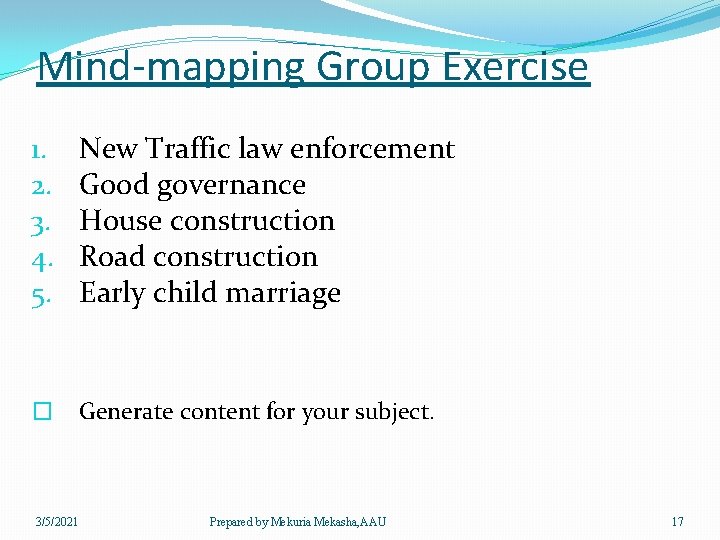
Mind-mapping Group Exercise 1. 2. 3. 4. 5. New Traffic law enforcement Good governance House construction Road construction Early child marriage � Generate content for your subject. 3/5/2021 Prepared by Mekuria Mekasha, AAU 17
CHOOSING THE RIGHT ANGLE �It has to have some sort of angle, some major thrust within the subject you have selected �After you have determined the subject for the article, make a list of all the possible angles of the subject �Which one is best? Rank the items on the list according to which you feel are the most appealing and unique to readers �*General idea is Running – Give angle! 3/5/2021 Prepared by Mekuria Mekasha, AAU 18
Types of Newspaper Features 1. The Business story. A story about business developments when they have an impact on jobs, prices, wages, taxes, goods , buying power. -It is not only about numbers, more than that, it is about people. - Turn statistics into stories. 2. The Commemorative story. They are news features fixed to the anniversary of an earlier news ev� nt. If indũviduals are unavailable you can write a article capturing t� e mood of the anniversary. 3. Explanatůry story. The story that answers�“how could that have happened? ” or “why did that happen? ”. The explanatory story need not solve the mystery, but it brings all available evidence to bear on it. (EX. Story on pedophiles, homosexuality…) 3/5/2021 Prepared by Mekuria Mekasha, AAU 19
Types of Features 4. The Trend story. Story that concentrates on current style. They make readers to ask themselves-”Should I be doing this or not doing it? ” EX. (Hippie, Chat chewing trend, shisha smoking…) 5. The Hobbyist story. Covering the habit of collecting something- coins, stamps etc. 6. The How – To Story A story with one or more experts / counselors who advice the reader how to accomplish a tricky task. 7. The Invention story. Inventors are good feature materials. 8. The Medical story. We can write feature Mekuria Mekasha, AAU stories in illness. Prepared and by death. 3/5/2021 20
Types of Features 9. The Number Story. This kind of feature uses interviews with experts and a familiar number such as “ 10” solutions, 10 problems. 10. The Odd – Occupation Story. Every community has an unusual jobs. These jobs can be good feature stories. 11. The Overview story. Stories supported with voluminous statistics from various official sources. EX. Stories dealing with missing children. 12. The Participatory story. This kind of story writing needs living a role in order to write about it, unless you misrepresent yourself to write about the intimate details of other people. EX. Life of prostitutes, detainees… 3/5/2021 Prepared by Mekuria Mekasha, AAU 21
13. The Profile story. Types of Features Profiles are detailed word portraits of interesting people. Profiles are typically written about prominent people, but not always. Sometimes ‘ little people” have unusual qualities that lend interest to profiles. Groups , institutions, events , and things can be profiled too. 14. The Travel story and Unfamiliar visitor story. It is a writing of places to visit and visited. You tell readers about historical places, annual festivals, cities resorts etc. Generally travel writing is about people and places. 15. Seasonal features. Features about seasons and holidays. 16. Personal experience. Written in the first person (I), these stories relate happenings that are unusual, funny or sometimes scary. 3/5/2021 Prepared by Mekuria Mekasha, AAU 22
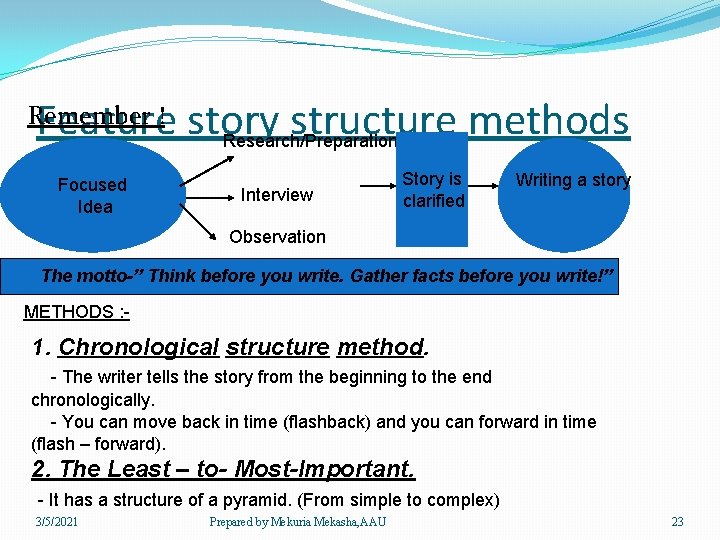
Feature story structure methods Remember ! Focused Idea Research/Preparation Interview Story is clarified Writing a story Observation The motto-” Think before you write. Gather facts before you write!” METHODS : - 1. Chronological structure method. - The writer tells the story from the beginning to the end chronologically. - You can move back in time (flashback) and you can forward in time (flash – forward). 2. The Least – to- Most-Important. - It has a structure of a pyramid. (From simple to complex) 3/5/2021 Prepared by Mekuria Mekasha, AAU 23
Feature story structure methods 3. The Problem and Solution - A feature writer cites the problem and tries to give solutions. (EX. – How to curb solution? ) 4. The catalog Method. - Eventually it is a list, where people, places, and events classified and explained. (If you write a travel story use this method. ) 5. The Repetitive Method. - It introduces the concept and hammer away that concept until the point is made 6. Combination Approach. - It is a system of combining all above methods. 3/5/2021 Prepared by Mekuria Mekasha, AAU 24
Individual assignment - 3 On story structure Methods Use a book on Feature writing for newspapers and magazines by Friedlander and Lee. a) read Mrs. Kelly’s Monster b) A boy of unusual vision Reflection tips: a) explain what the story is about. b) evaluate the writing methods used by the writer. 3/5/2021 Prepared by Mekuria Mekasha, AAU 25
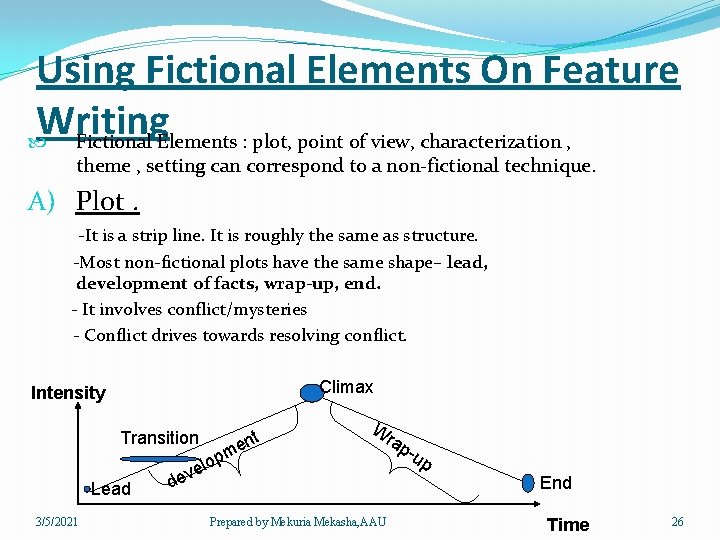
Using Fictional Elements On Feature Writing Fictional Elements : plot, point of view, characterization , theme , setting can correspond to a non-fictional technique. A) Plot. -It is a strip line. It is roughly the same as structure. -Most non-fictional plots have the same shape– lead, development of facts, wrap-up, end. - It involves conflict/mysteries - Conflict drives towards resolving conflict. Climax Intensity nt e m Transition Lead 3/5/2021 elo v e p W ra d Prepared by Mekuria Mekasha, AAU p- up End Time 26
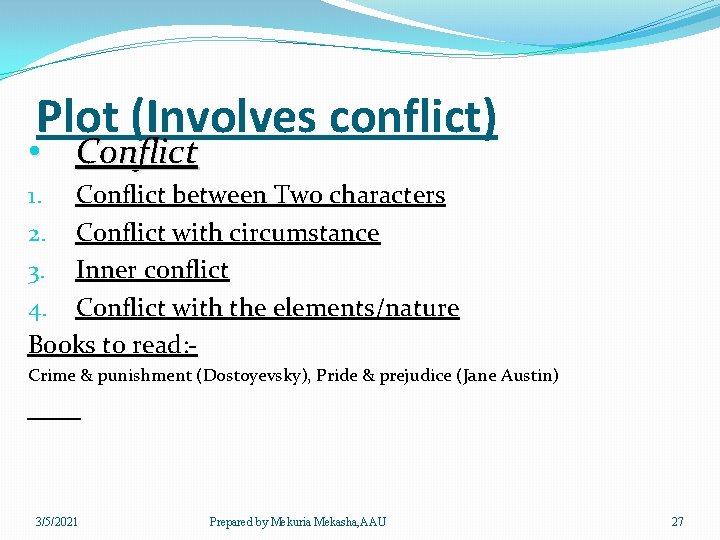
Plot (Involves conflict) • Conflict 1. Conflict between Two characters 2. Conflict with circumstance 3. Inner conflict 4. Conflict with the elements/nature Books to read: Crime & punishment (Dostoyevsky), Pride & prejudice (Jane Austin) 3/5/2021 Prepared by Mekuria Mekasha, AAU 27
Using fictional elements forthefeature writing: B) Point of view -It tells story from the journalist’s point of view (angle of a story). -Use first-person –”I” and use Third-person (she, he , they) - Keep one viewpoint only through out the story. - Tell through a character. C) Characterization -Presents a believable word picture of human being. -Characters give you stories. - know your characters. - keep characters number to a minimum. Don’t introduce irrelevant characters. - Spread characters through the story. - use movement, mannerisms & tricks of speech to establish 3/5/2021 Prepared by Mekuria Mekasha, AAU character. 28
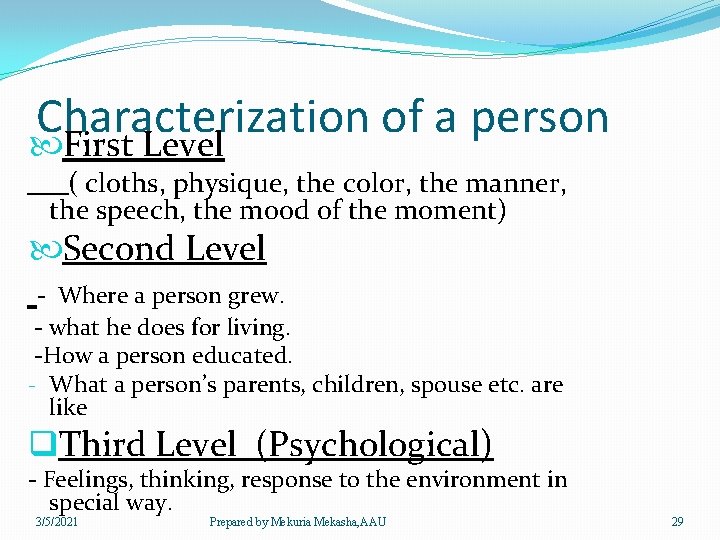
Characterization of a person First Level ( cloths, physique, the color, the manner, the speech, the mood of the moment) Second Level - Where a person grew. - what he does for living. -How a person educated. - What a person’s parents, children, spouse etc. are like q. Third Level (Psychological) - Feelings, thinking, response to the environment in special way. 3/5/2021 Prepared by Mekuria Mekasha, AAU 29
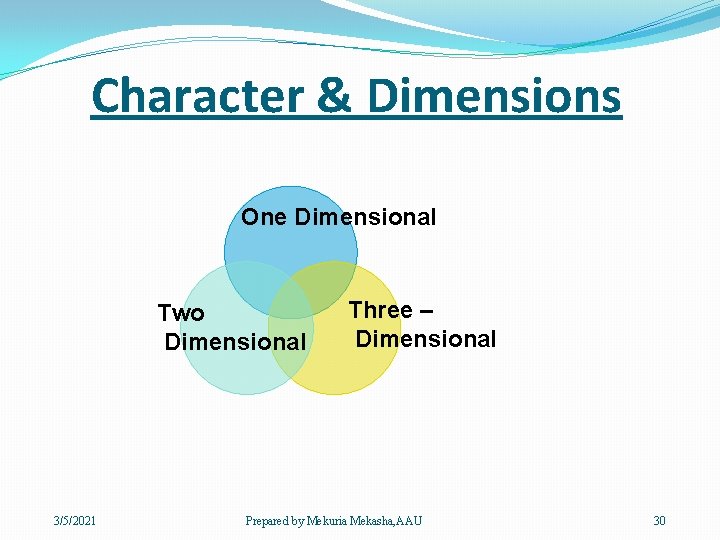
Character & Dimensions One Dimensional Two Dimensional 3/5/2021 Three – Dimensional Prepared by Mekuria Mekasha, AAU 30
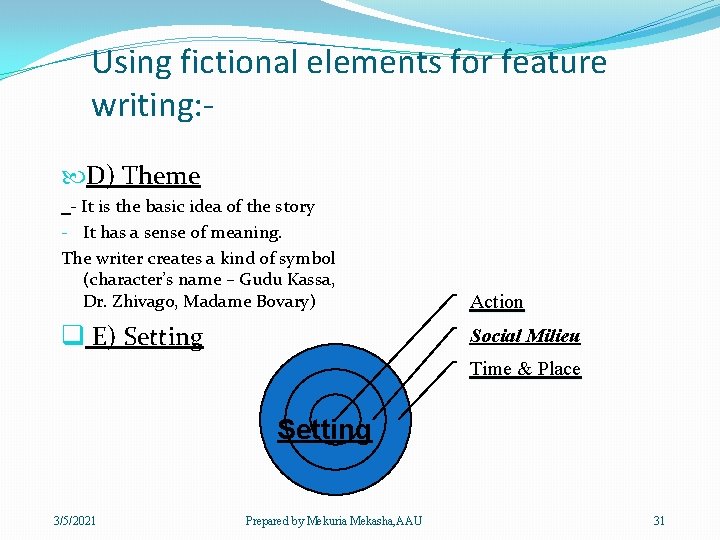
Using fictional elements for feature writing: D) Theme - It is the basic idea of the story - It has a sense of meaning. The writer creates a kind of symbol (character’s name – Gudu Kassa, Dr. Zhivago, Madame Bovary) Action q E) Setting Social Milieu Time & Place Setting 3/5/2021 Prepared by Mekuria Mekasha, AAU 31
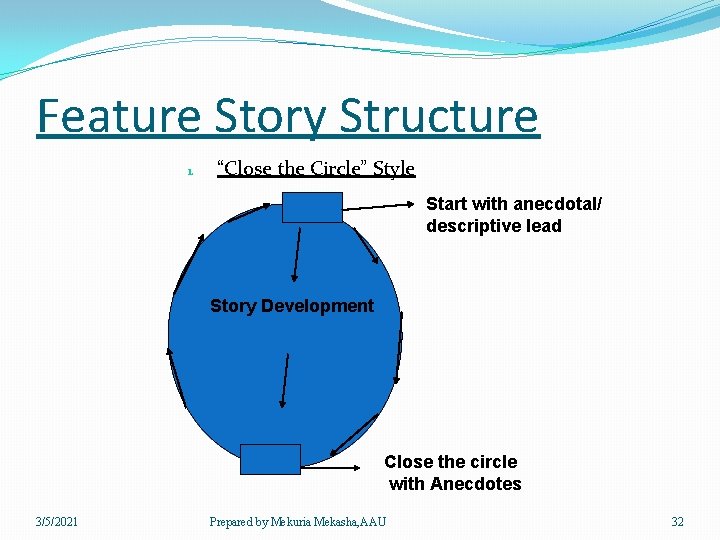
Feature Story Structure 1. “Close the Circle” Style Start with anecdotal/ descriptive lead Story Development Close the circle with Anecdotes 3/5/2021 Prepared by Mekuria Mekasha, AAU 32
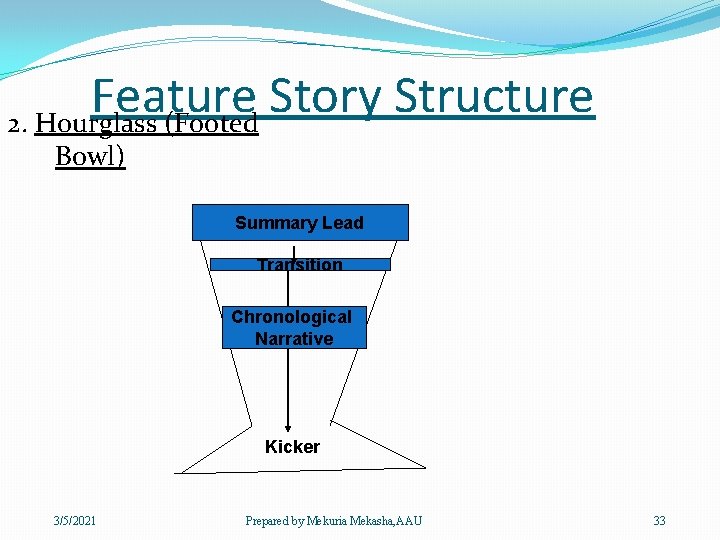
Feature Story Structure 2. Hourglass (Footed Bowl) Summary Lead Transition Chronological Narrative Kicker 3/5/2021 Prepared by Mekuria Mekasha, AAU 33
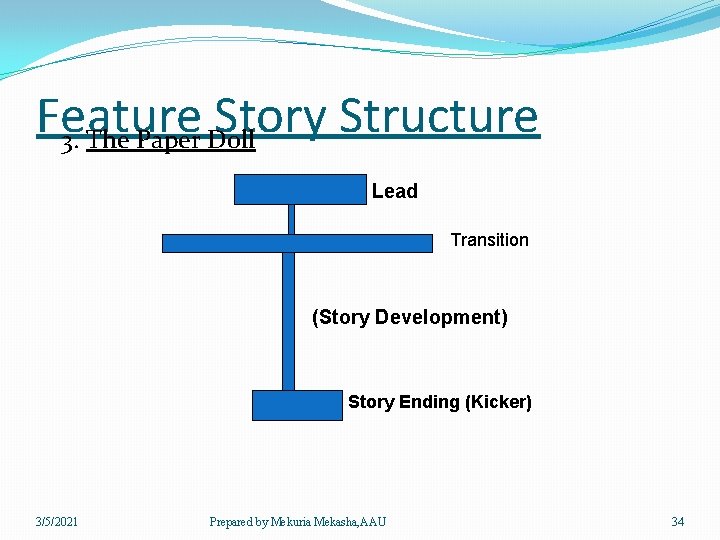
Feature Story Structure 3. The Paper Doll Lead Transition (Story Development) Story Ending (Kicker) 3/5/2021 Prepared by Mekuria Mekasha, AAU 34
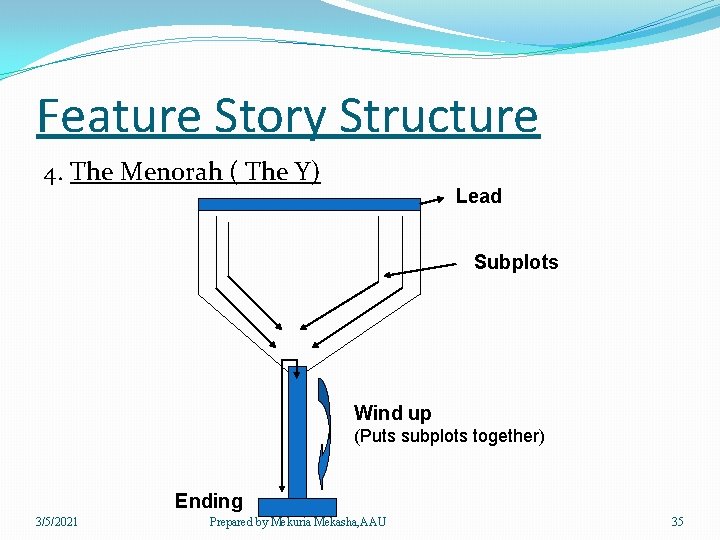
Feature Story Structure 4. The Menorah ( The Y) Lead Subplots Wind up (Puts subplots together) Ending 3/5/2021 Prepared by Mekuria Mekasha, AAU 35
Story Development Elements Leads - Grabs the readers attention. - gives the central idea. -Persuades the readers to read on. Foreshadowing (preparation – radio. TV) /Backshadowing (expositi. On- radio. TV) - a technique 5 sed in cinematogr. Aphy " fiction. - At hints at what is to come next/ passed Transition - It gives hint and encourage readers to keep on reading /viewing. - It can be time or place. 3/5/2021 Prepared by Mekuria Mekasha, AAU 36
Story Development Elements Nut Graphs - It is a well organized transition. - It is aj organized summary of what the sto. Ry is al, about. - tells the reader “ this is what the story is about”. Endings ( kicker) - Broadcart journalists and feature writers usualli feel the ending is nearly as important as t. He beginning of the story. - It defines the feeling that the reader is left with when the story stops. 3/5/2021 Prepared by Mekuria Mekasha, AAU 37
Individual Assignment 4 Article 1. Write major differences of Feature-and 2. writing. Mind –map on the following ѩssues (and draw the story idea � o feature and article writing. Problems: - 3. 4. 3/5/2021 Visit of president Al-Bashir in Ethiopia. Beggar problem in Addis. Prepared by Mekuria Mekasha, AAU 38
Turning News into Features Problems of ceremonial (routine) news v Ceremonial news generally contains very little news – value material. Avoid them! ü Publicizing routine functions like: Worksh ps, seminars, completion of training, award of prizes…. ü The VIP’s speeci or inaugura�addresses q The Remedy is to focus on : Ø Human Interest Angle. Р Ø Government & public sector. Ø Socio- economic &"welfare programs Ø Private sector. 3/5/2021 Prepared by Mekuria Mekasha, AAU 39
Researching for Feature Basic steps to feature research: 1. Gain a broad overview of the subject. 2. Learn about it in some depth. 3. Find and interview knowledgeable people. 3/5/2021 Prepared by Mekuria Mekasha, AAU 40
Sources for Feature Research. Media Libraries. Public and other private libraries. Useful government publications. Using Internet for research. Interviewing – a key form of research. Observation. Recall emotional estates Concentrate on important detail Seek other evidence Observe unobtrusively & Be participant 3/5/2021 Prepared by Mekuria Mekasha, AAU 41
Individual Assignment - 4 Assignment on feature research Select one of these topics and find three – four printed sources about it. Explain how you found this information. Real estate in Addis. Drug abuse in Ethiopia. Pedophilia in Addis. Tedi Afro. Ethiopian Election Board. 3/5/2021 Prepared by Mekuria Mekasha, AAU 42
Troubleshooting for feature writing 1. 2. 3. 4. 5. 6. 7. 8. Get your audience involved with the main character quickly. Let the reader know quickly what the piece will be about. Hide Exposition (information about place, back history, characters, relationships, agendas. . ) Make your audience laugh, cry, but make them wait. Keep the story moving as new characters come on the scene. Don’t invent a new character to solve the plot. Make sure characters have enough opposing and contradictory qualities. Put your work away for a few days (hours) before reading it. 3/5/2021 Prepared by Mekuria Mekasha, AAU 43
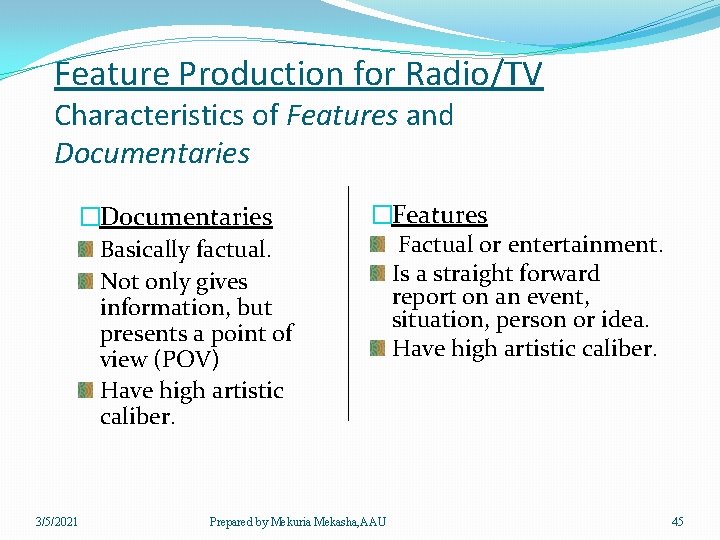
Feature Production for Radio/TV Characteristics of Features and Documentaries FORM �Documentaries �Features Basically factual. Not only gives information, but presents a point of view (POV) Have high artistic caliber. 3/5/2021 Prepared by Mekuria Mekasha, AAU Factual or entertainment. Is a straight forward report on an event, situation, person or idea. Have high artistic caliber. Dramatic- Faithfulness representation of true situation. 44
Feature Production for Radio/TV Characteristics of Features and Documentaries �Documentaries Basically factual. Not only gives information, but presents a point of view (POV) Have high artistic caliber. 3/5/2021 �Features Factual or entertainment. Is a straight forward report on an event, situation, person or idea. Have high artistic caliber. Prepared by Mekuria Mekasha, AAU 45
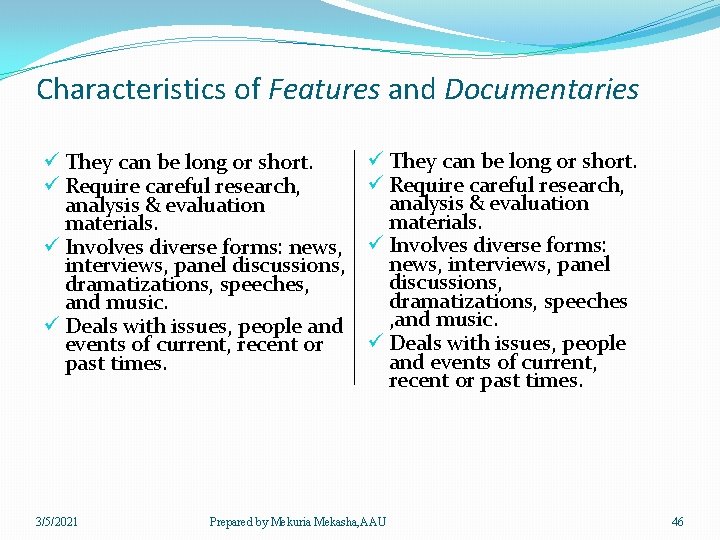
Characteristics of Features and Documentaries ü They can be long or short. ü Require careful research, analysis & evaluation materials. ü Involves diverse forms: news, interviews, panel discussions, dramatizations, speeches, and music. ü Deals with issues, people and events of current, recent or past times. 3/5/2021 ü They can be long or short. ü Require careful research, analysis & evaluation materials. ü Involves diverse forms: news, interviews, panel discussions, dramatizations, speeches , and music. ü Deals with issues, people and events of current, recent or past times. Prepared by Mekuria Mekasha, AAU 46
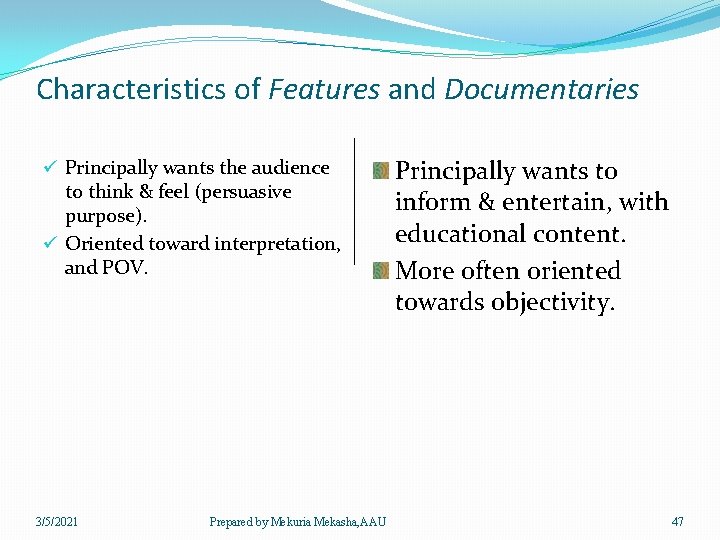
Characteristics of Features and Documentaries ü Principally wants the audience to think & feel (persuasive purpose). ü Oriented toward interpretation, and POV. 3/5/2021 Prepared by Mekuria Mekasha, AAU Principally wants to inform & entertain, with educational content. More often oriented towards objectivity. 47
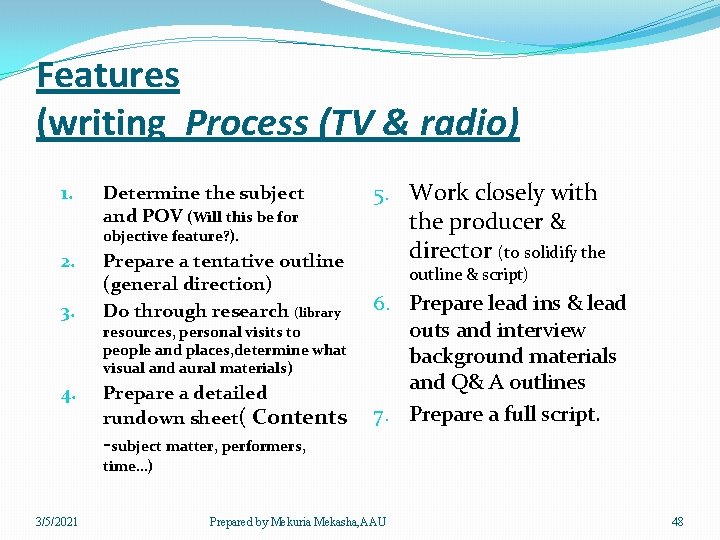
Features (writing Process (TV & radio) 1. Determine the subject and POV (Will this be for objective feature? ). 2. 3. 4. Prepare a tentative outline (general direction) Do through research (library resources, personal visits to people and places, determine what visual and aural materials) Prepare a detailed rundown sheet( Contents 5. Work closely with the producer & director (to solidify the outline & script) 6. Prepare lead ins & lead outs and interview background materials and Q& A outlines 7. Prepare a full script. -subject matter, performers, time…) 3/5/2021 Prepared by Mekuria Mekasha, AAU 48
4. Using of dramatization. The opening clearly establishes the locale. 5. Using of point of view. The ending is a clear 2. A narrator plays a linking, again, of past key role. and present, stressing the continuity of the 3. Using of interviewee. event. Interviewee may be 6. Look for interesting telling a story & juxtaposing. giving information. 1. 3/5/2021 Prepared by Mekuria Mekasha, AAU 49
When deciding on how to do features, list the following: The working title. The aim. The duration. Information you already have. Provisional content. Key questions. 3/5/2021 Interview sources. Reference sources. Actuality: The picture/ sound that will form a big part of the program. Prepared by Mekuria Mekasha, AAU 50
Feature Focus : The work centers on the writing of the script : - Strong story line - Clear visual image - Dramatization -Handling of known facts but still with a feeling of suspense. 3/5/2021 Prepared by Mekuria Mekasha, AAU 51
Feature Focus (cont. . ) News and Information Frequently uses opinion (POV). A straight forward report on events Examples: -Shows a life of someone in the community. -about the day-to-day operations of a new local industry. - story about local park/zoo, a new resort - Special health service in the community such as an HIV/AIDS support org. 3/5/2021 Prepared by Mekuria Mekasha, AAU 52
Feature Technique Human Interest is a key to good feature writing Know the problem or situation Explore the people ( characters) involved with the subject Find little things- they are important in establishing empathy Use narration ( Too much narration distracts feature writing) -The operation of local fire department, raising of chickens etc. 3/5/2021 Prepared by Mekuria Mekasha, AAU 53
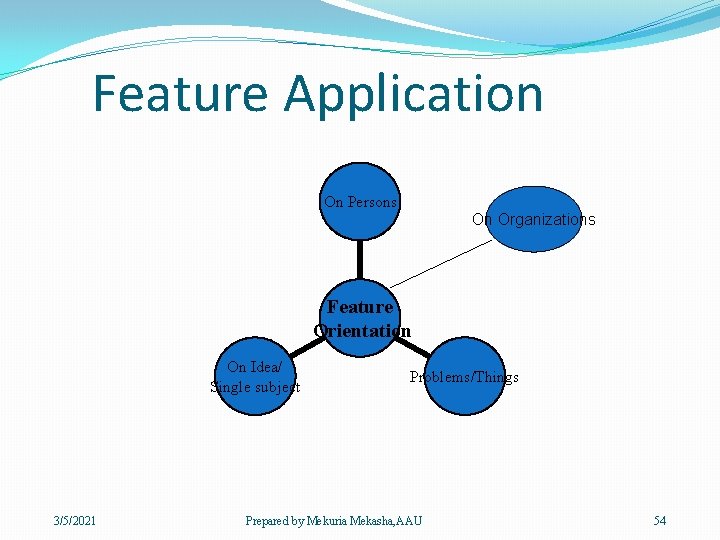
Feature Application On Persons On Organizations Feature Orientation On Idea/ Single subject 3/5/2021 Problems/Things Prepared by Mekuria Mekasha, AAU 54
Example: Decide on the following issue ( Which one is a feature story? ) 1. The life of homeless in the community. 2. The life of homeless with a strong point about the obligation to help homeless. 3/5/2021 Prepared by Mekuria Mekasha, AAU 55