
Feature Significance in Wide Neural Networks Janusz A




- Slides: 18
Feature Significance in Wide Neural Networks Janusz A. Starzyk 1 2 Rafał Niemiec 2 Adrian Horzyk starzykj@ohio. edu rniemiec@wsiz. rzeszow. pl horzyk@agh. edu. pl Google: Janusz Starzyk Google: Rafał Niemiec Google: Horzyk 1 Ohio University, Athens, Ohio, U. S. A. , School of Electrical Engineering and Computer Science 2 University of Information Technology and Management, Rzeszow, Poland 3 3 AGH University of Science and Technology Krakow, Poland
Introduction § § § Wide neural networks was recently proposed as a less costly alternative to deep neural networks, having no problem with exploding or vanishing gradient descent. We analyzed quality of features and properties of wide neural networks. We compared the random selection of weights in the hidden layer to the selection based on radial basis functions. Our study is devoted to feature selection and feature significance in wide neural networks. We introduced a measure to compare various feature selection techniques. We proved that this approach is computationally more efficient. 2
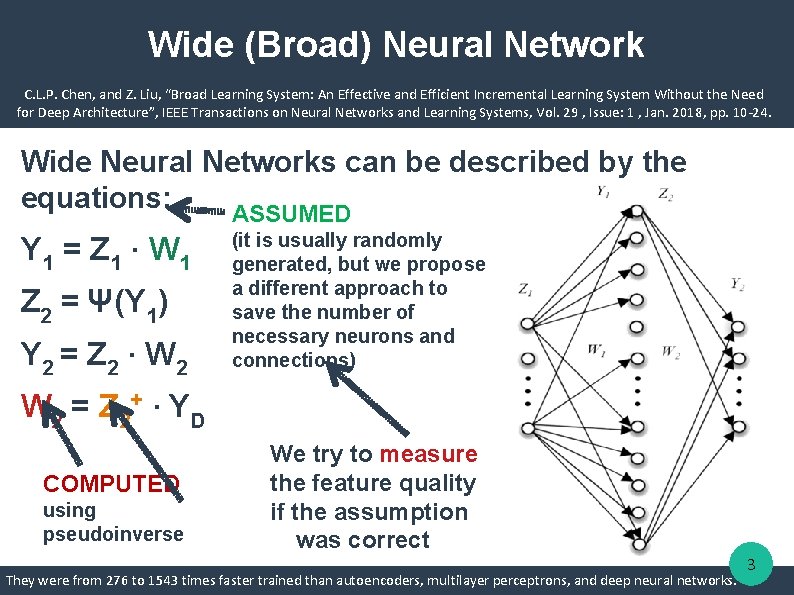
Wide (Broad) Neural Network C. L. P. Chen, and Z. Liu, “Broad Learning System: An Effective and Efficient Incremental Learning System Without the Need for Deep Architecture”, IEEE Transactions on Neural Networks and Learning Systems, Vol. 29 , Issue: 1 , Jan. 2018, pp. 10 -24. Wide Neural Networks can be described by the equations: ASSUMED Y 1 = Z 1 · W 1 Z 2 = Ψ(Y 1) Y 2 = Z 2 · W 2 (it is usually randomly generated, but we propose a different approach to save the number of necessary neurons and connections) W 2 = Z 2+ · Y D COMPUTED using pseudoinverse We try to measure the feature quality if the assumption was correct They were from 276 to 1543 times faster trained than autoencoders, multilayer perceptrons, and deep neural networks. 3
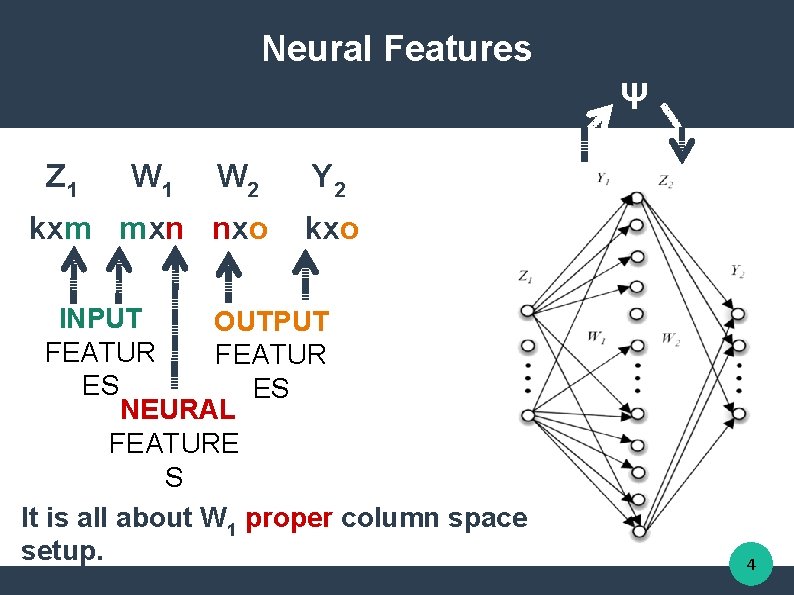
Neural Features Ψ Z 1 W 2 kxm mxn nxo Y 2 kxo INPUT OUTPUT FEATUR ES ES NEURAL FEATURE S It is all about W 1 proper column space setup. 4
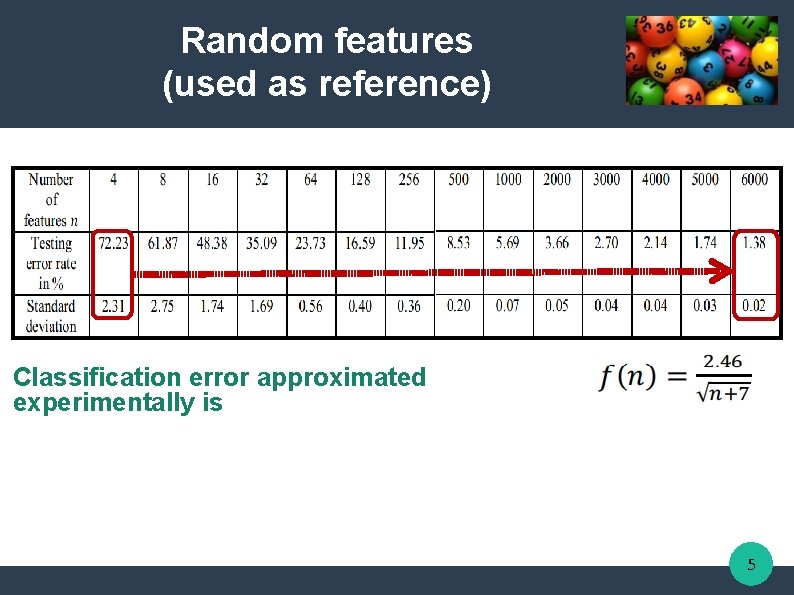
Random features (used as reference) Classification error approximated experimentally is 5
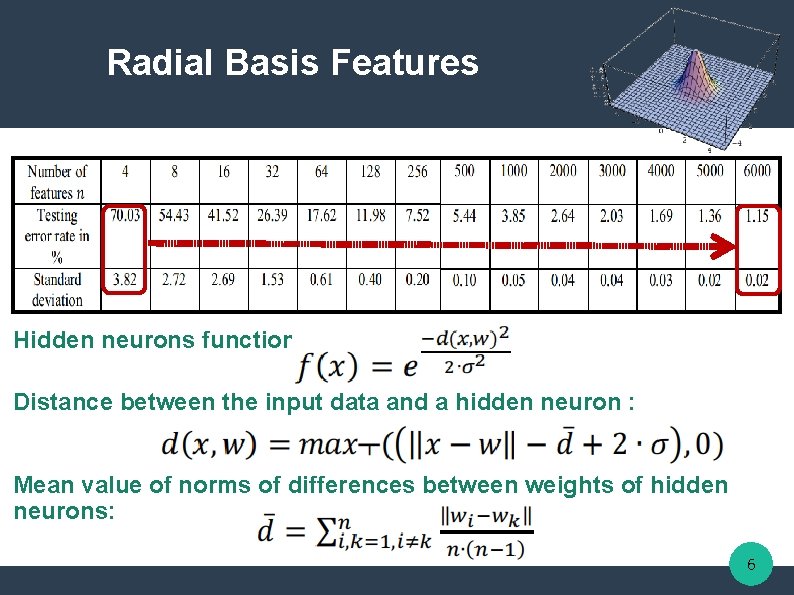
Radial Basis Features Hidden neurons function: Distance between the input data and a hidden neuron : Mean value of norms of differences between weights of hidden neurons: 6
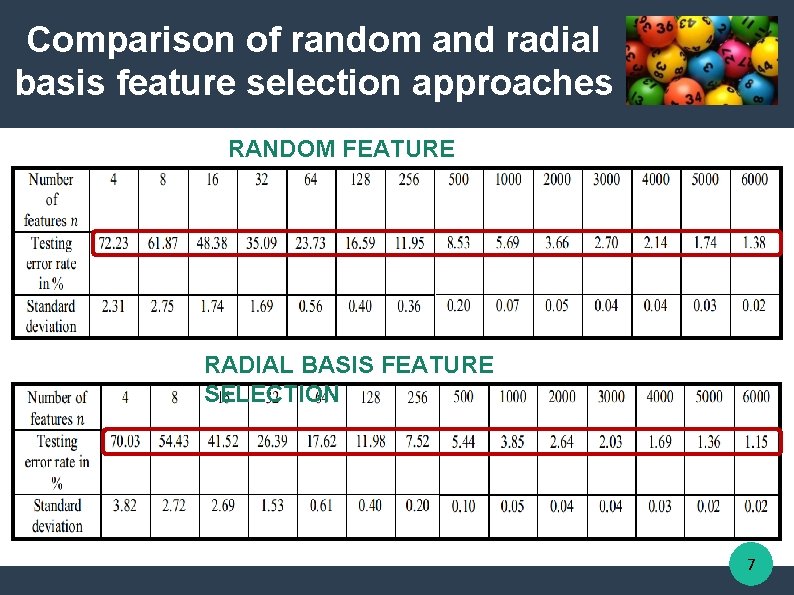
Comparison of random and radial basis feature selection approaches RANDOM FEATURE SELECTION RADIAL BASIS FEATURE SELECTION 7
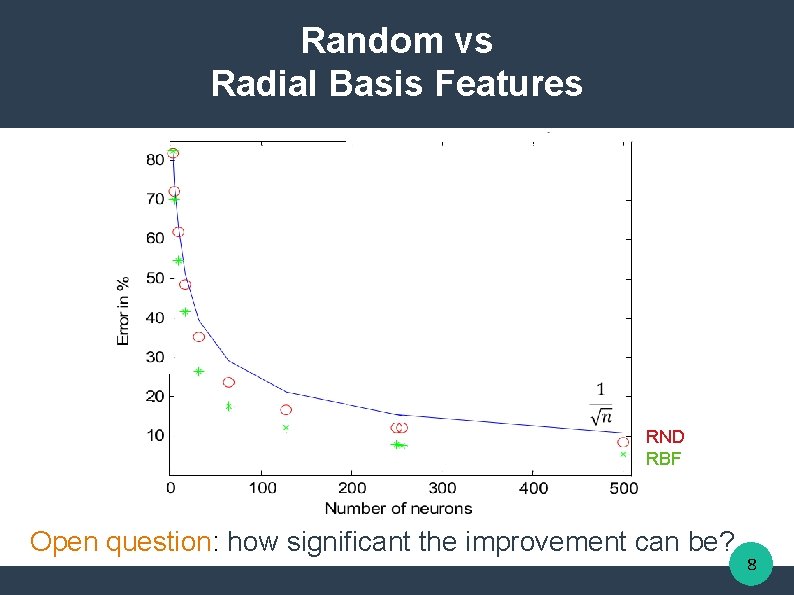
Random vs Radial Basis Features RND RBF Open question: how significant the improvement can be? 8
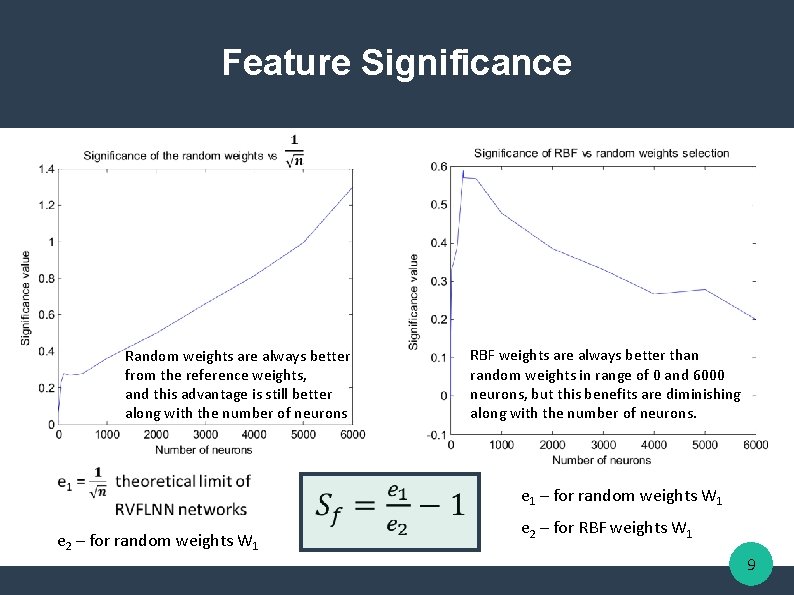
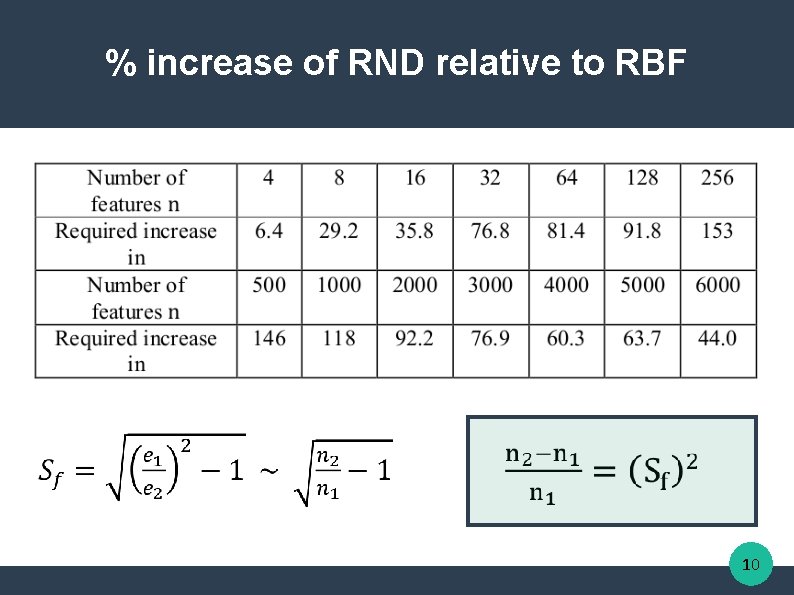
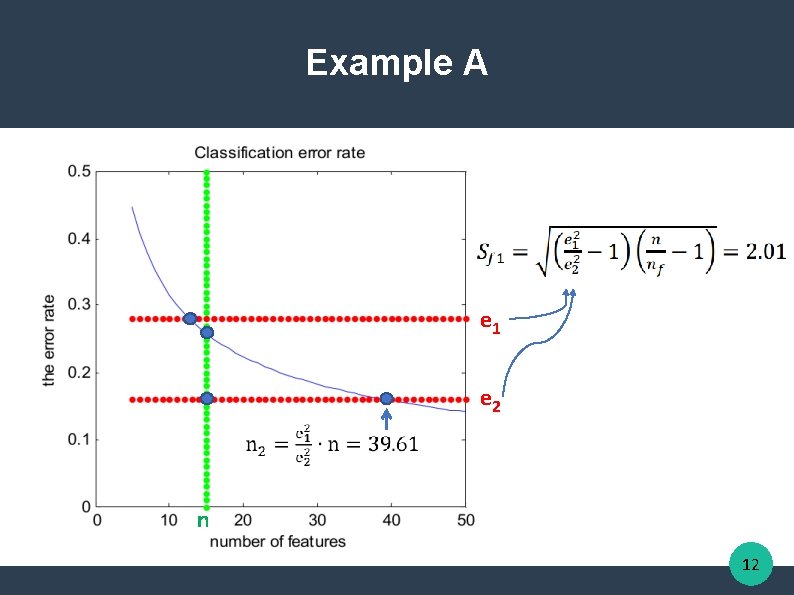
Feature Significance Random weights are always better from the reference weights, and this advantage is still better along with the number of neurons RBF weights are always better than random weights in range of 0 and 6000 neurons, but this benefits are diminishing along with the number of neurons. e 1 – for random weights W 1 e 2 – for RBF weights W 1 9
% increase of RND relative to RBF 10
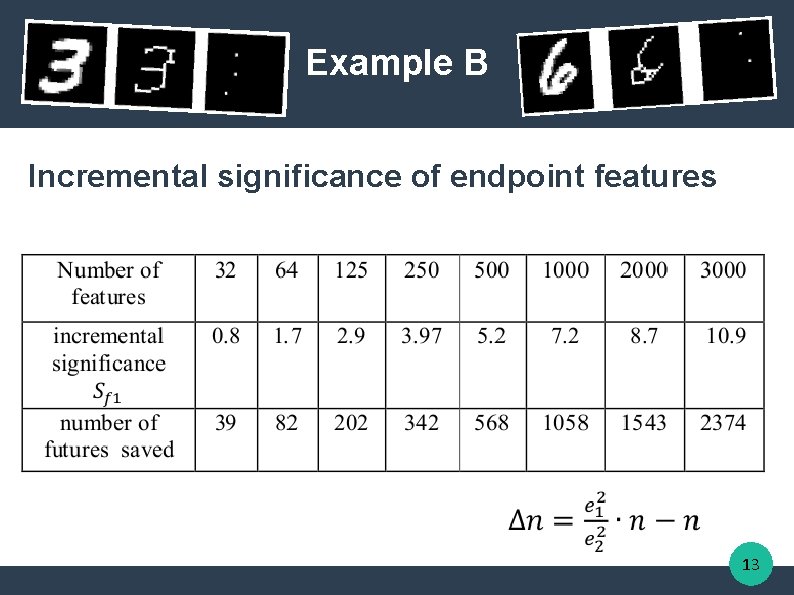
Incremental Feature Significance Suppose we have n features and want to add nf new features We want to measure n. RND features can be saved if nf will be added e. g. 11
Example A e 1 e 2 n 12
Example B Incremental significance of endpoint features 13
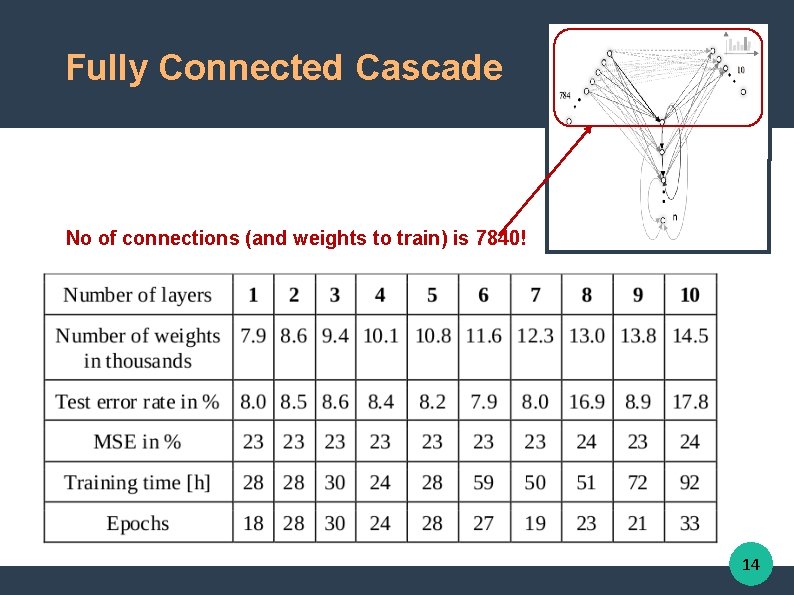
Fully Connected Cascade No of connections (and weights to train) is 7840! 14
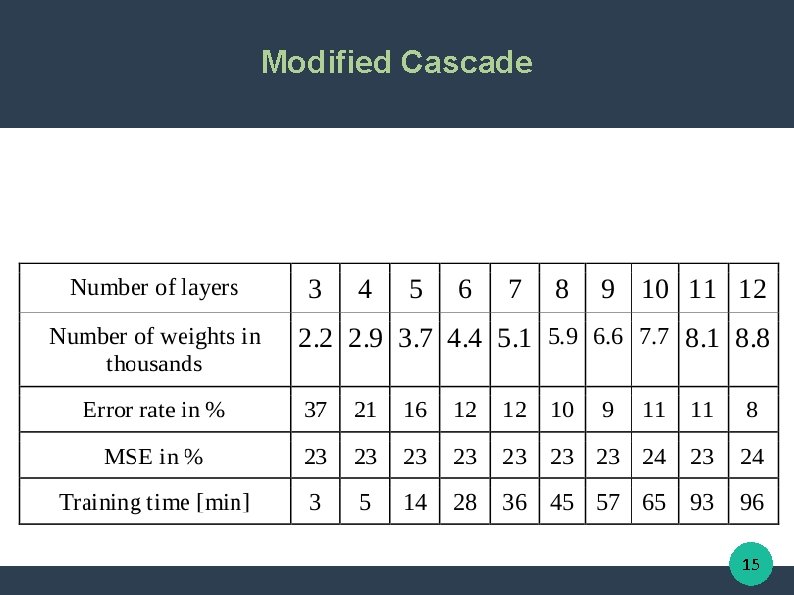
Modified Cascade 15
Summary & Future Plans § § § We discussed the significance of the feature selection for wide neural networks. We compared recognition accuracy on the MNIST dataset using two approaches. We compared wide networks to connected cascades. We introduced two simple feature significance measures. In future, we want to explore tradeoffs between the number of hidden neurons in wide neural networks vs. width and depth of deep neural networks to better understand tradeoffs between the two parameters in these modern network structures. 16
Janusz A. Starzyk starzykj@ohio. edu Google: Janusz Starzyk Rafał Niemiec Adrian Horzyk rniemiec@wsiz. rzeszow. pl horzyk@agh. edu. pl Google: Rafał Niemiec Google: Horzyk 謝謝 1. 2. 3. 4. 5. 6. Basawaraj, J. A. Starzyk, A. Horzyk, Episodic Memory in Minicolumn Associative Knowledge Graphs, IEEE Transactions on Neural Networks and Learning Systems, Vol. 30, Issue 11, 2019, pp. 3505 -3516, DOI: 10. 1109/TNNLS. 2019. 2927106 (TNNLS-2018 -P-9932), IF = 7. 982. J. A. Starzyk, Ł. Maciura, A. Horzyk, Associative Memories with Synaptic Delays, IEEE Transactions on Neural Networks and Learning Systems, Vol. . . , Issue. . , 2019, pp. . -. . . , DOI: 10. 1109/TNNLS. 2019. 2921143 (TNNLS-2018 -P-9188), IF = 7. 982. A. Horzyk, J. A. Starzyk, J. Graham, Integration of Semantic and Episodic Memories, IEEE Transactions on Neural Networks and Learning Systems, Vol. 28, Issue 12, Dec. 2017, pp. 3084 - 3095, DOI: 10. 1109/TNNLS. 2017. 2728203, IF = 6. 108. A. Horzyk, J. A. Starzyk, Fast Neural Network Adaptation with Associative Pulsing Neurons, IEEE Xplore, In: 2017 IEEE Symposium Series on Computational Intelligence, pp. 339 -346, 2017, DOI: 10. 1109/SSCI. 2017. 8285369. A. Horzyk, Neurons Can Sort Data Efficiently, Proc. of ICAISC 2017, Springer-Verlag, LNAI, 2017, pp. 64 - 74, ICAISC BEST PAPER AWARD 2017 sponsored by Springer. A. Horzyk, J. A. Starzyk and Basawaraj, Emergent creativity in declarative memories, IEEE Xplore, In: 2016 IEEE Symposium Series on Computational Intelligence, Greece, Athens: Institute of Electrical and Electronics Engineers, Curran Associates, Inc. 57 Morehouse Lane Red Hook, NY 12571 USA, 2016, ISBN 978 -1 -5090 -4239 -5, pp. 1 - 8, DOI: 10. 1109/SSCI. 2016. 7850029. 17
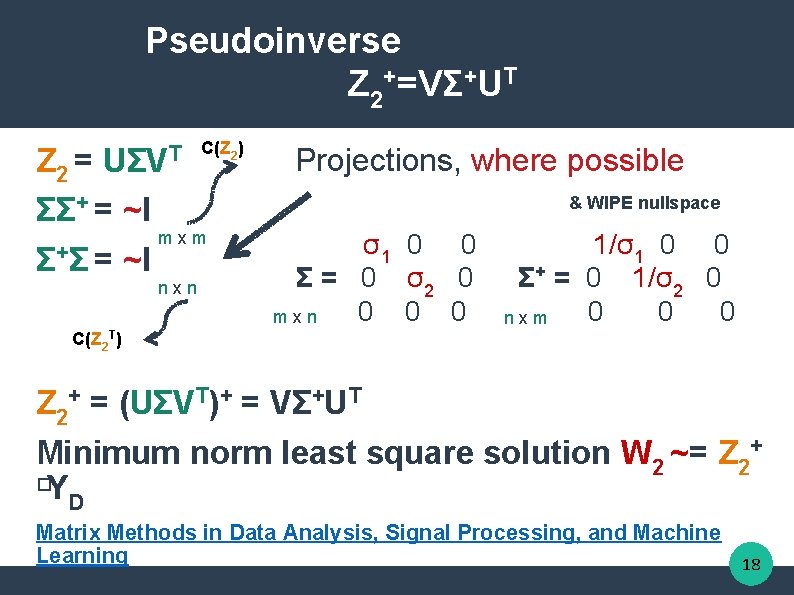
Pseudoinverse Z 2+=VΣ+UT Z 2 = UΣV ΣΣ+ = ~I Σ+ Σ = ~I T C(Z 2) Projections, where possible & WIPE nullspace mxm nxn σ1 0 0 Σ = 0 σ2 0 0 mxn 1/σ1 0 0 Σ+ = 0 1/σ2 0 0 nxm C(Z 2 T) Z 2+ = (UΣVT)+ = VΣ+UT Minimum norm least square solution W 2 ~= Z 2+ �Y D Matrix Methods in Data Analysis, Signal Processing, and Machine Learning 18