
Feature selection methods Isabelle Guyon isabelleclopinet com IPAM
Feature selection methods Isabelle Guyon isabelle@clopinet. com IPAM summer school on Mathematics in Brain Imaging. July 2008
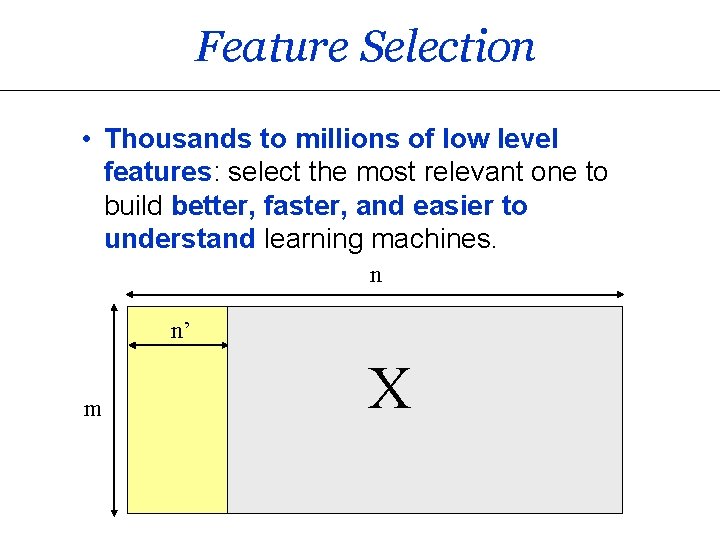
Feature Selection • Thousands to millions of low level features: select the most relevant one to build better, faster, and easier to understand learning machines. n n’ m X
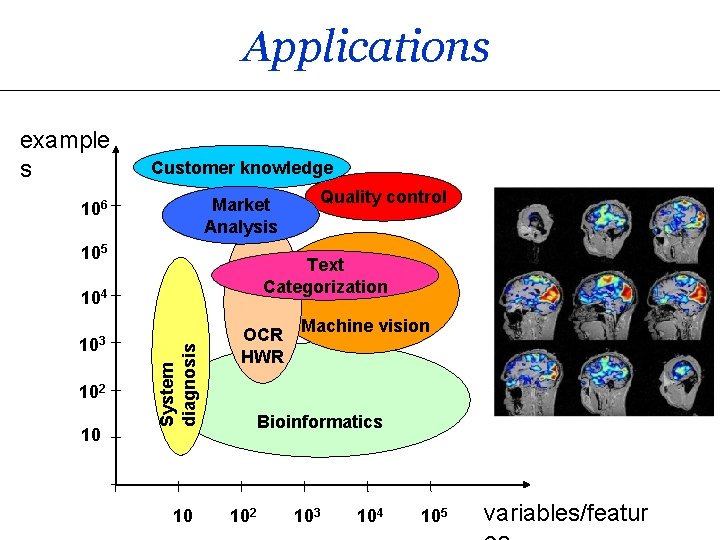
Applications example s Customer knowledge Market Analysis 106 105 Text Categorization 102 10 System diagnosis 104 103 Quality control 10 OCR HWR Machine vision Bioinformatics 102 103 104 105 variables/featur
Nomenclature • Univariate method: considers one variable (feature) at a time. • Multivariate method: considers subsets of variables (features) together. • Filter method: ranks features or feature subsets independently of the predictor (classifier). • Wrapper method: uses a classifier to assess features or feature subsets.
Univariate Filter Methods

Univariate feature ranking m- m+ P(Xi|Y=1) P(Xi|Y=-1) -1 xi s- s+ • Normally distributed classes, equal variance s 2 unknown; estimated from data as s 2 within. • Null hypothesis H 0: m+ = m • T statistic: If H 0 is true, t= (m+ - m-)/(swithin 1/m++1/m-) Student(m++m--2 d. f. )
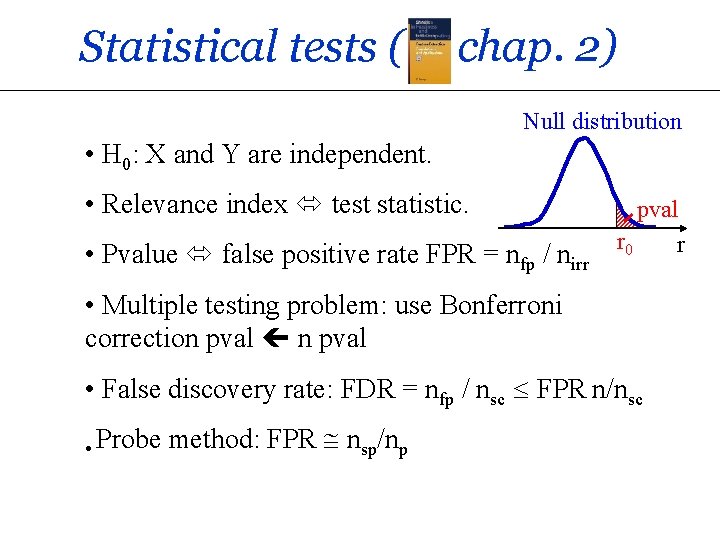
Statistical tests ( chap. 2) Null distribution • H 0: X and Y are independent. • Relevance index test statistic. • Pvalue false positive rate FPR = nfp / nirr pval r 0 r • Multiple testing problem: use Bonferroni correction pval • False discovery rate: FDR = nfp / nsc FPR n/nsc • Probe method: FPR nsp/np
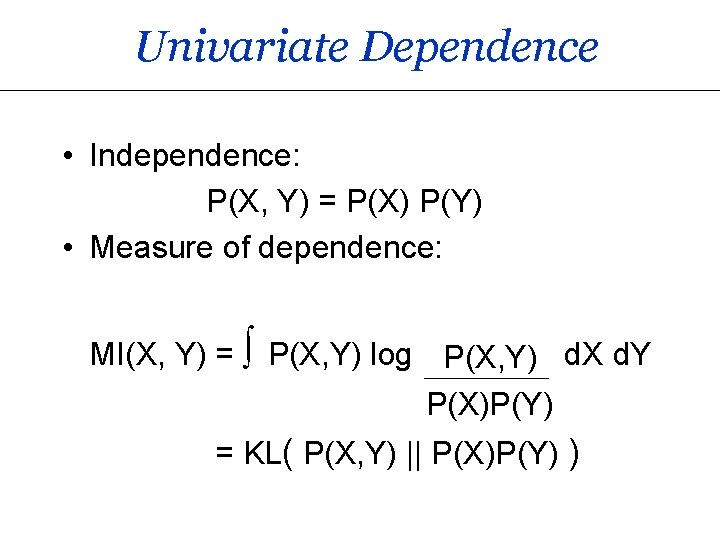
Univariate Dependence • Independence: P(X, Y) = P(X) P(Y) • Measure of dependence: MI(X, Y) = P(X, Y) log P(X, Y) d. X d. Y P(X)P(Y) = KL( P(X, Y) || P(X)P(Y) )
Other criteria ( chap. 3) A choice of feature selection ranking methods depending on the nature of: • the variables and the target (binary, categorical, continuous) • the problem (dependencies between variables, linear/nonlinear relationships between variables and target) • the available data (number of examples and number of variables, noise in data) • the available tabulated statistics.
Multivariate Methods
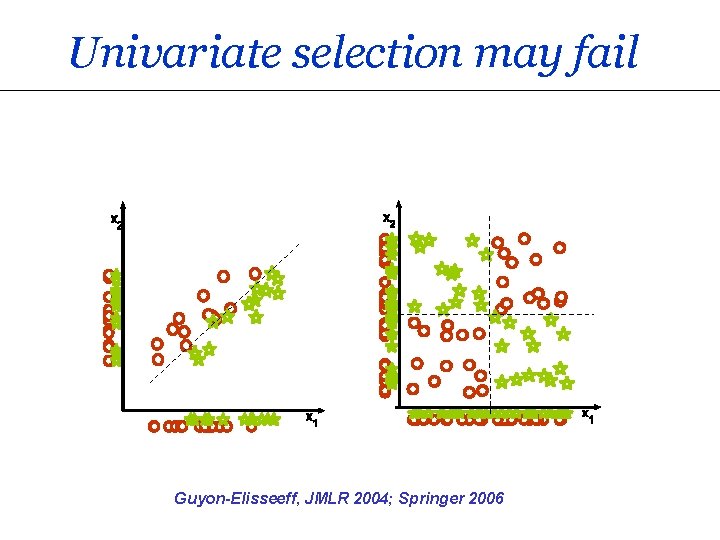
Univariate selection may fail Guyon-Elisseeff, JMLR 2004; Springer 2006
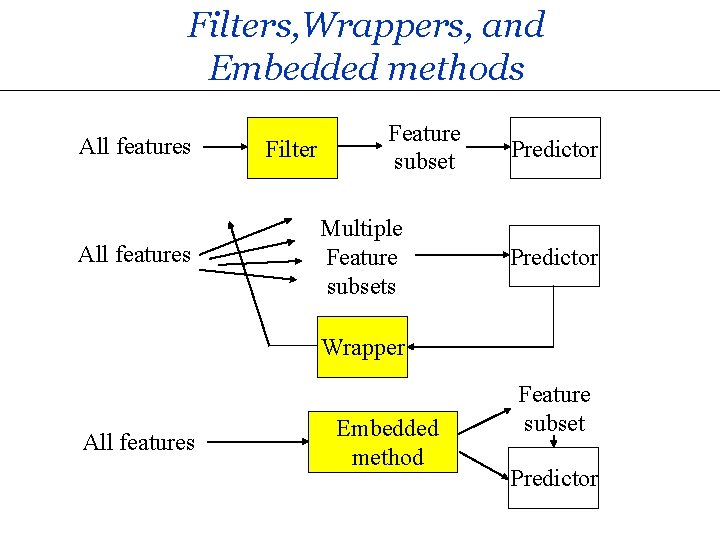
Filters, Wrappers, and Embedded methods All features Filter Feature subset Multiple Feature subsets Predictor Wrapper All features Embedded method Feature subset Predictor
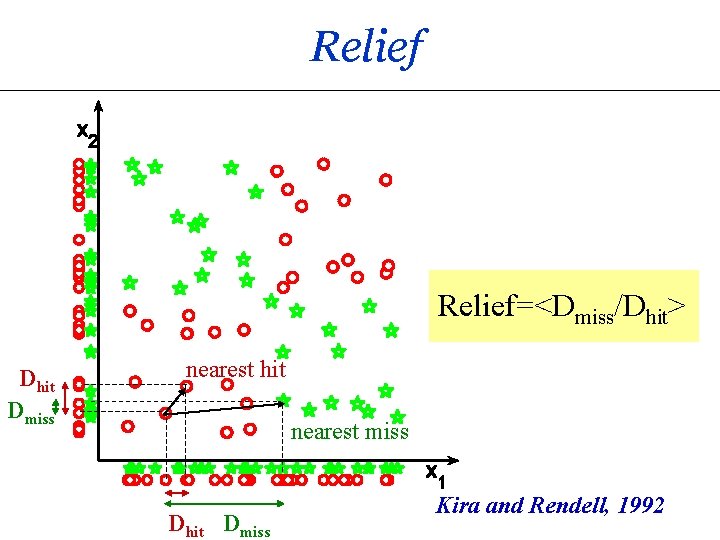
Relief=<Dmiss/Dhit> Dhit Dmiss nearest hit nearest miss Dhit Dmiss Kira and Rendell, 1992
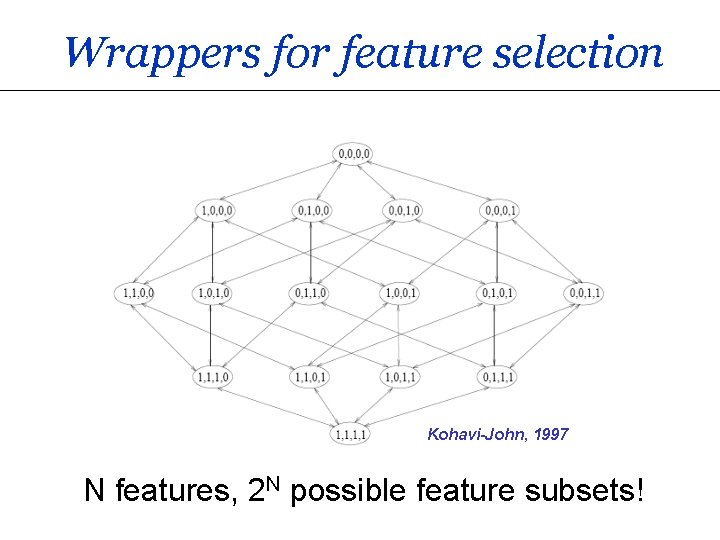
Wrappers for feature selection Kohavi-John, 1997 N features, 2 N possible feature subsets!
Search Strategies ( chap. 4) • • Exhaustive search. Simulated annealing, genetic algorithms. Beam search: keep k best n-k path at each step. g Greedy search: forward selection or backward elimination. • PTA(l, r): plus l , take away r – at each step, run SFS l times then SBS r times. • Floating search (SFFS and SBFS): One step of SFS (resp. SBS), then SBS (resp. SFS) as long as we find better subsets than those of the same size obtained so far. Any time, if a better subset of the same size was already found, switch abruptly.
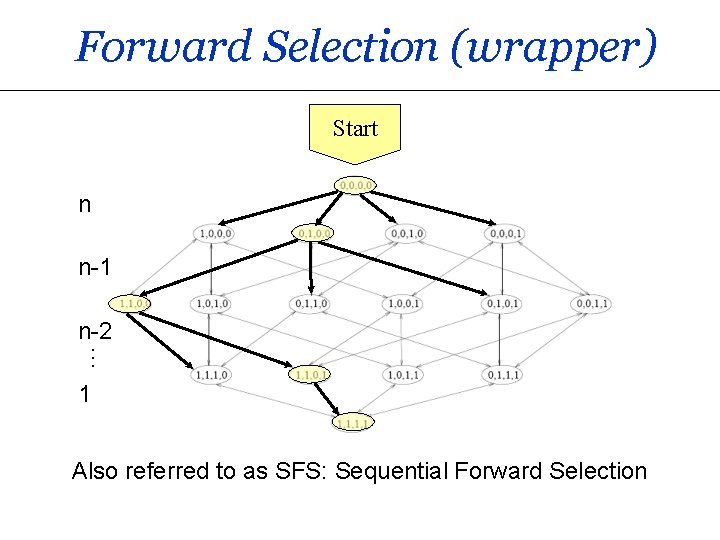
Forward Selection (wrapper) Start n n-1 n-2 … 1 Also referred to as SFS: Sequential Forward Selection
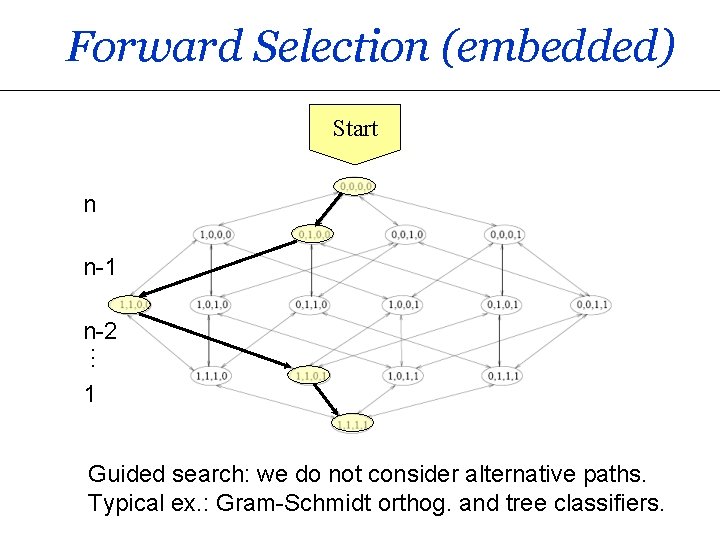
Forward Selection (embedded) Start n n-1 n-2 … 1 Guided search: we do not consider alternative paths. Typical ex. : Gram-Schmidt orthog. and tree classifiers.
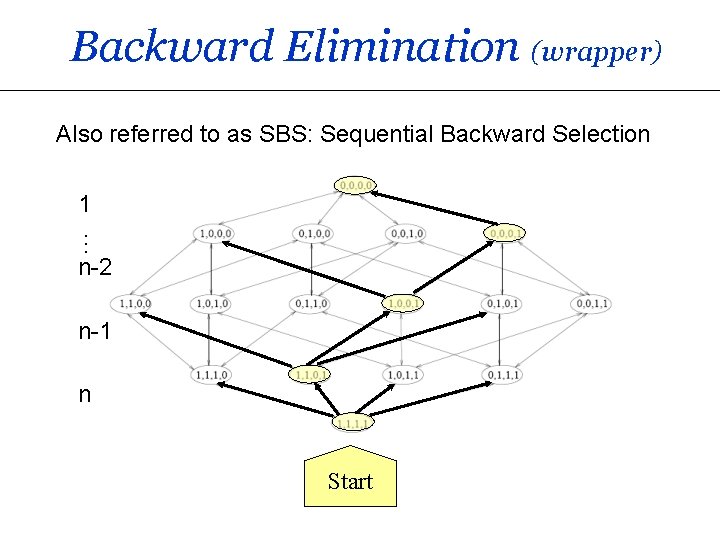
Backward Elimination (wrapper) Also referred to as SBS: Sequential Backward Selection 1 … n-2 n-1 n Start
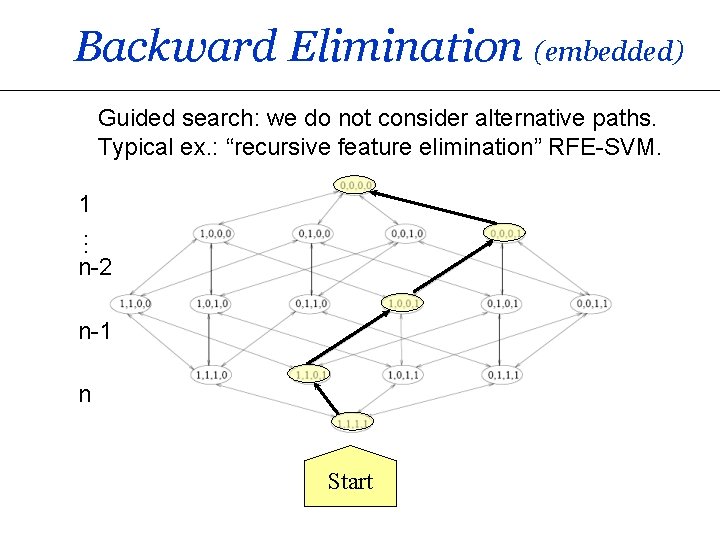
Backward Elimination (embedded) Guided search: we do not consider alternative paths. Typical ex. : “recursive feature elimination” RFE-SVM. 1 … n-2 n-1 n Start
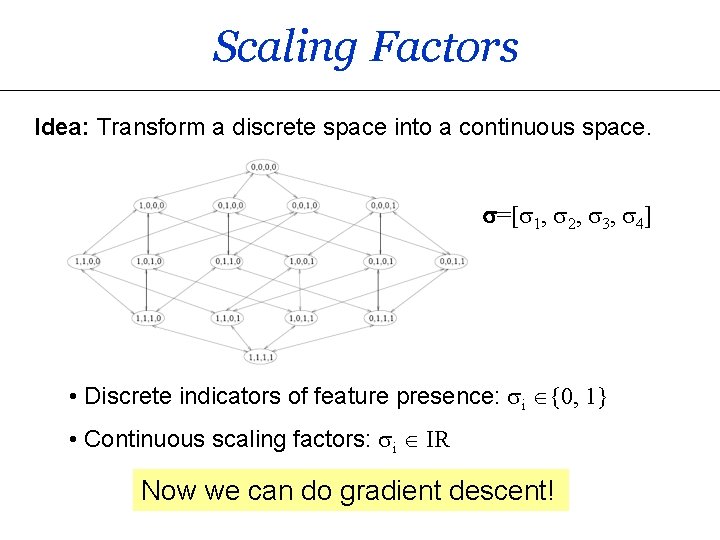
Scaling Factors Idea: Transform a discrete space into a continuous space. s=[s 1, s 2, s 3, s 4] • Discrete indicators of feature presence: si {0, 1} • Continuous scaling factors: si IR Now we can do gradient descent!
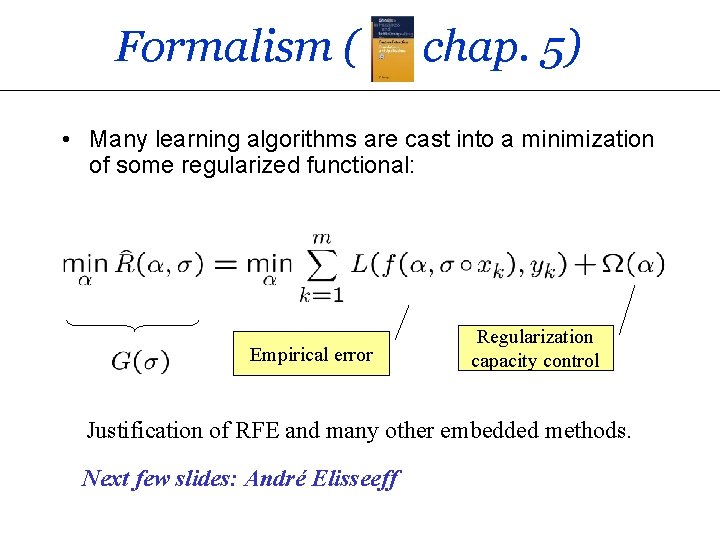
Formalism ( chap. 5) • Many learning algorithms are cast into a minimization of some regularized functional: Empirical error Regularization capacity control Justification of RFE and many other embedded methods. Next few slides: André Elisseeff
Embedded method • Embedded methods are a good inspiration to design new feature selection techniques for your own algorithms: – Find a functional that represents your prior knowledge about what a good model is. – Add the s weights into the functional and make sure it’s either differentiable or you can perform a sensitivity analysis efficiently – Optimize alternatively according to a and s – Use early stopping (validation set) or your own stopping criterion to stop and select the subset of features • Embedded methods are therefore not too far from wrapper techniques and can be extended to multiclass, regression, etc…
The l 1 SVM • A version of SVM where W(w)=||w||2 is replaced by the l 1 norm W(w)= i |wi| • Can be considered an embedded feature selection method: – Some weights will be drawn to zero (tend to remove redundant features) – Difference from the regular SVM where redundant features are included Bi et al 2003, Zhu et al, 2003
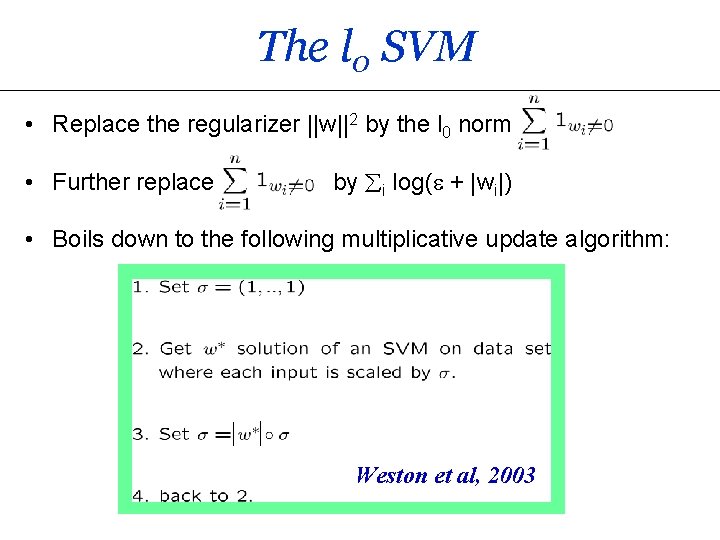
The l 0 SVM • Replace the regularizer ||w||2 by the l 0 norm • Further replace by i log( + |wi|) • Boils down to the following multiplicative update algorithm: Weston et al, 2003
Causality
What can go wrong? Guyon-Aliferis-Elisseeff, 2007
What can go wrong?
What can go wrong? X 2 Y Y X 1 X 2 X 1 Guyon-Aliferis-Elisseeff, 2007
http: //clopinet. com/causality

Wrapping up
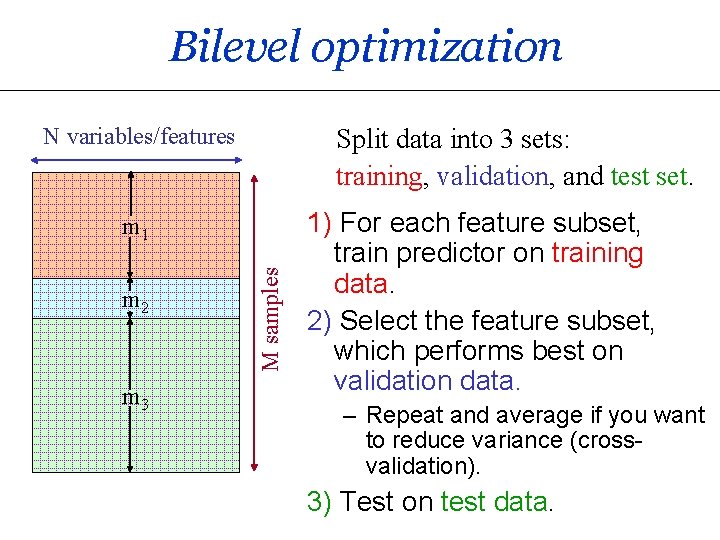
Bilevel optimization N variables/features Split data into 3 sets: training, validation, and test set. m 2 m 3 M samples m 1 1) For each feature subset, train predictor on training data. 2) Select the feature subset, which performs best on validation data. – Repeat and average if you want to reduce variance (crossvalidation). 3) Test on test data.
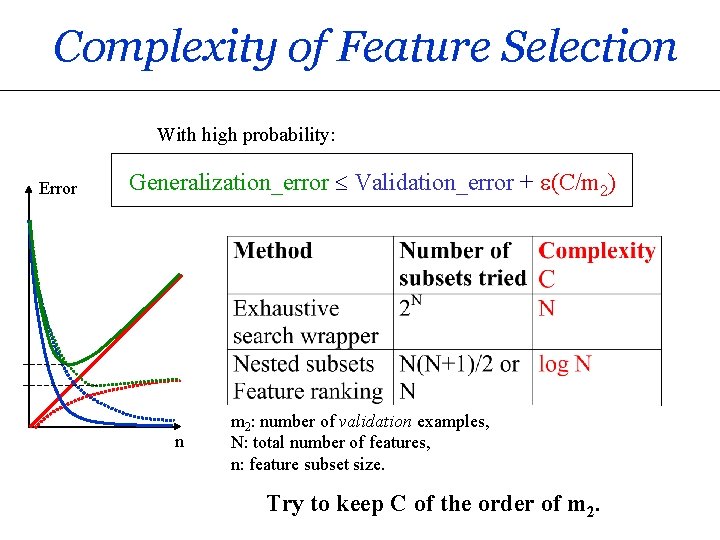
Complexity of Feature Selection With high probability: Error Generalization_error Validation_error + (C/m 2) n m 2: number of validation examples, N: total number of features, n: feature subset size. Try to keep C of the order of m 2.
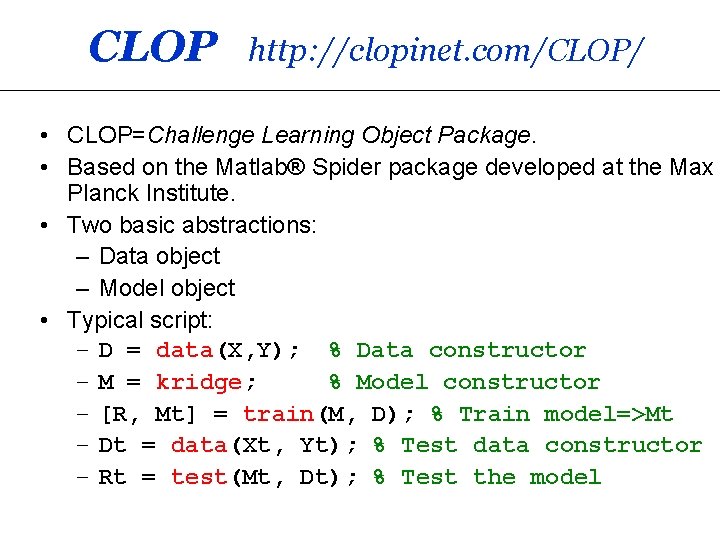
CLOP http: //clopinet. com/CLOP/ • CLOP=Challenge Learning Object Package. • Based on the Matlab® Spider package developed at the Max Planck Institute. • Two basic abstractions: – Data object – Model object • Typical script: – D = data(X, Y); % Data constructor – M = kridge; % Model constructor – [R, Mt] = train(M, D); % Train model=>Mt – Dt = data(Xt, Yt); % Test data constructor – Rt = test(Mt, Dt); % Test the model
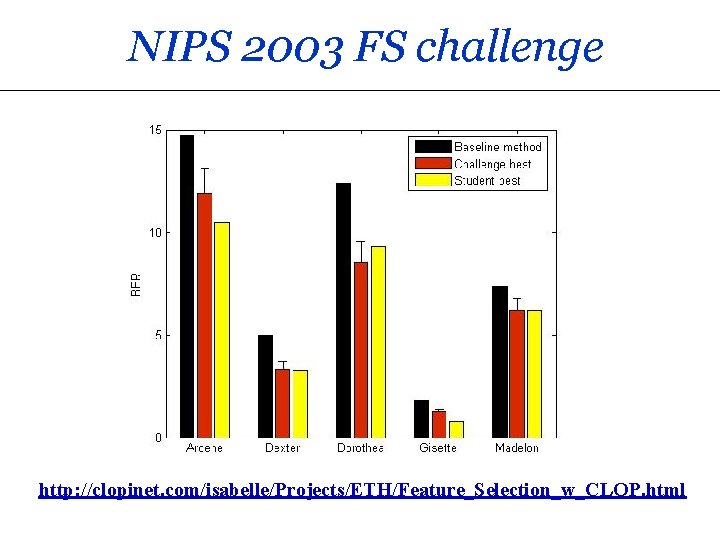
NIPS 2003 FS challenge http: //clopinet. com/isabelle/Projects/ETH/Feature_Selection_w_CLOP. html
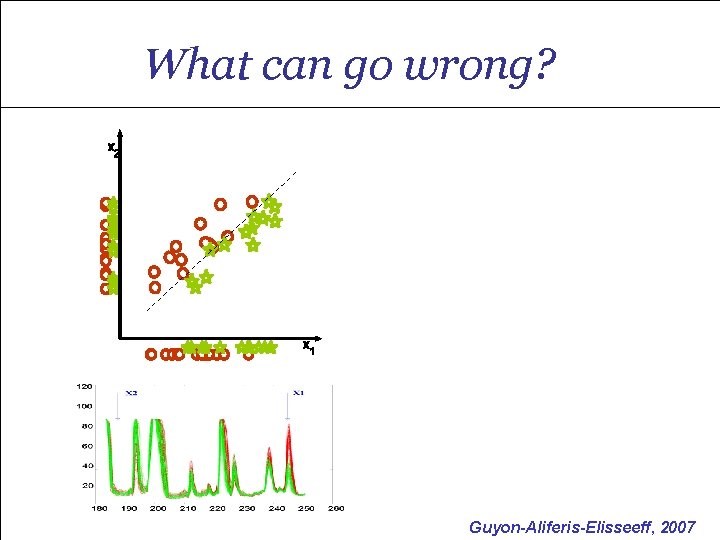
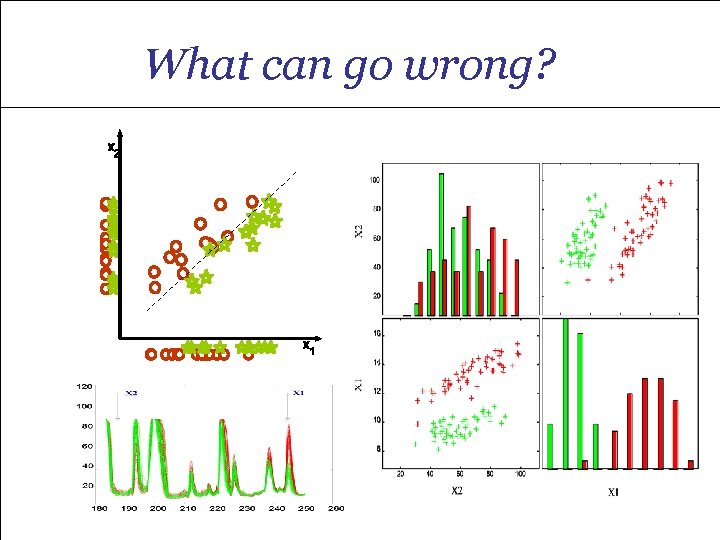
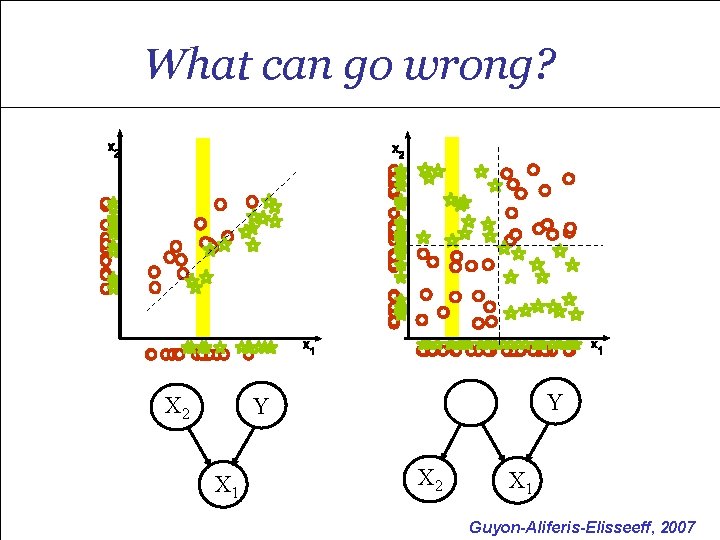
Conclusion • Feature selection focuses on uncovering subsets of variables X 1, X 2, … predictive of the target Y. • Multivariate feature selection is in principle more powerful than univariate feature selection, but not always in practice. • Taking a closer look at the type of dependencies in terms of causal relationships may help refining the notion of variable relevance.
Acknowledgements and references 1) Feature Extraction, Foundations and Applications I. Guyon et al, Eds. Springer, 2006. http: //clopinet. com/fextract-book 2) Causal feature selection I. Guyon, C. Aliferis, A. Elisseeff To appear in “Computational Methods of Feature Selection”, Huan Liu and Hiroshi Motoda Eds. , Chapman and Hall/CRC Press, 2007. http: //clopinet. com/causality
- Slides: 36