
Feature extraction from electroencephalographic records using EEGFrame framework
![Comparison to similar work Software Purpose EEGLab [4] Extensive Matlab toolbox for EEG analysis:](https://slidetodoc.com/presentation_image/23669fb4d32440bb24df6d8546b0f11d/image-13.jpg "Comparison to similar work Software Purpose EEGLab [4] Extensive Matlab toolbox for EEG analysis:")
- Slides: 15
Feature extraction from electroencephalographic records using EEGFrame framework Alan Jović, Lea Suć, Nikola Bogunović Faculty of Electrical Engineering and Computing, University of Zagreb Department of Electronics, Microelectronics, Computer and Intelligent Systems
Contents �Motivation �EEGFrame overview �EEG visualization �Features �Comparison to similar work �Conclusion 2/15
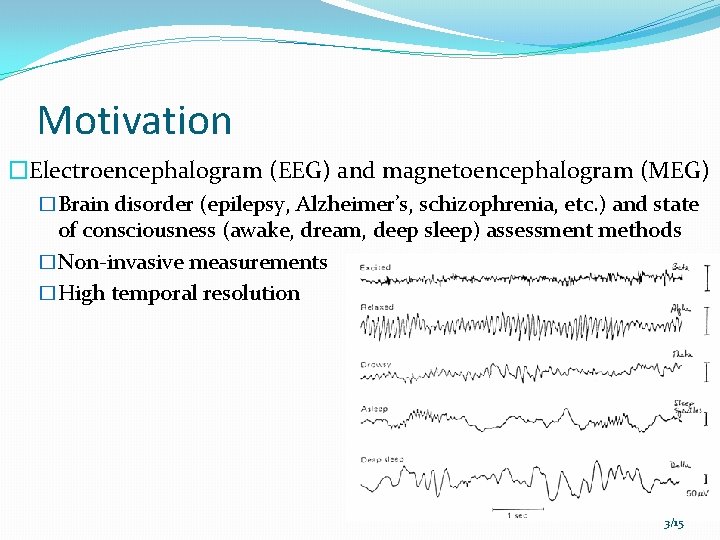
Motivation �Electroencephalogram (EEG) and magnetoencephalogram (MEG) �Brain disorder (epilepsy, Alzheimer’s, schizophrenia, etc. ) and state of consciousness (awake, dream, deep sleep) assessment methods �Non-invasive measurements �High temporal resolution 3/15
Motivation �Biomedical time-series (EEG/MEG, ECG, EMG, heart rate, etc. ) are inherently nonlinear, with periods of randomness and determinism �EEG in particular shows high degree of complexity when functioning normally �Complexity loss is pronounced in disorders such as epilepsy and Alzheimer’s �Non-stationarities (atypical behavior) occur often without warning �Noise often poses problems �Biodiversity complicates general model construction 4/15
Motivation �Which types of analyses? �Functional connectivity 1 �Complexity modelling 2 �Disorder detection/classification 3 �Disorder onset prediction 4 J. Sun, X. Hong, S. Tong, Phase Synchronization Analysis of EEG Signals: An Evaluation Based on Surrogate Tests, IEEE Trans Biomed Eng 59(8): 2254 -2263, 2012. 2 R. Hornero, D. Abásolo, J. Escudero, C. Gómez, Nonlinear analysis of electroencephalogram and magnetoencephalogram recordings in patients with Alzheimer’s disease, Phil. Trans. R. Soc. A 367: 314 -336, 2009. 3 Y. Song, J. Zhang, Automatic recognition of epileptic EEG patterns via Extreme Learning Machine and multiresolution feature extraction, Expert Systems with Applications 40: 5477 -5489, 2013. 4 F. Mormann, C. E. Elger, K. Lehnertz, Seizure anticipation: from algorithms to clinical practice. Curr. Opin. Neurol. 19: 187, 2006. 1 5/15
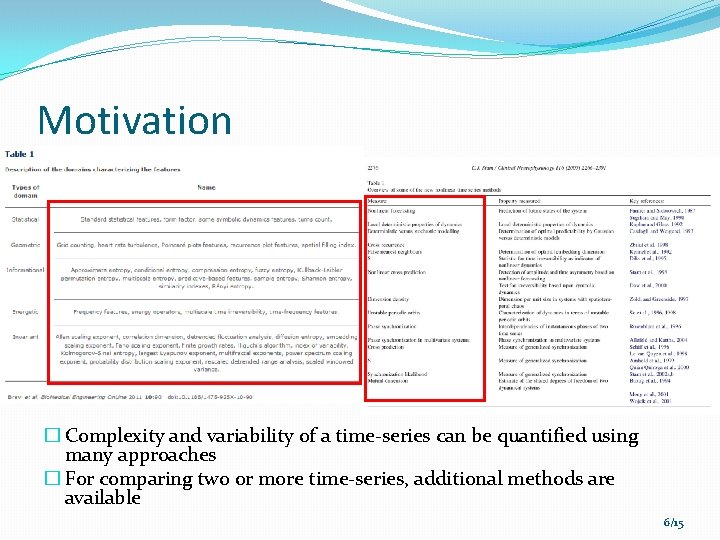
Motivation � Complexity and variability of a time-series can be quantified using many approaches � For comparing two or more time-series, additional methods are available 6/15
Motivation �Very few open-source, freely available frameworks for EEG/MEG time-series modelling currently available �Not many open-access EEG/MEG records databases available, e. g. Physio. Net �Plethora of possibly applicable features ÞDifficult repeatability and reliable comparison of scientific work in this domain 7/15
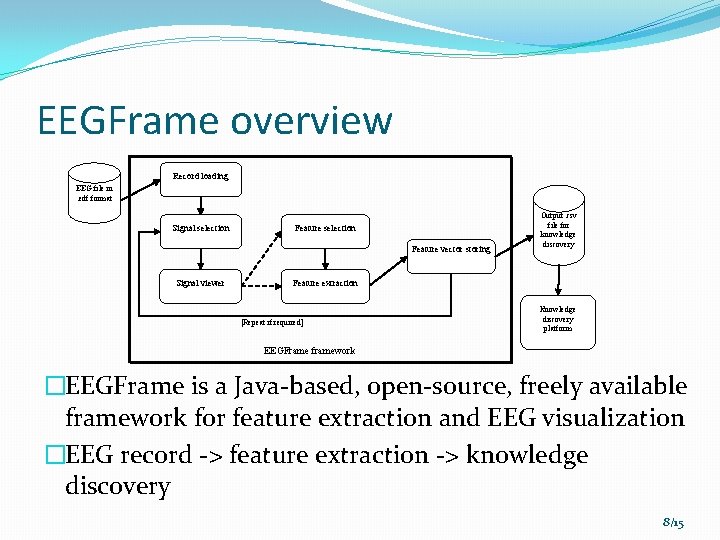
EEGFrame overview Record loading EEG file in. edf format Signal selection Feature vector storing Signal viewer Output. csv file for knowledge discovery Feature extraction [Repeat if required] Knowledge discovery platform EEGFrame framework �EEGFrame is a Java-based, open-source, freely available framework for feature extraction and EEG visualization �EEG record -> feature extraction -> knowledge discovery 8/15
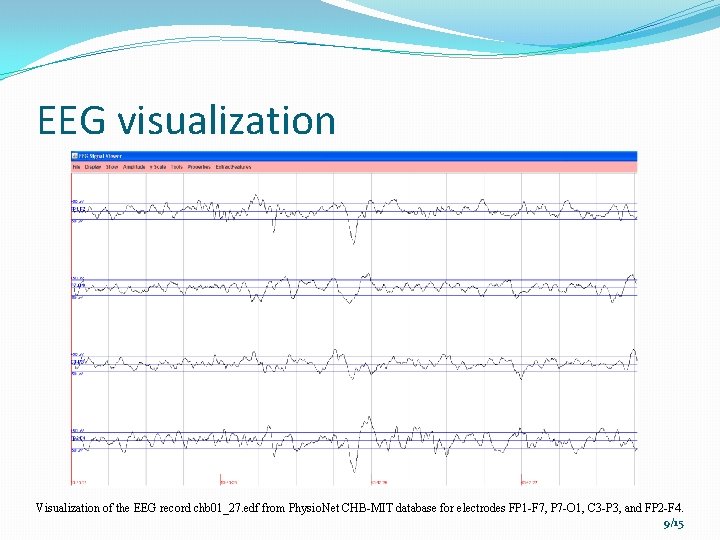
EEG visualization Visualization of the EEG record chb 01_27. edf from Physio. Net CHB-MIT database for electrodes FP 1 -F 7, P 7 -O 1, C 3 -P 3, and FP 2 -F 4. 9/15
Implemented features �Univariate methods, mostly derived from HRVFrame* �Variability and complexity description methods �Statistical, geometric, frequency, time-frequency, nonlinear features �Adapted and tested for EEG analysis �Bivariate and multivariate methods �Aimed at multiple EEG trails analysis (e. g. mutual information, synchronization likelihood) �The goal is to quantify both the intensity and direction of two or more time-series correspondence �A topic of recent research * A. Jović, N. Bogunović, HRVFrame: Java-Based Framework for Feature Extraction from Cardiac Rhythm, Lecture Notes in Artificial Intelligence. 6747 (2011) ; 96 -100. 10/15
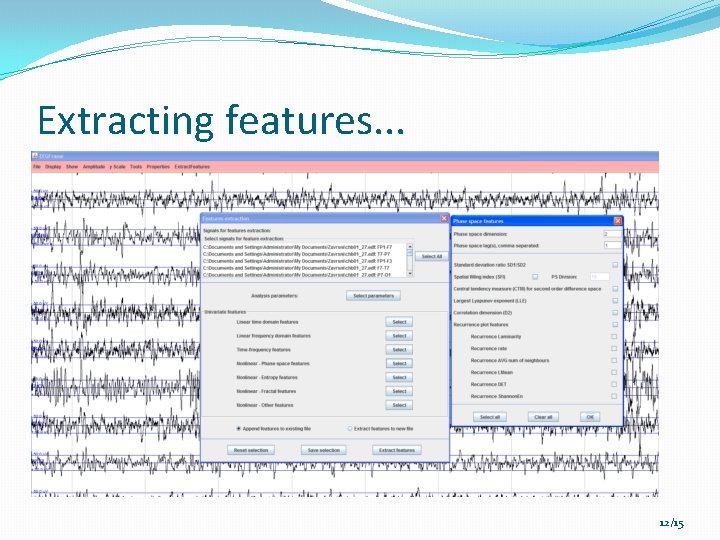
Implemented features �EEGFrame is divided into several packages �Around 50 implemented features in total at the moment, most of them implemented in their own Java class �The focus is on nonlinear features (more than 20 methods: entropy, phase-space, fractal, multivariate, other) � The GUI supports selection of specific features and their parameters (if any) for feature vectors elicitation 11/15
Extracting features. . . 12/15
Comparison to similar work Software Purpose EEGLab [4] Extensive Matlab toolbox for EEG analysis: visualization, 3 D brain modelling, feature extraction, several plugins (NFT, ERICA, BCILAB. . . ) Bio. Sig [5] Implementation language Type Implemented features Matlab Embedded Time/frequency/timefrequency/independent component transformations and features / unknown total number of features Reading and writing routines for many biomedical time-series data formats; EEG preprocessing, visualization, feature extraction (multivariate autoregressive modeling) and classification (via Matlab/Octave) C/C++, Matlab (or Octave) Some functions standalone, mostly embedded Time/frequency/time-frequency transformations and features, unknown total number of features Py. EEG [6] Feature extraction framework, feature vector output for data mining Python Embedded Frequency/nonlinear features, currently 21 features in total EEGFrame Signal inspection, feature extraction framework, handles. EDF input, feature vector output for data mining Java Stand-alone or embedded Time/frequency/timefrequency/nonlinear features, currently 49 features in total 13/15
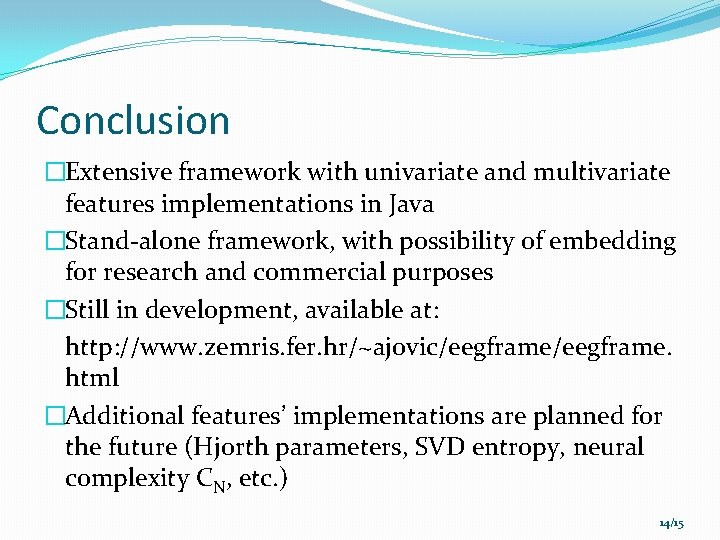
Conclusion �Extensive framework with univariate and multivariate features implementations in Java �Stand-alone framework, with possibility of embedding for research and commercial purposes �Still in development, available at: http: //www. zemris. fer. hr/~ajovic/eegframe. html �Additional features’ implementations are planned for the future (Hjorth parameters, SVD entropy, neural complexity CN, etc. ) 14/15
Thank you! 15/15