
Feature Driven Development Eric Nickell Overview History What
![References [1] Palmer, Stephen. "FDD History. " N. p. , 2010. Web. 27 Mar](https://slidetodoc.com/presentation_image_h/f125e6f5ab5d5924c6cd07e48dfaa8a1/image-28.jpg "References [1] Palmer, Stephen. \"FDD History. \" N. p. , 2010. Web. 27 Mar")
- Slides: 28
Feature Driven Development Eric Nickell
Overview History What is Feature Driven Development? What is a Feature? Feature Driven Development Roles Feature Driven Development Process ◦ Class Ownership ◦ Mandated Code Inspections Reporting Summary References
History Original Creator: Jeff De Luca ◦ Singapore in late 1997 FDD evolved from an actual project ◦ ◦ Bank Loan Automation Luca was Project manager 50 member developer team Peter Coad : Chief Architect 1990’s object-oriented analysis and design expert
What is Feature Driven Development? FDD is an agile software development process FDD uses a short-iteration model FDD combines key advantages of other popular agile approaches along with other industry-recognized best practices FDD was created to easily scale to much larger projects and teams
What is a Feature? Definition: small function expressed in clientvalued terms FDD’s form of a customer requirement
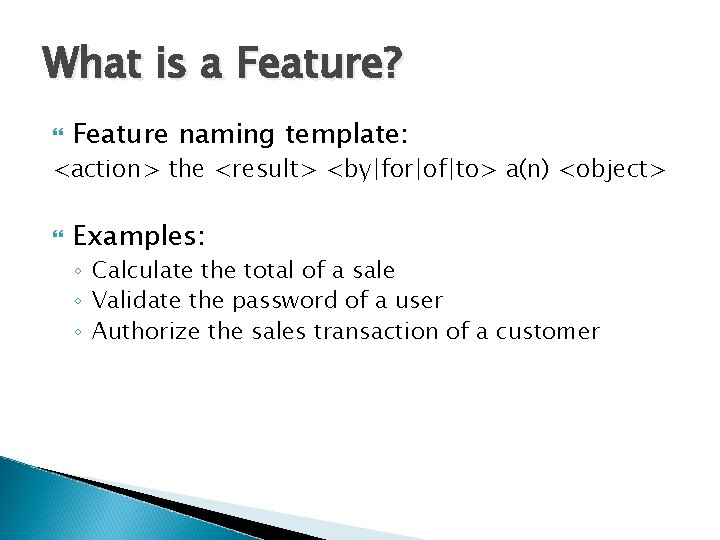
What is a Feature? Feature naming template: <action> the <result> <by|for|of|to> a(n) <object> Examples: ◦ Calculate the total of a sale ◦ Validate the password of a user ◦ Authorize the sales transaction of a customer
What is a Feature? Features are to be “small” in the sense they will take no more than two weeks to complete Features that appear to take longer are to be broken up into a set of smaller features Note: Two weeks is the maximum, most features take far less time (1 - 5 days)
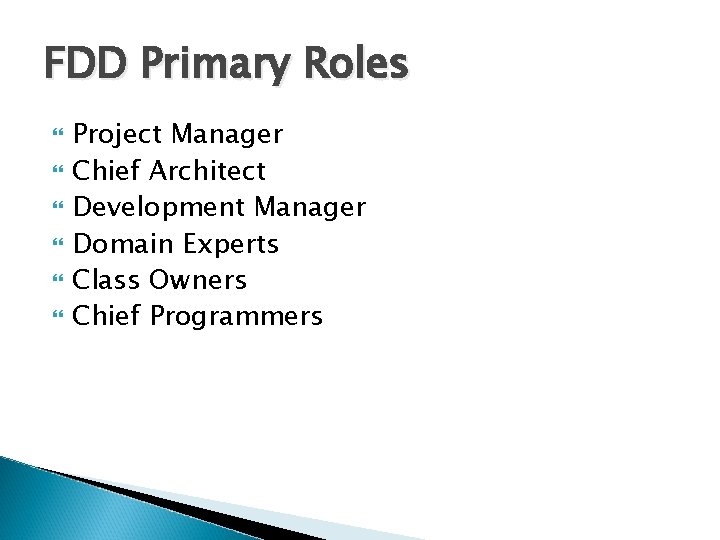
FDD Primary Roles Project Manager Chief Architect Development Manager Domain Experts Class Owners Chief Programmers
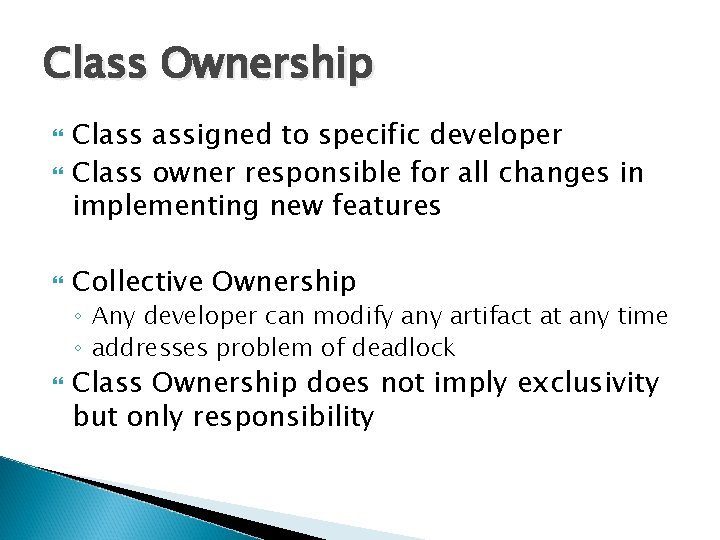
Class Ownership Class assigned to specific developer Class owner responsible for all changes in implementing new features Collective Ownership ◦ Any developer can modify any artifact at any time ◦ addresses problem of deadlock Class Ownership does not imply exclusivity but only responsibility
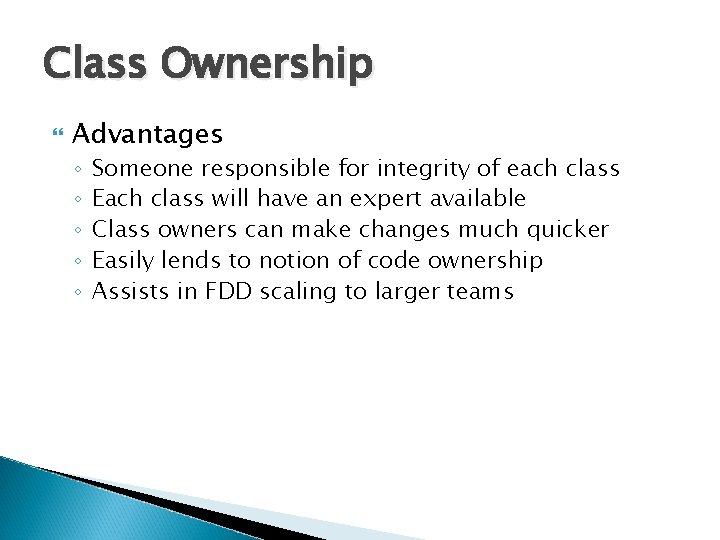
Class Ownership Advantages ◦ ◦ ◦ Someone responsible for integrity of each class Each class will have an expert available Class owners can make changes much quicker Easily lends to notion of code ownership Assists in FDD scaling to larger teams
FDD Primary Roles Project Manager Chief Architect Development Manager Domain Experts Class Owners Chief Programmers
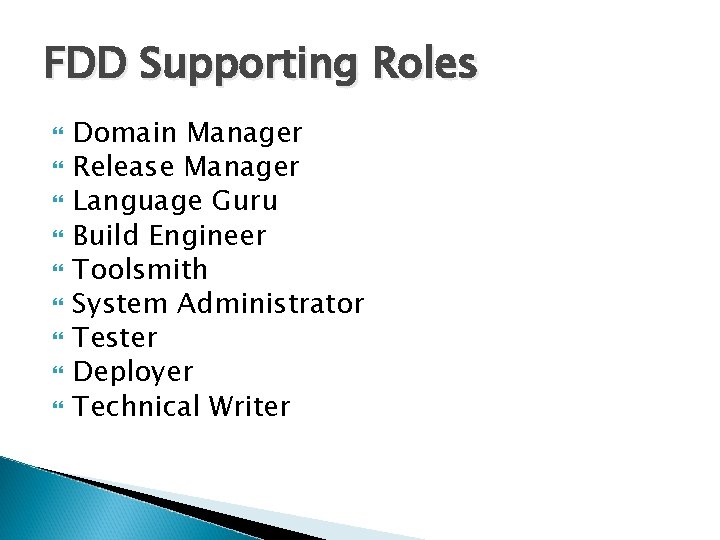
FDD Supporting Roles Domain Manager Release Manager Language Guru Build Engineer Toolsmith System Administrator Tester Deployer Technical Writer
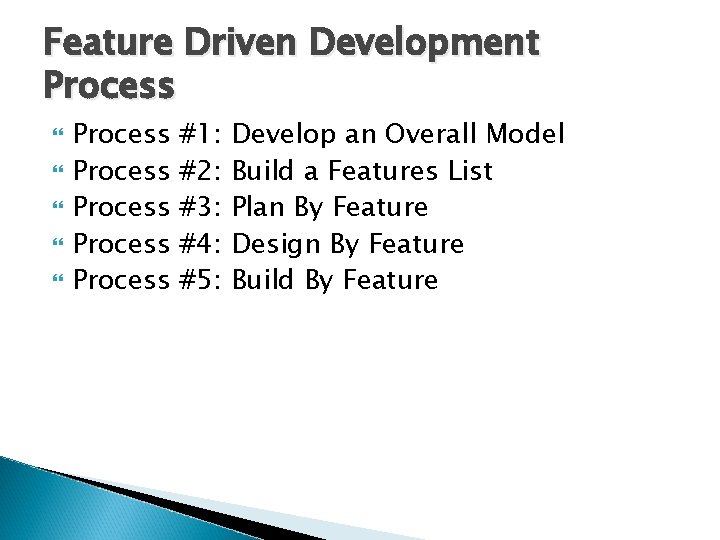
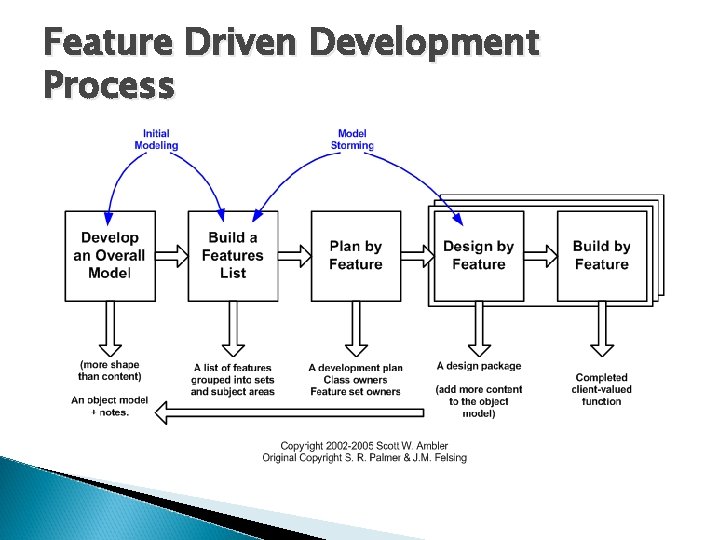
Feature Driven Development Process Process #1: #2: #3: #4: #5: Develop an Overall Model Build a Features List Plan By Feature Design By Feature Build By Feature
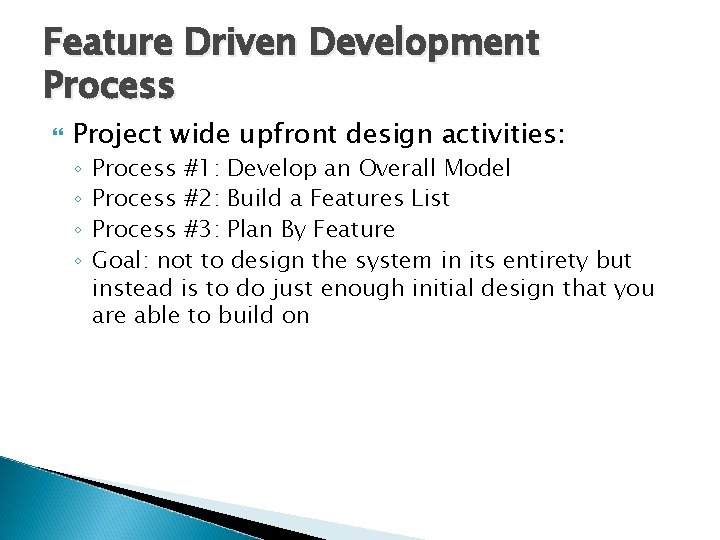
Feature Driven Development Process Project wide upfront design activities: ◦ ◦ Process #1: Develop an Overall Model Process #2: Build a Features List Process #3: Plan By Feature Goal: not to design the system in its entirety but instead is to do just enough initial design that you are able to build on
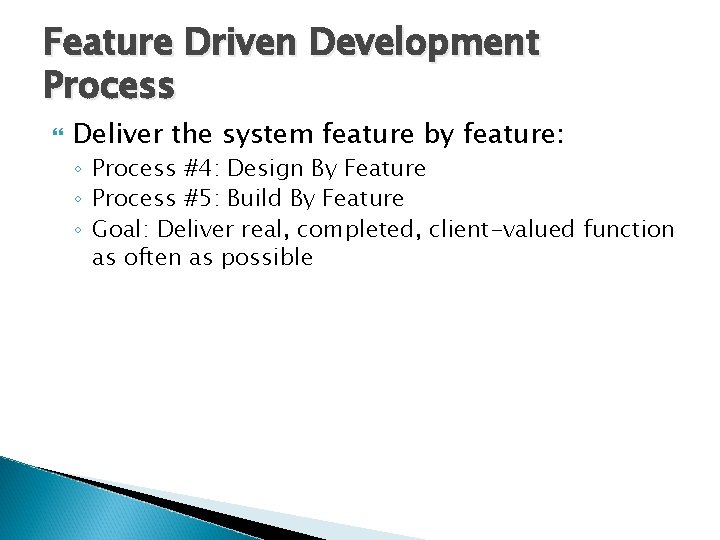
Feature Driven Development Process Deliver the system feature by feature: ◦ Process #4: Design By Feature ◦ Process #5: Build By Feature ◦ Goal: Deliver real, completed, client-valued function as often as possible
Feature Driven Development Process
Process #1: Develop an Overall Model Form a modeling team Domain walk-through Build High-level object model Record Notes Goal - for team members to gain a good, shared understanding of the problem domain and build a foundation
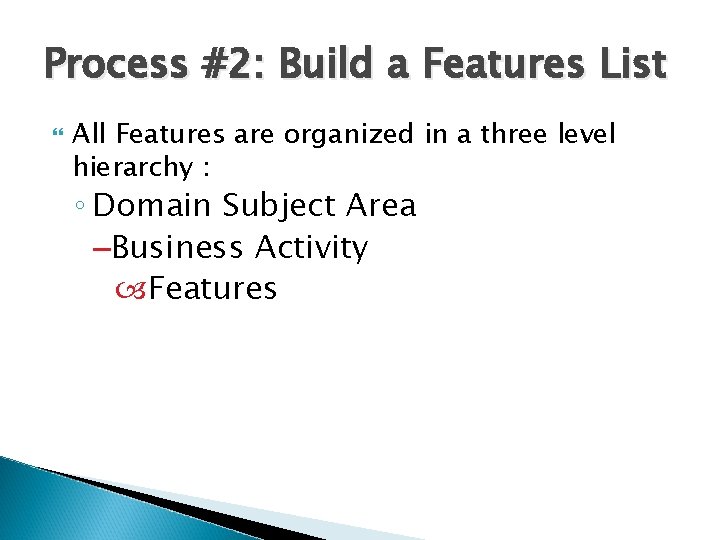
Process #2: Build a Features List All Features are organized in a three level hierarchy : ◦ Domain Subject Area –Business Activity Features
Process #3: Plan By Feature Construct initial schedule ◦ Formed on level of individual features Prioritize by business value Also consider dependencies, difficulty, and risks Assign responsibilities to team members ◦ Determine Class Owners ◦ Assign feature sets to chief programmers
Process #4: Design By Feature Form Feature Teams Team members collaborate on the full low level analysis and design Certain features may require teams to bring in domain experts Teams need to update the model artifact to support their changes
Feature Teams Chief Programmers pick teams based on the current feature in development Chief Programmers lead picked team Usually 3 to 5 people Upon completion of the current feature the team disbands Each team will concurrently work on their own independent iteration Possible to be on multiple teams at once
Process #4: Design By Feature Form Feature Teams Team members collaborate on the full low level analysis and design Certain features may require teams to bring in domain experts Teams need to update the model artifact to support their changes
Process #5: Build By Feature Implement designed feature Test feature ◦ Unit-level ◦ Feature-level Mandated Code Inspections Integrate with regular build
Mandated Code Inspections Two Main Reasons ◦ Research has shown that when done properly, inspections find more bugs as well as different types of bugs than any other form of testing ◦ Great learning experience
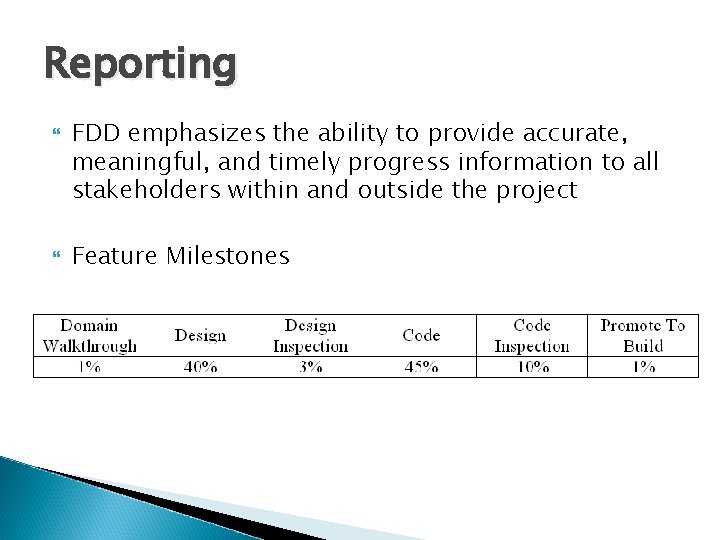
Reporting FDD emphasizes the ability to provide accurate, meaningful, and timely progress information to all stakeholders within and outside the project Feature Milestones
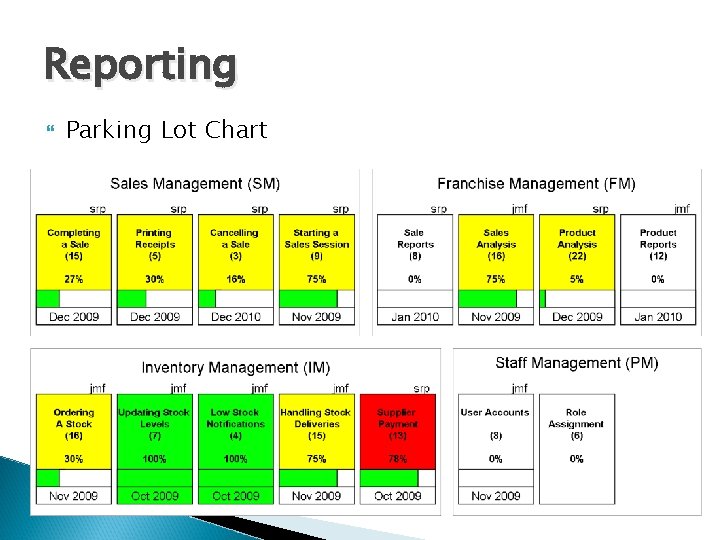
Reporting Parking Lot Chart
Summary FDD combines many of the best practices of other agile models FDD was initially created for and is more geared towards large project teams FDD puts less focus on initial design and quickly gets to the point where the team can deliver new functionality to the project feature by feature
References [1] Palmer, Stephen. "FDD History. " N. p. , 2010. Web. 27 Mar 2010. <http: //www. step 10. com/Software. Process/Feature. Driven. Development/FDDHistory. html>. [2] Ambler, Scott. "Feature Driven Development (FDD) and Agile Modeling. " Agile Modeling. N. p. , 2005 -2009. Web. 27 Mar 2010. <http: //www. agilemodeling. com/essays/fdd. htm>. [3] Palmer, Stephen. "An Introduction to Feature-Driven Development. " DZone. N. p. , 11/20/2009. Web. 27 Mar 2010. <http: //agile. dzone. com/articles/introduction-feature-driven>. [4] Palmer, Stephen. "An Introduction to Feature-Driven Development – Part 2. " DZone. N. p. , 11/20/2009. Web. 27 Mar 2010. <http: //java. dzone. com/articles/introduction-feature-driven-2>. [5] De Luca, Jeff. "The Latest FDD Processes. " Nebulon. N. p. , n. d. Web. 27 Mar 2010. <http: //www. nebulon. com/articles/fdd/download/fddprocesses. USLetter. pdf>. [6] Palmer, Stephen. "FDD: People. " N. p. , 2010. Web. 27 Mar 2010. <http: //www. step 10. com/Software. Process/Feature. Driven. Development/FDDPeople. html>.