
Feasibility Study Process Detail 6 th May 2010

Feasibility Study – Process Detail 6 th May 2010
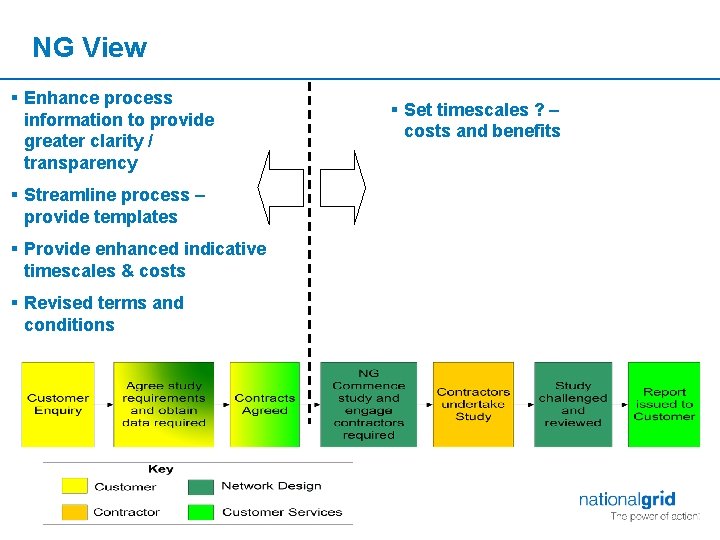
NG View § Enhance process information to provide greater clarity / transparency § Streamline process – provide templates § Provide enhanced indicative timescales & costs § Revised terms and conditions § Set timescales ? – costs and benefits
Contents ® Why undertake any analysis? ® UK’s gas supply and demand requirements ® Commercial and operational drivers ® Legislation ® What is transient analysis? ® Study Categories and associated timescales and costs ® Uncomplicated ® Intermediate ® Complex ® Project process ® Transient analysis case study
Why undertake any analysis? ® In operating the NTS pipeline system National Grid NTS has to satisfy a wide range of the legal, regulatory, gas supply, commercial and operational requirements ® Large and rapid changes in operational parameters (offtake rate, ramp rate, pressure, etc. ) due to supply variations, demand changes, compressor operations etc. may impact on the operation of the NTS pipeline systems and National Grid assets: ® Affect the efficient and effective operation of the pipeline system lead to transient flow variations ® Trigger safety devices and cut off supply at the installation ® Cause damage to National Grid equipment at installations such as pressure regulators, filters and orifice plate meters ® Adversely affect other Users of the system (entry and exit points) in the vicinity
UK’s gas supply and demand requirements ® The NTS pipeline network is continually expanding to meet the UK’s gas supply and demand requirements ® Increasing number of supply and demand scenarios have to be considered and accommodated ® Flows through the pipeline network were historically North to South - now it has to be capable of flows East to West and West to East as well ® Increasing number of new entry points, storage sites and large exit connections (e. g. power stations)
Commercial and operational requirements ® Power station operation has changed over the years due to changes in the electricity commercial regime (i. e. the New Electricity Trading Arrangements (NETA) etc. ) ® Many power stations were originally designed for “base load” operation but now operate in other modes (e. g. “ 2 shifting” etc. ) ® Power station technology has developed over the years to be more efficient (increased flow requirement) and have greater flexibility ® As a result Customers are requesting changes to operating requirements to remain competitive
Legislation ® Health and Safety at Work etc. Act 1974 ® Applies to all persons involved with work activities, including employers, the self employed, employees, designers, manufacturers, suppliers etc. as well as the owner of premises ® Places general duties on such people to ensure, so far as is reasonably practicable, the health, safety and welfare of employees and the health and safety of other persons such as members of the public who may be affected by the work activity ® Pipeline Safety Regulations (PSR) 1996 ® Regulation 5 covers “Design of a pipeline” and National Grid are required to ensure that the design of a pipeline or any modification to it, takes into account the operating regime for the pipeline and the conditions of the fluid to be conveyed ® Pressure Systems (Safety) Regulations (PSSR) 2000 ® Imposes duties on designers, manufacturers etc. to ensure pressure systems are fit for purpose, so as to prevent “danger” (e. g. Regulation 4) ® Responsibility on National Grid to ensure Safe Operating Limits (SOLs) of our equipment and the Customer’s are not exceeded

Pressure Systems (Safety) Regulations 2000 ® The Approved Code Of Practice (ACOP) issued by the HSE (publication L 122) provides further information on Regulation 4 which covers “Design and construction” ® Paragraph 58 states: ® “The designer, manufacturer, importer or supplier should consider and take due account of the following, where applicable: (c) all extreme operating conditions including start-up, shutdown and reasonably foreseeable fault or emergency conditions; (e) any foreseeable changes to the design conditions; (g) protection against system failure, using suitable measuring, control and protective devices as appropriate; ” ® Paragraph 61 goes onto state: ® “Account should be taken of the most onerous combination of temperature, pressure and other relevant parameters to which the equipment may be subjected under reasonably foreseeable circumstances. These should include the conditions which will exist during start-up, shutdown and stand-by operation. ”
What is transient analysis? ® The NTS pipeline network does not operate under “steady state” conditions ® Detailed analysis of the dynamic behaviour of the pipeline network and the facility needs to be undertaken to ensure the National Grid equipment and associated pipeline systems (providing the supply) can continue to operate safely ® The two main operational scenarios which could produce undesirable transient effects in the pipeline network are: 1. During start-up (i. e. commissioning or normal start-up), when the load starts up against low pressure conditions in the pipeline/pipework system providing the supply 2. During shutdown of the load in response to an emergency situation
Operating regimes: Start-up ® Start-up - when a large load (such as a power station) is brought into operation, the sudden flow demand can cause the supply pressure to reduce to an unacceptable level for a short period at the point of connection on the NTS/inlet to the installation supplying the load ® Equipment on National Grid installations needs to be considered to ensure they can respond at the required speed and to ensure they are not damaged
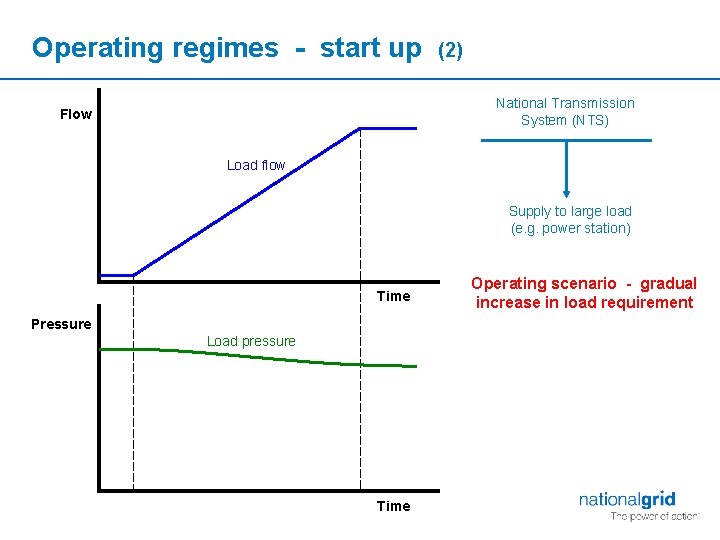
Operating regimes - start up (2) National Transmission System (NTS) Flow Load flow Supply to large load (e. g. power station) Time Pressure Load pressure Time Operating scenario - gradual increase in load requirement
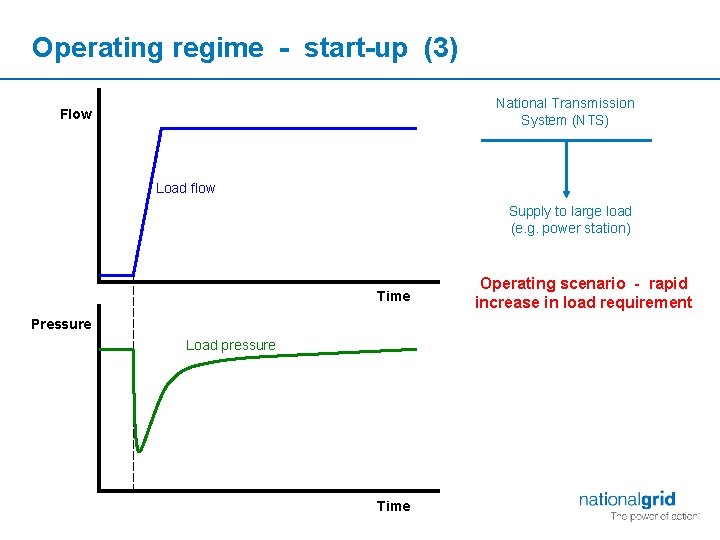
Operating regime - start-up (3) National Transmission System (NTS) Flow Load flow Supply to large load (e. g. power station) Time Pressure Load pressure Time Operating scenario - rapid increase in load requirement
Operating regimes - Shutdown ® Shutdown - Under a fault condition the load could be required to shutdown quickly with rapid load shedding and this can occur in fractions of a second ® This event can pressurise the supply pipework/pipeline to an unacceptable level for a short period due to the “pressure wave” which propagates back through the supply pipework
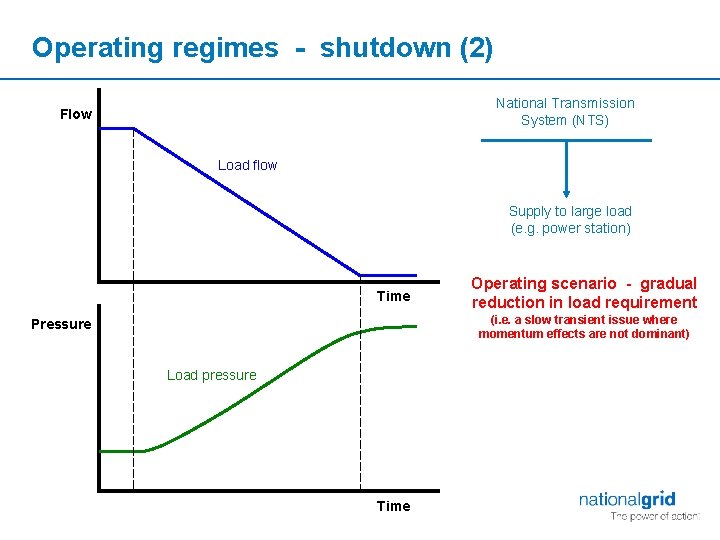
Operating regimes - shutdown (2) National Transmission System (NTS) Flow Load flow Supply to large load (e. g. power station) Time Operating scenario - gradual reduction in load requirement (i. e. a slow transient issue where momentum effects are not dominant) Pressure Load pressure Time
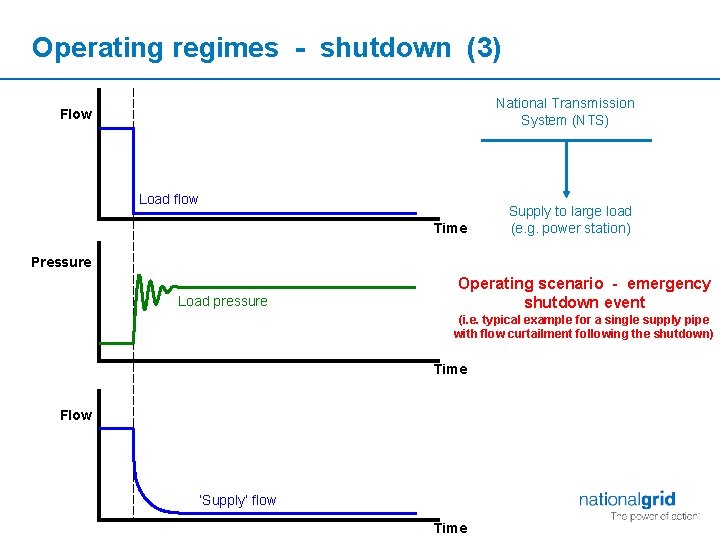
Operating regimes - shutdown (3) National Transmission System (NTS) Flow Load flow Time Supply to large load (e. g. power station) Pressure Load pressure Operating scenario - emergency shutdown event (i. e. typical example for a single supply pipe with flow curtailment following the shutdown) Time Flow ‘Supply’ flow Time
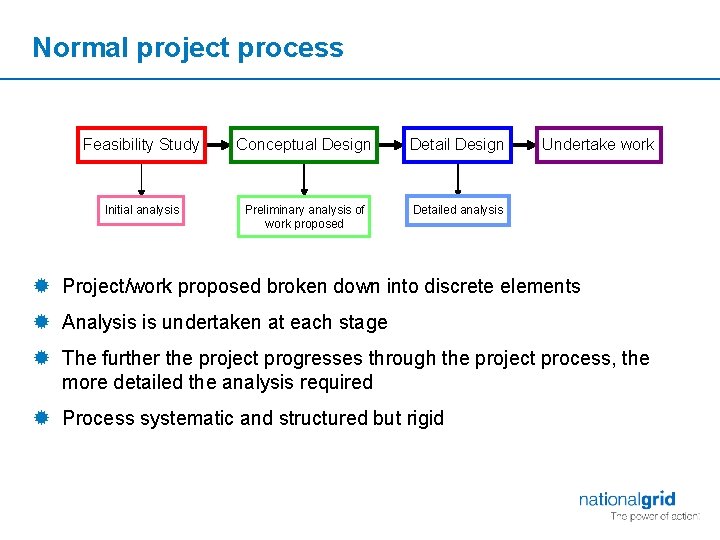
Normal project process Feasibility Study Conceptual Design Detail Design Initial analysis Preliminary analysis of work proposed Detailed analysis Undertake work ® Project/work proposed broken down into discrete elements ® Analysis is undertaken at each stage ® The further the project progresses through the project process, the more detailed the analysis required ® Process systematic and structured but rigid
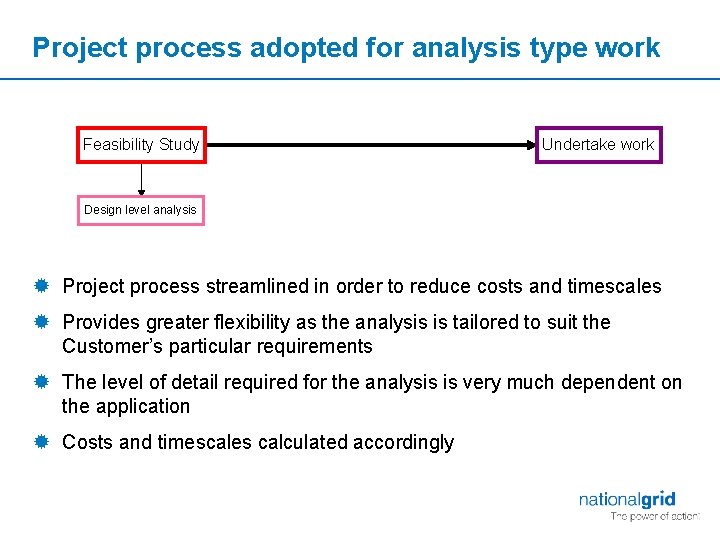
Project process adopted for analysis type work Feasibility Study Undertake work Design level analysis ® Project process streamlined in order to reduce costs and timescales ® Provides greater flexibility as the analysis is tailored to suit the Customer’s particular requirements ® The level of detail required for the analysis is very much dependent on the application ® Costs and timescales calculated accordingly
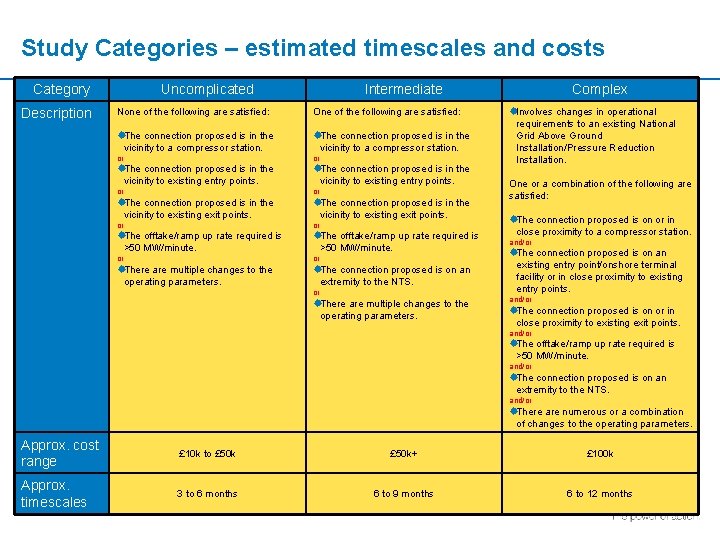
Study Categories – estimated timescales and costs Category Description Uncomplicated Intermediate None of the following are satisfied: One of the following are satisfied: ®The connection proposed is in the vicinity to a compressor station. or or ®The connection proposed is in the vicinity to existing entry points. or or ®The connection proposed is in the vicinity to existing exit points. or or ®The offtake/ramp up rate required is >50 MW/minute. or or ®There are multiple changes to the operating parameters. ®The connection proposed is on an extremity to the NTS. or ®There are multiple changes to the operating parameters. Complex ®Involves changes in operational requirements to an existing National Grid Above Ground Installation/Pressure Reduction Installation. One or a combination of the following are satisfied: ®The connection proposed is on or in close proximity to a compressor station. and/or ®The connection proposed is on an existing entry point/onshore terminal facility or in close proximity to existing entry points. and/or ®The connection proposed is on or in close proximity to existing exit points. and/or ®The offtake/ramp up rate required is >50 MW/minute. and/or ®The connection proposed is on an extremity to the NTS. and/or ®There are numerous or a combination of changes to the operating parameters. Approx. cost range £ 10 k to £ 50 k+ £ 100 k Approx. timescales 3 to 6 months 6 to 9 months 6 to 12 months
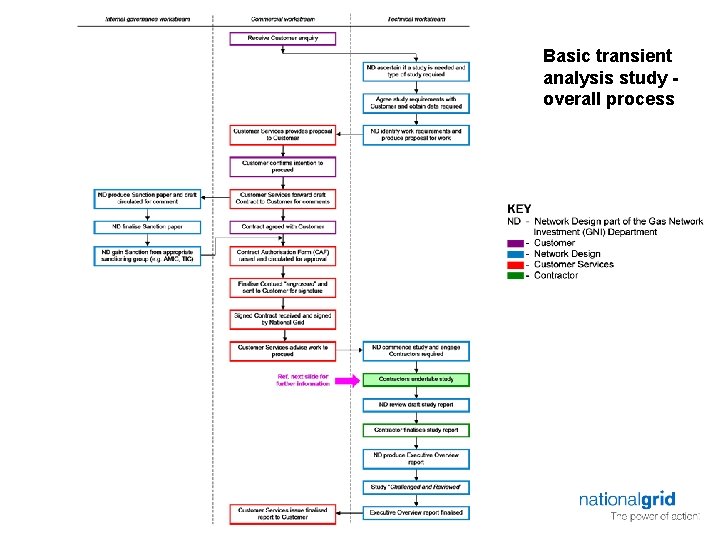
Basic transient analysis study overall process
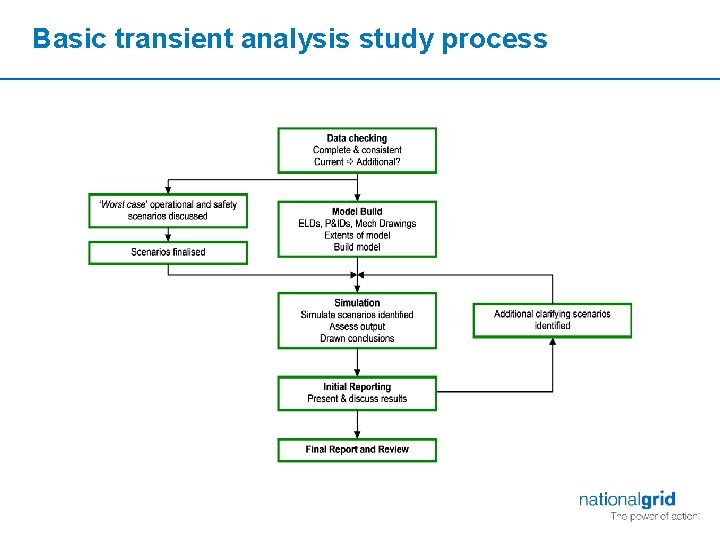
Basic transient analysis study process
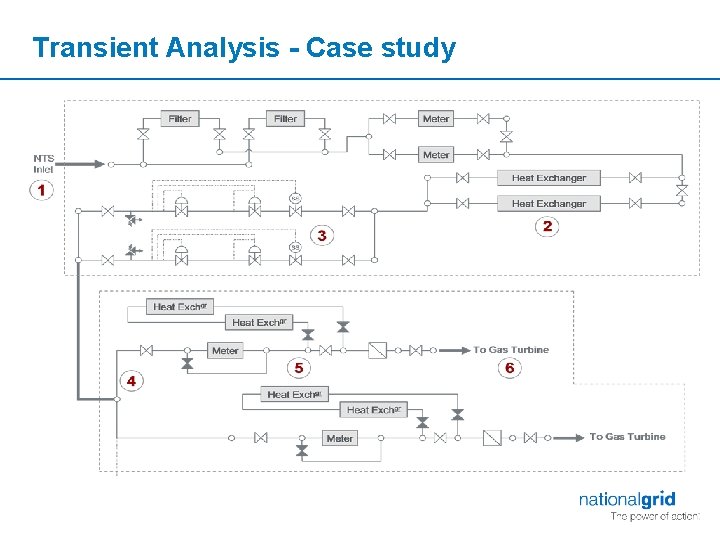
Transient Analysis - Case study
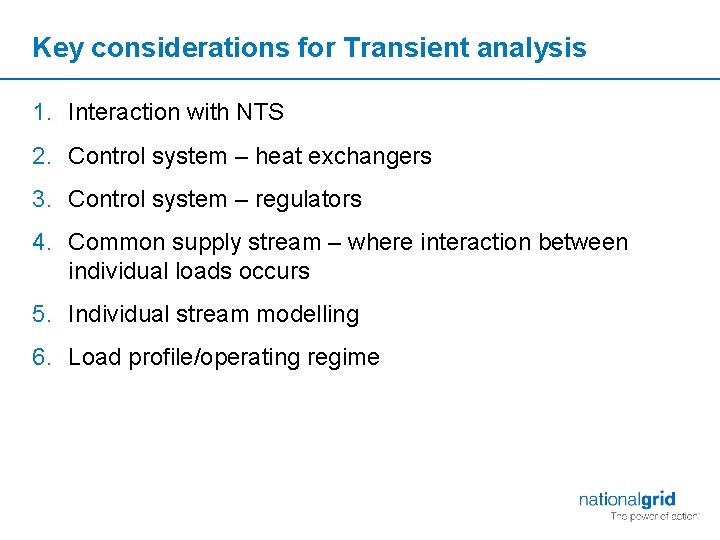
Key considerations for Transient analysis 1. Interaction with NTS 2. Control system – heat exchangers 3. Control system – regulators 4. Common supply stream – where interaction between individual loads occurs 5. Individual stream modelling 6. Load profile/operating regime
Scenarios ® NTS modelling – for start-up and shutdown ® Ramp-up – for each load (individually and in combination) for each start-up profile ® Shutdown – ESD events for each load (individually and in combination) for various NTS pressure conditions ® For this case study over 60 scenarios were modelled
Any questions
- Slides: 24