
FDSN International Federation of Digital Seismograph Networks The


- Slides: 20
FDSN International Federation of Digital Seismograph Networks The FDSN • is the organization that brings together the digital broad-band seismographic networks throughout the world • has commission status within IASPEI, the International Association of Seismology and Physics of the Earth’s Interior, and IUGG, the International Union of Geodesy and Geophysics (ICSU) • was established in 1986 (20 years !) to support the establishment of new digital broad-band seismographic technology, primarily for scientific network. • as many national networks moved and are moving to digital technology, FDSN has assumed the coordination role among all modern seismographic networks worldwide • is not an inter-governmental organization ASC, Bangkok, 9. 11. 2006 Domenico Giardini
FDSN Federation of Digital Seismic Networks The FDSN • promotes the installation of modern digital broad-band stations: over 2400 BB digital stations globally today, over 1000 openly available in real-time telemetry • coordinates global activities in station site selection, data exchange, and instrumentation standardization • promotes inter-operability among infrastructures • promotes a variable-geometry approach, with a backbone of over 300 globally distributed, high-quality stations, enhanced by a mosaic of national and regional networks • promotes the deployment of ocean-bottom seismic observatories, in cooperation with other international ocean programs (ION), to complement the coverage of land-based seismic instrumentation ASC, Bangkok, 9. 11. 2006 Domenico Giardini
FDSN Federation of Digital Seismic Networks The FDSN • maintains an advanced system of networked data centers to oversee the collection, archive and distribution of the continuous and event waveforms, with primary FDSN archive at IRIS DMS • promotes open-data access: all FDSN member networks agree to opendata availability; each member contributes at least one station to the global archive and most members allow open access to waveform data at their data centers • promotes real-time access to data • provides global monitoring of one of the most important natural hazards - earthquakes - and shares the GEOSS goal of achieving a global strategy for coordinated Earth observation; FDSN is a GEO participant, building the land-based component for one of the priority targets for the GEOSS 10 -yr implementation plan ASC, Bangkok, 9. 11. 2006 Domenico Giardini
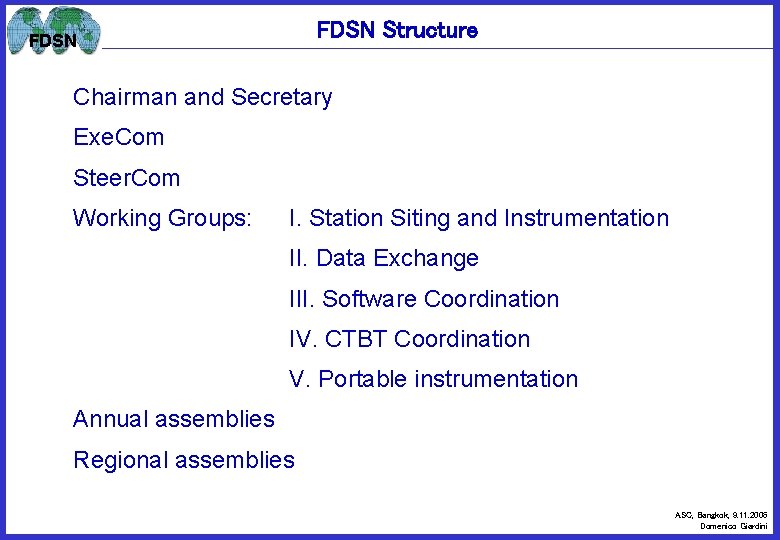
FDSN Structure FDSN Chairman and Secretary Exe. Com Steer. Com Working Groups: I. Station Siting and Instrumentation II. Data Exchange III. Software Coordination IV. CTBT Coordination V. Portable instrumentation Annual assemblies Regional assemblies ASC, Bangkok, 9. 11. 2006 Domenico Giardini
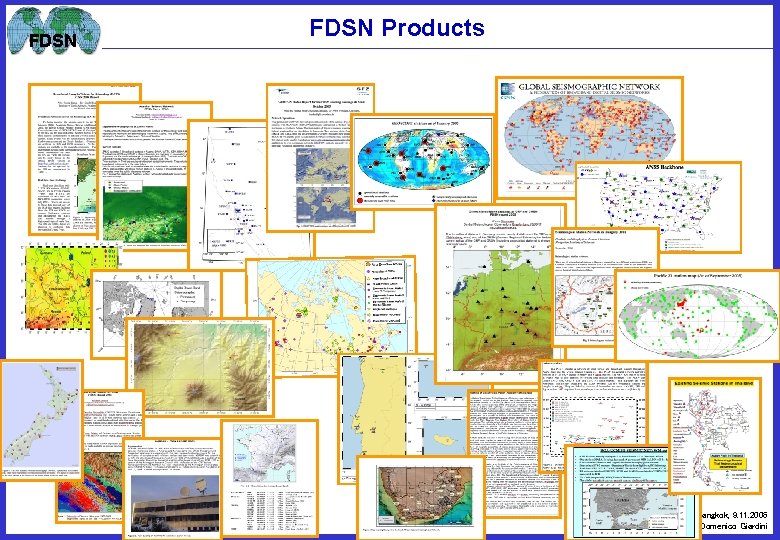
FDSN Products ASC, Bangkok, 9. 11. 2006 Domenico Giardini
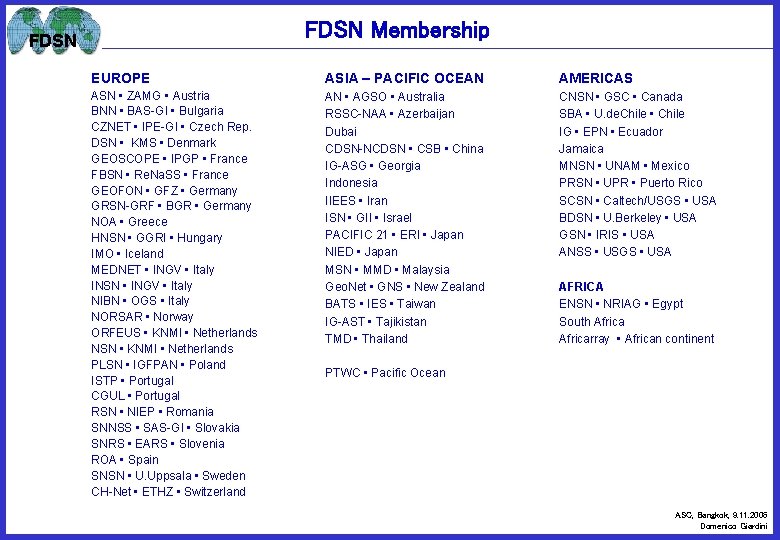
FDSN Membership FDSN EUROPE ASIA – PACIFIC OCEAN AMERICAS ASN • ZAMG • Austria BNN • BAS-GI • Bulgaria CZNET • IPE-GI • Czech Rep. DSN • KMS • Denmark GEOSCOPE • IPGP • France FBSN • Re. Na. SS • France GEOFON • GFZ • Germany GRSN-GRF • BGR • Germany NOA • Greece HNSN • GGRI • Hungary IMO • Iceland MEDNET • INGV • Italy INSN • INGV • Italy NIBN • OGS • Italy NORSAR • Norway ORFEUS • KNMI • Netherlands NSN • KNMI • Netherlands PLSN • IGFPAN • Poland ISTP • Portugal CGUL • Portugal RSN • NIEP • Romania SNNSS • SAS-GI • Slovakia SNRS • EARS • Slovenia ROA • Spain SNSN • U. Uppsala • Sweden CH-Net • ETHZ • Switzerland AN • AGSO • Australia RSSC-NAA • Azerbaijan Dubai CDSN-NCDSN • CSB • China IG-ASG • Georgia Indonesia IIEES • Iran ISN • GII • Israel PACIFIC 21 • ERI • Japan NIED • Japan MSN • MMD • Malaysia Geo. Net • GNS • New Zealand BATS • IES • Taiwan IG-AST • Tajikistan TMD • Thailand CNSN • GSC • Canada SBA • U. de. Chile • Chile IG • EPN • Ecuador Jamaica MNSN • UNAM • Mexico PRSN • UPR • Puerto Rico SCSN • Caltech/USGS • USA BDSN • U. Berkeley • USA GSN • IRIS • USA ANSS • USGS • USA AFRICA ENSN • NRIAG • Egypt South Africarray • African continent PTWC • Pacific Ocean ASC, Bangkok, 9. 11. 2006 Domenico Giardini
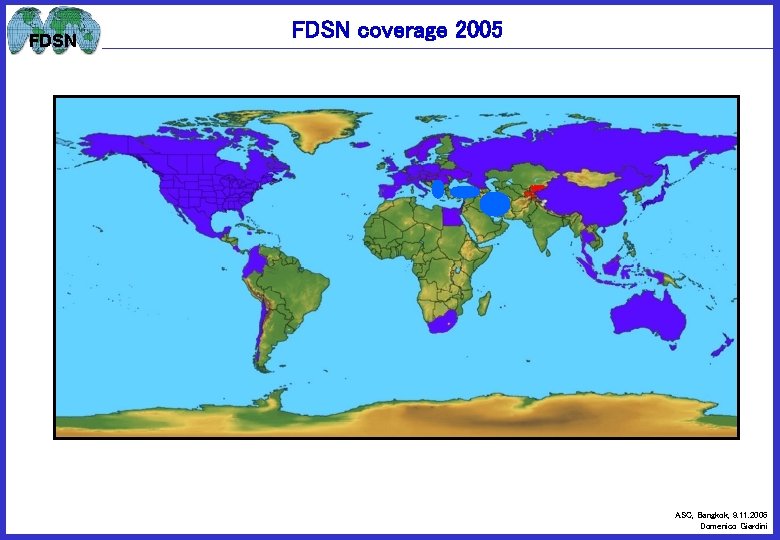
FDSN coverage 2005 ASC, Bangkok, 9. 11. 2006 Domenico Giardini
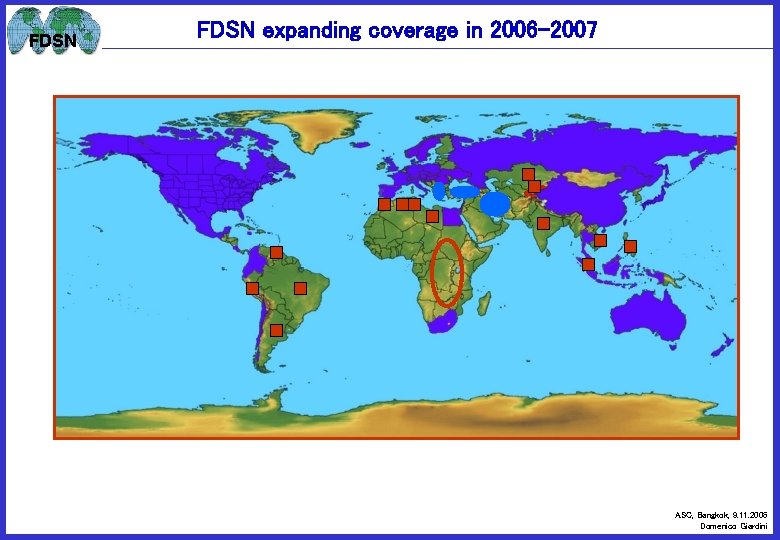
FDSN expanding coverage in 2006 -2007 ASC, Bangkok, 9. 11. 2006 Domenico Giardini
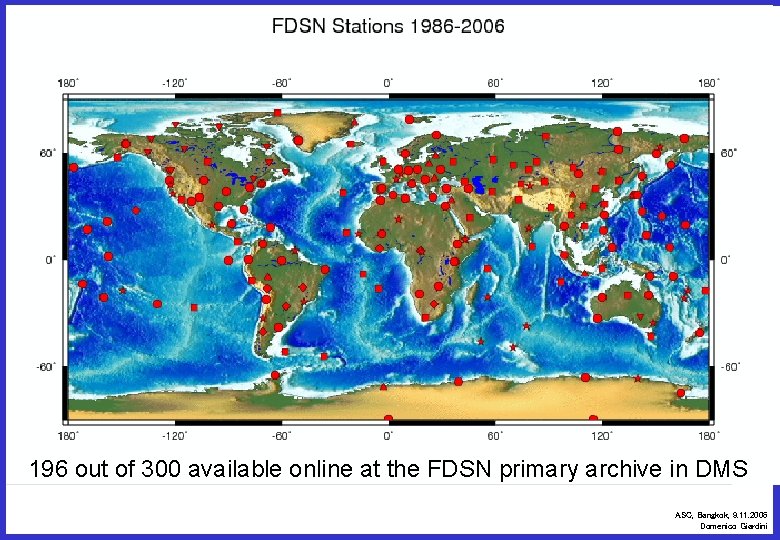
FDSN 196 out of 300 available online at the FDSN primary archive in DMS ASC, Bangkok, 9. 11. 2006 Domenico Giardini
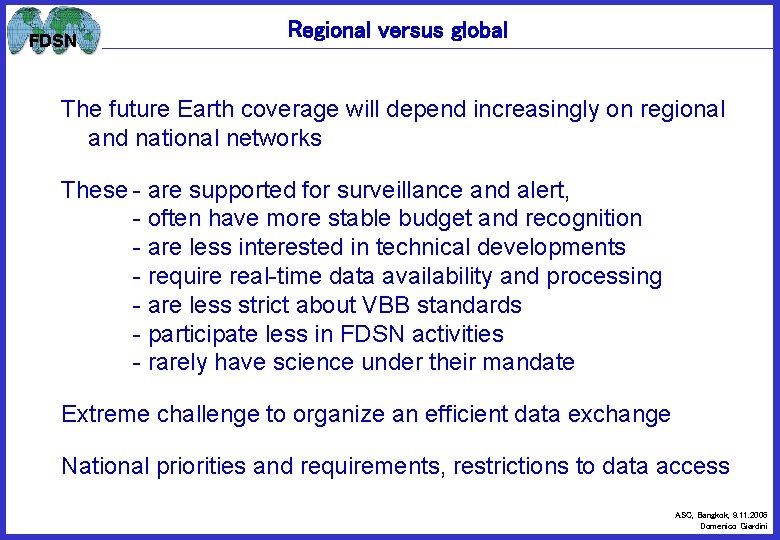
FDSN Regional versus global The future Earth coverage will depend increasingly on regional and national networks These - are supported for surveillance and alert, - often have more stable budget and recognition - are less interested in technical developments - require real-time data availability and processing - are less strict about VBB standards - participate less in FDSN activities - rarely have science under their mandate Extreme challenge to organize an efficient data exchange National priorities and requirements, restrictions to data access ASC, Bangkok, 9. 11. 2006 Domenico Giardini
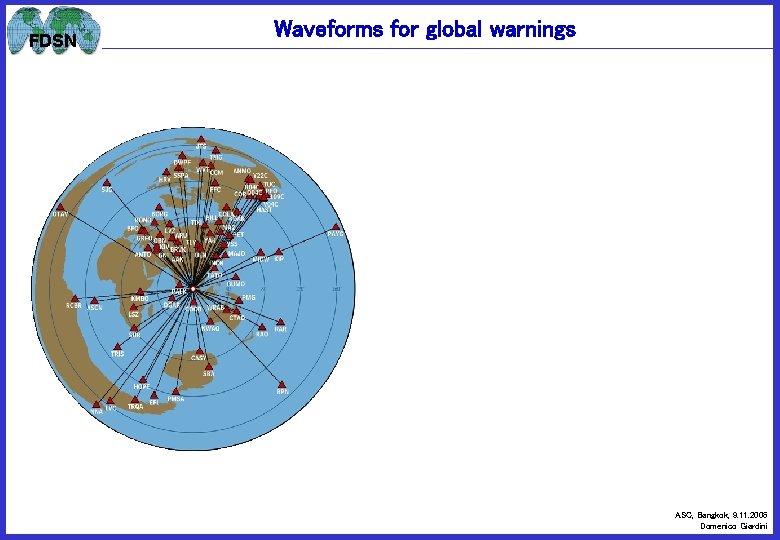
FDSN Waveforms for global warnings ASC, Bangkok, 9. 11. 2006 Domenico Giardini
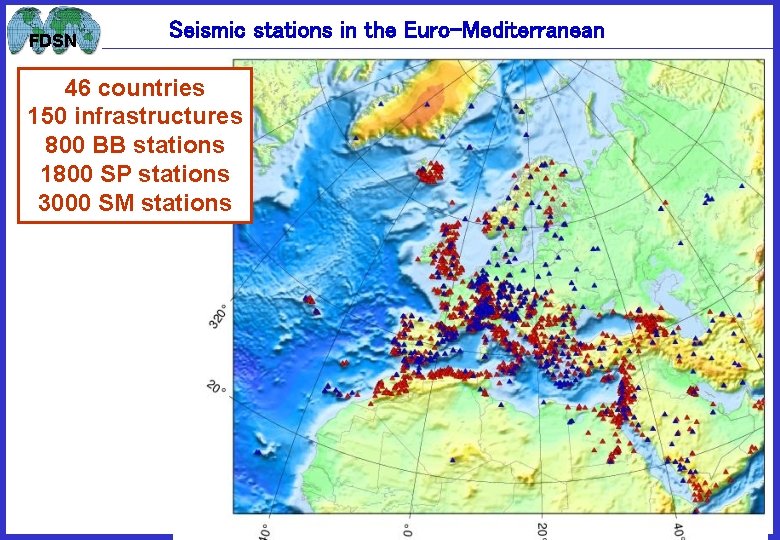
FDSN Seismic stations in the Euro-Mediterranean 46 countries 150 infrastructures 800 BB stations 1800 SP stations 3000 SM stations ASC, Bangkok, 9. 11. 2006 Domenico Giardini
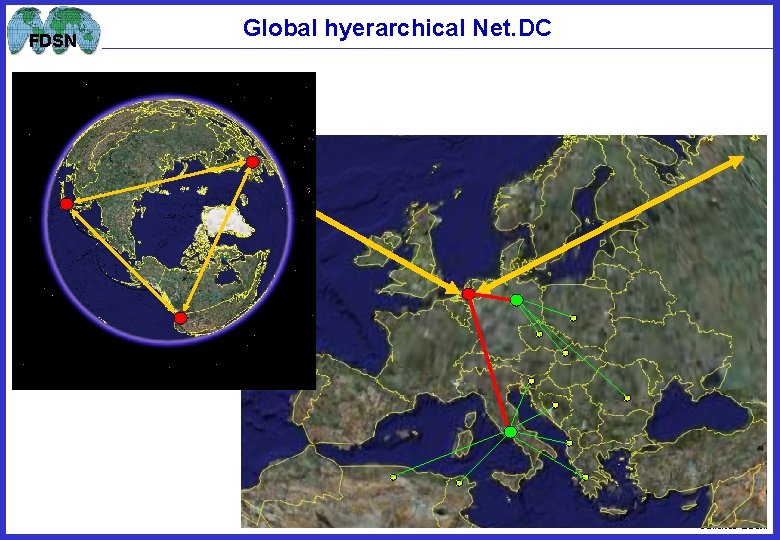
FDSN Global hyerarchical Net. DC ASC, Bangkok, 9. 11. 2006 Domenico Giardini
FDSN International organizations in seismology The issue of who can represent the seismological community in the various international frameworks has become a very important one. Seismology is not covered under the mandate of any inter-governmental organization (i. e. WMO, IOC, UNESCO) IASPEI is within the ICSU framework FDSN is a voluntary club ISC is a focused organization with one single mandate National centers offer sometimes a global coverage, notably NEIC/USGS Regional centers (EMSC, ORFEUS) play indeed a regional role Global networks (GSN/IRIS, GEOFON, GEOSCOPE) are science-driven and science-supported, although some shift is ongoing after Sumatra No international agency is responsible for earthquake warning or hazard CTBTO is an integovernmental organization, with a single mandate WMO is evaluating if it should bring seismology back under its mandate ASC, Bangkok, 9. 11. 2006 Domenico Giardini
FDSN GEOSS The Group on Earth Observation (GEOSS) signed by 60 countries and 40 participating organizations in 2005, approving the GEOSS (Global Earth Observation System of Systems) 10 -yr plan Mandate: coordination of the Earth observing systems, integration of space-based and in-situ segments, North-South technology transfer UN-style structure: Committees and WGs; Secretariat at WMO; Plenary Assembly once per year; 106 Tasks; 2 -yr, 6 -yr and 10 -yr goals Integration with various international organizations and consortia: CEOS, GGOS, IGOS, GOOS, GTOS, GCOS, GLOSS, IGBP, IGOL, GARS, NCRP, IOC, IGFA … FDSN is a participating organization, GSN a national system, GSN/FDSN a global system, DMS a national and global system Strong top-level involvement of NOAA and USGS, but little concrete involvement in activities so far Global representation for seismology secured by strong commitment of FDSN Chairman, FDSN Exe. Com and GSN chair ASC, Bangkok, 9. 11. 2006 Domenico Giardini
FDSN Priorities 2006 -2007 Designated Chairman: G. Suarez, UNAM Designated Secretary: T. van. Eck, ORFEUS Definition agenda 2007 -2011 Reform WG-I and WG-II, improve availability of information, Improve access to real-time data, complete geographical coverage GEO Initiate discussion on the representation of the seismological community ASC, Bangkok, 9. 11. 2006 Domenico Giardini
FDSN ASC, Bangkok, 9. 11. 2006 Domenico Giardini
FDSN A FDSN mandate for more structural support ? • Data mining for structure – Receiver functions, Phase velocity maps • Establish reference models and standards • Synthetics and simulations • Global coordination of temporary deployments • Global role in capacity building • Data mining for hazard – Structure, empirical Green functions, attenuation laws – Rapid source parameters, early warning • Structured access to HPC – Code benchmarking – Open source and community support ASC, Bangkok, 9. 11. 2006 Domenico Giardini
FDSN Capacity building A comprehensive strategy of capacity building must tackle all aspects and all users, from the more basic to the more advanced Progress in global seismology will stall unless a more comprehensive approach to data access is pursued, including local capacity building IRIS and EARTHSCOPE data and facilities should exploit their potential for advancement in SHA IRIS has a global mandate for seismology representation The long-term strategy of IRIS should consider a wider mandate for structural support to seismology ASC, Bangkok, 9. 11. 2006 Domenico Giardini
FDSN Managed Products • Earthquake Catalogs – Hypocenters – Magnitudes – Moment tensors • Waveform Products – FARM/SPYDER® – Record Sections • Maps • Station Lists – Response curves • Tomography – Velocity models – Visualizations • Seismo. Archives – Scanned images of historic recordings ASC, Bangkok, 9. 11. 2006 Domenico Giardini