
FDA FOOD CODE NEW VS OLD The Will


- Slides: 44
FDA FOOD CODE NEW VS OLD
Ø The Will County Health Department is adopting the FDA Food Code effective January 1, 2019 Ø The new code is based on efforts from the food industry and government partners Ø The new code is based on scientific data and updated regularly Ø The new code will promote uniformity throughout the state Ø The new code focuses on reducing the risks of foodborne illness and good retail practices Ø The new code will require Active Managerial Control of foodborne illness risk factors
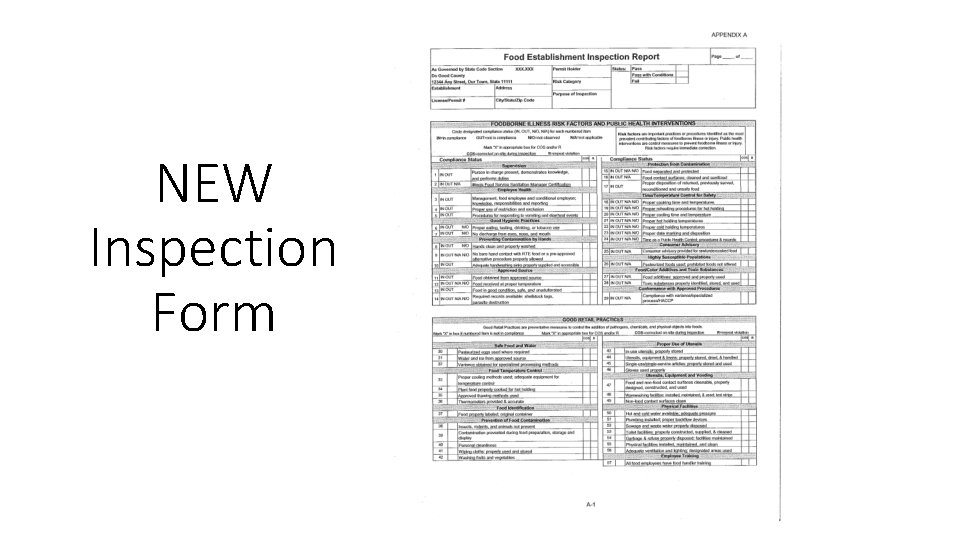
NEW VS OLD ØInspections will not result in a numerical score Ø 29 Foodborne Illness Risk Factors and Public Health Interventions Ø 29 Good Retail Practices Ø Inspections will be based more on procedural question and answer and evaluating active managerial control ØPermit status will be a direct result of the ØNumber of foodborne illness risk factors and public health interventions marked out of compliance ØNumber of repeat foodborne illness risk factors and public health interventions marked out of compliance
NEW Inspection Form
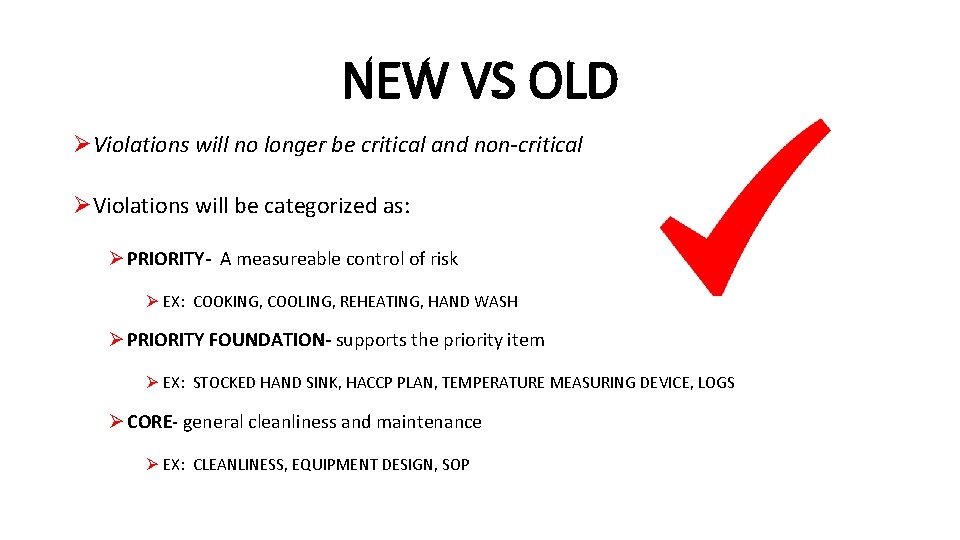
NEW VS OLD ØViolations will no longer be critical and non-critical ØViolations will be categorized as: Ø PRIORITY- A measureable control of risk Ø EX: COOKING, COOLING, REHEATING, HAND WASH Ø PRIORITY FOUNDATION- supports the priority item Ø EX: STOCKED HAND SINK, HACCP PLAN, TEMPERATURE MEASURING DEVICE, LOGS Ø CORE- general cleanliness and maintenance Ø EX: CLEANLINESS, EQUIPMENT DESIGN, SOP
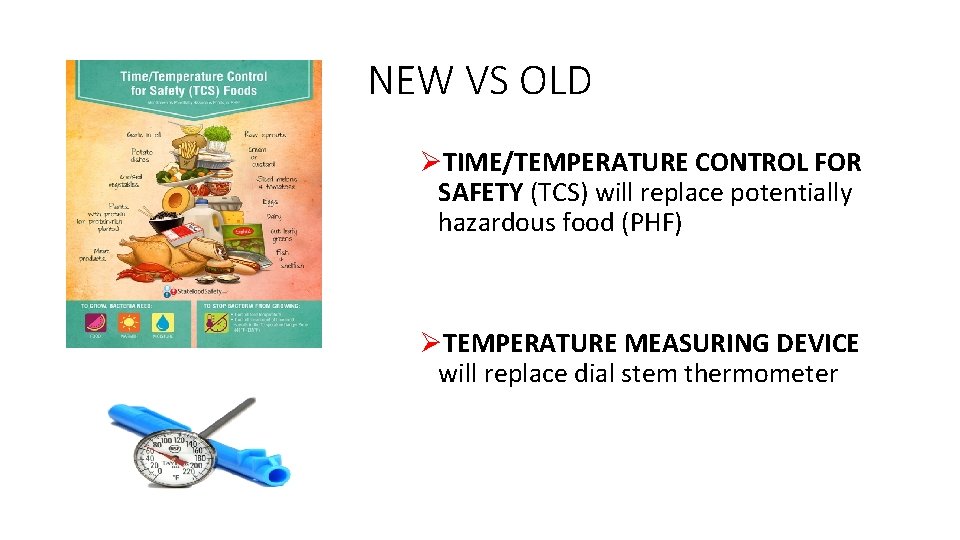
NEW VS OLD ØTIME/TEMPERATURE CONTROL FOR SAFETY (TCS) will replace potentially hazardous food (PHF) ØTEMPERATURE MEASURING DEVICE will replace dial stem thermometer
NEW VS OLD ØCERTIFIED FOOD PROTECTION MANAGER (CFPM) replaces Food Service Sanitation Manager(FSSMC) ØANSI Approved course and exam ØAt least one employee with supervisor or management responsibilities on duty during all hours of operation. ØPerson in Charge (PIC) is required during all hours of operation and should be a CFPM
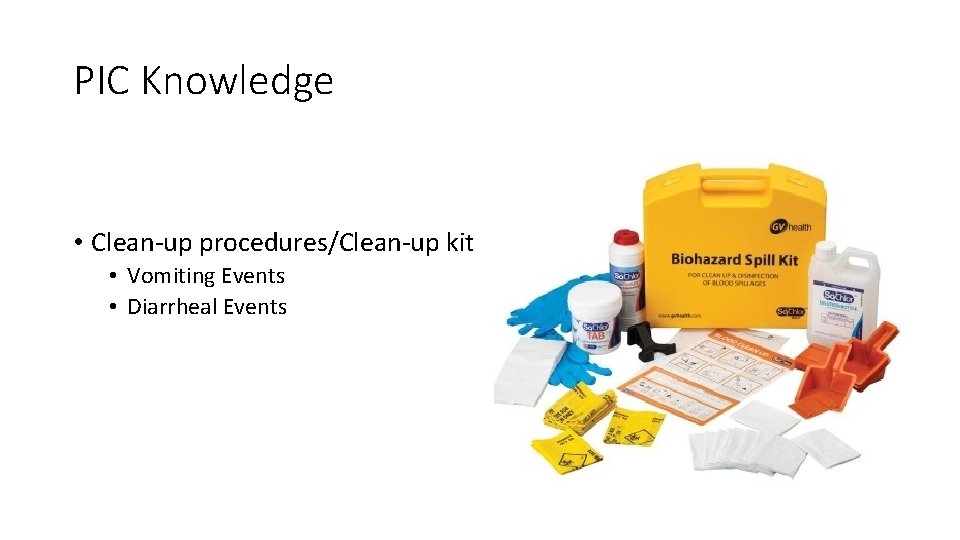
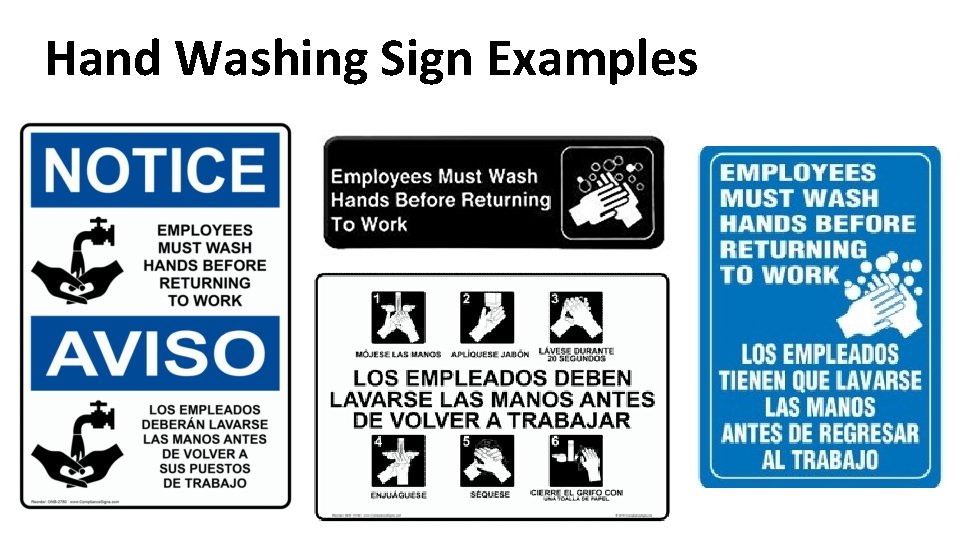
NEW REQUIREMENTS ØVOMIT AND DIARRHEAL CLEANUP KIT IS REQUIRED (SECTION 2 -501. 11) ØHAND WASHING SIGNS AT EVERY HAND SINK (SECTION 6 -301. 14) ØDESIGNATED AREA FOR RETURNS/ DAMAGED PRODUCT (SECTION 6 -404. 11) ØVARIANCE REQUIREMENTS FOR SPECIAL PROCESSES (SECTION 3 -502. 11)
NEW REQUIREMENTS ØEMPLOYEE HEALTH POLICY ØEmployee Reporting ØEmployee Health Restrictions and Exclusions ØGood Hygiene Practices Examples of these policies can be found on our website
Person In Charge 1 -201. 10 Means the individual present at a Food Establishment who is responsible for the operation at the time of inspection
Responsibility of PIC 2 -101. 11 • Designate a Person In Charge (PIC) • PIC present at establishment during hours of operation
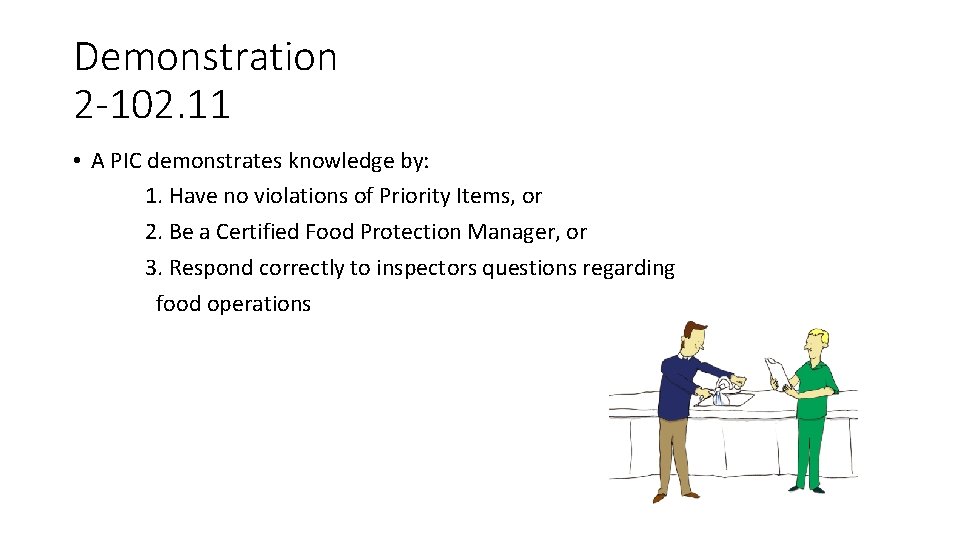
Demonstration 2 -102. 11 • A PIC demonstrates knowledge by: 1. Have no violations of Priority Items, or 2. Be a Certified Food Protection Manager, or 3. Respond correctly to inspectors questions regarding food operations
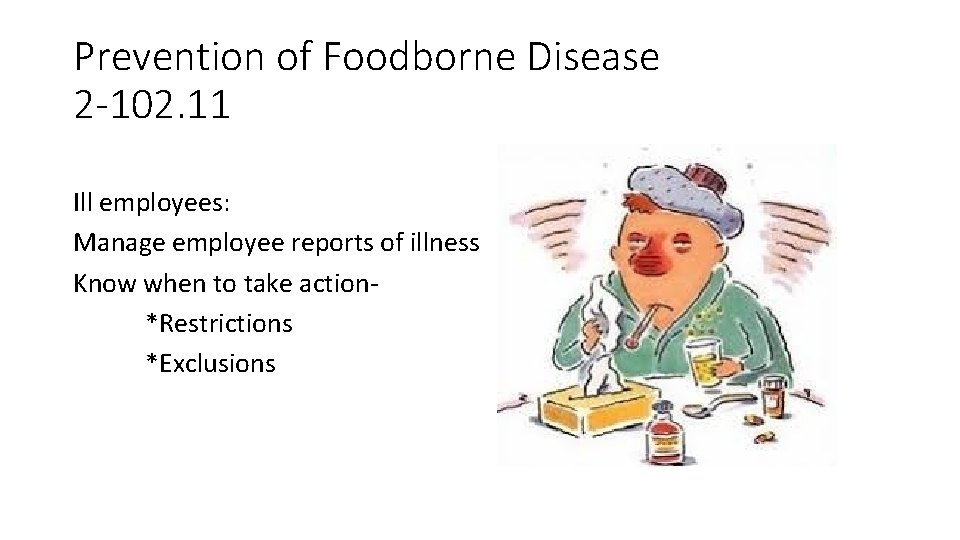
Prevention of Foodborne Disease 2 -102. 11 Ill employees: Manage employee reports of illness Know when to take action*Restrictions *Exclusions
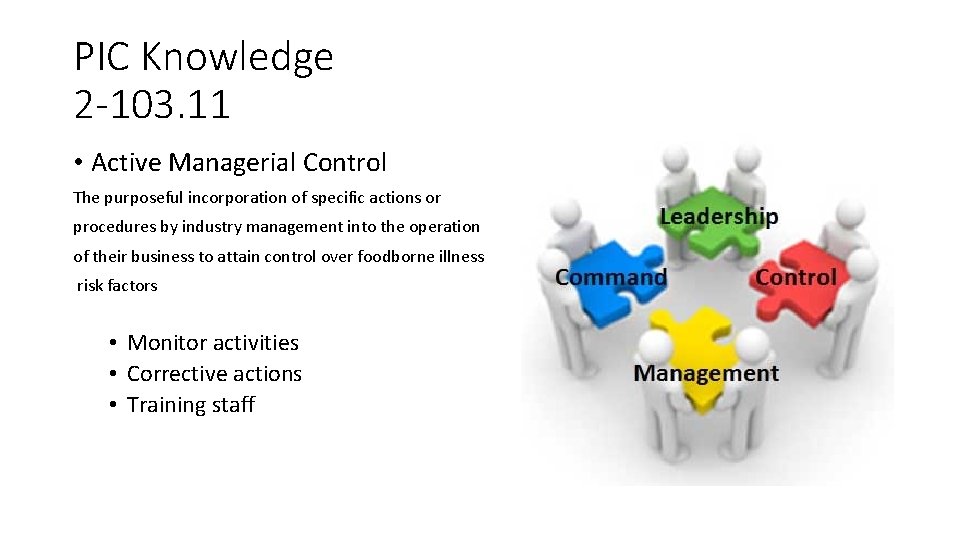
PIC Knowledge 2 -103. 11 • Active Managerial Control The purposeful incorporation of specific actions or procedures by industry management into the operation of their business to attain control over foodborne illness risk factors • Monitor activities • Corrective actions • Training staff
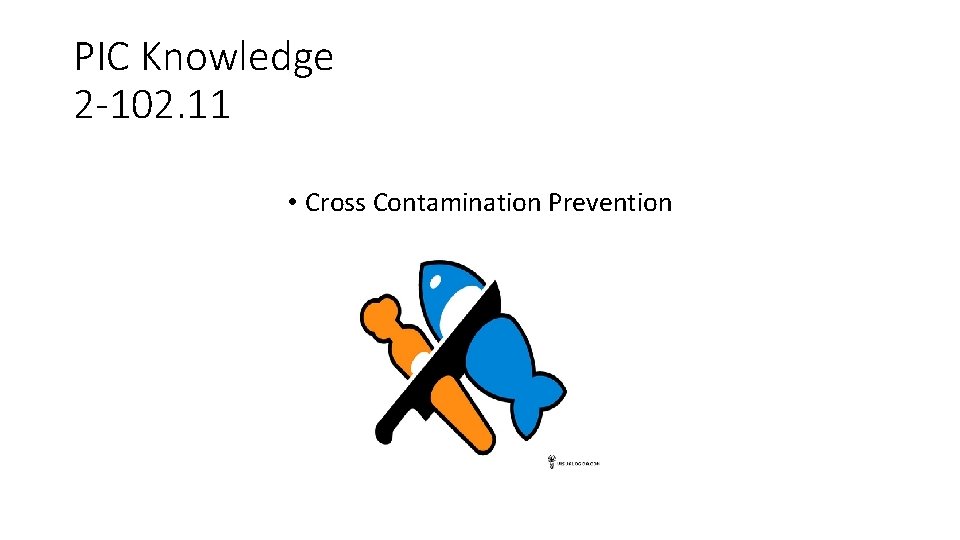
PIC Knowledge 2 -102. 11 • Cross Contamination Prevention
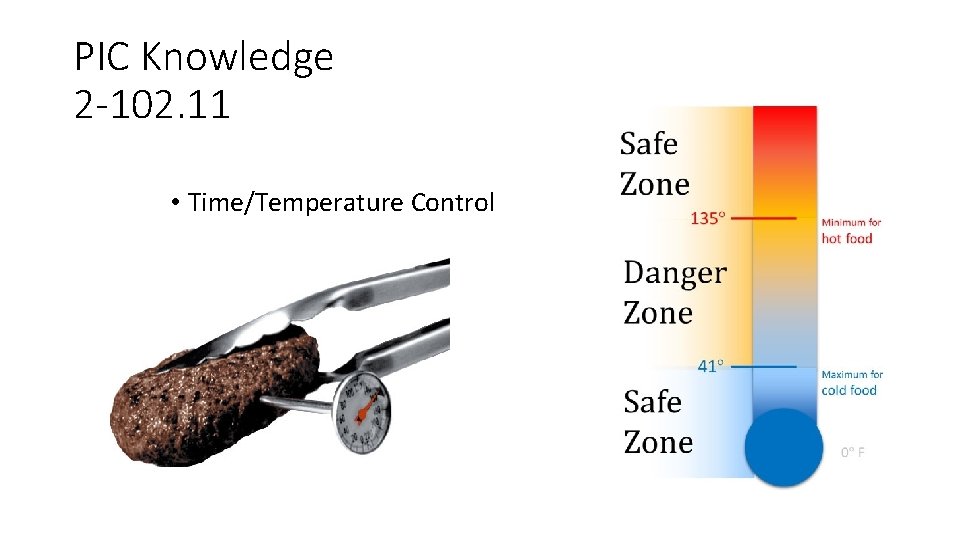
PIC Knowledge 2 -102. 11 • Time/Temperature Control
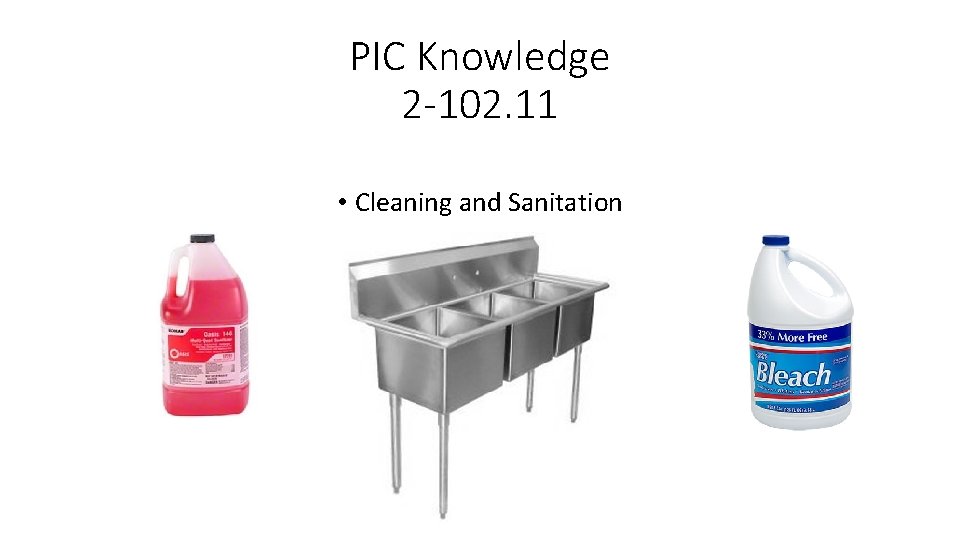
PIC Knowledge 2 -102. 11 • Cleaning and Sanitation
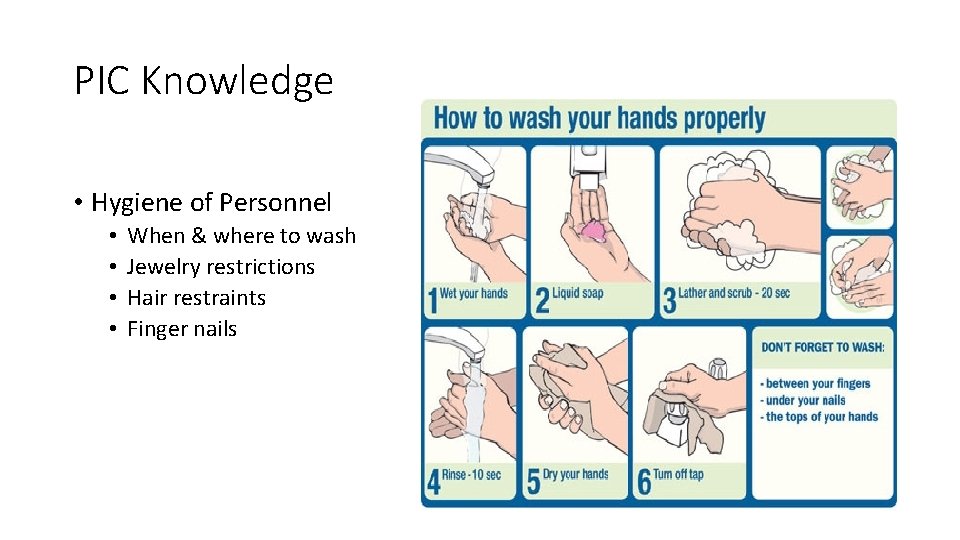
PIC Knowledge • Hygiene of Personnel • • When & where to wash Jewelry restrictions Hair restraints Finger nails
PIC Knowledge • Emergencies: • • • Complaints Recalls Power Failures Water/Hot Water Loss Sewage Backups Fire
PIC Knowledge • Clean-up procedures/Clean-up kit • Vomiting Events • Diarrheal Events
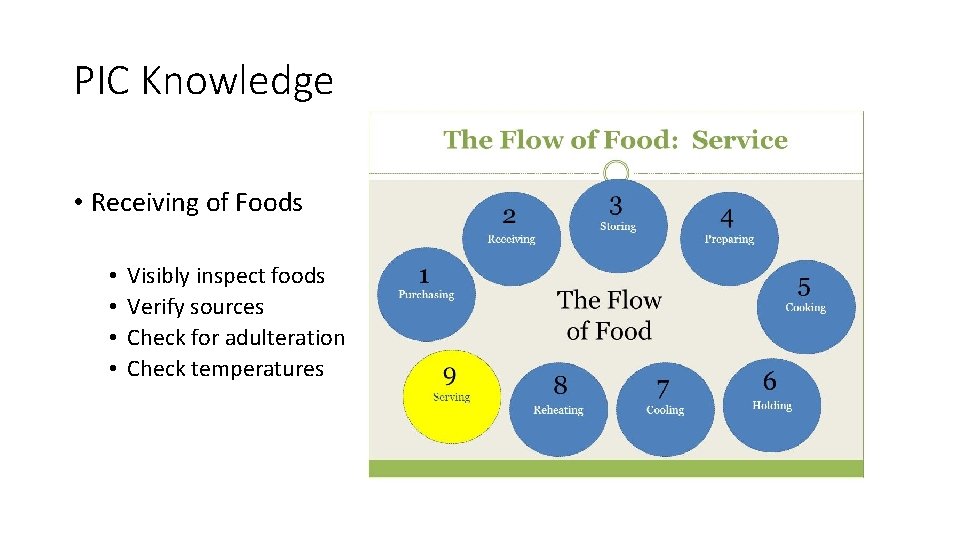
PIC Knowledge • Receiving of Foods • • Visibly inspect foods Verify sources Check for adulteration Check temperatures
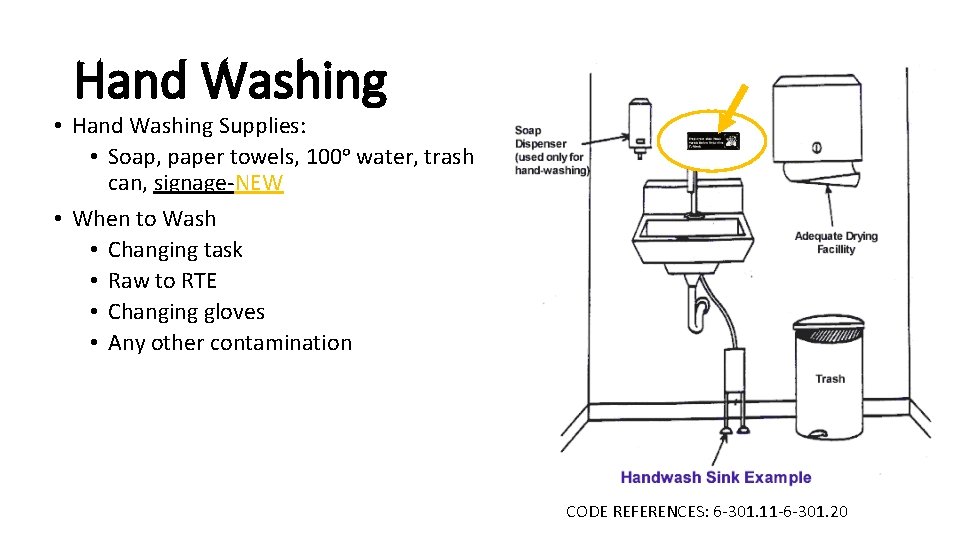
Hand Washing • Hand Washing Supplies: • Soap, paper towels, 100ᵒ water, trash can, signage-NEW • When to Wash • Changing task • Raw to RTE • Changing gloves • Any other contamination CODE REFERENCES: 6 -301. 11 -6 -301. 20
Hand Washing Sign Examples
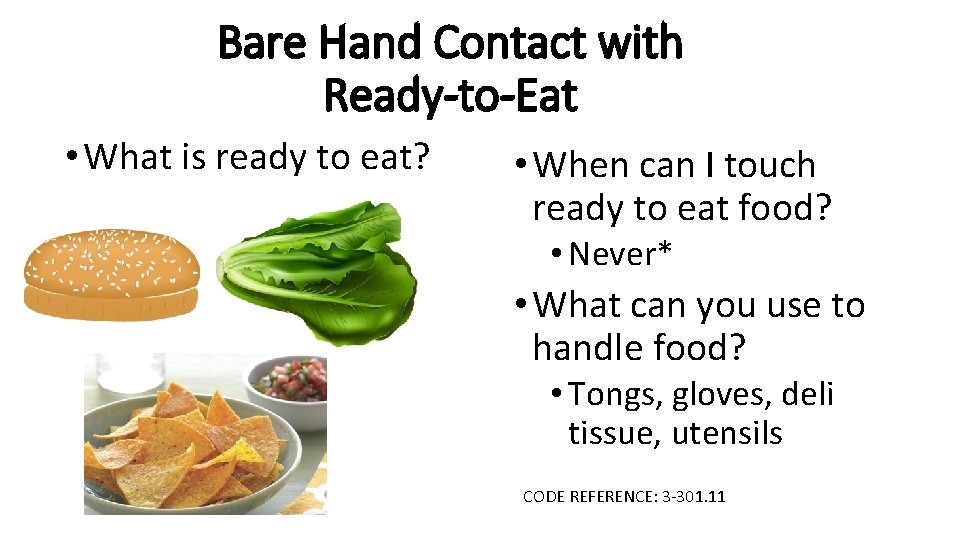
Bare Hand Contact with Ready-to-Eat • What is ready to eat? • When can I touch ready to eat food? • Never* • What can you use to handle food? • Tongs, gloves, deli tissue, utensils CODE REFERENCE: 3 -301. 11
Bare Hand Contact Exception - NEW • Bare hand contact can be done BUT it requires: • Form 1 -D • Written procedure • Training • Policy • Documentation • Not available for schools, daycares or nursing facilities • Requests can be rejected or revoked CODE REFERENCE: 3 -301. 11 If you are interested in this policy, contact your Area Sanitarian
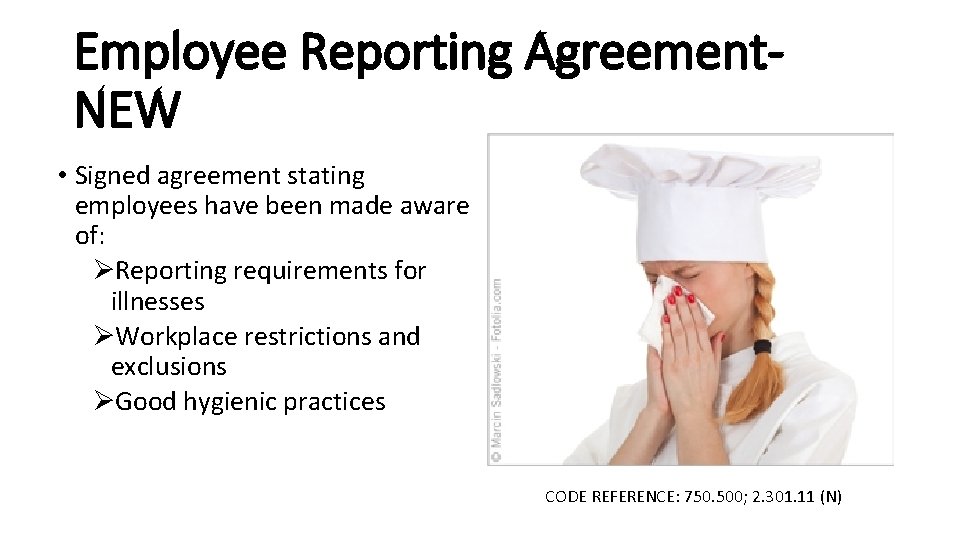
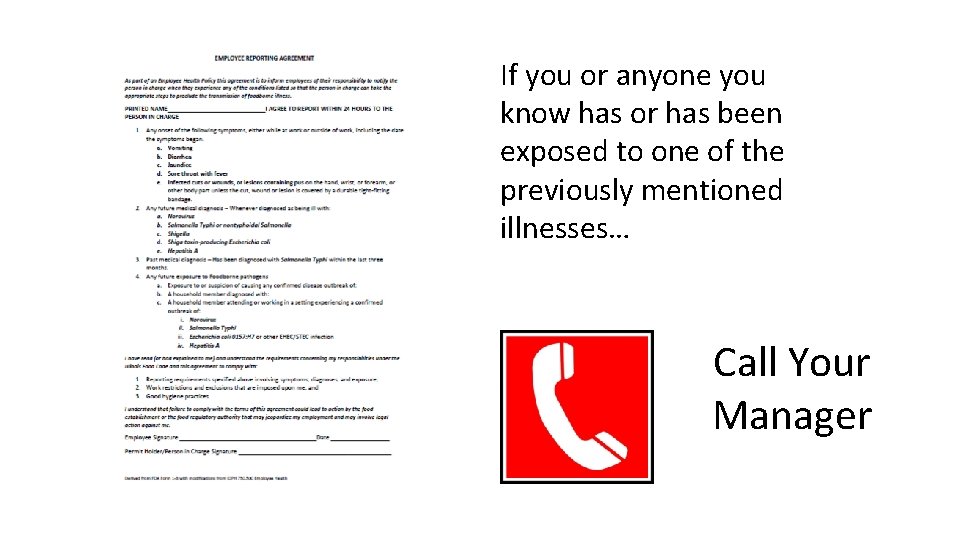
Employee Reporting Agreement. NEW • Signed agreement stating employees have been made aware of: ØReporting requirements for illnesses ØWorkplace restrictions and exclusions ØGood hygienic practices CODE REFERENCE: 750. 500; 2. 301. 11 (N)
When do I report?
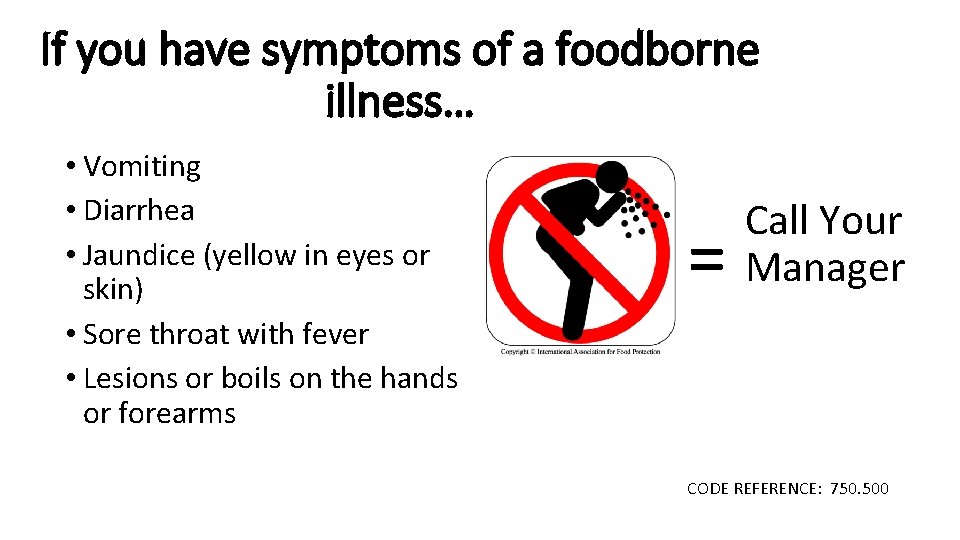
If you have symptoms of a foodborne illness… • Vomiting • Diarrhea • Jaundice (yellow in eyes or skin) • Sore throat with fever • Lesions or boils on the hands or forearms = Call Your Manager CODE REFERENCE: 750. 500
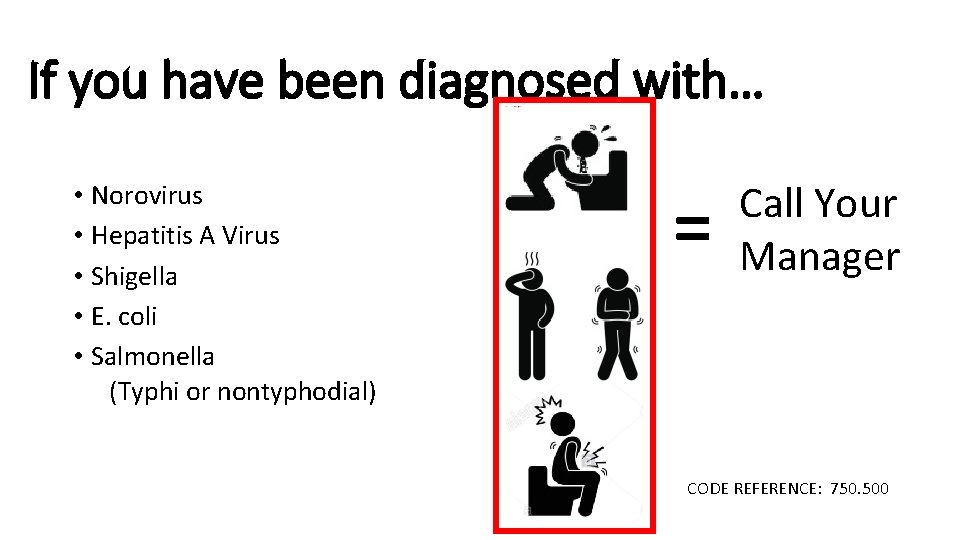
If you have been diagnosed with… • Norovirus • Hepatitis A Virus • Shigella • E. coli • Salmonella (Typhi or nontyphodial) = Call Your Manager CODE REFERENCE: 750. 500
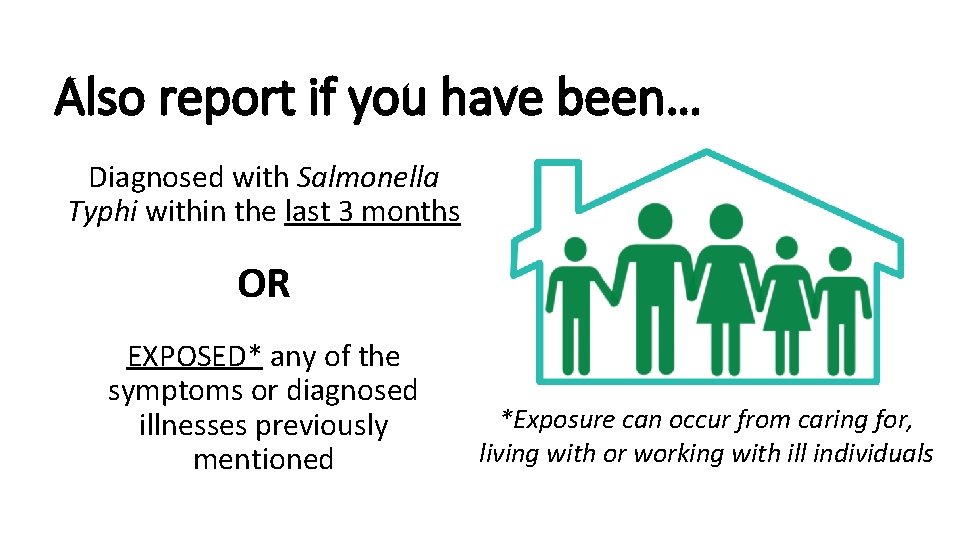
Also report if you have been… Diagnosed with Salmonella Typhi within the last 3 months OR EXPOSED* any of the symptoms or diagnosed illnesses previously mentioned *Exposure can occur from caring for, living with or working with ill individuals
Oh No! I have a common cold, can I still work? Yes! But… …food employees with persistent cough and sneezing or discharge from the eyes, nose or mouth cannot work around exposed food, clean equipment, utensils, linens or unwrapped singleservice articles CODE REFERENCE: 2 -401. 12
If you or anyone you know has or has been exposed to one of the previously mentioned illnesses… Call Your Manager
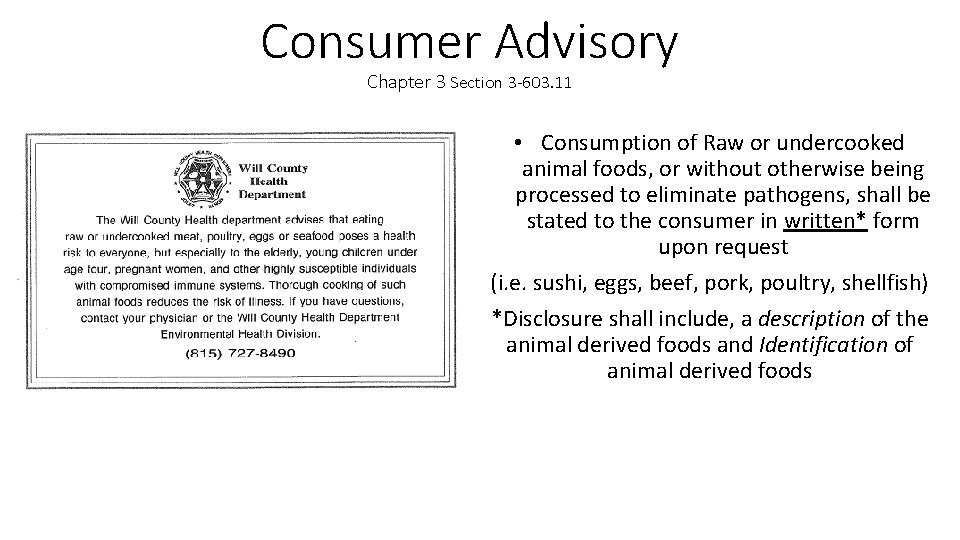
Consumer Advisory Chapter 3 Section 3 -603. 11 • Consumption of Raw or undercooked animal foods, or without otherwise being processed to eliminate pathogens, shall be stated to the consumer in written* form upon request (i. e. sushi, eggs, beef, pork, poultry, shellfish) *Disclosure shall include, a description of the animal derived foods and Identification of animal derived foods
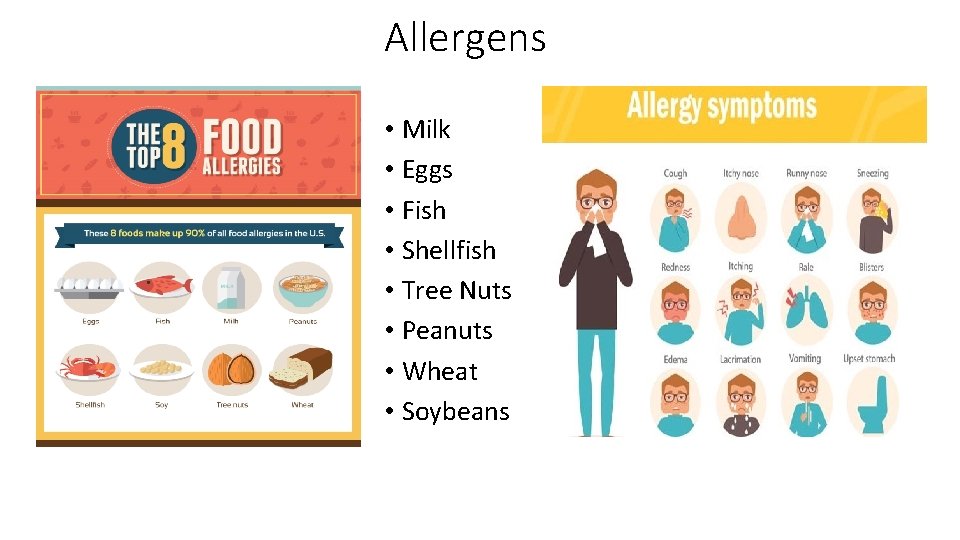
Allergens • Milk • Eggs • Fish • Shellfish • Tree Nuts • Peanuts • Wheat • Soybeans
Allergen Training ANSI accredited Food Allergen Training is required for all Level 1 High Risk Facilities. • Excluded are multi-state franchises, with internal training, nursing homes, day care facilities, schools, and Level II or Level III risk facilities. • Compliance shall by met by July 2018
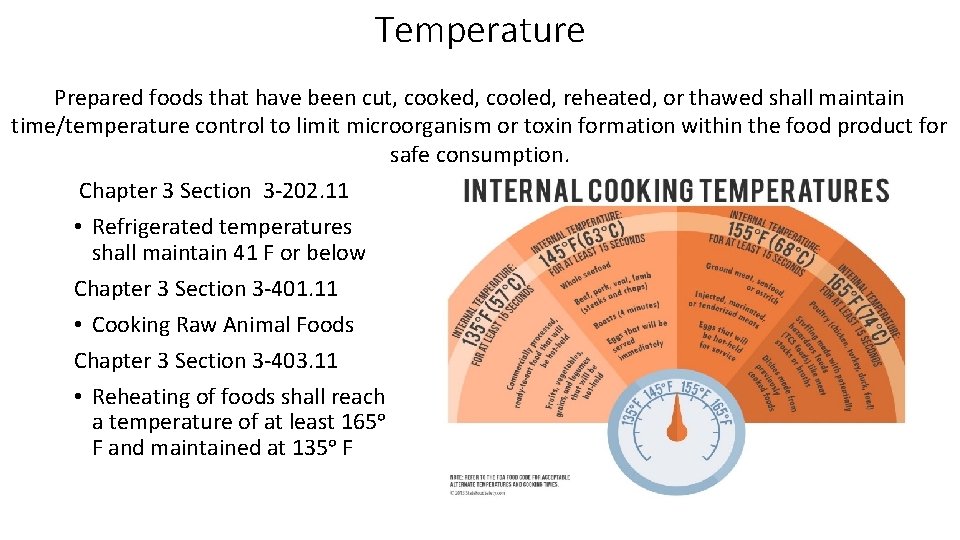
Temperature Prepared foods that have been cut, cooked, cooled, reheated, or thawed shall maintain time/temperature control to limit microorganism or toxin formation within the food product for safe consumption. Chapter 3 Section 3 -202. 11 • Refrigerated temperatures shall maintain 41 F or below Chapter 3 Section 3 -401. 11 • Cooking Raw Animal Foods Chapter 3 Section 3 -403. 11 • Reheating of foods shall reach a temperature of at least 165ᵒ F and maintained at 135ᵒ F
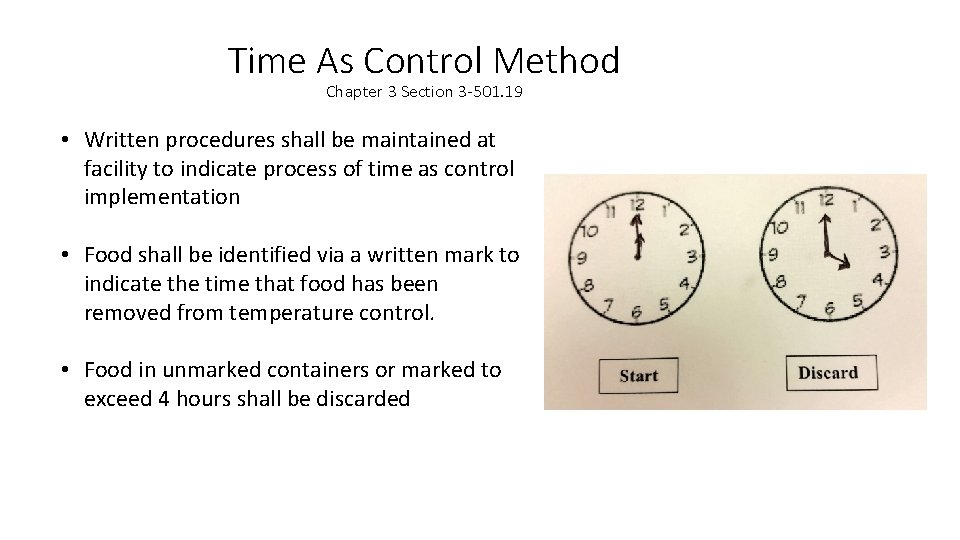
Time As Control Method Chapter 3 Section 3 -501. 19 • Written procedures shall be maintained at facility to indicate process of time as control implementation • Food shall be identified via a written mark to indicate the time that food has been removed from temperature control. • Food in unmarked containers or marked to exceed 4 hours shall be discarded
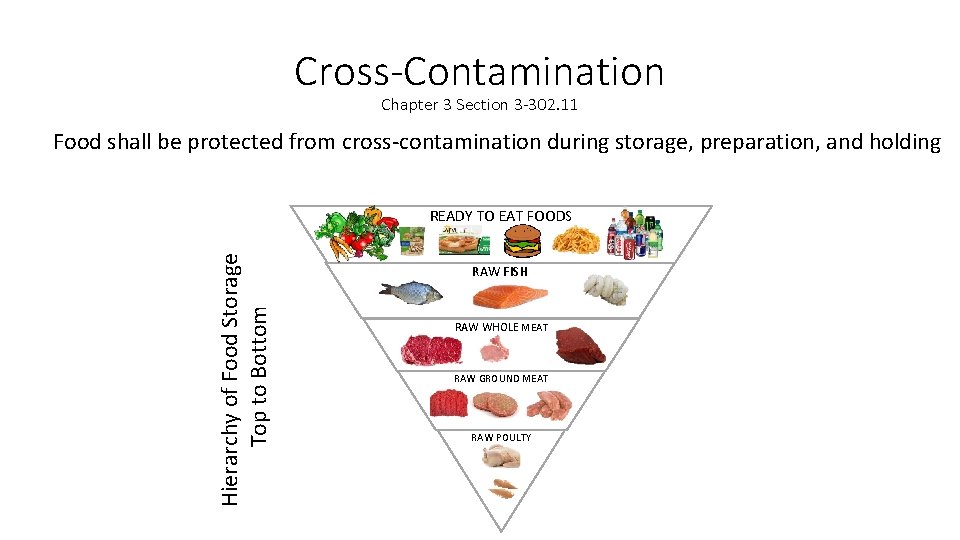
Cross-Contamination Chapter 3 Section 3 -302. 11 Food shall be protected from cross-contamination during storage, preparation, and holding Hierarchy of Food Storage Top to Bottom READY TO EAT FOODS RAW FISH RAW WHOLE MEAT RAW GROUND MEAT RAW POULTY
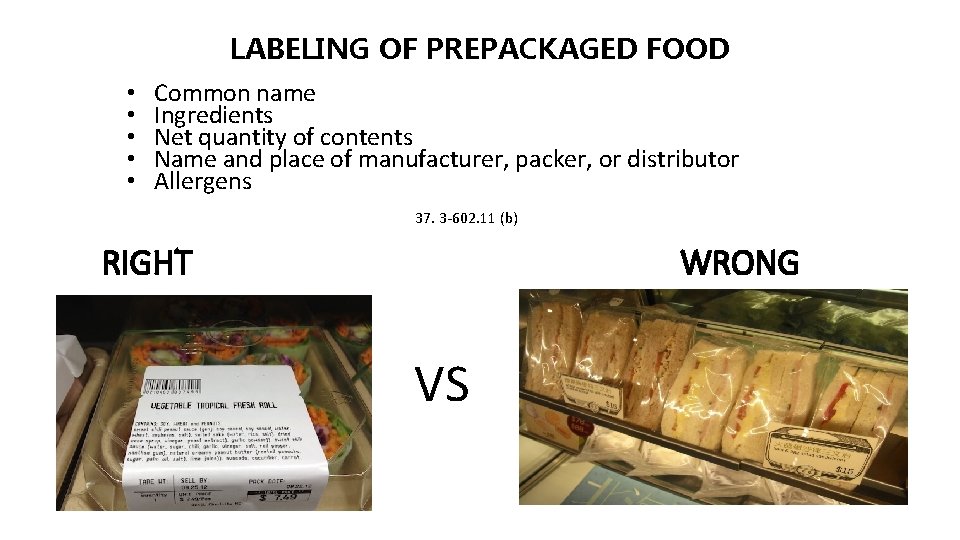
LABELING OF PREPACKAGED FOOD • • • Common name Ingredients Net quantity of contents Name and place of manufacturer, packer, or distributor Allergens 37. 3 -602. 11 (b) RIGHT WRONG VS
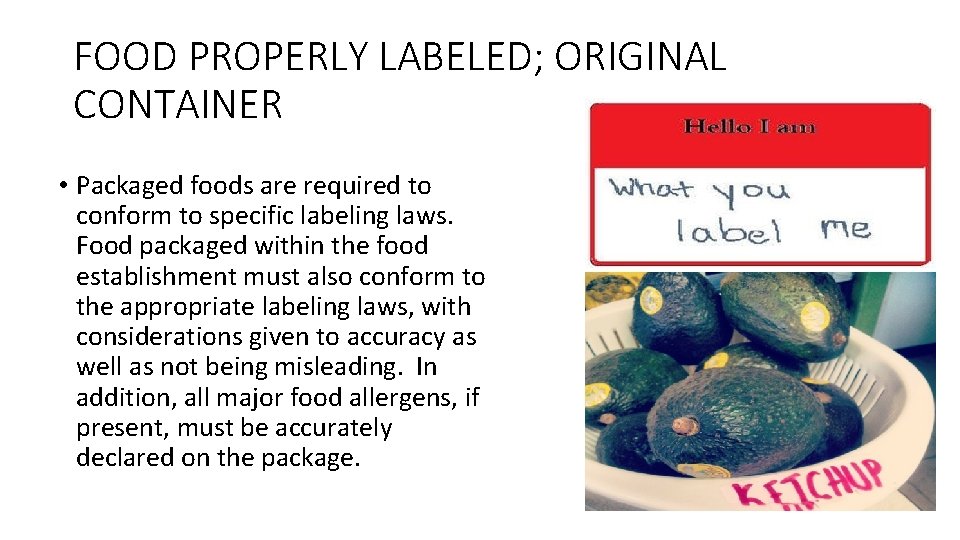
FOOD PROPERLY LABELED; ORIGINAL CONTAINER • Packaged foods are required to conform to specific labeling laws. Food packaged within the food establishment must also conform to the appropriate labeling laws, with considerations given to accuracy as well as not being misleading. In addition, all major food allergens, if present, must be accurately declared on the package.
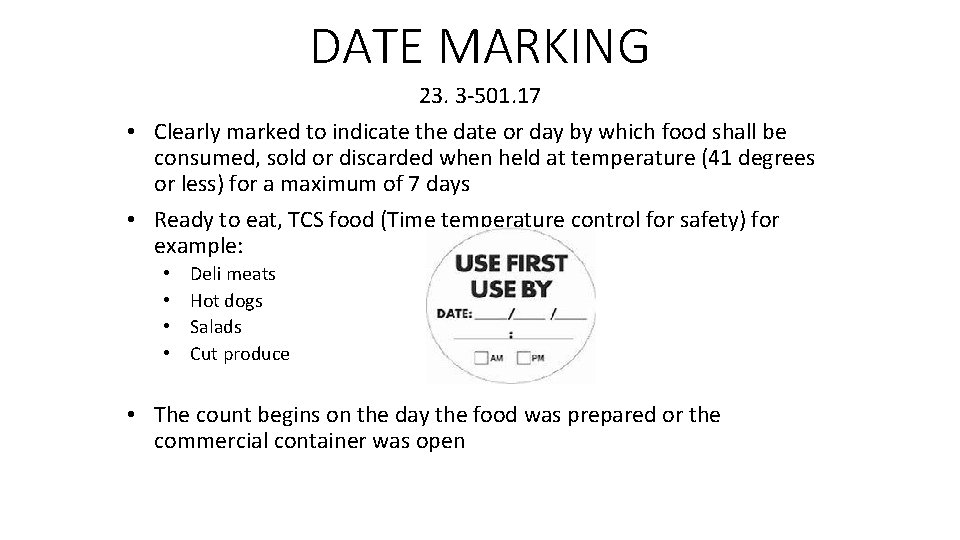
DATE MARKING 23. 3 -501. 17 • Clearly marked to indicate the date or day by which food shall be consumed, sold or discarded when held at temperature (41 degrees or less) for a maximum of 7 days • Ready to eat, TCS food (Time temperature control for safety) for example: • • Deli meats Hot dogs Salads Cut produce • The count begins on the day the food was prepared or the commercial container was open
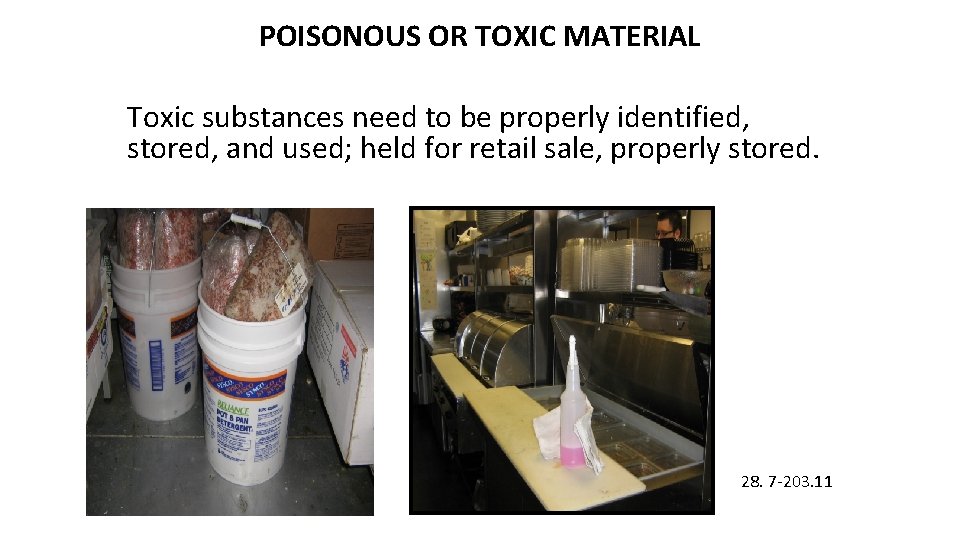
POISONOUS OR TOXIC MATERIAL Toxic substances need to be properly identified, stored, and used; held for retail sale, properly stored. 28. 7 -203. 11
The Will County Health Department Eastern Branch Office 5601 W Monee. Manhattan Rd Suite 109 Monee, IL 60449 Phone 708 -534 -5721 Main Office 501 Ella Ave Joliet, IL 60433 Phone 815 -727 -8490 Northern Branch Office 323 Quadrangle Dr Bolingbrook, IL 60440 Phone 630 -679 -7030 www. willcountyhealth. org