
FCCs NEPA Process Overview of NEPA Overview of
- Slides: 31
FCC’s NEPA Process Overview of NEPA • Overview of FCC’s NEPA rules and procedures, including new rule changes • Nuts and bolts of how best to comply with our rules •
NEPA Requires agencies to consider and disclose the environmental effects of their actions to improve decision making and encourage transparency, public participation, and accountability. • Requires agencies to integrate environmental considerations into their decisions. •
NEPA and CEQ Regulations Define effects to include ecological, aesthetic, historic, social, cumulative and indirect. • Define “major federal actions” to include programs, rules, funding, licensing and permitting. • NEPA sets out a process—no mandated outcome •
NEPA Three levels of review: • Environmental Impact Statements (EISs) • Environmental Assessments (EAs) Finding of No Significant Impact (FONSI) • Categorical exclusions (CE, CX, Cat. Ex) “Extraordinary circumstances”
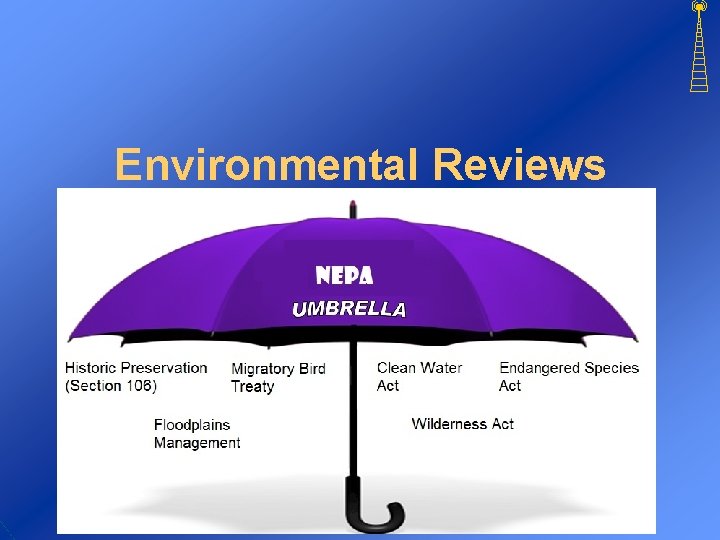
Environmental Reviews
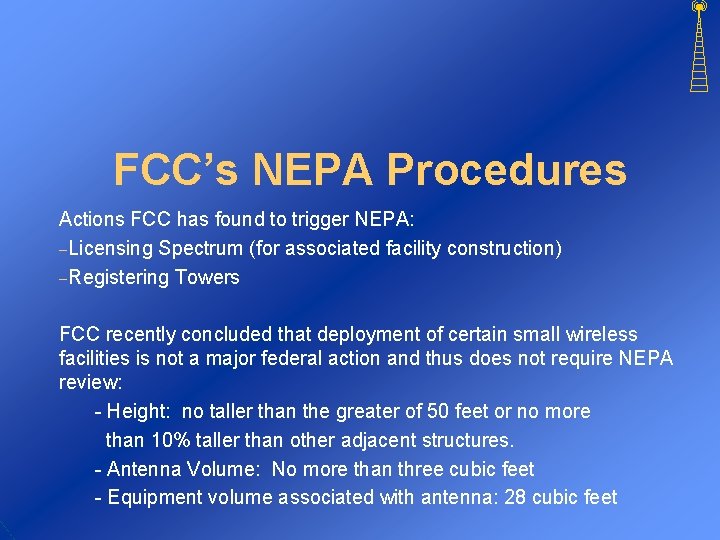
FCC’s NEPA Procedures Actions FCC has found to trigger NEPA: -Licensing Spectrum (for associated facility construction) -Registering Towers FCC recently concluded that deployment of certain small wireless facilities is not a major federal action and thus does not require NEPA review: Height: no taller than the greater of 50 feet or no more than 10% taller than other adjacent structures. Antenna Volume: No more than three cubic feet Equipment volume associated with antenna: 28 cubic feet
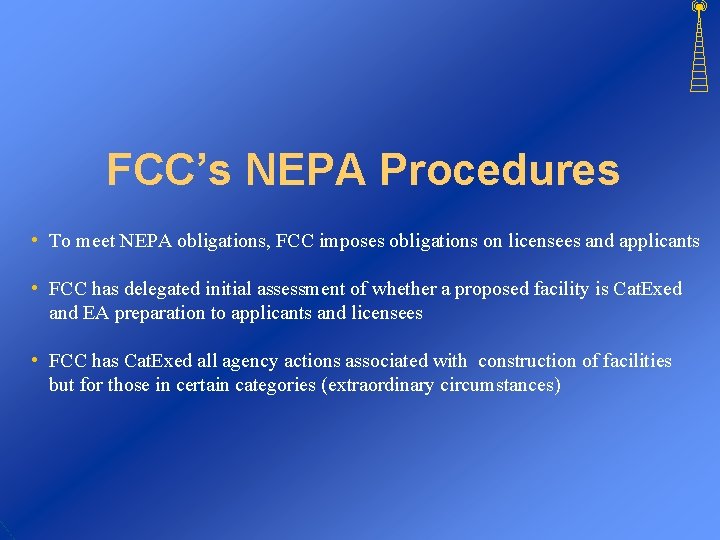
FCC’s NEPA Procedures • To meet NEPA obligations, FCC imposes obligations on licensees and applicants • FCC has delegated initial assessment of whether a proposed facility is Cat. Exed and EA preparation to applicants and licensees • FCC has Cat. Exed all agency actions associated with construction of facilities but for those in certain categories (extraordinary circumstances)
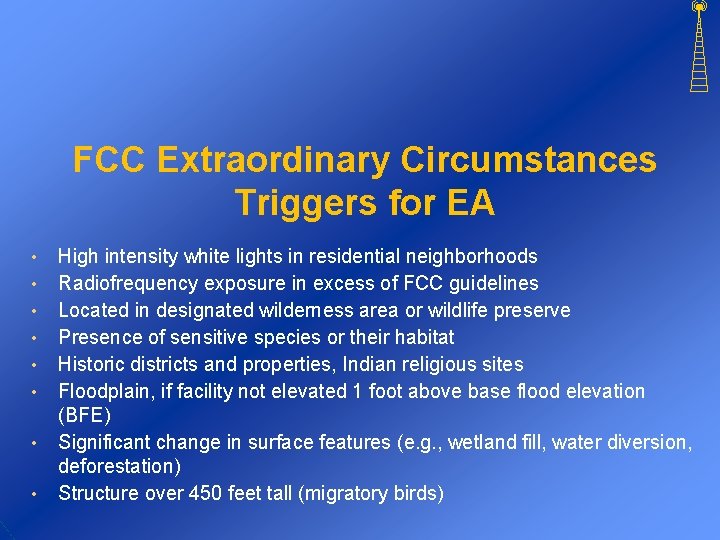
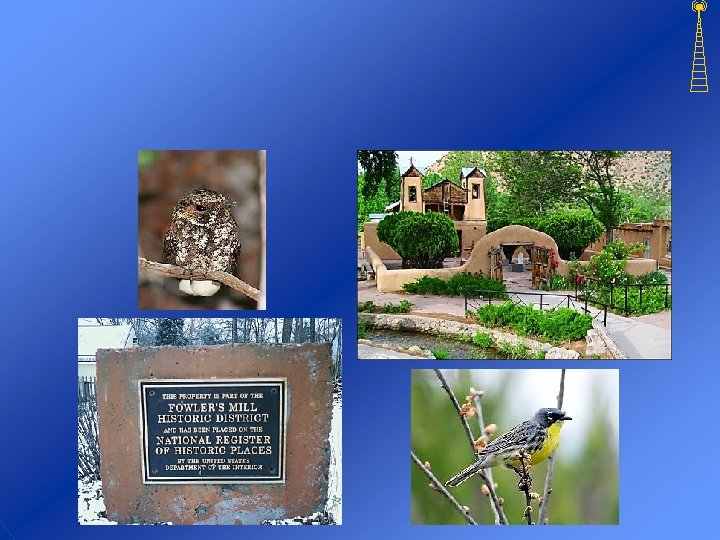
FCC Extraordinary Circumstances Triggers for EA • • High intensity white lights in residential neighborhoods Radiofrequency exposure in excess of FCC guidelines Located in designated wilderness area or wildlife preserve Presence of sensitive species or their habitat Historic districts and properties, Indian religious sites Floodplain, if facility not elevated 1 foot above base flood elevation (BFE) Significant change in surface features (e. g. , wetland fill, water diversion, deforestation) Structure over 450 feet tall (migratory birds)
Who Needs to Comply? Registrants - Tower owners needing to register for aircraft navigation safety Non licensee tower owners wanting towers available for collocators • Licensees and spectrum lessees - Commercial licensees, utilities, broadcasters, railroad, mining companies… - Site specific (e. g. public safety) and geographic area licenses •
How to Comply: FCC Form 854/Form 601 • • • Prior to FCC’s granting an application, an applicant must certify that the proposed antenna structure will not have a significant effect on the environment. Certifying means all statements are “true, complete, correct, and made in good faith. ” To answer questions and to certify, complete the NEPA Checklist in the regulations. If any circumstances are present so that the project might have a significant effect, the applicant must submit an EA. Retain the Checklist for your records.
NEPA Checklist Will the facility be located in an officially designated wilderness area? • Will it be located in an officially designated wildlife preserve? • Will the facility affect listed or jeopardize proposed threatened or endangered species (TES) or designated critical habitat? • Will the facility affect districts, sites, buildings, structures or objects significant in American history, architecture, archaeology, engineering or culture that are listed, or are eligible for listing in the National Register of Historic Places? • Will the facility affect Indian religious sites? • Will it be located in a floodplain and not be elevated 1 foot above BFE? • Will construction involve “significant change in surface features (e. g. , wetland fill, deforestation or water diversion)”? • Will the facility be over 450 feet (so might affect migratory birds)? • Will the facility have high intensity white lights in residentially zoned neighborhood? • Radio Frequency exposure? All other facility deployments are categorically excluded. •
Premature Construction/Clearance A licensee (site specific or geographic) or applicant violates Section 1. 1312 if it begins constructing a facility, including clearing soil or vegetation, disturbing ground or digging, before ascertaining whether the facility may have a significant environmental impact by reviewing the NEPA Checklist.
Form 601 Application for WTB Radio Service Authorization Would a Commission grant of authorization for this location be an action which may have a significant environmental effect? (22 of Schedule I, 26 of D, 48 of M) See 47 CFR 1. 1307. • If “Yes, ” submit an EA in accordance with 47 CFR Sections 1. 1308 and 1. 1311. This item is required for compliance with NEPA. See also Part 1, Subpart I of the FCC rules (47 CFR 1. 1301 1. 1319).
Form 854 Application for Antenna Structure Registration Item 49 Does the applicant certify that authorizations at this location would not have a significant environmental effect pursuant to Section 1. 1307? Before certifying, comply with environmental notice requirements and review Section 1. 1307 checklist. If “no, ” submit an environmental assessment in accordance with 47 CFR 1. 1308 and 1. 1311.
Options Once an EA is Triggered Begin the EA Process; FCC approval typically takes about 45 days. OR Consult with agencies on changes to eliminate or mitigate triggering effects. OR Consider an alternative site with fewer environmental impacts.
When EAs are Required EA is required under two circumstances: • Action meets one or more of the specific criteria stated in rules (checklist) e. g. , may affect historic properties or Indian religious sites adverse effect found through Section 106 process; may affect threatened or endangered species or critical habitat if USFWS required formal consultation and Biological Assessment. ; involves a wetland or other significant change in surface feature. • FCC orders EA in response to petition or on its own motion EA requirement applies, if triggered, even if project excluded from Section 106 review
Contents of EA Requirements outlined in 47 CFR 1. 1311 • In addition to addressing all factors in 47 CFR 1. 1307(a) and (b), the EA must include info on site selection and alternatives sites, impact of operation and maintenance in sensitive areas, extent of unavoidable effects, features of site with special environmental significance, evidence of site approval by other agencies… Not just a summary of checklist. • Specific expectations for each factor are spelled out in EA checklist (under revision)
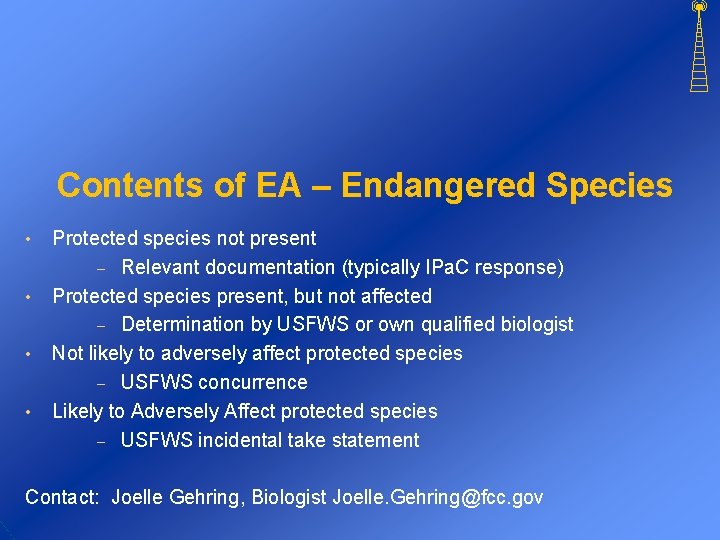
Contents of EA – Endangered Species • • Protected species not present - Relevant documentation (typically IPa. C response) Protected species present, but not affected - Determination by USFWS or own qualified biologist Not likely to adversely affect protected species - USFWS concurrence Likely to Adversely Affect protected species - USFWS incidental take statement Contact: Joelle Gehring, Biologist Joelle. Gehring@fcc. gov
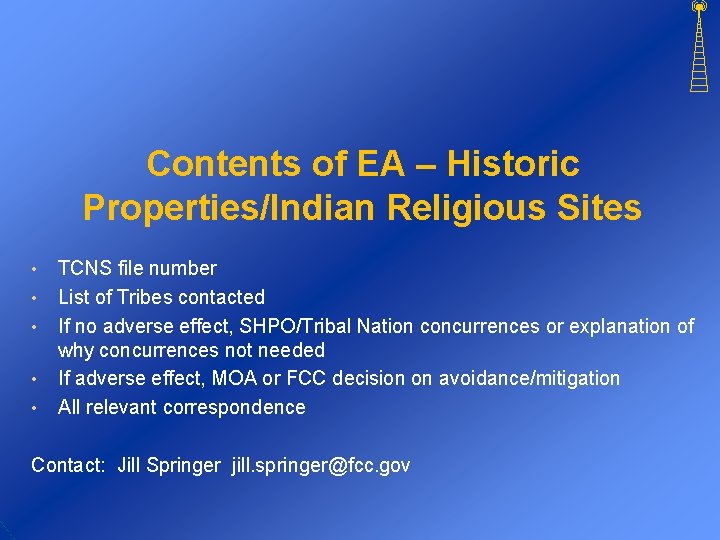
Contents of EA – Historic Properties/Indian Religious Sites • • • TCNS file number List of Tribes contacted If no adverse effect, SHPO/Tribal Nation concurrences or explanation of why concurrences not needed If adverse effect, MOA or FCC decision on avoidance/mitigation All relevant correspondence Contact: Jill Springer jill. springer@fcc. gov
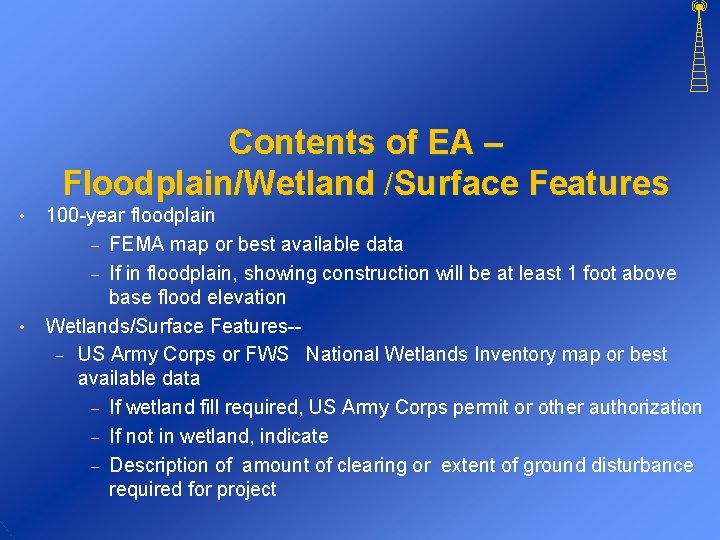
Contents of EA – Floodplain/Wetland /Surface Features • • 100 year floodplain - FEMA map or best available data - If in floodplain, showing construction will be at least 1 foot above base flood elevation Wetlands/Surface Features - US Army Corps or FWS National Wetlands Inventory map or best available data - If wetland fill required, US Army Corps permit or other authorization - If not in wetland, indicate - Description of amount of clearing or extent of ground disturbance required for project
Contents of EA – Other Factors Migratory Birds • Wilderness area/wildlife preserve (generally on federal land) - Relevant databases, maps, etc. - If in protected area, relevant approvals or permits • High-intensity white lights - Type of lights - Location (will not use high-intensity white lights in residentially zoned area) • Radiofrequency exposure - Certification of compliance with Commission guidelines •
Processing of EAs Placed on Public Notice within one week • Completeness review by Day 20. • 30 day comment period • Staff may request additional information - Will not delay processing if timely response and no material change • If no issues or petitions to deny, FONSI granted within 45 days •
Environmental Review • • If after review, no significant impact, applicant certifies and if no request for further environmental review (854) or petitions to deny (601) or agency ID’d issues, application granted. If an EA was prepared, and no significant issues, the Commission can issue a FONSI. If the Bureau determines that a proposal will have a significant effect, the applicant will then have an opportunity to amend its application so as to reduce, minimize, eliminate environmental problems. Section 1. 1308(c) If an applicant cannot certify no significant impact, FCC can prepare an EIS or the applicant can withdraw the application.
Other Agencies • No EA is needed if another agency has done NEPA • Federal land management agency EAs and EISs are sufficient, but not Cat. Exs
Enforcement Actions • Letters document compliance violations and formally warn that future violations could result in penalties or referrals to the Enforcement Bureau. WTB violation letters build a clear record to identify repeat offenders and facilitate appropriate action to address future violations. - Letters may be published on the FCC website and have been covered in the trade press. - • The FCC can take further action, including monetary fines and other penalties.
Compliance Review • Failure to perform required environmental and historic preservation review prior to construction can result in significant delays in deployment. • Work should not proceed during investigation. • Investigations may take time. - Information gathering/document production - Case review - Potential site visit - Course of action evaluation (Enforcement Bureau referral or WTB issued letter)
Environmental Compliance Violations • • • Failure to complete environmental review requirements (e. g. , wetlands, Section 106, Tribal reviews, ESA) prior to ground disturbance or construction. Falsely certifying “No Environmental Effect” in application. Failure to submit EA when triggered by the environmental checklist (major modification). Construction—including ground disturbance or clearing- prior to FCC issuing a FONSI following filing and public notice of EA. Failure to complete required mitigation. Failure to register a tower prior to construction.
Reminders • • • The height/design of a tower does not determine whether a proposed tower is subject to the NEPA process – some level of review is required, even if ultimately Cat. Exed Antenna Structure Registration requires environmental notice, even without an EA The grant of a license is not permission to construct; even with a license, building or disturbing ground without following environmental regulations can be a rule violation. A licensee must consider environmental effects and if necessary, complete an EA before constructing facilities or disturbing ground on a site not otherwise requiring pre construction authorization Refer to rules (1. 1307 (checklist), 1. 1311(EAs) throughout process, not only form instructions and checklists
More Reminders No public safety exception: Rules apply to public safety entities regardless of whether: • the proposed tower is on state, county, or locally owned land; • a commercial collocator is on site; or • the proposed project is a replacement tower. No replacement tower exception: Section 106 exception for replacement towers does not apply to NEPA—unless facility is in a right of way.
Questions? Contact: Erica Rosenberg Erica. Rosenberg@FCC. gov 202. 418. 1343