
FCChh Luminosity Evolution and Ultimate Parameters Daniel Schulte
- Slides: 12
FCC-hh Luminosity Evolution and Ultimate Parameters Daniel Schulte, Michael Benedikt, Frank Zimmermann CERN December 2014
Motivation • Baseline parameters are based on reasonable assumptions • Many technology and beam studies are required to establish validity of current baseline, e. g. magnets, beam power issues, … • Simplifications made for baseline parameters • Need to explore how far the beam parameters can be pushed • To achieve higher performance • To improve cost and relax specifications • For both a simplified model of the luminosity evolution and the average luminosity is required, including • Beam-beam limits, beam burn-off, beam lifetime (e. g. beam-gas scattering), emittance damping, synchrotron radiation heating, intrabeam scattering, … • Xavier is developing this tool • Need also to guide the parameter exploration FCC-hh Ultimate Parameters Daniel Schulte CERN, December 2014 2
Parameter Sets • To focus the parameter exploration studies we introduce an additional “ultimate” parameter set • Goal is that one can reasonably hope to achieve this performance after some operational experience with FCC and by improving the hardware, e. g. introducing crab cavities • Similar concept has been followed for LHC • This will lead to two parameter sets: baseline and ultimate. • Further parameter sets might come • E. g. for staging scenarios • or further exploration of the parameter space • But the stable centre will be the baseline set (=promise) and the ultimate parameter set (=reasonable hope) • Those will be the ones shown in a general FCC presentation FCC-hh Ultimate Parameters Daniel Schulte CERN, December 2014 3
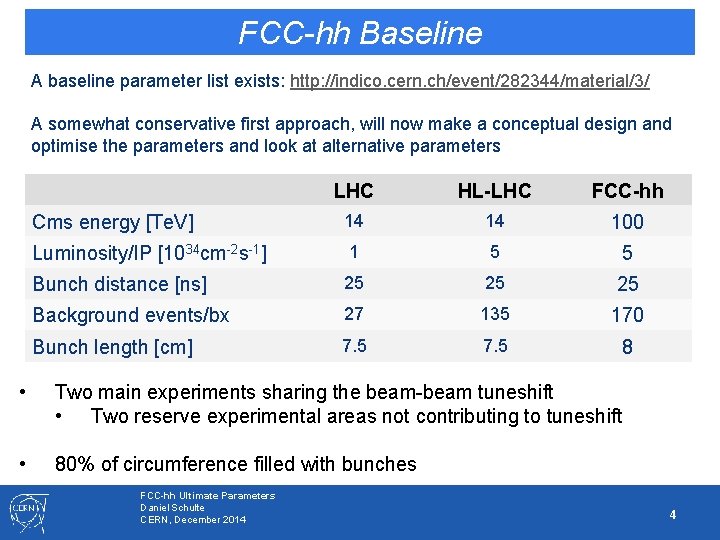
FCC-hh Baseline A baseline parameter list exists: http: //indico. cern. ch/event/282344/material/3/ A somewhat conservative first approach, will now make a conceptual design and optimise the parameters and look at alternative parameters LHC HL-LHC FCC-hh Cms energy [Te. V] 14 14 100 Luminosity/IP [1034 cm-2 s-1] 1 5 5 Bunch distance [ns] 25 25 25 Background events/bx 27 135 170 Bunch length [cm] 7. 5 8 • Two main experiments sharing the beam-beam tuneshift • Two reserve experimental areas not contributing to tuneshift • 80% of circumference filled with bunches FCC-hh Ultimate Parameters Daniel Schulte CERN, December 2014 4
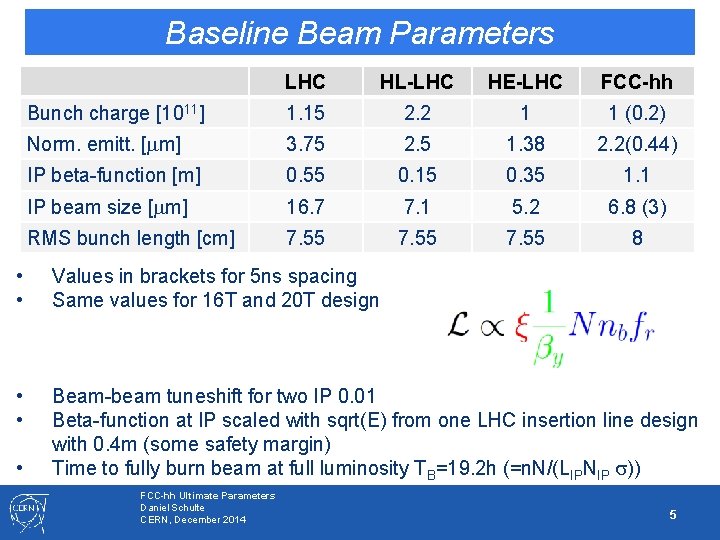
Baseline Beam Parameters LHC HL-LHC HE-LHC FCC-hh Bunch charge [1011] 1. 15 2. 2 1 1 (0. 2) Norm. emitt. [mm] 3. 75 2. 5 1. 38 2. 2(0. 44) IP beta-function [m] 0. 55 0. 15 0. 35 1. 1 IP beam size [mm] 16. 7 7. 1 5. 2 6. 8 (3) RMS bunch length [cm] 7. 55 8 • • Values in brackets for 5 ns spacing Same values for 16 T and 20 T design • • Beam-beam tuneshift for two IP 0. 01 Beta-function at IP scaled with sqrt(E) from one LHC insertion line design with 0. 4 m (some safety margin) Time to fully burn beam at full luminosity TB=19. 2 h (=n. N/(LIPNIP s)) • FCC-hh Ultimate Parameters Daniel Schulte CERN, December 2014 5
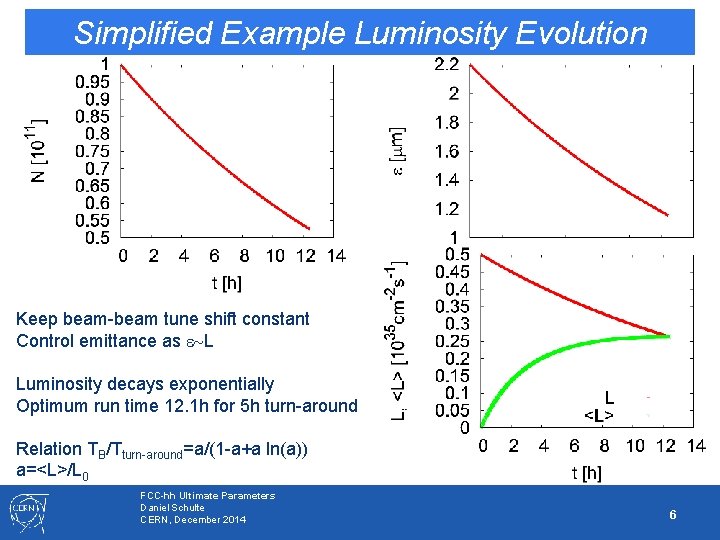
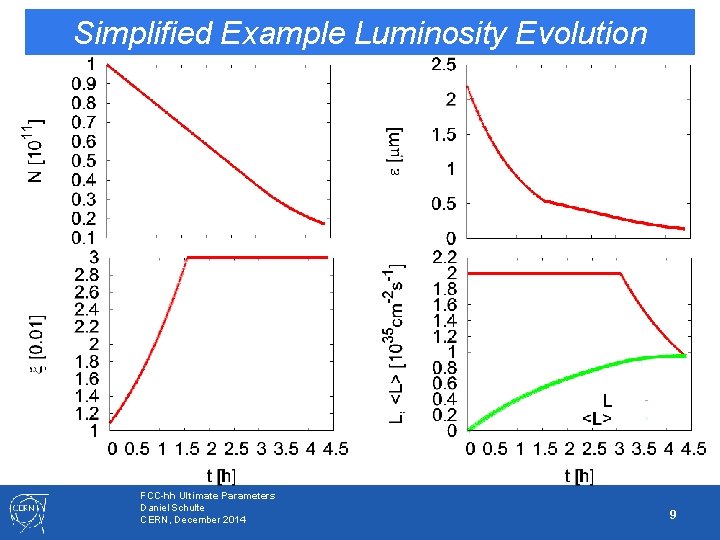
Simplified Example Luminosity Evolution Keep beam-beam tune shift constant Control emittance as e~L Luminosity decays exponentially Optimum run time 12. 1 h for 5 h turn-around Relation TB/Tturn-around=a/(1 -a+a ln(a)) a=<L>/L 0 FCC-hh Ultimate Parameters Daniel Schulte CERN, December 2014 6
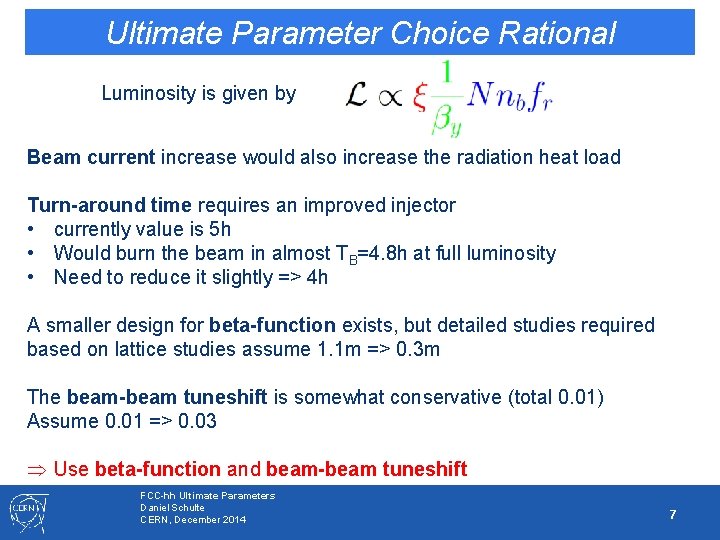
Ultimate Parameter Choice Rational Luminosity is given by Beam current increase would also increase the radiation heat load Turn-around time requires an improved injector • currently value is 5 h • Would burn the beam in almost TB=4. 8 h at full luminosity • Need to reduce it slightly => 4 h A smaller design for beta-function exists, but detailed studies required based on lattice studies assume 1. 1 m => 0. 3 m The beam-beam tuneshift is somewhat conservative (total 0. 01) Assume 0. 01 => 0. 03 Use beta-function and beam-beam tuneshift FCC-hh Ultimate Parameters Daniel Schulte CERN, December 2014 7
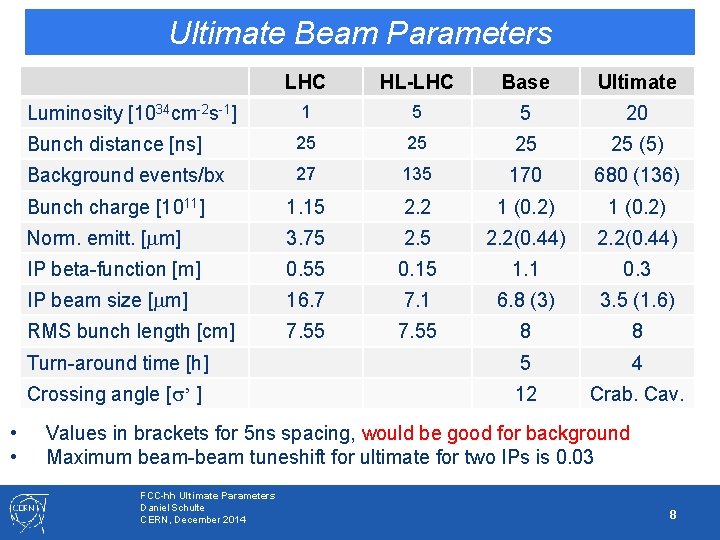
Ultimate Beam Parameters • • LHC HL-LHC Base Ultimate Luminosity [1034 cm-2 s-1] 1 5 5 20 Bunch distance [ns] 25 25 (5) Background events/bx 27 135 170 680 (136) Bunch charge [1011] 1. 15 2. 2 1 (0. 2) Norm. emitt. [mm] 3. 75 2. 2(0. 44) IP beta-function [m] 0. 55 0. 15 1. 1 0. 3 IP beam size [mm] 16. 7 7. 1 6. 8 (3) 3. 5 (1. 6) RMS bunch length [cm] 7. 55 8 8 Turn-around time [h] 5 4 Crossing angle [s’ ] 12 Crab. Cav. Values in brackets for 5 ns spacing, would be good for background Maximum beam-beam tuneshift for ultimate for two IPs is 0. 03 FCC-hh Ultimate Parameters Daniel Schulte CERN, December 2014 8
Simplified Example Luminosity Evolution FCC-hh Ultimate Parameters Daniel Schulte CERN, December 2014 9
Note: Circumference, Magnets, Energy For the civil engineering studies we maintain the 93 km and 100 km tunnels (3. 5 and 3. 75 times the LHC circumference) We will maintain a baseline parameter list for 100 km and regard 93 km as an alternative until these studies come to a conclusion Rarc=(C-16. 8 km-16*(1 -a)*Ldisp)/(2 p) Ldisp=0. 4 km a=0. 75 Reffective=0. 805 Rarc This allows to reach Ecms=100 Te. V with 16 T magnets 93 km would lead to Ecms=91. 5 Te. V FCC-hh Ultimate Parameters Daniel Schulte CERN, December 2014 10
Note: Availability Assumptions: • Three year operating cycles • Two years of operation • One year of shut-down • i. e. 720 in three years • One quarter used for commissioning, MDs, … • 540 days of scheduled luminosity operation • 70% of actual luminosity operation • 378 days of effective operation • i. e. 126 per year • i. e. 1. 08864 x 107 s/year • L 0=5 x 1034 cm-2 s-1 <L>/L 0=0. 46 leads to 250 fb-1 per year FCC-hh Ultimate Parameters Daniel Schulte CERN, December 2014 11
Conclusion Luminosity evolution model is important • A number of simplification made sofar • E. g. neglected beam heating by IBS and synchrotron radiation • E. g. neglected beam loss through other processes than luminosity • … Include relevant effects and check their importance/define budgets Parameter space exploration is important • To make sure we do not inhibit later performance improvements • To identify potential to relax specifications • To understand margins We are introducing an ultimate parameter set to focus parameter space exploration Good test case for luminosity evolution studies FCC-hh Ultimate Parameters Daniel Schulte CERN, December 2014 12