
FCC Meeting CBRS License Areas and Practical Deployment
FCC Meeting CBRS License Areas and Practical Deployment of Network CBSDs April 3, 2018
CBRS Rules Create Substantial Deployment Problems • The CBRS rules currently specify the use of Census Tracts for Priority Access Licensees (PALs), which are very small license areas • AT&T requested Comm. Scope to analyze the practical impact of the CBRS interference protection rules given the small market areas, based on part 96 rules • The study demonstrates that the small license areas will create significant deployment issues – Unable to deploy so as to cover the entire tract – Can deploy, but to cover the border areas, must severely limit power and deploy many more CBSDs than what may be actually needed • AT&T accordingly recommends substantially increasing the size of licenses in urban areas to limit near-border impacts 9/16/2020 1
Current CBRS Border Coordination Requirements • The rules specify a PAL protected area (PPA) based on a -96 d. Bm/10 MHz contour (47 CFR § 96. 26(c)(2)) – The PPA contour at maximum power in many cases, especially in urban areas, would be larger than the Census Tract and therefore the power would have to be limited to bring the PPA within the Census Tract boundary (47 CFR § 96. 26(c)(3)) or the PPA would be defined by the Census Tract boundary • The rules also provide for an aggregate CBSD signal level of -80 d. Bm/10 MHz for all CBSDs deployed around a Census Tract (47 CFR § 96. 41(d)) – The aggregate interference may impose limits that mean a provider may not be able to take advantage of the 47 d. Bm/10 MHz EIRP for outdoor devices in the band – The -80 d. Bm/10 MHz limit creates a daisy-chain of relationships between adjacent tracts, and tracts adjacent to those tracts, etc – To determine what impact a CBSD might have on a particular PAL in an adjacent Census Tract, you need to look at least two Census Tracts deep • The rules provides for outdoor CAT B power levels – 47 d. Bm/10 MHz – CBRS use cases depend upon CAT B deployments 9/16/2020 2
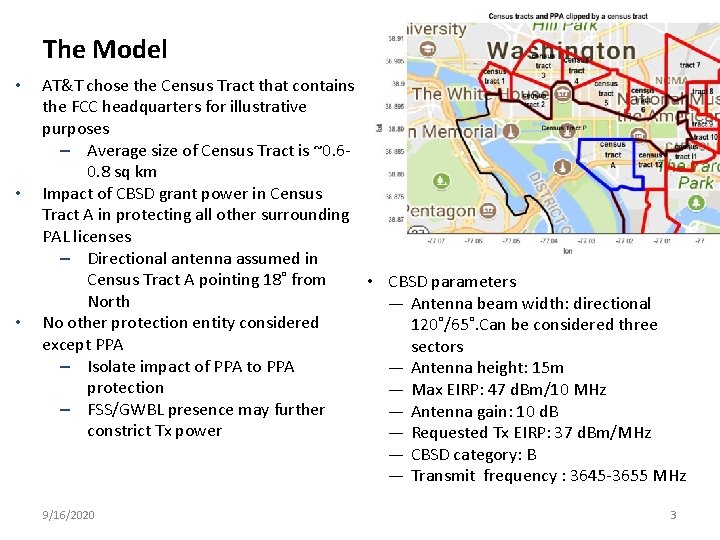
The Model • • • AT&T chose the Census Tract that contains the FCC headquarters for illustrative purposes – Average size of Census Tract is ~0. 60. 8 sq km Impact of CBSD grant power in Census Tract A in protecting all other surrounding PAL licenses – Directional antenna assumed in Census Tract A pointing 18˚ from • CBSD parameters North — Antenna beam width: directional No other protection entity considered 120˚/65˚. Can be considered three except PPA sectors – Isolate impact of PPA to PPA ― Antenna height: 15 m protection ― Max EIRP: 47 d. Bm/10 MHz – FSS/GWBL presence may further ― Antenna gain: 10 d. B constrict Tx power ― Requested Tx EIRP: 37 d. Bm/MHz ― CBSD category: B ― Transmit frequency : 3645 -3655 MHz 9/16/2020 3
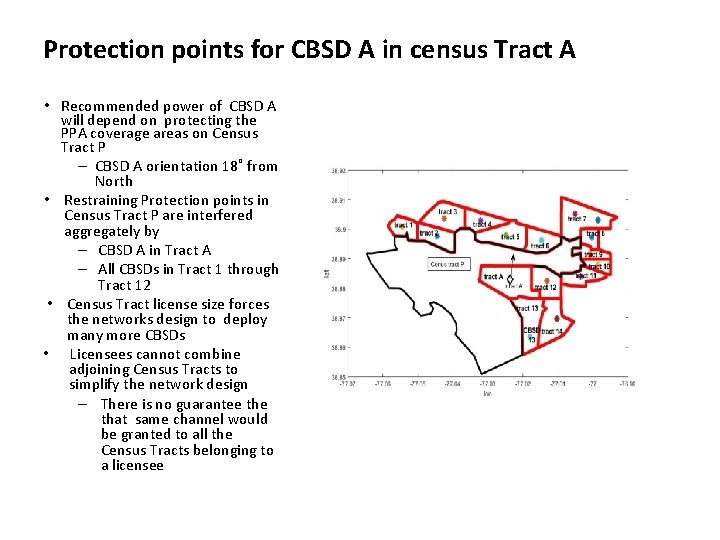
Protection points for CBSD A in census Tract A • Recommended power of CBSD A will depend on protecting the PPA coverage areas on Census Tract P – CBSD A orientation 18˚ from North • Restraining Protection points in Census Tract P are interfered aggregately by – CBSD A in Tract A – All CBSDs in Tract 1 through Tract 12 • Census Tract license size forces the networks design to deploy many more CBSDs • Licensees cannot combine adjoining Census Tracts to simplify the network design – There is no guarantee that same channel would be granted to all the Census Tracts belonging to a licensee
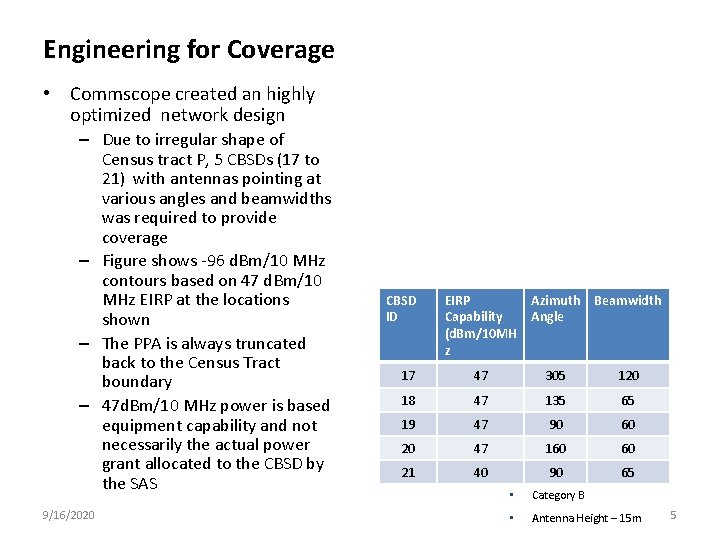
Engineering for Coverage • Commscope created an highly optimized network design – Due to irregular shape of Census tract P, 5 CBSDs (17 to 21) with antennas pointing at various angles and beamwidths was required to provide coverage – Figure shows -96 d. Bm/10 MHz contours based on 47 d. Bm/10 MHz EIRP at the locations shown – The PPA is always truncated back to the Census Tract boundary – 47 d. Bm/10 MHz power is based equipment capability and not necessarily the actual power grant allocated to the CBSD by the SAS 9/16/2020 CBSD ID EIRP Capability (d. Bm/10 MH z Azimuth Angle Beamwidth 17 47 305 120 18 47 135 65 19 47 90 60 20 47 160 60 21 40 90 65 • Category B • Antenna Height – 15 m 5
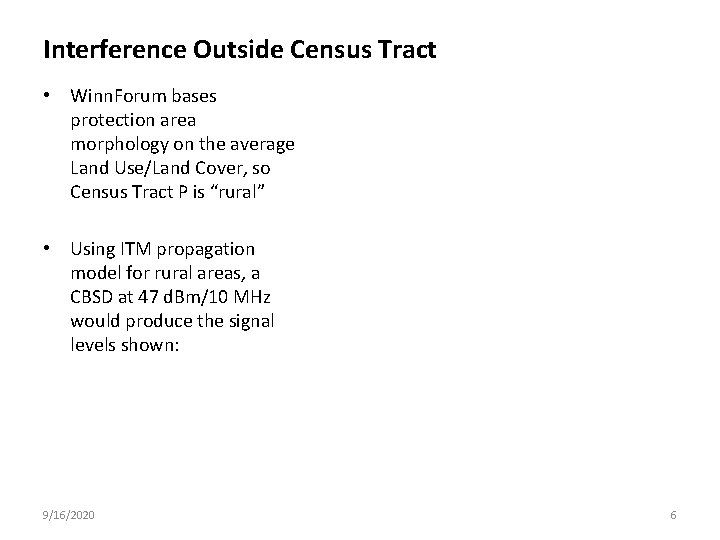
Interference Outside Census Tract • Winn. Forum bases protection area morphology on the average Land Use/Land Cover, so Census Tract P is “rural” • Using ITM propagation model for rural areas, a CBSD at 47 d. Bm/10 MHz would produce the signal levels shown: 9/16/2020 6
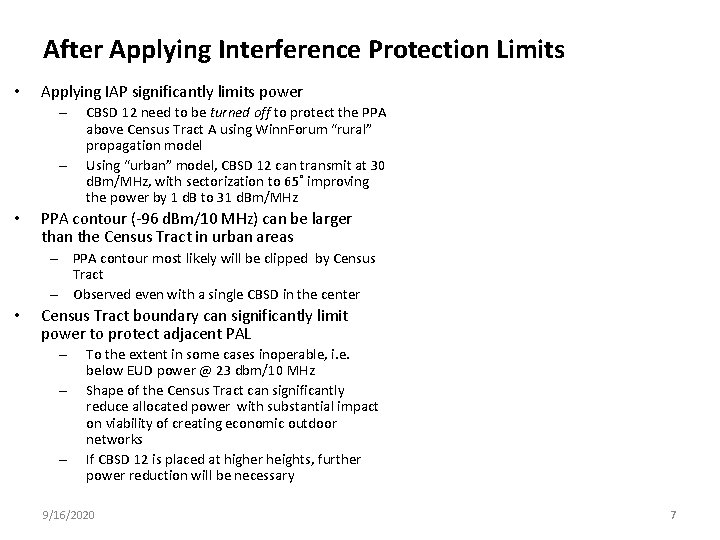
After Applying Interference Protection Limits • Applying IAP significantly limits power – – • CBSD 12 need to be turned off to protect the PPA above Census Tract A using Winn. Forum “rural” propagation model Using “urban” model, CBSD 12 can transmit at 30 d. Bm/MHz, with sectorization to 65˚ improving the power by 1 d. B to 31 d. Bm/MHz PPA contour (-96 d. Bm/10 MHz) can be larger than the Census Tract in urban areas – PPA contour most likely will be clipped by Census Tract – Observed even with a single CBSD in the center • Census Tract boundary can significantly limit power to protect adjacent PAL – – – To the extent in some cases inoperable, i. e. below EUD power @ 23 dbm/10 MHz Shape of the Census Tract can significantly reduce allocated power with substantial impact on viability of creating economic outdoor networks If CBSD 12 is placed at higher heights, further power reduction will be necessary 9/16/2020 7
Practical Impact on PAL Licensees • Unable to deploy so as to cover the entire Census Tract, or • Can deploy, but to cover the border areas, must severely limit power and deploy many more CBSDs than what may be actually needed. – – 9/16/2020 Increase in equipment costs Increase in maintenance costs More backhaul needed (more equipment and costs) More approvals for mounting CBSDs needed (local zoning, building owners, etc) 8
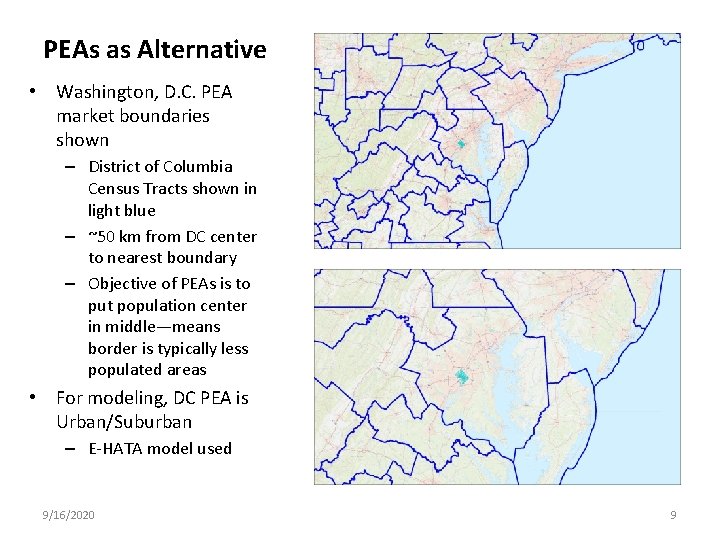
PEAs as Alternative • Washington, D. C. PEA market boundaries shown – District of Columbia Census Tracts shown in light blue – ~50 km from DC center to nearest boundary – Objective of PEAs is to put population center in middle—means border is typically less populated areas • For modeling, DC PEA is Urban/Suburban – E-HATA model used 9/16/2020 9
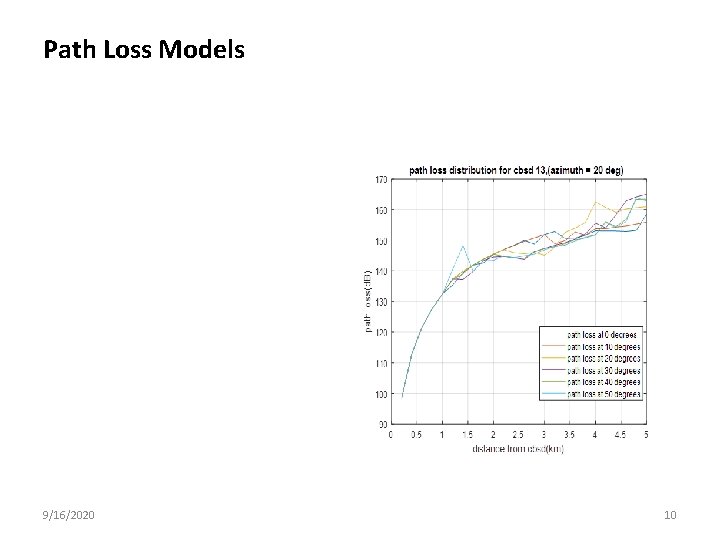
Path Loss Models 9/16/2020 10
PPA Protection for DC PEA • Approximately 143 d. B Path loss is realized at PPA contour – EIRP 47 d. Bm/10 MHz and coverage contour is -96 d. Bm/10 MHz • Approximately 127 d. B path loss required to be below -80 d. Bm/10 MHz interference protection to adjacent Census Tract – With 10 surrounding CBSD Path loss would be 137 d. B • In urban and suburban environment – At least 2 km distance needed to realize ~127 -137 d. B loss – Protection with mean (not median) -80 d. Bm/10 MHz with the current Winn. Forum requirement will add 10 d. B more – Will require at least 4 km distance from transmitter to have interference below ‑ 80 d. Bm/10 MHz • PPA needs to be at least 2 -4 km from transmitter site – Significant Census Tract boundaries in DC are less than 0. 5 km from centroid • PEA area allows to plan CBSD locations inward so that CBSD power is not interference limited by adjacent licensee – Impossible to do this in Census Tract as it interferes with adjacent Census Tract even when placed in middle 9/16/2020 11
Conclusion • In urban areas, the small size of the Census Tracts can create significant practical deployment issues given the need to adjust power to protect adjacent licensees • Net impact is that providers will not be able to deploy networks operating at 47 d. Bm/10 MHz, but will instead be forced to very, very dense network deployments – Super small cell deployments forced by protection of adjacent licensees – Super small cell deployments forced by irregular borders of Census Tracts • Practical example using FCC Census Tract demonstrates 7 d. B in power reduction – FCC Census Tract is large compared to other Census Tracts bounding National Mall – National Mall and Federal Triangle are precisely the types of areas where robust outdoor coverage would be beneficial – Max allowed power from outdoor sites is essential to provide adequate indoor coverage • PEAs would permit deploying at max power for coverage and limiting impact of border areas 9/16/2020 12
- Slides: 13