
FaultTolerance in Avionics Systems Jonathan Herman 1 Overview

- Slides: 41
Fault-Tolerance in Avionics Systems Jonathan Herman 1
Overview �Introduction �Byzantine Faults �Common Mode Faults �Fault Tolerant Scheduler �History and Examples 2
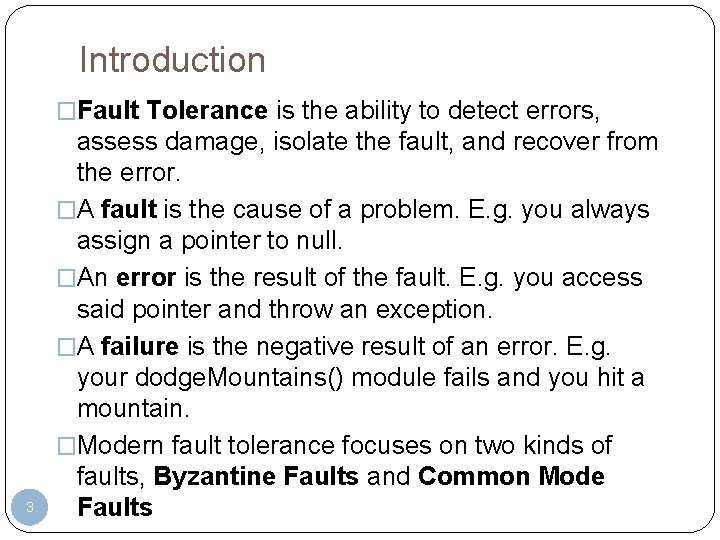
Introduction �Fault Tolerance is the ability to detect errors, 3 assess damage, isolate the fault, and recover from the error. �A fault is the cause of a problem. E. g. you always assign a pointer to null. �An error is the result of the fault. E. g. you access said pointer and throw an exception. �A failure is the negative result of an error. E. g. your dodge. Mountains() module fails and you hit a mountain. �Modern fault tolerance focuses on two kinds of faults, Byzantine Faults and Common Mode Faults
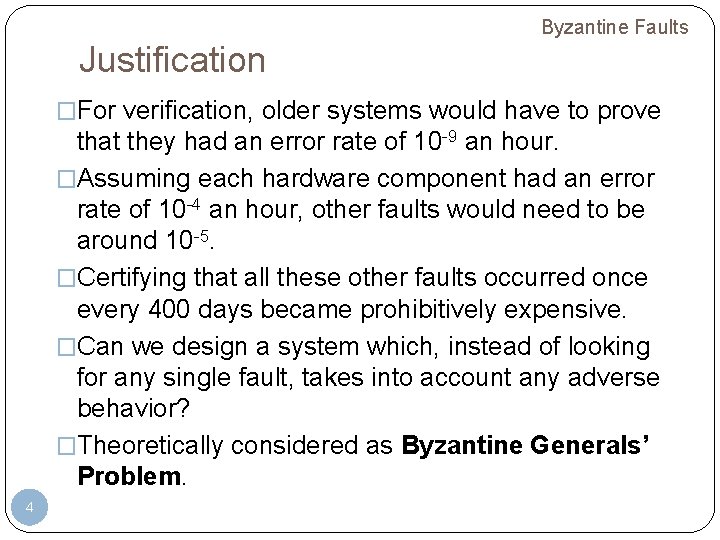
Byzantine Faults Justification �For verification, older systems would have to prove that they had an error rate of 10 -9 an hour. �Assuming each hardware component had an error rate of 10 -4 an hour, other faults would need to be around 10 -5. �Certifying that all these other faults occurred once every 400 days became prohibitively expensive. �Can we design a system which, instead of looking for any single fault, takes into account any adverse behavior? �Theoretically considered as Byzantine Generals’ Problem. 4
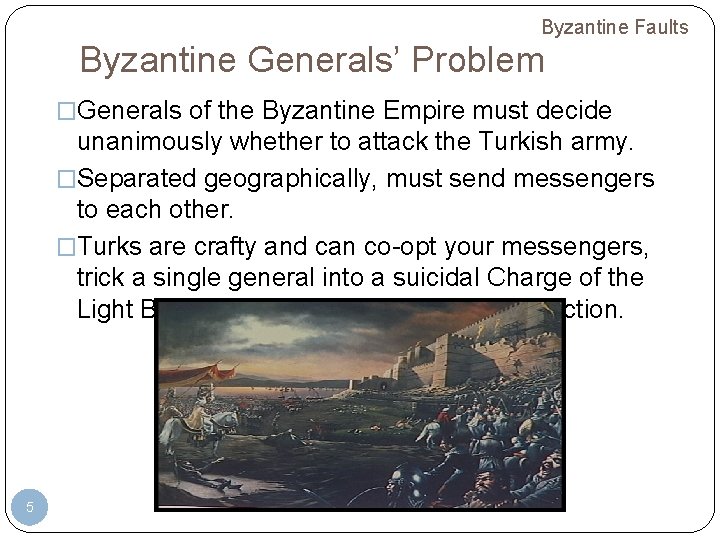
Byzantine Faults Byzantine Generals’ Problem �Generals of the Byzantine Empire must decide unanimously whether to attack the Turkish army. �Separated geographically, must send messengers to each other. �Turks are crafty and can co-opt your messengers, trick a single general into a suicidal Charge of the Light Brigade, or confuse generals into inaction. 5
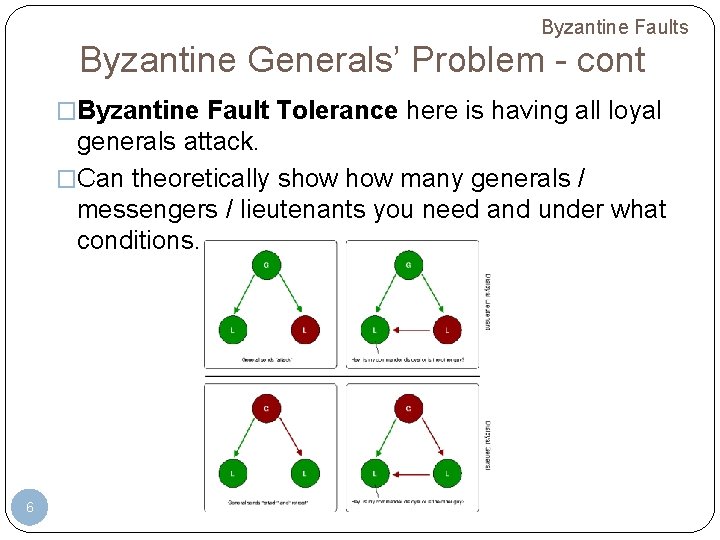
Byzantine Faults Byzantine Generals’ Problem - cont �Byzantine Fault Tolerance here is having all loyal generals attack. �Can theoretically show many generals / messengers / lieutenants you need and under what conditions. 6
Byzantine Faults Byzantine Resilience �A Byzantine Fault consists of any arbitrary behavior from a failed component. Could include: �Sending different output to different destinations �Starting and stopping execution randomly �Can also be thought of as any unpredicted 7 hardware error. �A Byzantine Resilient system makes no assumption about component behavior. �Show instead that if any single component fails, you can survive. �Byzantine Resilience theory can specify exact number of components / algorithms needed, though in practice systems aren’t entirely resilient but use theory to show their error rate meets certain metrics.
Byzantine Faults Fault Containment Region �Systems are partitioned into Fault Containment Regions, your Byzantine generals. �Errors outside a Fault Containment Region (FCR) cannot cause an error inside, nor can error inside propagate outside. �In practice, usually requires that FCR has independent processor, memory, IO, data, and often power. 8
Byzantine Faults Voting �Voting is one method of using multiple FCRs, where a voter takes output from the FCRs and decides the correct output. � 3 varieties: Exact: output values must match bit for bit. 2. Approximate: values must be w/in a certain range of avg. 3. Mechanical: system physically creates correct output. E. g. �Each component provides a fraction of force needed to move output �A bad component will have its output overwhelmed by good 1. 9
Byzantine Faults Voting Applications �Your messengers must be Byzantine Resilient also. �Inputs, such as samples of sensor data, can also use a voter. �Most aircraft provide redundant sensors. �Transmission media can use voters and multiple connections. �Voters are components! They must be extremely reliable or the system is pointless. �Voting is often used to vote on the state of a component. 10
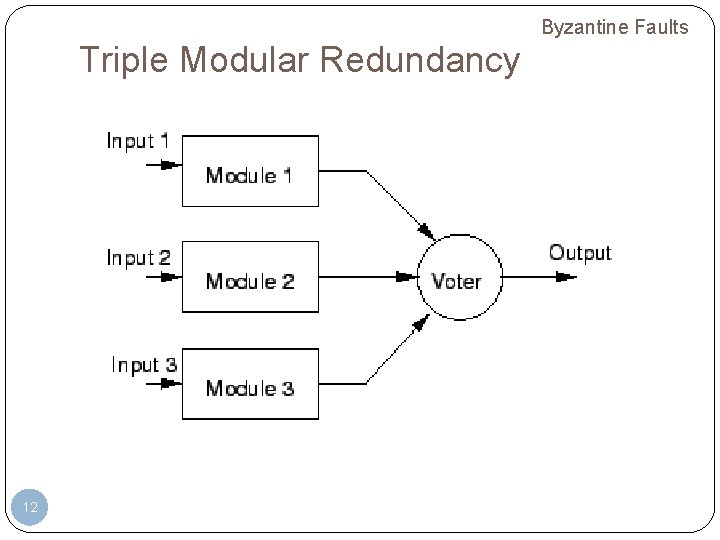
Byzantine Faults Triple Modular Redundancy �Originated with Apollo. � 3 systems operate on input. Majority value or average wins. �The voter can optionally shutdown and reconfigure bad components. �Created and used before Byzantine Generals’ paper, though it solves the same problem. �Still widely in use today. �Other applications in: �Minority Report �Rendezvous with Rama 11
Byzantine Faults Triple Modular Redundancy 12
Byzantine Faults Replication �This is not voting. Uses simpler hardware or software to reconcile outputs. 1. Command / Monitor: command is primary CPU, monitor merely checks output of command. 2. Primary / Backup: same as C/M, but backup computer can take over as primary. 3. Hot Swap: backup always has same state as primary for instantaneous replacement. 13
Byzantine Faults Dual - Dual �Two pairs of each processing component, both executing on all input. �In each pair, both components send their output to simple hardware comparator. If it finds that output differs, switches over to other pair until first pair reconfigured / replaced. �Used in lots of old interplanetary satellites. 14
Byzantine Faults Integrated Modular Avionics �IMA recap: instead of distributing systems throughout airplane based on application (say radar CPU, HUD CPU), a network of processing modules runs distributed applications. �If you lose part of the plane other modules can take over your tasks. �Each of these modules is a Fault Containment Region. �Line between TMR, Dual-Dual and IMA is blurry. 15
Byzantine Faults Effects on Software �Programs need to be written without knowledge of hardware resilience. �Even operating systems are unaware of Byzantine Resilience, instead software just assumes that Byzantine Errors don’t happen. �The hardware and software used to detect and isolate faults, mask errors, and reconfigure components are kept separate form any operational software. �Simplifies code. 16
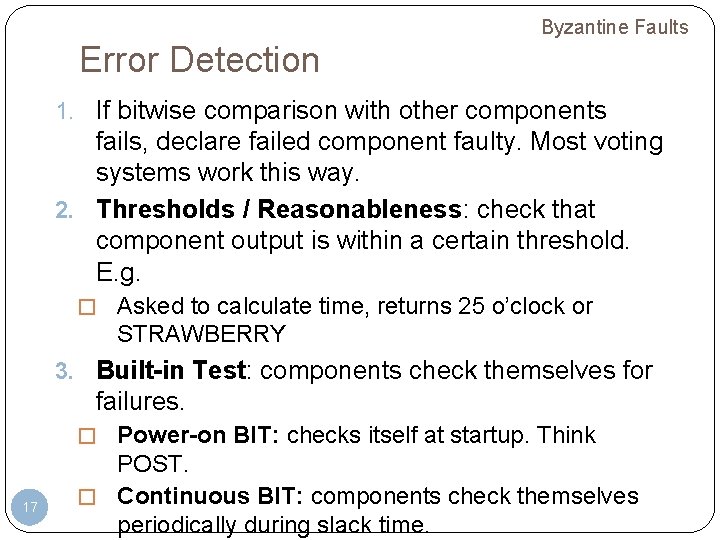
Byzantine Faults Error Detection 1. If bitwise comparison with other components fails, declare failed component faulty. Most voting systems work this way. 2. Thresholds / Reasonableness: check that component output is within a certain threshold. E. g. � Asked to calculate time, returns 25 o’clock or STRAWBERRY 3. Built-in Test: components check themselves for failures. � Power-on BIT: checks itself at startup. Think 17 POST. � Continuous BIT: components check themselves periodically during slack time.
Byzantine Faults Component Synchronization �For components to work together smoothly, their clocks must be synchronized. �Clocks themselves must be Byzantine Resilient (to a certain degree). �Surprise, redundancy needed. �Voting used to determine the specific time. �After time determined, push out to all Fault Containment Regions. 18
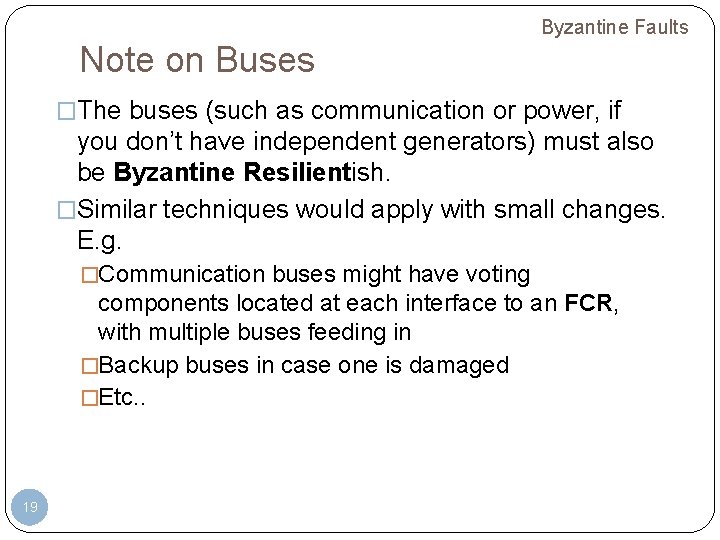
Byzantine Faults Note on Buses �The buses (such as communication or power, if you don’t have independent generators) must also be Byzantine Resilientish. �Similar techniques would apply with small changes. E. g. �Communication buses might have voting components located at each interface to an FCR, with multiple buses feeding in �Backup buses in case one is damaged �Etc. . 19
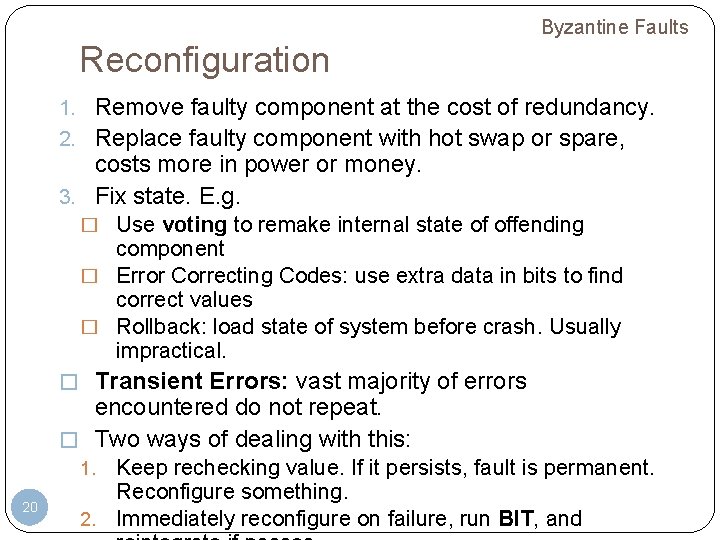
Byzantine Faults Reconfiguration 1. Remove faulty component at the cost of redundancy. 2. Replace faulty component with hot swap or spare, costs more in power or money. 3. Fix state. E. g. � Use voting to remake internal state of offending component � Error Correcting Codes: use extra data in bits to find correct values � Rollback: load state of system before crash. Usually impractical. � Transient Errors: vast majority of errors encountered do not repeat. � Two ways of dealing with this: Keep rechecking value. If it persists, fault is permanent. Reconfigure something. 2. Immediately reconfigure on failure, run BIT, and 1. 20
Overview �Introduction �Byzantine Faults �Common Mode Faults �Fault Tolerant Scheduler �History and Examples 21
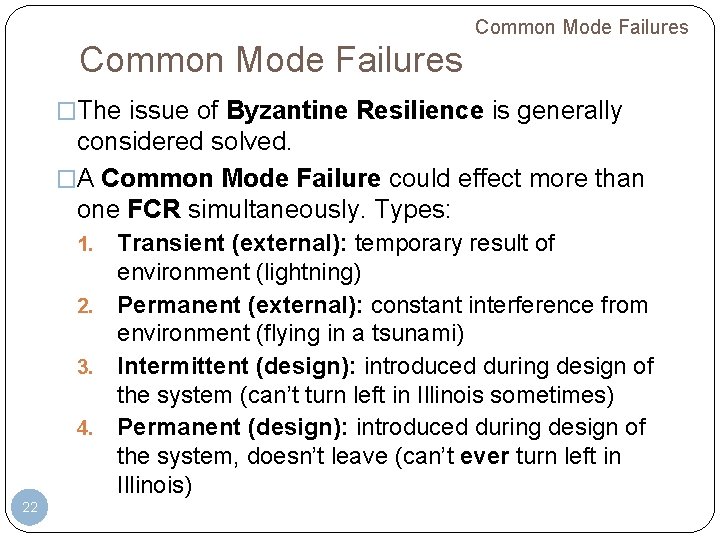
Common Mode Failures �The issue of Byzantine Resilience is generally considered solved. �A Common Mode Failure could effect more than one FCR simultaneously. Types: Transient (external): temporary result of environment (lightning) 2. Permanent (external): constant interference from environment (flying in a tsunami) 3. Intermittent (design): introduced during design of the system (can’t turn left in Illinois sometimes) 4. Permanent (design): introduced during design of the system, doesn’t leave (can’t ever turn left in Illinois) 1. 22
Common Mode Failures - cont �Combat using 3 things: Fault Avoidance during design 2. Fault Removal through testing, evaluation, fault insertion 3. Fault Tolerance through exception handlers and program checkpointing / restarting 1. 23
Common Mode Failures Fault Avoidance 1. Don’t reinvent wheel. �Problems arise because manufactures like to design own hardware �Existing hardware has already been tested / verified in field �COTS hardware offers a cheap alternative with lots of unofficial testing ** �Conform to existing standards for similar reasons 2. Formal Methods �The Space Shuttle takes this approach 3. Design Diversity �Run systems using different hardware / software 24 designed by different teams
Common Mode Failures **Cots Interlude �COTS components are not as rigorously designed and tested for safety as custom-made aircraft components. �Say you wanted to use an IEEE 1394 (Firewire) bus in your airplane. Designed with a tree topology; if you kill a root, you orphan its children. �If you want to use COTS, need to wrap it. Levels: Enhanced Fault Protection: add another layer of hardware /software to monitor / maintain COTS. 2. Fault Protection by Design Diversity: add backup. 1. � 25 3. For 1394 example, this would mean adding different system as backup Fault Protection by Redundancy: replicate the
Common Mode Failures Fault Removal �Basically means test the system rigorously to find problems. �Fault Insertion: fake faults to make sure you system can handle them. 26
Common Mode Failures Fault Tolerance �Watchdog Timers: task which occasionally runs and verifies system state. �Could find an invalid PC, for example �Hardware Exceptions: when invalid hardware operation found, throw and catch hardware exceptions. �Runtime Checks: software exceptions, etc. �Program Checkpointing: periodically save state, reload state when an error is found. Impractical often. �Restarting: always an option. 27
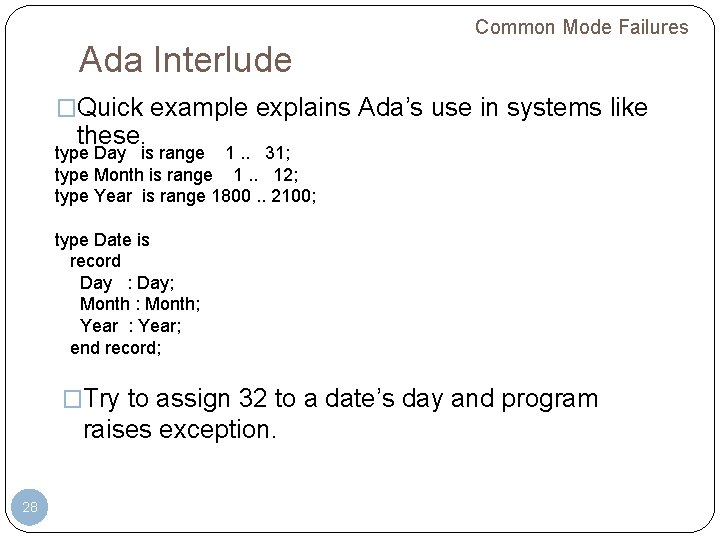
Common Mode Failures Ada Interlude �Quick example explains Ada’s use in systems like these. type Day is range 1. . 31; type Month is range 1. . 12; type Year is range 1800. . 2100; type Date is record Day : Day; Month : Month; Year : Year; end record; �Try to assign 32 to a date’s day and program raises exception. 28
Overview �Introduction �Byzantine Faults �Common Mode Faults �Fault Tolerant Scheduler �History and Examples 29
Scheduler Fault-Tolerant Scheduling Example �Assume we are working with duplicated processing modules (like IMA). �Requirements: 1. Schedule tasks among candidate processors which can handle timing requirements 2. Provide mechanisms for fault tolerance, like managing replicated executions and checking tasks executed successfully � Surprise, the solution involves executing tasks at different modules. � All replicated tasks and any verification of those tasks must complete before task’s deadline. 30
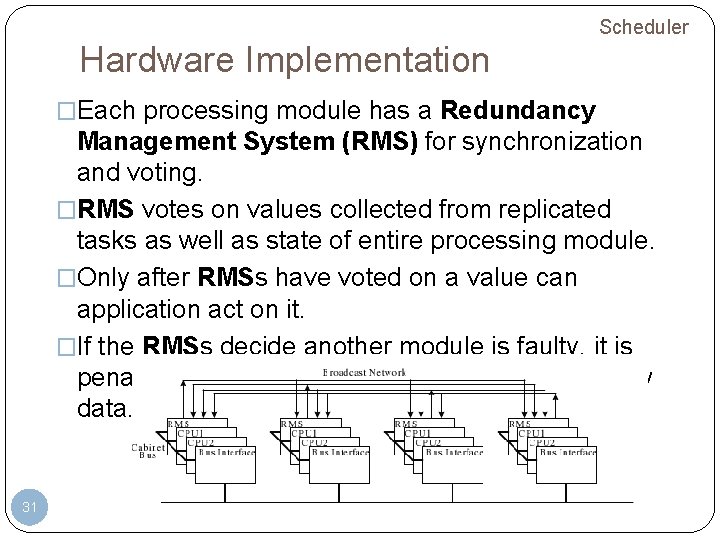
Scheduler Hardware Implementation �Each processing module has a Redundancy Management System (RMS) for synchronization and voting. �RMS votes on values collected from replicated tasks as well as state of entire processing module. �Only after RMSs have voted on a value can application act on it. �If the RMSs decide another module is faulty, it is penalized and given a chance to recover with new data. 31
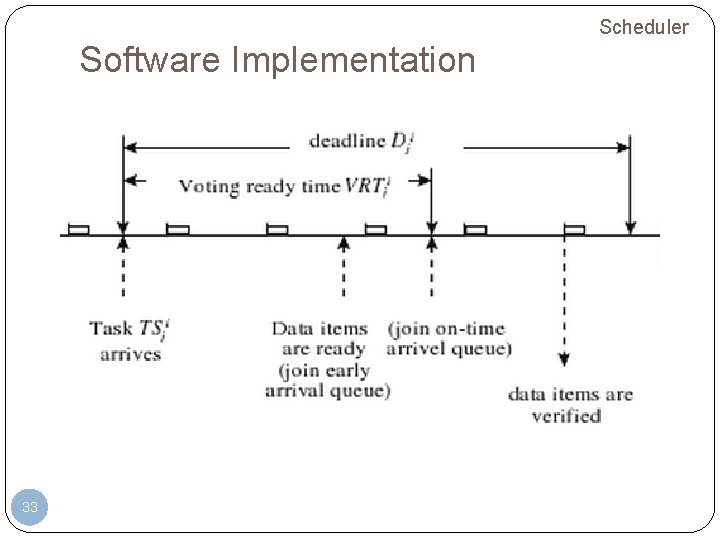
Scheduler Software Implementation �On task release, task is replicated across modules. When the modules task completes, its results are moved to a voting queue. �After the Voting Run Time, which is between the release and deadline of a task, voter is executed and calculates results from voting queue. The Voting Ready Time is determined by the algorithm used. �Any task added to voting queue but not processed by voter must be processed next time around. 32
Scheduler Software Implementation 33
Overview �Introduction �Byzantine Faults �Common Mode Faults �Fault Tolerant Scheduler �History and Examples 34
History and Examples History �Originally, NASA and avionics manufacturers concentrated on fault avoidance. �Apollo had a computer with rigorously verified code. No permanent failure was ever recorded. �Triple Modular Redundant and Dual-Dual systems appeared in the early 70’s. �Exact consensus was used for fault detection / isolation �First commercial examples appeared in automatic landing for jumbo jets. � 747 used TMR, Lockheed L-1011 Dual-Dual 35
History and Examples History - cont �Dual-Dual and TMR designed to prevent Byzantine Faults, though theory was not yet present. �Later research into Byzantine Resilience provided theoretical basis for design. �Now the main cause of failure is Common-Mode Failures. 36
History and Examples History - cont �Space Shuttle had to be able to finish mission after one failure, land safely after 2. �Used 4 independent computing systems, each its own FCR. �Backup 5 th system loaded with simpler which can land shuttle if needed. �All control given to 5 th system with the flip of a switch. �Early example of Common-Mode Failure protection, though not explicitly designed as such. 37
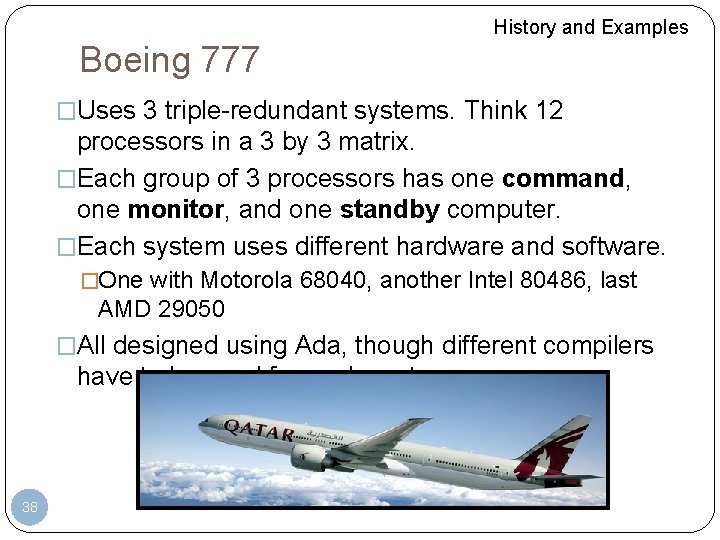
History and Examples Boeing 777 �Uses 3 triple-redundant systems. Think 12 processors in a 3 by 3 matrix. �Each group of 3 processors has one command, one monitor, and one standby computer. �Each system uses different hardware and software. �One with Motorola 68040, another Intel 80486, last AMD 29050 �All designed using Ada, though different compilers have to be used for each system. 38
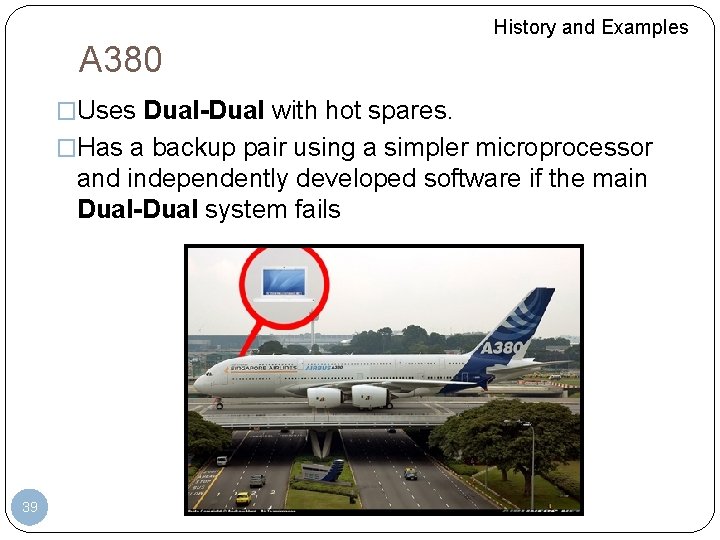
History and Examples A 380 �Uses Dual-Dual with hot spares. �Has a backup pair using a simpler microprocessor and independently developed software if the main Dual-Dual system fails 39
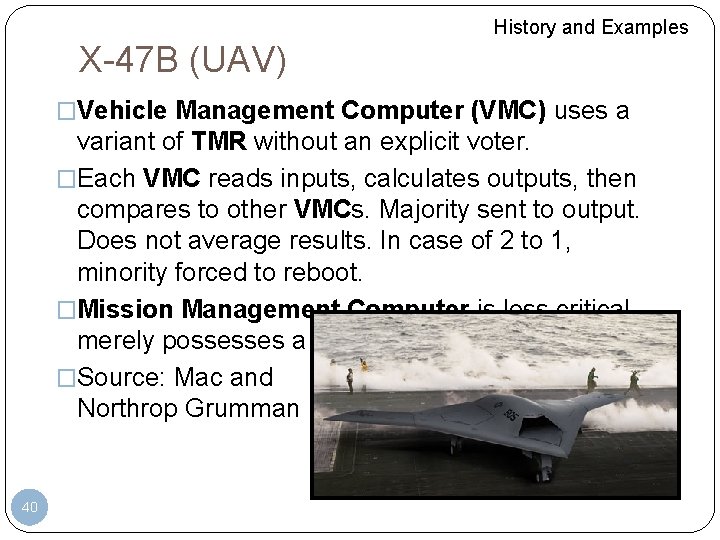
History and Examples X-47 B (UAV) �Vehicle Management Computer (VMC) uses a variant of TMR without an explicit voter. �Each VMC reads inputs, calculates outputs, then compares to other VMCs. Majority sent to output. Does not average results. In case of 2 to 1, minority forced to reboot. �Mission Management Computer is less critical, merely possesses a hot swap. �Source: Mac and Northrop Grumman 40
Questions? 41