
Faults and Failures in Railway Signalling Systems Martin
![Possible states in relay circuits [reference 17] Number of relays in circuit(n) 1 2](https://slidetodoc.com/presentation_image/446b1393d0169475ff7abf90b339d298/image-15.jpg "Possible states in relay circuits [reference 17] Number of relays in circuit(n) 1 2")
![References: • [1] Red for Danger -L. T. C Rolt, 1966 & 2007 •](https://slidetodoc.com/presentation_image/446b1393d0169475ff7abf90b339d298/image-91.jpg "References: • [1] Red for Danger -L. T. C Rolt, 1966 & 2007 •")
- Slides: 91
Faults and Failures in Railway Signalling Systems Martin Philip White Senior Principle Engineer, Signals
Summary of Faults and Failures in Railway Signalling Systems Presentation • Video of Settle Junction Signal Box. • Summary of main categories of Faults and Failures. • UK Legislation relating to Railway Safety. • Classification of failures-Right-side and Wrong side failures. • Examples of Wrong Side Failures in UK 1985 -1988. • Possible states in relay circuits. • Photos of major railway crashes in UK-Quintinshill, Harrow and Wealdstone and Clapham Junction. • Video of aftermath of Harrow and Wealdstone crash. • Signalling relay symbols. • Operation of typical signalling relay. • Trouble shooting simulation on relay circuit. • Duplicated relay contacts simulation. • Duplicated terminal simulation. • Parallel fusing simulation. • Changeover Circuits • Biased relay and polarised circuit simulation. • ESP simulation. • UK Four aspect signal simulation and relevance to ATP fixed block signalling. • Problems with junction signalling: Bourne End/Raynes Park/Colwich Junction. Relevance to Singapore. • References.
Causes of Faults and Failures in Railway Signalling Systems
1) Equipment faults Faults due to equipment failure are the most common type of signalling faults. In most cases they will result in “Rightside” failures. E. g. Point detection and track circuit failures. These faults occur almost daily on most railway systems. They are not directly unsafe. However they can indirectly result in an unsafe condition arising as they can force the operator to revert to manual operation of the signalling system and trains have to be authorised to pass signals at danger. Unsafe situations can then arise, due to the potential for miss-communication between operators and drivers.
2) Cable faults are more common in older signalling systems, where the trackside cabling and wiring inside the signalling equipment rooms is starting to deteriorate. In most cases, cable failures will result in rightside failures. In the worst case, a core to core cable or wiring fault can result in a Wrongside Failure. This is most common in older installations, where the cable/wiring insulation has started to deteriorate. External circuits are most susceptible, as trackside cables are more easily damaged. The risk of a Wrongside Failure on external circuits, is reduced by the use of “Double Cut Circuits”. In these, the controlling function(s) is/are cut into both the positive and negative legs of the circuit.
3) Design faults not detected by the checking and testing process Note design errors can apply to all technologiesmechanical, relay based and CBI. If a design error isn’t detected by the checking and testing process, it may lie dormant perhaps for many years.
4) Faults due to errors by maintenance personnel when replacing or resetting faulty equipment a) Bletchley-Latched relay replaced in wrong state. => Resulting in points moving underneath train b) Leeds-Power supply feeding polarised circuits incorrectly replaced. => Resulting in points moving underneath train. c) Severn Tunnel-Axle counter incorrectly reset whilst train still in tunnel. => Resulting in clear signal for a following train that hit the stationary train the tunnel.
5) Installation errors not detected by the inspection and testing process. (e. g. Clapham Junction) 6) Operational errors by Drivers and Signalmen compounded by deficiencies in the signalling system. [e. g. Quintinshill, Hawes Junction (Signalmen’s error), Harrow and Wealdstone, Lewisham. (Driver’s error)].
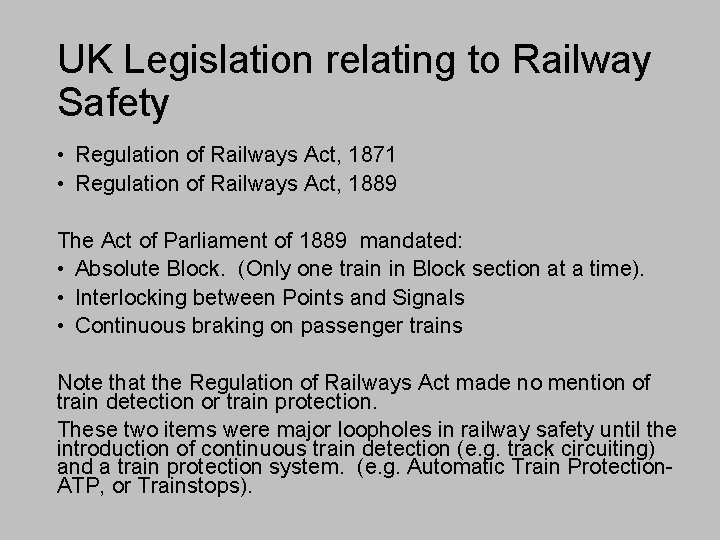
UK Legislation relating to Railway Safety • Regulation of Railways Act, 1871 • Regulation of Railways Act, 1889 The Act of Parliament of 1889 mandated: • Absolute Block. (Only one train in Block section at a time). • Interlocking between Points and Signals • Continuous braking on passenger trains Note that the Regulation of Railways Act made no mention of train detection or train protection. These two items were major loopholes in railway safety until the introduction of continuous train detection (e. g. track circuiting) and a train protection system. (e. g. Automatic Train Protection. ATP, or Trainstops).
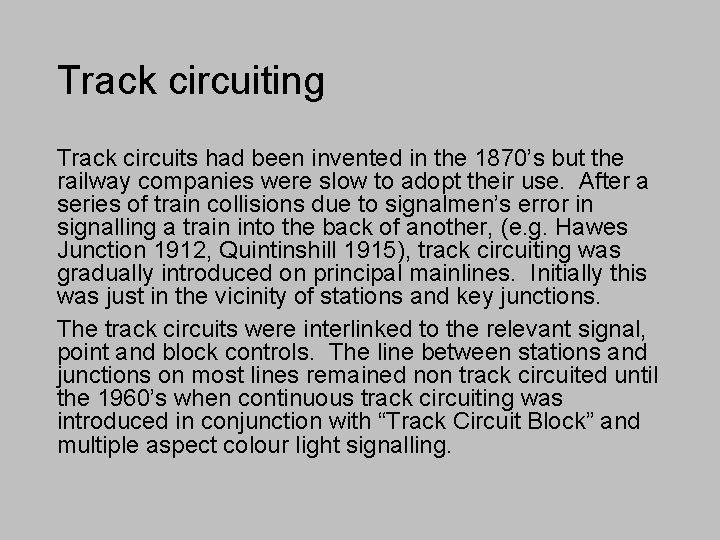
Track circuiting Track circuits had been invented in the 1870’s but the railway companies were slow to adopt their use. After a series of train collisions due to signalmen’s error in signalling a train into the back of another, (e. g. Hawes Junction 1912, Quintinshill 1915), track circuiting was gradually introduced on principal mainlines. Initially this was just in the vicinity of stations and key junctions. The track circuits were interlinked to the relevant signal, point and block controls. The line between stations and junctions on most lines remained non track circuited until the 1960’s when continuous track circuiting was introduced in conjunction with “Track Circuit Block” and multiple aspect colour light signalling.
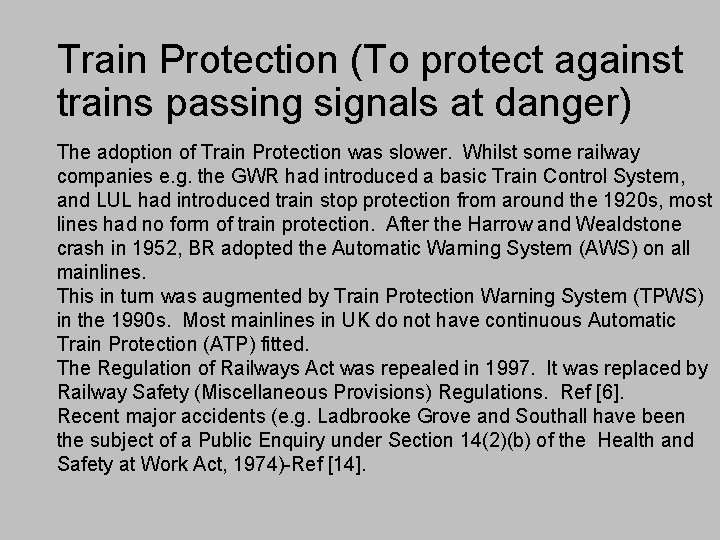
Train Protection (To protect against trains passing signals at danger) The adoption of Train Protection was slower. Whilst some railway companies e. g. the GWR had introduced a basic Train Control System, and LUL had introduced train stop protection from around the 1920 s, most lines had no form of train protection. After the Harrow and Wealdstone crash in 1952, BR adopted the Automatic Warning System (AWS) on all mainlines. This in turn was augmented by Train Protection Warning System (TPWS) in the 1990 s. Most mainlines in UK do not have continuous Automatic Train Protection (ATP) fitted. The Regulation of Railways Act was repealed in 1997. It was replaced by Railway Safety (Miscellaneous Provisions) Regulations. Ref [6]. Recent major accidents (e. g. Ladbrooke Grove and Southall have been the subject of a Public Enquiry under Section 14(2)(b) of the Health and Safety at Work Act, 1974)-Ref [14].
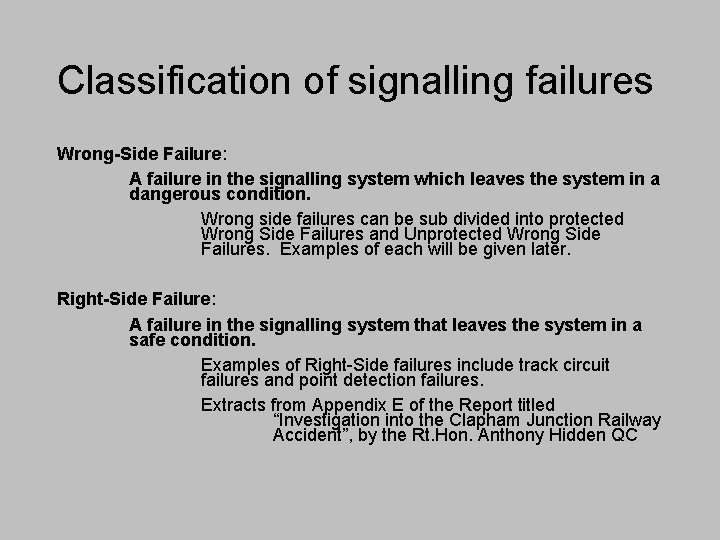
Classification of signalling failures Wrong-Side Failure: A failure in the signalling system which leaves the system in a dangerous condition. Wrong side failures can be sub divided into protected Wrong Side Failures and Unprotected Wrong Side Failures. Examples of each will be given later. Right-Side Failure: A failure in the signalling system that leaves the system in a safe condition. Examples of Right-Side failures include track circuit failures and point detection failures. Extracts from Appendix E of the Report titled “Investigation into the Clapham Junction Railway Accident”, by the Rt. Hon. Anthony Hidden QC
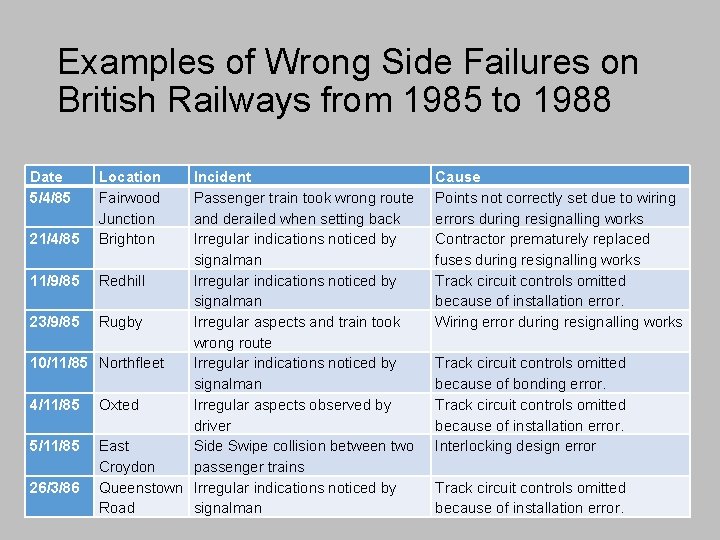
Examples of Wrong Side Failures on British Railways from 1985 to 1988 Date 5/4/85 Location Fairwood Junction Brighton Incident Passenger train took wrong route and derailed when setting back 21/4/85 Irregular indications noticed by signalman 11/9/85 Redhill Irregular indications noticed by signalman 23/9/85 Rugby Irregular aspects and train took wrong route 10/11/85 Northfleet Irregular indications noticed by signalman 4/11/85 Oxted Irregular aspects observed by driver 5/11/85 East Side Swipe collision between two Croydon passenger trains 26/3/86 Queenstown Irregular indications noticed by Road signalman Cause Points not correctly set due to wiring errors during resignalling works Contractor prematurely replaced fuses during resignalling works Track circuit controls omitted because of installation error. Wiring error during resignalling works Track circuit controls omitted because of bonding error. Track circuit controls omitted because of installation error. Interlocking design error Track circuit controls omitted because of installation error.
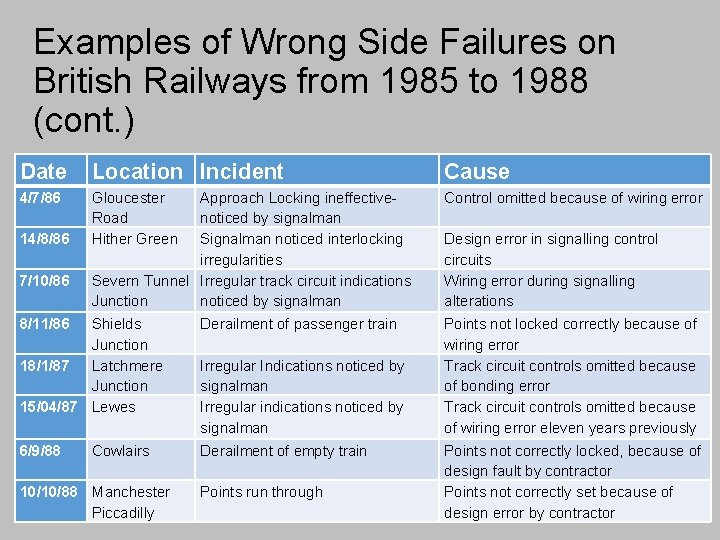
Examples of Wrong Side Failures on British Railways from 1985 to 1988 (cont. ) Date Location Incident Cause 4/7/86 Gloucester Road Hither Green Control omitted because of wiring error 14/8/86 7/10/86 Approach Locking ineffectivenoticed by signalman Signalman noticed interlocking irregularities Severn Tunnel Irregular track circuit indications Junction noticed by signalman 8/11/86 Shields Junction 18/1/87 Latchmere Junction 15/04/87 Lewes Derailment of passenger train 6/9/88 Derailment of empty train Cowlairs 10/10/88 Manchester Piccadilly Irregular Indications noticed by signalman Irregular indications noticed by signalman Points run through Design error in signalling control circuits Wiring error during signalling alterations Points not locked correctly because of wiring error Track circuit controls omitted because of bonding error Track circuit controls omitted because of wiring error eleven years previously Points not correctly locked, because of design fault by contractor Points not correctly set because of design error by contractor
Possible states in relay circuits [reference 17] Number of relays in circuit(n) 1 2 3 4 5 6 7 8 9 10 11 12 13 14 15 16 17 18 No of possible states (2 n) (To make 2 to power of n) 1 2 8 16 32 64 128 256 512 1, 024 2, 048 4, 096 8, 192 16, 384 32, 768 65, 536 131, 072 262, 144
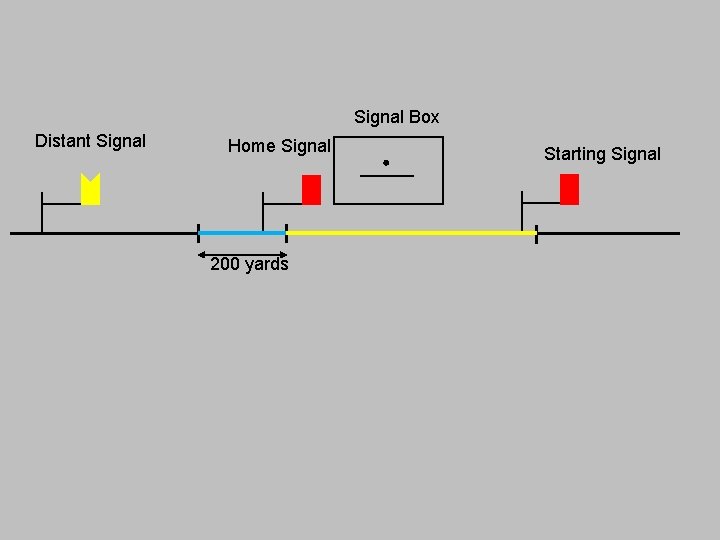
Signal Box Distant Signal Home Signal 200 yards Starting Signal
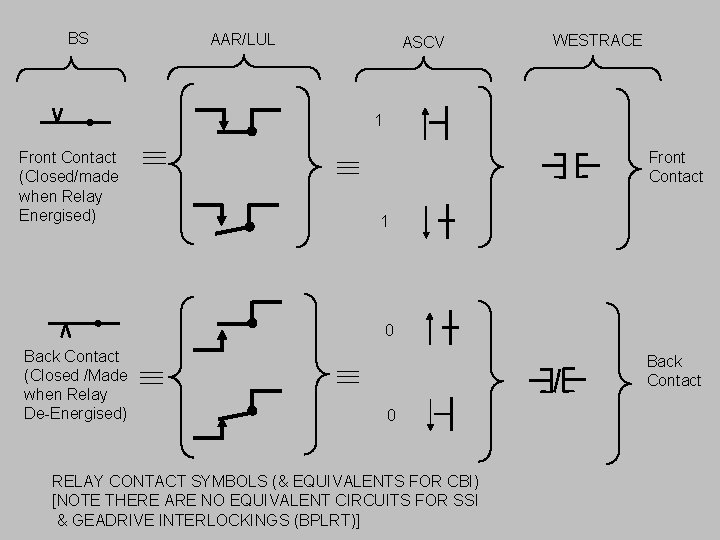
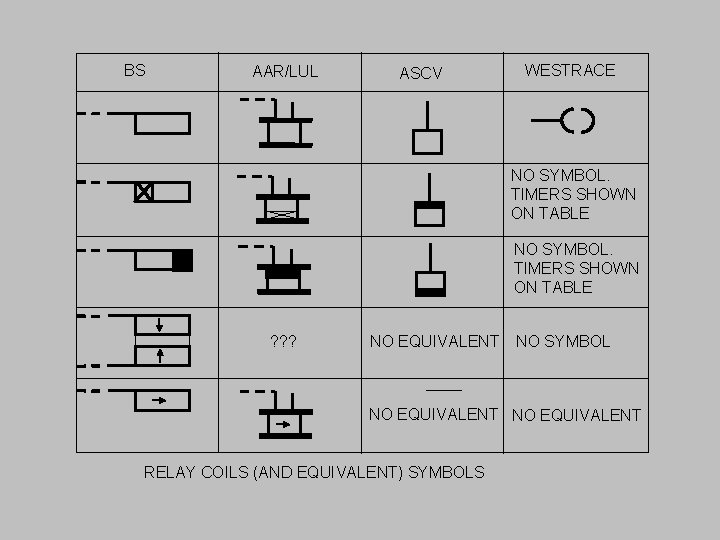
BS AAR/LUL ASCV WESTRACE 1 Front Contact (Closed/made when Relay Energised) Front Contact 1 0 Back Contact (Closed /Made when Relay De-Energised) Back Contact 0 RELAY CONTACT SYMBOLS (& EQUIVALENTS FOR CBI) [NOTE THERE ARE NO EQUIVALENT CIRCUITS FOR SSI & GEADRIVE INTERLOCKINGS (BPLRT)]
BS AAR/LUL ASCV WESTRACE NO SYMBOL. TIMERS SHOWN ON TABLE ? ? ? NO EQUIVALENT NO SYMBOL NO EQUIVALENT RELAY COILS (AND EQUIVALENT) SYMBOLS
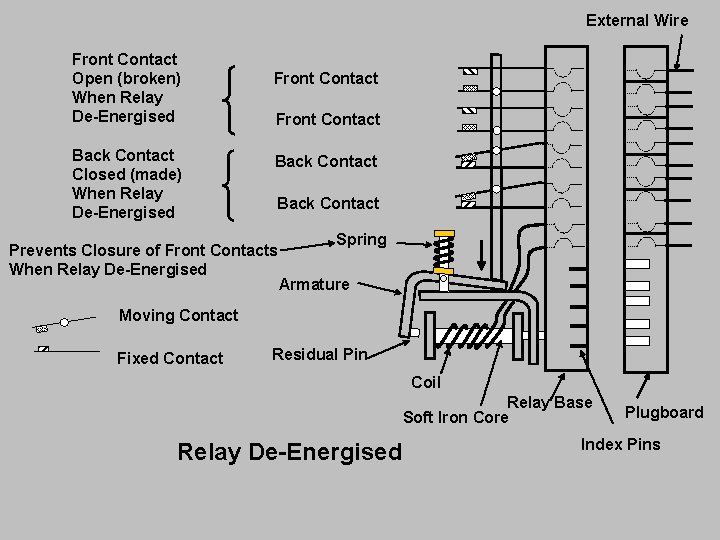
External Wire Front Contact Open (broken) When Relay De-Energised Back Contact Closed (made) When Relay De-Energised Front Contact Back Contact Prevents Closure of Front Contacts When Relay De-Energised Spring Armature Moving Contact Fixed Contact Residual Pin Coil Relay Base Soft Iron Core Relay De-Energised Plugboard Index Pins
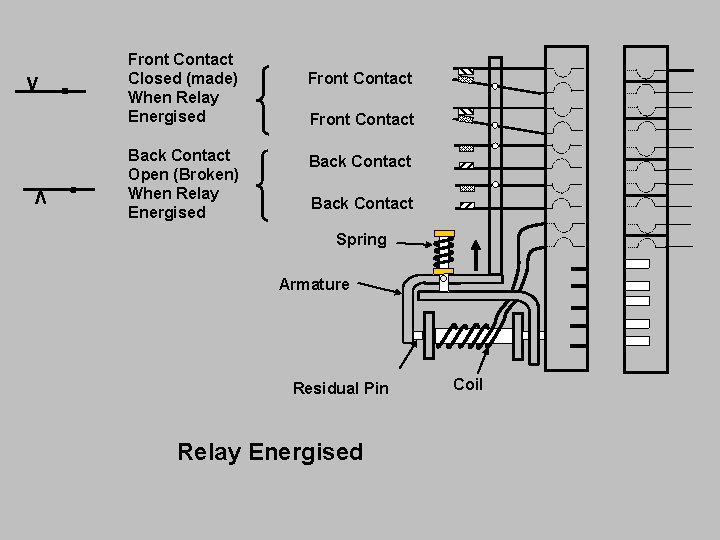
Front Contact Closed (made) When Relay Energised Back Contact Open (Broken) When Relay Energised Front Contact Back Contact Spring Armature Residual Pin Relay Energised Coil
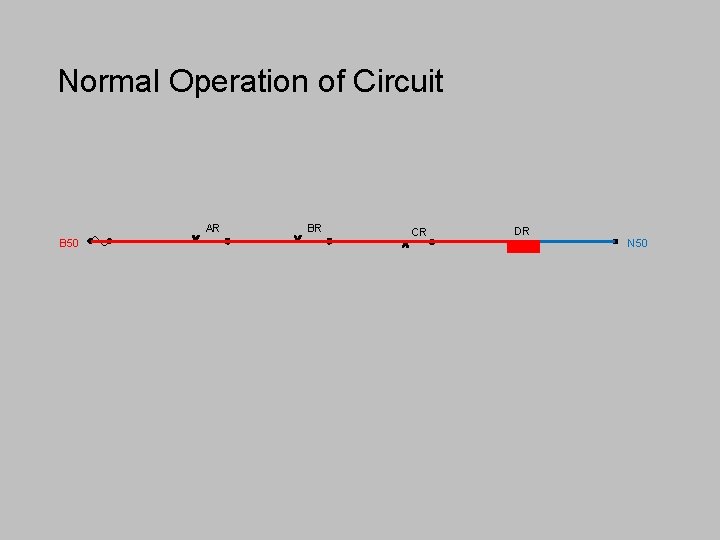
Normal Operation of Circuit AR B 50 BR CR DR N 50
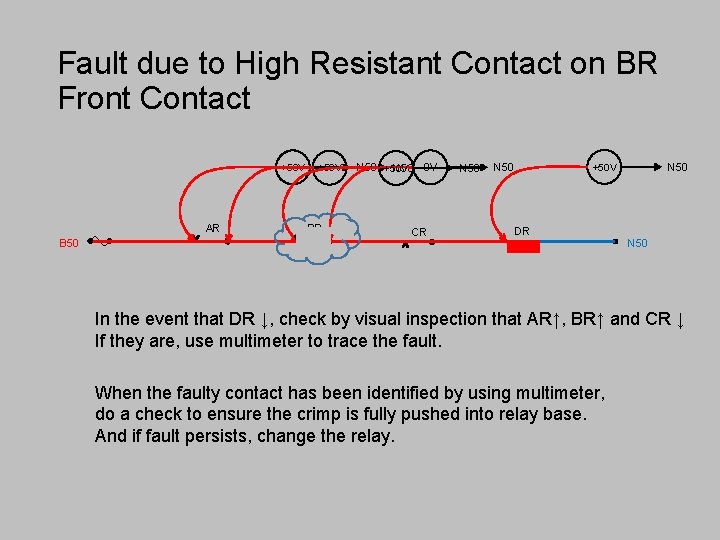
Fault due to High Resistant Contact on BR Front Contact +50 V AR B 50 +50 V BR N 50 +50 V N 50 0 V CR N 50 +50 V DR N 50 In the event that DR ↓, check by visual inspection that AR↑, BR↑ and CR ↓ If they are, use multimeter to trace the fault. When the faulty contact has been identified by using multimeter, do a check to ensure the crimp is fully pushed into relay base. And if fault persists, change the relay.
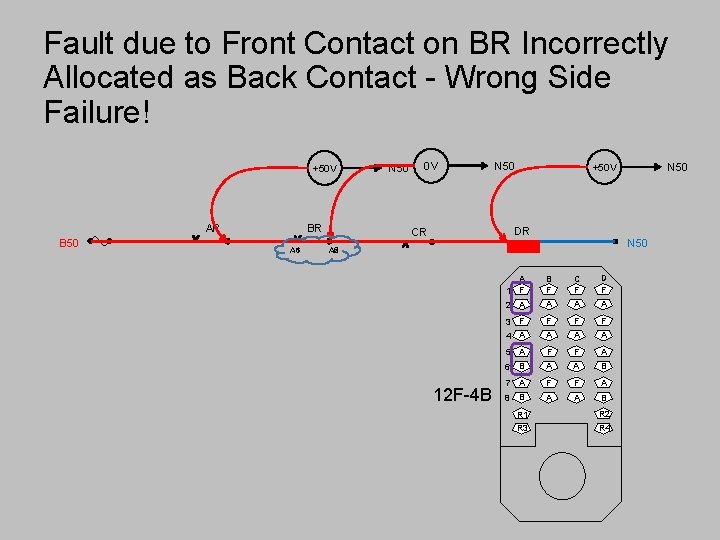
Fault due to Front Contact on BR Incorrectly Allocated as Back Contact - Wrong Side Failure! +50 V AR B 50 BR N 50 0 V N 50 DR CR N 50 A 1 A 2 A 6 A 5 12 F-4 B N 50 +50 V A 1 F B F C F D F 2 A A 3 F 4 A F F F A A A 5 A 6 B F F A A A B 7 A F F A 8 B A A B R 1 R 2 R 3 R 4
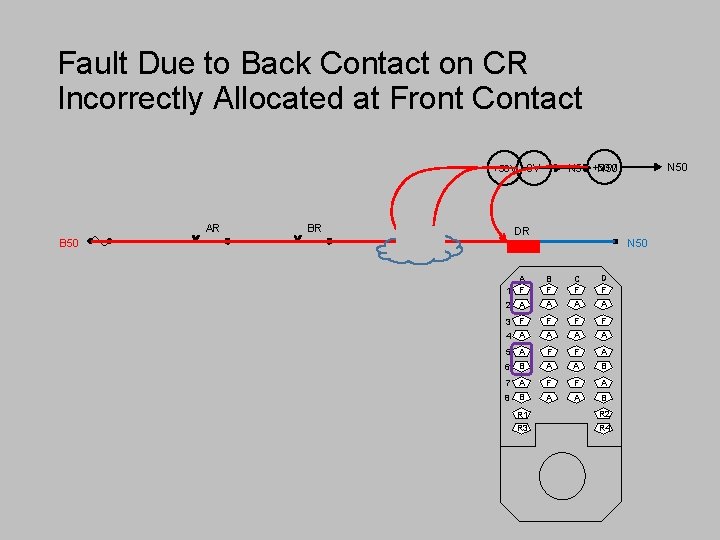
Fault Due to Back Contact on CR Incorrectly Allocated at Front Contact AR B 50 BR CR N 50 +50 V N 50 0 V +50 V DR N 50 A 1 A 2 A 6 A 5 A 1 F B F C F D F 2 A A 3 F 4 A F F F A A A 5 A 6 B F F A A A B 7 A F F A 8 B A A B R 1 R 2 R 3 R 4
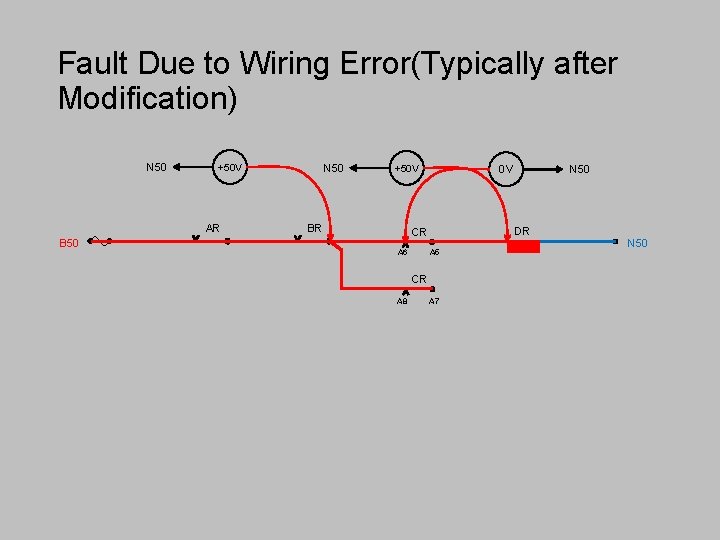
Fault Due to Wiring Error(Typically after Modification) N 50 +50 V AR B 50 N 50 BR +50 V CR A 6 A 5 CR A 8 A 7 N 50 0 V DR N 50
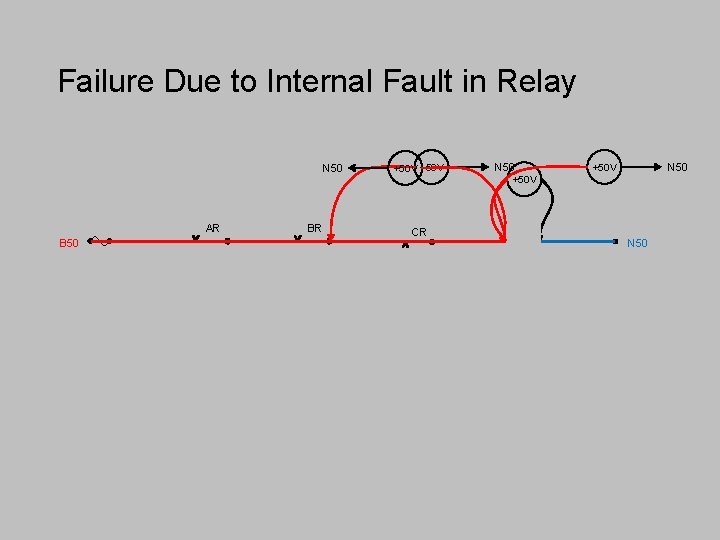
Failure Due to Internal Fault in Relay N 50 AR B 50 BR +50 V N 50 +50 V CR DR N 50
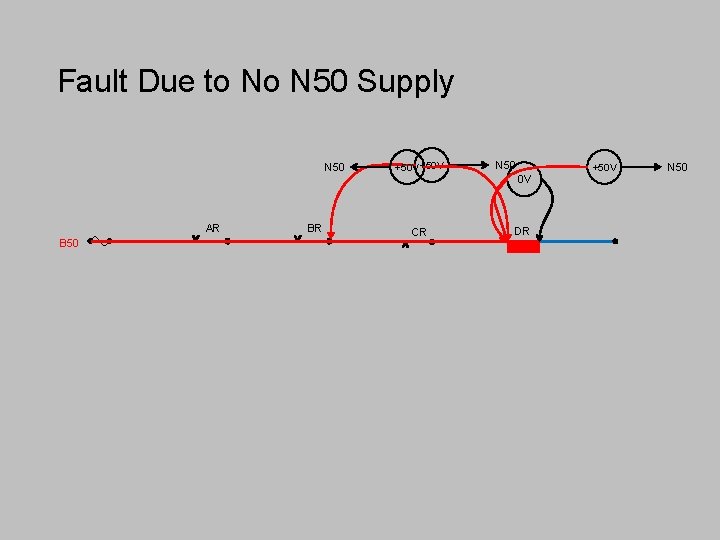
Fault Due to No N 50 Supply N 50 +50 V 0 V AR B 50 BR CR DR N 50
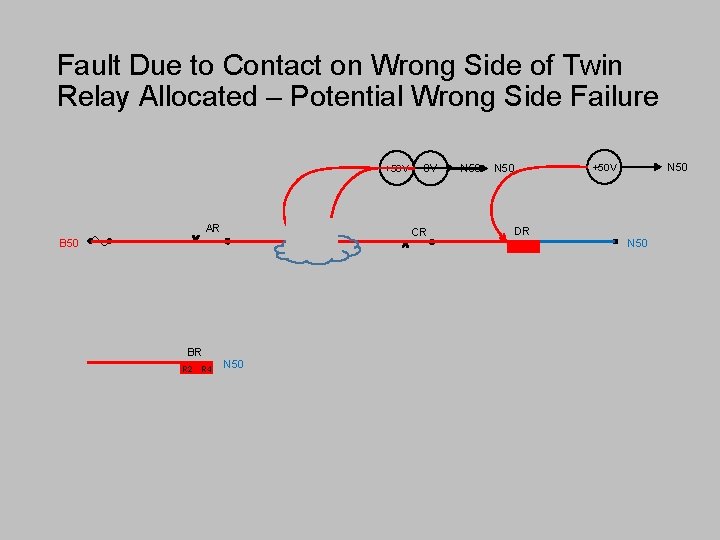
Fault Due to Contact on Wrong Side of Twin Relay Allocated – Potential Wrong Side Failure +50 V AR BR B 50 C 1 C 2 A 1 A 2 BR R 2 R 4 N 50 0 V CR N 50 DR N 50 +50 V N 50
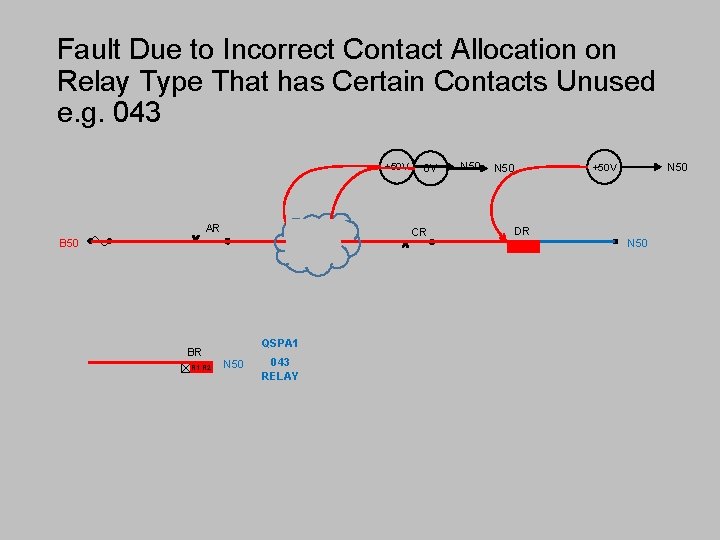
Fault Due to Incorrect Contact Allocation on Relay Type That has Certain Contacts Unused e. g. 043 +50 V AR BR B 50 B 7 B 8 B 1 B 2 BR R 1 R 2 QSPA 1 N 50 043 RELAY 0 V CR N 50 DR N 50 +50 V N 50
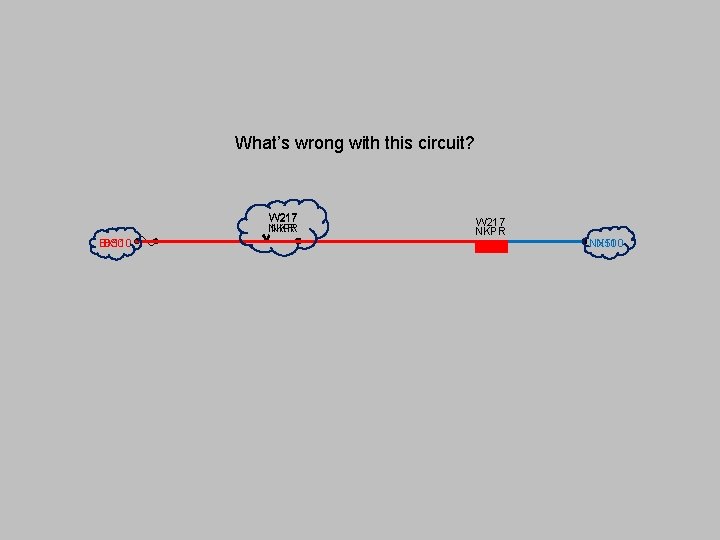
What’s wrong with this circuit? W 217 NKR NKPR BX 110 B 50 W 217 NKPR N 50 NX 110
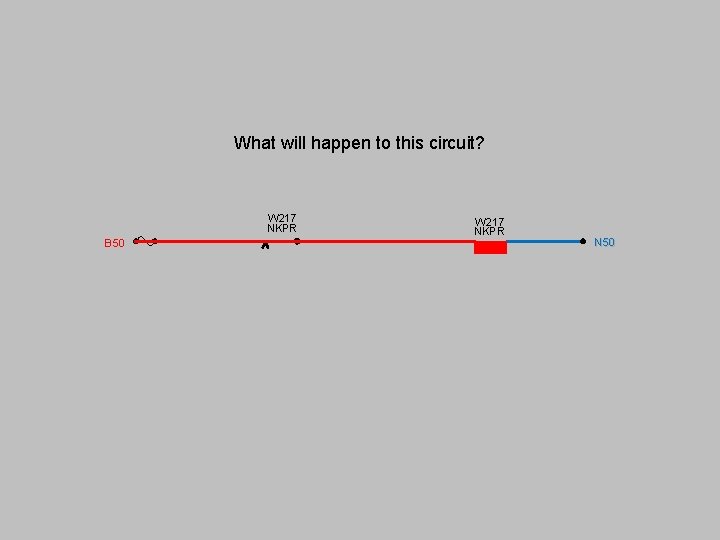
What will happen to this circuit? W 217 NKPR B 50 W 217 NKPR N 50
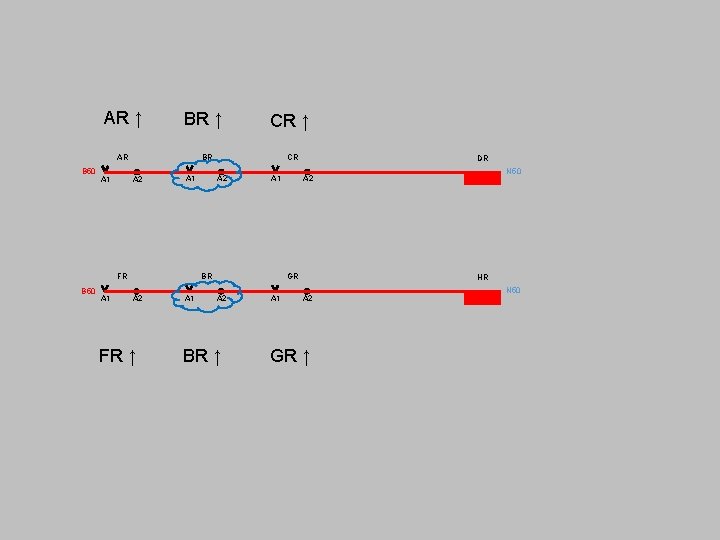
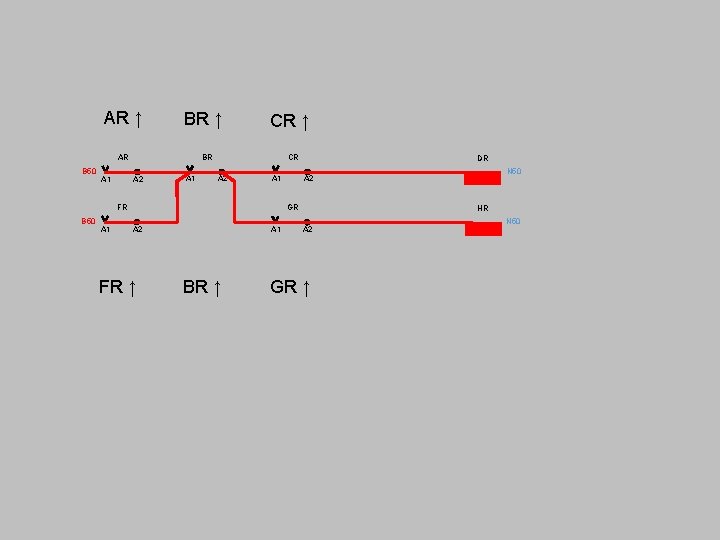
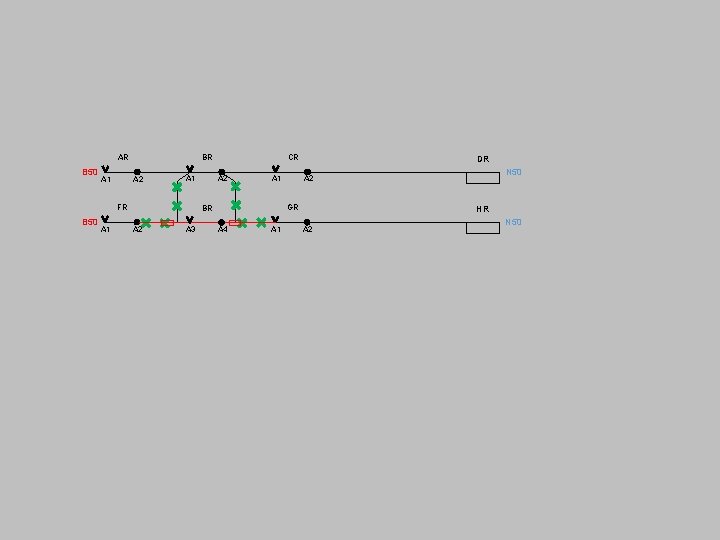
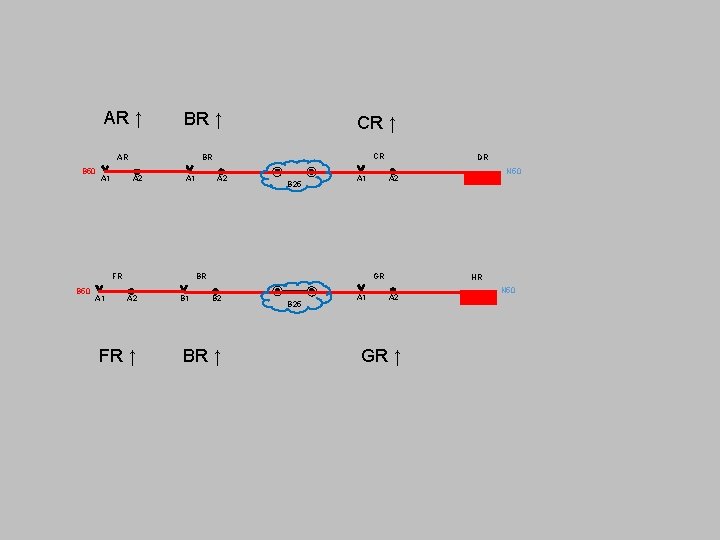
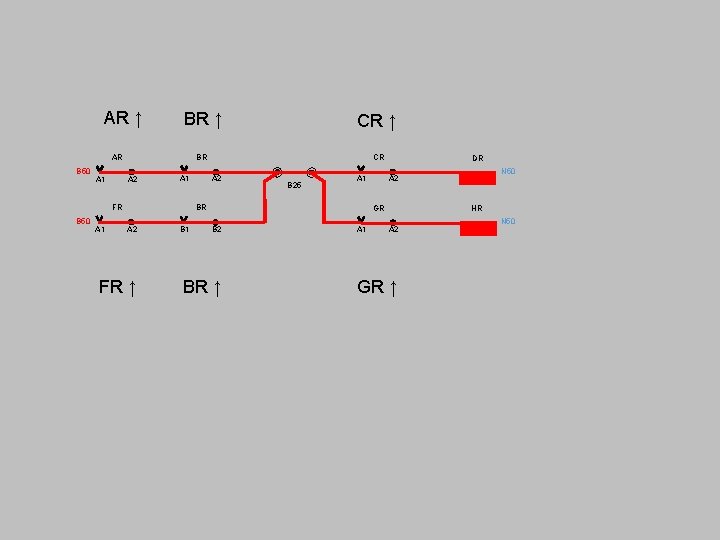
Duplication of Relay Contacts and Links
AR ↑ B 50 BR ↑ CR ↑ AR BR CR A 1 A 2 FR BR GR A 1 A 2 FR ↑ BR ↑ GR ↑ DR N 50 HR N 50
AR ↑ B 50 BR ↑ CR ↑ AR BR CR A 1 A 2 FR GR A 1 A 2 FR ↑ BR ↑ GR ↑ DR N 50 HR N 50
B 50 AR BR CR A 1 A 2 FR BR GR A 1 A 2 A 3 A 4 A 1 A 2 DR N 50 HR N 50
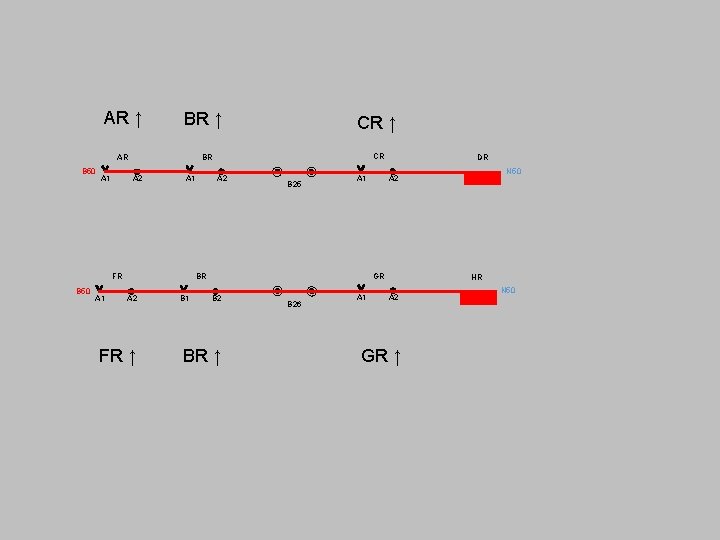
AR ↑ B 50 BR ↑ AR BR A 1 A 2 FR BR A 1 A 2 B 1 B 2 FR ↑ BR ↑ CR B 25 N 50 A 1 A 2 GR B 25 DR A 1 A 2 GR ↑ HR N 50
AR ↑ B 50 BR ↑ CR ↑ AR BR CR A 1 A 2 FR BR GR A 1 A 2 B 1 B 2 A 1 A 2 FR ↑ BR ↑ GR ↑ B 25 DR N 50 A 1 A 2 HR N 50
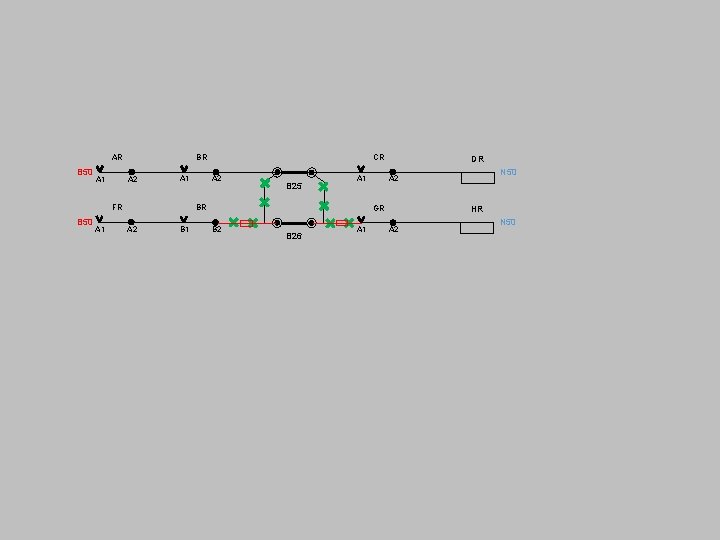
B 50 AR BR CR A 1 A 2 FR BR A 1 A 2 B 1 B 25 GR B 26 A 1 A 2 DR N 50 HR N 50
AR ↑ B 50 BR ↑ AR BR A 1 A 2 FR BR A 1 A 2 B 1 B 2 FR ↑ BR ↑ CR B 25 N 50 A 1 A 2 GR B 26 DR A 1 A 2 GR ↑ HR N 50
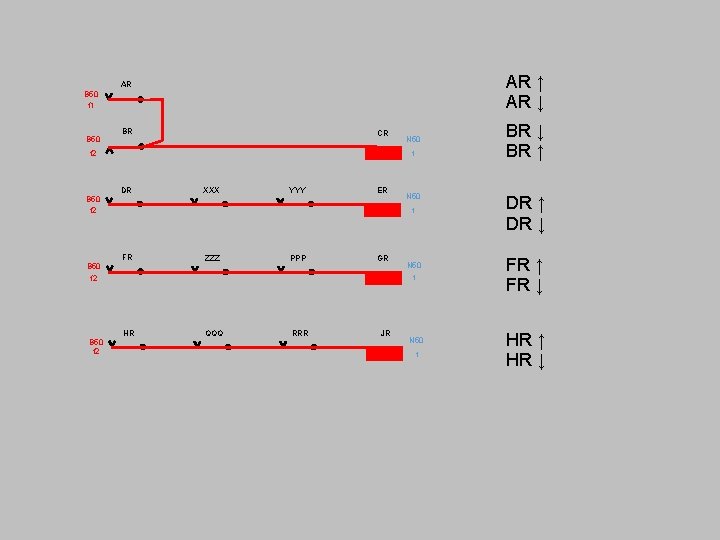
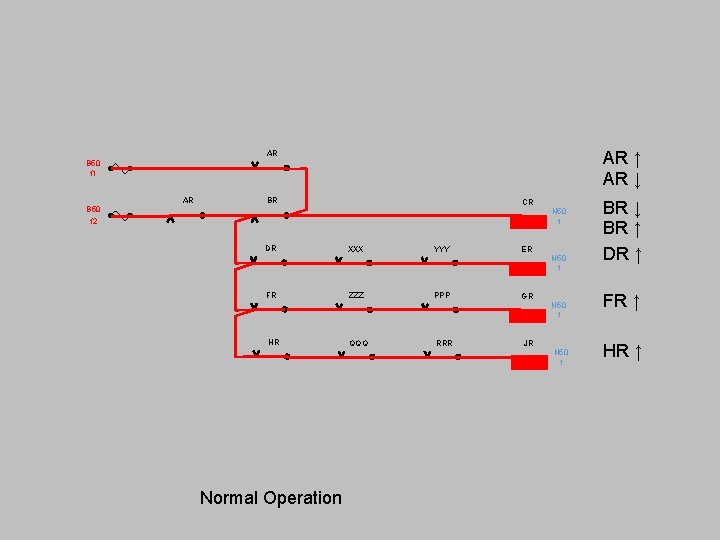
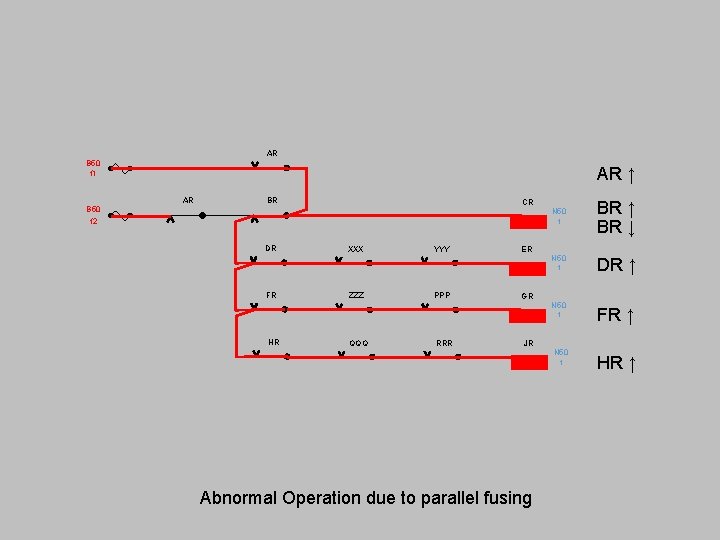
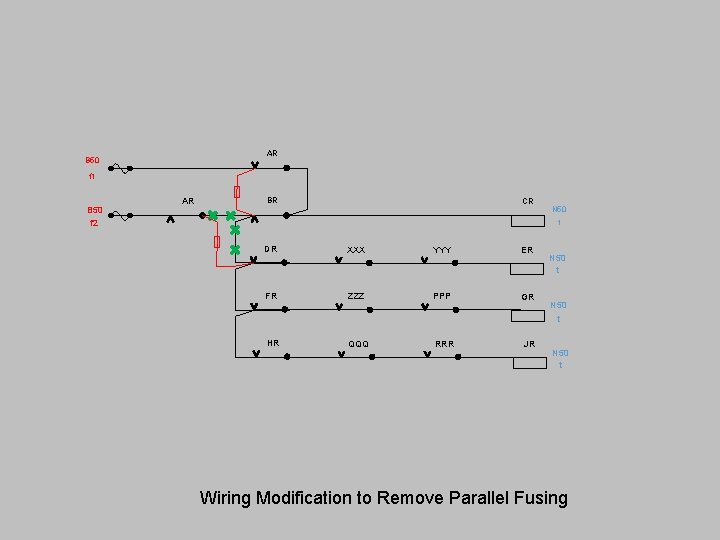
Simulation of Parallel Fusing
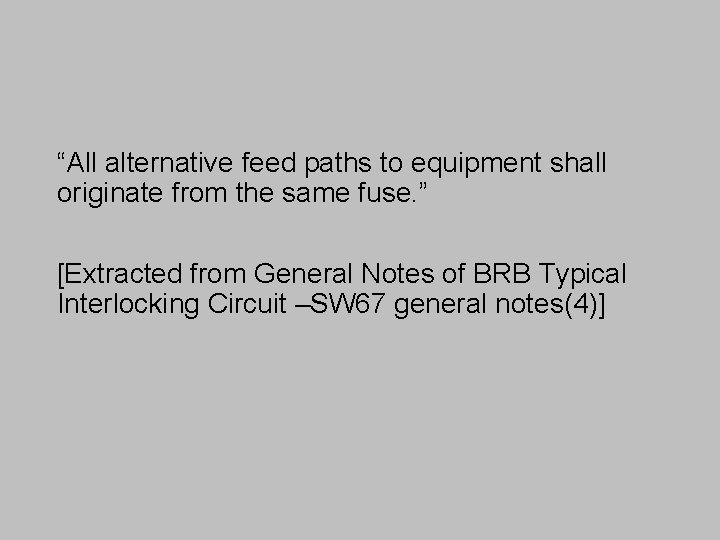
“All alternative feed paths to equipment shall originate from the same fuse. ” [Extracted from General Notes of BRB Typical Interlocking Circuit –SW 67 general notes(4)]
AR ↑ AR ↓ AR B 50 f 1 B 50 BR CR t f 2 DR XXX YYY ER B 50 f 2 N 50 t FR ZZZ PPP GR N 50 t HR B 50 f 2 N 50 QQQ RRR JR N 50 t BR ↓ BR ↑ DR ↓ FR ↑ FR ↓ HR ↑ HR ↓
AR ↑ AR ↓ AR B 50 f 1 B 50 f 2 AR BR CR N 50 t DR FR XXX ZZZ YYY PPP ER N 50 t GR N 50 t HR Normal Operation QQQ RRR JR N 50 t BR ↓ BR ↑ DR ↑ FR ↑ HR ↑
AR B 50 f 1 B 50 f 2 AR ↑ AR BR DR FR CR XXX ZZZ YYY PPP ER N 50 t BR ↑ BR ↓ N 50 t DR ↑ GR N 50 t HR QQQ RRR JR Abnormal Operation due to parallel fusing N 50 t FR ↑ HR ↑
AR B 50 f 1 B 50 f 2 AR BR CR N 50 t DR XXX YYY ER FR ZZZ PPP GR HR QQQ RRR JR N 50 t Wiring Modification to Remove Parallel Fusing
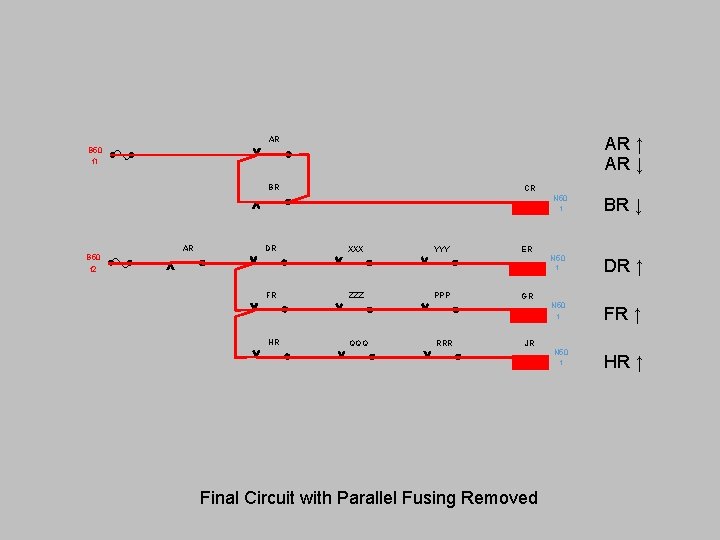
AR ↑ AR ↓ AR B 50 f 1 BR CR N 50 t AR B 50 DR XXX YYY ER f 2 FR HR ZZZ QQQ PPP RRR BR ↓ N 50 t DR ↑ N 50 t FR ↑ GR JR N 50 t Final Circuit with Parallel Fusing Removed HR ↑
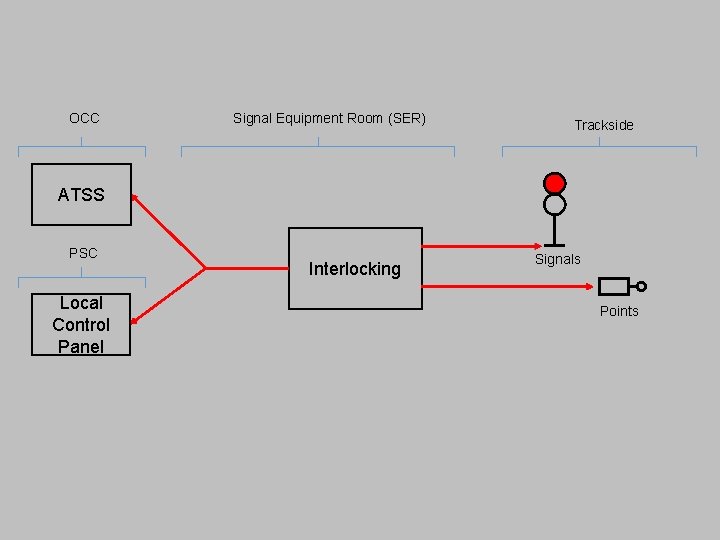
OCC Signal Equipment Room (SER) Trackside ATSS PSC Local Control Panel Interlocking Signals Points
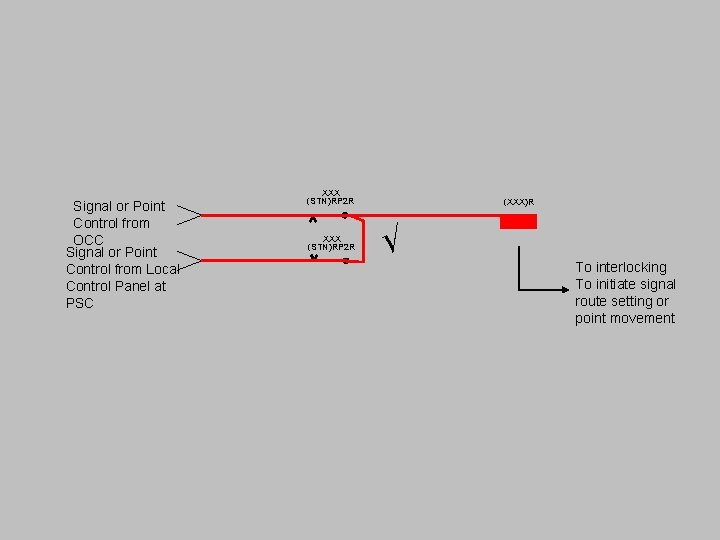
Signal or Point Control from OCC Signal or Point Control from Local Control Panel at PSC XXX (STN)RP 2 R (XXX)R √ To interlocking To initiate signal route setting or point movement
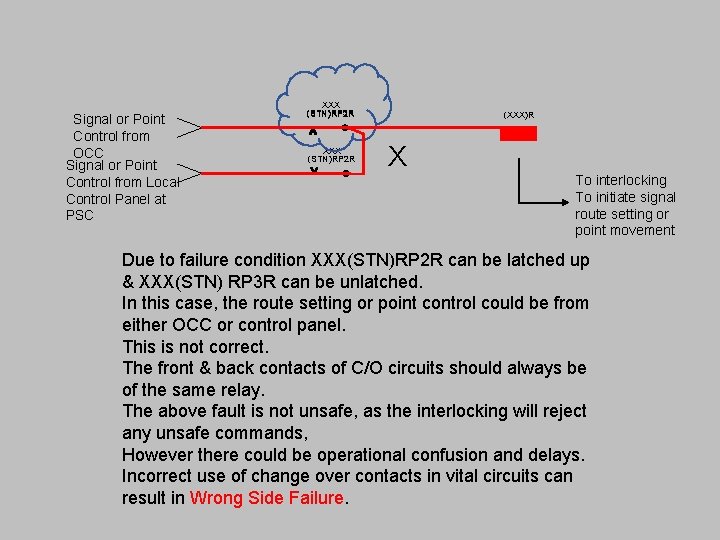
Signal or Point Control from OCC Signal or Point Control from Local Control Panel at PSC XXX (STN)RP 3 R (STN)RP 2 R XXX (STN)RP 2 R (XXX)R X To interlocking To initiate signal route setting or point movement Due to failure condition XXX(STN)RP 2 R can be latched up & XXX(STN) RP 3 R can be unlatched. In this case, the route setting or point control could be from either OCC or control panel. This is not correct. The front & back contacts of C/O circuits should always be of the same relay. The above fault is not unsafe, as the interlocking will reject any unsafe commands, However there could be operational confusion and delays. Incorrect use of change over contacts in vital circuits can result in Wrong Side Failure.
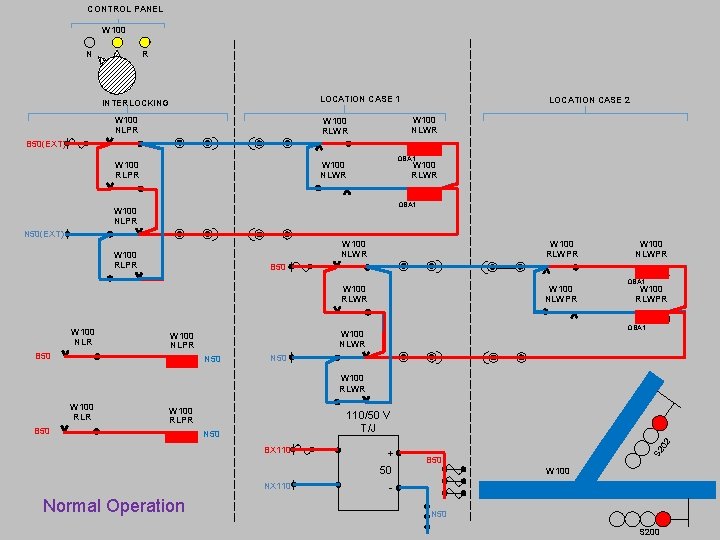
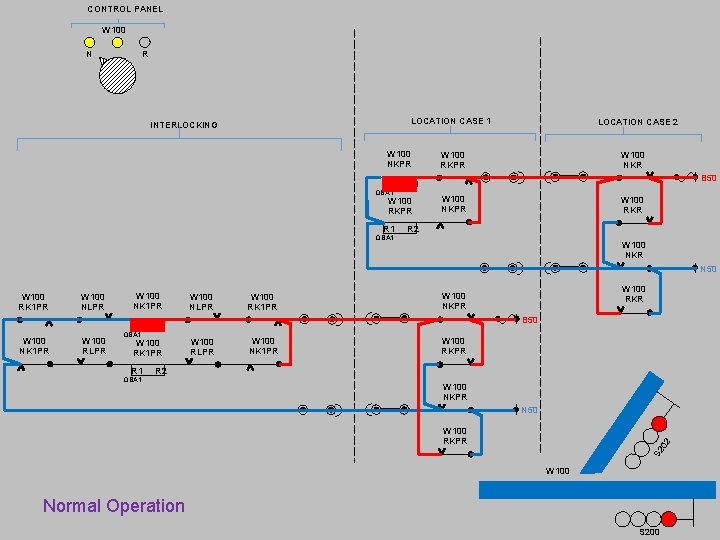
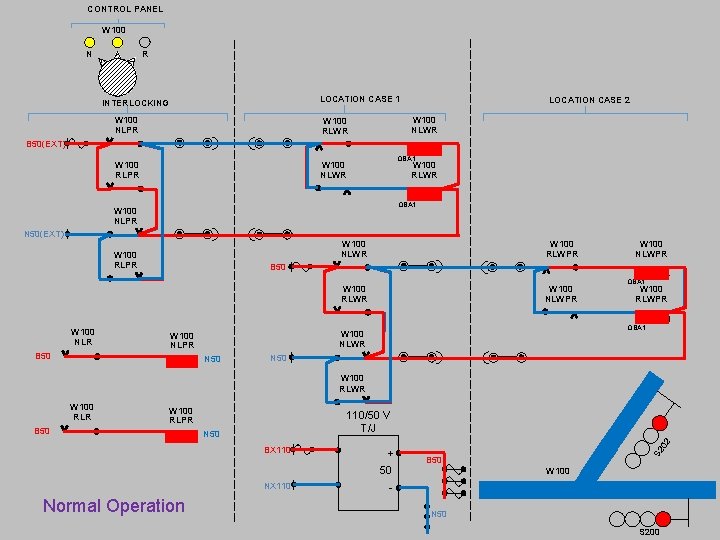
Biased Relay and Polarised Circuit Normal Operation and Potential Problems
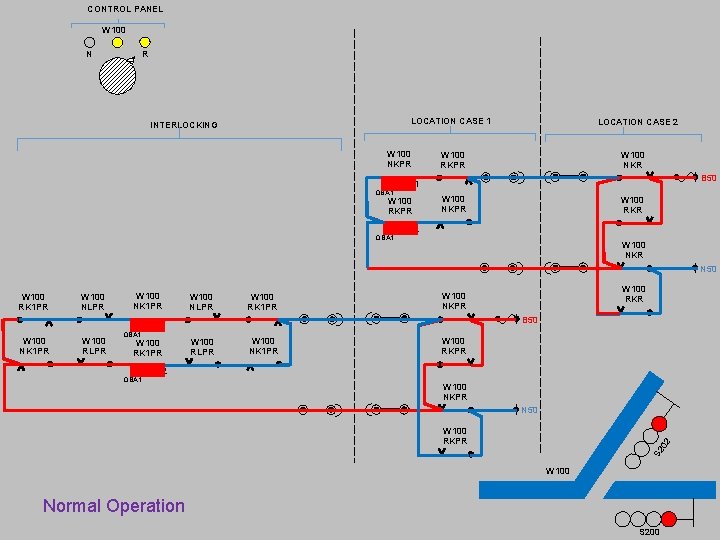
CONTROL PANEL W 100 R N LOCATION CASE 1 INTERLOCKING W 100 NLPR LOCATION CASE 2 W 100 NLWR W 100 RLWR B 50(EXT) R 1 R 2 QBA 1 W 100 RLWR W 100 NLWR W 100 RLPR R 2 R 1 QBA 1 W 100 NLPR N 50(EXT) W 100 RLPR W 100 NLWR W 100 RLWPR W 100 RLWR W 100 NLWPR B 50 W 100 NLWPR R 1 R 2 QBA 1 W 100 RLWPR R 2 R 1 W 100 NLR W 100 NLWR W 100 NLPR B 50 QBA 1 N 50 W 100 RLWR W 100 RLPR N 50 BX 110 + 50 NX 110 Normal Operation 02 B 50 110/50 V T/J S 2 W 100 RLR B 50 W 100 N 50 S 200
CONTROL PANEL W 100 R N LOCATION CASE 1 INTERLOCKING W 100 NKPR LOCATION CASE 2 W 100 NKR W 100 RKPR B 50 R 2 R 1 QBA 1 W 100 RKPR W 100 NKPR W 100 RKR R 1 R 2 QBA 1 W 100 NKR N 50 W 100 RK 1 PR W 100 NLPR W 100 NK 1 PR W 100 NLPR W 100 RK 1 PR B 50 R 2 R 1 W 100 NK 1 PR W 100 RLPR QBA 1 W 100 RK 1 PR W 100 RKR W 100 NKPR W 100 RLPR W 100 NK 1 PR W 100 RKPR R 1 R 2 QBA 1 W 100 NKPR N 50 S 2 02 W 100 RKPR W 100 Normal Operation S 200
CONTROL PANEL W 100 R N LOCATION CASE 1 INTERLOCKING W 100 NLPR LOCATION CASE 2 W 100 NLWR W 100 RLWR B 50(EXT) R 1 R 2 QBA 1 W 100 RLWR W 100 NLWR W 100 RLPR R 2 R 1 QBA 1 W 100 NLPR N 50(EXT) W 100 RLPR W 100 NLWR W 100 RLWPR W 100 RLWR W 100 NLWPR B 50 W 100 NLWPR R 1 R 2 QBA 1 W 100 RLWPR R 2 R 1 W 100 NLR W 100 NLWR W 100 NLPR B 50 QBA 1 N 50 W 100 RLWR W 100 RLPR N 50 BX 110 + 50 NX 110 Normal Operation 02 B 50 110/50 V T/J S 2 W 100 RLR B 50 W 100 N 50 S 200
CONTROL PANEL W 100 R N LOCATION CASE 1 INTERLOCKING W 100 NKPR LOCATION CASE 2 W 100 NKR W 100 RKPR B 50 R 2 R 1 QBA 1 W 100 RKPR W 100 NKPR W 100 RKR R 1 R 2 QBA 1 W 100 NKR N 50 W 100 RK 1 PR W 100 NLPR W 100 NK 1 PR W 100 NLPR W 100 RK 1 PR B 50 R 2 R 1 W 100 NK 1 PR W 100 RLPR QBA 1 W 100 RK 1 PR W 100 RKR W 100 NKPR W 100 RLPR W 100 NK 1 PR W 100 RKPR R 1 R 2 QBA 1 W 100 NKPR N 50 S 2 02 W 100 RKPR W 100 Normal Operation S 200
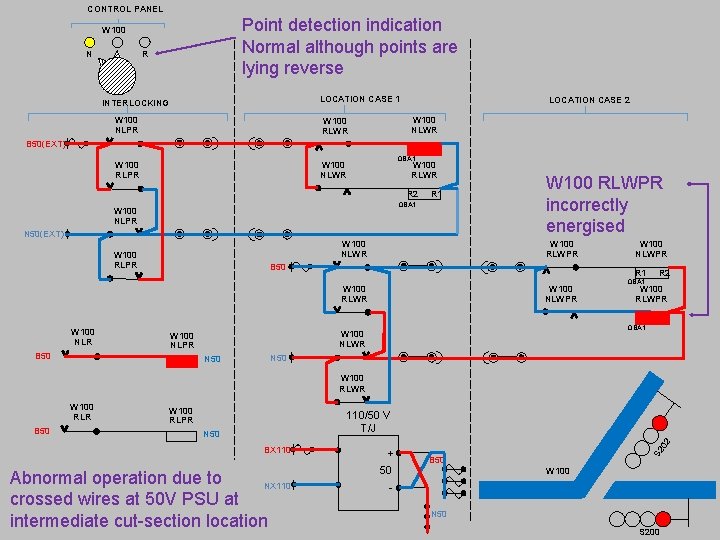
CONTROL PANEL Point detection indication Normal although points are lying reverse W 100 R N LOCATION CASE 1 INTERLOCKING W 100 NLPR LOCATION CASE 2 W 100 NLWR W 100 RLWR B 50(EXT) R 1 R 2 QBA 1 W 100 RLWR W 100 NLWR W 100 RLPR R 2 R 1 QBA 1 W 100 NLPR N 50(EXT) W 100 RLPR W 100 RLWPR incorrectly energised W 100 NLWR W 100 RLWPR W 100 RLWR W 100 NLWPR B 50 W 100 NLWPR R 1 R 2 QBA 1 W 100 RLWPR R 2 R 1 W 100 NLR W 100 NLWR W 100 NLPR B 50 QBA 1 N 50 W 100 RLWR 110/50 V T/J N 50 BX 110 + Abnormal operation due to NX 110 crossed wires at 50 V PSU at intermediate cut-section location 50 02 B 50 W 100 RLPR S 2 W 100 RLR B 50 W 100 N 50 S 200
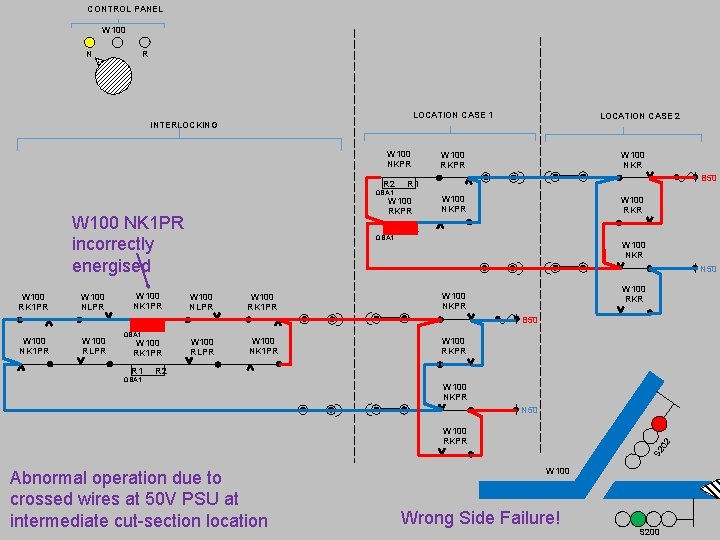
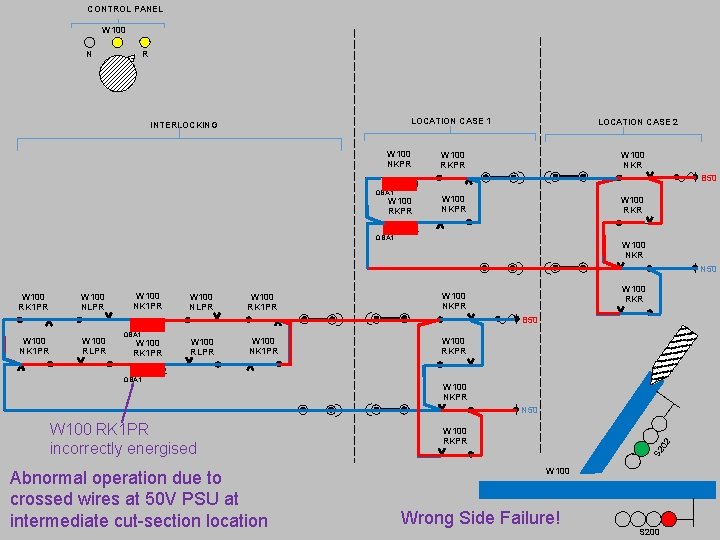
CONTROL PANEL W 100 R N LOCATION CASE 1 INTERLOCKING W 100 NKPR LOCATION CASE 2 W 100 NKR W 100 RKPR B 50 R 2 R 1 QBA 1 W 100 RKPR W 100 NK 1 PR incorrectly energised W 100 RK 1 PR W 100 NLPR W 100 NK 1 PR W 100 NKPR R 1 R 2 QBA 1 W 100 NKR N 50 W 100 NLPR W 100 RK 1 PR W 100 RLPR QBA 1 W 100 RK 1 PR W 100 RKR W 100 NKPR B 50 R 2 R 1 W 100 NK 1 PR W 100 RKR W 100 RLPR W 100 NK 1 PR W 100 RKPR R 1 R 2 QBA 1 W 100 NKPR N 50 S 2 02 W 100 RKPR Abnormal operation due to crossed wires at 50 V PSU at intermediate cut-section location W 100 Wrong Side Failure! S 200
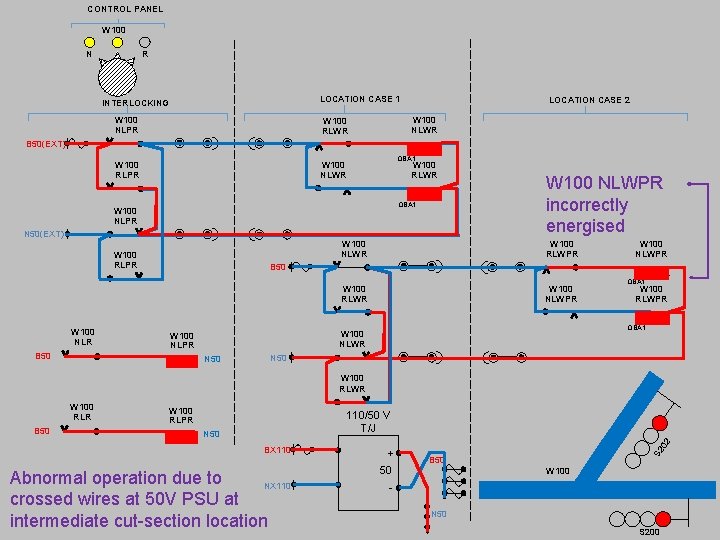
CONTROL PANEL W 100 R N LOCATION CASE 1 INTERLOCKING W 100 NLPR LOCATION CASE 2 W 100 NLWR W 100 RLWR B 50(EXT) R 1 R 2 QBA 1 W 100 RLWR W 100 NLWR W 100 RLPR R 2 R 1 QBA 1 W 100 NLPR N 50(EXT) W 100 RLPR W 100 NLWPR incorrectly energised W 100 NLWR W 100 RLWPR W 100 RLWR W 100 NLWPR B 50 W 100 NLWPR R 1 R 2 QBA 1 W 100 RLWPR R 2 R 1 W 100 NLR W 100 NLWR W 100 NLPR B 50 QBA 1 N 50 W 100 RLWR 110/50 V T/J N 50 BX 110 + Abnormal operation due to NX 110 crossed wires at 50 V PSU at intermediate cut-section location 50 02 B 50 W 100 RLPR S 2 W 100 RLR B 50 W 100 N 50 S 200
CONTROL PANEL W 100 R N LOCATION CASE 1 INTERLOCKING W 100 NKPR LOCATION CASE 2 W 100 NKR W 100 RKPR B 50 R 2 R 1 QBA 1 W 100 RKPR W 100 NKPR W 100 RKR R 1 R 2 QBA 1 W 100 NKR N 50 W 100 RK 1 PR W 100 NLPR W 100 NK 1 PR W 100 NLPR W 100 RK 1 PR B 50 R 2 R 1 W 100 NK 1 PR W 100 RLPR QBA 1 W 100 RK 1 PR W 100 RKR W 100 NKPR W 100 RLPR W 100 NK 1 PR W 100 RKPR R 1 R 2 QBA 1 W 100 NKPR N 50 Abnormal operation due to crossed wires at 50 V PSU at intermediate cut-section location 02 W 100 RKPR S 2 W 100 RK 1 PR incorrectly energised W 100 Wrong Side Failure! S 200
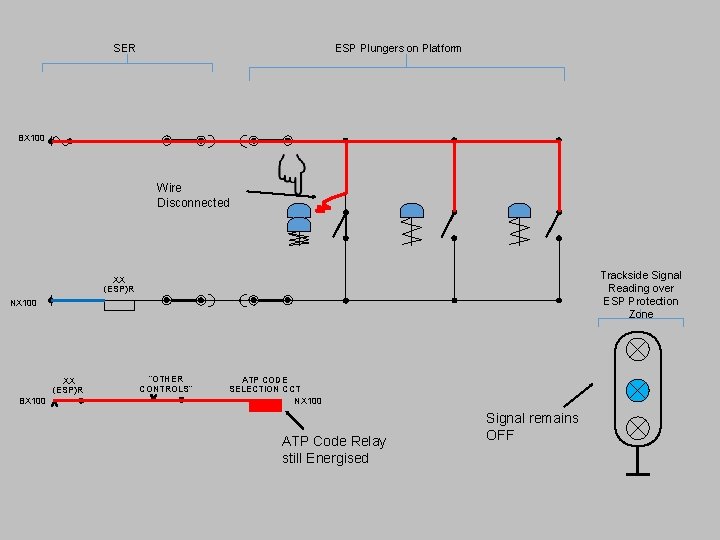
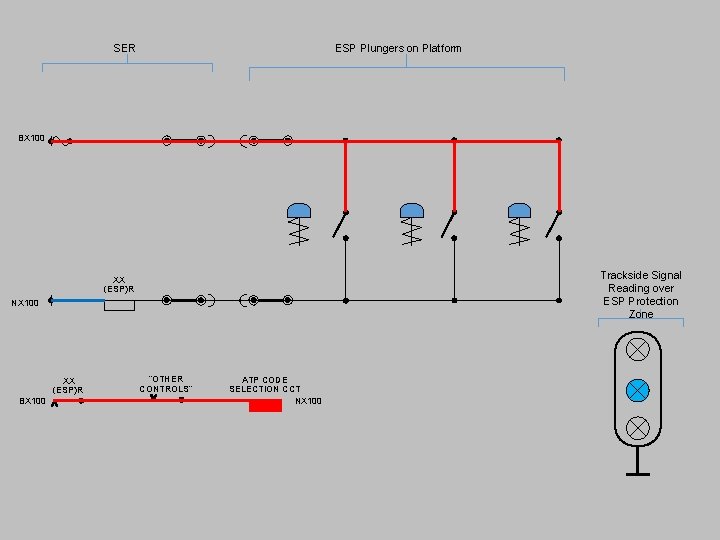
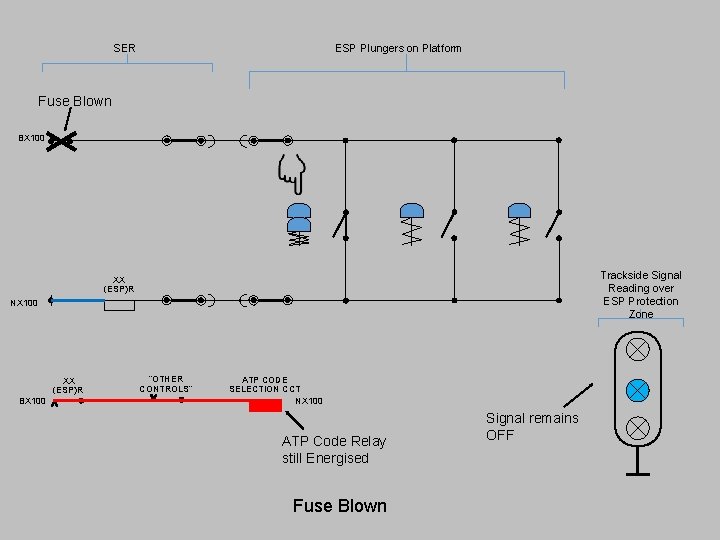
ESP Circuit – Single Cut Normally De-energised
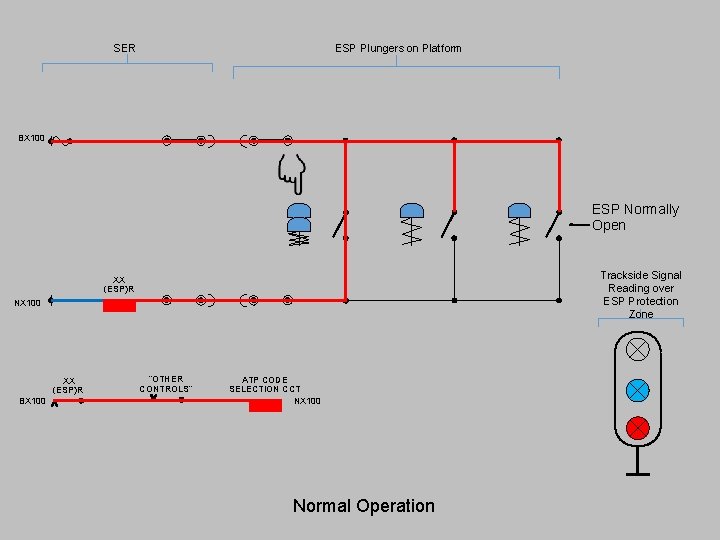
SER ESP Plungers on Platform BX 100 ESP Normally Open Trackside Signal Reading over ESP Protection Zone XX (ESP)R NX 100 XX (ESP)R BX 100 “OTHER CONTROLS” ATP CODE SELECTION CCT NX 100 Normal Operation
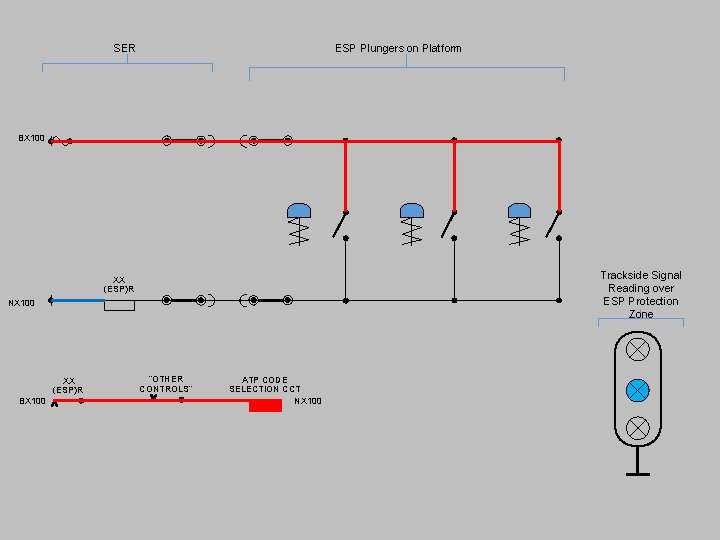
SER ESP Plungers on Platform BX 100 Trackside Signal Reading over ESP Protection Zone XX (ESP)R NX 100 XX (ESP)R BX 100 “OTHER CONTROLS” ATP CODE SELECTION CCT NX 100
SER ESP Plungers on Platform BX 100 Wire Disconnected Trackside Signal Reading over ESP Protection Zone XX (ESP)R NX 100 XX (ESP)R BX 100 “OTHER CONTROLS” ATP CODE SELECTION CCT NX 100 ATP Code Relay still Energised Signal remains OFF
SER ESP Plungers on Platform BX 100 Trackside Signal Reading over ESP Protection Zone XX (ESP)R NX 100 XX (ESP)R BX 100 “OTHER CONTROLS” ATP CODE SELECTION CCT NX 100
SER ESP Plungers on Platform Fuse Blown BX 100 Trackside Signal Reading over ESP Protection Zone XX (ESP)R NX 100 XX (ESP)R BX 100 “OTHER CONTROLS” ATP CODE SELECTION CCT NX 100 ATP Code Relay still Energised Fuse Blown Signal remains OFF
ESP Circuit – Single Cut Normally Energised
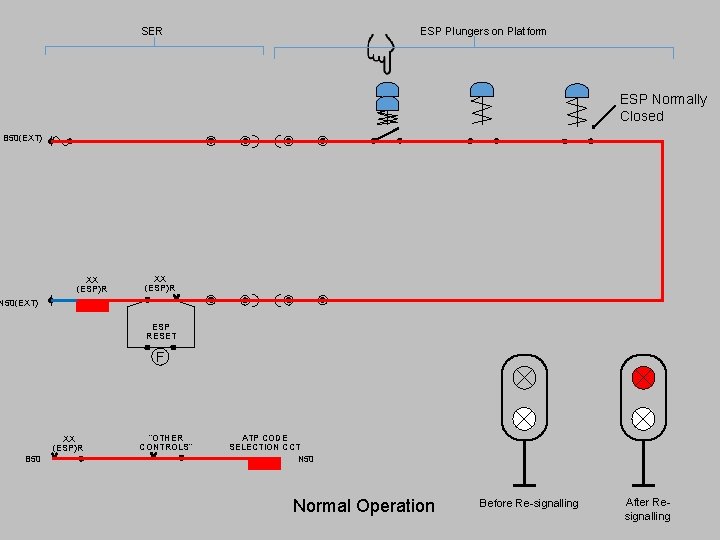
SER ESP Plungers on Platform ESP Normally Closed B 50(EXT) XX (ESP)R N 50(EXT) ESP RESET F XX (ESP)R B 50 “OTHER CONTROLS” ATP CODE SELECTION CCT N 50 Normal Operation Before Re-signalling After Resignalling
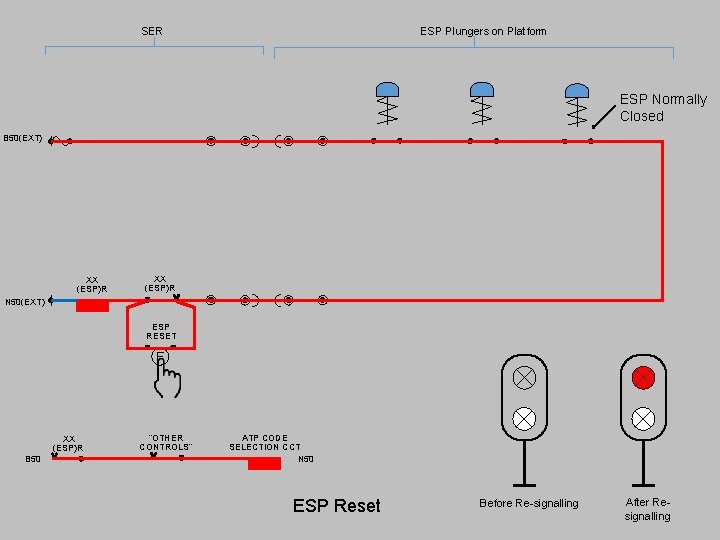
SER ESP Plungers on Platform ESP Normally Closed B 50(EXT) XX (ESP)R N 50(EXT) ESP RESET F XX (ESP)R B 50 “OTHER CONTROLS” ATP CODE SELECTION CCT N 50 ESP Reset Before Re-signalling After Resignalling
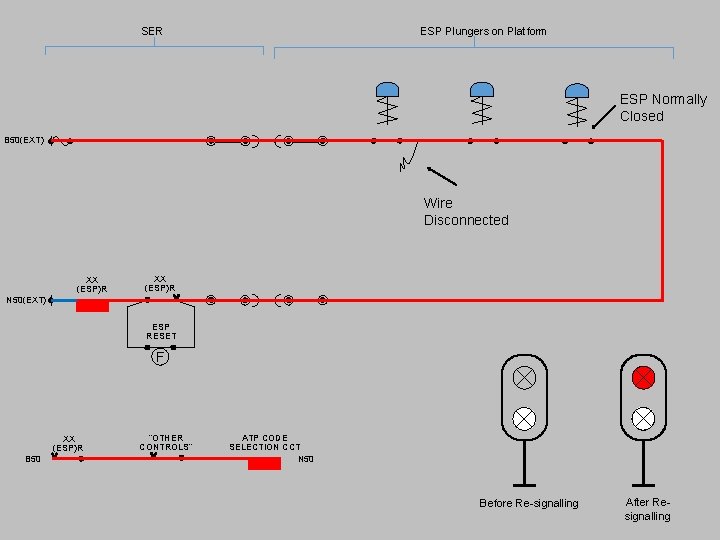
SER ESP Plungers on Platform ESP Normally Closed B 50(EXT) Wire Disconnected XX (ESP)R N 50(EXT) ESP RESET F XX (ESP)R B 50 “OTHER CONTROLS” ATP CODE SELECTION CCT N 50 Before Re-signalling After Resignalling
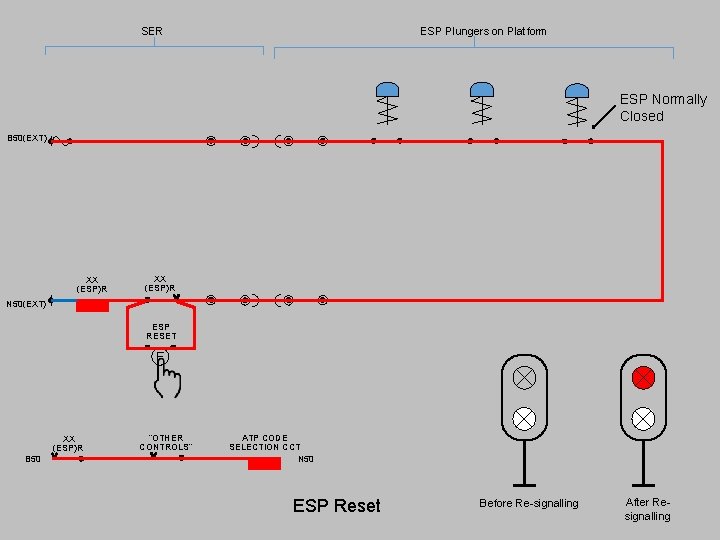
SER ESP Plungers on Platform ESP Normally Closed B 50(EXT) XX (ESP)R N 50(EXT) ESP RESET F XX (ESP)R B 50 “OTHER CONTROLS” ATP CODE SELECTION CCT N 50 ESP Reset Before Re-signalling After Resignalling
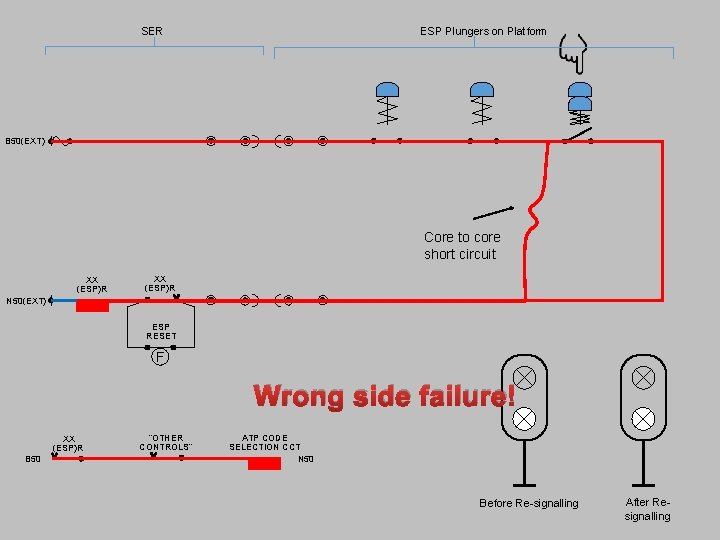
SER ESP Plungers on Platform B 50(EXT) Core to core short circuit XX (ESP)R N 50(EXT) ESP RESET F Wrong side failure! XX (ESP)R B 50 “OTHER CONTROLS” ATP CODE SELECTION CCT N 50 Before Re-signalling After Resignalling
ESP Circuit – Double Cut Normally Energised
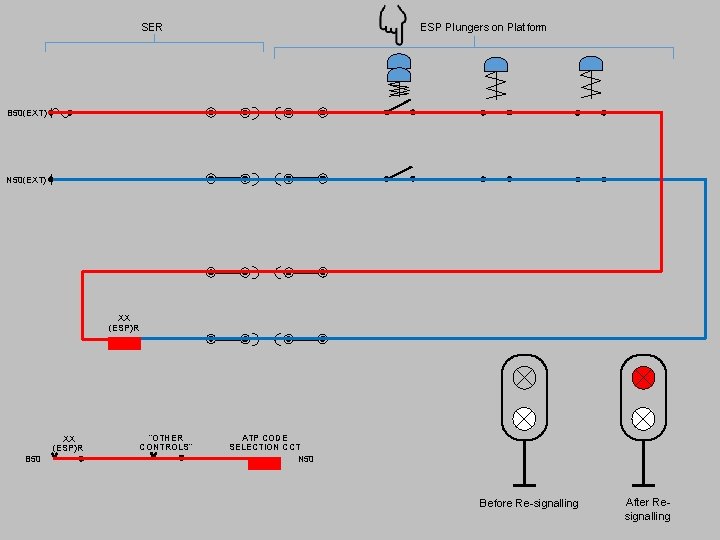
SER ESP Plungers on Platform B 50(EXT) N 50(EXT) XX (ESP)R B 50 “OTHER CONTROLS” ATP CODE SELECTION CCT N 50 Before Re-signalling After Resignalling
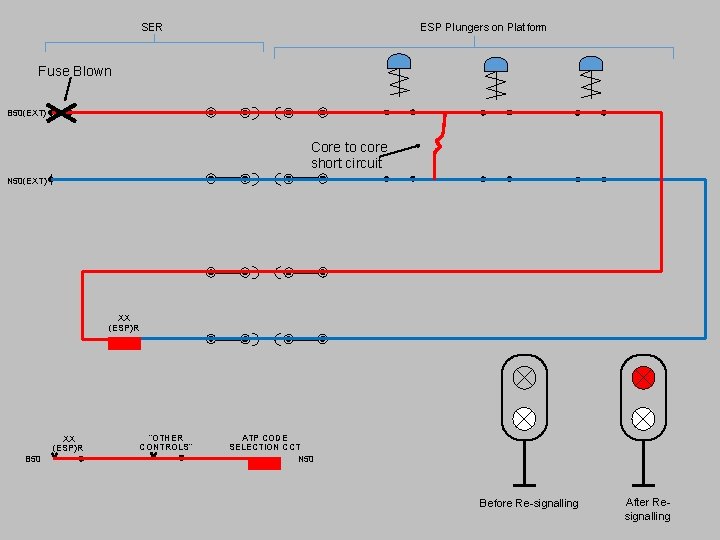
SER ESP Plungers on Platform Fuse Blown B 50(EXT) Core to core short circuit N 50(EXT) XX (ESP)R B 50 “OTHER CONTROLS” ATP CODE SELECTION CCT N 50 Before Re-signalling After Resignalling
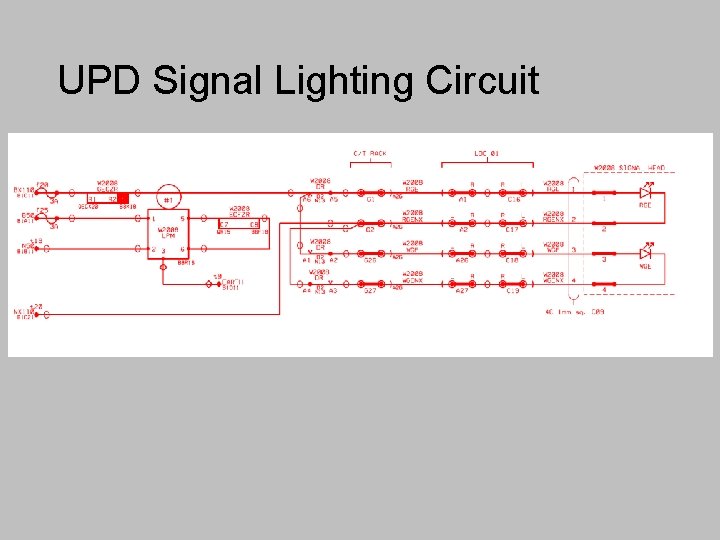
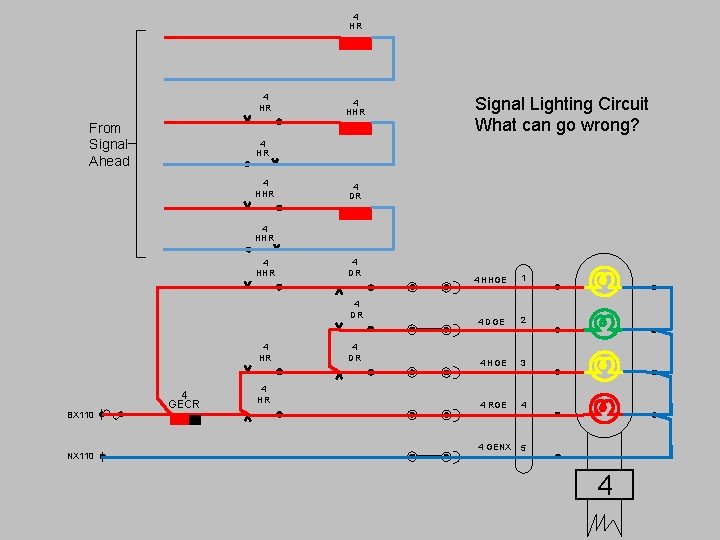
UPD Signal Lighting Circuit
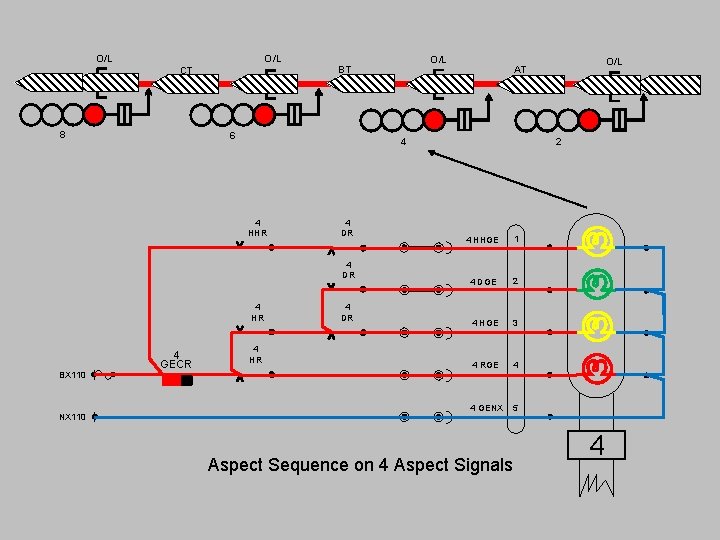
4 Aspect Signal
O/L CT 8 6 4 DR 4 HR BX 110 NX 110 4 HR 4 DR O/L AT 4 4 HHR 4 GECR O/L BT 2 4 HHGE 1 4 DGE 2 4 HGE 3 4 RGE 4 4 GENX 5 Aspect Sequence on 4 Aspect Signals 4
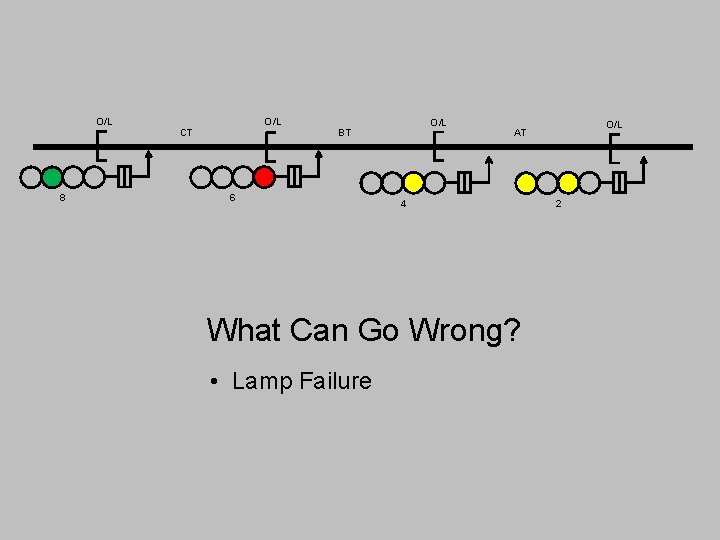
O/L 8 O/L CT O/L BT 6 4 What Can Go Wrong? • Lamp Failure O/L AT 2
4 HR From Signal Ahead 4 HHR Signal Lighting Circuit What can go wrong? 4 HR 4 HHR 4 DR 4 HR BX 110 NX 110 4 GECR 4 HR 4 DR 4 HHGE 1 4 DGE 2 4 HGE 3 4 RGE 4 4 GENX 5 4
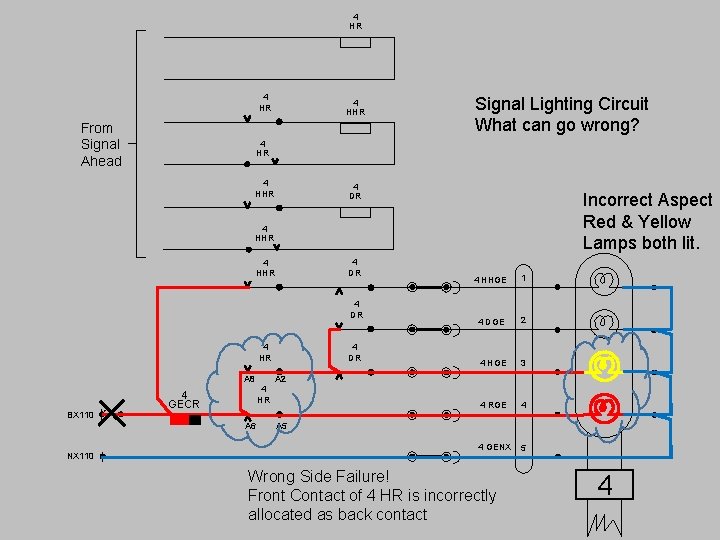
4 HR From Signal Ahead 4 HHR Signal Lighting Circuit What can go wrong? 4 HR 4 HHR 4 DR Incorrect Aspect Red & Yellow Lamps both lit. 4 HHR 4 DR 4 HR BX 110 4 GECR A 8 A 7 A 1 A 2 4 HR 4 DR 4 HHGE 1 4 DGE 2 4 HGE 3 4 RGE 4 4 GENX 5 A 6 A 5 NX 110 Wrong Side Failure! Front Contact of 4 HR is incorrectly allocated as back contact 4
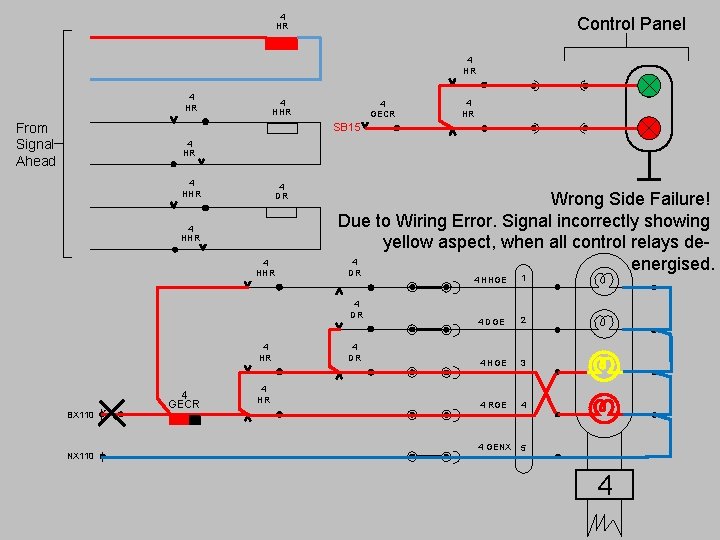
4 HR Control Panel 4 HR From Signal Ahead 4 HHR 4 GECR 4 HR SB 15 4 HR 4 HHR 4 DR 4 HHR Wrong Side Failure! Due to Wiring Error. Signal incorrectly showing yellow aspect, when all control relays de 4 energised. DR 4 HR BX 110 NX 110 4 GECR 4 HR 4 DR 4 HHGE 1 4 DGE 2 4 HGE 3 4 RGE 4 4 GENX 5 4
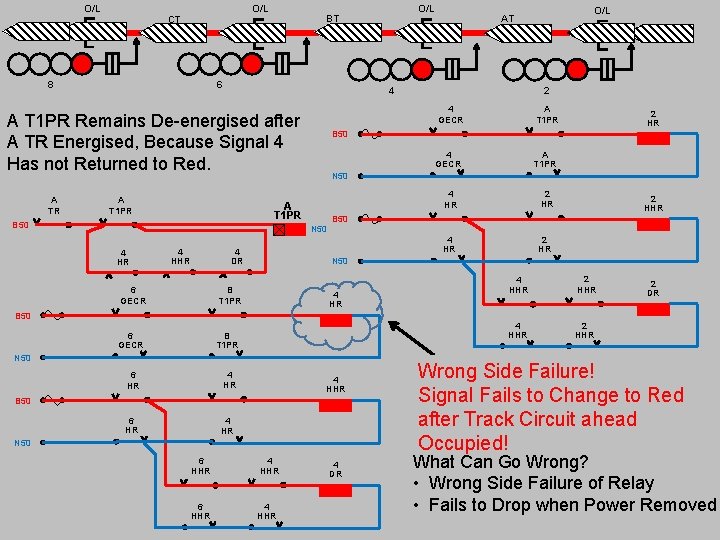
O/L CT 8 6 A T 1 PR 4 HHR 4 DR 6 GECR B T 1 PR 6 HR 4 GECR A T 1 PR 4 HR 2 HR N 50 4 HR 2 B 50 A T 1 PR B 50 O/L AT 4 A T 1 PR Remains De-energised after A TR Energised, Because Signal 4 Has not Returned to Red. A TR O/L BT 2 HHR B 50 N 50 4 HR 4 HHR 2 DR B 50 N 50 4 HHR B 50 N 50 6 HHR 4 DR Wrong Side Failure! Relay Remains up Signal Fails to Change to Red after Power Removed! after Track Circuit ahead Occupied! What Can Go Wrong? • Wrong Side Failure of Relay • Fails to Drop when Power Removed
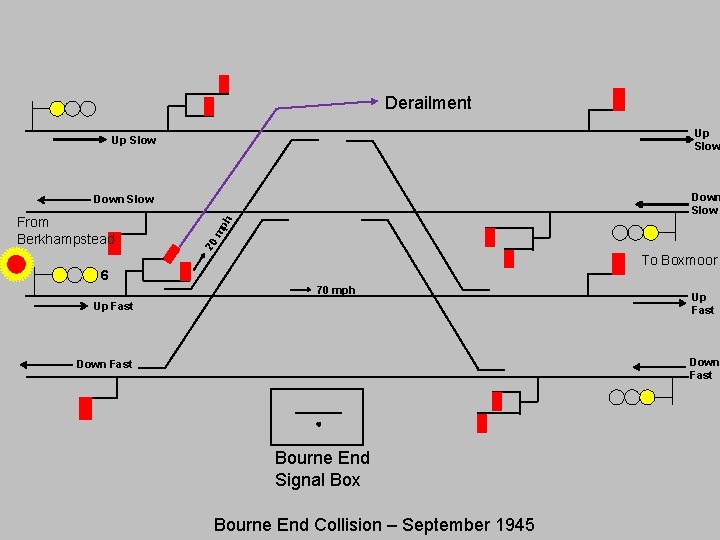
Derailment Up Slow Down Slow mp 20 From Berkhampstead h Up Slow To Boxmoor 6 70 mph Up Fast Down Fast Bourne End Signal Box Bourne End Collision – September 1945
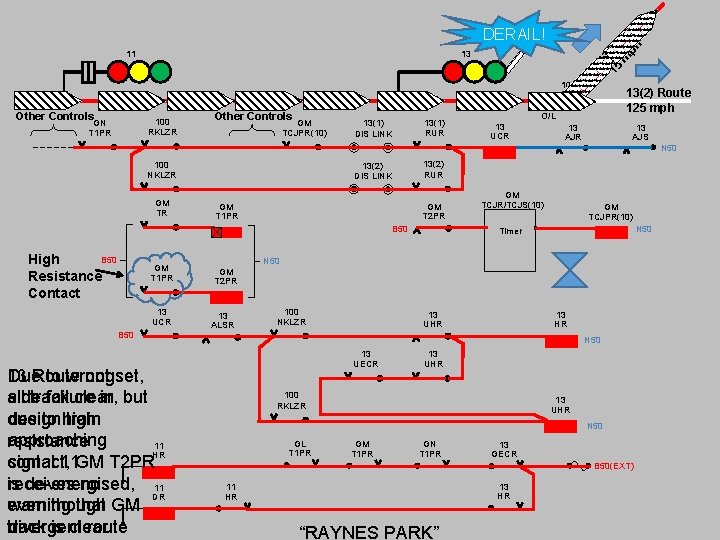
13 15 (1) m Ro ph u te DERAIL! 13 11 GL Other Controls 100 RKLZR GN T 1 PR Other Controls GM TCJPR(10) 100 GN GM 13(1) DIS LINK 13(1) RUR 13(2) Route 125 mph O/L 13 UCR 13 AJS N 50 100 NKLZR GM TR 13(2) RUR 13(2) DIS LINK GM T 2 PR GM T 1 PR B 50 High Resistance Contact GM T 1 PR 13 UCR B 50 Due to wrong 13 Route not set, side failure in all track clear, but design train due to high approaching resistance 11 HR signal 11 contact, GM T 2 PR receives no is de-energised, 11 DR warning that even though GM divergent route track is clear. GM TCJR/TCJS(10) GM TCJPR(10) N 50 Timer N 50 GM T 2 PR 13 ALSR 100 NKLZR 13 UHR 13 HR N 50 13 UECR 13 UHR 100 RKLZR 13 UHR N 50 GL T 1 PR GM T 1 PR GN T 1 PR 13 GECR B 50(EXT) 13 HR 11 HR “RAYNES PARK”
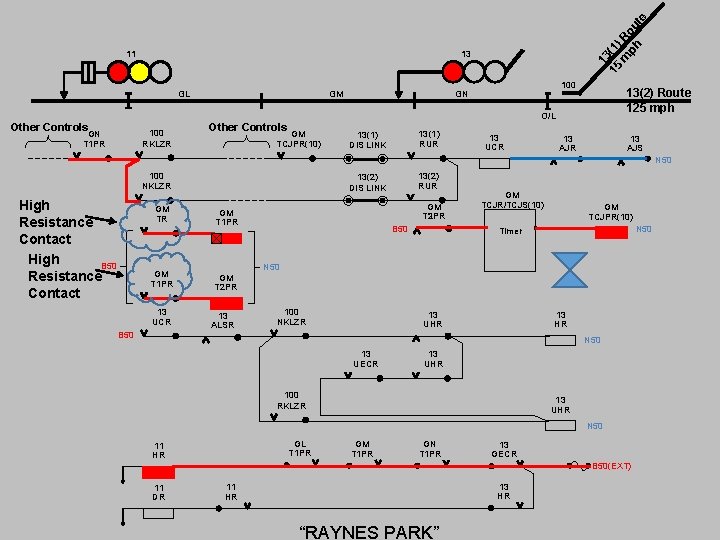
13 15 (1) m Ro ph u te 13 11 GL 100 GN GM 13(2) Route 125 mph O/L Other Controls 100 RKLZR GN T 1 PR Other Controls GM TCJPR(10) 13(1) RUR 13(1) DIS LINK 13 UCR 13 AJS N 50 100 NKLZR High Resistance Contact High B 50 Resistance Contact GM TR GM T 1 PR 13 UCR B 50 13(2) RUR 13(2) DIS LINK GM T 2 PR T 1 PR GM T 1 PR B 50 GM TCJR/TCJS(10) GM TCJPR(10) N 50 Timer N 50 GM T 2 PR 13 ALSR 100 NKLZR 13 UHR 13 HR N 50 13 UECR 13 UHR 100 RKLZR 13 UHR N 50 GL T 1 PR 11 HR GM T 1 PR GN T 1 PR 13 GECR B 50(EXT) 11 DR 13 HR 11 HR “RAYNES PARK”
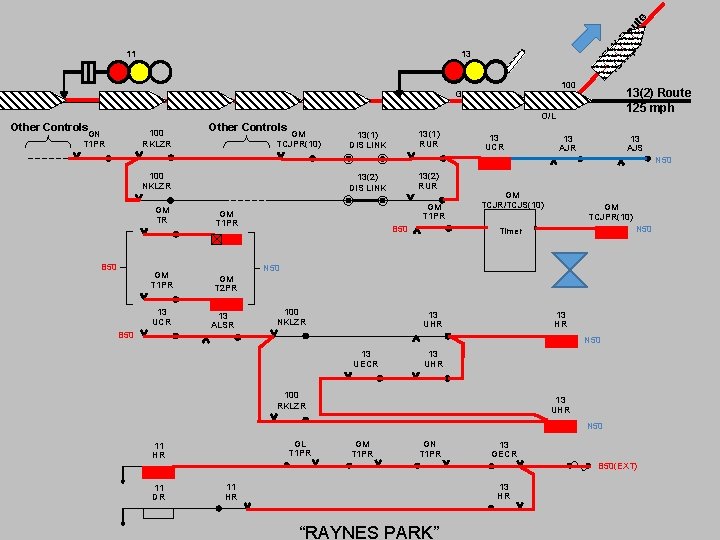
13 15 (1) m Ro ph u te 13 11 GL 100 GN GM 13(2) Route 125 mph O/L Other Controls 100 RKLZR GN T 1 PR Other Controls GM TCJPR(10) 13(1) RUR 13(1) DIS LINK 13 UCR 13 AJS N 50 100 NKLZR GM TR B 50 GM T 1 PR 13 UCR B 50 13(2) RUR 13(2) DIS LINK GM T 1 PR B 50 GM TCJR/TCJS(10) GM TCJPR(10) N 50 Timer N 50 GM T 2 PR 13 ALSR 100 NKLZR 13 UHR 13 HR N 50 13 UECR 13 UHR 100 RKLZR 13 UHR N 50 GL T 1 PR 11 HR GM T 1 PR GN T 1 PR 13 GECR B 50(EXT) 11 DR 13 HR 11 HR “RAYNES PARK”
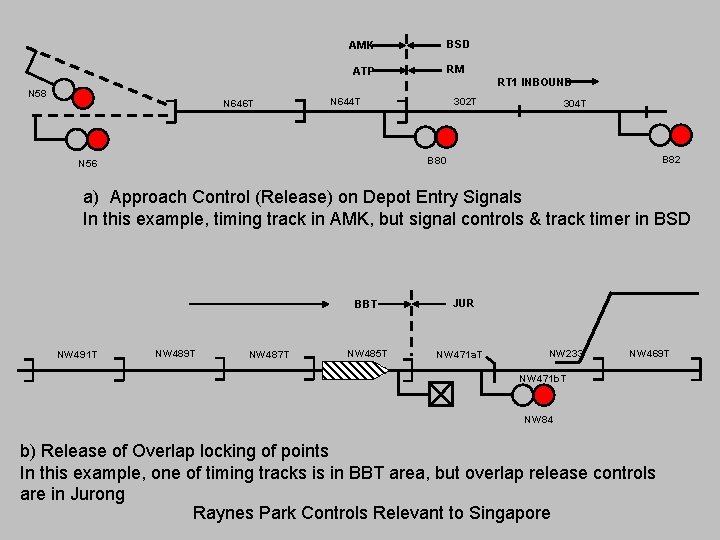
N 58 N 646 T AMK BSD ATP RM RT 1 INBOUND N 644 T 302 T 304 T B 82 B 80 N 56 a) Approach Control (Release) on Depot Entry Signals In this example, timing track in AMK, but signal controls & track timer in BSD BBT NW 491 T NW 489 T NW 487 T NW 485 T JUR NW 471 a. T NW 233 NW 469 T NW 471 b. T NW 84 b) Release of Overlap locking of points In this example, one of timing tracks is in BBT area, but overlap release controls are in Jurong Raynes Park Controls Relevant to Singapore
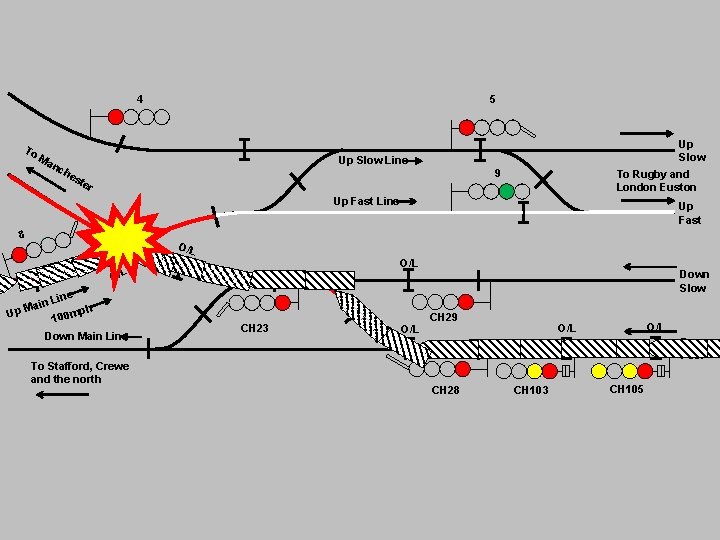
4 To Ma nc 5 Up Slow To Rugby and London Euston Up Slow Line he 9 ste r Up Fast Line 8 O/L O/L Up Up Fast Main Line ph 100 m Down Main Line To Stafford, Crewe and the north CH 23 O/L Down Slow CH 29 O/L Down Fast CH 28 CH 103 CH 105
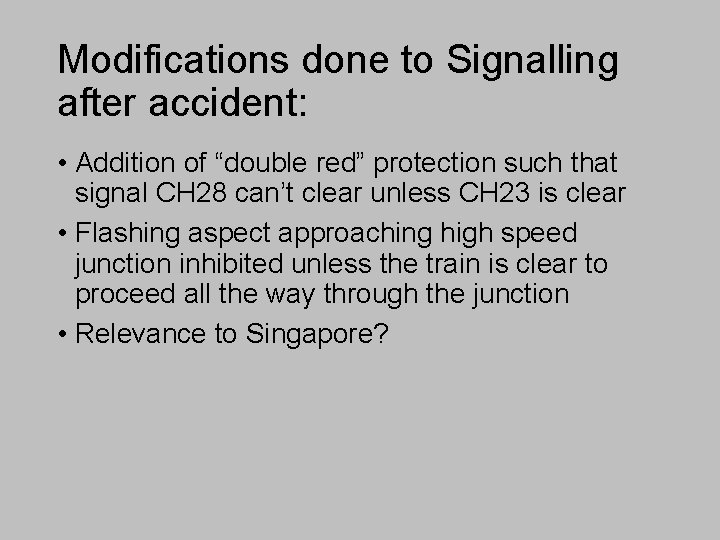
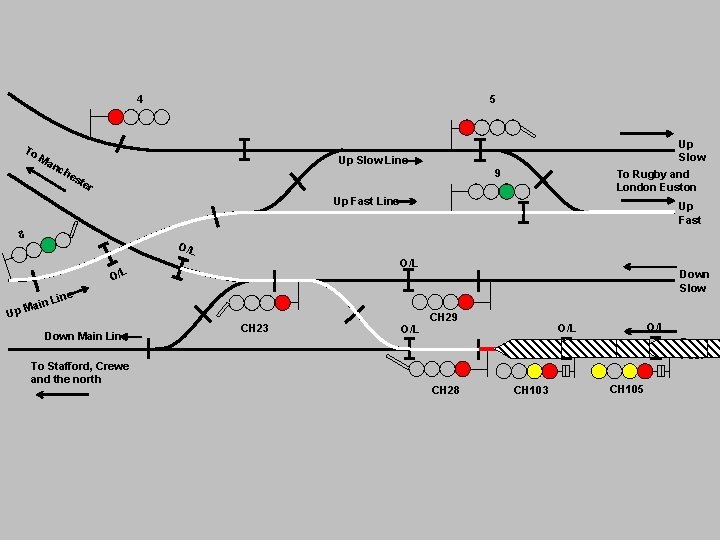
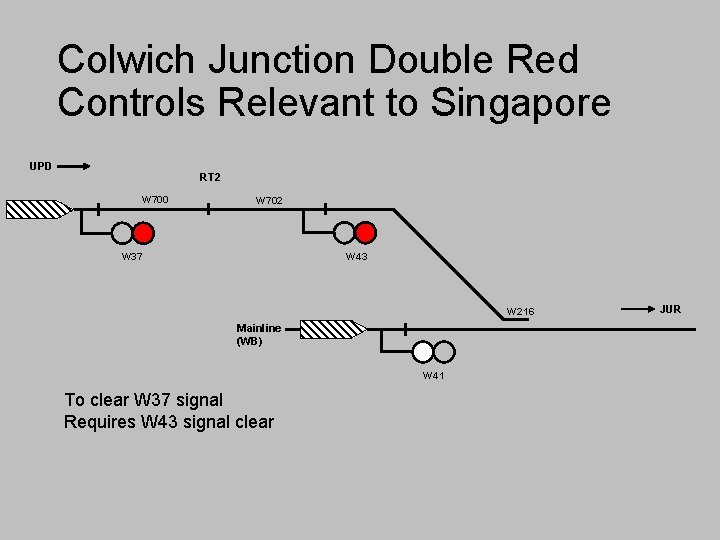
Modifications done to Signalling after accident: • Addition of “double red” protection such that signal CH 28 can’t clear unless CH 23 is clear • Flashing aspect approaching high speed junction inhibited unless the train is clear to proceed all the way through the junction • Relevance to Singapore?
4 To Ma nc 5 Up Slow To Rugby and London Euston Up Slow Line he 9 ste r Up Fast Line 8 O/L O/L Up Up Fast Main Down Slow Line Down Main Line To Stafford, Crewe and the north CH 23 O/L CH 29 O/L Down Fast CH 28 CH 103 CH 105
Colwich Junction Double Red Controls Relevant to Singapore UPD RT 2 W 700 W 702 W 43 W 37 W 216 Mainline (WB) W 41 To clear W 37 signal Requires W 43 signal clear JUR
References: • [1] Red for Danger -L. T. C Rolt, 1966 & 2007 • [2] The Conspiracy of Quintinshill-Jack Richards and Adrian Searle, 2013 • [3] British Railway Accidents of the Twentieth Century -J. A. B. Hamilton, 1967 • [4] Bourne End Rail Disaster 1945 -Ray Potter, 1997 • [5] Investigation into the Clapham Junction Railway Accident -Anthony Hidden QC, 1989 • [6] Railway Signalling and Control-IRSE, 2014 • [7] European Railway Signalling-IRSE, 1995 • [8] Report of an Inquiry into the Collision that occurred at Newton Junction 21 July 1991 -UK Health and Safety Executive, 1992 • [9] Website on UK Railway Accidents-www. railwaysarchive. co. uk • [10] UK Rail Accident Investigation Board website-www. raib. co. uk • [11] Presentation titled “British Junction Signalling-Time for a Change? ”- Stanley Hall OBE, 2001 • [12] The Ladbrooke Grove Enquiry. Part 1 Report-The Rt. Hon. Lord Cullen, 2000 • [13] SW 67 Series of Typical Free Wired Interlocking Circuits. (Based on BRB “Yellow Book” Standard circuits for free wired relay based interlockings, later became SW 67 series of standard circuits in UK Railtrack, then Network Rail). • [14] UK Rail Accident Investigation Board (RAIB) report into SPAD at Wooten Bassett 7 March 2015. • [15] Testing and Commissioning-IRSE paper by J. D. Corrie C Eng MIEE FIRSE • [16] Level Crossings: A guide for managers, designers and operators. • UK Office of Rail Regulation Railway Safety Publication 7, December 2011. • [17] Paper titled “An investigation into post installation testing methods used on LUL signalling systems” by Michael Neave