
Fault Tolerant Sensor Network Routing for Patient Monitoring

- Slides: 20
Fault Tolerant Sensor Network Routing for Patient Monitoring • Shanshan Jiang, Annarita Giani, Allen Yang, Yuan Xue, and Ruzena Bajcsy Vanderbilt University of California at Berkeley TRUST Autumn 2008 Conference November 11 th, 2008
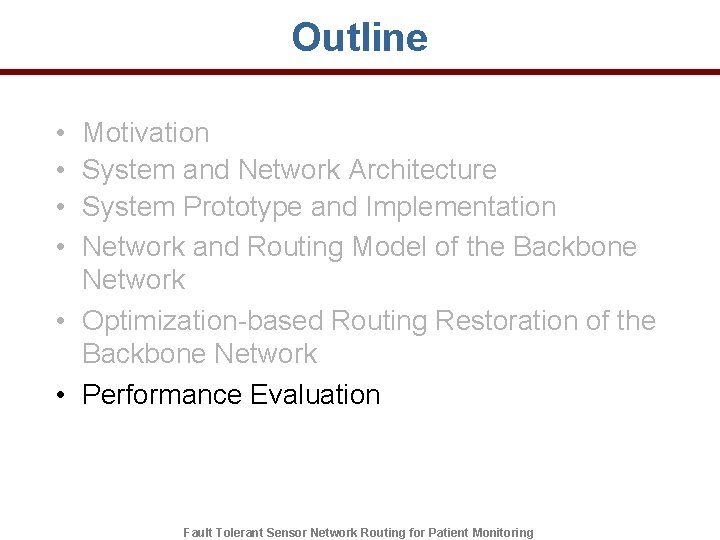
Outline • • Motivation System and Network Architecture System Prototype and Implementation Network and Routing Model of the Backbone Network • Optimization-based Routing Restoration of the Backbone Network • Performance Evaluation Fault Tolerant Sensor Network Routing for Patient Monitoring
Motivation • Aging population – According to the U. S. Census Bureau, the number of people over the age of 65 is expected to hit 70 million by 2030, having doubled since 2000. • Health care expenditures – Health care expenditures in the United States are projected to rise to 15. 9% of the GDP ($2. 6 trillion) by 2010. – The cost of health care for the nation’s aging population has become a national concern. Fault Tolerant Sensor Network Routing for Patient Monitoring
Motivation • Wireless Sensor Networks – Deploy wearable sensors on the bodies of patients in a residential setting – Continuously monitor physiological signals (such as ECG, blood oxygen levels) and other health related information (such as physical activity) • Advantages – Shift from a clinic-oriented, centralized healthcare system to a patientoriented, distributed healthcare system – Reduce healthcare expenses through more efficient use of clinical resources and earlier detection of medical conditions • Challenges – Performance, Reliability, Scalability, Qo. S, Privacy, Security … – More prone to failures, caused by power exhaustion, software and hardware faults, natural disasters, malicious attacks, and human errors etc. Provide fault-tolerant wireless communication that can satisfy both the performance and reliability requirements Fault Tolerant Sensor Network Routing for Patient Monitoring
Outline • • Motivation System and Network Architecture System Prototype and Implementation Network and Routing Model of the Backbone Network • Optimization-based Routing Restoration of the Backbone Network • Performance Evaluation Fault Tolerant Sensor Network Routing for Patient Monitoring
System and Network Architecture Fault Tolerant Sensor Network Routing for Patient Monitoring
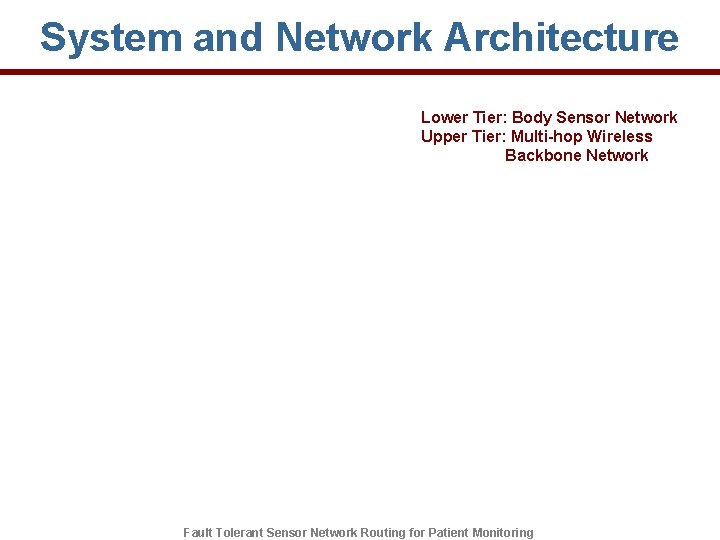
System and Network Architecture Lower Tier: Body Sensor Network Upper Tier: Multi-hop Wireless Backbone Network Fault Tolerant Sensor Network Routing for Patient Monitoring
Outline • • Motivation System and Network Architecture System Prototype and Implementation Network and Routing Model of the Backbone Network • Optimization-based Routing Restoration of the Backbone Network • Performance Evaluation Fault Tolerant Sensor Network Routing for Patient Monitoring
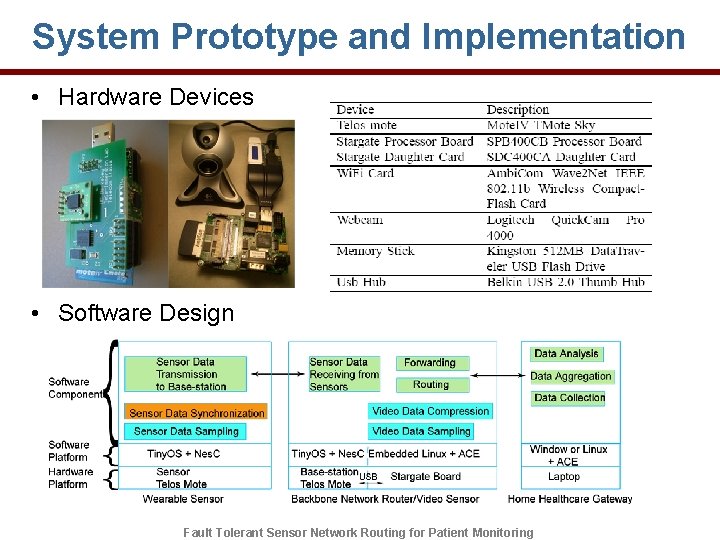
System Prototype and Implementation • Hardware Devices • Software Design Fault Tolerant Sensor Network Routing for Patient Monitoring
System Prototype Experiment Fault Tolerant Sensor Network Routing for Patient Monitoring
Outline • • Motivation System and Network Architecture System Prototype and Implementation Network and Routing Model of the Backbone Network • Optimization-based Routing Restoration of the Backbone Network • Performance Evaluation Fault Tolerant Sensor Network Routing for Patient Monitoring
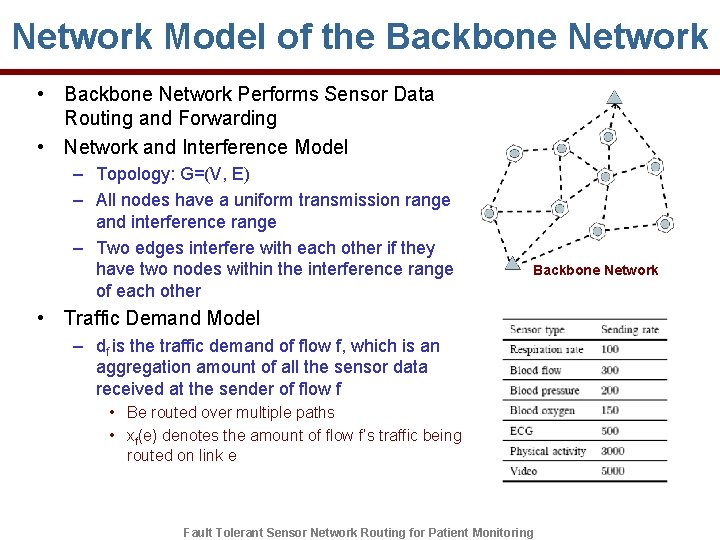
Network Model of the Backbone Network • Backbone Network Performs Sensor Data Routing and Forwarding • Network and Interference Model – Topology: G=(V, E) – All nodes have a uniform transmission range and interference range – Two edges interfere with each other if they have two nodes within the interference range of each other Backbone Network • Traffic Demand Model – df is the traffic demand of flow f, which is an aggregation amount of all the sensor data received at the sender of flow f • Be routed over multiple paths • xf(e) denotes the amount of flow f’s traffic being routed on link e Fault Tolerant Sensor Network Routing for Patient Monitoring
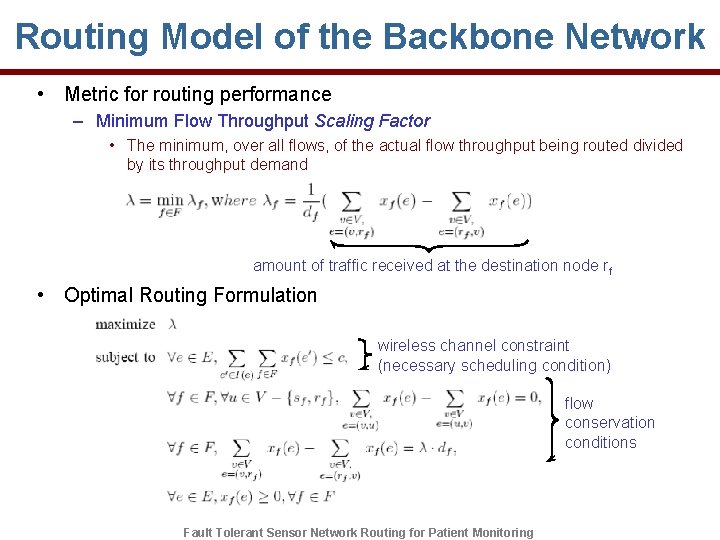
Routing Model of the Backbone Network • Metric for routing performance – Minimum Flow Throughput Scaling Factor • The minimum, over all flows, of the actual flow throughput being routed divided by its throughput demand amount of traffic received at the destination node rf • Optimal Routing Formulation wireless channel constraint (necessary scheduling condition) flow conservation conditions Fault Tolerant Sensor Network Routing for Patient Monitoring
Outline • • Motivation System and Network Architecture System Prototype and Implementation Network and Routing Model of the Backbone Network • Optimization-based Routing Restoration of the Backbone Network • Performance Evaluation Fault Tolerant Sensor Network Routing for Patient Monitoring
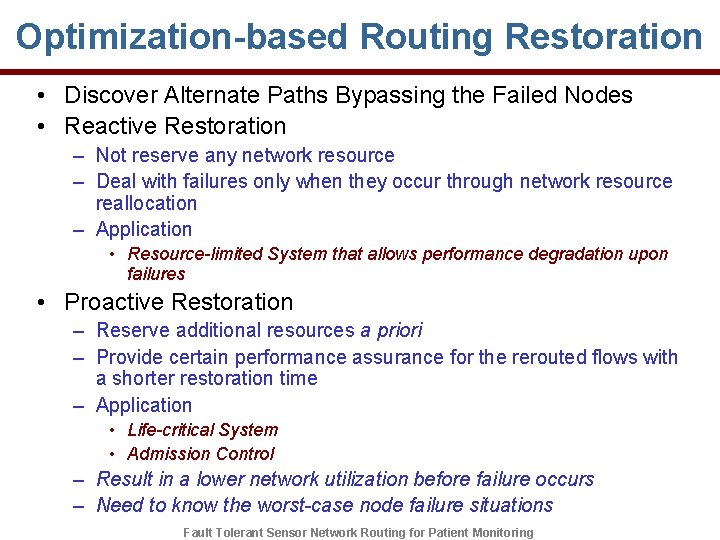
Optimization-based Routing Restoration • Discover Alternate Paths Bypassing the Failed Nodes • Reactive Restoration – Not reserve any network resource – Deal with failures only when they occur through network resource reallocation – Application • Resource-limited System that allows performance degradation upon failures • Proactive Restoration – Reserve additional resources a priori – Provide certain performance assurance for the rerouted flows with a shorter restoration time – Application • Life-critical System • Admission Control – Result in a lower network utilization before failure occurs – Need to know the worst-case node failure situations Fault Tolerant Sensor Network Routing for Patient Monitoring
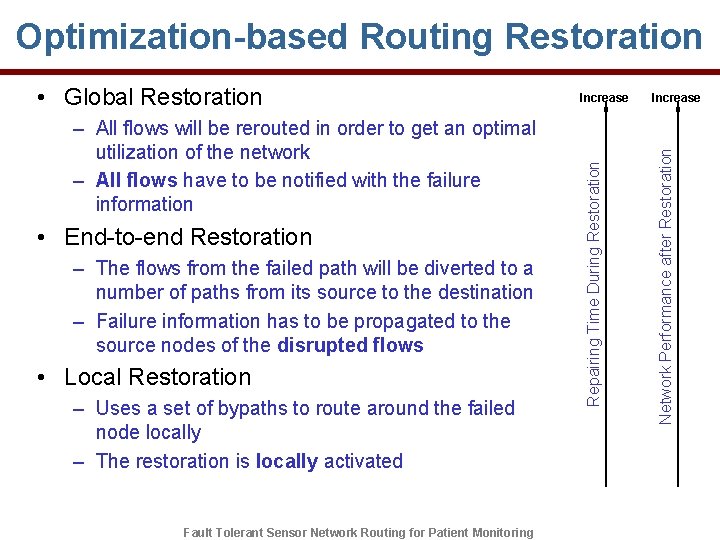
Optimization-based Routing Restoration • End-to-end Restoration – The flows from the failed path will be diverted to a number of paths from its source to the destination – Failure information has to be propagated to the source nodes of the disrupted flows • Local Restoration – Uses a set of bypaths to route around the failed node locally – The restoration is locally activated Fault Tolerant Sensor Network Routing for Patient Monitoring Increase Network Performance after Restoration – All flows will be rerouted in order to get an optimal utilization of the network – All flows have to be notified with the failure information Increase Repairing Time During Restoration • Global Restoration
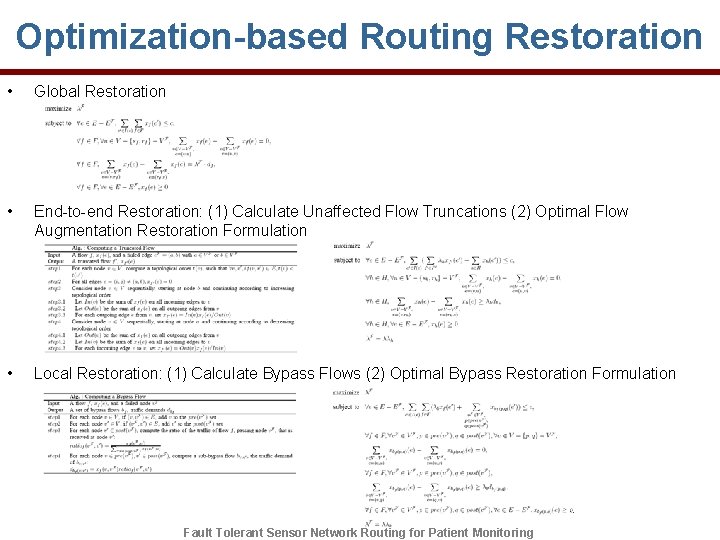
Optimization-based Routing Restoration • Global Restoration • End-to-end Restoration: (1) Calculate Unaffected Flow Truncations (2) Optimal Flow Augmentation Restoration Formulation • Local Restoration: (1) Calculate Bypass Flows (2) Optimal Bypass Restoration Formulation Fault Tolerant Sensor Network Routing for Patient Monitoring
Outline • • Motivation System and Network Architecture System Prototype and Implementation Network and Routing Model of the Backbone Network • Optimization-based Routing Restoration of the Backbone Network • Performance Evaluation Fault Tolerant Sensor Network Routing for Patient Monitoring
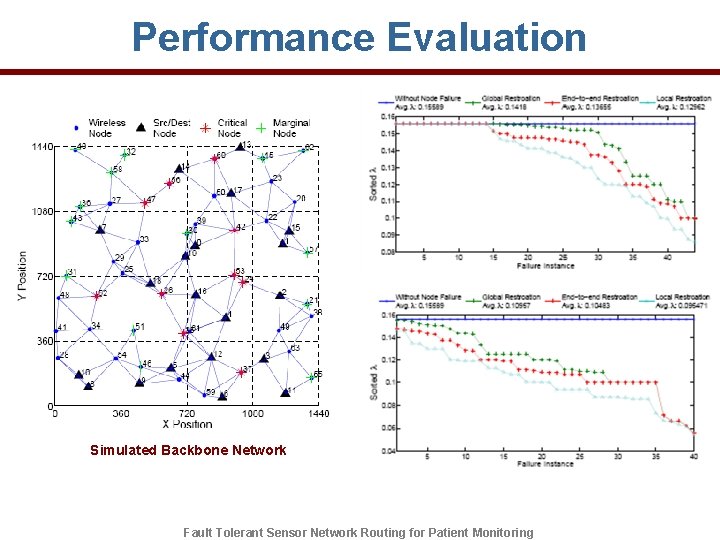
Performance Evaluation Simulated Backbone Network Fault Tolerant Sensor Network Routing for Patient Monitoring
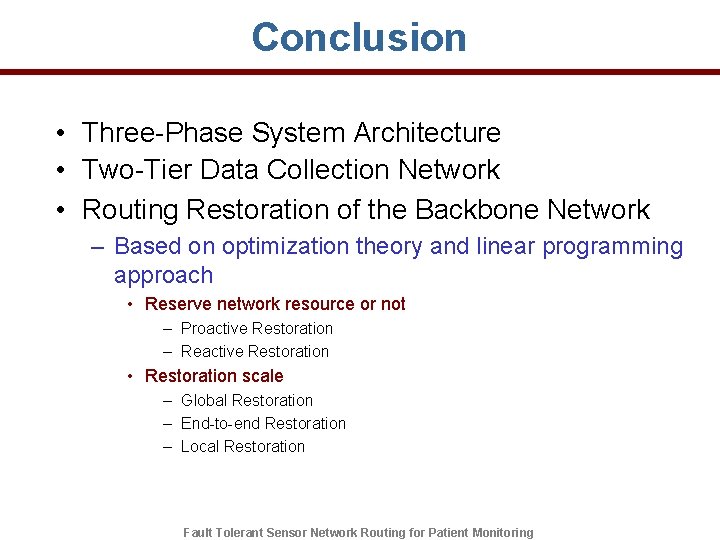
Conclusion • Three-Phase System Architecture • Two-Tier Data Collection Network • Routing Restoration of the Backbone Network – Based on optimization theory and linear programming approach • Reserve network resource or not – Proactive Restoration – Reactive Restoration • Restoration scale – Global Restoration – End-to-end Restoration – Local Restoration Fault Tolerant Sensor Network Routing for Patient Monitoring