
Fault Detection and Isolation an overview Mara Jess
- Slides: 30
Fault Detection and Isolation: an overview María Jesús de la Fuente Dpto. Ingeniería de Sistemas y Automática Universidad de Valladolid
Outline Universidad de Valladolid n n Introduction: industrial process automation Systems and faults: n n n Diagnosis approaches n n n n Model – free methods Model – based methods Knowledge based methods FDI: Fault detection and isolation n n What is a fault Fault types Fault detection Fault isolation Fault estimation Evaluation FDI performance Conclusions
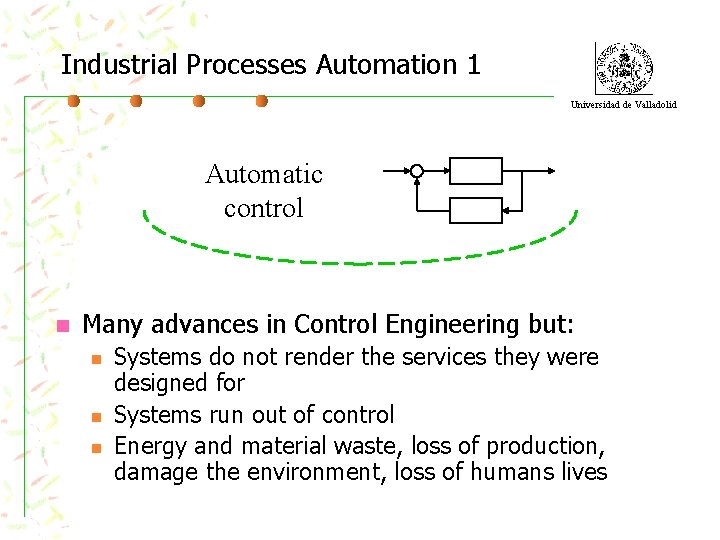
Industrial Processes Automation 1 Universidad de Valladolid Automatic control n Many advances in Control Engineering but: n n n Systems do not render the services they were designed for Systems run out of control Energy and material waste, loss of production, damage the environment, loss of humans lives
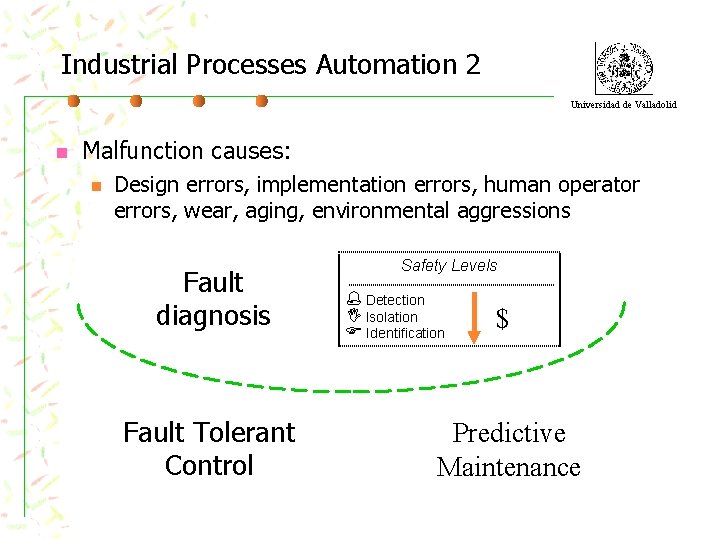
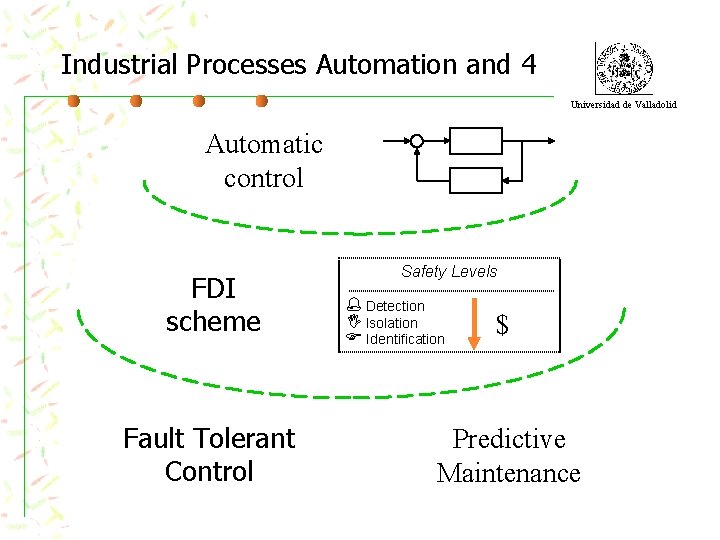
Industrial Processes Automation 2 Universidad de Valladolid n Malfunction causes: n Design errors, implementation errors, human operator errors, wear, aging, environmental aggressions Fault diagnosis Fault Tolerant Control Safety Levels % Detection I Isolation Identification $ Predictive Maintenance
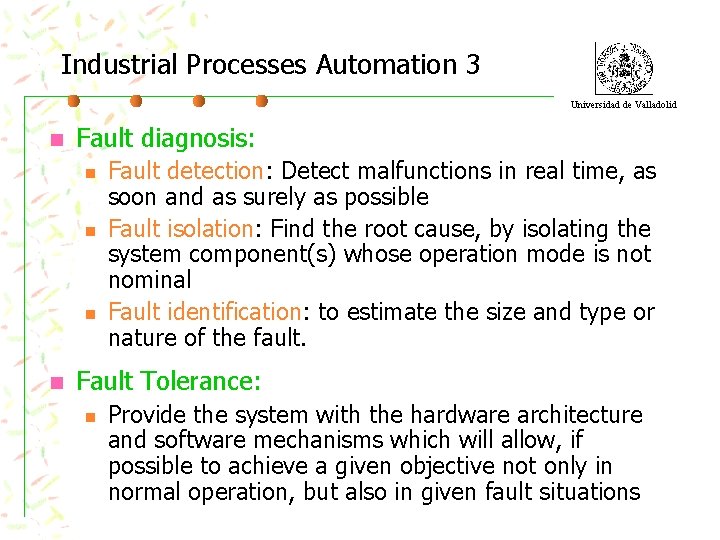
Industrial Processes Automation 3 Universidad de Valladolid n Fault diagnosis: n n Fault detection: Detect malfunctions in real time, as soon and as surely as possible Fault isolation: Find the root cause, by isolating the system component(s) whose operation mode is not nominal Fault identification: to estimate the size and type or nature of the fault. Fault Tolerance: n Provide the system with the hardware architecture and software mechanisms which will allow, if possible to achieve a given objective not only in normal operation, but also in given fault situations
Industrial Processes Automation and 4 Universidad de Valladolid Automatic control FDI scheme Fault Tolerant Control Safety Levels % Detection I Isolation Identification $ Predictive Maintenance
Faults 1 Universidad de Valladolid n Some definitions: n n Fault: an unpermitted deviation of at least one characteristic property or parameter of the system from the acceptable/usual/standard condition. Failure: a permanent interruption of a system’s ability to perform a required function under specific operating conditions. Disturbance: an unknown (and uncontrolled) input acting on the system which result in a departure from the current state. Symptom: a change of an observable quantity from normal behavior, i. e. , an observable effect of a fault.
Faults 2 Universidad de Valladolid n n Reliability: ability of the system to perform a required function under stated conditions. Safety: ability of the system not to cause danger to persons or equipment or environment. Availability: probability that a system or equipment will operate satisfactorily at any point of time. Maintainability: concerns with the needs for repair and the ease with which repairs can be made.
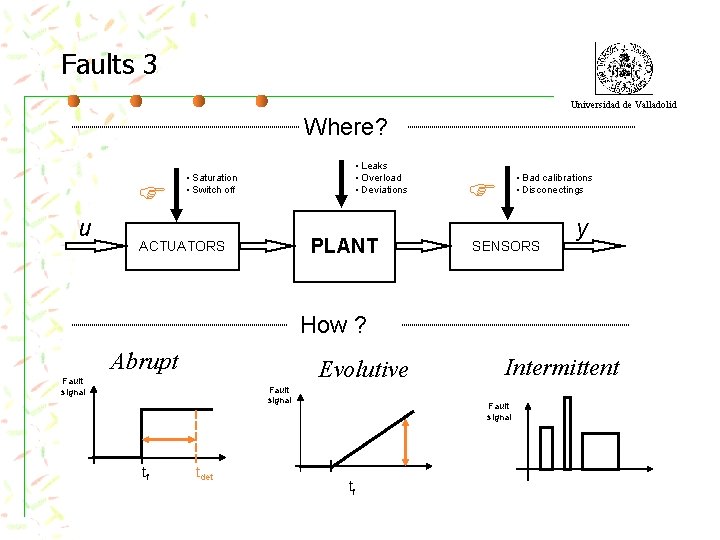
Faults 3 Universidad de Valladolid Where? u • Leaks • Overload • Deviations • Saturation • Switch off PLANT ACTUATORS • Bad calibrations • Disconectings SENSORS y How ? Abrupt Evolutive Fault signal tf tdet Intermittent Fault signal tf
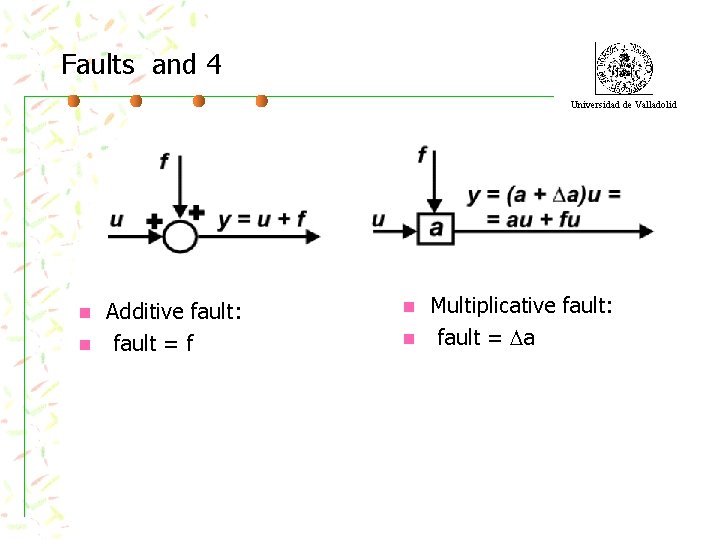
Faults and 4 Universidad de Valladolid n n Additive fault: fault = f n n Multiplicative fault: fault = a
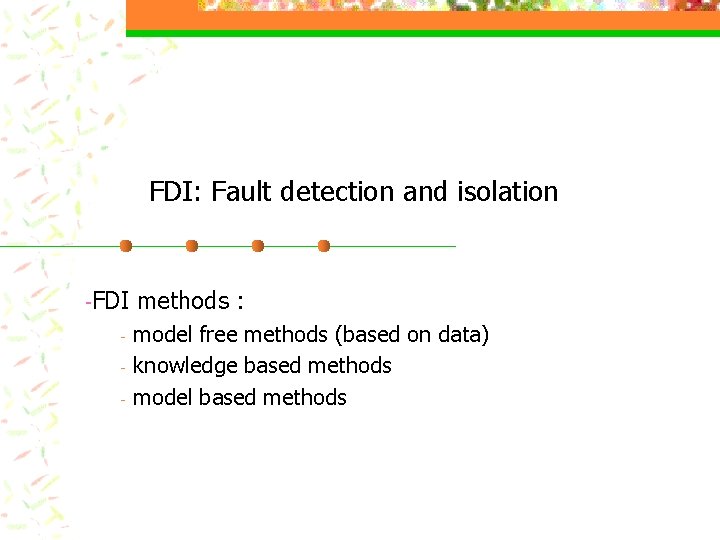
FDI: Fault detection and isolation -FDI - methods : model free methods (based on data) knowledge based methods model based methods
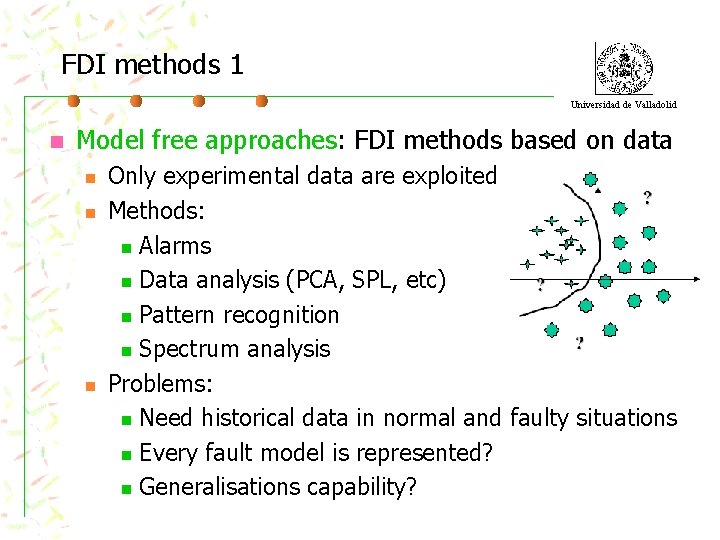
FDI methods 1 Universidad de Valladolid n Model free approaches: FDI methods based on data n n n Only experimental data are exploited Methods: n Alarms n Data analysis (PCA, SPL, etc) n Pattern recognition n Spectrum analysis Problems: n Need historical data in normal and faulty situations n Every fault model is represented? n Generalisations capability?
FDI methods 2 Universidad de Valladolid n Methods based on knowledge: n Expert systems: diagnosis = heuristic process n Expert codes his heuristic knowledge in rules: If set of symptoms THEN malfunction n Advantage: consolidate approach n Problems: Related to experience (knowledge acquisition is a complex task, device dependent) n Related to classification methods (new faults, multiples faults) n Related software: maintenance of the knowledge base (consistency) n
FDI methods 3 Universidad de Valladolid n n Methods based on soft-computing: combination of data and heuristic knowledge n Neural networks n Fuzzy logic n Genetic algorithms n Combination between them Causal analysis techniques: are based on the causal modeling of fault-symptom relationships: n Signed direct graphs n Symptoms trees.
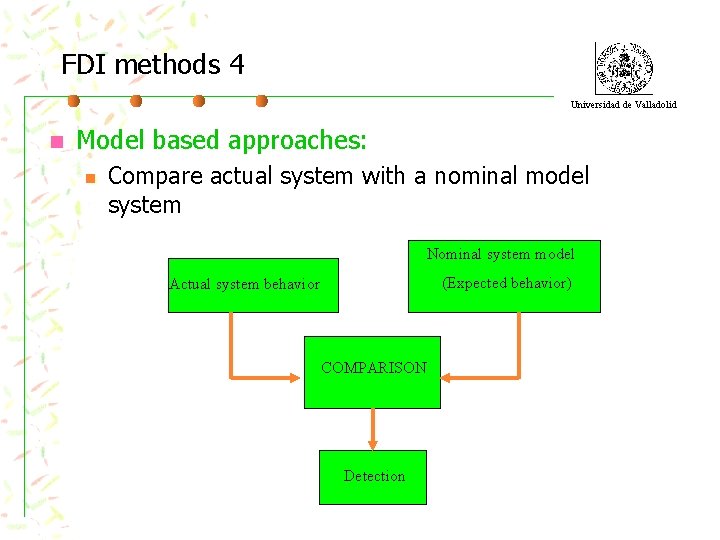
FDI methods 4 Universidad de Valladolid n Model based approaches: n Compare actual system with a nominal model system Nominal system model (Expected behavior) Actual system behavior COMPARISON Detection
FDI methods 5 Universidad de Valladolid n Model based approaches: two main areas: n n n FDI => from the control engineering point of view DX => Artificial Intelligence point of view From FDI: n Models: n n n Observers (Luenberger, unknown input etc. ) Kalman filters parity equations parameter estimation (Identification algorithms) Extension to non linear systems (non-linear models)
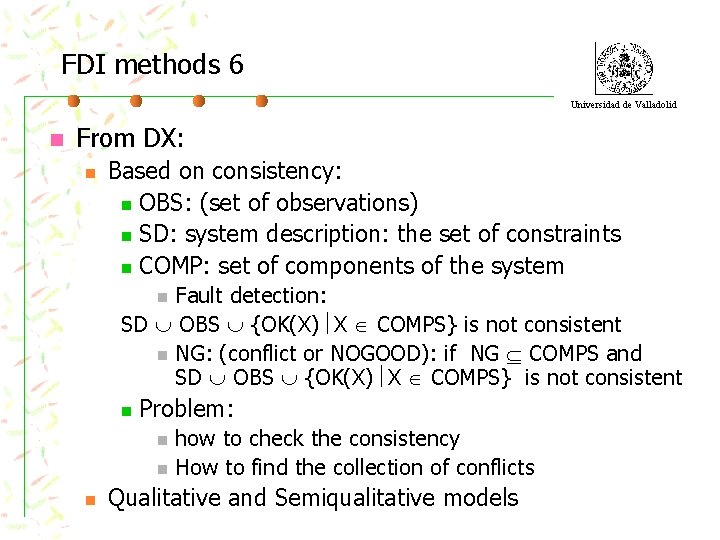
FDI methods 6 Universidad de Valladolid n From DX: n Based on consistency: n OBS: (set of observations) n SD: system description: the set of constraints n COMP: set of components of the system Fault detection: SD OBS {OK(X) X COMPS} is not consistent n NG: (conflict or NOGOOD): if NG COMPS and SD OBS {OK(X) X COMPS} is not consistent n n Problem: how to check the consistency n How to find the collection of conflicts n n Qualitative and Semiqualitative models
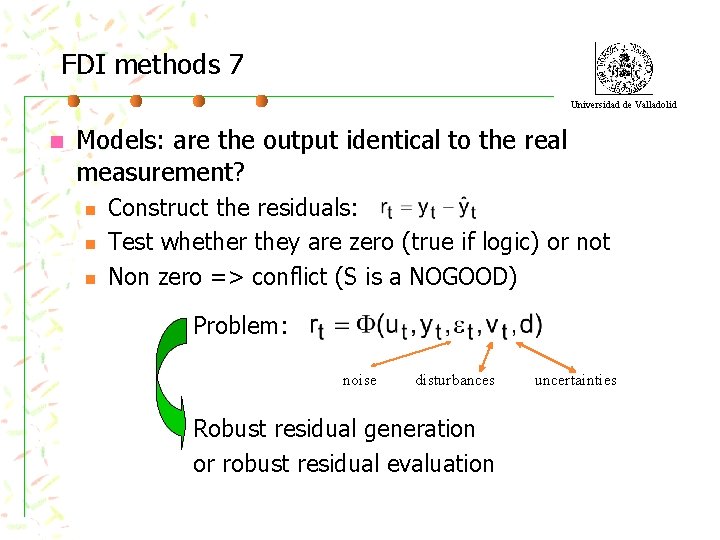
FDI methods 7 Universidad de Valladolid n Models: are the output identical to the real measurement? n n n Construct the residuals: Test whether they are zero (true if logic) or not Non zero => conflict (S is a NOGOOD) Problem: noise disturbances Robust residual generation or robust residual evaluation uncertainties
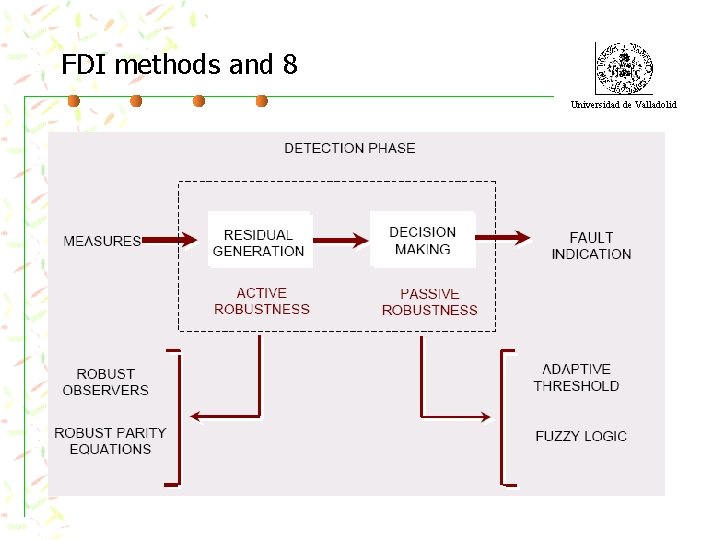
FDI methods and 8 Universidad de Valladolid
FDI: Fault detection and Isolation Decision theory: Fault detection Fault isolation Fault estimation
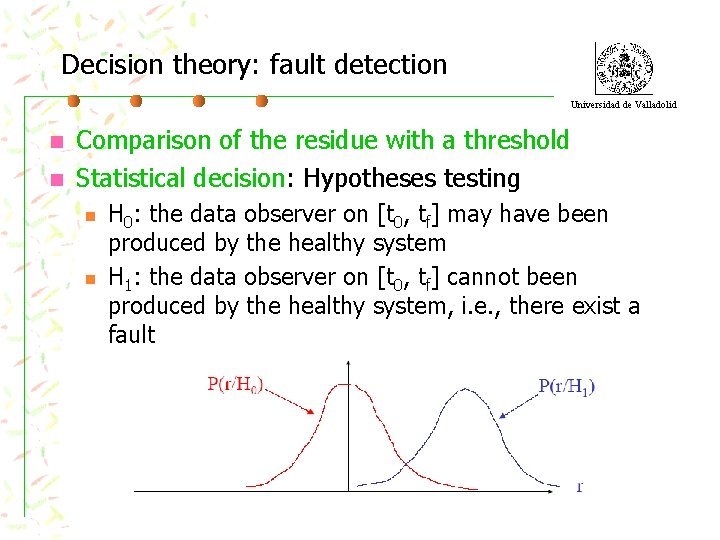
Decision theory: fault detection Universidad de Valladolid n n Comparison of the residue with a threshold Statistical decision: Hypotheses testing n n H 0: the data observer on [t 0, tf] may have been produced by the healthy system H 1: the data observer on [t 0, tf] cannot been produced by the healthy system, i. e. , there exist a fault
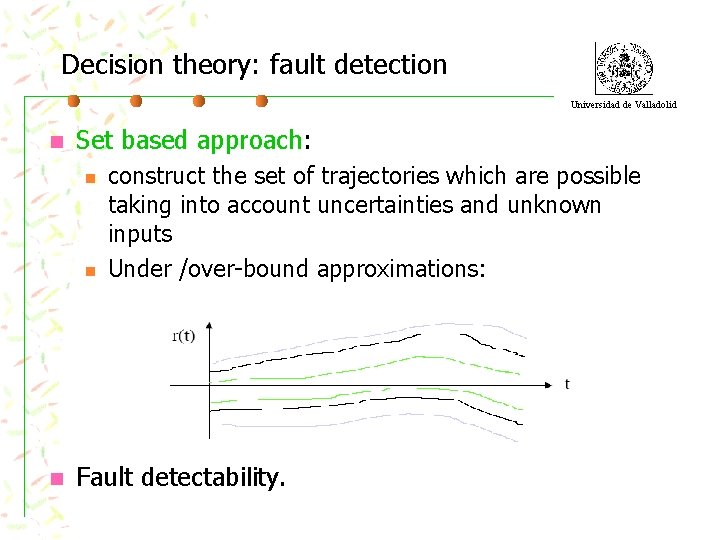
Decision theory: fault detection Universidad de Valladolid n Set based approach: n n n construct the set of trajectories which are possible taking into account uncertainties and unknown inputs Under /over-bound approximations: Fault detectability.
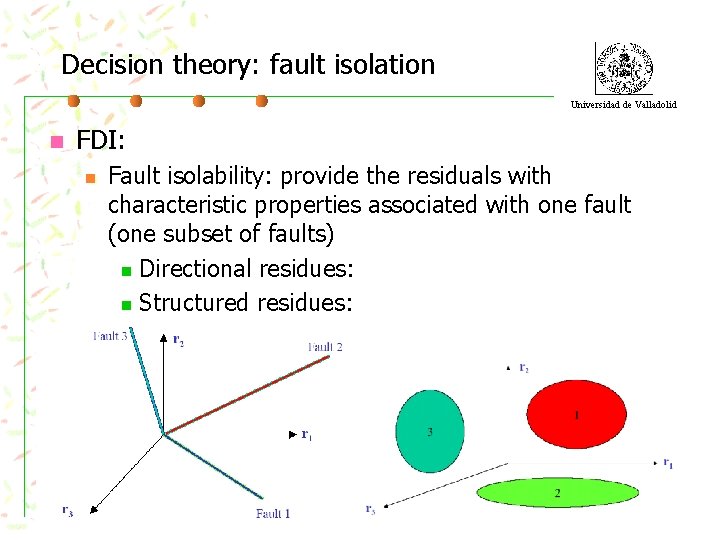
Decision theory: fault isolation Universidad de Valladolid n FDI: n Fault isolability: provide the residuals with characteristic properties associated with one fault (one subset of faults) n Directional residues: n Structured residues:
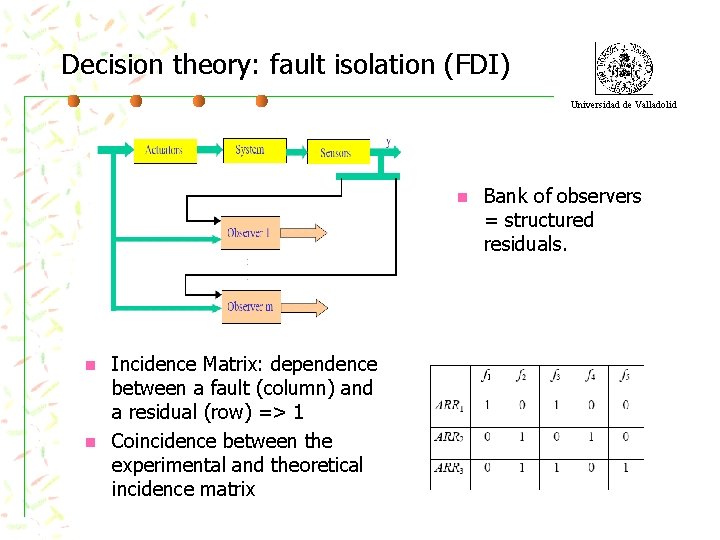
Decision theory: fault isolation (FDI) Universidad de Valladolid n n n Incidence Matrix: dependence between a fault (column) and a residual (row) => 1 Coincidence between the experimental and theoretical incidence matrix Bank of observers = structured residuals.
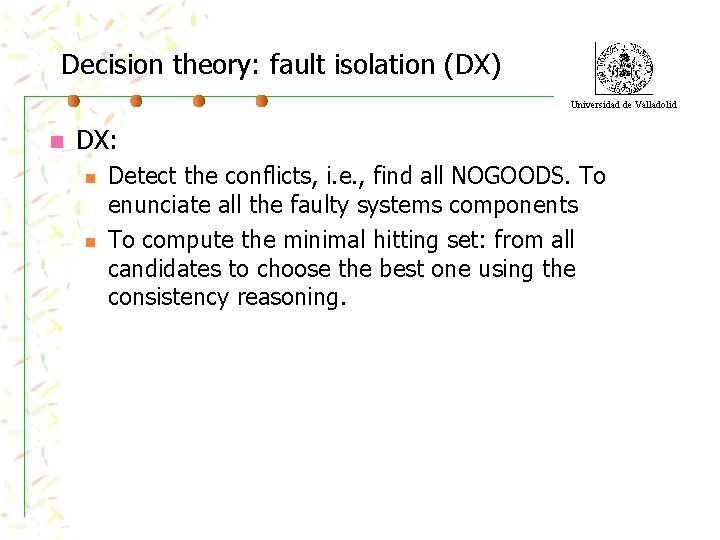
Decision theory: fault isolation (DX) Universidad de Valladolid n DX: n n Detect the conflicts, i. e. , find all NOGOODS. To enunciate all the faulty systems components To compute the minimal hitting set: from all candidates to choose the best one using the consistency reasoning.
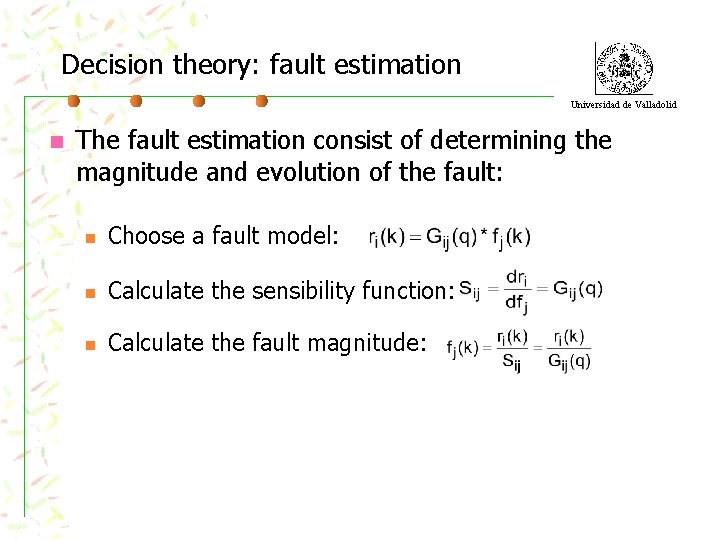
Decision theory: fault estimation Universidad de Valladolid n The fault estimation consist of determining the magnitude and evolution of the fault: n Choose a fault model: n Calculate the sensibility function: n Calculate the fault magnitude:
FDI: Fault detection and Isolation - Evaluation of FDI performance Conclusions
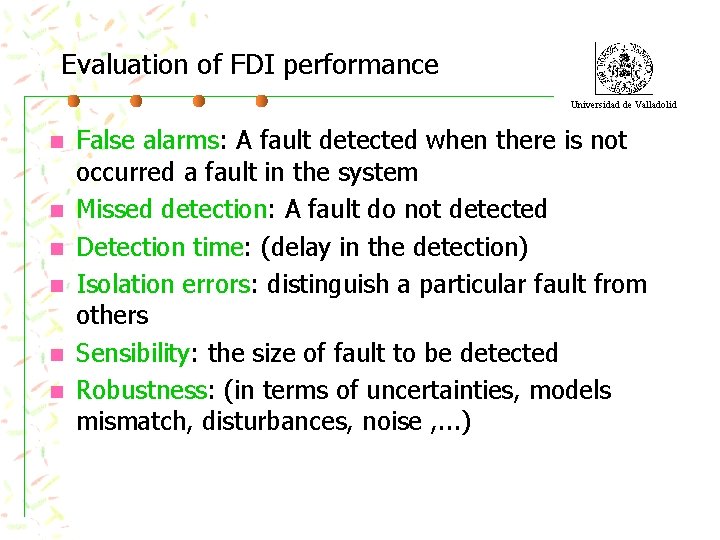
Evaluation of FDI performance Universidad de Valladolid n n n False alarms: A fault detected when there is not occurred a fault in the system Missed detection: A fault do not detected Detection time: (delay in the detection) Isolation errors: distinguish a particular fault from others Sensibility: the size of fault to be detected Robustness: (in terms of uncertainties, models mismatch, disturbances, noise , . . . )
Conclusions Universidad de Valladolid n FDI: a mature field n n Huge literature SAFEPROCESS European projects like MONET Further research focuses on: n n n New class of systems (e. g. Hybrid systems) Applications Fault tolerance issues
Bibliography Universidad de Valladolid n R. J. Patton, P. Frank and R. Clark (1989), Fault Diagnosis in Dynamic Systems. Theory and applications. Control Engineering Series, Prentice Hall ( A new edition in 2000) n A. D. Pouliezos, G. D. Stavrakakis, (1994), Real time fault monitoring of industrial processes, Kluwer Academic Publishers n J. Gertler (1998), Fault detection and diagnosis in Engineering Systems, Marcel Dekker, New York n J. Chen and R. J. Patton (1999), Robust model-based fault diagnosis for dynamic systems, Kluwer Academic Publishers n Etc…