
Fats Oils and Grease FOG Program FSE Employee
- Slides: 70
Fats, Oils, and Grease – FOG Program FSE Employee Training Best Management Practices (BMPs) and Grease Control Equipment (GCE) Training for Food Service Establishment (FSE) Employees
BACKGROUND ¡ ¡ Prohibited discharge of fats, oils, and grease (FOG) causes or significantly contributes to 38% of all sanitary sewer overflows (SSOs) within Dothan’s wastewater collection system. The City of Dothan is under an EPA administrative order on consent for the City’s wastewater system requiring the City to develop and enforce a FOG control program and to prevent sanitary sewer overflows (SSOs).
Legal Authority ¡ ¡ Federal and State mandates require the prevention of sanitary sewer overflows (SSOs). The “Fats, Oils, and Grease (FOG) Ordinance” is one measure providing adequate regulation to enforce design, sizing, installation, maintenance, and record keeping of grease control equipment.
The FSE FOG Program Objectives ¡ ¡ Reduce FOG related sanitary sewer overflows. Provide increased education and awareness of FOG and to improve FOG remediation efforts at FSEs. FOG discharge and related SSOs are NO accident!
FOG Program FSE Employee Training – Goals and Outcomes ¡ ¡ ¡ Understand background and purpose for the FOG Program. Fully understand how using kitchen BMPs to control FOG discharge is related to sewer blockages and sanitary sewer overflows (SSOs). Be able to properly clean and maintain a grease trap (if applicable) in accordance with the FOG Ordinance. Understand the consequences to FSE employees/management for illicit FOG disposal. Fully understand FOG record requirements. Understand the 25% rule, properly conduct measurements, and keep records.
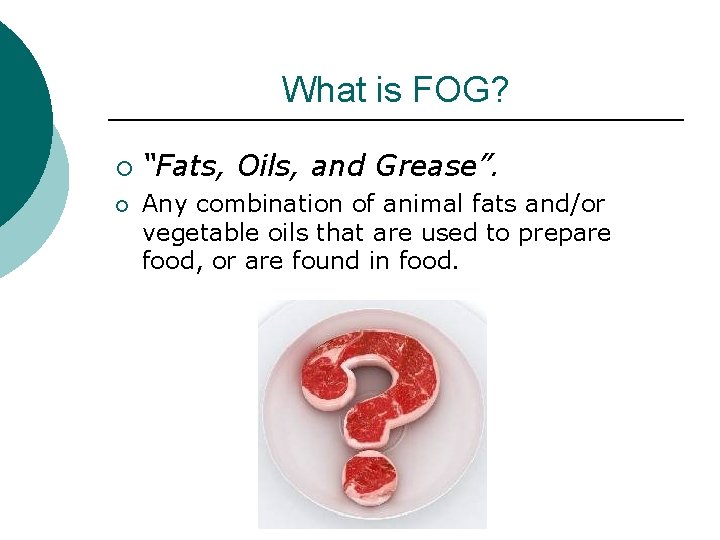
What is FOG? ¡ ¡ “Fats, Oils, and Grease”. Any combination of animal fats and/or vegetable oils that are used to prepare food, or are found in food.
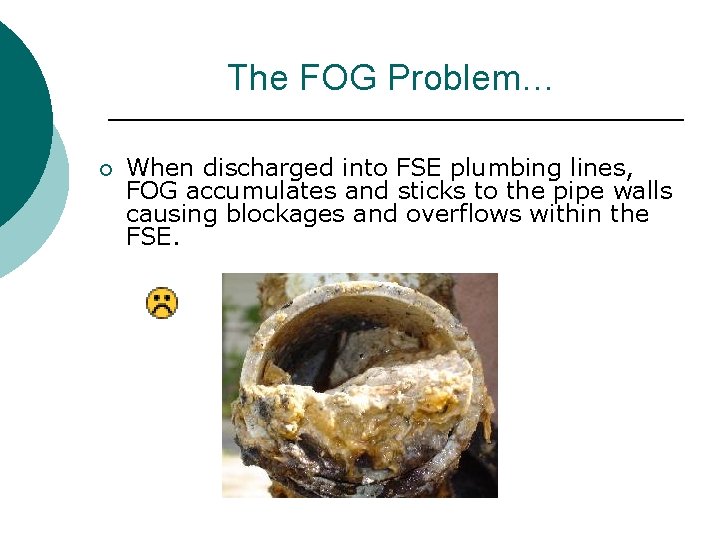
The FOG Problem… ¡ When discharged into FSE plumbing lines, FOG accumulates and sticks to the pipe walls causing blockages and overflows within the FSE.
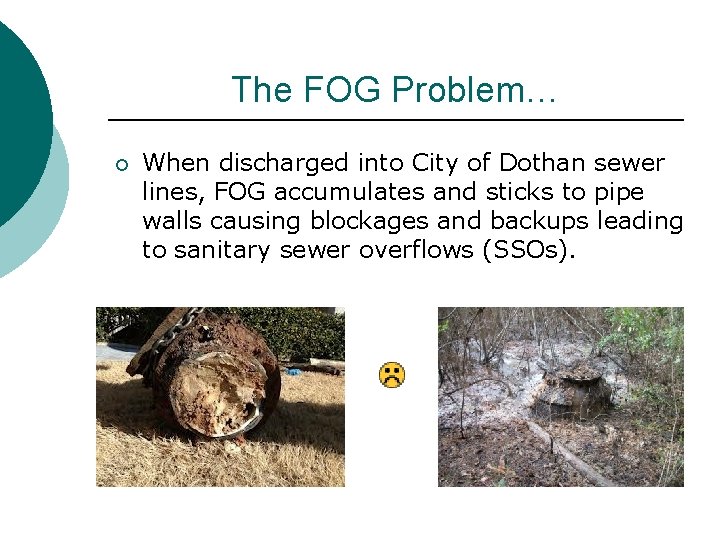
The FOG Problem… ¡ When discharged into City of Dothan sewer lines, FOG accumulates and sticks to pipe walls causing blockages and backups leading to sanitary sewer overflows (SSOs).
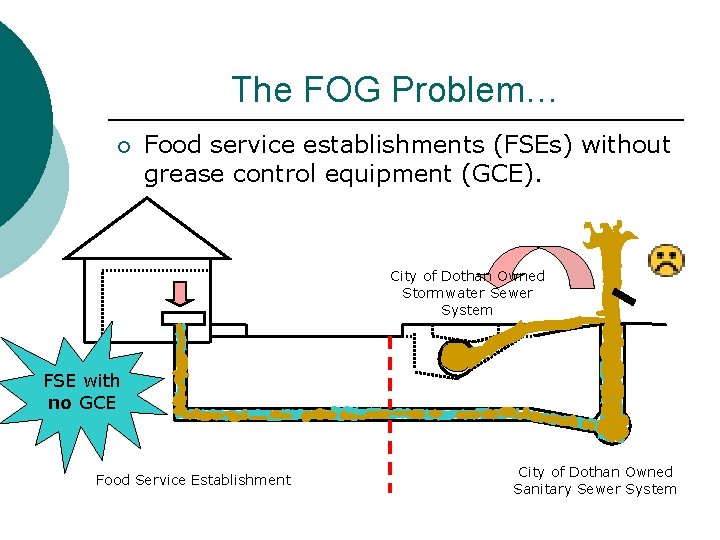
The FOG Problem… ¡ Food service establishments (FSEs) without grease control equipment (GCE). City of Dothan Owned Stormwater Sewer System FSE with no GCE Food Service Establishment City of Dothan Owned Sanitary Sewer System
The FOG Problem… ¡ ¡ Poor or no “Best Management Practices (BMPs)” including failure to regularly & properly clean GCE. Improperly sized, installed, or maintained GCE…And…
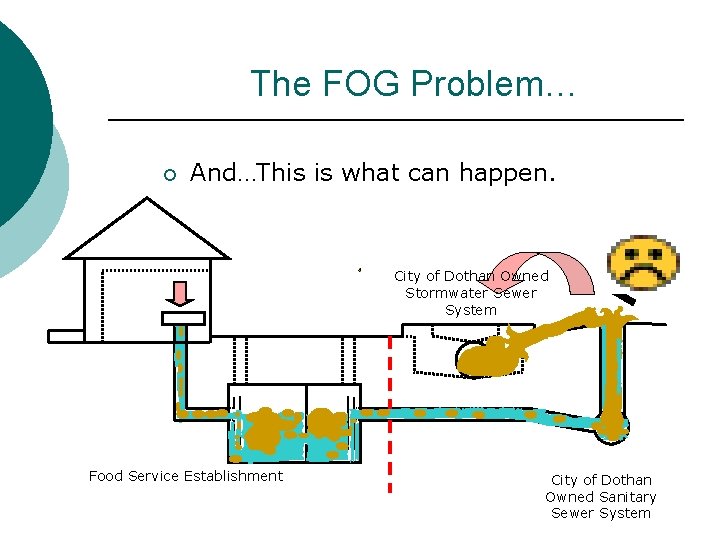
The FOG Problem… ¡ And…This is what can happen. City of Dothan Owned Stormwater Sewer System Food Service Establishment City of Dothan Owned Sanitary Sewer System
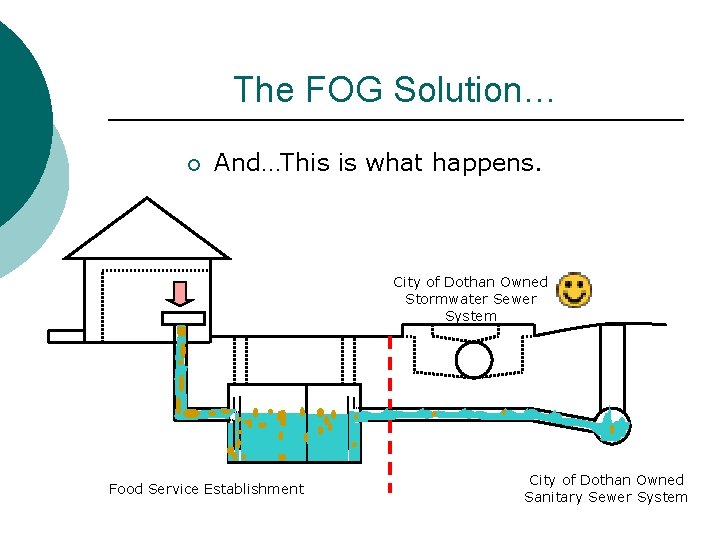
The FOG Solution… ¡ ¡ Properly size, install, regularly clean and maintain all GCE. Implement BMPs…And…
The FOG Solution… ¡ And…This is what happens. City of Dothan Owned Stormwater Sewer System Food Service Establishment City of Dothan Owned Sanitary Sewer System
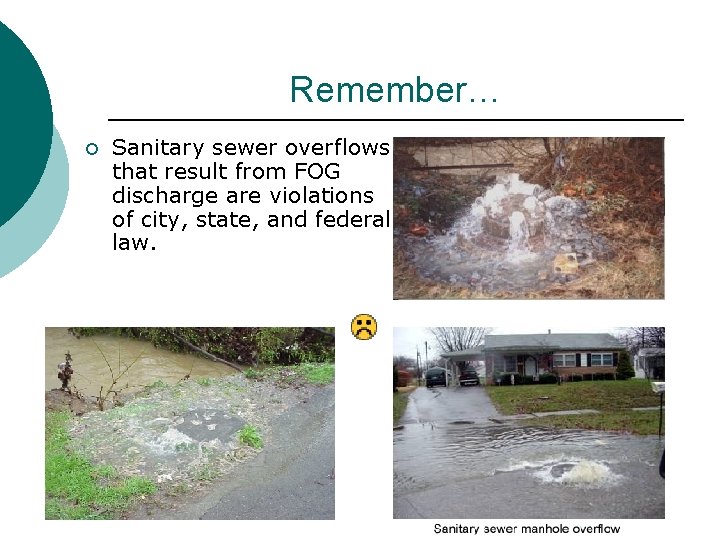
Remember… ¡ Sanitary sewer overflows that result from FOG discharge are violations of city, state, and federal law.
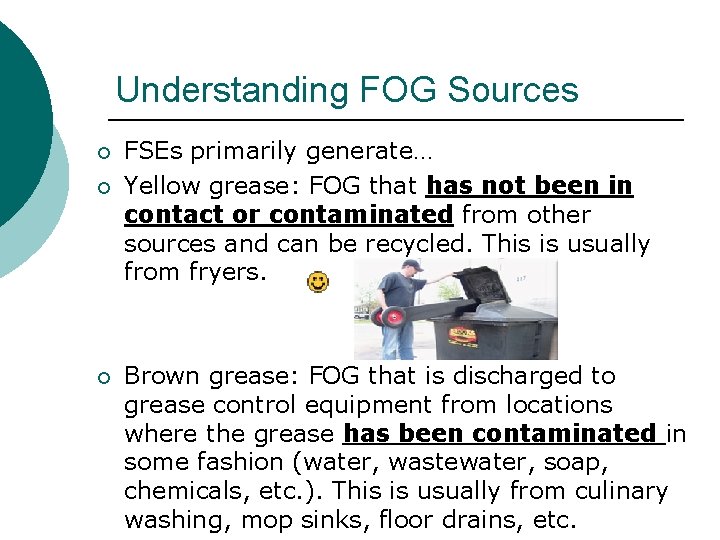
Understanding FOG Sources ¡ ¡ ¡ FSEs primarily generate… Yellow grease: FOG that has not been in contact or contaminated from other sources and can be recycled. This is usually from fryers. Brown grease: FOG that is discharged to grease control equipment from locations where the grease has been contaminated in some fashion (water, wastewater, soap, chemicals, etc. ). This is usually from culinary washing, mop sinks, floor drains, etc.
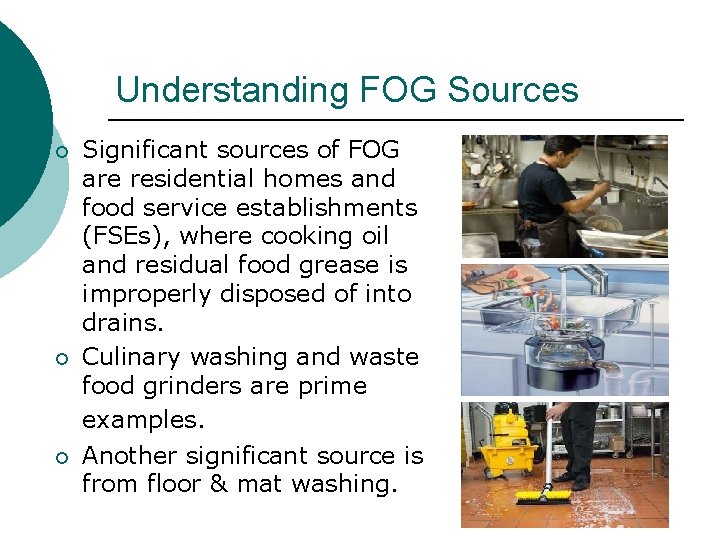
Understanding FOG Sources ¡ ¡ ¡ Significant sources of FOG are residential homes and food service establishments (FSEs), where cooking oil and residual food grease is improperly disposed of into drains. Culinary washing and waste food grinders are prime examples. Another significant source is from floor & mat washing.
Understanding FOG Sources ¡ ¡ ¡ Separate yellow and brown grease disposal is required. Disposal of brown grease into the grease recycle bin is a violation of the FOG Ordinance. Contaminants in the brown grease such as cleaning chemicals, soaps and even the water, make it mostly unsuitable for recycling.
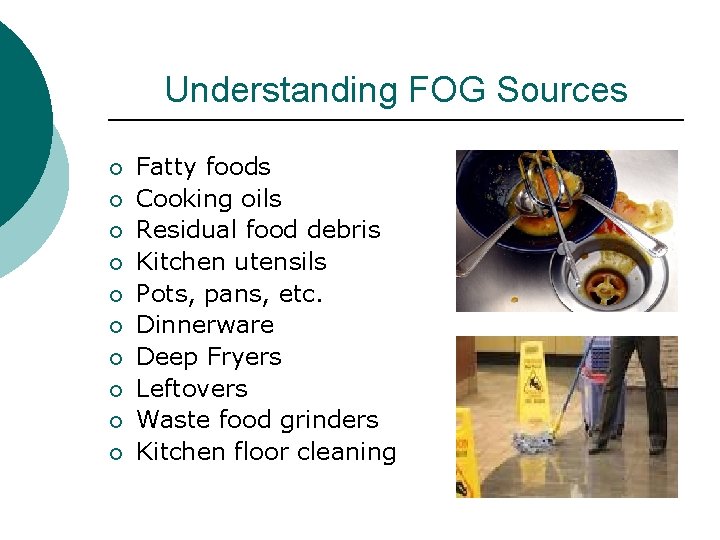
Understanding FOG Sources ¡ ¡ ¡ ¡ ¡ Fatty foods Cooking oils Residual food debris Kitchen utensils Pots, pans, etc. Dinnerware Deep Fryers Leftovers Waste food grinders Kitchen floor cleaning
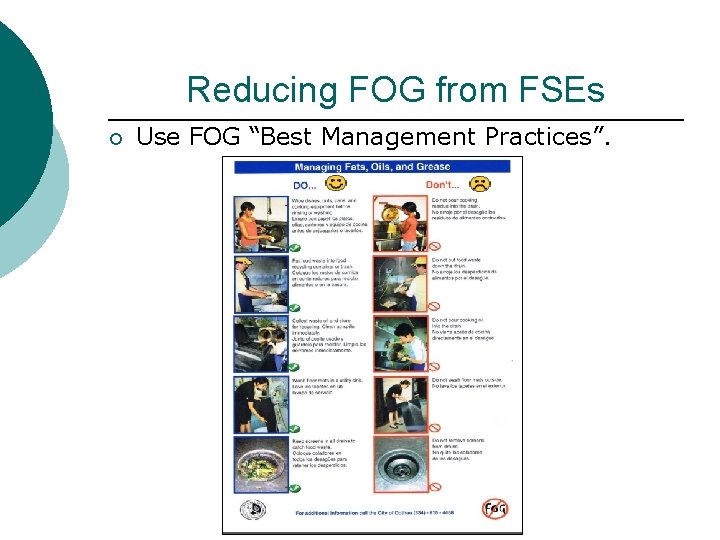
Reducing FOG from FSEs ¡ Use FOG “Best Management Practices”.
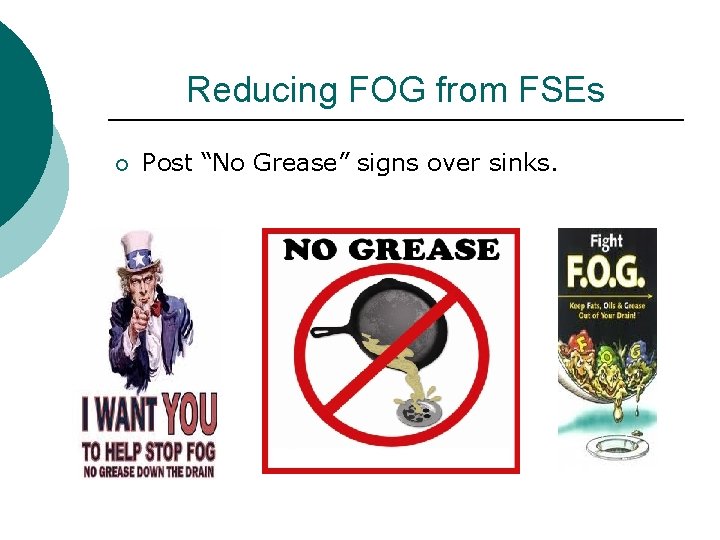
Reducing FOG from FSEs ¡ Post “No Grease” signs over sinks.
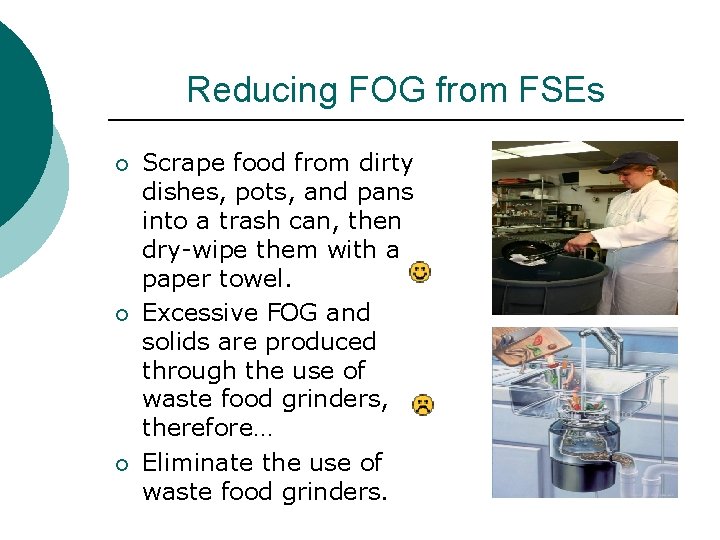
Reducing FOG from FSEs ¡ ¡ ¡ Scrape food from dirty dishes, pots, and pans into a trash can, then dry wipe them with a paper towel. Excessive FOG and solids are produced through the use of waste food grinders, therefore… Eliminate the use of waste food grinders.
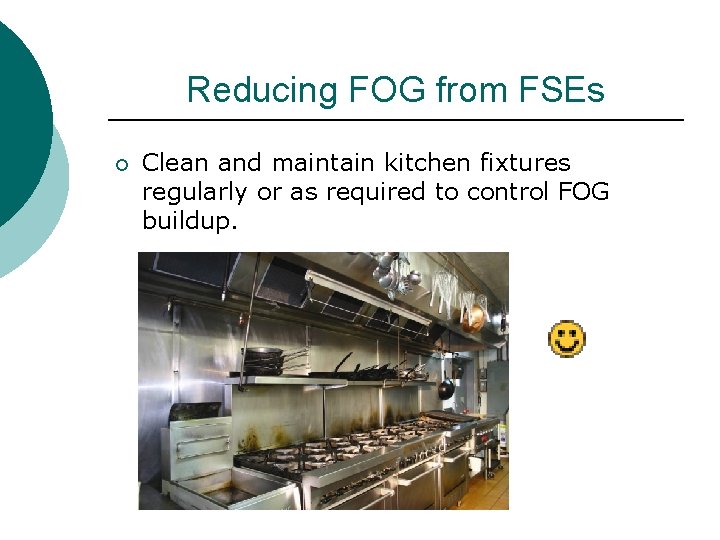
Reducing FOG from FSEs ¡ Clean and maintain kitchen fixtures regularly or as required to control FOG buildup.
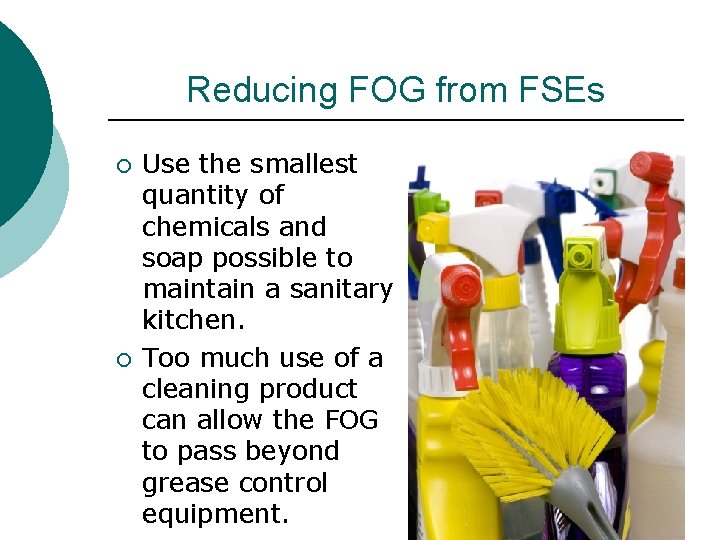
Reducing FOG from FSEs ¡ ¡ Use the smallest quantity of chemicals and soap possible to maintain a sanitary kitchen. Too much use of a cleaning product can allow the FOG to pass beyond grease control equipment.
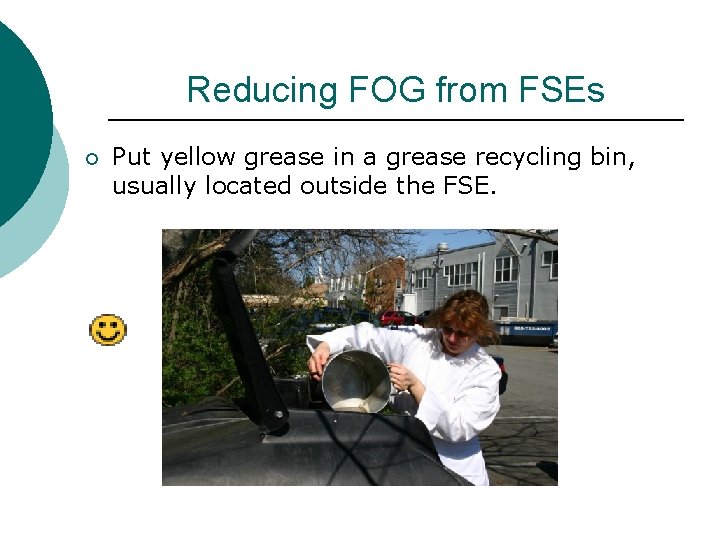
Reducing FOG from FSEs ¡ Put yellow grease in a grease recycling bin, usually located outside the FSE.
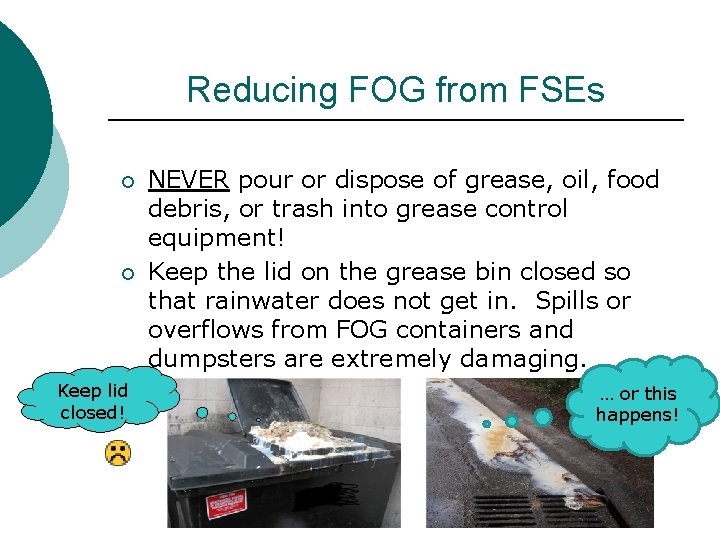
Reducing FOG from FSEs ¡ ¡ Keep lid closed! NEVER pour or dispose of grease, oil, food debris, or trash into grease control equipment! Keep the lid on the grease bin closed so that rainwater does not get in. Spills or overflows from FOG containers and dumpsters are extremely damaging. … or this happens!
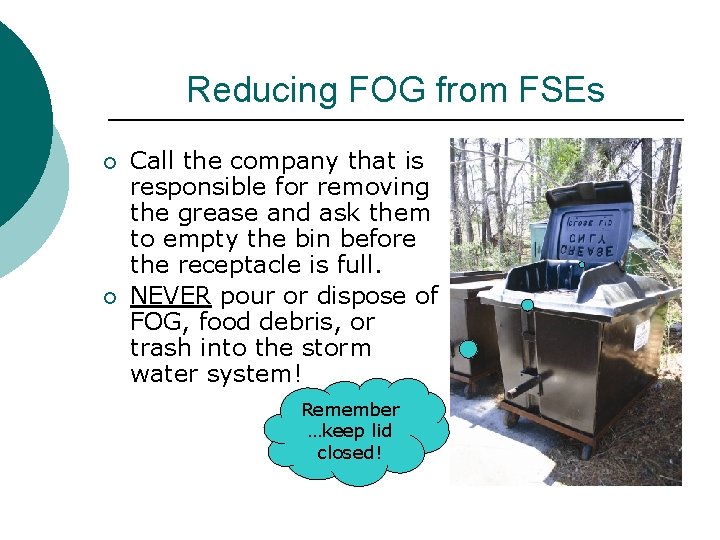
Reducing FOG from FSEs ¡ ¡ Call the company that is responsible for removing the grease and ask them to empty the bin before the receptacle is full. NEVER pour or dispose of FOG, food debris, or trash into the storm water system! Remember …keep lid closed!
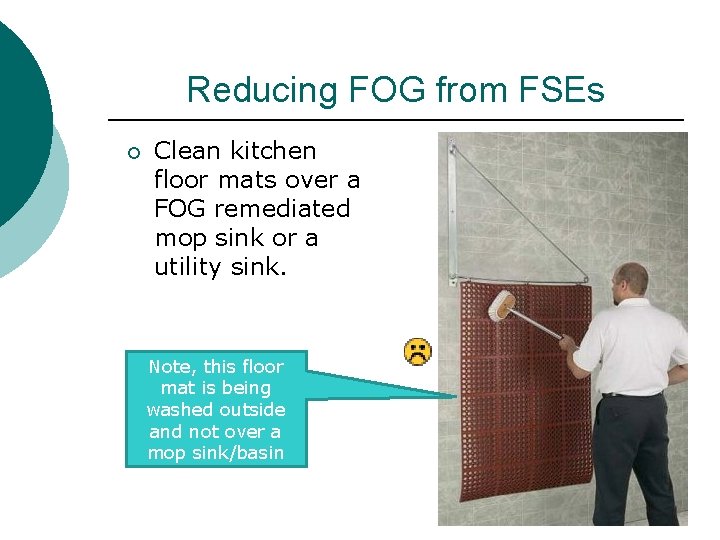
Reducing FOG from FSEs ¡ Clean kitchen floor mats over a FOG remediated mop sink or a utility sink. Note, this floor mat is being washed outside and not over a mop sink/basin
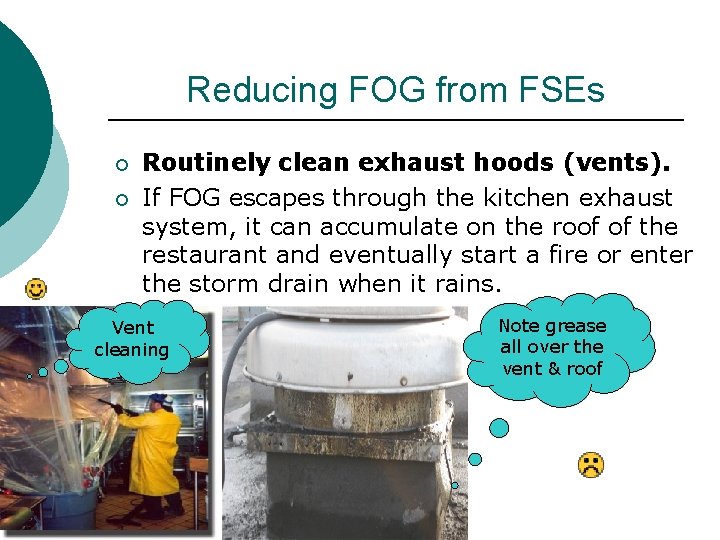
Reducing FOG from FSEs ¡ ¡ Routinely clean exhaust hoods (vents). If FOG escapes through the kitchen exhaust system, it can accumulate on the roof of the restaurant and eventually start a fire or enter the storm drain when it rains. Vent cleaning Note grease all over the vent & roof
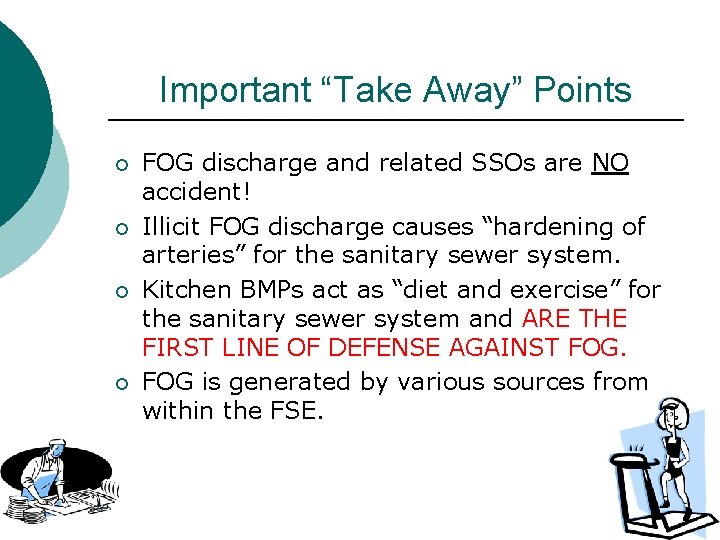
Important “Take Away” Points ¡ ¡ FOG discharge and related SSOs are NO accident! Illicit FOG discharge causes “hardening of arteries” for the sanitary sewer system. Kitchen BMPs act as “diet and exercise” for the sanitary sewer system and ARE THE FIRST LINE OF DEFENSE AGAINST FOG is generated by various sources from within the FSE.
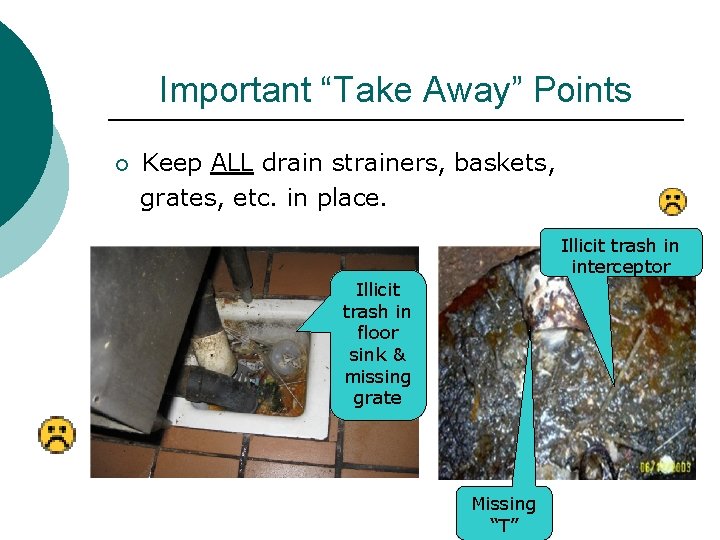
Important “Take Away” Points ¡ Keep ALL drain strainers, baskets, grates, etc. in place. Illicit trash in interceptor Illicit trash in floor sink & missing grate Missing “T”
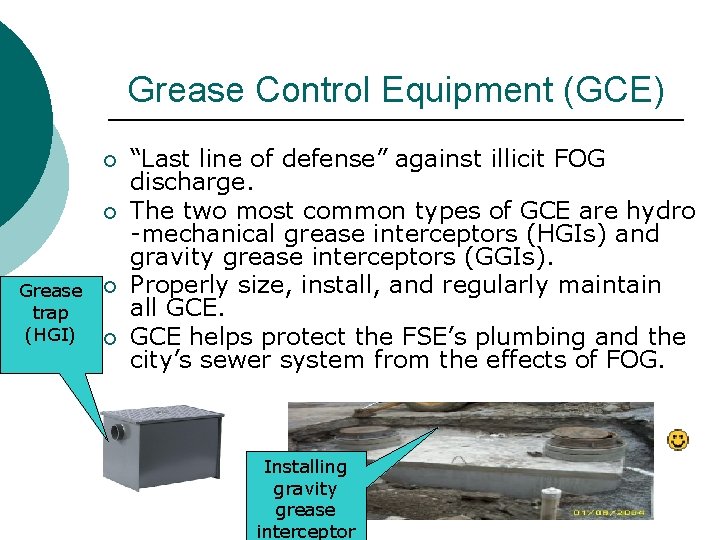
Grease Control Equipment (GCE) ¡ ¡ Grease trap (HGI) ¡ ¡ “Last line of defense” against illicit FOG discharge. The two most common types of GCE are hydro mechanical grease interceptors (HGIs) and gravity grease interceptors (GGIs). Properly size, install, and regularly maintain all GCE helps protect the FSE’s plumbing and the city’s sewer system from the effects of FOG. Installing gravity grease interceptor
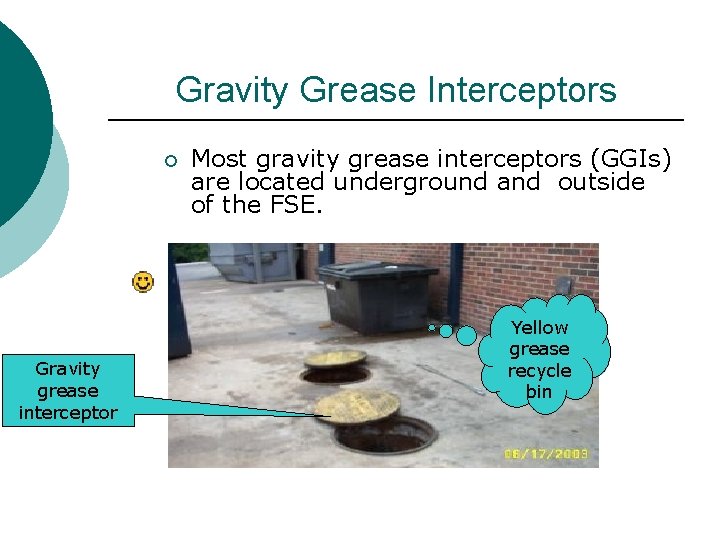
Gravity Grease Interceptors ¡ Gravity grease interceptor Most gravity grease interceptors (GGIs) are located underground and outside of the FSE. Yellow grease recycle bin
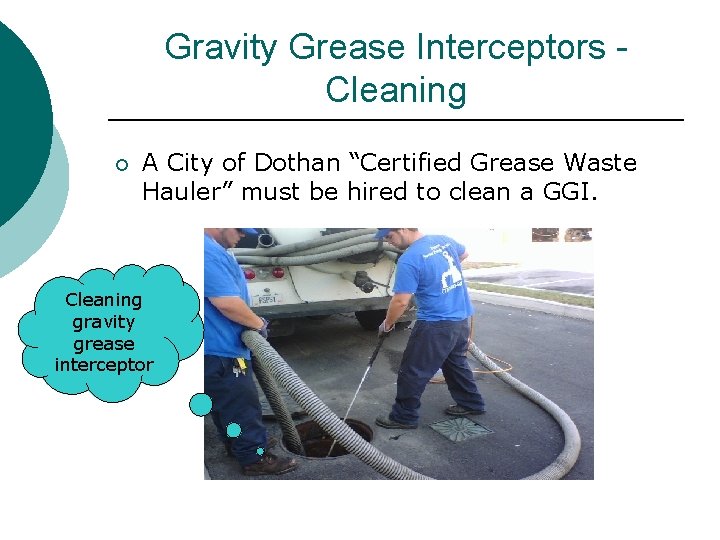
Gravity Grease Interceptors Cleaning ¡ A City of Dothan “Certified Grease Waste Hauler” must be hired to clean a GGI. Cleaning gravity grease interceptor
Gravity Grease Interceptors Cleaning ¡ ¡ ¡ At no time shall the cleaning frequency exceed 90 days unless approved in writing by the City. Failure to meet this requirement shall result in enforcement action. Approval to exceed the 90 day cleaning frequency will be considered on a case by case basis with submittal by the FSE documenting proof of the proposed cleaning frequency.
Gravity Grease Interceptors Cleaning ¡ ¡ It is advisable to observe the interceptor after pumping and cleaning is completed by the grease waste hauler (GWH) to ensure that a complete pump out and cleaning of the tank was accomplished. Any deficiencies noted by the GWH should be repaired ASAP. Keep records of any abnormal observances and all repairs for a minimum of three years. Notify the FOG Program within 24 hrs. (Mon. thru Fri. ) of any GCE deficiencies and again when repairs are completed.
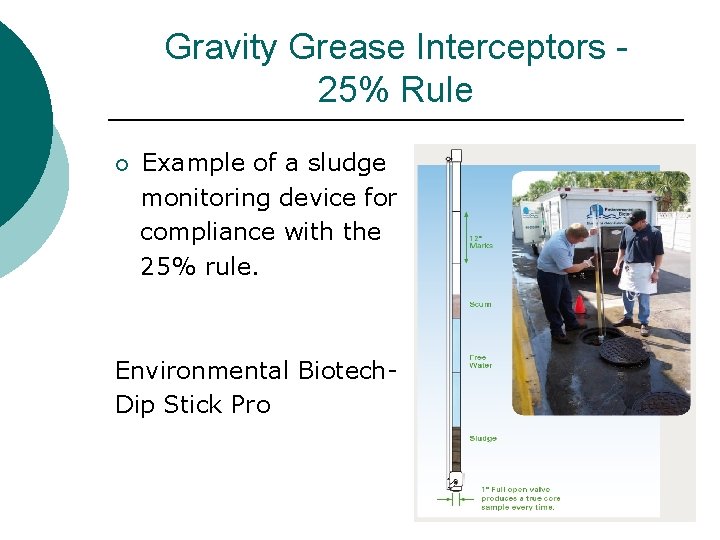
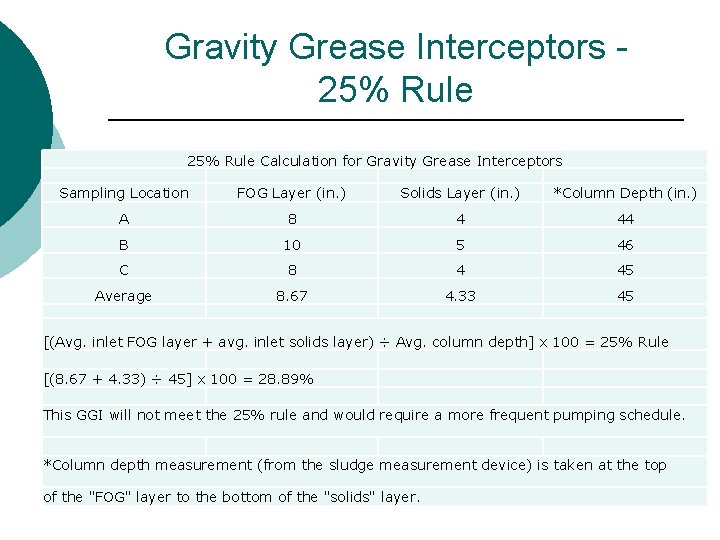
Gravity Grease Interceptors 25% Rule ¡ ¡ ¡ Gravity grease interceptors must be pumped in full (total pump of all contents) when the total accumulations of surface FOG (including floating solids) and settled solids reaches twenty five percent (25%) of the grease interceptor’s inlet chamber liquid depth. This criterion is referred to as the “ 25 Percent Rule”. Some FSEs may need to consider a more frequent pumping schedule such as 30 days or 60 days to meet the 25% rule requirement.
Gravity Grease Interceptors 25% Rule ¡ Example of a sludge monitoring device for compliance with the 25% rule. Environmental Biotech Dip Stick Pro
Gravity Grease Interceptors 25% Rule Calculation for Gravity Grease Interceptors Sampling Location FOG Layer (in. ) Solids Layer (in. ) *Column Depth (in. ) A 8 4 44 B 10 5 46 C 8 4 45 Average 8. 67 4. 33 45 [(Avg. inlet FOG layer + avg. inlet solids layer) ÷ Avg. column depth] x 100 = 25% Rule [(8. 67 + 4. 33) ÷ 45] x 100 = 28. 89% This GGI will not meet the 25% rule and would require a more frequent pumping schedule. *Column depth measurement (from the sludge measurement device) is taken at the top of the "FOG" layer to the bottom of the "solids" layer.
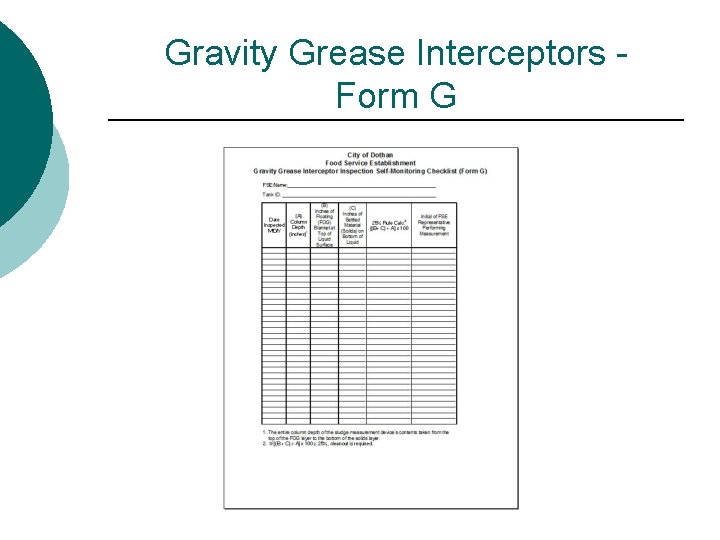
Gravity Grease Interceptors Form G ¡ ¡ ¡ The GGI shall be checked for % FOG + solids as often as necessary to comply with the 25% rule. The “Gravity Grease Interceptor Inspection (FORM G)” shall be properly completed each time the % FOG + solids measurement is taken… This is a mandatory requirement of FOG Ordinance.
Gravity Grease Interceptors Form G
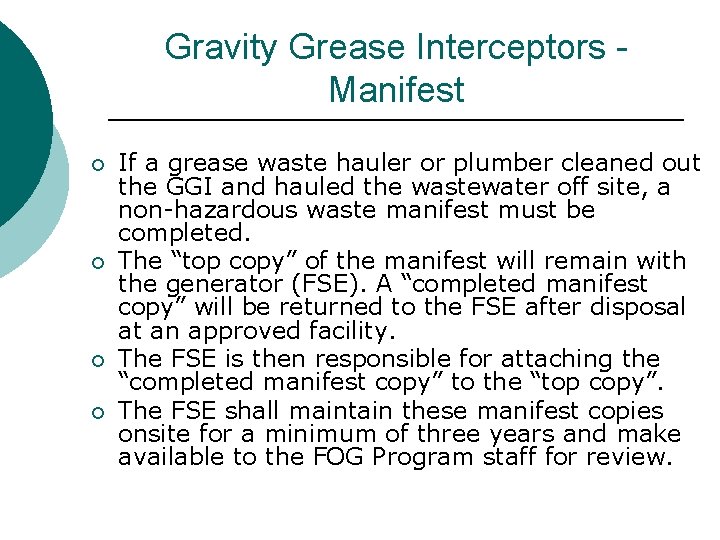
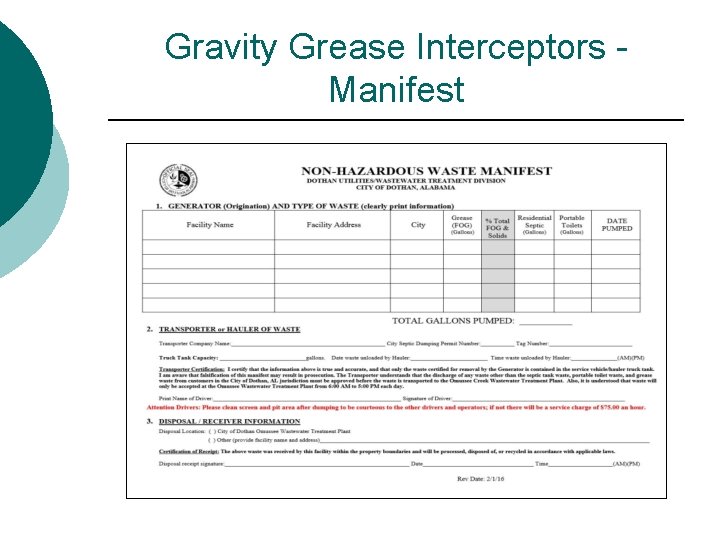
Gravity Grease Interceptors Manifest ¡ ¡ If a grease waste hauler or plumber cleaned out the GGI and hauled the wastewater off site, a non hazardous waste manifest must be completed. The “top copy” of the manifest will remain with the generator (FSE). A “completed manifest copy” will be returned to the FSE after disposal at an approved facility. The FSE is then responsible for attaching the “completed manifest copy” to the “top copy”. The FSE shall maintain these manifest copies onsite for a minimum of three years and make available to the FOG Program staff for review.
Gravity Grease Interceptors Manifest
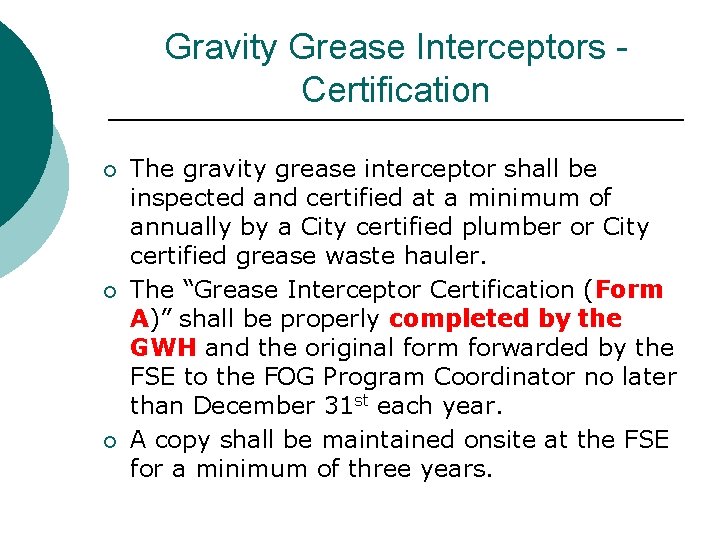
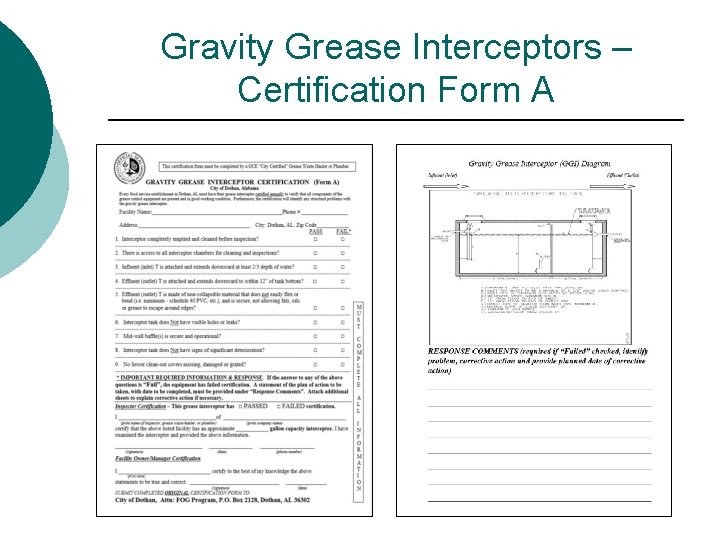
Gravity Grease Interceptors Certification ¡ ¡ ¡ The gravity grease interceptor shall be inspected and certified at a minimum of annually by a City certified plumber or City certified grease waste hauler. The “Grease Interceptor Certification (Form A)” shall be properly completed by the GWH and the original form forwarded by the FSE to the FOG Program Coordinator no later than December 31 st each year. A copy shall be maintained onsite at the FSE for a minimum of three years.
Gravity Grease Interceptors – Certification Form A
Gravity Grease Interceptors Certification ¡ Failure of GCE certification: The FSE is responsible for including detailed “Corrective Action Response” information on the certification form, giving the reason of the failure, what corrective action will be taken and the date it will be completed.
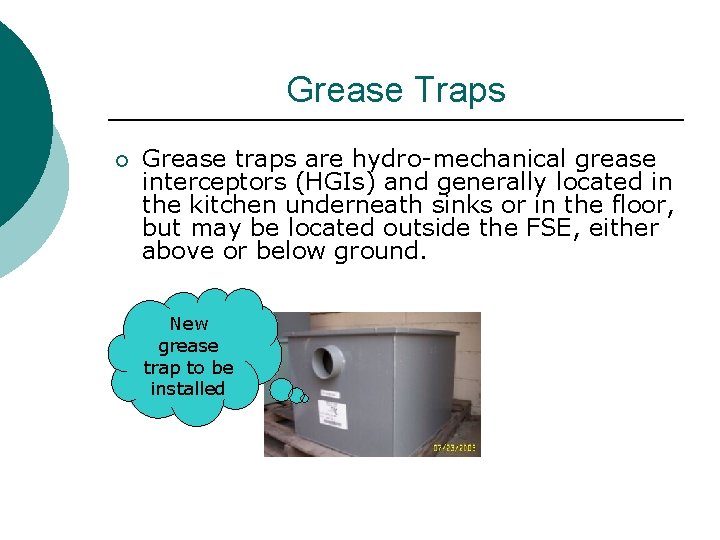
Grease Traps ¡ Grease traps are hydro mechanical grease interceptors (HGIs) and generally located in the kitchen underneath sinks or in the floor, but may be located outside the FSE, either above or below ground. New grease trap to be installed
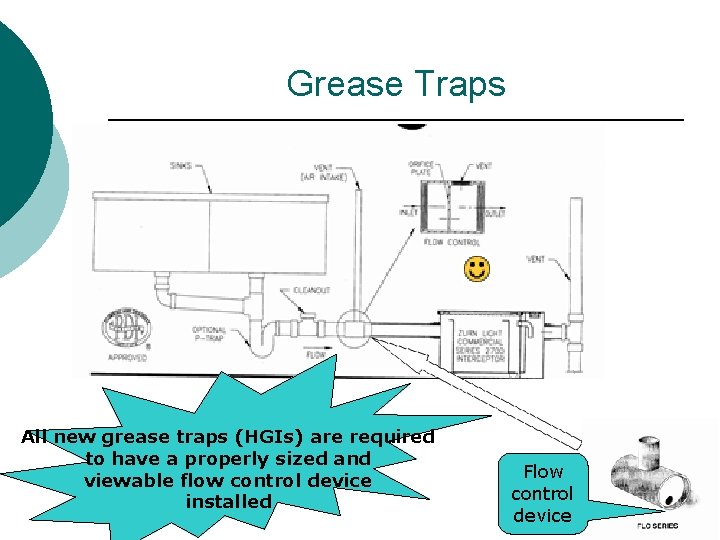
Grease Traps All new grease traps (HGIs) are required to have a properly sized and viewable flow control device installed Flow control device
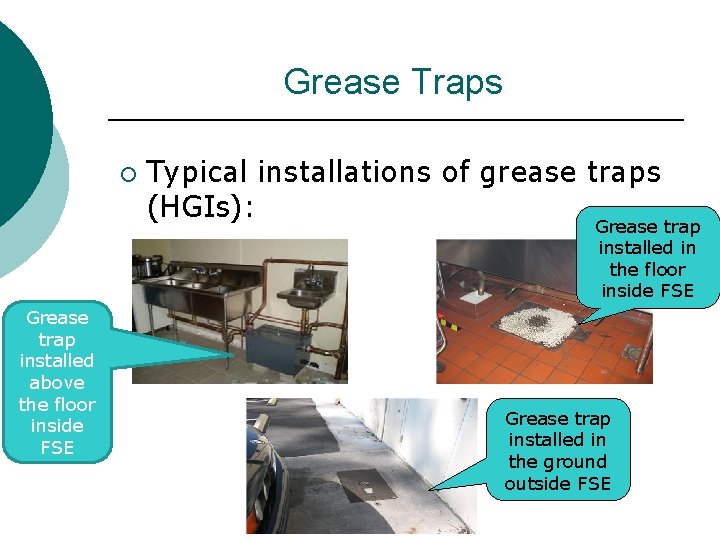
Grease Traps ¡ Typical installations of grease traps (HGIs): Grease trap installed in the floor inside FSE Grease trap installed above the floor inside FSE Grease trap installed in the ground outside FSE
Grease Trap - Cleaning ¡ ¡ ¡ The HGI should be cleaned a minimum of once every 30 days or when about a quarter of its volume is occupied by FOG and solids. The cleaning frequency may be as often as once or twice a week in order to prevent 25% of the capacity being occupied with FOG and food solids. The cleaning frequency will greatly depend on the FSE’s best management practices (BMPs) to control grease and solids discharges.
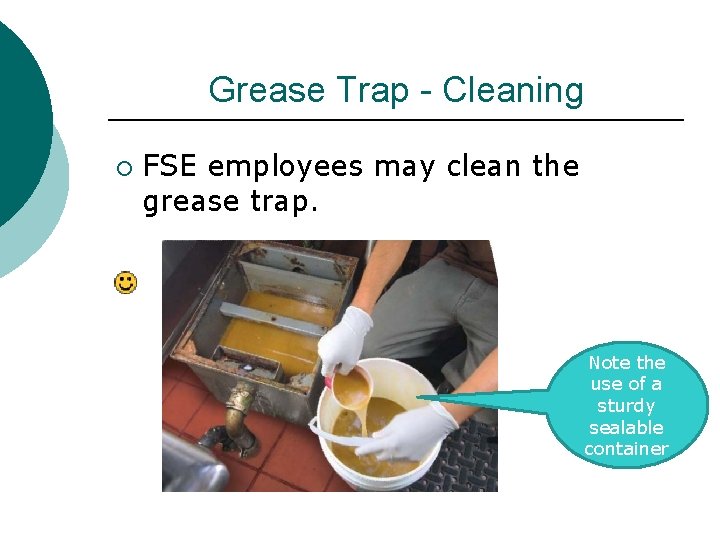
Grease Trap - Cleaning ¡ FSE employees may clean the grease trap. Note the use of a sturdy sealable container
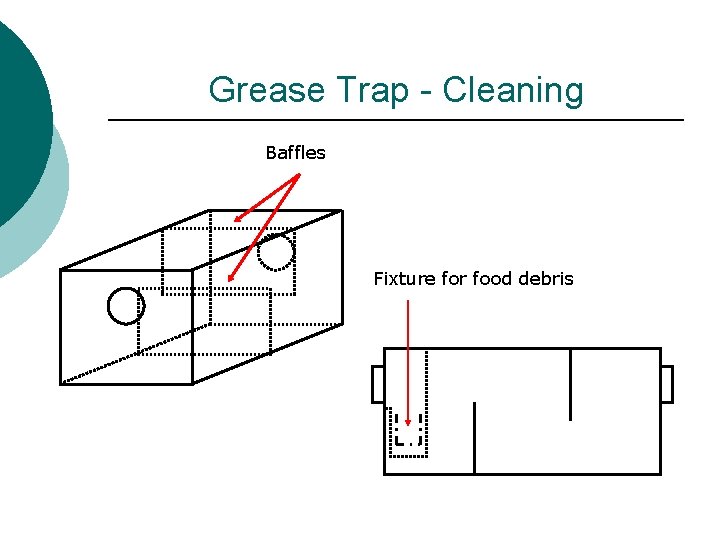
Grease Trap - Cleaning Baffles Fixture for food debris
Grease Trap Cleaning Tools & Materials ¡ ¡ ¡ A large trash can or use the dumpster. Sturdy sealable containers in which to place the waste. Absorbent material (floor dry or clay kitty litter). Clean paper towels or cloth rags. Proper hand tools and safety equipment for opening/cleaning trap (allen wrench, screw driver, rubber gloves, safety glasses, etc. ). Tools for removing contents: scoop – for water and solids, scraper (putty knife), wet/dry vacuum.
Grease Trap - Cleaning ¡ ¡ Clean out the grease trap ENTIRELY. Remove the baffle(s). Scrape the baffle(s) and inside walls of the tank to remove FOG buildup. Dry wipe the trap rather than using water and cleaning chemicals.
Grease Trap - Cleaning ¡ ¡ Check all components of the grease trap. Document and report to the FSE management any noted deficiencies. Make sure grease trap is properly reassembled. Examine the gasket for damage (replace if necessary). Clean and reinstall the rubber gasket and reposition lid on tank, ensuring screws are properly tightened.
Grease Trap - Cleaning ¡ ¡ The cleaned out contents should be placed into sturdy sealed containers and only disposed of in the trash/dumpster, or pumped and hauled offsite by a City approved grease waste hauler/plumber. Do not dispose of the grease trap contents in the grease recycle bin. This is a violation of the FOG Ordinance. And…
Grease Trap - Cleaning ¡ ¡ And…It is ILLEGAL to dump GCE waste or kitchen waste into the sanitary sewer system (toilets, cleanouts, manholes, etc. connected to the City sanitary sewer), storm drains, ponds, or outdoor areas. Violators can be prosecuted. I wish I hadn't done that!! Don’t let this be you!!
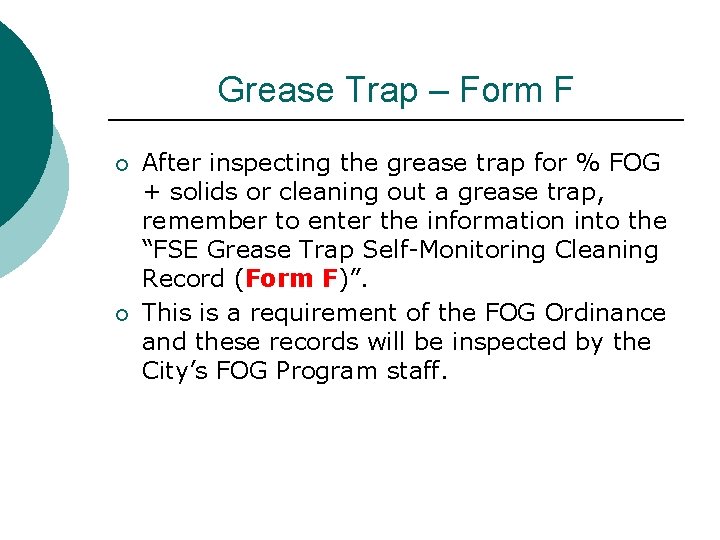
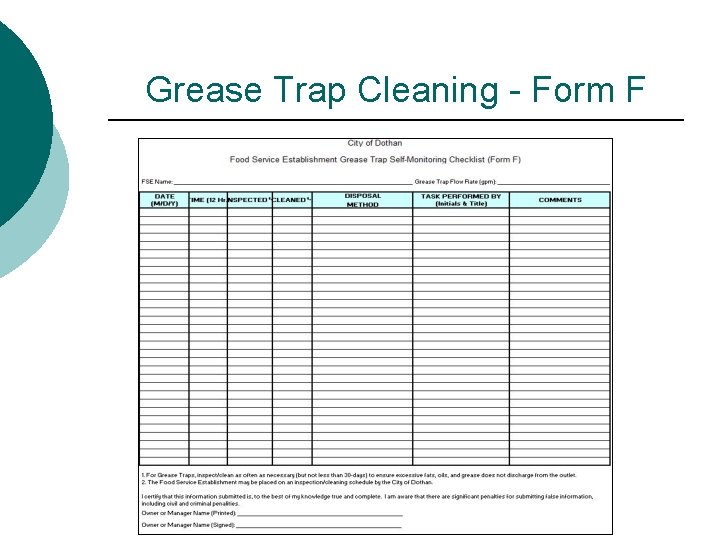
Grease Trap – Form F ¡ ¡ After inspecting the grease trap for % FOG + solids or cleaning out a grease trap, remember to enter the information into the “FSE Grease Trap Self Monitoring Cleaning Record (Form F)”. This is a requirement of the FOG Ordinance and these records will be inspected by the City’s FOG Program staff.
Grease Trap Cleaning - Form F
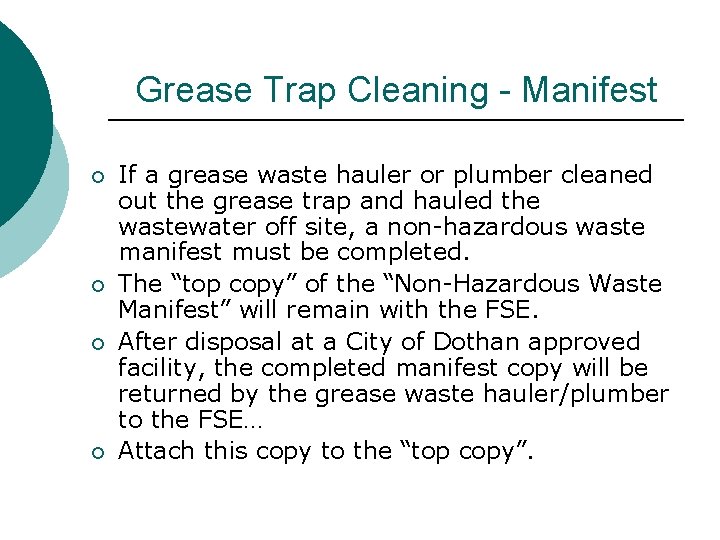
Grease Trap Cleaning - Manifest ¡ ¡ If a grease waste hauler or plumber cleaned out the grease trap and hauled the wastewater off site, a non hazardous waste manifest must be completed. The “top copy” of the “Non Hazardous Waste Manifest” will remain with the FSE. After disposal at a City of Dothan approved facility, the completed manifest copy will be returned by the grease waste hauler/plumber to the FSE… Attach this copy to the “top copy”.
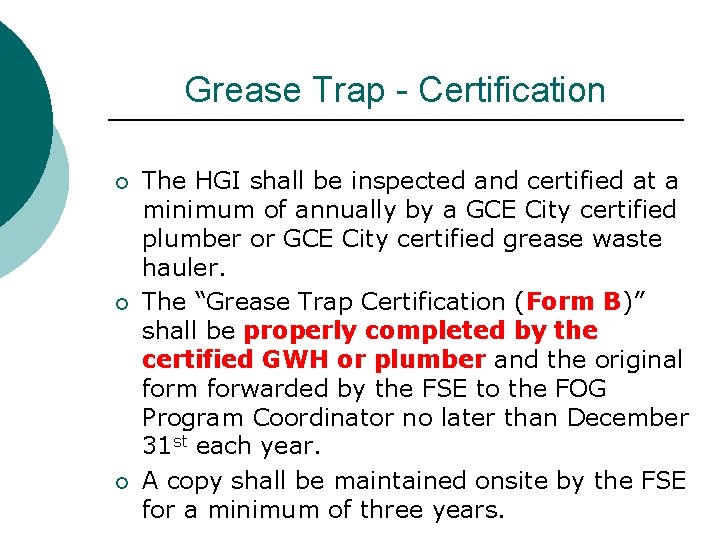
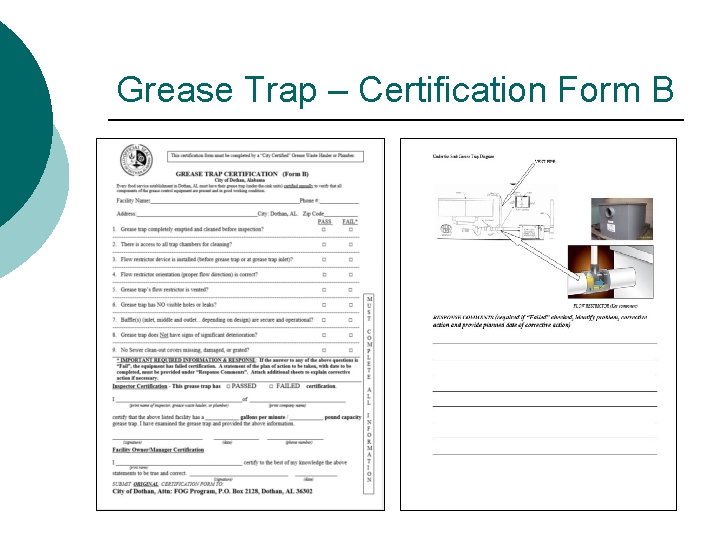
Grease Trap - Certification ¡ ¡ ¡ The HGI shall be inspected and certified at a minimum of annually by a GCE City certified plumber or GCE City certified grease waste hauler. The “Grease Trap Certification (Form B)” shall be properly completed by the certified GWH or plumber and the original form forwarded by the FSE to the FOG Program Coordinator no later than December 31 st each year. A copy shall be maintained onsite by the FSE for a minimum of three years.
Grease Trap – Certification Form B
Grease Trap - Certification ¡ Failure of GCE certification: The FSE is responsible for including detailed “Corrective Action Response” information on the certification form, giving the reason of the failure, what corrective action will be taken and the date it will be completed.
Record Keeping and Reporting ¡ ¡ ¡ Proper records and reporting are mandatory. At a minimum, all associated GCE records shall be maintained a minimum of three years… And…shall be made available to the City of Dothan FOG Program personnel for inspection.
Record Keeping and Reporting ¡ ¡ ¡ As previously discussed, all GCE must be certified annually (Form A or B) by a City certified GWH or plumber each year and the original form forwarded to the FOG Program Coordinator by December 31 st… A copy shall be maintained onsite by the FSE. Failure of GCE certification: The FSE is responsible for including detailed “Corrective Action Response” information on the certification form, giving the reason for the failure, what corrective action will be or was taken, and the date corrective action will be or was completed.
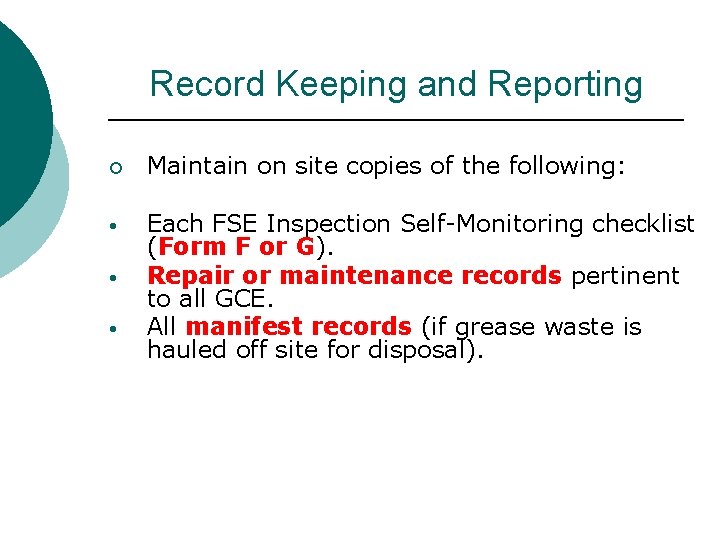
Record Keeping and Reporting ¡ Maintain on site copies of the following: • Each FSE Inspection Self Monitoring checklist (Form F or G). Repair or maintenance records pertinent to all GCE. All manifest records (if grease waste is hauled off site for disposal). • •
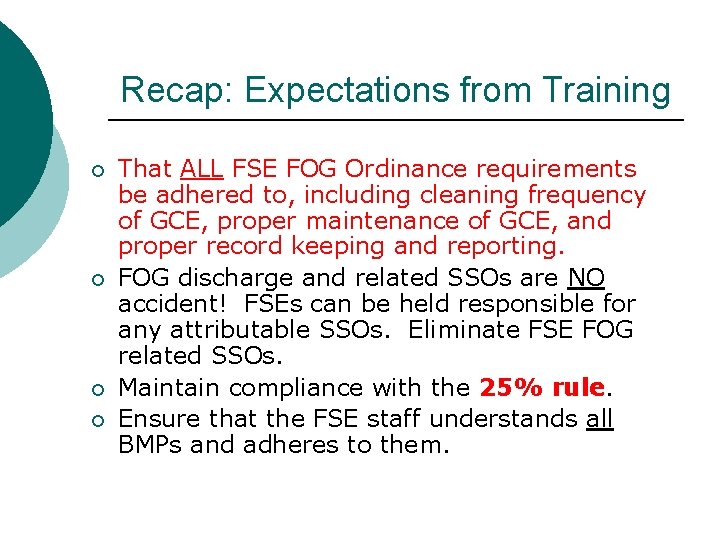
Recap: Expectations from Training ¡ ¡ That ALL FSE FOG Ordinance requirements be adhered to, including cleaning frequency of GCE, proper maintenance of GCE, and proper record keeping and reporting. FOG discharge and related SSOs are NO accident! FSEs can be held responsible for any attributable SSOs. Eliminate FSE FOG related SSOs. Maintain compliance with the 25% rule. Ensure that the FSE staff understands all BMPs and adheres to them.
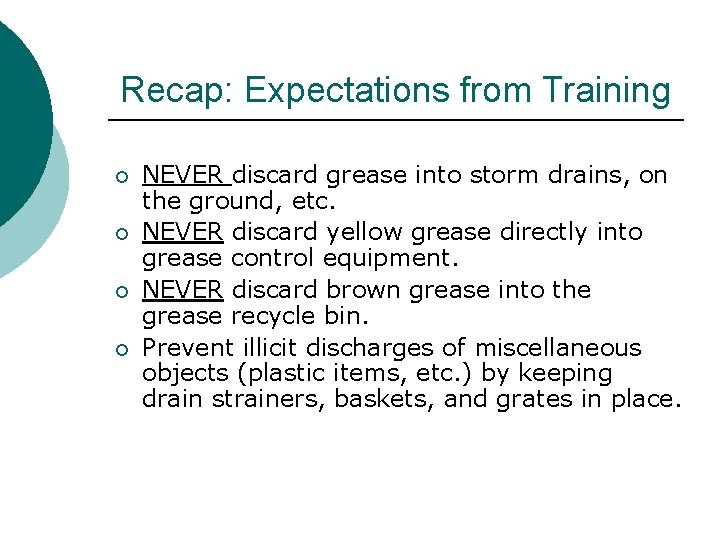
Recap: Expectations from Training ¡ ¡ NEVER discard grease into storm drains, on the ground, etc. NEVER discard yellow grease directly into grease control equipment. NEVER discard brown grease into the grease recycle bin. Prevent illicit discharges of miscellaneous objects (plastic items, etc. ) by keeping drain strainers, baskets, and grates in place.
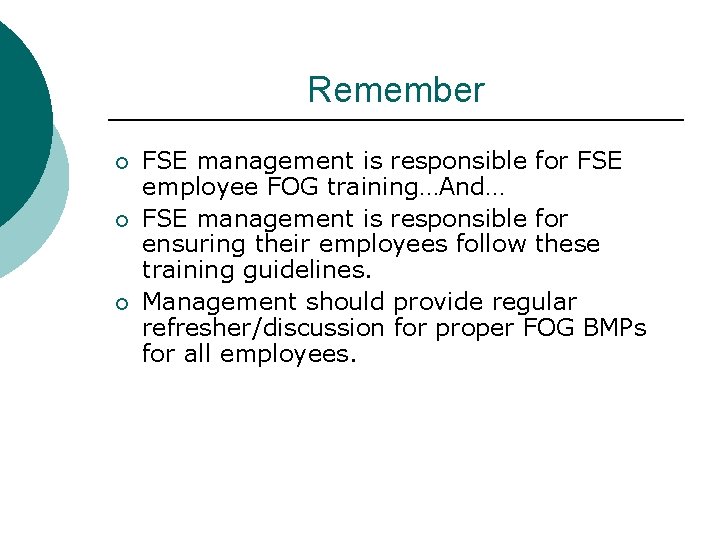
Remember ¡ ¡ ¡ FSE management is responsible for FSE employee FOG training…And… FSE management is responsible for ensuring their employees follow these training guidelines. Management should provide regular refresher/discussion for proper FOG BMPs for all employees.
Fats, Oils, and Grease Program ¡ ¡ By following these FSE FOG Training guidelines, backups into the restaurant and damage from FOG to the sanitary sewer system is easily avoidable. For more information regarding FOG or the FOG program, contact… City of Dothan FOG Program Coordinator PO Box 2128 Dothan, AL. 36302 rhunter@dothan. org Direct Phone: 334 615 4458 Office: Civic Center Room 317
Fats, Oils, and Grease Program ¡ Questions