
Fatigue Fatigue failure under cyclic stress specimen compression
- Slides: 8
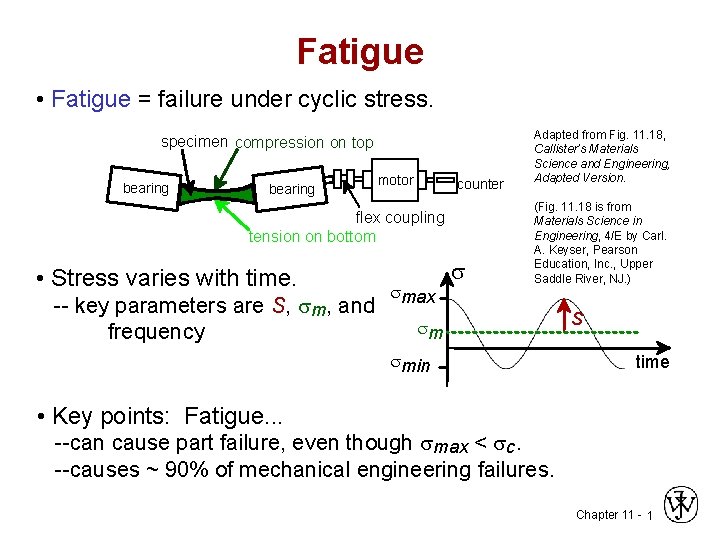
Fatigue • Fatigue = failure under cyclic stress. specimen compression on top bearing motor counter flex coupling tension on bottom • Stress varies with time. -- key parameters are S, sm, and frequency smax s Adapted from Fig. 11. 18, Callister’s Materials Science and Engineering, Adapted Version. (Fig. 11. 18 is from Materials Science in Engineering, 4/E by Carl. A. Keyser, Pearson Education, Inc. , Upper Saddle River, NJ. ) sm smin S time • Key points: Fatigue. . . --can cause part failure, even though smax < sc. --causes ~ 90% of mechanical engineering failures. Chapter 11 - 1
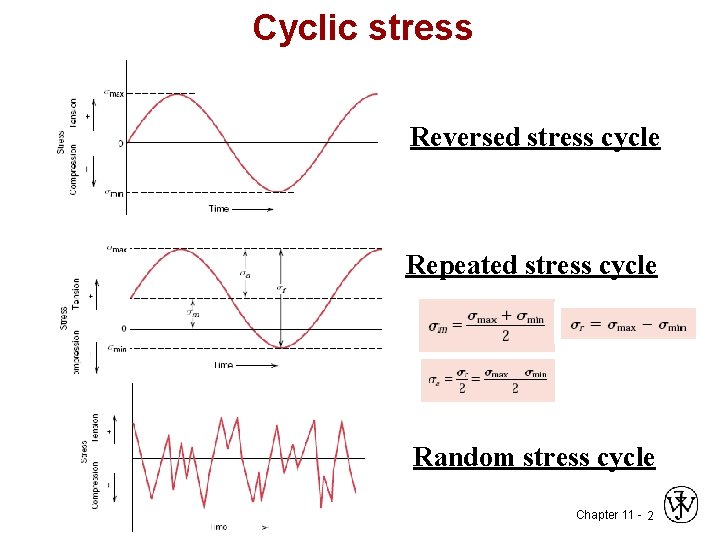
Cyclic stress Reversed stress cycle Repeated stress cycle Random stress cycle Chapter 11 - 2
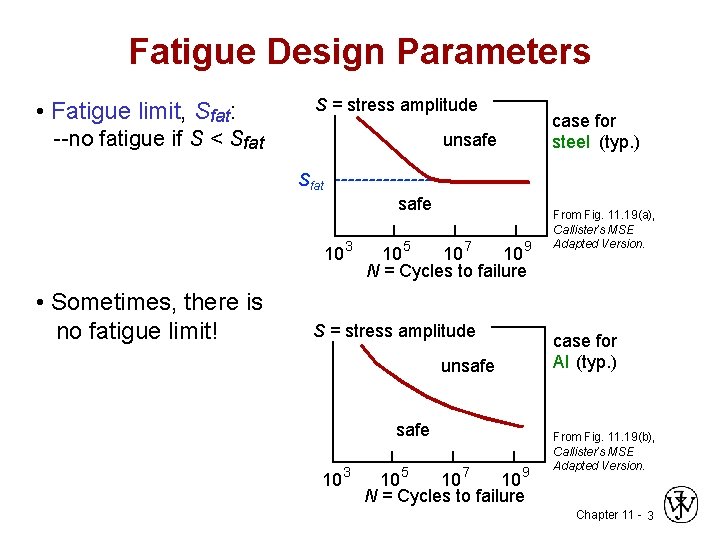
Fatigue Design Parameters • Fatigue limit, Sfat: S = stress amplitude --no fatigue if S < Sfat unsafe case for steel (typ. ) Sfat safe 10 3 • Sometimes, there is no fatigue limit! 10 5 10 7 10 9 N = Cycles to failure S = stress amplitude unsafe 10 3 10 5 10 7 10 9 N = Cycles to failure From Fig. 11. 19(a), Callister’s MSE Adapted Version. case for Al (typ. ) From Fig. 11. 19(b), Callister’s MSE Adapted Version. Chapter 11 - 3
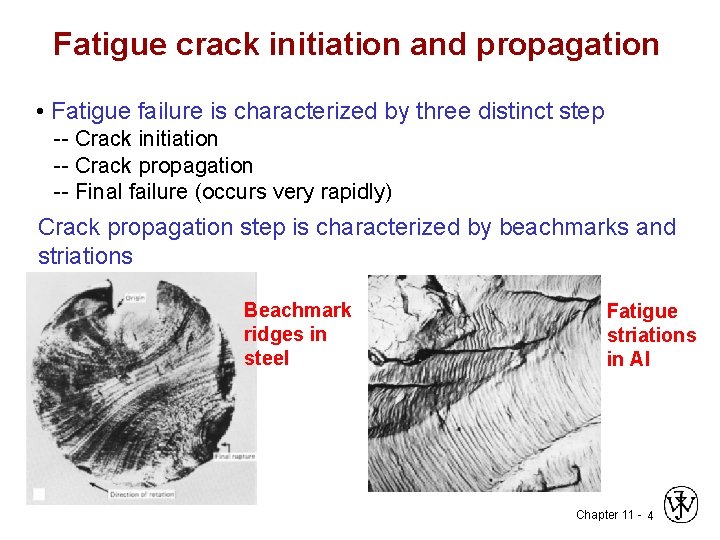
Fatigue crack initiation and propagation • Fatigue failure is characterized by three distinct step -- Crack initiation -- Crack propagation -- Final failure (occurs very rapidly) Crack propagation step is characterized by beachmarks and striations Beachmark ridges in steel Fatigue striations in Al Chapter 11 - 4
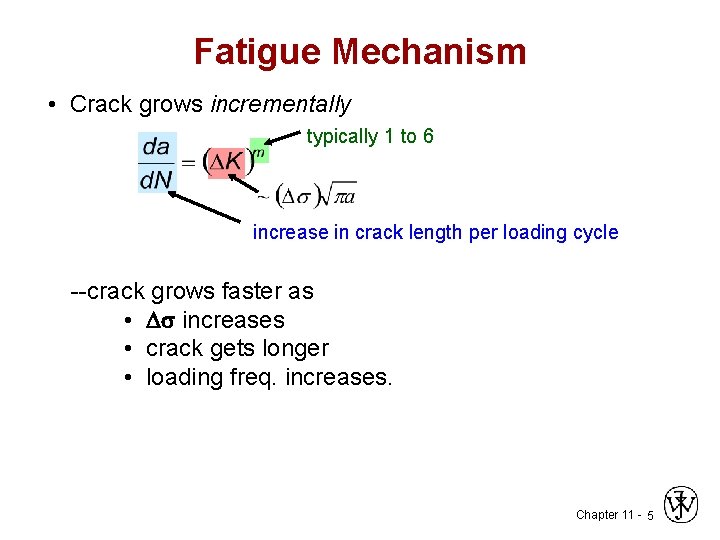
Fatigue Mechanism • Crack grows incrementally typically 1 to 6 increase in crack length per loading cycle --crack grows faster as • Ds increases • crack gets longer • loading freq. increases. Chapter 11 - 5
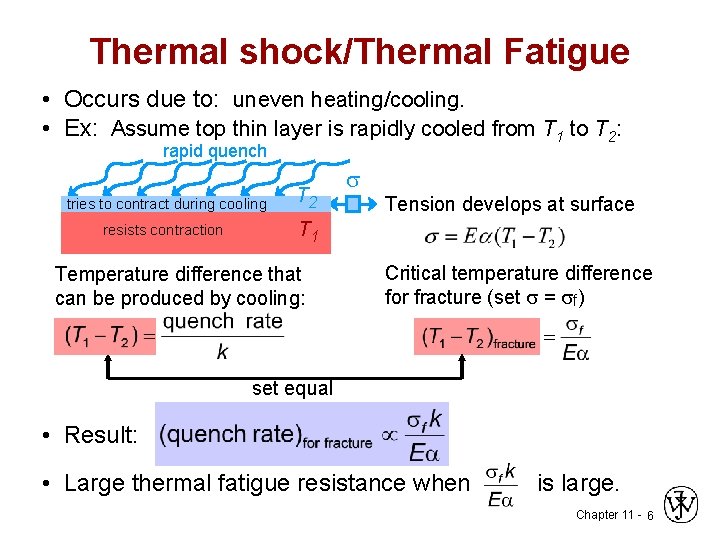
Thermal shock/Thermal Fatigue • Occurs due to: uneven heating/cooling. • Ex: Assume top thin layer is rapidly cooled from T 1 to T 2: rapid quench tries to contract during cooling T 2 resists contraction T 1 Temperature difference that can be produced by cooling: s Tension develops at surface Critical temperature difference for fracture (set s = sf) set equal • Result: • Large thermal fatigue resistance when is large. Chapter 11 - 6
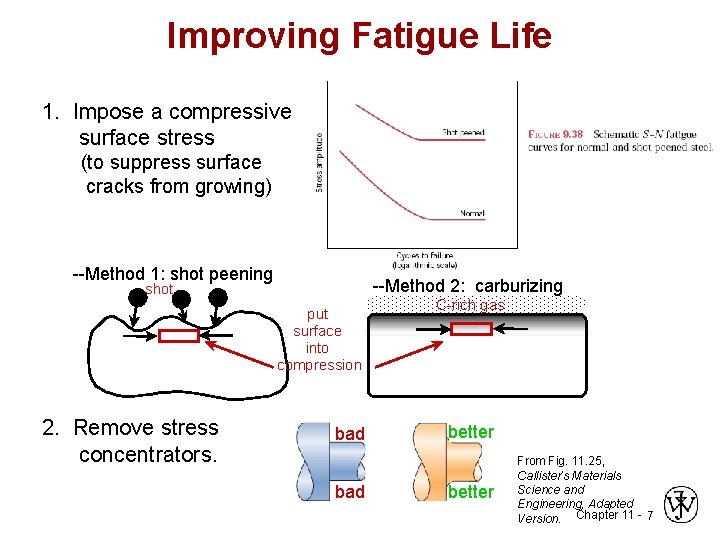
Improving Fatigue Life 1. Impose a compressive surface stress (to suppress surface cracks from growing) --Method 1: shot peening --Method 2: carburizing shot put surface into compression 2. Remove stress concentrators. bad C-rich gas better From Fig. 11. 25, Callister’s Materials Science and Engineering, Adapted Version. Chapter 11 - 7
SUMMARY • Engineering materials don't reach theoretical strength. • Flaws produce stress concentrations that cause premature failure. • Sharp corners produce large stress concentrations and premature failure. • Failure type depends on T and stress: - for noncyclic s and T < 0. 4 Tm, failure stress decreases with: - increased maximum flaw size, - decreased T, - increased rate of loading. - for cyclic s: - cycles to fail decreases as Ds increases. - for higher T (T > 0. 4 Tm): - time to fail decreases as s or T increases. Chapter 11 - 8