
Fathilah binti Ali Hazleen Anuar and Raina Jama
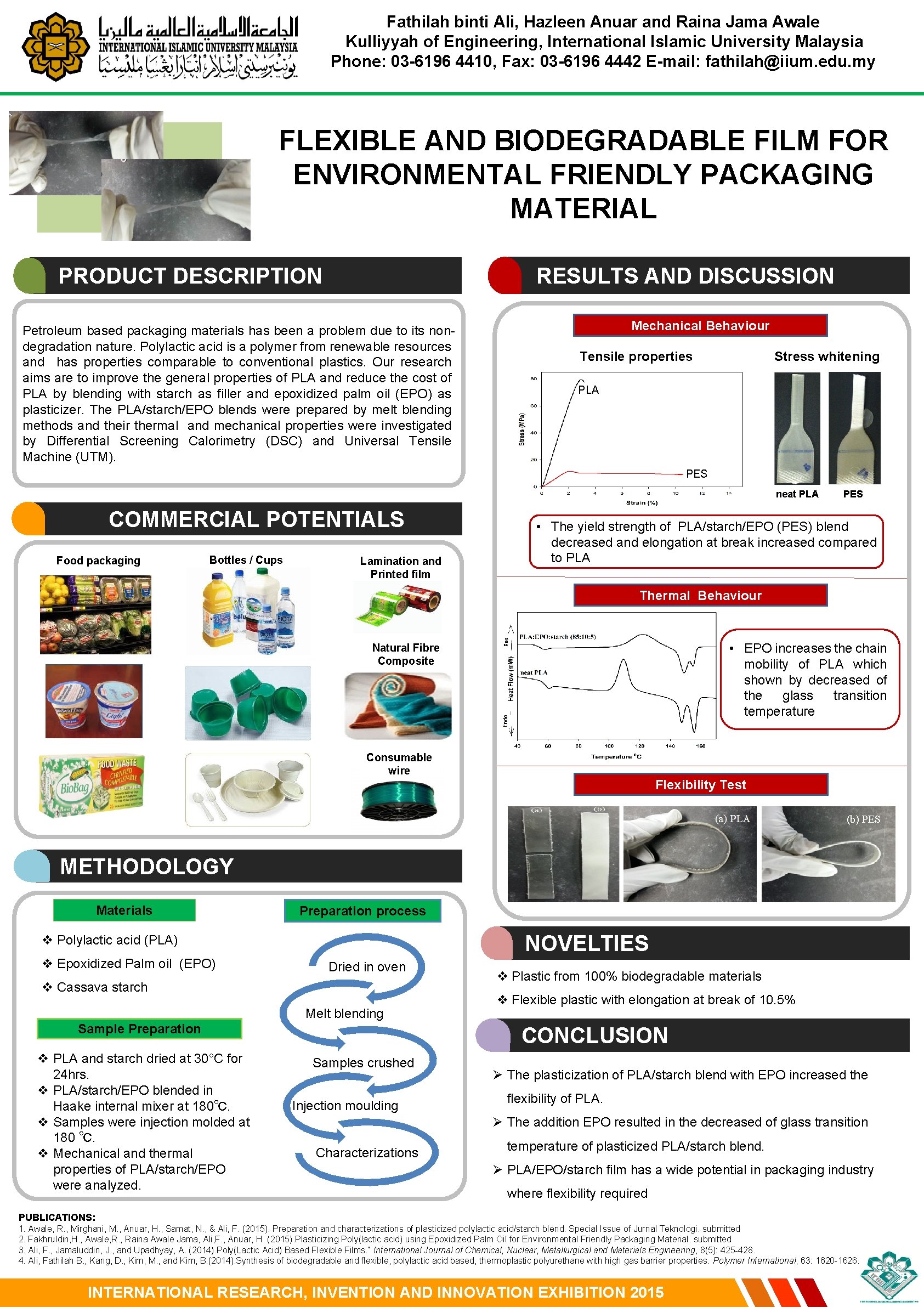
Fathilah binti Ali, Hazleen Anuar and Raina Jama Awale Kulliyyah of Engineering, International Islamic University Malaysia Phone: 03 -6196 4410, Fax: 03 -6196 4442 E-mail: fathilah@iium. edu. my FLEXIBLE AND BIODEGRADABLE FILM FOR ENVIRONMENTAL FRIENDLY PACKAGING MATERIAL RESULTS AND DISCUSSION PRODUCT DESCRIPTION Petroleum based packaging materials has been a problem due to its nondegradation nature. Polylactic acid is a polymer from renewable resources and has properties comparable to conventional plastics. Our research aims are to improve the general properties of PLA and reduce the cost of PLA by blending with starch as filler and epoxidized palm oil (EPO) as plasticizer. The PLA/starch/EPO blends were prepared by melt blending methods and their thermal and mechanical properties were investigated by Differential Screening Calorimetry (DSC) and Universal Tensile Machine (UTM). Mechanical Behaviour Tensile properties Stress whitening PLA PES neat PLA COMMERCIAL POTENTIALS Food packaging Bottles / Cups Lamination and Printed film PES • The yield strength of PLA/starch/EPO (PES) blend decreased and elongation at break increased compared to PLA Thermal Behaviour • EPO increases the chain mobility of PLA which shown by decreased of the glass transition temperature Natural Fibre Composite Consumable wire Flexibility Test (b) PES METHODOLOGY Materials Preparation process NOVELTIES v Polylactic acid (PLA) v Epoxidized Palm oil (EPO) Dried in oven v Cassava starch Melt blending Sample Preparation v PLA and starch dried at 30°C for 24 hrs. v PLA/starch/EPO blended in Haake internal mixer at 180℃. v Samples were injection molded at 180 ℃. v Mechanical and thermal properties of PLA/starch/EPO were analyzed. v Plastic from 100% biodegradable materials v Flexible plastic with elongation at break of 10. 5% CONCLUSION Samples crushed Injection moulding Ø The plasticization of PLA/starch blend with EPO increased the flexibility of PLA. Ø The addition EPO resulted in the decreased of glass transition Characterizations temperature of plasticized PLA/starch blend. Ø PLA/EPO/starch film has a wide potential in packaging industry where flexibility required PUBLICATIONS: 1. Awale, R. , Mirghani, M. , Anuar, H. , Samat, N. , & Ali, F. (2015). Preparation and characterizations of plasticized polylactic acid/starch blend. Special Issue of Jurnal Teknologi. submitted 2. Fakhruldin, H. , Awale, R. , Raina Awale Jama, Ali, F. , Anuar, H. (2015). Plasticizing Poly(lactic acid) using Epoxidized Palm Oil for Environmental Friendly Packaging Material. submitted 3. Ali, F. , Jamaluddin, J. , and Upadhyay, A. (2014). Poly(Lactic Acid) Based Flexible Films. ” International Journal of Chemical, Nuclear, Metallurgical and Materials Engineering, 8(5): 425 -428. 4. Ali, Fathilah B. , Kang, D. , Kim, M. , and Kim, B. (2014). Synthesis of biodegradable and flexible, polylactic acid based, thermoplastic polyurethane with high gas barrier properties. Polymer International, 63: 1620 -1626. INTERNATIONAL RESEARCH, INVENTION AND INNOVATION EXHIBITION 2015
- Slides: 1