
Father Bruno Hussar 1911 1996 Interfaith Harmony Leo
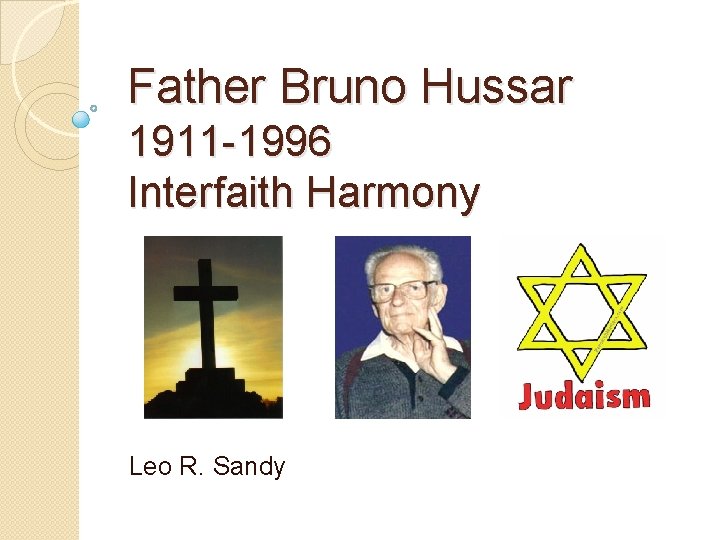
Father Bruno Hussar 1911 -1996 Interfaith Harmony Leo R. Sandy
Hussar cont’d �Hussar founded an interfaith village where Jews and Arabs live, learn, and work together – Neve Shalom/Wahat al. Salam (Oasis of Peace) �He has been repeatedly nominated for the Nobel Peace Prize �Using the conflict management approach, his school has taught more than 35, 000 people
Hussar cont’d �Hussar was born to parents who were non-practicing Jews, a Hungarian father and French mother �After the loss of his parents and a close friend, he yearned to understand the meaning of life �His journey began with a study of the Bible but he felt closely connected to both Christianity and Judaism
Hussar cont’d �He finally decided to become a Catholic priest, and went to Israel to establish and head a Dominican Center for Jewish Studies �He used his new position to promote interfaith studies such as conducting conferences on Christian/Jewish dialogue �After the Six-Day War in 1967, Hussar came to the idea that for peace to happen
Hussar �Thus, he developed an interfaith village “to show that is was possible to live together in a spirit of equality and brotherly cooperation, respecting differences which would be mutually enriching; and at the same time to form a model for a ‘school for peace’” �The Trappist monastery heard of his vision and leased him 100 acres of land for very little rent. The property was on a hilltop between Jerusalem and Tel Aviv
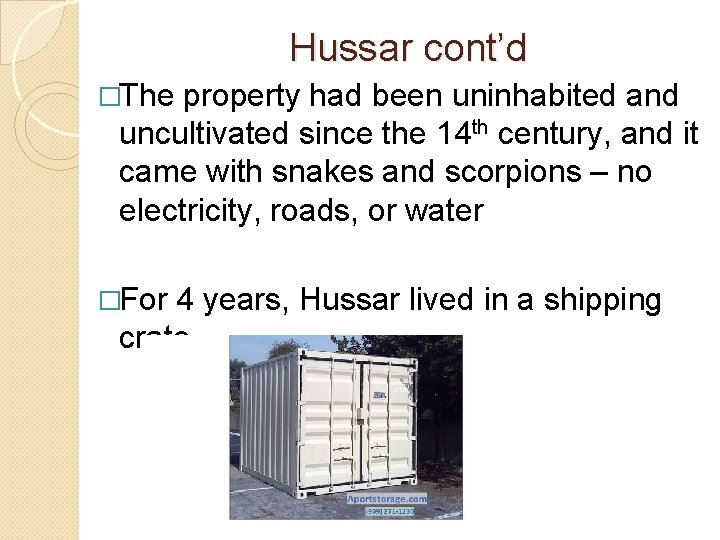
Hussar cont’d �The property had been uninhabited and uncultivated since the 14 th century, and it came with snakes and scorpions – no electricity, roads, or water �For 4 years, Hussar lived in a shipping crate
Hussar cont’d �After many years, a Jewish family came; Pax Christi contributed funds; and more residents came �Those who came risked being called traitors by their relatives, friends, and neighbors �Many arguments arose within the mixed group but no one gave up
Hussar cont’d �At the school, every child learned both Hebrew and Arabic as well as regular academic subjects taught by both Jewish and Arab teachers. �Although there were typical disagreements among the children, none centered on religious differences �Some families who came were agnostic and led secular lives
Hussar cont’d �Hussar’s new School for Peace brought together Jews and Arabs together, and often for the first time in their lives �He used psychodrama and had Arab and Jewish children reverse roles �Many children lost enemies and found friends through the process
Hussar cont’d �As of 2008, there were 50 families living in the interfaith village. It was expected to triple in the coming years �Two hundred children from nearby towns attend the Oasis of Peace School which has grades preschool through junior high �Over 45, 000 people have attended workshops at the school including people from Cyprus, Kosovo, and Northern
Hussar cont’d �More than 500 have been trained as conflict moderators �After Hussar died in 1996 his epitaph was carved in three languages – Hebrew, Arabic, and English – and his body was laid to rest in his beloved village �His vision showed that even in a troubled region, interfaith harmony is possible
Hussar Quotes � One thing is certain: The real solution to this problem will be political, not military, with negotiations conducted with mutual respect �What’s very important is that there’s a sort of invisible communion (among) all human beings in the world �The most solid rock of all is fraternal love. We can never go wrong with love
Oasis of Peace Web Page �http: //wasns. org/
Video Neve Shalon-Wahat al Salam
References �Beller, K, & Chase, H. (2008). Great peacemakers: True stories from around the world. Sedona, AZ: LTS Press Explore: Oasis of Peace. Retreived from https: //video. search. yahoo. com/yhs/search ? fr=yhs-mozilla-001&hsimp=yhs 001&hspart=mozilla&p=You. Tube+Oasis+o f+Peace#id=1&vid=527 e 7 e 97 be 34 d 193 b 6 a 41029940 e 815 c&action=click
- Slides: 15