
Fatality Prevention in the Workplace Forum Managing the
- Slides: 41
Fatality Prevention in the Workplace Forum Managing the Contractor/ Contracted Services Risk Breakout – Best Practice Sponsored by Indiana University of Pennsylvania Safety Sciences Department in cooperation with Alcoa Foundation
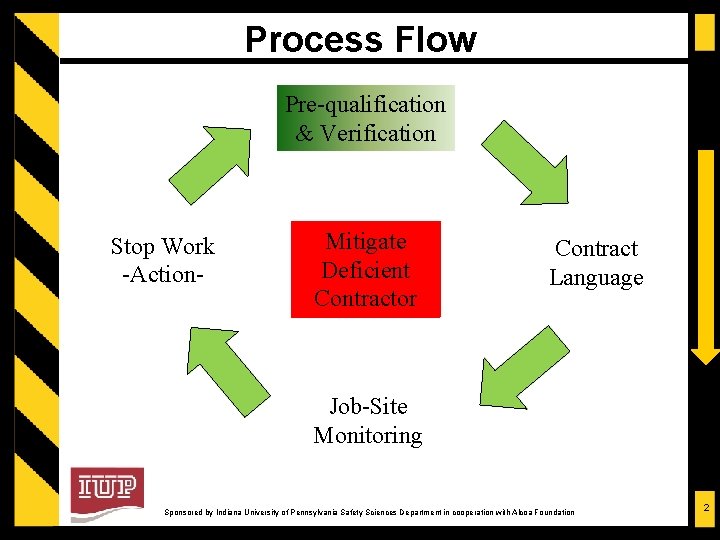
Process Flow Pre-qualification & Verification Stop Work -Action- Mitigate Deficient Contractor Contract Language Job-Site Monitoring Sponsored by Indiana University of Pennsylvania Safety Sciences Department in cooperation with Alcoa Foundation 2
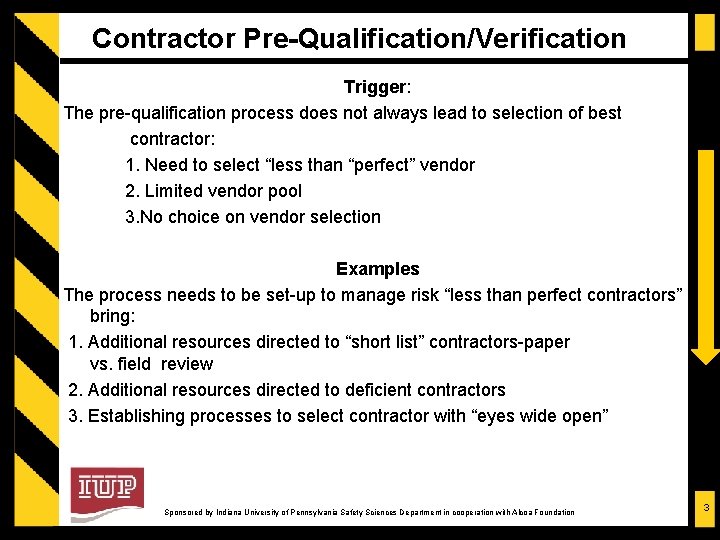
Contractor Pre-Qualification/Verification Trigger: The pre-qualification process does not always lead to selection of best contractor: 1. Need to select “less than “perfect” vendor 2. Limited vendor pool 3. No choice on vendor selection Examples The process needs to be set-up to manage risk “less than perfect contractors” bring: 1. Additional resources directed to “short list” contractors-paper vs. field review 2. Additional resources directed to deficient contractors 3. Establishing processes to select contractor with “eyes wide open” Sponsored by Indiana University of Pennsylvania Safety Sciences Department in cooperation with Alcoa Foundation 3
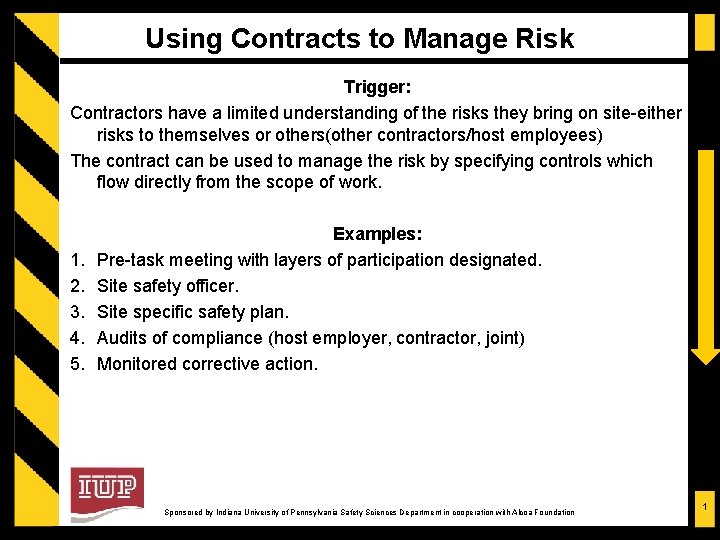
Using Contracts to Manage Risk Trigger: Contractors have a limited understanding of the risks they bring on site-either risks to themselves or others(other contractors/host employees) The contract can be used to manage the risk by specifying controls which flow directly from the scope of work. 1. 2. 3. 4. 5. Examples: Pre-task meeting with layers of participation designated. Site safety officer. Site specific safety plan. Audits of compliance (host employer, contractor, joint) Monitored corrective action. Sponsored by Indiana University of Pennsylvania Safety Sciences Department in cooperation with Alcoa Foundation 1
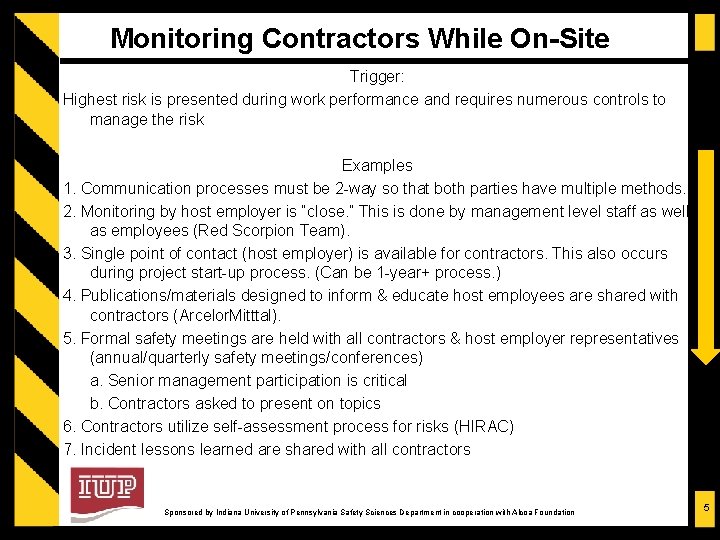
Monitoring Contractors While On-Site Trigger: Highest risk is presented during work performance and requires numerous controls to manage the risk Examples 1. Communication processes must be 2 -way so that both parties have multiple methods. 2. Monitoring by host employer is “close. ” This is done by management level staff as well as employees (Red Scorpion Team). 3. Single point of contact (host employer) is available for contractors. This also occurs during project start-up process. (Can be 1 -year+ process. ) 4. Publications/materials designed to inform & educate host employees are shared with contractors (Arcelor. Mitttal). 5. Formal safety meetings are held with all contractors & host employer representatives (annual/quarterly safety meetings/conferences) a. Senior management participation is critical b. Contractors asked to present on topics 6. Contractors utilize self-assessment process for risks (HIRAC) 7. Incident lessons learned are shared with all contractors Sponsored by Indiana University of Pennsylvania Safety Sciences Department in cooperation with Alcoa Foundation 5
Multiple Company Best Practice Alcoa, Chevron, Flour Const, Duke Energy and GM Sponsored by Indiana University of Pennsylvania Safety Sciences Department in cooperation with Alcoa Foundation 6
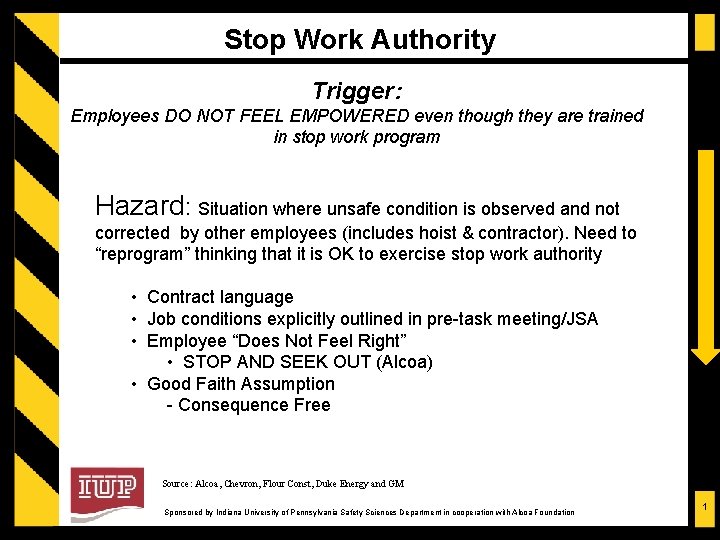
Stop Work Authority Trigger: Employees DO NOT FEEL EMPOWERED even though they are trained in stop work program Hazard: Situation where unsafe condition is observed and not corrected by other employees (includes hoist & contractor). Need to “reprogram” thinking that it is OK to exercise stop work authority • Contract language • Job conditions explicitly outlined in pre-task meeting/JSA • Employee “Does Not Feel Right” • STOP AND SEEK OUT (Alcoa) • Good Faith Assumption - Consequence Free Source: Alcoa, Chevron, Flour Const, Duke Energy and GM Sponsored by Indiana University of Pennsylvania Safety Sciences Department in cooperation with Alcoa Foundation 1
- Improving Deficient Contractor Performance Kathy Wilmer, Duke Energy Sponsored by Indiana University of Pennsylvania Safety Sciences Department in cooperation with Alcoa Foundation 8
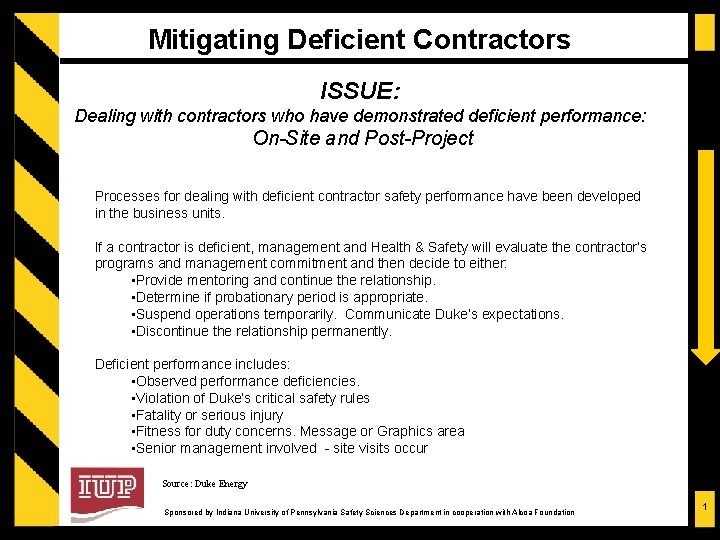
Mitigating Deficient Contractors ISSUE: Dealing with contractors who have demonstrated deficient performance: On-Site and Post-Project Processes for dealing with deficient contractor safety performance have been developed in the business units. If a contractor is deficient, management and Health & Safety will evaluate the contractor’s programs and management commitment and then decide to either: • Provide mentoring and continue the relationship. • Determine if probationary period is appropriate. • Suspend operations temporarily. Communicate Duke’s expectations. • Discontinue the relationship permanently. Deficient performance includes: • Observed performance deficiencies. • Violation of Duke’s critical safety rules • Fatality or serious injury • Fitness for duty concerns. Message or Graphics area • Senior management involved - site visits occur Source: Duke Energy Sponsored by Indiana University of Pennsylvania Safety Sciences Department in cooperation with Alcoa Foundation 1
Improving Deficient Contractor Performance- Duke Energy Dealing with contractors who have demonstrated deficient performance. Processes for dealing with deficient contractor safety performance have been developed in the business units. If a contractor is deficient, management and Health & Safety will evaluate the contractor’s programs and management commitment and then decide to either: • Provide mentoring and continue the relationship. • Determine if probationary period is appropriate. • Suspend operations temporarily. Communicate Duke’s expectations. • Discontinue the relationship permanently. Deficient performance includes: • Observed performance deficiencies. • Violation of Duke’s critical safety rules • Fatality or serious injury • Fitness for duty concerns. Message or Graphics area Source: Duke Energy Sponsored by Indiana University of Pennsylvania Safety Sciences Department in cooperation with Alcoa Foundation 1
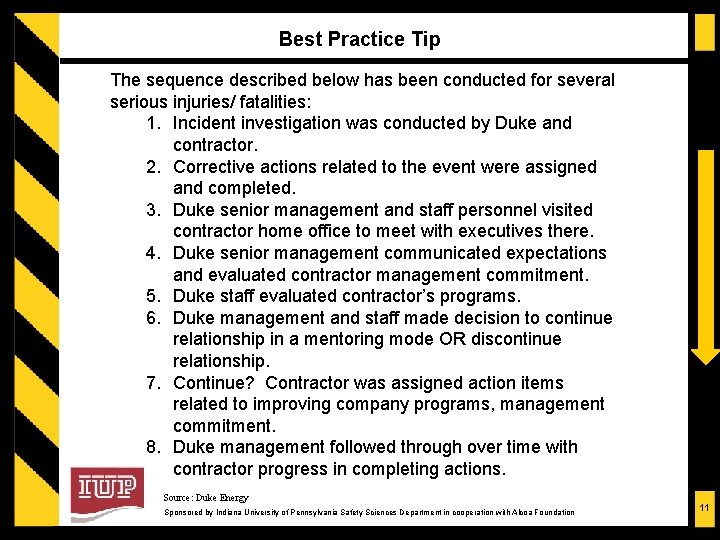
Best Practice Tip The sequence described below has been conducted for several serious injuries/ fatalities: 1. Incident investigation was conducted by Duke and contractor. 2. Corrective actions related to the event were assigned and completed. 3. Duke senior management and staff personnel visited contractor home office to meet with executives there. 4. Duke senior management communicated expectations and evaluated contractor management commitment. 5. Duke staff evaluated contractor’s programs. 6. Duke management and staff made decision to continue relationship in a mentoring mode OR discontinue relationship. 7. Continue? Contractor was assigned action items related to improving company programs, management commitment. 8. Duke management followed through over time with contractor progress in completing actions. Source: Duke Energy Sponsored by Indiana University of Pennsylvania Safety Sciences Department in cooperation with Alcoa Foundation 11
H&S Contractor Management System Mike Dwyer, Arcelor. Mittal Sponsored by Indiana University of Pennsylvania Safety Sciences Department in cooperation with Alcoa Foundation 12
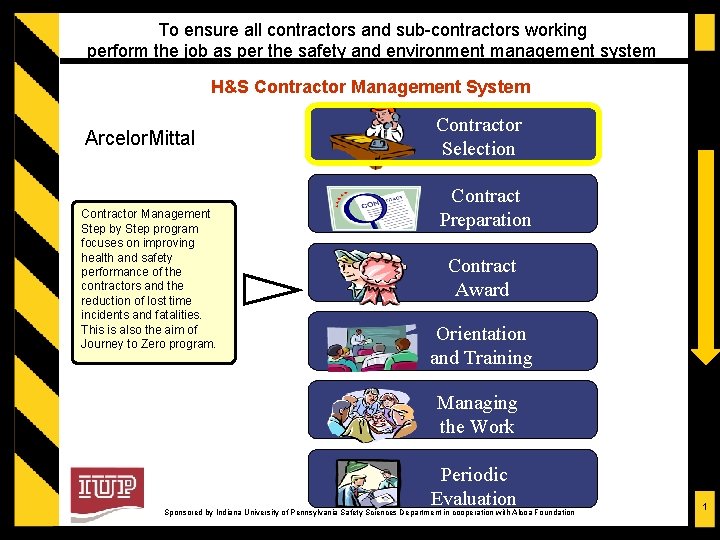
To ensure all contractors and sub-contractors working perform the job as per the safety and environment management system H&S Contractor Management System Arcelor. Mittal Contractor Management Step by Step program focuses on improving health and safety performance of the contractors and the reduction of lost time incidents and fatalities. This is also the aim of Journey to Zero program. Contractor Selection Contract Preparation Contract Award Orientation and Training Managing the Work Periodic Evaluation Sponsored by Indiana University of Pennsylvania Safety Sciences Department in cooperation with Alcoa Foundation 1
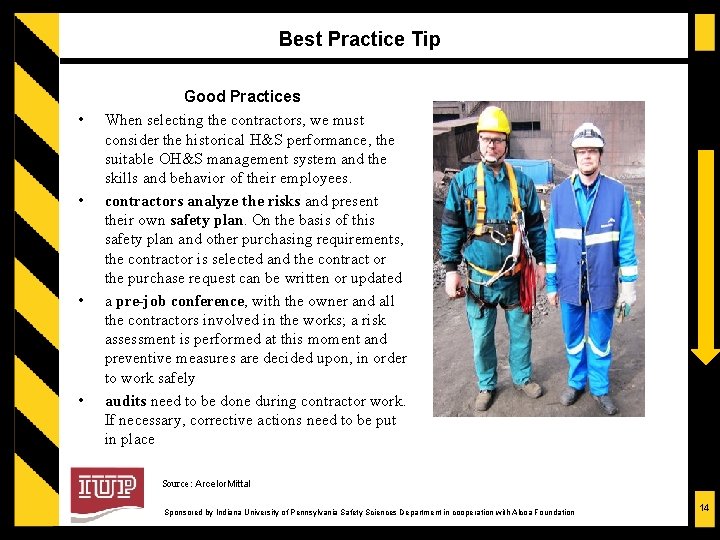
Best Practice Tip • • Good Practices When selecting the contractors, we must consider the historical H&S performance, the suitable OH&S management system and the skills and behavior of their employees. contractors analyze the risks and present their own safety plan. On the basis of this safety plan and other purchasing requirements, the contractor is selected and the contract or the purchase request can be written or updated a pre-job conference, with the owner and all the contractors involved in the works; a risk assessment is performed at this moment and preventive measures are decided upon, in order to work safely audits need to be done during contractor work. If necessary, corrective actions need to be put in place Source: Arcelor. Mittal Sponsored by Indiana University of Pennsylvania Safety Sciences Department in cooperation with Alcoa Foundation 14
Risk Assessment Process Dave Bielecki, Arcelor. Mittal Sponsored by Indiana University of Pennsylvania Safety Sciences Department in cooperation with Alcoa Foundation 15
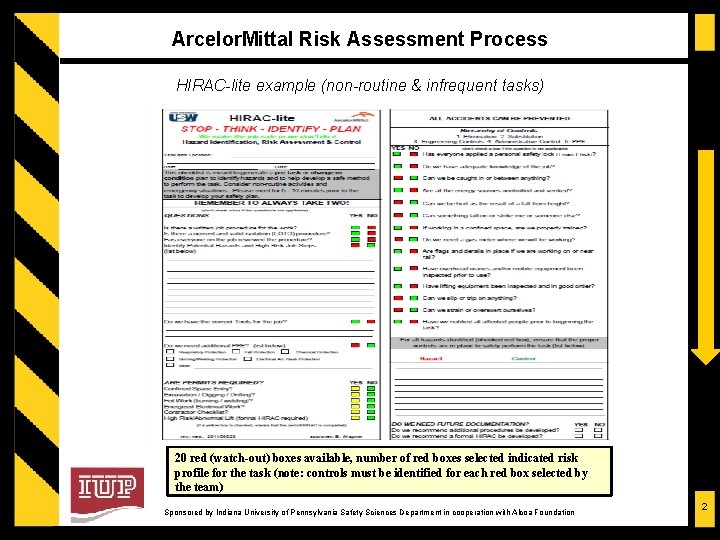
Arcelor. Mittal Risk Assessment Process HIRAC-lite example (non-routine & infrequent tasks) 20 red (watch-out) boxes available, number of red boxes selected indicated risk profile for the task (note: controls must be identified for each red box selected by the team) Sponsored by Indiana University of Pennsylvania Safety Sciences Department in cooperation with Alcoa Foundation 2
Best Practice Tip Contractors must conduct a formal risk assessment by completing a Hazard Identification, Risk Assessment and Control Checklist such as the HIRAC-Lite or similar document Source: Arcelor. Mittal Sponsored by Indiana University of Pennsylvania Safety Sciences Department in cooperation with Alcoa Foundation 17
Reducing risk through Implementation of Global Safe Permit to Work Program Heath Huschak, Koppers Sponsored by Indiana University of Pennsylvania Safety Sciences Department in cooperation with Alcoa Foundation 18
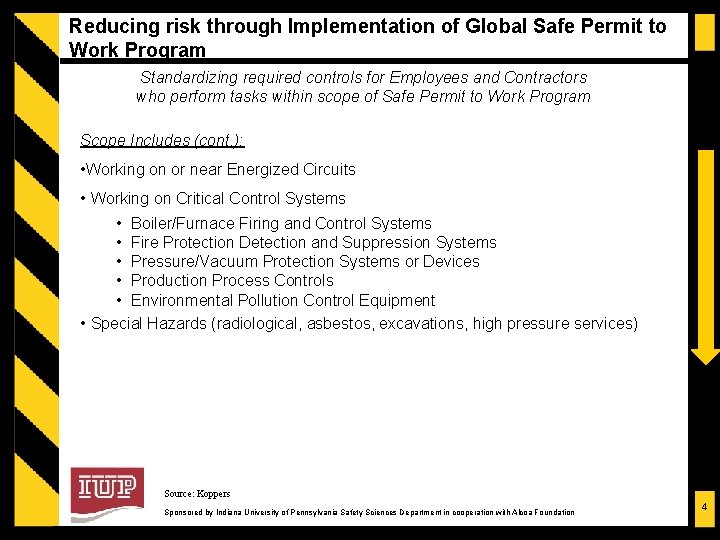
Reducing risk through Implementation of Global Safe Permit to Work Program (Koppers) Standardizing required controls for Employees and Contractors who perform tasks within scope of Safe Permit to Work Program Triggering Event – Lack of consistent control measures to manage known higher risk activities, some of which are known to result in fatalities. Fatality involving employees working on burner control equipment and improperly bypassing critical burner controls. Hazard – Various employee and contracted tasks with high hazard. Source: Koppers Sponsored by Indiana University of Pennsylvania Safety Sciences Department in cooperation with Alcoa Foundation 4
Reducing risk through Implementation of Global Safe Permit to Work Program Standardizing required controls for Employees and Contractors who perform tasks within scope of Safe Permit to Work Program Best Practice – Develop policy, standard permits and guidance appendices for tasks within limited scope of program. Requires formal Task Hazard Assessment prior to assignment of work. Scope Includes: • Hazardous Atmospheres • Confined Spaces, • External IDLH not associated with CSE • Hot Work • Working at Heights • Scaffolding inspection standards • Regulates of crane man basket work • Requires formal evaluation of “ad hoc” use of fall arrest equipment Source: Koppers Sponsored by Indiana University of Pennsylvania Safety Sciences Department in cooperation with Alcoa Foundation 4
Reducing risk through Implementation of Global Safe Permit to Work Program Standardizing required controls for Employees and Contractors who perform tasks within scope of Safe Permit to Work Program Scope Includes (cont. ): • Working on or near Energized Circuits • Working on Critical Control Systems • Boiler/Furnace Firing and Control Systems • Fire Protection Detection and Suppression Systems • Pressure/Vacuum Protection Systems or Devices • Production Process Controls • Environmental Pollution Control Equipment • Special Hazards (radiological, asbestos, excavations, high pressure services) Source: Koppers Sponsored by Indiana University of Pennsylvania Safety Sciences Department in cooperation with Alcoa Foundation 4
Engaged leadership taking project ownership Robert T. Geary, General Motors Corp. Sponsored by Indiana University of Pennsylvania Safety Sciences Department in cooperation with Alcoa Foundation 22
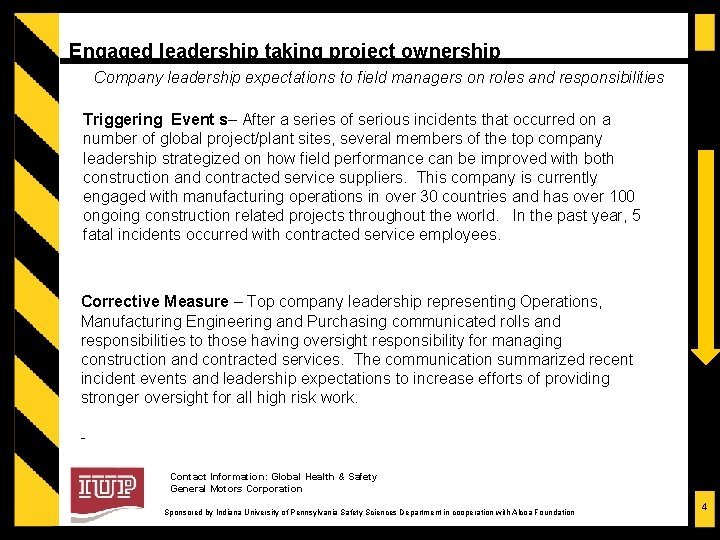
Engaged leadership taking project ownership Company leadership expectations to field managers on roles and responsibilities Triggering Event s– After a series of serious incidents that occurred on a number of global project/plant sites, several members of the top company leadership strategized on how field performance can be improved with both construction and contracted service suppliers. This company is currently engaged with manufacturing operations in over 30 countries and has over 100 ongoing construction related projects throughout the world. In the past year, 5 fatal incidents occurred with contracted service employees. Corrective Measure – Top company leadership representing Operations, Manufacturing Engineering and Purchasing communicated rolls and responsibilities to those having oversight responsibility for managing construction and contracted services. The communication summarized recent incident events and leadership expectations to increase efforts of providing stronger oversight for all high risk work. Contact Information: Global Health & Safety General Motors Corporation Sponsored by Indiana University of Pennsylvania Safety Sciences Department in cooperation with Alcoa Foundation 4
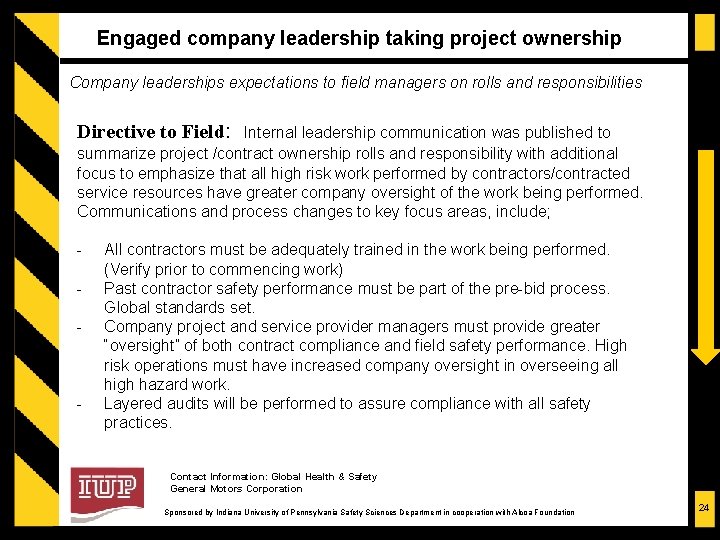
Engaged company leadership taking project ownership Company leaderships expectations to field managers on rolls and responsibilities Directive to Field: Internal leadership communication was published to summarize project /contract ownership rolls and responsibility with additional focus to emphasize that all high risk work performed by contractors/contracted service resources have greater company oversight of the work being performed. Communications and process changes to key focus areas, include; - - All contractors must be adequately trained in the work being performed. (Verify prior to commencing work) Past contractor safety performance must be part of the pre-bid process. Global standards set. Company project and service provider managers must provide greater “oversight” of both contract compliance and field safety performance. High risk operations must have increased company oversight in overseeing all high hazard work. Layered audits will be performed to assure compliance with all safety practices. Contact Information: Global Health & Safety General Motors Corporation Sponsored by Indiana University of Pennsylvania Safety Sciences Department in cooperation with Alcoa Foundation 24
Contractor Safety at United States Steel Corporation Edward Mazurkiewicz, US Steel Sponsored by Indiana University of Pennsylvania Safety Sciences Department in cooperation with Alcoa Foundation 25
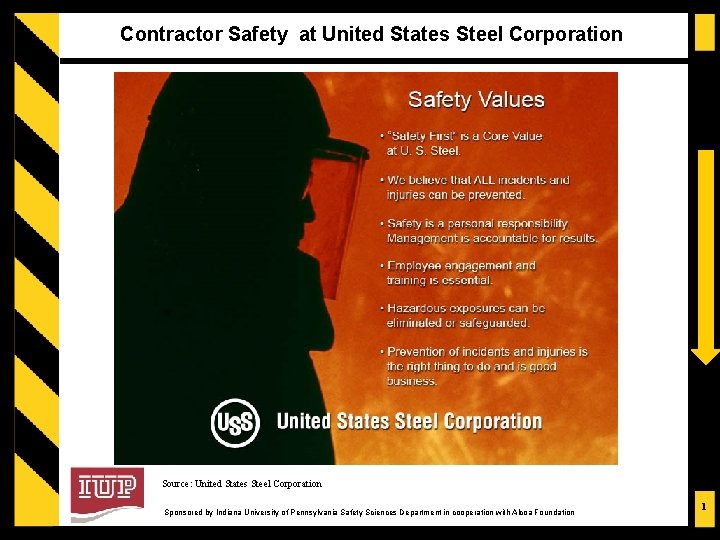
Contractor Safety at United States Steel Corporation Source: United States Steel Corporation Sponsored by Indiana University of Pennsylvania Safety Sciences Department in cooperation with Alcoa Foundation 1
Contractor Safety at United States Steel Corporation Discussion Topics § S-001 Key Elements § U. S. Steel Managements Responsibilities Source: United States Steel Corporation Sponsored by Indiana University of Pennsylvania Safety Sciences Department in cooperation with Alcoa Foundation 2
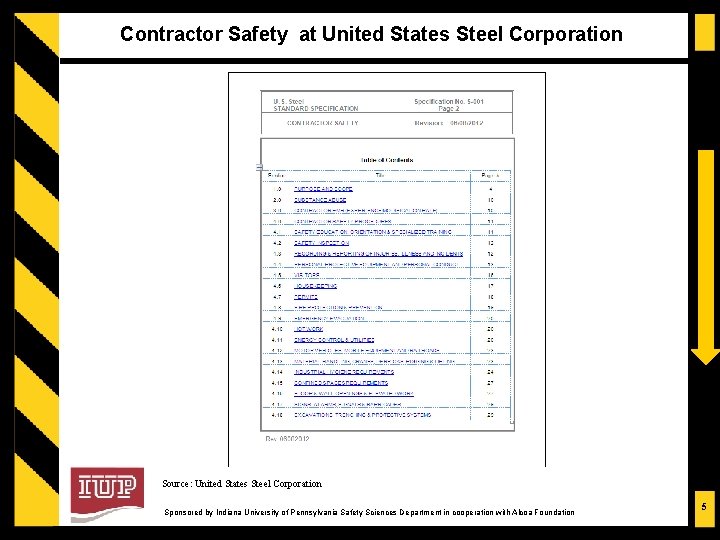
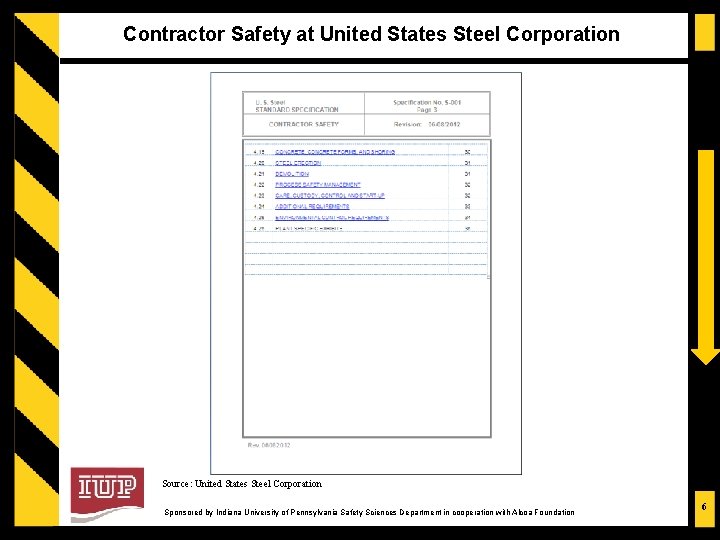
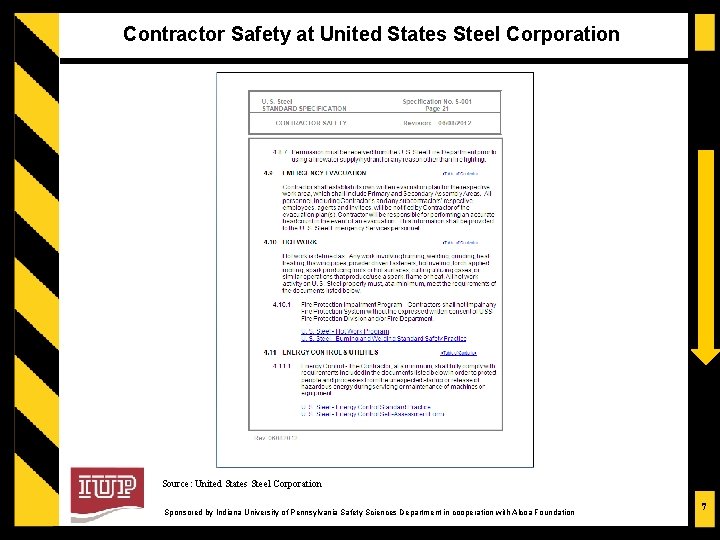
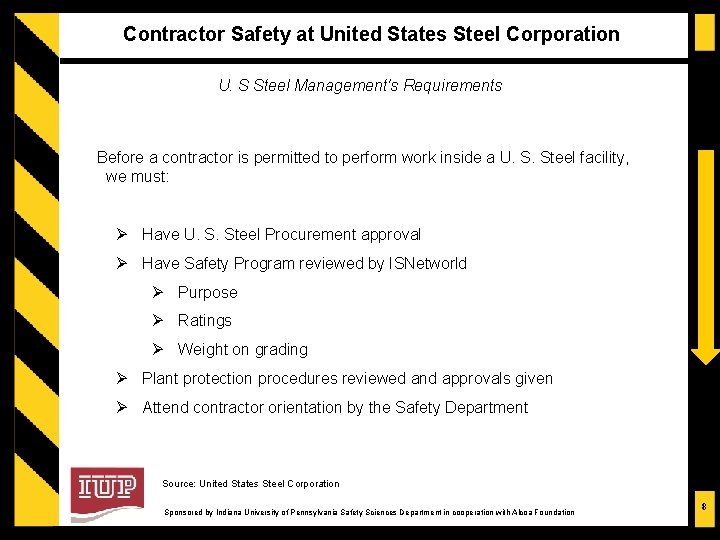
Contractor Safety at United States Steel Corporation S-001 Key Elements § U. S. Steel’s standard specification for contractors § Sets forth the governing contractor safety responsibilities § Contractors must be pre-approved by the Safety and Industrial Hygiene Department § Contractors are required to comply with S-001 whenever working on U. S. Steel property Source: United States Steel Corporation Sponsored by Indiana University of Pennsylvania Safety Sciences Department in cooperation with Alcoa Foundation 3
Contractor Safety at United States Steel Corporation S-001 Key Elements § Establishes a minimum level of contractor safety requirements for all persons working within U. S. Steel facilities § Is not intended to provide legal or other professional advice § Is U. S. Steel’s legal responsibility to warn contractors of all the hazards (hidden or obvious) that they may encounter Source: United States Steel Corporation Sponsored by Indiana University of Pennsylvania Safety Sciences Department in cooperation with Alcoa Foundation 4
Contractor Safety at United States Steel Corporation Source: United States Steel Corporation Sponsored by Indiana University of Pennsylvania Safety Sciences Department in cooperation with Alcoa Foundation 5
Contractor Safety at United States Steel Corporation Source: United States Steel Corporation Sponsored by Indiana University of Pennsylvania Safety Sciences Department in cooperation with Alcoa Foundation 6
Contractor Safety at United States Steel Corporation Source: United States Steel Corporation Sponsored by Indiana University of Pennsylvania Safety Sciences Department in cooperation with Alcoa Foundation 7
Contractor Safety at United States Steel Corporation U. S Steel Management's Requirements Before a contractor is permitted to perform work inside a U. S. Steel facility, we must: Ø Have U. S. Steel Procurement approval Ø Have Safety Program reviewed by ISNetworld Ø Purpose Ø Ratings Ø Weight on grading Ø Plant protection procedures reviewed and approvals given Ø Attend contractor orientation by the Safety Department Source: United States Steel Corporation Sponsored by Indiana University of Pennsylvania Safety Sciences Department in cooperation with Alcoa Foundation 8
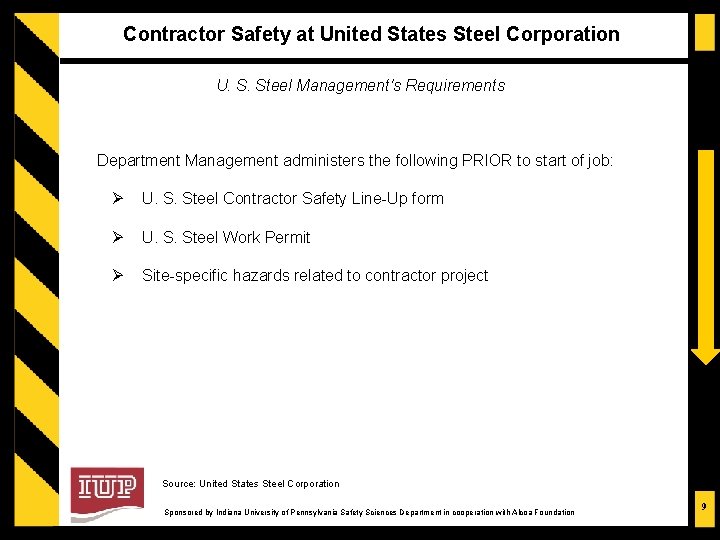
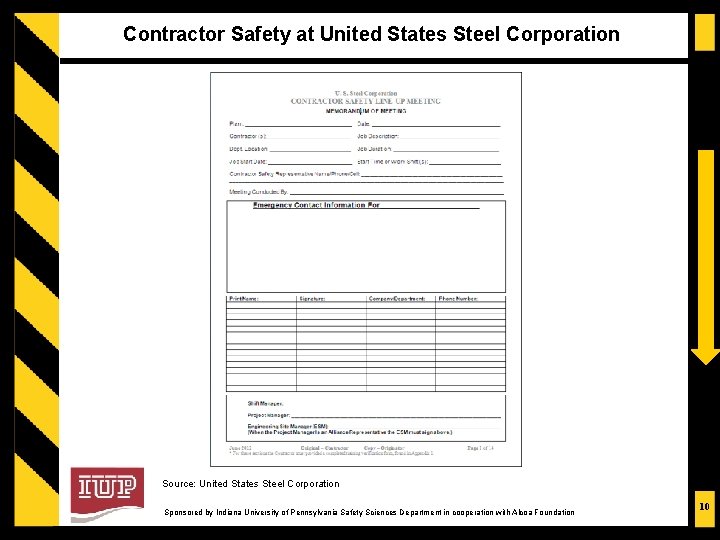
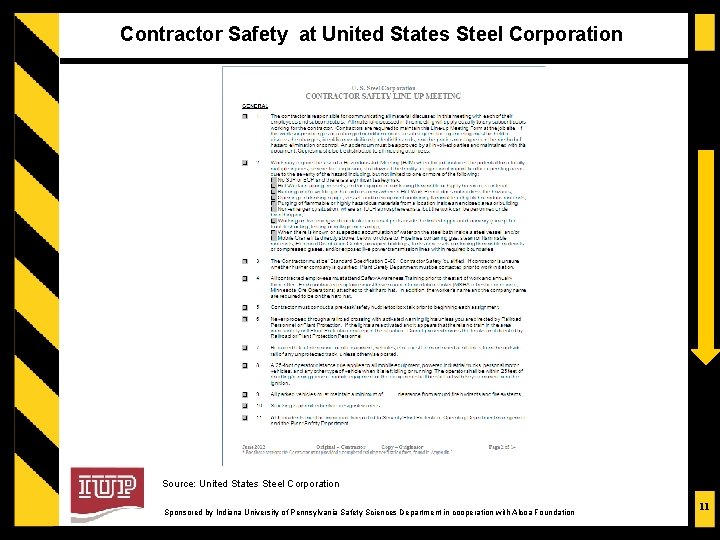
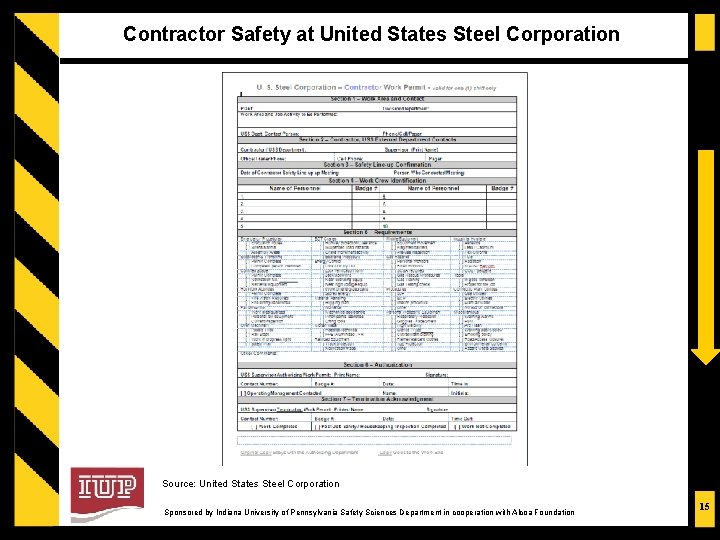
Contractor Safety at United States Steel Corporation U. S. Steel Management's Requirements Department Management administers the following PRIOR to start of job: Ø U. S. Steel Contractor Safety Line-Up form Ø U. S. Steel Work Permit Ø Site-specific hazards related to contractor project Source: United States Steel Corporation Sponsored by Indiana University of Pennsylvania Safety Sciences Department in cooperation with Alcoa Foundation 9
Contractor Safety at United States Steel Corporation Source: United States Steel Corporation Sponsored by Indiana University of Pennsylvania Safety Sciences Department in cooperation with Alcoa Foundation 10
Contractor Safety at United States Steel Corporation Source: United States Steel Corporation Sponsored by Indiana University of Pennsylvania Safety Sciences Department in cooperation with Alcoa Foundation 11
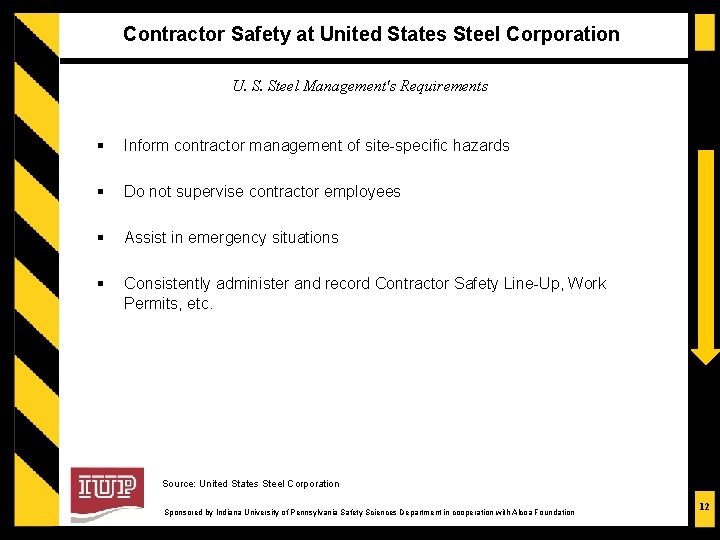
Contractor Safety at United States Steel Corporation U. S. Steel Management's Requirements § Inform contractor management of site-specific hazards § Do not supervise contractor employees § Assist in emergency situations § Consistently administer and record Contractor Safety Line-Up, Work Permits, etc. Source: United States Steel Corporation Sponsored by Indiana University of Pennsylvania Safety Sciences Department in cooperation with Alcoa Foundation 12
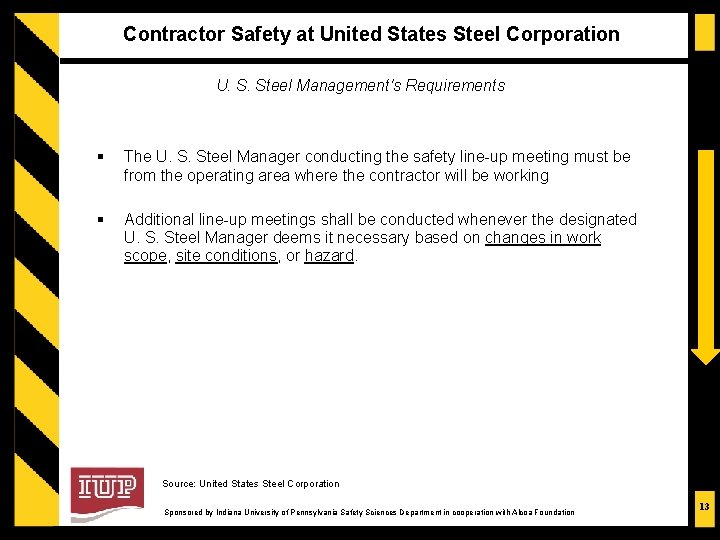
Contractor Safety at United States Steel Corporation U. S. Steel Management's Requirements § The U. S. Steel Manager conducting the safety line-up meeting must be from the operating area where the contractor will be working § Additional line-up meetings shall be conducted whenever the designated U. S. Steel Manager deems it necessary based on changes in work scope, site conditions, or hazard. Source: United States Steel Corporation Sponsored by Indiana University of Pennsylvania Safety Sciences Department in cooperation with Alcoa Foundation 13
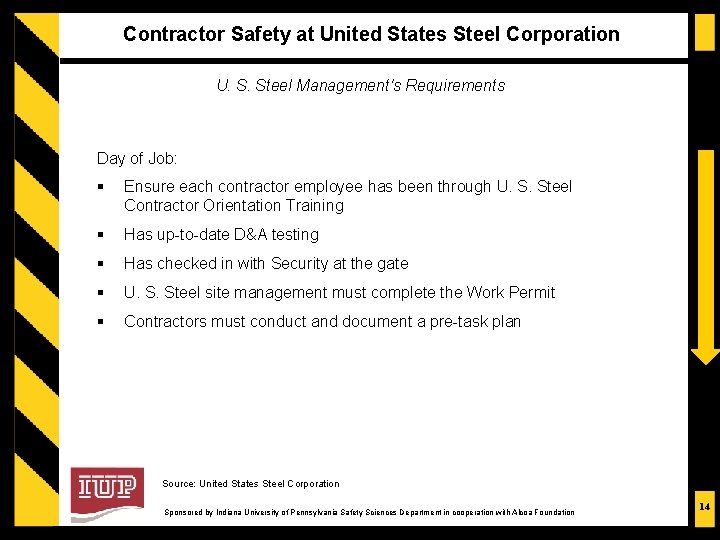
Contractor Safety at United States Steel Corporation U. S. Steel Management's Requirements Day of Job: § Ensure each contractor employee has been through U. S. Steel Contractor Orientation Training § Has up-to-date D&A testing § Has checked in with Security at the gate § U. S. Steel site management must complete the Work Permit § Contractors must conduct and document a pre-task plan Source: United States Steel Corporation Sponsored by Indiana University of Pennsylvania Safety Sciences Department in cooperation with Alcoa Foundation 14
Contractor Safety at United States Steel Corporation Source: United States Steel Corporation Sponsored by Indiana University of Pennsylvania Safety Sciences Department in cooperation with Alcoa Foundation 15
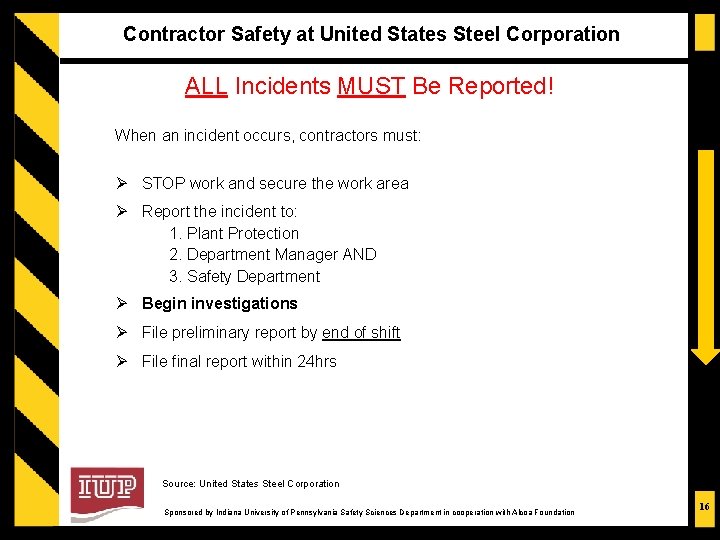
Contractor Safety at United States Steel Corporation ALL Incidents MUST Be Reported! When an incident occurs, contractors must: Ø STOP work and secure the work area Ø Report the incident to: 1. Plant Protection 2. Department Manager AND 3. Safety Department Ø Begin investigations Ø File preliminary report by end of shift Ø File final report within 24 hrs Source: United States Steel Corporation Sponsored by Indiana University of Pennsylvania Safety Sciences Department in cooperation with Alcoa Foundation 16