
Fatalism Week 06 LOGO In todays lecture v

- Slides: 85
Fatalism Week 06 LOGO
In today’s lecture… v. Recap v. Fatalism and free will v. Karma v. Logical determinism v. Theological determinism v. Causal determinism
Recap v. Eternalism v. Presentism v. Parallel universes v. Hirsute v. The Time Traveler’s Wife v. The idle argument
Fatalism and free will v. Fatalism is the view that the future is fixed and determined. It means that we humans have no control over what is going to happen in the future. v. If something is going to happen, it will happen no matter what we think or do. There are no alternative possibilities for the future.
Fatalism and free will v‘Free will’ (自由意志) can be understood as the idea that human action is not completely determined by external causes, but can be the result of conscious choice (有意識的選擇). v. A person has free will if and only if he or she has choice, i. e. if he or she can choose among alternative courses of action.
Fatalism and free will v. An action is free only if it is caused by the person himself or herself rather than something else. v. Thus, ‘free will’ can be defined as the power to make choices and, at least to some extent, to be in control of one’s own future. (will 意志 = power or ability to make choices or decisions)
Fatalism and free will v. From the standpoint of ethics, the idea of responsibility is tied to a person’s being free. v. For example, it might be wrong to punish someone for doing something wrong if he was not acting on his own free will.
Fatalism and free will v. To say that people have free will is to say that they can make choices – more than one possible futures are open to them. Does it imply that fatalism must be false if people have free will?
Fatalism and free will v. Taking ‘free will’ into consideration, there are two possible interpretations (解釋) of fatalism: [1] Free will is an illusion (假象). We do not have free will; and because of that, we have no control over future events.
Fatalism and free will v. OR: [2] Even if we have free will, we cannot change the future through our thoughts and actions. If something is going to happen, it will happen no matter what we think or do. (This, as you might remember, is the so-called ‘idle argument’. )
Fatalism and free will v. Suppose a fortune-teller tells you that you are going to be drown one day in the future. You don’t want this to happen, so you stay away from water all the time. v. However, if fatalism is true and fortuning-telling is reliable, then no matter how hard you try, you will get drown in the water one day.
Fatalism v. Many people go to fortune-tellers because they want to change their ‘fate’ (i. e. their future). v. But fortune-telling is possible only if fatalism is true, i. e. that the future is fixed and determined. v. But if fatalism is true, there is nothing you can do to change your future!
Fatalism If so, what is the point of asking the fortune-teller about your ‘fate’?
Karma v. The doctrine of ‘karma’ (因果報應) originated in ancient Indian religion and then spread to other cultures such as China and Japan. Today many people in India and other Asian countries still believe in the law of karma.
Karma v. Karma is a central notion in Hinduism (印度教) and Buddhism ( 佛教). It is believed to be the universal (普遍的) law of cause and effect. v. However, unlike the scientific concept of causality (因果律) in physics, karma should be understood as a religious or ethical concept.
Karma v. We hope to find a causal explanation for everything that happens. We want to know why some people enjoy happy lives while others suffer great pain for no obvious reasons. v. The concept of ‘karma’ is supposed to provide such an explanation.
Karma v. According to the doctrine of karma, events that appear to happen for no reason are actually the result of a person’s past actions. v. In Hinduism and Buddhism there is a kind of logic about collecting karma and its relation to how or where we will be re-born on the ‘Wheel of Karma’ (輪迴).
Karma v. Karma is often understood as related to reincarnation (輪迴轉生), i. e. the rebirth of one’s soul (靈魂) in another life, another person, or another life-form. v. As such, karma can be seen as effects or consequences of past actions that continue from one life to the next.
Karma v. An action (cause) may not be followed immediately by its corresponding effect because there might be several causal relations working together at the same time. v. As a result, the consequences of a past action may show up not in this life but in another lifetime.
Karma v. Thus, karma is premised on the belief that all of an individual’s suffering and enjoyment is deserved (應得的), i. e. as a result of the person’s past actions (in this life and previous lives). v. Things that happen in this life can have their source in what a person did in his or her past lives.
Karma v. The present life is only one in a chain of lives. v. Karma accumulates (積累) throughout a lifetime; it determines the conditions of one’s next existence, including the amount of pain and pleasure to be experienced.
Karma v. It is important to notice, however, that Hinduism (印度教) and Buddhism (佛教) offer very different interpretations (解釋) of the doctrine of karma.
Karma v. Hinduism looks in the rear-view mirror and focuses on the effects of past action on the present. v. Hindus believe that karma is fatalistic. There is no escape from the universal law of cause and effect. There is nothing you can do to change your fate.
Karma v. The doctrine of karma in Hinduism precludes (排除、否定) choice and free will. Major events in a person’s life are destined (注 定) to happen; they are unavoidable (不能避免的).
Karma v. In contrast, Buddhism is forward -looking and focuses on the consequences of present actions for the future. v. Karma is not seen as fatalistic or deterministic. Buddhism asserts that we have free will and therefore we are responsible for our own salvation (救贖).
Karma v. According to Buddhism, karma implies duties and responsibilities – our present actions will have either positive or negative effects in the future. v. From the standpoint of Buddhism, we have free will and so we can make ethical decisions – we can freely choose between doing good and doing evil.
Karma v. In Buddhism, reincarnation is a miserable phenomenon (可悲的現 象). v. The Buddhist ideal is to break free from the cycle of life and death and to achieve nirvana (湼 槃), i. e. the extinction (去除) of greed (貪), hate (瞋) and delusion (痴).
Karma v. Nirvana is the liberation (解脫) from samsara or the ‘cycle of life’. v. Karma implies action and consequence. Nirvana, in contrast, is a condition in which there are no actions, no feelings, and no troubles. It is, as Buddhists would say, completely peaceful.
Karma If you don’t remember any of the actions of your past lives, does it sound strange that you must suffer the consequences of those actions?
Karma If the doctrine of karma is true knowledge, it has to be verifiable (可證實的) through the scientific method. How do we know that the law of karma is true if there is no scientific evidence for it?
Read! Go to the course website, download and read a very short article titled “The True Meaning of ‘Karma’ in Buddhism”.
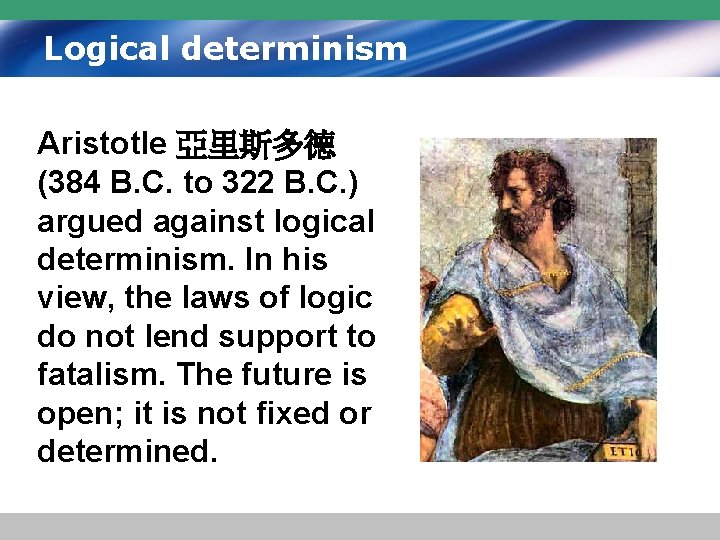
Logical determinism Aristotle 亞里斯多德 (384 B. C. to 322 B. C. ) argued against logical determinism. In his view, the laws of logic do not lend support to fatalism. The future is open; it is not fixed or determined.
Logical determinism v. To understand the argument of logical determinism (邏輯決定論 a. k. a. logical fatalism) and Aristotle’s counterargument against it, let us begin with the following statement: ‘There will be a sea battle tomorrow. ’
Logical determinism v. The law of bivalence states that: For any proposition p, p is either true or false. v. Logical determinism is the view that if the law of bivalence applies to all statements, the statement ‘There will be a sea battle tomorrow’ must have a true-value, i. e. it must be either true or false.
Logical determinism v. Accordingly, the statement ‘There will be a sea battle tomorrow’ is true if there really is a sea battle tomorrow (i. e. if there is a corresponding future fact). v. The statement is false if there is no sea battle tomorrow (i. e. if there is no corresponding future fact).
Logical determinism v. From the point of view of logical determinism, the statement ‘There will be a sea battle tomorrow’ must have a truthvalue (according to the law of bivalence), although we do not know at present whether the statement is true or false.
Logical determinism v. But if statements about the future have truth-values, the future is fixed and determined. v. In other words, we cannot prevent a sea battle from happening if it is going to happen. Likewise, we cannot cause a sea battle to happen if it is not going to happening.
Logical determinism v. Thus, according to logical determinism, the truth or falsehood of the statement ‘There will be a sea battle tomorrow’ depends on the presence or absence of some future fact. Whether the statement is true or not has nothing to do with what we think or do at present.
Logical determinism v. The truth or falsehood of the statements such as ‘There will be a sea battle tomorrow’ seems to be pre-destined (已經注定的) as a matter of logical necessity. v. Thus, the law of bivalence seems to lend support to logical determinism or fatalism.
Logical determinism v. Aristotle believed that fatalism, or logical determinism, is not true. In his view, some statements about the future, such as ‘There will be a sea battle tomorrow’, do not have truth-values at present. v. According to Aristotle, the law of bivalence is not applicable to some statements about the future.
Logical determinism v. Aristotle believed that the future, unlike the past, is ‘open’ (i. e. not fixed or determined). v. In his view, future events are not fixed or determined because of logical necessity. Logical determinism or fatalism does not follow from the law of bivalence.
Logical determinism v. Consider the statements below: [1] Eithere will be a sea battle tomorrow or there will not be a sea battle tomorrow. [2] There will be a sea battle tomorrow.
Logical determinism v. Aristotle would say that [1] is necessarily true because it exhausts all the possibilities (已經 包括所有可能性). v. However, [2] is neither true nor false right now. If a sea battle occurs, it will become true. If a sea battle does not occur, it will not be true.
Think! Aristotle, however, would say that the statement ‘The sun will rise tomorrow’ does have a truthvalue. What is the difference between the statement ‘There will be a sea battle tomorrow’ and the statement ‘The sun will rise tomorrow’?
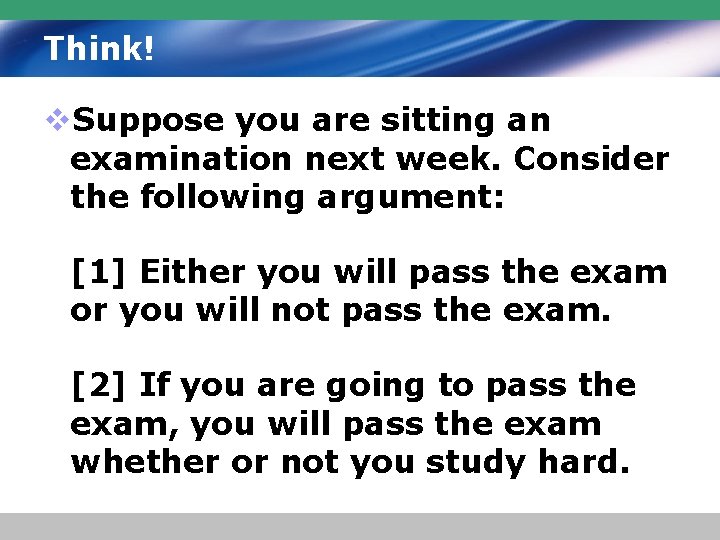
Think! v. Suppose you are sitting an examination next week. Consider the following argument: [1] Either you will pass the exam or you will not pass the exam. [2] If you are going to pass the exam, you will pass the exam whether or not you study hard.
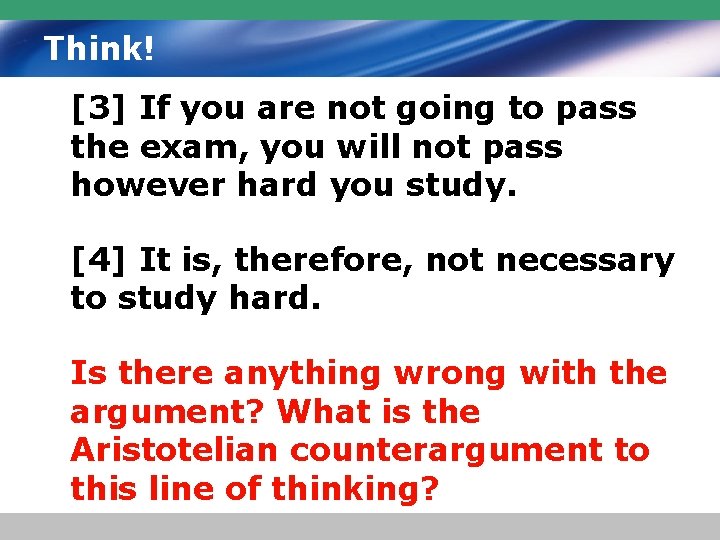
Think! [3] If you are not going to pass the exam, you will not pass however hard you study. [4] It is, therefore, not necessary to study hard. Is there anything wrong with the argument? What is the Aristotelian counterargument to this line of thinking?
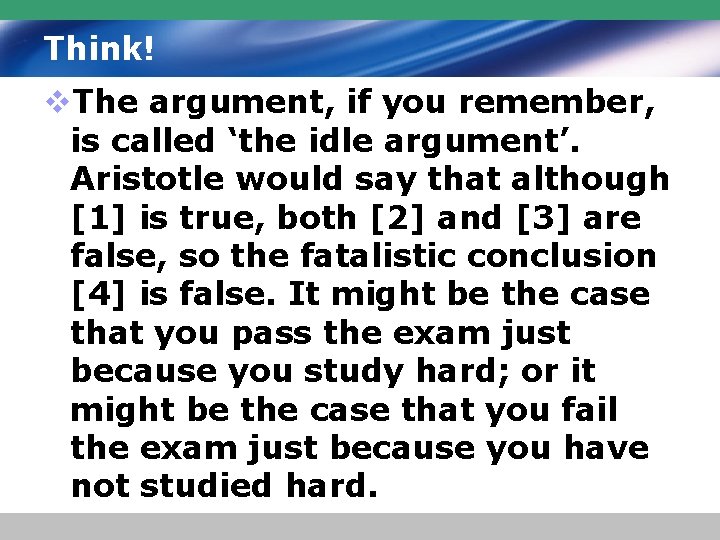
Think! v. The argument, if you remember, is called ‘the idle argument’. Aristotle would say that although [1] is true, both [2] and [3] are false, so the fatalistic conclusion [4] is false. It might be the case that you pass the exam just because you study hard; or it might be the case that you fail the exam just because you have not studied hard.
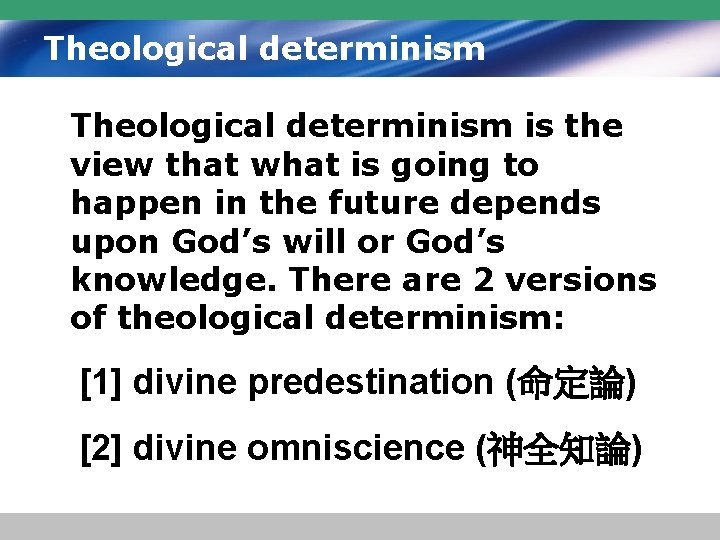
Theological determinism is the view that what is going to happen in the future depends upon God’s will or God’s knowledge. There are 2 versions of theological determinism: [1] divine predestination (命定論) [2] divine omniscience (神全知論)
Theological determinism v. Divine predestination (命定論) is the idea that God has predetermined (注定) what would happen to us. All events are made to happen by God. v. If everything happens as a result of ‘God’s will’, there are no chance events (i. e. random events without causes), and humans do not have free will.
Theological determinism v. More interesting still is the doctrine of ‘divine omniscience’ ( 神全知論) or the idea that God knows everything. v. If God is omniscient (allknowing), and if omniscience applies to the future, then the future is already known to God.
Theological determinism v. If God is all-knowing, then the future can only be what God knows it to be. It has to be so because what God knows must be true. (That is precisely what ‘divine omniscience’ means. ) If God already knows what I am going to do in the next minute, do I really have free will?
Theological determinism Do we have free will (the power to make choices and decisions) if there is an all-knowing God (or an all-knowing fortune-teller for that matter) who already knows every choice that we are going to make?
Theological determinism v. If I really had the freedom to make choices, then it would be in my power to make some of God’s knowledge false, but that is impossible. v. Because choice is a necessary condition for free will, I have no free will if an all-knowing God (or an all-knowing fortune-teller) exists.
Theological determinism The idea of responsibility is based on the assumption that people can make free choices. Am I responsible for my actions if I do not have choice and free will? Why should I be punished in hell for the sins I committed if I am not responsible for my actions?
Theological determinism v. A basic assumption of theological determinism is the existence of God. But how do we know that God really exists? v. And even if God really exists, it does not necessarily follow that God has predetermined the future, or that He is all-knowing.
Causal determinism v. Causal determinism (a. k. a. ‘physical determinism’ or simply ‘determinism’) is the view that [1] what is going to happen in the future is entirely determined by the interaction (互動) between past events and the laws of cause and effect, and [2] all events, including human actions and decisions, can be explained in terms of the laws of causality.
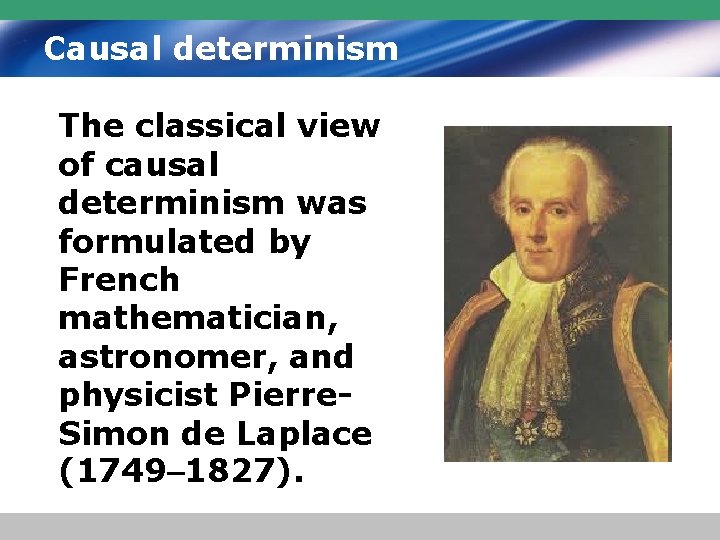
Causal determinism The classical view of causal determinism was formulated by French mathematician, astronomer, and physicist Pierre. Simon de Laplace (1749– 1827).
Causal determinism v. Laplace argued that an intelligent calculator (known as Laplace’s Demon), provided with exact knowledge of the state of the universe at present, would be able to predict the entire future. v. Many scientists, such as Newton, also share this mechanistic worldview (機械論的世界觀).
Causal determinism v. Causal determinism is often taken as a basic assumption of the natural sciences. v. According to this view, events which seem to occur by chance can be more fully understood if more was known about them. There are more scientific causal laws waiting to be discovered.
Causal determinism v. There are no chance events. Nothing happens at random. All events in the universe are linked together in a chain or network of causes and effects. v. The laws of nature are laws of causality, and the main purpose of modern science is to explain causal connections through the discovery of causal laws.
Think! Do you think that every event must have a cause? Do you think we can ultimately explain every event in terms of scientific causal laws? Do you think that scientists can predict the future accurately based on their knowledge of causal laws?
Free will vs. determinism v. The most important question: Do all human actions have causes? v. Although science has not discovered all the laws governing human action, it would appear that human behavior, like other natural events, is causally determined.
Free will vs. determinism v. However, not everyone agrees that the doctrine of determinism is applicable to human action. v. That is why we have the ‘free will vs. determinism’ debate – there are different ways to explain human action.
Free will vs. determinism v‘Will’ (意志) can be seen as the power or ability to make choices or decisions. v. Free will (自由意志), as mentioned earlier, is the power or ability to consciously choose one’s own actions free from any external forces.
Free will vs. determinism v. Free will can be understood as a person’s ability to make his or her own decision without being forced to make that decision. v. When a person makes a free decision, it must be possible that he or she could have decided something else (i. e. choice).
Free will vs. determinism v. Determinism is the view that every event has a cause. As such, we can explain events (including human actions) in terms of causal laws because effects always follow necessarily from their causes.
Free will vs. determinism v. Determinism (決定論) is related to fatalism (宿命論). But the two doctrines are different because determinism does not necessarily imply that human action is futile or ineffectual (沒有效用的). v. Determinism is simply the idea that everything that happens is caused by something else.
Free will vs. determinism v. So far, there is little scientific evidence in support of the existence of free will. v. On the other hand, experiments seem to lend support to determinism by showing that some human behavior can be reliably predicted and controlled, but nobody knows the limits within which this can be done.
Free will vs. determinism Do we have free will? Can we make choices and decisions for ourselves? Do we really have control over our own actions and decisions?
Free will vs. determinism There are 3 different viewpoints in the debate concerning free will and determinism: [1] hard determinism (硬決定論) [2] libertarianism (自由論) [3] soft determinism (軟決定論)
Free will vs. determinism v. Geneticists (遺傳學家) would say that our personalities (性格), thoughts and actions are determined by our genes (基因). v. Psychologists (心理學家) would say that our personalities, thoughts and actions are determined by environmental factors.
Free will vs. determinism v. Hard determinism (硬決定論) is the view that human freedom is an illusion (假象) because all human actions are determined. v. If hard determinism is true, none of us make genuine choices. All of our actions are the result of the interplay of heredity (遺傳), environment, biochemistry and neurophysiology (神經生理學).
Free will vs. determinism v. In other words, all of our actions are causally determined by factors beyond our control (past events, heredity, environment, brain chemistry, etc. ). v. Thus, human actions are governed by causal laws and can be adequately explained in terms of cause and effect.
Free will vs. determinism v. Hard determinism also argues that human actions are highly predictable (可預測的). v. If thoughts and actions are determined by genetic and environmental factors, etc. , knowledge of the causal laws governing these factors should allow us to predict human behavior with great precision.
Free will vs. determinism v. As noted earlier, a necessary condition for free will is the ability to do otherwise. An action is free only if it could have been otherwise. v. But if hard determinism is true, then we could not do anything other than what we actually do.
Free will vs. determinism v. To sum up, hard determinism argues that [1] all human actions are causally determined; and [2] the concept of ‘free will’ is unscientific, unclear, or meaningless, and therefore should not be used as an explanation for human actions.
Free will vs. determinism If free will is an illusion, do we have control over our own actions and decisions? Should we be responsible for the things we do and the choices we make?
Free will vs. determinism v‘Libertarianism’ (自由論) argues that [1] we have free will, and [2] free will is incompatible (不 相容) with determinism. v. From the standpoint of libertarianism, genes, environment, biochemistry, etc. are not sufficient causes of our thoughts and actions.
Free will vs. determinism v. Libertarians admit (承認) that genes, environment and biochemistry do have some influence over our thinking and behavior. But these factors do not causally determine our thoughts and actions. v. Libertarians argue that we have freedom (free will) to make choices.
Free will vs. determinism v. Libertarianism rejects the mechanistic worldview – determinism is not true as far as human action is concerned. v. For libertarians, our behavior is not determined by external causes or factors beyond our control, but is – at least to some extent – the result of conscious choice.
Free will vs. determinism v. Soft determinism (軟決定論; a. k. a. compatibilism) is the belief that free will and determinism are compatible (可相容的). v. Soft determinists agree that causal determinism is generally true, but we can still have free will to the extent that our actions are not compelled (被強迫) by external circumstances.
Free will vs. determinism v. Some soft determinists argue that we are free not because our actions are not bound by (受限於) causal laws. In their view, events can have multiple causes, and people’s conscious choice should also be taken into consideration as one of the causes.
Think! Is free will and determinism compatible? Can we have free will if our thoughts and actions are bound by causal laws?
Read! Read the article titled ‘A Brief Introduction to Some Terms and Concepts’ which is available at the course website: filmandphilosophy. weebly. com
Next week