
Fatal Risk Management Operator Reference Guide v 1



- Slides: 52
Fatal Risk Management Operator Reference Guide (v 1. 0) Fatality Prevention Program
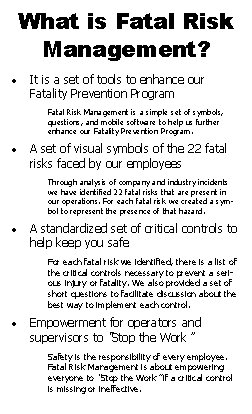
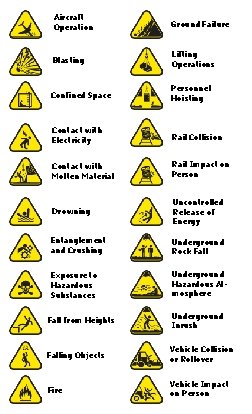
What is Fatal Risk Management? It is a set of tools to enhance our Fatality Prevention Program Fatal Risk Management is a simple set of symbols, questions, and mobile software to help us further enhance our Fatality Prevention Program. A set of visual symbols of the 22 fatal risks faced by our employees Through analysis of company and industry incidents we have identified 22 fatal risks that are present in our operations. For each fatal risk we created a symbol to represent the presence of that hazard. A standardized set of critical controls to help keep you safe For each fatal risk we identified, there is a list of the critical controls necessary to prevent a serious injury or fatality. We also provided a set of short questions to facilitate discussion about the best way to implement each control. Empowerment for operators and supervisors to “Stop the Work” Safety is the responsibility of every employee. Fatal Risk Management is about empowering everyone to “Stop the Work” if a critical control is missing or ineffective.
How Do I Use Fatal Risk Management? Step 1 - Identify the Risks Identify the Fatal Risks that may be present in your job task. Be reasonable and focus on the fatal risks you are most likely to encounter during your task. Many tasks will have multiple fatal risks, but don ’t go overboard trying to pick as many as possible. Step 2 - Review the Controls This booklet contains the critical controls and verification questions to ask for each fatal risk. Review the information in the booklet to help you plan how to complete the task safely. Step 3 - Communicate the Work Plan Have a conversation with your co-workers/team/crew about how you will implement each of the critical controls. Talk about it in your tailgate meeting, in the field, or during a job. It’s all about communication and understanding how to complete a task safely. Step 4 - Stop the Work if Necessary “Stop the Work” immediately if you realize that a critical control is missing or not correctly implemented.
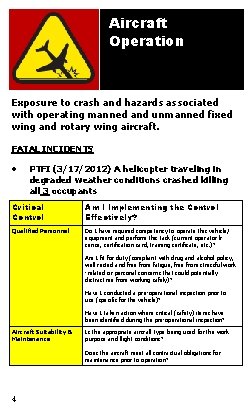
Aircraft Operation Exposure to crash and hazards associated with operating manned and unmanned fixed wing and rotary wing aircraft. FATAL INCIDENTS PTFI (3/17/2012) A helicopter traveling in degraded weather conditions crashed killing all 3 occupants Critical Control Am I Implementing the Control Effectively? Qualified Personnel Do I have required competency to operate this vehicle/ equipment and perform this task (current operator license, certification card, training certificate, etc. )? Am I fit for duty (compliant with drug and alcohol policy, well rested and free from fatigue, free from stressful work -related or personal concerns that could potentially distract me from working safely)? Have I conducted a pre-operational inspection prior to use (specific for the vehicle)? Have I taken action where critical (safety) items have been identified during the pre-operational inspection? Aircraft Suitability & Maintenance Is the appropriate aircraft type being used for the work purpose and flight conditions? Does the aircraft meet all contractual obligations for maintenance prior to operation? 4
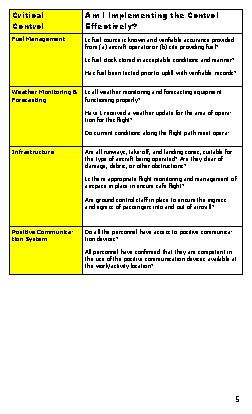
Critical Control Am I Implementing the Control Effectively? Fuel Management Is fuel source is known and verifiable assurance provided from (a) aircraft operator or (b) site providing fuel? Is fuel stock stored in acceptable conditions and manner? Has fuel been tested prior to uplift with verifiable records? Weather Monitoring & Forecasting Is all weather monitoring and forecasting equipment functioning properly? Have I received a weather update for the area of operation for this flight? Do current conditions along the flight path meet opera- Infrastructure Are all runways, take-off, and landing zones, suitable for the type of aircraft being operated? Are they clear of damage, debris, or other obstructions? Is there appropriate flight monitoring and management of airspace in place in ensure safe flight? Are ground control staff in place to ensure the ingress and egress of passengers into and out of aircraft? Positive Communication System Do all the personnel have access to positive communication devices? All personnel have confirmed that they are competent in the use of the positive communication devices available at the work/activity location? 5
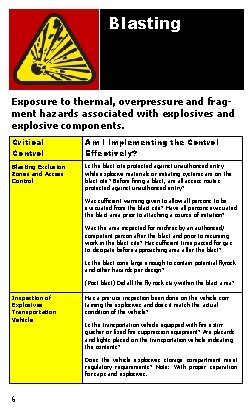
Blasting Exposure to thermal, overpressure and fragment hazards associated with explosives and explosive components. Critical Control Am I Implementing the Control Effectively? Blasting Exclusion Zones and Access Control Is the blast site protected against unauthorized entry while explosive materials or initiating systems are on the blast site? Before firing a blast, are all access routes protected against unauthorized entry? Was sufficient warning given to allow all persons to be evacuated from the blast site? Have all persons evacuated the blast area prior to attaching a source of initiation? Was the area inspected for misfires by an authorized/ competent person after the blast and prior to resuming work in the blast site? Has sufficient time passed for gas to dissipate before approaching area after the blast? Is the blast zone large enough to contain potential flyrock and other hazards per design? (Post blast) Did all the fly rock stay within the blast area? Inspection of Explosives Transportation Vehicle Has a pre-use inspection been done on the vehicle containing the explosives and does it match the actual condition of the vehicle? Is the transportation vehicle equipped with fire extinguisher or fixed fire suppression equipment? Are placards and lights placed on the transportation vehicle indicating the contents? Does the vehicle explosives storage compartment meet regulatory requirements? Note: With proper separation for caps and explosives. 6
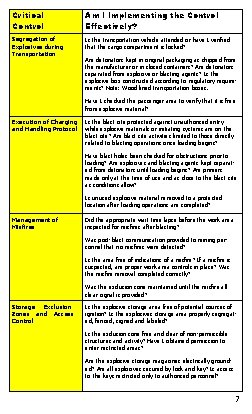
Critical Control Am I Implementing the Control Effectively? Segregation of Explosives during Transportation Is the transportation vehicle attended or have I verified that the cargo compartment is locked? Are detonators kept in original packaging as shipped from the manufacturer or in closed containers? Are detonators separated from explosive or blasting agents? Is the explosive box constructed according to regulatory requirements? Note: Wood lined transportation boxes. Have I checked the passenger area to verify that it is free from explosive material? Execution of Charging and Handling Protocol Is the blast site protected against unauthorized entry while explosive materials or initiating systems are on the blast site? Are blast site activities limited to those directly related to blasting operations once loading begins? Have blast holes been checked for obstructions prior to loading? Are explosives and blasting agents kept separated from detonators until loading begins? Are primers made only at the time of use and as close to the blast site as conditions allow? Is unused explosive material removed to a protected location after loading operations are completed? Management of Misfires Did the appropriate wait time lapse before the work area inspected for misfires after blasting? Was post-blast communication provided to mining personnel that no misfires were detected? Is the area free of indications of a misfire? If a misfire is suspected, are proper work area controls in place? Was the misfire removal completed correctly? Was the exclusion zone maintained until the misfire all clear signal is provided? Storage Exclusion Zones and Access Control Is the explosive storage area free of potential sources of ignition? Is the explosives storage area properly segregated, fenced, signed and labeled? Is the exclusion zone free and clear of non-permissible structures and activity? Have I obtained permission to enter restricted areas? Are the explosive storage magazines electrically grounded? Are all explosives secured by lock and key? Is access to the keys restricted only to authorized personnel? 7
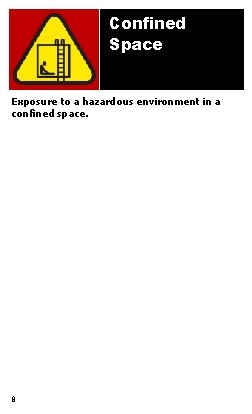
Confined Space Exposure to a hazardous environment in a confined space. 8
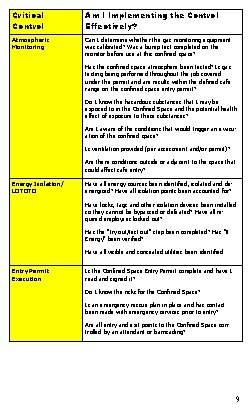
Critical Control Am I Implementing the Control Effectively? Atmospheric Monitoring Can I determine whether the gas monitoring equipment was calibrated? Was a bump test completed on the monitor before use at this confined space? Has the confined space atmosphere been tested? Is gas testing being performed throughout the job covered under the permit and are results within the defined safe range on the confined space entry permit? Do I know the hazardous substances that I may be exposed to in the Confined Space and the potential health effect of exposure to these substances? Am I aware of the conditions that would trigger an evacuation of the confined space? Is ventilation provided (per assessment and/or permit)? Are there conditions outside or adjacent to the space that could affect safe entry? Energy Isolation/ LOTOTO Have all energy sources been identified, isolated and deenergized? Have all isolation points been accounted for? Have locks, tags and other isolation devices been installed so they cannot be bypassed or defeated? Have all required employees locked out? Has the "try out/test out" step been completed? Has "0 Energy" been verified? Have all visible and concealed utilities been identified Entry Permit Execution Is the Confined Space Entry Permit complete and have I read and signed it? Do I know the risks for the Confined Space? Is an emergency rescue plan in place and has contact been made with emergency services prior to entry? Are all entry and exit points to the Confined Space controlled by an attendant or barricading? 9
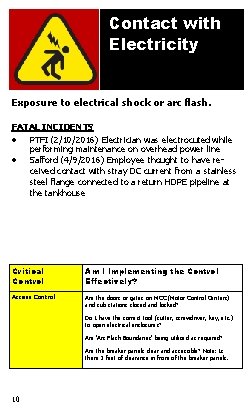
Contact with Electricity Exposure to electrical shock or arc flash. FATAL INCIDENTS PTFI (2/10/2016) Electrician was electrocuted while performing maintenance on overhead power line Safford (4/9/2016) Employee thought to have received contact with stray DC current from a stainless steel flange connected to a return HDPE pipeline at the tankhouse Critical Control Am I Implementing the Control Effectively? Access Control Are the doors or gates on MCC (Motor Control Centers) and sub stations closed and locked? Do I have the correct tool (cutter, screwdriver, key, etc. ) to open electrical enclosures? Are 'Arc Flash Boundaries' being utilized as required? Are the breaker panels clear and accessible? Note: Is there 3 feet of clearance in from of the breaker panels. 10
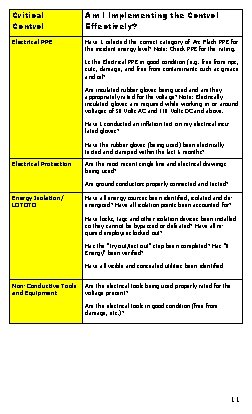
Critical Control Am I Implementing the Control Effectively? Electrical PPE Have I selected the correct category of Arc Flash PPE for the incident energy level? Note: Check PPE for the rating. Is the Electrical PPE in good condition (e. g. free from rips, cuts, damage, and free from contaminants such as grease and oil? Are insulated rubber gloves being used and are they appropriately rated for the voltage? Note: Electrically insulated gloves are required while working in or around voltages of 50 Volts AC and 110 Volts DC and above. Have I conducted an inflation test on my electrical insulated gloves? Have the rubber gloves (being used) been electrically tested and stamped within the last 6 months? Electrical Protection Are the most recent single line and electrical drawings being used? Are ground conductors properly connected and tested? Energy Isolation/ LOTOTO Have all energy sources been identified, isolated and deenergized? Have all isolation points been accounted for? Have locks, tags and other isolation devices been installed so they cannot be bypassed or defeated? Have all required employees locked out? Has the "try out/test out" step been completed? Has "0 Energy" been verified? Have all visible and concealed utilities been identified Non-Conductive Tools and Equipment Are the electrical tools being used properly rated for the voltage present? Are the electrical tools in good condition (free from damage, etc. )? 11
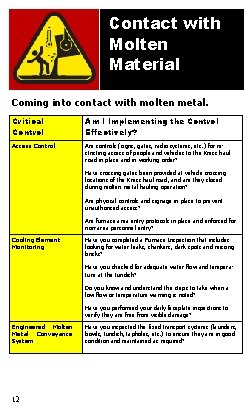
Contact with Molten Material Coming into contact with molten metal. Critical Control Am I Implementing the Control Effectively? Access Control Are controls (signs, gates, radio systems, etc. ) for restricting access of people and vehicles to the Kress haul road in place and in working order? Have crossing gates been provided at vehicle crossing locations of the Kress haul road, and are they closed during molten metal hauling operation? Are physical controls and signage in place to prevent unauthorized access? Are furnace area entry protocols in place and enforced for non-area personnel entry? Cooling Element Monitoring Have you completed a Furnace Inspection that includes looking for water leaks, shankers, dark spots and missing bricks? Have you checked for adequate water flow and temperature at the tundish? Do you know and understand the steps to take when a low flow or temperature warning is noted? Have you performed your daily faceplate inspections to verify they are free from visible damage? Engineered Molten Metal Conveyance System 12 Have you inspected the fixed transport systems (launders, bowls, tundish, tapholes, etc. ) to ensure they are in good condition and maintained as required?
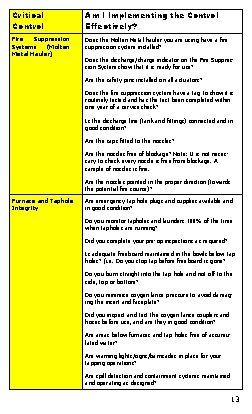
Critical Control Am I Implementing the Control Effectively? Fire Suppression Systems (Molten Metal Hauler) Does the Molten Metal hauler you are using have a fire suppression system installed? Does the discharge/charge indicator on the Fire Suppression System show that it is ready for use? Are the safety pins installed on all actuators? Does the fire suppression system have a tag to show it is routinely tested and has the test been completed within one year of a service check? Is the discharge line (tank and fittings) connected and in good condition? Are the caps fitted to the nozzles? Are the nozzles free of blockage? Note: It is not necessary to check every nozzle is free from blockage. A sample of nozzles is fine. Are the nozzles pointed in the proper direction (towards the potential fire source)? Furnace and Taphole Integrity Are emergency tap hole plugs and supplies available and in good condition? Do you monitor tapholes and launders 100% of the time when tapholes are running? Did you complete your pre-op inspections as required? Is adequate freeboard maintained in the bowls below tap holes? (i. e. Do you stop tap before freeboard is gone? Do you burn straight into the tap hole and not off to the side, top or bottom? Do you minimize oxygen lance pressure to avoid damaging the insert and faceplate? Did you inspect and test the oxygen lance couplers and hoses before use, and are they in good condition? Are areas below furnaces and tap holes free of accumulated water? Are warning lights/signs/barricades in place for your tapping operations? Are spill detection and containment systems maintained and operating as designed? 13
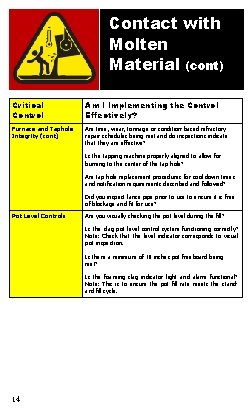
Contact with Molten Material (cont) Critical Control Am I Implementing the Control Effectively? Furnace and Taphole Integrity (cont) Are time, wear, tonnage or condition-based refractory repair schedules being met and do inspections indicate that they are effective? Is the tapping machine properly aligned to allow for burning to the center of the tap hole? Are tap hole replacement procedures for cool down times and notification requirements described and followed? Did you inspect lance pipe prior to use to ensure it is free of blockage and fit for use? Pot Level Controls Are you visually checking the pot level during the fill? Is the slag pot level control system functioning correctly? Note: Check that the level indicator corresponds to visual pot inspection. Is there a minimum of 18 inches pot freeboard being met? Is the foaming slag indicator light and alarm functional? Note: This is to ensure the pot fill rate meets the standard fill cycle. 14
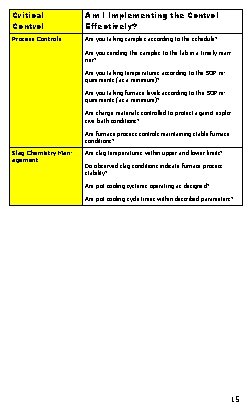
Critical Control Am I Implementing the Control Effectively? Process Controls Are you taking samples according to the schedule? Are you sending the samples to the lab in a timely manner? Are you taking temperatures according to the SOP requirements (as a minimum)? Are you taking furnace levels according to the SOP requirements (as a minimum)? Are charge materials controlled to protect against explosive bath conditions? Are furnace process controls maintaining stable furnace conditions? Slag Chemistry Management Are slag temperatures within upper and lower limits? Do observed slag conditions indicate furnace process stability? Are pot cooling systems operating as designed? Are pot cooling cycle times within described parameters? 15
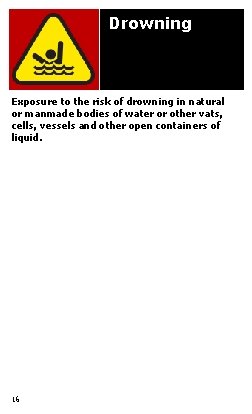
Drowning Exposure to the risk of drowning in natural or manmade bodies of water or other vats, cells, vessels and other open containers of liquid. 16
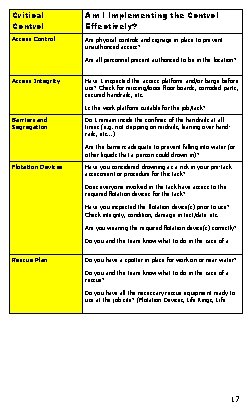
Critical Control Am I Implementing the Control Effectively? Access Control Are physical controls and signage in place to prevent unauthorized access? Are all personnel present authorized to be in the location? Access Integrity Have I inspected the access platform and/or barge before use? Check for missing/loose floor boards, corroded parts, secured handrails, etc. Is the work platform suitable for the job/task? Barriers and Segregation Do I remain inside the confines of the handrails at all times (e. g. not stepping on midrails, leaning over handrails, etc. . . ) Are the barriers adequate to prevent falling into water (or other liquids that a person could drown in)? Flotation Devices Have you considered drowning as a risk in your pre-task assessment or procedure for this task? Does everyone involved in the task have access to the required flotation devices for the task? Have you inspected the flotation device(s) prior to use? Check integrity, condition, damage in test/date etc. Are you wearing the required flotation device(s) correctly? Do you and the team know what to do in the case of a Rescue Plan Do you have a spotter in place for work on or near water? Do you and the team know what to do in the case of a rescue? Do you have all the necessary rescue equipment ready to use at the job site? (Flotation Devices, Life Rings, Life 17
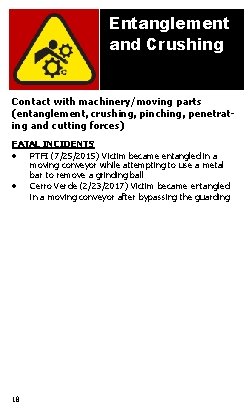
Entanglement and Crushing Contact with machinery/moving parts (entanglement, crushing, pinching, penetrating and cutting forces) FATAL INCIDENTS PTFI (7/25/2015) Victim became entangled in a moving conveyor while attempting to use a metal bar to remove a grinding ball Cerro Verde (2/23/2017) Victim became entangled in a moving conveyor after bypassing the guarding 18
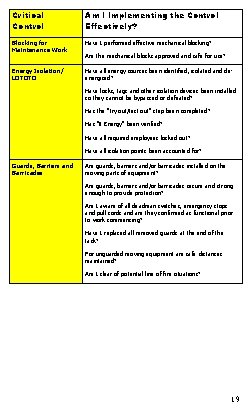
Critical Control Am I Implementing the Control Effectively? Blocking for Maintenance Work Have I performed effective mechanical blocking? Energy Isolation/ LOTOTO Have all energy sources been identified, isolated and deenergized? Are the mechanical blocks approved and safe for use? Have locks, tags and other isolation devices been installed so they cannot be bypassed or defeated? Has the "try out/test out" step been completed? Has "0 Energy" been verified? Have all required employees locked out? Have all isolation points been accounted for? Guards, Barriers and Barricades Are guards, barriers and/or barricades installed on the moving parts of equipment? Are guards, barriers and/or barricades secure and strong enough to provide protection? Am I aware of all deadman switches, emergency stops and pull cords and are they confirmed as functional prior to work commencing? Have I replaced all removed guards at the end of the task? For unguarded moving equipment are safe distances maintained? Am I clear of potential line of fire situations? 19
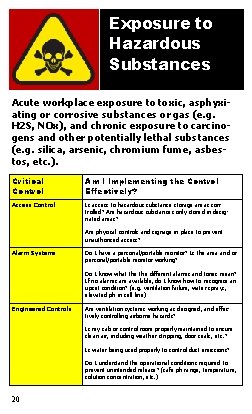
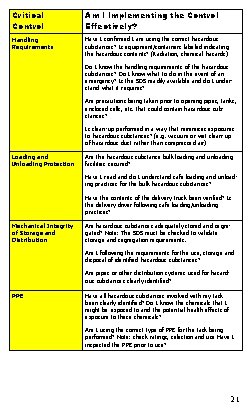
Exposure to Hazardous Substances Acute workplace exposure to toxic, asphyxiating or corrosive substances or gas (e. g. H 2 S, NOx), and chronic exposure to carcinogens and other potentially lethal substances (e. g. silica, arsenic, chromium fume, asbestos, etc. ). Critical Control Am I Implementing the Control Effectively? Access Control Is access to hazardous substance storage areas controlled? Are hazardous substances only stored in designated areas? Are physical controls and signage in place to prevent unauthorized access? Alarm Systems Do I have a personal/portable monitor? Is the area and or personal/portable monitor working? Do I know what the different alarms and tones mean? If no alarms are available, do I know how to recognize an upset condition? (e. g. ventilation failure, water sprays, elevated ph in cell line) Engineered Controls Are ventilation systems working as designed, and effectively controlling airborne hazards? Is my cab or control room properly maintained to ensure clean air, including weather stripping, door seals, etc. ? Is water being used properly to control dust emissions? Do I understand the operational conditions required to prevent unintended release? (safe ph range, temperature, solution concentration, etc. ) 20
Critical Control Am I Implementing the Control Effectively? Handling Requirements Have I confirmed I am using the correct hazardous substances? Is equipment/containers labeled indicating the hazardous contents? (Radiation, chemical hazards) Do I know the handling requirements of the hazardous substances? Do I know what to do in the event of an emergency? Is the SDS readily available and do I understand what it requires? Are precautions being taken prior to opening pipes, tanks, enclosed cells, etc. that could contain hazardous substances? Is clean-up performed in a way that minimizes exposures to hazardous substances? (e. g. vacuum or wet clean-up of hazardous dust rather than compressed air) Loading and Unloading Protection Are the hazardous substance bulk loading and unloading facilities secured? Have I read and do I understand safe loading and unloading practices for the bulk hazardous substances? Have the contents of the delivery truck been verified? Is the delivery driver following safe loading/unloading practices? Mechanical Integrity of Storage and Distribution Are hazardous substances adequately stored and segregated? Note: The SDS must be checked to validate storage and segregation requirements. Am I following the requirements for the use, storage and disposal of identified hazardous substances? Are pipes or other distribution systems used for hazardous substances clearly identified? PPE Have all hazardous substances involved with my task been clearly identified? Do I know the chemicals that I might be exposed to and the potential health effects of exposure to these chemicals? Am I using the correct type of PPE for the task being performed? Note: check ratings, selection and use Have I inspected the PPE prior to use? 21
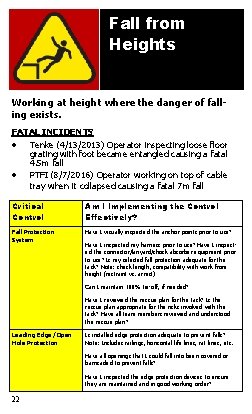
Fall from Heights Working at height where the danger of falling exists. FATAL INCIDENTS Tenke (4/13/2013) Operator inspecting loose floor grating with foot became entangled causing a fatal 4. 5 m fall PTFI (8/7/2016) Operator working on top of cable tray when it collapsed causing a fatal 7 m fall Critical Control Am I Implementing the Control Effectively? Fall Protection System Have I visually inspected the anchor points prior to use? Have I inspected my harness prior to use? Have I inspected the connector/lanyard/shock absorber equipment prior to use? Is my selected fall protection adequate for the task? Note: check length, compatibility with work from height (restraint vs. arrest) Can I maintain 100% tie-off, if needed? Have I reviewed the rescue plan for the task? Is the rescue plan appropriate for the risks involved with the task? Have all team members reviewed and understood the rescue plan? Leading Edge /Open Hole Protection Is installed edge protection adequate to prevent falls? Note: Includes railings, horizontal life lines, rat lines, etc. Have all openings that I could fall into been covered or barricaded to prevent falls? Have I inspected the edge protection devices to ensure they are maintained and in good working order? 22
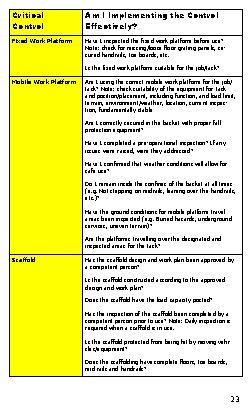
Critical Control Am I Implementing the Control Effectively? Fixed Work Platform Have I inspected the fixed work platform before use? Note: check for missing/loose floor grating panels, secured handrails, toe boards, etc. Is the fixed work platform suitable for the job/task? Mobile Work Platform Am I using the correct mobile work platform for the job/ task? Note: check suitability of the equipment for task and position/placement, including function, and load limit, terrain, environment/weather, location, current inspection, fundamentally stable Am I correctly secured in the basket with proper fall protection equipment? Have I completed a pre-operational inspection? If any issues were raised, were they addressed? Have I confirmed that weather conditions will allow for safe use? Do I remain inside the confines of the basket at all times (e. g. Not stepping on midrails, leaning over the handrails, etc. )? Have the ground conditions for mobile platform travel areas been inspected (e. g. Buried hazards, underground services, uneven terrain)? Are the platforms travelling over the designated and inspected areas for the task? Scaffold Has the scaffold design and work plan been approved by a competent person? Is the scaffold constructed according to the approved design and work plan? Does the scaffold have the load capacity posted? Has the inspection of the scaffold been completed by a competent person prior to use? Note: Daily inspection is required when a scaffold is in use. Is the scaffold protected from being hit by moving vehicles/equipment? Does the scaffolding have complete floors, toe boards, mid rails and handrails? 23
Falling Objects Exposure to falling objects (e. g. tools, material, equipment, structures, etc. ). 24
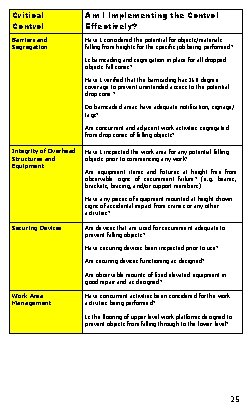
Critical Control Am I Implementing the Control Effectively? Barriers and Segregation Have I considered the potential for objects/materials falling from heights for the specific job being performed? Is barricading and segregation in place for all dropped objects fall zones? Have I verified that the barricading has 360 degree coverage to prevent unintended access to the potential drop zone ? Do barricaded areas have adequate notification, signage/ tags? Are concurrent and adjacent work activities segregated from drop zones of falling objects? Integrity of Overhead Structures and Equipment Have I inspected the work area for any potential falling objects prior to commencing any work? Are equipment items and fixtures at height free from observable signs of securement failure? (e. g. beams, brackets, bracing, and/or support members) Have any pieces of equipment mounted at height shown signs of accidental impact from cranes or any other activities? Securing Devices Are devices that are used for securement adequate to prevent falling objects? Have securing devices been inspected prior to use? Are securing devices functioning as designed? Are observable mounts of fixed elevated equipment in good repair and as designed? Work Area Management Have concurrent activities been considered for the work activities being performed? Is the flooring of upper level work platforms designed to prevent objects from falling through to the lower level? 25
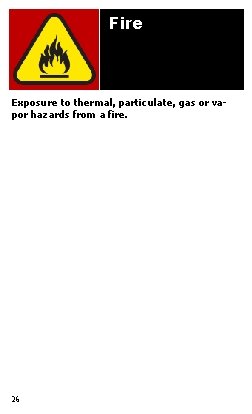
Fire Exposure to thermal, particulate, gas or vapor hazards from a fire. 26
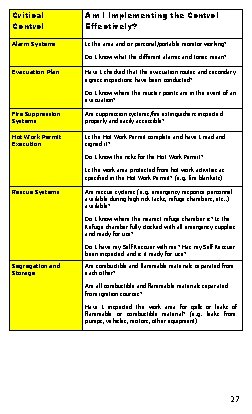
Critical Control Am I Implementing the Control Effectively? Alarm Systems Is the area and or personal/portable monitor working? Do I know what the different alarms and tones mean? Evacuation Plan Have I checked that the evacuation routes and secondary egress inspections have been conducted? Do I know where the muster points are in the event of an evacuation? Fire Suppression Systems Are suppression systems/fire extinguishers inspected properly and easily accessible? Hot Work Permit Execution Is the Hot Work Permit complete and have I read and signed it? Do I know the risks for the Hot Work Permit? Is the work area protected from hot work activities as specified in the Hot Work Permit? (e. g. fire blankets) Rescue Systems Are rescue systems (e. g. emergency response personnel available during high risk tasks, refuge chambers, etc. . ) available? Do I know where the nearest refuge chamber is? Is the Refuge chamber fully stocked with all emergency supplies and ready for use? Do I have my Self Rescuer with me? Has my Self Rescuer been inspected and is it ready for use? Segregation and Storage Are combustible and flammable materials separated from each other? Are all combustible and flammable materials separated from ignition sources? Have I inspected the work area for spills or leaks of flammable or combustible material? (e. g. leaks from pumps, vehicles, motors, other equipment) 27
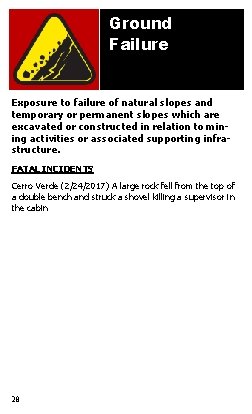
Ground Failure Exposure to failure of natural slopes and temporary or permanent slopes which are excavated or constructed in relation to mining activities or associated supporting infrastructure. FATAL INCIDENTS Cerro Verde (2/24/2017) A large rock fell from the top of a double bench and struck a shovel killing a supervisor in the cabin 28
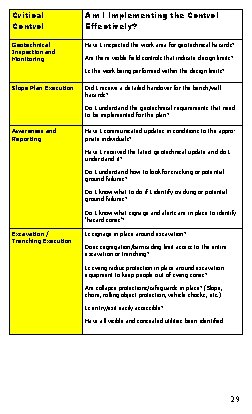
Critical Control Am I Implementing the Control Effectively? Geotechnical Inspection and Monitoring Have I inspected the work area for geotechnical hazards? Are there visible field controls that indicate design limits? Is the work being performed within the design limits? Slope Plan Execution Did I receive a detailed handover for the bench/wall hazards? Do I understand the geotechnical requirements that need to be implemented for the plan? Awareness and Reporting Have I communicated updates in conditions to the appropriate individuals? Have I received the latest geotechnical update and do I understand it? Do I understand how to look for cracking or potential ground failures? Do I know what to do if I identify cracking or potential ground failures? Do I know what signage and alerts are in place to identify 'hazard zones'? Excavation / Trenching Execution Is signage in place around excavation? Does segregation/barricading limit access to the entire excavation or trenching? Is swing radius protection in place around excavation equipment to keep people out of swing zones? Are collapse protections/safeguards in place? (Slope, shore, rolling object protection, vehicle chocks, etc. ) Is entry/exit easily accessible? Have all visible and concealed utilities been identified 29
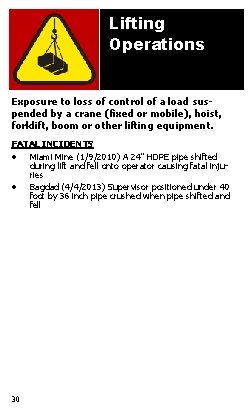
Lifting Operations Exposure to loss of control of a load suspended by a crane (fixed or mobile), hoist, forklift, boom or other lifting equipment. FATAL INCIDENTS Miami Mine (1/9/2010) A 24" HDPE pipe shifted during lift and fell onto operator causing fatal injuries Bagdad (4/4/2013) Supervisor positioned under 40 foot by 36 inch pipe crushed when pipe shifted and fell 30
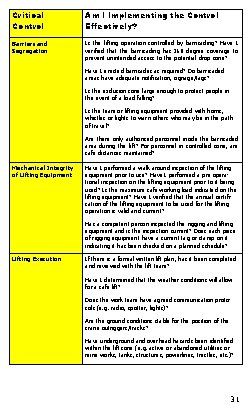
Critical Control Am I Implementing the Control Effectively? Barriers and Segregation Is the lifting operation controlled by barricading? Have I verified that the barricading has 360 degree coverage to prevent unintended access to the potential drop zone? Have I erected barricades as required? Do barricaded areas have adequate notification, signage/tags? Is the exclusion zone large enough to protect people in the event of a load falling? Is the team or lifting equipment provided with horns, whistles or lights to warn others who may be in the path of travel? Are there only authorized personnel inside the barricaded area during the lift? For personnel in controlled zone, are safe distances maintained? Mechanical Integrity of Lifting Equipment Have I performed a walk around inspection of the lifting equipment prior to use? Have I performed a pre operational inspection on the lifting equipment prior to it being used? Is the maximum safe working load indicated on the lifting equipment? Have I verified that the annual certification of the lifting equipment to be used for the lifting operation is valid and current? Has a competent person inspected the rigging and lifting equipment and is the inspection current? Does each piece of rigging equipment have a current tag or stamp on it indicating it has been checked on a planned schedule? Lifting Execution If there is a formal written lift plan, has it been completed and reviewed with the lift team? Have I determined that the weather conditions will allow for a safe lift? Does the work team have agreed communication protocols (e. g. radio, spotter, lights)? Are the ground conditions stable for the position of the crane outriggers/tracks? Have underground and overhead hazards been identified within the lift zone (e. g. active or abandoned utilities or mine works, tanks, structures, powerlines, trestles, etc. )? 31
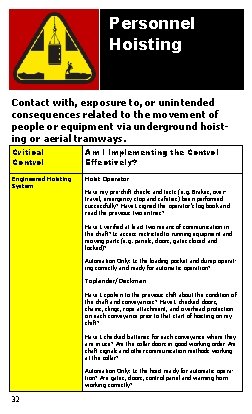
Personnel Hoisting Contact with, exposure to, or unintended consequences related to the movement of people or equipment via underground hoisting or aerial tramways. Critical Control Am I Implementing the Control Effectively? Engineered Hoisting System Hoist Operator Have my pre-shift checks and tests (e. g. Brakes, overtravel, emergency stop and safeties) been performed successfully? Have I signed the operator's log book and read the previous two entries? Have I verified at least two means of communication in the shaft? Is access restricted to running equipment and moving parts (e. g. panels, doors, gates closed and locked)? Automation Only: Is the loading pocket and dump operating correctly and ready for automatic operation? Toplander/Deckman Have I spoken to the previous shift about the condition of the shaft and conveyances? Have I checked doors, chains, slings, rope attachment, and overhead protection on each conveyance prior to that start of hoisting on my shift? Have I checked batteries for each conveyance where they are in use? Are the collar doors in good working order Are shaft signals and other communication methods working at the collar? Automation Only: Is the hoist ready for automatic operation? Are gates, doors, control panel and warning horn working correctly? 32
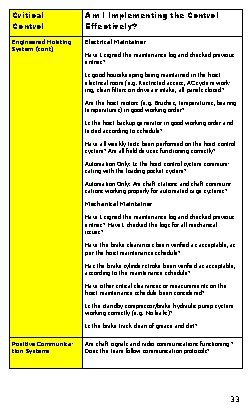
Critical Control Am I Implementing the Control Effectively? Engineered Hoisting System (cont) Electrical Maintainer Have I signed the maintenance log and checked previous entries? Is good housekeeping being maintained in the hoist electrical room (e. g. Restricted access, AC system working, clean filters on drive air intake, all panels closed? Are the hoist motors (e. g. Brushes, temperatures, bearing temperatures) in good working order? Is the hoist backup generator in good working order and tested according to schedule? Have all weekly tests been performed on the hoist control system? Are all field devices functioning correctly? Automation Only: Is the hoist control system communicating with the loading pocket system? Automation Only: Are shaft stations and shaft communications working properly for automated cage systems? Mechanical Maintainer Have I signed the maintenance log and checked previous entries? Have I checked the logs for all mechanical issues? Have the brake clearances been verified as acceptable, as per the hoist maintenance schedule? Has the brake cylinder stroke been verified as acceptable, according to the maintenance schedule? Have other critical clearances or measurements on the hoist maintenance schedule been considered? Is the standby compressor/brake hydraulic pump system working correctly (e. g. No leaks)? Is the brake track clean of grease and dirt? Positive Communication Systems Are shaft signals and radio communications functioning ? Does the team follow communication protocols? 33
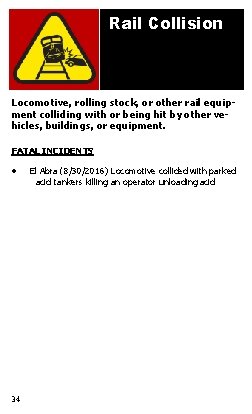
Rail Collision Locomotive, rolling stock, or other rail equipment colliding with or being hit by other vehicles, buildings, or equipment. FATAL INCIDENTS 34 El Abra (8/30/2016) Locomotive collided with parked acid tankers killing an operator unloading acid
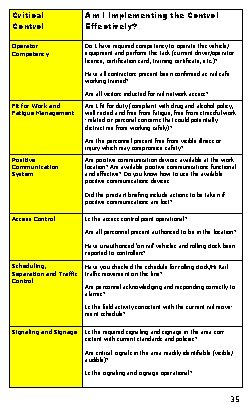
Critical Control Am I Implementing the Control Effectively? Operator Competency Do I have required competency to operate this vehicle/ equipment and perform this task (current driver/operator license, certification card, training certificate, etc. )? Have all contractors present been confirmed as rail safe working trained? Are all visitors inducted for rail network access? Fit for Work and Fatigue Management Am I fit for duty (compliant with drug and alcohol policy, well rested and free from fatigue, free from stressful work -related or personal concerns that could potentially distract me from working safely)? Are the personnel present free from visible illness or injury which may compromise safety? Positive Communication System Are positive communication devices available at the work location? Are available positive communications functional and effective? Do you know how to use the available positive communications devices Did the prestart briefing include actions to be taken if positive communications are lost? Access Control Is the access control point operational? Are all personnel present authorized to be in the location? Have unauthorized 'on rail' vehicles and rolling stock been reported to controllers? Scheduling, Separation and Traffic Control Have you checked the schedule for rolling stock/Hi Rail traffic movement on this line? Are personnel acknowledging and responding correctly to alarms? Is the field activity consistent with the current rail movement schedule? Signaling and Signage Is the required signaling and signage in the area consistent with current standards and policies? Are critical signals in the area readily identifiable (visible/ audible)? Is the signaling and signage operational? 35
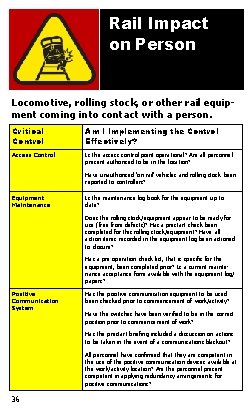
Rail Impact on Person Locomotive, rolling stock, or other rail equipment coming into contact with a person. Critical Control Am I Implementing the Control Effectively? Access Control Is the access control point operational? Are all personnel present authorized to be in the location? Have unauthorized 'on rail' vehicles and rolling stock been reported to controllers? Equipment Maintenance Is the maintenance log book for the equipment up to date? Does the rolling stock/equipment appear to be ready for use (free from defects)? Has a prestart check been completed for this rolling stock/equipment? Have all action items recorded in the equipment log been actioned to closure? Has a pre operation check list, that is specific for the equipment, been completed prior? Is a current maintenance acceptance form available with the equipment log/ papers? Positive Communication System Has the positive communication equipment to be used been checked prior to commencement of work/activity? Have the switches have been verified to be in the correct position prior to commencement of work? Has the prestart briefing included a discussion on actions to be taken in the event of a communications blackout? All personnel have confirmed that they are competent in the use of the positive communication devices available at the work/activity location? Are the personnel present competent in applying redundancy arrangements for positive communications? 36
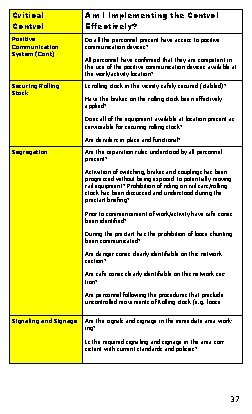
Critical Control Am I Implementing the Control Effectively? Positive Communication System (Cont) Do all the personnel present have access to positive communication devices? Securing Rolling Stock Is rolling stock in the vicinity safely secured (stabled)? All personnel have confirmed that they are competent in the use of the positive communication devices available at the work/activity location? Have the brakes on the rolling stock been effectively applied? Does all of the equipment available at location present as serviceable for securing rolling stock? Are derailers in place and functional? Segregation Are the separation rules understood by all personnel present? Activation of switching, brakes and couplings has been progressed without being exposed to potentially moving rail equipment? Prohibition of riding on rail cars/rolling stock has been discussed and understood during the prestart briefing? Prior to commencement of work/activity have safe zones been identified? During the prestart has the prohibition of loose shunting been communicated? Are danger zones clearly identifiable on this network section? Are safe zones clearly identifiable on this network section? Are personnel following the procedures that preclude uncontrolled movements of Rolling stock (e. g. loose Signaling and Signage Are the signals and signage in the immediate area working? Is the required signaling and signage in the area consistent with current standards and policies? 37
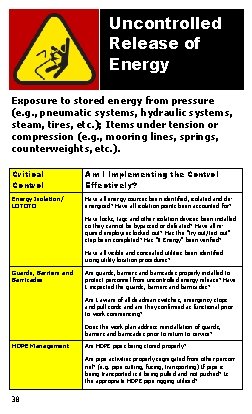
Uncontrolled Release of Energy Exposure to stored energy from pressure (e. g. , pneumatic systems, hydraulic systems, steam, tires, etc. ); Items under tension or compression (e. g. , mooring lines, springs, counterweights, etc. ). Critical Control Am I Implementing the Control Effectively? Energy Isolation/ LOTOTO Have all energy sources been identified, isolated and deenergized? Have all isolation points been accounted for? Have locks, tags and other isolation devices been installed so they cannot be bypassed or defeated? Have all required employees locked out? Has the "try out/test out" step been completed? Has "0 Energy" been verified? Have all visible and concealed utilities been identified using utility location procedures? Guards, Barriers and Barricades Are guards, barriers and barricades properly installed to protect personnel from uncontrolled energy release? Have I inspected the guards, barriers and barricades? Am I aware of all deadman switches, emergency stops and pull cords and are they confirmed as functional prior to work commencing? Does the work plan address reinstallation of guards, barriers and barricades prior to return to service? HDPE Management Are HDPE pipes being stored properly? Are pipe activities properly segregated from other personnel? (e. g. pipe cutting, fusing, transporting) If pipe is being transported is it being pulled and not pushed? Is the appropriate HDPE pipe rigging utilized? 38
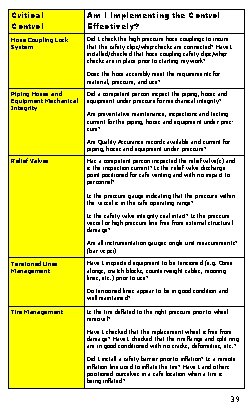
Critical Control Am I Implementing the Control Effectively? Hose Coupling Lock System Did I check the high pressure hose couplings to insure that the safety clips/whip-checks are connected? Have I installed/checked that hose coupling safety clips/whipchecks are in place prior to starting my work? Does the hose assembly meet the requirements for material, pressure, and use? Piping Hoses and Equipment Mechanical Integrity Did a competent person inspect the piping, hoses and equipment under pressure for mechanical integrity? Are preventative maintenance, inspections and testing current for the piping, hoses and equipment under pressure? Are Quality Assurance records available and current for piping, hoses and equipment under pressure? Relief Valves Has a competent person inspected the relief valve(s) and is the inspection current? Is the relief valve discharge point positioned for safe venting and with no impact to personnel? Is the pressure gauge indicating that the pressure within the vessel is in the safe operating range? Is the safety valve integrity seal intact? Is the pressure vessel or high pressure line free from external structural damage? Are all instrumentation gauges single unit measurements? (bar vs psi) Tensioned Lines Management Have I inspected equipment to be tensioned (e. g. Come alongs, snatch blocks, counterweight cables, mooring lines, etc. ) prior to use? Do tensioned lines appear to be in good condition and well maintained? Tire Management Is the tire deflated to the right pressure prior to wheel removal? Have I checked that the replacement wheel is free from damage? Have I checked that the rim flange and split ring are in good conditioned with no cracks, deformities, etc. ? Did I install a safety barrier prior to inflation? Is a remote inflation line used to inflate the tire? Have I and others positioned ourselves in a safe location when a tire is being inflated? 39
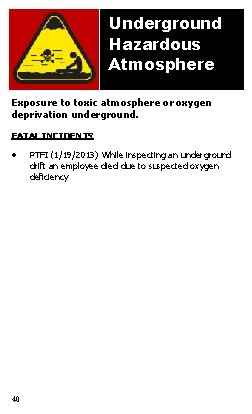
Underground Hazardous Atmosphere Exposure to toxic atmosphere or oxygen deprivation underground. FATAL INCIDENTS 40 PTFI (1/19/2013) While inspecting an underground drift an employee died due to suspected oxygen deficiency
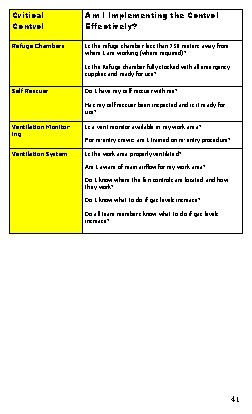
Critical Control Am I Implementing the Control Effectively? Refuge Chambers Is the refuge chamber less than 750 meters away from where I am working (where required)? Is the Refuge chamber fully stocked with all emergency supplies and ready for use? Self Rescuer Do I have my self rescuer with me? Has my self rescuer been inspected and is it ready for use? Ventilation Monitoring Is a vent monitor available in my work area? Ventilation System Is the work area properly ventilated? For re-entry crews: am I trained on re-entry procedure? Am I aware of main airflow for my work area? Do I know where the fan controls are located and how they work? Do I know what to do if gas levels increase? Do all team members know what to do if gas levels increase? 41
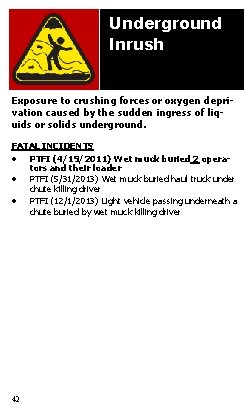
Underground Inrush Exposure to crushing forces or oxygen deprivation caused by the sudden ingress of liquids or solids underground. FATAL INCIDENTS PTFI (4/19/2011) Wet muck buried 2 operators and their loader PTFI (5/31/2013) Wet muck buried haul truck under chute killing driver PTFI (12/1/2013) Light vehicle passing underneath a chute buried by wet muck killing driver 42
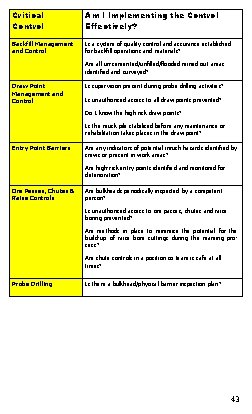
Critical Control Am I Implementing the Control Effectively? Backfill Management and Control Is a system of quality control and assurance established for backfill operations and materials? Are all un-cemented/unfilled/flooded mined out areas identified and surveyed? Draw Point Management and Control Is supervision present during probe drilling activities? Is unauthorized access to all draw points prevented? Do I know the high risk draw points? Is the muck pile stabilized before any maintenance or rehabilitation takes places in the draw point? Entry Point Barriers Are any indicators of potential inrush hazards identified by crews or present in work areas? Are high-risk entry points identified and monitored for deterioration? Ore Passes, Chutes & Raise Controls Are bulkheads periodically inspected by a competent person? Is unauthorized access to ore passes, chutes and raise boring prevented? Are methods in place to minimize the potential for the build-up of raise bore cuttings during the reaming process? Are chute controls in a position so team is safe at all times? Probe Drilling Is there a bulkhead/physical barrier inspection plan? 43
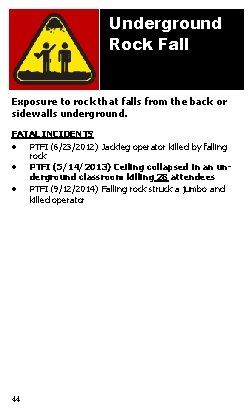
Underground Rock Fall Exposure to rock that falls from the back or sidewalls underground. FATAL INCIDENTS PTFI (6/23/2012) Jackleg operator killed by falling rock PTFI (5/14/2013) Ceiling collapsed in an underground classroom killing 28 attendees PTFI (9/12/2014) Falling rock struck a jumbo and killed operator 44
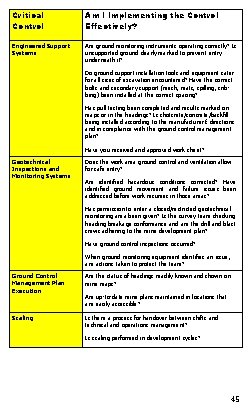
Critical Control Am I Implementing the Control Effectively? Engineered Support Systems Are ground monitoring instruments operating correctly? Is unsupported ground clearly marked to prevent entry underneath it? Do ground support installation tools and equipment cater for all sizes of excavation encountered? Have the correct bolts and secondary support (mesh, mats, spilling, cribbing) been installed at the correct spacing? Has pull testing been completed and results marked on maps or in the headings? Is shotcrete/concrete/backfill being installed according to the manufacturer’s directions and in compliance with the ground control management plan? Have you received and approved work sheet? Geotechnical Inspections and Monitoring Systems Does the work area ground control and ventilation allow for safe entry? Are identified hazardous conditions corrected? Have identified ground movement and failure issues been addressed before work resumes in those areas? Has permission to enter a closed/restricted geotechnical monitoring area been given? Is the survey team checking heading breakage conformance and are the drill and blast crews adhering to the mine development plan? Have ground control inspections occurred? When ground monitoring equipment identifies an issue, are actions taken to protect the team? Ground Control Management Plan Execution Are the status of headings readily known and shown on mine maps? Scaling Is there a process for handover between shifts and technical and operations management? Are up-to-date mine plans maintained in locations that are easily accessible? Is scaling performed in development cycles? 45
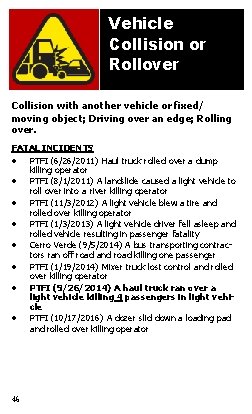
Vehicle Collision or Rollover Collision with another vehicle or fixed/ moving object; Driving over an edge; Rolling over. FATAL INCIDENTS PTFI (6/26/2011) Haul truck rolled over a dump killing operator PTFI (8/1/2011) A landslide caused a light vehicle to roll over into a river killing operator PTFI (11/3/2012) A light vehicle blew a tire and rolled over killing operator PTFI (1/3/2013) A light vehicle driver fell asleep and rolled vehicle resulting in passenger fatality Cerro Verde (9/5/2014) A bus transporting contractors ran off road and road killing one passenger PTFI (1/19/2014) Mixer truck lost control and rolled over killing operator PTFI (9/26/2014) A haul truck ran over a light vehicle killing 4 passengers in light vehicle PTFI (10/17/2016) A dozer slid down a loading pad and rolled over killing operator 46
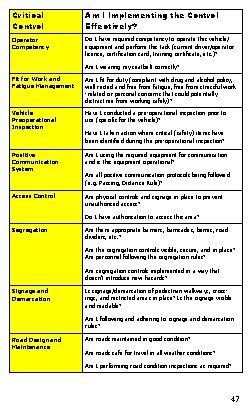
Critical Control Am I Implementing the Control Effectively? Operator Competency Do I have required competency to operate this vehicle/ equipment and perform this task (current driver/operator license, certification card, training certificate, etc. )? Am I wearing my seatbelt correctly? Fit for Work and Fatigue Management Am I fit for duty (compliant with drug and alcohol policy, well rested and free from fatigue, free from stressful work -related or personal concerns that could potentially distract me from working safely)? Vehicle Preoperational Inspection Have I conducted a pre-operational inspection prior to use (specific for the vehicle)? Positive Communication System Am I using the required equipment for communication and is this equipment operational? Access Control Are physical controls and signage in place to prevent unauthorized access? Have I taken action where critical (safety) items have been identified during the pre-operational inspection? Are all positive communication protocols being followed (e. g. Passing, Distance Rule)? Do I have authorization to access this area? Segregation Are there appropriate barriers, barricades, berms, road dividers, etc. ? Are the segregation controls visible, secure, and in place? Are personnel following the segregation rules? Are segregation controls implemented in a way that doesn't introduce new hazards? Signage and Demarcation Is signage/demarcation of pedestrian walkways, crossings, and restricted areas in place? Is the signage visible and readable? Am I following and adhering to signage and demarcation rules? Road Design and Maintenance Are roads maintained in good condition? Are roads safe for travel in all weather conditions? Am I performing road condition inspections as required? 47
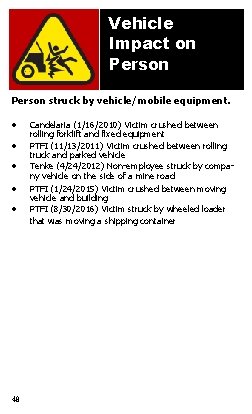
Vehicle Impact on Person struck by vehicle/mobile equipment. 48 Candelaria (1/16/2010) Victim crushed between rolling forklift and fixed equipment PTFI (11/13/2011) Victim crushed between rolling truck and parked vehicle Tenke (4/24/2012) Non-employee struck by company vehicle on the side of a mine road PTFI (1/24/2015) Victim crushed between moving vehicle and building PTFI (8/30/2016) Victim struck by wheeled loader that was moving a shipping container
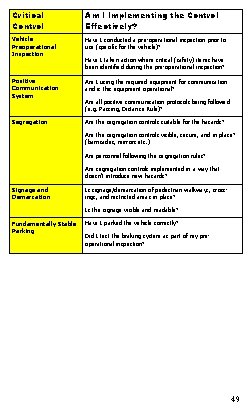
Critical Control Am I Implementing the Control Effectively? Vehicle Preoperational Inspection Have I conducted a pre-operational inspection prior to use (specific for the vehicle)? Positive Communication System Am I using the required equipment for communication and is this equipment operational? Segregation Are the segregation controls suitable for the hazards? Have I taken action where critical (safety) items have been identified during the pre-operational inspection? Are all positive communication protocols being followed (e. g. Passing, Distance Rule)? Are the segregation controls visible, secure, and in place? (barricades, mirrors etc. ) Are personnel following the segregation rules? Are segregation controls implemented in a way that doesn't introduce new hazards? Signage and Demarcation Is signage/demarcation of pedestrian walkways, crossings, and restricted areas in place? Is the signage visible and readable? Fundamentally Stable Parking Have I parked the vehicle correctly? Did I test the braking system as part of my preoperational inspection? 49
Notes
Notes
Aircraft Operation Ground Failure Blasting Lifting Operations Confined Space Personnel Hoisting Contact with Electricity Rail Collision Contact with Molten Material Rail Impact on Person Drowning Uncontrolled Release of Energy Entanglement and Crushing Underground Rock Fall Exposure to Hazardous Substances Underground Hazardous Atmosphere Fall from Heights Underground Inrush Falling Objects Vehicle Collision or Rollover Fire Vehicle Impact on Person