
Fasttrack program of elective joint replacement in hip


- Slides: 6
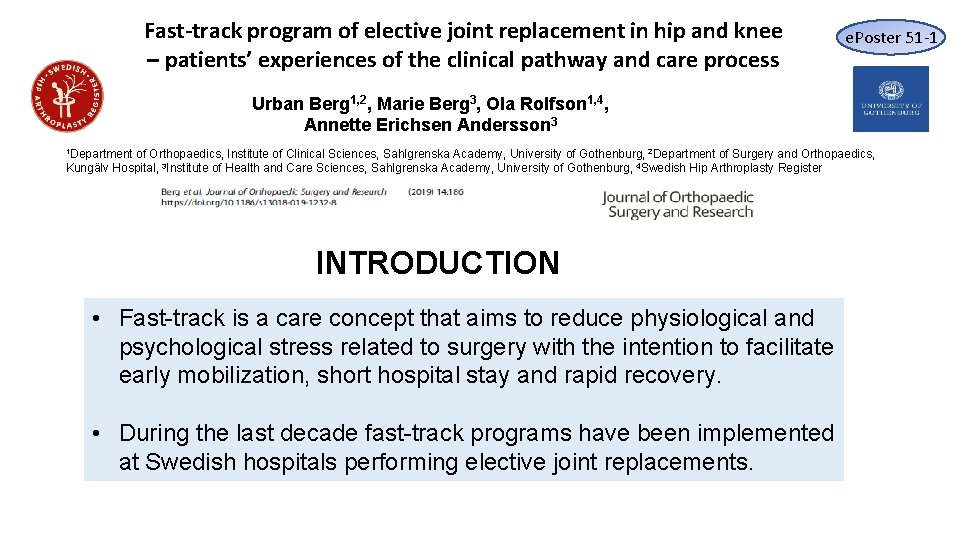
Fast-track program of elective joint replacement in hip and knee – patients’ experiences of the clinical pathway and care process e. Poster 51 -1 Urban Berg 1, 2, Marie Berg 3, Ola Rolfson 1, 4, Annette Erichsen Andersson 3 1 Department of Orthopaedics, Institute of Clinical Sciences, Sahlgrenska Academy, University of Gothenburg, 2 Department of Surgery and Orthopaedics, Kungälv Hospital, 3 Institute of Health and Care Sciences, Sahlgrenska Academy, University of Gothenburg, 4 Swedish Hip Arthroplasty Register INTRODUCTION • Fast-track is a care concept that aims to reduce physiological and psychological stress related to surgery with the intention to facilitate early mobilization, short hospital stay and rapid recovery. • During the last decade fast-track programs have been implemented at Swedish hospitals performing elective joint replacements.
Fast-track program of elective joint replacement in hip and knee – patients’ experiences of the clinical pathway and care process AIM The aim of the study was to explore the patients’ experiences of the clinical pathway and care in a fast-track program of elective total hip and knee replacement (THR/TKR) in order to identify factors that may influence recovery and clinical outcome. e. Poster 51 -2
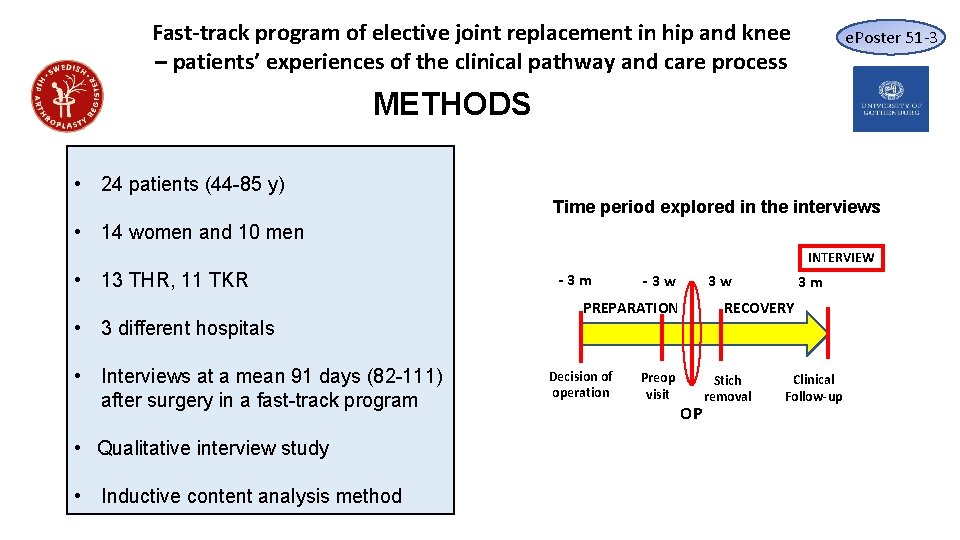
Fast-track program of elective joint replacement in hip and knee – patients’ experiences of the clinical pathway and care process e. Poster 51 -3 METHODS • 24 patients (44 -85 y) Time period explored in the interviews • 14 women and 10 men INTERVIEW • 13 THR, 11 TKR • 3 different hospitals • Interviews at a mean 91 days (82 -111) after surgery in a fast-track program • Qualitative interview study • Inductive content analysis method - 3 m 3 w - 3 w PREPARATION Decision of operation Preop visit 3 m RECOVERY OP Stich removal Clinical Follow-up
Fast-track program of elective joint replacement in hip and knee – patients’ experiences of the clinical pathway and care process e. Poster 51 -4 RESULTS CLINICAL PATHWAY GENERIC CATEGORIES Phase 1: Preparation - from surgery decision until hospital admission 1. 1 Confirmation that surgery is needed 1. 2 Planning the date of surgery 1. 3 Planning the anesthesia 1. 4 Information about care and outcome of surgery Phase 2: Hospital stay for 2. 1 Admission on the day of surgery 2. 2 Early mobilization after surgery 2. 3 Early discharge Phase 3: Recovery - after discharge from hospital 3. 1 Managing daily life 3. 2 Rehab program and recovery 3. 3 Feedback and follow-up SUBCATEGORIES 1. 1. 1 Fear of not being accepted for surgery 1. 1. 2 Satisfaction when decision was made 1. 1. 3 Importance of shared decision-making 1. 2. 1 Frustration when not knowing the date, and satisfaction when knowing it 1. 2. 2 Desire to influence the timing of surgery 1. 2. 3 Fear that the operation may be canceled 1. 3. 1 Fear of being awake and having unpleasant experiences during surgery 1. 3. 2 Fear of complications of spinal anesthesia 1. 3. 3 Importance of shared decision-making 1. 4. 1 Diversity in information needs 1. 4. 2 Scanty information about the recovery 1. 4. 3 Influenced by information from other sources 2. 1. 1 Recognition and a feeling of familiarity 2. 1. 2 Affirmation and seen by the staff 2. 2. 1 Mentally prepared and safe to be mobilized 2. 2. 2 Hesitation but ready to cooperate 2. 3. 1 Acceptance and satisfaction 2. 3. 2 Objections and worries 3. 1. 1 Safety when having support at home 3. 1. 2 Diversity in pain control 3. 2. 1 Different needs for personal coaching 3. 2. 2 Uncertainty about progress 3. 3. 1 Concerns about unfulfilled expectations 3. 3. 2 Need for further explanations from the surgeon
Fast-track program of elective joint replacement in hip and knee – patients’ experiences of the clinical pathway and care process DISCUSSION KEY POINTS: • Great diversity in needs for information and patient involvement • Recovery phase filled with uncertainty about progress and questions about unfulfilled expectations • The need for feedback and follow-up after hospital discharge not met e. Poster 51 -5
Fast-track program of elective joint replacement in hip and knee – patients’ experiences of the clinical pathway and care process CONCLUSION • More focus on the period after hospital discharge may improve recovery, patient satisfaction and functional outcome • Person-centred approach from decisionmaking until recovery may be an important element in optimizing the care e. Poster 51 -6