
Fasthandoff Mechanisms for Wireless Internet Presenter Ashutosh Dutta
![Pre-authorization CN DATA[CN<->A(X)] MN-CA key AA CA Subnet X AR Subnet Y pre-authorization MN](https://slidetodoc.com/presentation_image_h2/943dd082b066a4bdf1454df17c8330e0/image-42.jpg "Pre-authorization CN DATA[CN<->A(X)] MN-CA key AA CA Subnet X AR Subnet Y pre-authorization MN")
![Proactive Handover: Initial Phase CN DATA[CN<->A(X)] MN-AR key AA CA Subnet X AR Subnet](https://slidetodoc.com/presentation_image_h2/943dd082b066a4bdf1454df17c8330e0/image-43.jpg "Proactive Handover: Initial Phase CN DATA[CN<->A(X)] MN-AR key AA CA Subnet X AR Subnet")
![Proactive Handover: Tunneling Phase CN DATA[CN<->A(X)] MN-AR key AA CA Subnet X AR Re-Invite[CN<->A(Y)]](https://slidetodoc.com/presentation_image_h2/943dd082b066a4bdf1454df17c8330e0/image-44.jpg "Proactive Handover: Tunneling Phase CN DATA[CN<->A(X)] MN-AR key AA CA Subnet X AR Re-Invite[CN<->A(Y)]")
![Proactive Handover: Completion Phase DATA [CN<->A(Y)] over proactive hanover tunnel [AR<->A(X)] AA Subnet X](https://slidetodoc.com/presentation_image_h2/943dd082b066a4bdf1454df17c8330e0/image-45.jpg "Proactive Handover: Completion Phase DATA [CN<->A(Y)] over proactive hanover tunnel [AR<->A(X)] AA Subnet X")
- Slides: 56
Fast-handoff Mechanisms for Wireless Internet Presenter - Ashutosh Dutta 04/12/2005 IRT Group Meeting adutta@research. telcordia. com
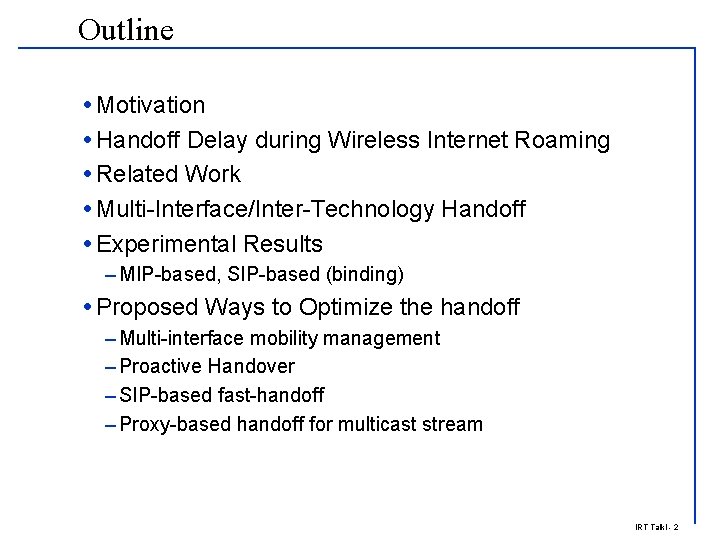
Outline Motivation Handoff Delay during Wireless Internet Roaming Related Work Multi-Interface/Inter-Technology Handoff Experimental Results – MIP-based, SIP-based (binding) Proposed Ways to Optimize the handoff – Multi-interface mobility management – Proactive Handover – SIP-based fast-handoff – Proxy-based handoff for multicast stream IRT Talkl - 2
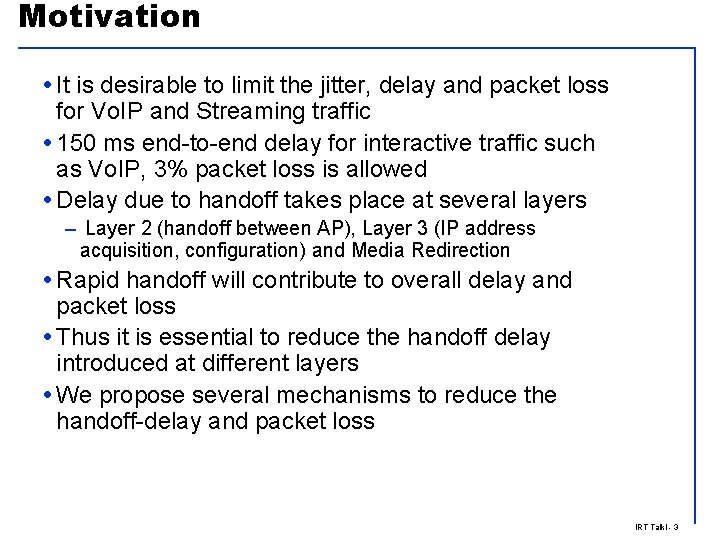
Motivation It is desirable to limit the jitter, delay and packet loss for Vo. IP and Streaming traffic 150 ms end-to-end delay for interactive traffic such as Vo. IP, 3% packet loss is allowed Delay due to handoff takes place at several layers – Layer 2 (handoff between AP), Layer 3 (IP address acquisition, configuration) and Media Redirection Rapid handoff will contribute to overall delay and packet loss Thus it is essential to reduce the handoff delay introduced at different layers We propose several mechanisms to reduce the handoff-delay and packet loss IRT Talkl - 3
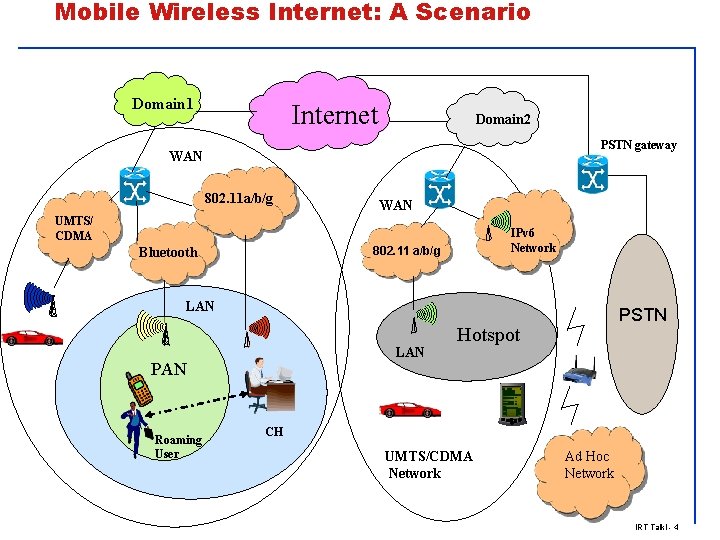
Mobile Wireless Internet: A Scenario Domain 1 Internet Domain 2 PSTN gateway WAN 802. 11 a/b/g WAN UMTS/ CDMA IPv 6 Network 802. 11 a/b/g Bluetooth LAN PAN Roaming User PSTN Hotspot CH UMTS/CDMA Network Ad Hoc Network IRT Talkl - 4
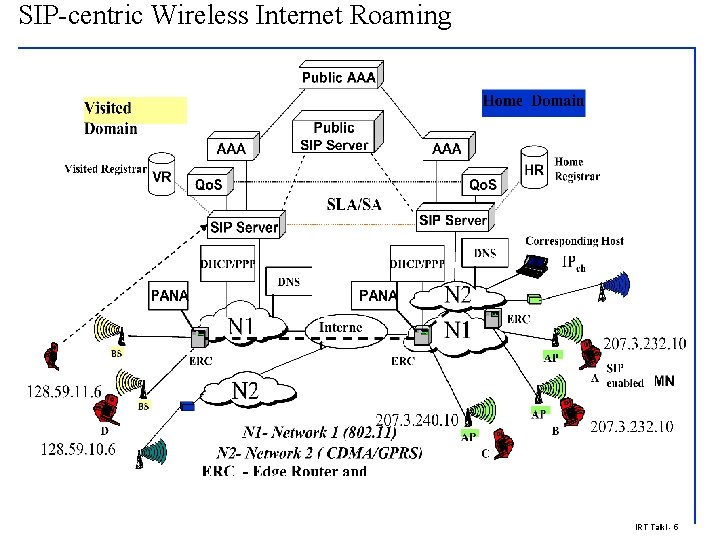
SIP-centric Wireless Internet Roaming IRT Talkl - 5
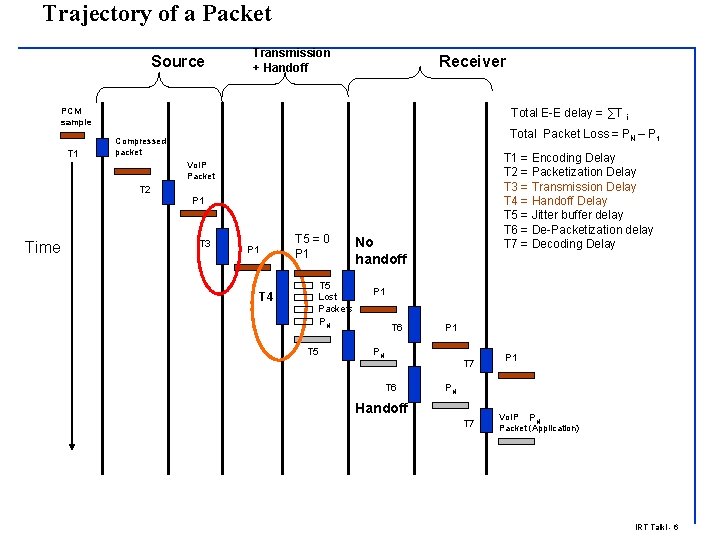
Trajectory of a Packet Source Transmission + Handoff Receiver PCM sample T 1 Total E-E delay = ∑T i Total Packet Loss = PN – P 1 Compressed packet T 1 = Encoding Delay T 2 = Packetization Delay T 3 = Transmission Delay T 4 = Handoff Delay T 5 = Jitter buffer delay T 6 = De-Packetization delay T 7 = Decoding Delay Vo. IP Packet T 2 Time P 1 T 3 P 1 T 4 T 5 = 0 P 1 T 5 Lost Packets PN T 5 No handoff P 1 T 6 P 1 PN T 7 T 6 P 1 PN Handoff T 7 Vo. IP PN Packet (Application) IRT Talkl - 6
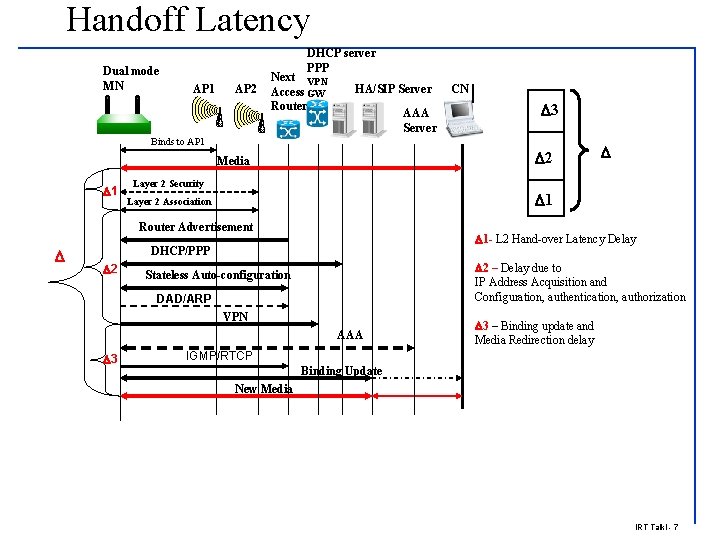
Handoff Latency Dual mode MN DHCP server PPP AP 1 AP 2 Next VPN Access GW Router HA/SIP Server AAA Server Binds to AP 1 Layer 2 Security 1 - L 2 Hand-over Latency Delay DHCP/PPP 2 2 – Delay due to IP Address Acquisition and Configuration, authentication, authorization Stateless Auto-configuration DAD/ARP VPN AAA 3 1 Layer 2 Association Router Advertisement 3 2 Media 1 CN 3 – Binding update and Media Redirection delay IGMP/RTCP Binding Update New Media IRT Talkl - 7
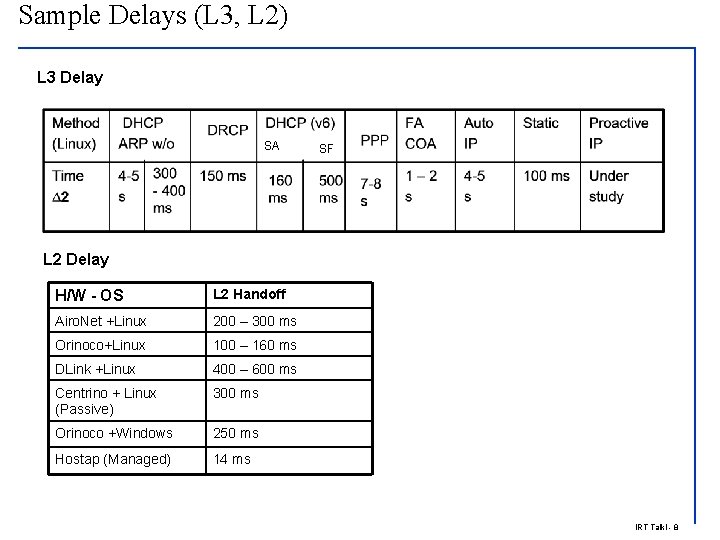
Sample Delays (L 3, L 2) L 3 Delay SA SF L 2 Delay H/W - OS L 2 Handoff Airo. Net +Linux 200 – 300 ms Orinoco+Linux 100 – 160 ms DLink +Linux 400 – 600 ms Centrino + Linux (Passive) 300 ms Orinoco +Windows 250 ms Hostap (Managed) 14 ms IRT Talkl - 8
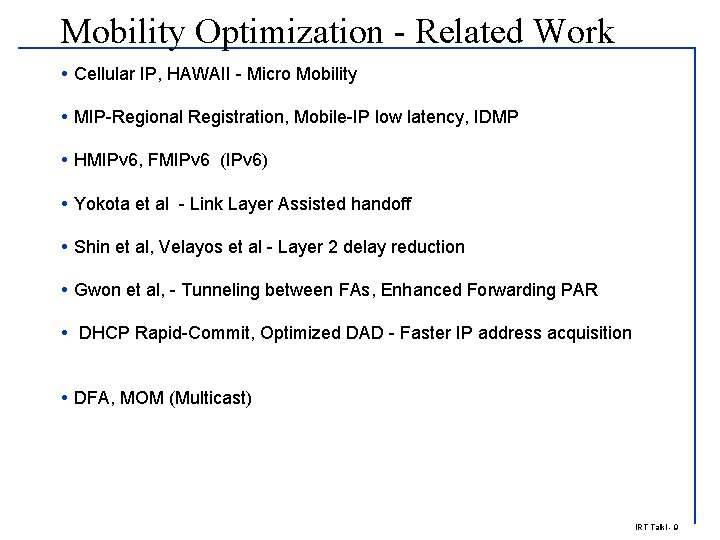
Mobility Optimization - Related Work Cellular IP, HAWAII - Micro Mobility MIP-Regional Registration, Mobile-IP low latency, IDMP HMIPv 6, FMIPv 6 (IPv 6) Yokota et al - Link Layer Assisted handoff Shin et al, Velayos et al - Layer 2 delay reduction Gwon et al, - Tunneling between FAs, Enhanced Forwarding PAR DHCP Rapid-Commit, Optimized DAD - Faster IP address acquisition DFA, MOM (Multicast) IRT Talkl - 9
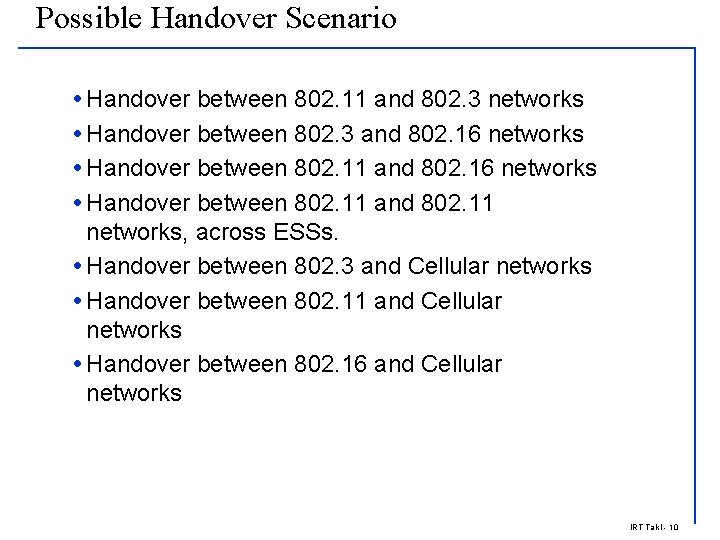
Possible Handover Scenario Handover between 802. 11 and 802. 3 networks Handover between 802. 3 and 802. 16 networks Handover between 802. 11 and 802. 11 networks, across ESSs. Handover between 802. 3 and Cellular networks Handover between 802. 11 and Cellular networks Handover between 802. 16 and Cellular networks IRT Talkl - 10
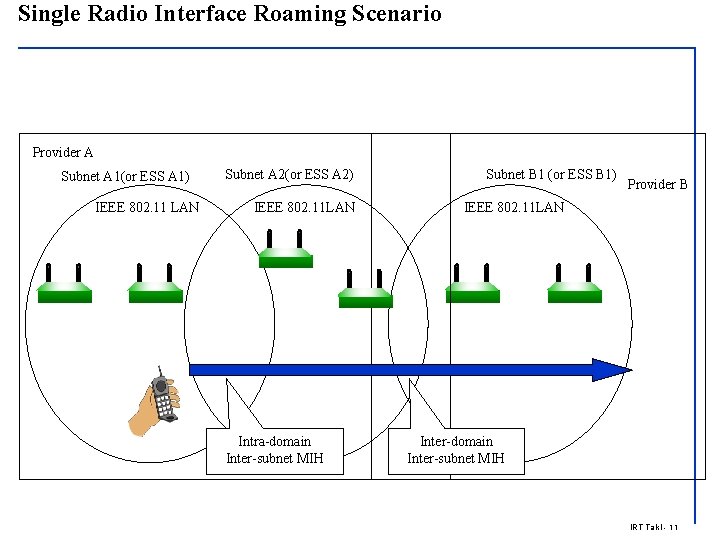
Single Radio Interface Roaming Scenario Provider A Subnet A 1(or ESS A 1) IEEE 802. 11 LAN Subnet A 2(or ESS A 2) IEEE 802. 11 LAN Intra-domain Inter-subnet MIH Subnet B 1 (or ESS B 1) Provider B IEEE 802. 11 LAN Inter-domain Inter-subnet MIH IRT Talkl - 11
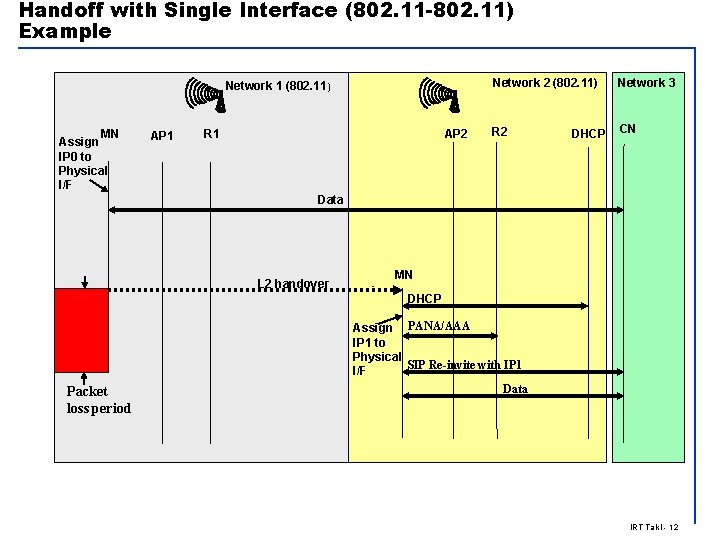
Handoff with Single Interface (802. 11 -802. 11) Example Network 1 (802. 11) MN Assign IP 0 to Physical I/F AP 1 R 1 AP 2 Network 2 (802. 11) Network 3 R 2 CN DHCP Data L 2 handover - MN DHCP Packet loss period Assign PANA/AAA IP 1 to Physical SIP Re-invite with IP 1 I/F Data IRT Talkl - 12
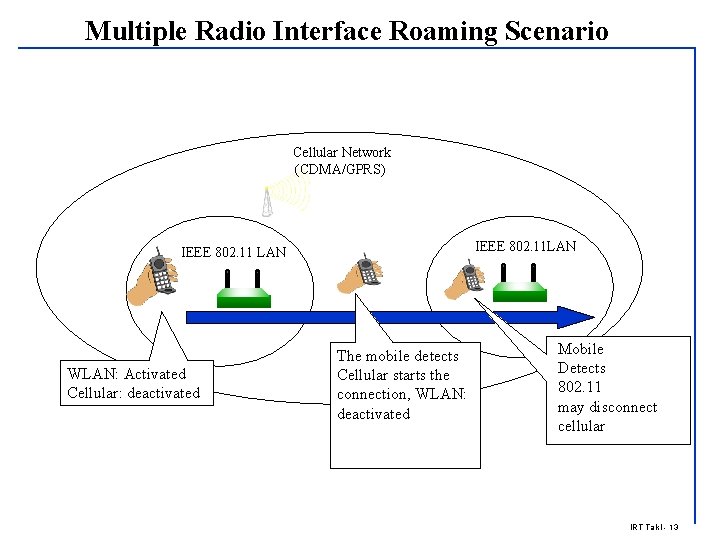
Multiple Radio Interface Roaming Scenario Cellular Network (CDMA/GPRS) IEEE 802. 11 LAN IEEE 802. 11 LAN WLAN: Activated Cellular: deactivated The mobile detects Cellular starts the connection, WLAN: deactivated Mobile Detects 802. 11 may disconnect cellular IRT Talkl - 13
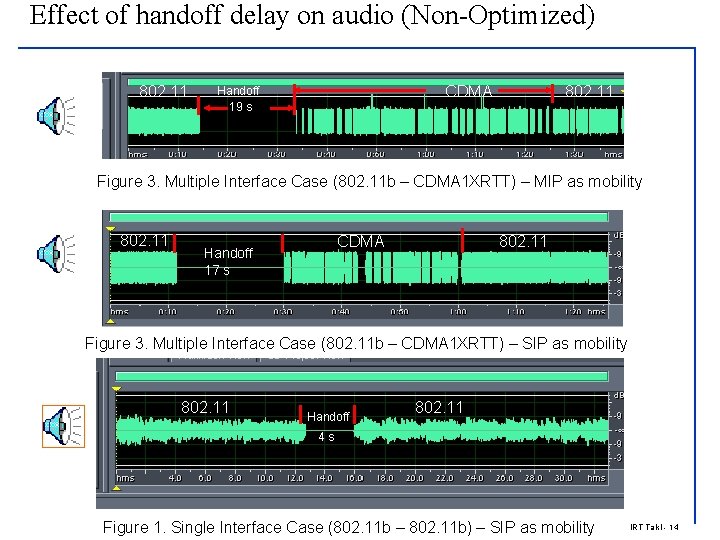
Effect of handoff delay on audio (Non-Optimized) 802. 11 CDMA Handoff 19 s 802. 11 Figure 3. Multiple Interface Case (802. 11 b – CDMA 1 XRTT) – MIP as mobility 802. 11 CDMA Handoff 17 s 802. 11 Figure 3. Multiple Interface Case (802. 11 b – CDMA 1 XRTT) – SIP as mobility 802. 11 Handoff 802. 11 4 s Figure 1. Single Interface Case (802. 11 b – 802. 11 b) – SIP as mobility IRT Talkl - 14
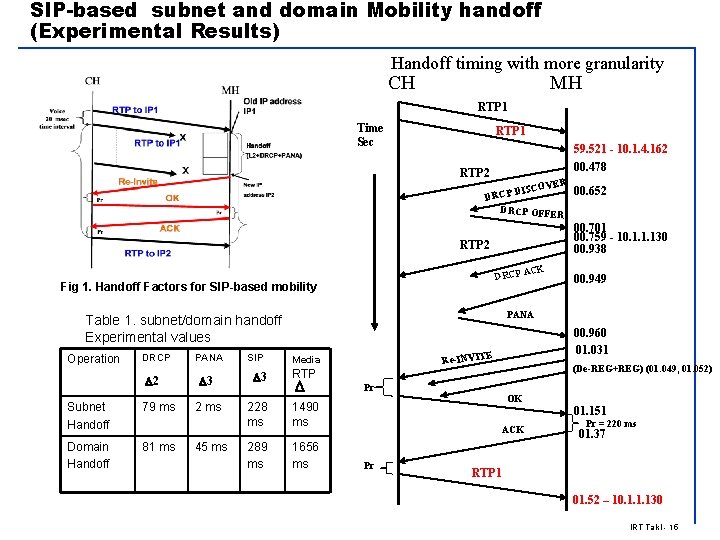
SIP-based subnet and domain Mobility handoff (Experimental Results) Handoff timing with more granularity CH MH RTP 1 Time Sec RTP 1 59. 521 - 10. 1. 4. 162 00. 478 RTP 2 VER DISCO P C R D DRCP OFFER 00. 701 00. 759 - 10. 1. 1. 130 00. 938 RTP 2 CK DRCP A Fig 1. Handoff Factors for SIP-based mobility DRCP 2 Subnet Handoff 79 ms Domain Handoff 81 ms PANA SIP 3 RTP 2 ms 228 ms 1490 ms 289 ms 1656 ms 00. 960 01. 031 E Re-INVIT Media 3 45 ms 00. 949 PANA Table 1. subnet/domain handoff Experimental values Operation 00. 652 Pr (De-REG+REG) (01. 049, 01. 052) OK 01. 151 ACK Pr Pr = 220 ms 01. 37 RTP 1 01. 52 – 10. 1. 1. 130 IRT Talkl - 15
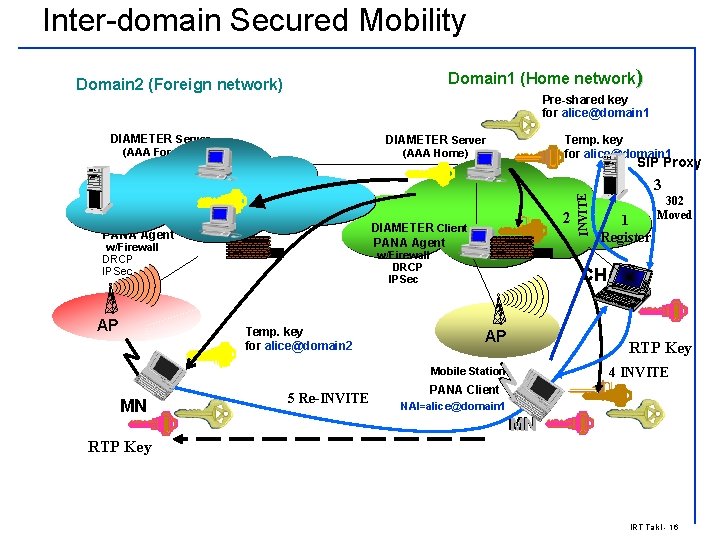
Inter-domain Secured Mobility Domain 1 (Home network) Domain 2 (Foreign network) Pre-shared key for alice@domain 1 Temp. key for alice@domain 1 DIAMETER Server (AAA Foreign) (AAA Home) SIP Proxy DIAMETER Client PANA Agent w/Firewall DRCP IPSec AP 2 DIAMETER Client PANA Agent w/Firewall DRCP IPSec Temp. key for alice@domain 2 MN 3 1 Register 302 Moved CH AP RTP Key 4 INVITE Mobile Station 5 Re-INVITE DIAMETER Server PANA Client NAI=alice@domain 1 MN RTP Key IRT Talkl - 16
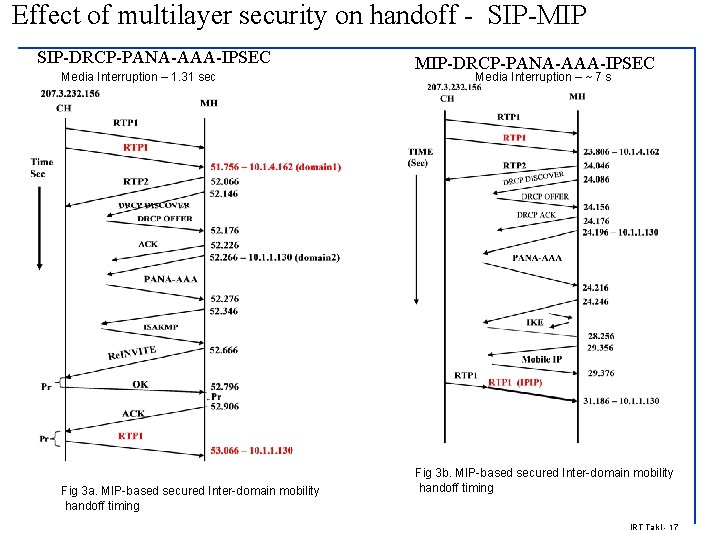
Effect of multilayer security on handoff - SIP-MIP SIP-DRCP-PANA-AAA-IPSEC Media Interruption – 1. 31 sec Fig 3 a. MIP-based secured Inter-domain mobility handoff timing MIP-DRCP-PANA-AAA-IPSEC Media Interruption – ~ 7 s Fig 3 b. MIP-based secured Inter-domain mobility handoff timing IRT Talkl - 17
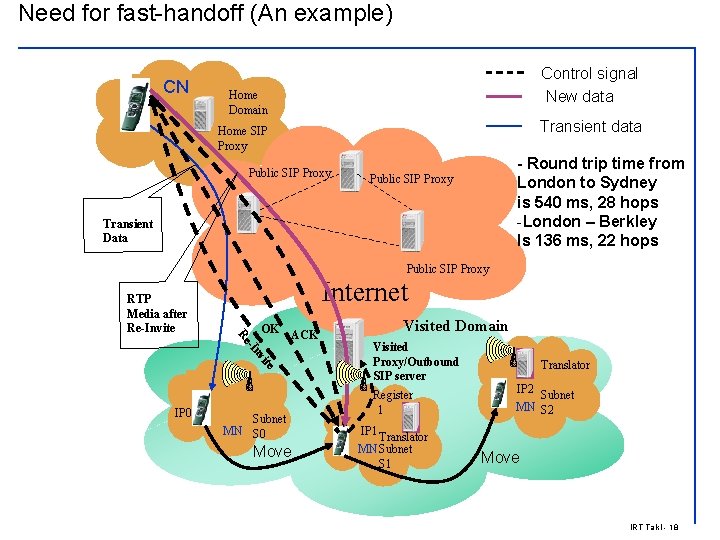
Need for fast-handoff (An example) CN Control signal New data Home Domain Transient data Home SIP Proxy Public SIP Proxy - Round trip time from London to Sydney is 540 ms, 28 hops -London – Berkley Is 136 ms, 22 hops Public SIP Proxy Transient Data Public SIP Proxy Internet OK ACK te vi -In Re RTP Media after Re-Invite IP 0 Subnet MN S 0 Move Visited Domain Visited Proxy/Outbound SIP server Register 1 IP 1 Translator MN Subnet S 1 Translator IP 2 Subnet MN S 2 Move IRT Talkl - 18
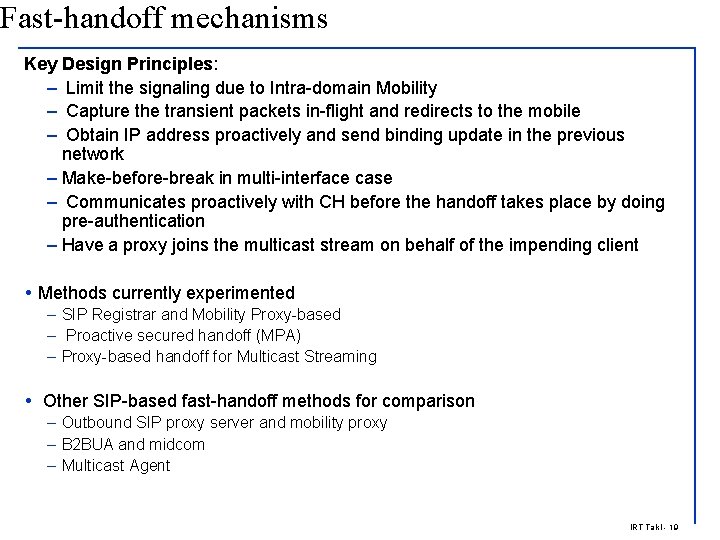
Fast-handoff mechanisms Key Design Principles: – Limit the signaling due to Intra-domain Mobility – Capture the transient packets in-flight and redirects to the mobile – Obtain IP address proactively and send binding update in the previous network – Make-before-break in multi-interface case – Communicates proactively with CH before the handoff takes place by doing pre-authentication – Have a proxy joins the multicast stream on behalf of the impending client Methods currently experimented – SIP Registrar and Mobility Proxy-based – Proactive secured handoff (MPA) – Proxy-based handoff for Multicast Streaming Other SIP-based fast-handoff methods for comparison – Outbound SIP proxy server and mobility proxy – B 2 BUA and midcom – Multicast Agent IRT Talkl - 19
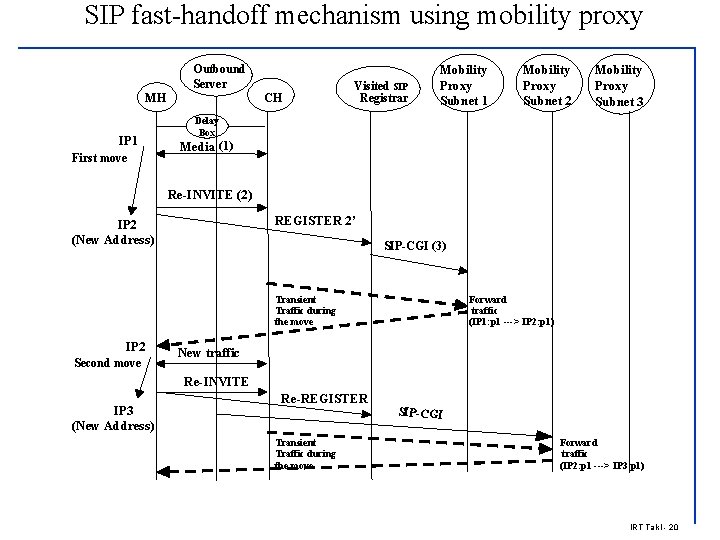
SIP fast-handoff mechanism using mobility proxy Outbound Server CH MH IP 1 First move Visited SIP Registrar Mobility Proxy Subnet 1 Mobility Proxy Subnet 2 Mobility Proxy Subnet 3 Delay Box Media (1) Re-INVITE (2) REGISTER 2’ IP 2 (New Address) SIP-CGI (3) Transient Traffic during the move IP 2 Second move Forward traffic (IP 1: p 1 ---> IP 2: p 1) New traffic Re-INVITE IP 3 (New Address) Re-REGISTER Transient Traffic during the move SIP-CGI Forward traffic (IP 2: p 1 ---> IP 3: p 1) IRT Talkl - 20
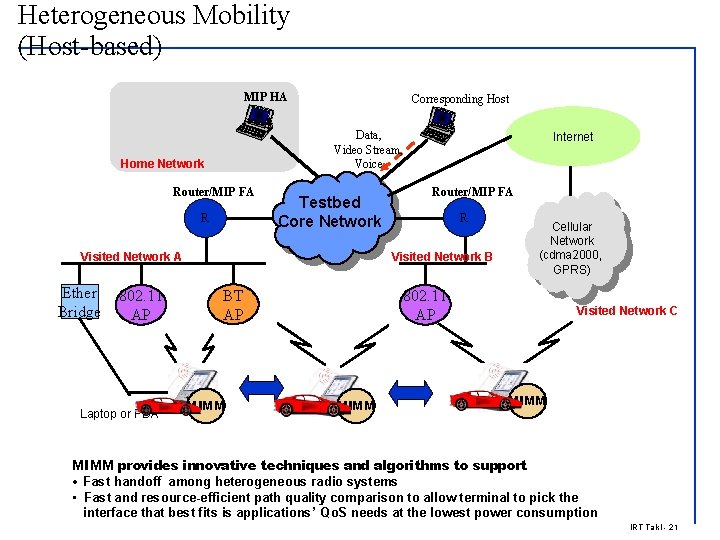
Heterogeneous Mobility (Host-based) MIP HA Corresponding Host Data, Video Stream, Voice Home Network Router/MIP FA R Testbed Core Network Visited Network A Ether Bridge 802. 11 AP Laptop or PDA Internet Router/MIP FA R Visited Network B BT AP MIMM Cellular Network (cdma 2000, GPRS) 802. 11 AP MIMM Visited Network C MIMM provides innovative techniques and algorithms to support • Fast handoff among heterogeneous radio systems • Fast and resource-efficient path quality comparison to allow terminal to pick the interface that best fits is applications’ Qo. S needs at the lowest power consumption IRT Talkl - 21
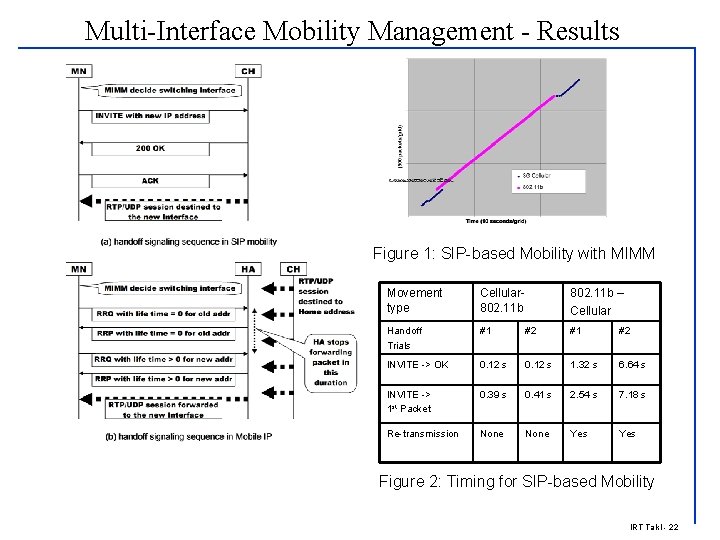
Multi-Interface Mobility Management - Results Figure 1: SIP-based Mobility with MIMM Movement type Cellular 802. 11 b – Cellular Handoff Trials #1 #2 INVITE -> OK 0. 12 s 1. 32 s 6. 64 s INVITE -> 1 st Packet 0. 39 s 0. 41 s 2. 54 s 7. 18 s Re-transmission None Yes Figure 2: Timing for SIP-based Mobility IRT Talkl - 22
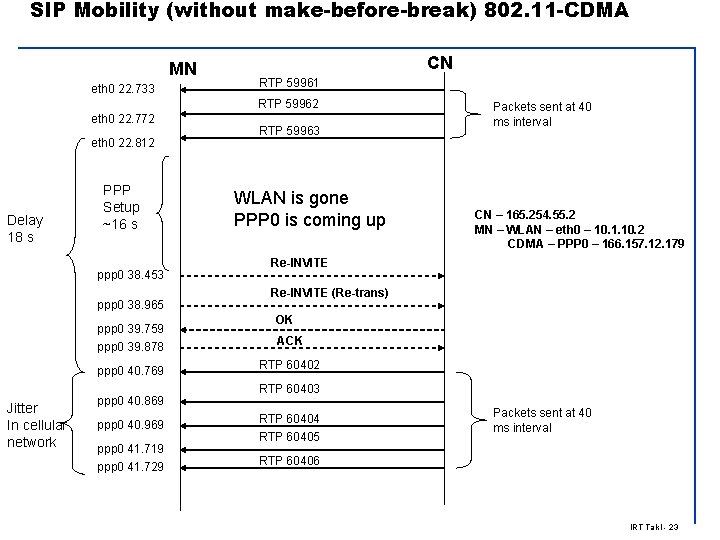
SIP Mobility (without make-before-break) 802. 11 -CDMA MN eth 0 22. 733 CN RTP 59961 RTP 59962 eth 0 22. 772 eth 0 22. 812 Delay 18 s PPP Setup ~16 s ppp 0 38. 453 ppp 0 38. 965 ppp 0 39. 759 ppp 0 39. 878 ppp 0 40. 769 Jitter In cellular network ppp 0 40. 869 ppp 0 40. 969 ppp 0 41. 719 ppp 0 41. 729 RTP 59963 WLAN is gone PPP 0 is coming up Packets sent at 40 ms interval CN – 165. 254. 55. 2 MN – WLAN – eth 0 – 10. 1. 10. 2 CDMA – PPP 0 – 166. 157. 12. 179 Re-INVITE (Re-trans) OK ACK RTP 60402 RTP 60403 RTP 60404 RTP 60405 Packets sent at 40 ms interval RTP 60406 IRT Talkl - 23
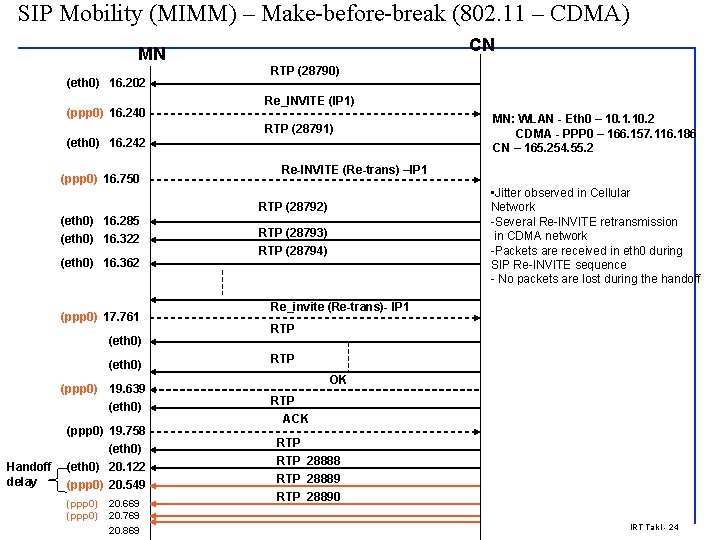
SIP Mobility (MIMM) – Make-before-break (802. 11 – CDMA) CN MN (eth 0) 16. 202 (ppp 0) 16. 240 RTP (28790) Re_INVITE (IP 1) RTP (28791) (eth 0) 16. 242 (ppp 0) 16. 750 Re-INVITE (Re-trans) –IP 1 • Jitter observed in Cellular Network -Several Re-INVITE retransmission in CDMA network -Packets are received in eth 0 during SIP Re-INVITE sequence - No packets are lost during the handoff RTP (28792) (eth 0) 16. 285 (eth 0) 16. 322 (eth 0) 16. 362 (ppp 0) 17. 761 (eth 0) (ppp 0) 19. 639 (eth 0) Handoff delay (ppp 0) 19. 758 (eth 0) 20. 122 (ppp 0) 20. 549 (ppp 0) 20. 669 20. 769 20. 869 MN: WLAN - Eth 0 – 10. 1. 10. 2 CDMA - PPP 0 – 166. 157. 116. 186 CN – 165. 254. 55. 2 RTP (28793) RTP (28794) Re_invite (Re-trans)- IP 1 RTP OK RTP ACK RTP 28888 RTP 28889 RTP 28890 IRT Talkl - 24
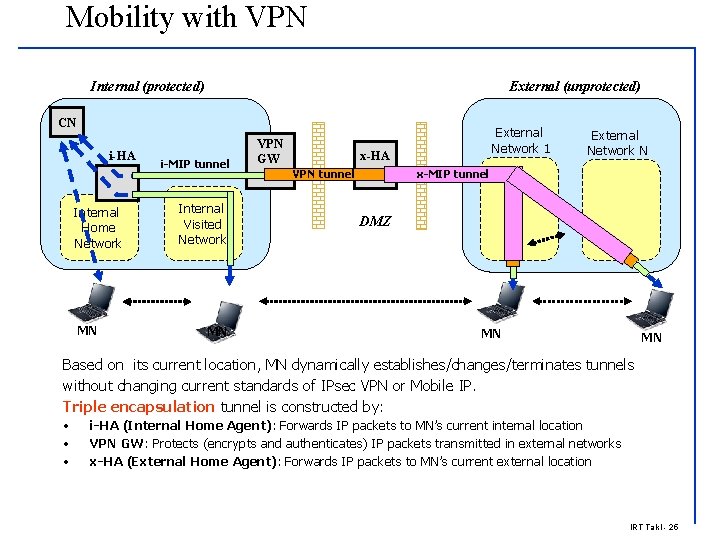
Mobility with VPN Internal (protected) External (unprotected) CN i-HA Internal Home Network MN i-MIP tunnel Internal Visited Network MN VPN GW External Network 1 x-HA VPN tunnel External Network N x-MIP tunnel DMZ MN MN Based on its current location, MN dynamically establishes/changes/terminates tunnels without changing current standards of IPsec VPN or Mobile IP. Triple encapsulation tunnel is constructed by: • • • i-HA (Internal Home Agent): Forwards IP packets to MN’s current internal location VPN GW: Protects (encrypts and authenticates) IP packets transmitted in external networks x-HA (External Home Agent): Forwards IP packets to MN’s current external location IRT Talkl - 25
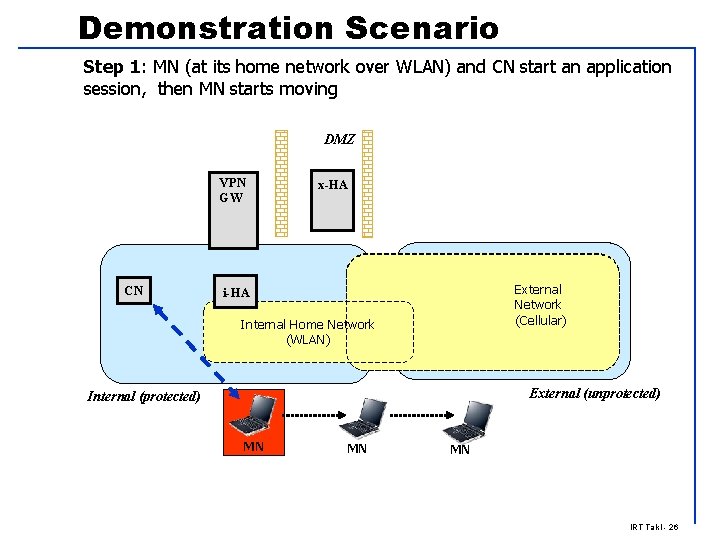
Demonstration Scenario Step 1: MN (at its home network over WLAN) and CN start an application session, then MN starts moving DMZ VPN GW CN x-HA External Network (Cellular) i-HA Internal Home Network (WLAN) External (unprotected) Internal (protected) MN MN MN IRT Talkl - 26
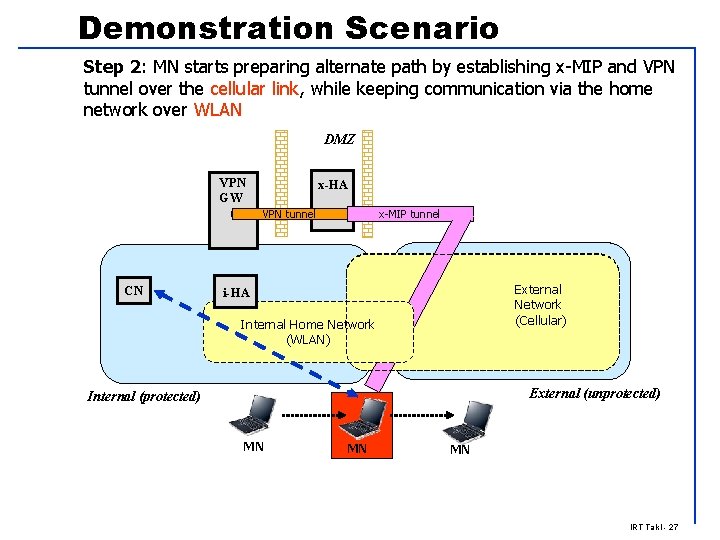
Demonstration Scenario Step 2: MN starts preparing alternate path by establishing x-MIP and VPN tunnel over the cellular link, while keeping communication via the home network over WLAN DMZ VPN GW x-HA VPN tunnel CN x-MIP tunnel External Network (Cellular) i-HA Internal Home Network (WLAN) External (unprotected) Internal (protected) MN MN MN IRT Talkl - 27
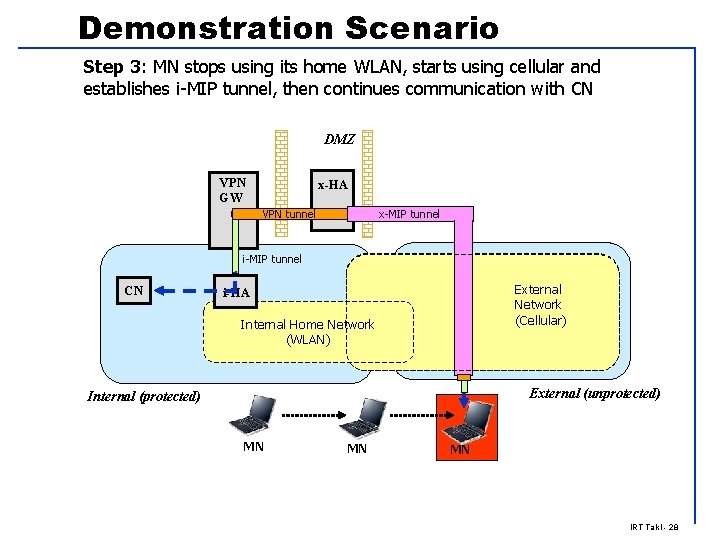
Demonstration Scenario Step 3: MN stops using its home WLAN, starts using cellular and establishes i-MIP tunnel, then continues communication with CN DMZ VPN GW x-HA VPN tunnel x-MIP tunnel i-MIP tunnel CN External Network (Cellular) i-HA Internal Home Network (WLAN) External (unprotected) Internal (protected) MN MN MN IRT Talkl - 28
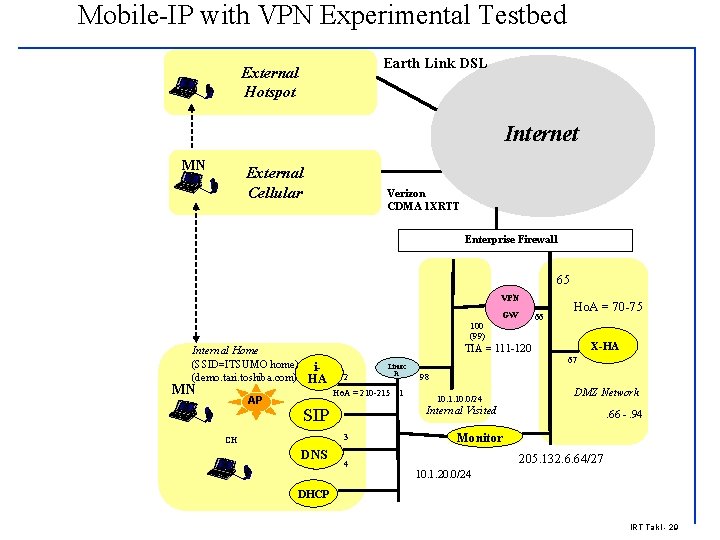
Mobile-IP with VPN Experimental Testbed Earth Link DSL External Hotspot Internet MN External Cellular Verizon CDMA 1 XRTT Enterprise Firewall 65 VPN GW 66 100 (99) Internal Home (SSID=ITSUMO home) i(demo. tari. toshiba. com) HA MN AP 2 Linux R 67 98 10. 1. 10. 0/24 DMZ Network Internal Visited SIP 3 DNS X-HA TIA = 111 -120 Ho. A = 210 -215 1 CH Ho. A = 70 -75 4 . 66 -. 94 Monitor 205. 132. 6. 64/27 10. 1. 20. 0/24 DHCP IRT Talkl - 29
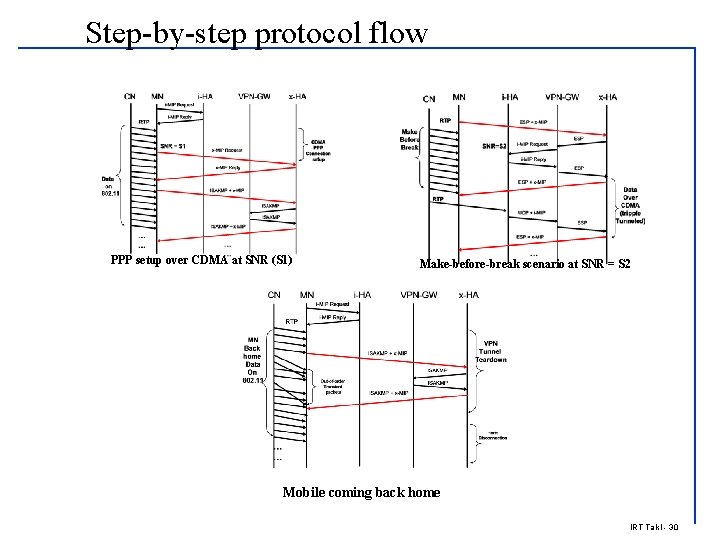
Step-by-step protocol flow PPP setup over CDMA at SNR (S 1) Make-before-break scenario at SNR = S 2 Mobile coming back home IRT Talkl - 30
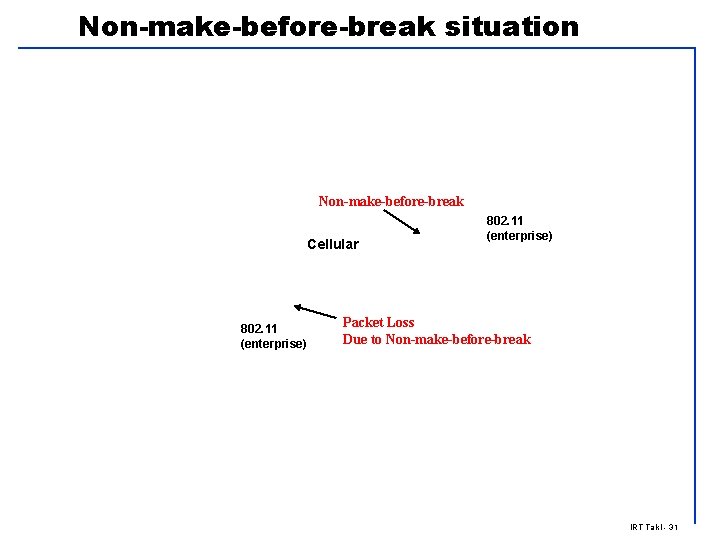
Non-make-before-break situation Non-make-before-break Cellular 802. 11 (enterprise) Packet Loss Due to Non-make-before-break IRT Talkl - 31
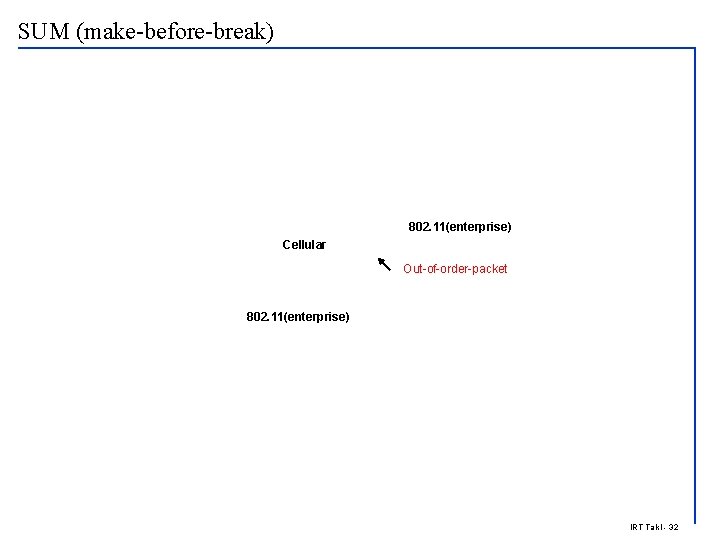
SUM (make-before-break) 802. 11(enterprise) Cellular Out-of-order-packet 802. 11(enterprise) IRT Talkl - 32
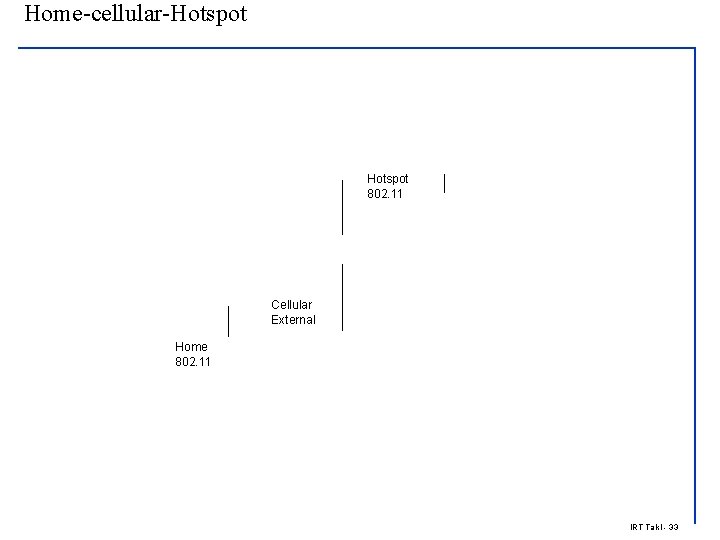
Home-cellular-Hotspot 802. 11 Cellular External Home 802. 11 IRT Talkl - 33
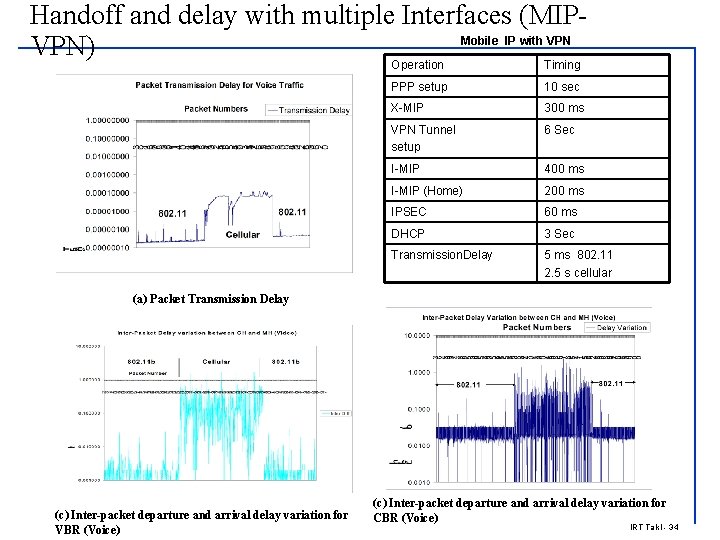
Handoff and delay with multiple Interfaces (MIPMobile IP with VPN) Operation Timing PPP setup 10 sec X-MIP 300 ms VPN Tunnel setup 6 Sec I-MIP 400 ms I-MIP (Home) 200 ms IPSEC 60 ms DHCP 3 Sec Transmission. Delay 5 ms 802. 11 2. 5 s cellular (a) Packet Transmission Delay (c) Inter-packet departure and arrival delay variation for VBR (Voice) (c) Inter-packet departure and arrival delay variation for CBR (Voice) IRT Talkl - 34
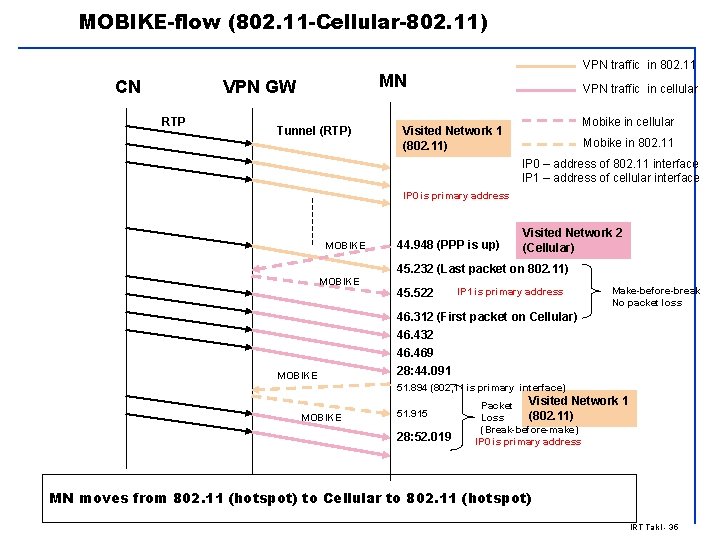
MOBIKE-flow (802. 11 -Cellular-802. 11) CN MN VPN GW RTP VPN traffic in 802. 11 Tunnel (RTP) VPN traffic in cellular Mobike in cellular Visited Network 1 (802. 11) Mobike in 802. 11 IP 0 – address of 802. 11 interface IP 1 – address of cellular interface IP 0 is primary address MOBIKE 44. 948 (PPP is up) Visited Network 2 (Cellular) 45. 232 (Last packet on 802. 11) MOBIKE 45. 522 IP 1 is primary address Make-before-break No packet loss 46. 312 (First packet on Cellular) 46. 432 46. 469 28: 44. 091 51. 894 (802, 11 is primary interface) MOBIKE 51. 915 28: 52. 019 Visited Network Packet (802. 11) Loss (Break-before-make) IP 0 is primary address 1 MN moves from 802. 11 (hotspot) to Cellular to 802. 11 (hotspot) IRT Talkl - 35
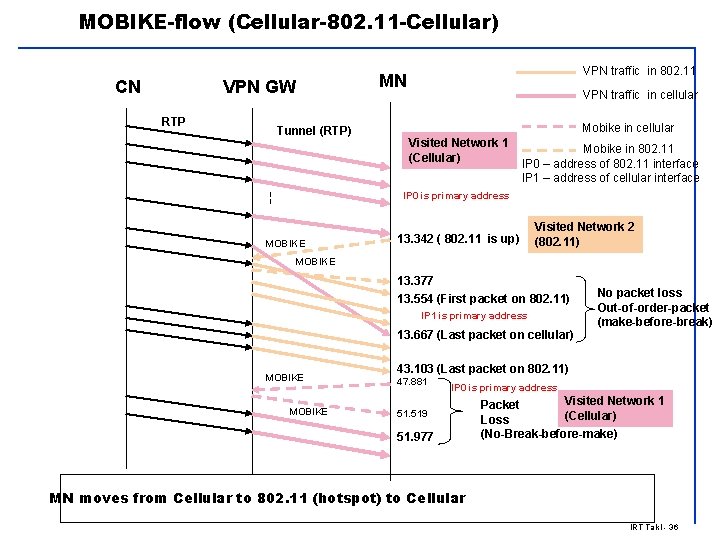
MOBIKE-flow (Cellular-802. 11 -Cellular) CN VPN GW RTP Tunnel (RTP) VPN traffic in 802. 11 MN VPN traffic in cellular Mobike in cellular Visited Network 1 (Cellular) Mobike in 802. 11 IP 0 – address of 802. 11 interface IP 1 – address of cellular interface IP 0 is primary address MOBIKE 13. 342 ( 802. 11 is up) Visited Network 2 (802. 11) MOBIKE 13. 377 13. 554 (First packet on 802. 11) IP 1 is primary address 13. 667 (Last packet on cellular) MOBIKE No packet loss Out-of-order-packet (make-before-break) 43. 103 (Last packet on 802. 11) 47. 881 IP 0 is primary address 51. 519 51. 977 Visited Network 1 Packet (Cellular) Loss (No-Break-before-make) MN moves from Cellular to 802. 11 (hotspot) to Cellular IRT Talkl - 36
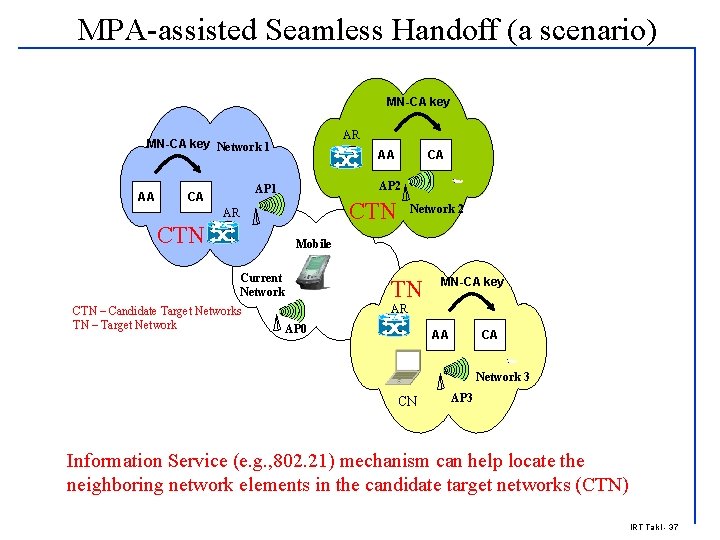
MPA-assisted Seamless Handoff (a scenario) MN-CA key AR MN-CA key Network 1 AA AA AP 2 AP 1 CA CA CTN AR CTN Network 2 Mobile Current Network CTN – Candidate Target Networks TN – Target Network TN MN-CA key AR AP 0 AA CA Network 3 CN AP 3 Information Service (e. g. , 802. 21) mechanism can help locate the neighboring network elements in the candidate target networks (CTN) IRT Talkl - 37
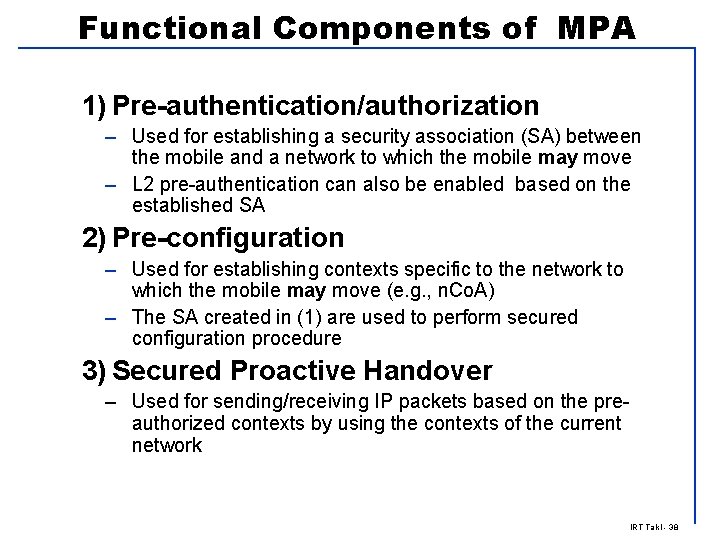
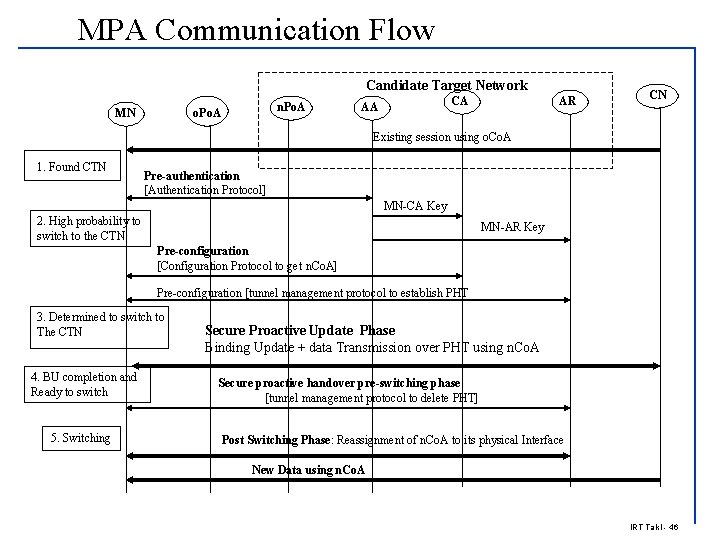
Functional Components of MPA 1) Pre-authentication/authorization – Used for establishing a security association (SA) between the mobile and a network to which the mobile may move – L 2 pre-authentication can also be enabled based on the established SA 2) Pre-configuration – Used for establishing contexts specific to the network to which the mobile may move (e. g. , n. Co. A) – The SA created in (1) are used to perform secured configuration procedure 3) Secured Proactive Handover – Used for sending/receiving IP packets based on the preauthorized contexts by using the contexts of the current network IRT Talkl - 38
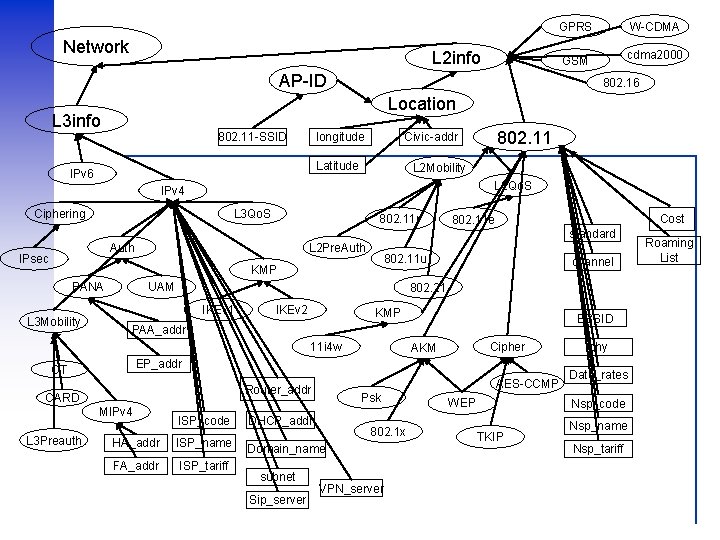
Network GPRS W-CDMA GSM cdma 2000 L 2 info AP-ID 802. 16 Location L 3 info 802. 11 -SSID longitude Latitude IPv 6 802. 11 Civic-addr L 2 Mobility L 2 Qo. S IPv 4 Ciphering L 3 Qo. S 802. 11 r Cost 802. 11 e standard Auth IPsec L 2 Pre. Auth 802. 11 u KMP PANA L 3 Mobility UAM 802. 21 IKEv 2 KMP BSSID PAA_addr 11 i 4 w Cipher AKM EP_addr CT AES-CCMP Router_addr CARD MIPv 4 L 3 Preauth channel ISP_code HA_addr ISP_name FA_addr ISP_tariff Psk DHCP_addr 802. 1 x Domain_name subnet Sip_server VPN_server WEP phy Data_rates Nsp_code TKIP Nsp_name Nsp_tariff Roaming List
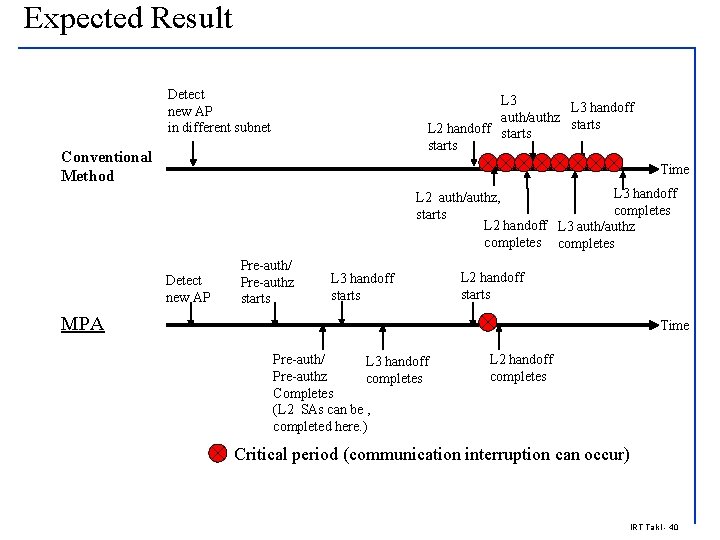
Expected Result Detect new AP in different subnet L 3 handoff auth/authz starts L 2 handoff starts Conventional Method Time L 3 handoff L 2 auth/authz, completes starts L 2 handoff L 3 auth/authz completes Detect new AP Pre-auth/ Pre-authz starts L 3 handoff starts L 2 handoff starts MPA Time Pre-auth/ L 3 handoff Pre-authz completes Completes (L 2 SAs can be , completed here. ) L 2 handoff completes Critical period (communication interruption can occur) IRT Talkl - 40
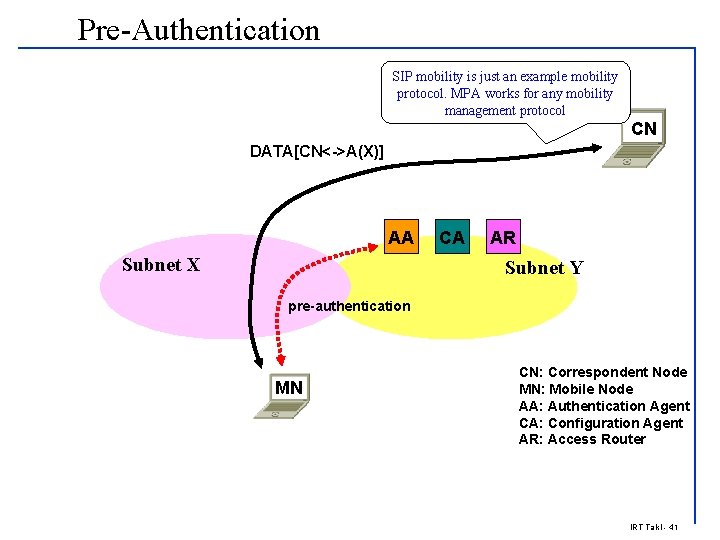
Pre-Authentication SIP mobility is just an example mobility protocol. MPA works for any mobility management protocol CN DATA[CN<->A(X)] AA Subnet X CA AR Subnet Y pre-authentication MN CN: Correspondent Node MN: Mobile Node AA: Authentication Agent CA: Configuration Agent AR: Access Router IRT Talkl - 41
Pre-authorization CN DATA[CN<->A(X)] MN-CA key AA CA Subnet X AR Subnet Y pre-authorization MN IP address: A(X) Current subnet: X Status: Pre-authentication done Action: pre-authorization CN: Correspondent Node MN: Mobile Node AA: Authentication Agent CA: Configuration Agent AR: Access Router IRT Talkl - 42
Proactive Handover: Initial Phase CN DATA[CN<->A(X)] MN-AR key AA CA Subnet X AR Subnet Y Secure Proactive Handover tunnel establishment procedure MN IP address: A(X), A(Y) Current subnet: X Status: Pre-authorization done Action: PH Initiation CN: Correspondent Node MN: Mobile Node AA: Authentication Agent CA: Configuration Agent AR: Access Router IRT Talkl - 43
Proactive Handover: Tunneling Phase CN DATA[CN<->A(X)] MN-AR key AA CA Subnet X AR Re-Invite[CN<->A(Y)] Subnet Y SIP Re-Invite over proactive hanodver tunnel [AR<->A(X)] MN IP address: A(X), A(Y) Current subnet: X Status: PH tunnel established Action: SIP Re-Invite CN: Correspondent Node MN: Mobile Node AA: Authentication Agent CA: Configuration Agent AR: Access Router IRT Talkl - 44
Proactive Handover: Completion Phase DATA [CN<->A(Y)] over proactive hanover tunnel [AR<->A(X)] AA Subnet X CA CN AR Subnet Y Proactive handover stop procedure MN IP address: A(X), A(Y) Current subnet: X Status: SIP Re-Invite done Action: PH Completion L 2 handoff procedure CN: Correspondent Node MN: Mobile Node AA: Authentication Agent CA: Configuration Agent AR: Access Router IRT Talkl - 45
MPA Communication Flow Candidate Target Network MN n. Po. A o. Po. A CA AA AR CN Existing session using o. Co. A 1. Found CTN Pre-authentication [Authentication Protocol] MN-CA Key 2. High probability to switch to the CTN MN-AR Key Pre-configuration [Configuration Protocol to get n. Co. A] Pre-configuration [tunnel management protocol to establish PHT 3. Determined to switch to The CTN 4. BU completion and Ready to switch 5. Switching Secure Proactive Update Phase Binding Update + data Transmission over PHT using n. Co. A Secure proactive handover pre-switching phase [tunnel management protocol to delete PHT] Post Switching Phase: Reassignment of n. Co. A to its physical Interface New Data using n. Co. A IRT Talkl - 46
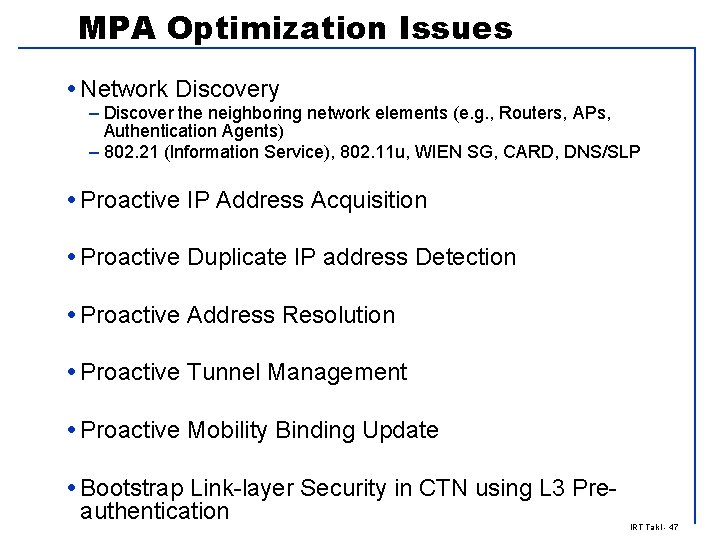
MPA Optimization Issues Network Discovery – Discover the neighboring network elements (e. g. , Routers, APs, Authentication Agents) – 802. 21 (Information Service), 802. 11 u, WIEN SG, CARD, DNS/SLP Proactive IP Address Acquisition Proactive Duplicate IP address Detection Proactive Address Resolution Proactive Tunnel Management Proactive Mobility Binding Update Bootstrap Link-layer Security in CTN using L 3 Preauthentication IRT Talkl - 47
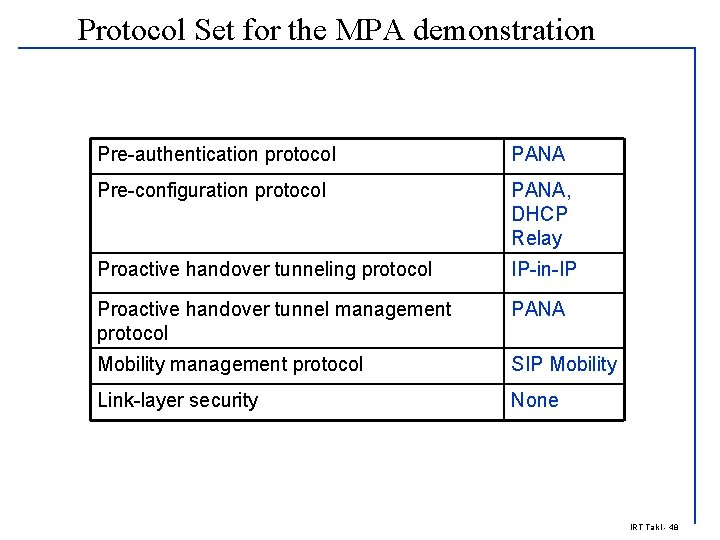
Protocol Set for the MPA demonstration Pre-authentication protocol PANA Pre-configuration protocol PANA, DHCP Relay Proactive handover tunneling protocol IP-in-IP Proactive handover tunnel management protocol PANA Mobility management protocol SIP Mobility Link-layer security None IRT Talkl - 48
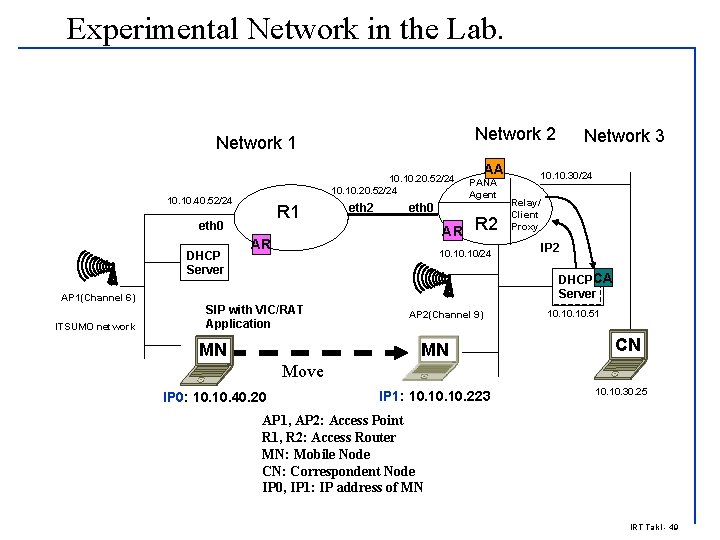
Experimental Network in the Lab. Network 2 Network 1 10. 10. 20. 52/24 10. 40. 52/24 R 1 eth 0 DHCP Server AP 1(Channel 6) ITSUMO network eth 2 eth 0 AR AR AA PANA Agent R 2 10. 10/24 Network 3 10. 30/24 Relay/ Client Proxy IP 2 DHCPCA Server SIP with VIC/RAT Application MN AP 2(Channel 9) MN 10. 10. 51 CN Move IP 0: 10. 40. 20 IP 1: 10. 10. 223 10. 30. 25 AP 1, AP 2: Access Point R 1, R 2: Access Router MN: Mobile Node CN: Correspondent Node IP 0, IP 1: IP address of MN IRT Talkl - 49
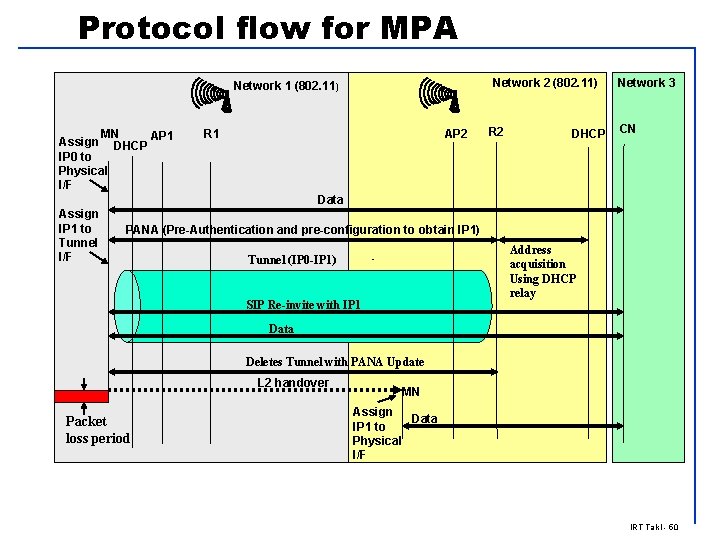
Protocol flow for MPA Network 2 (802. 11) Network 1 (802. 11) MN AP 1 Assign DHCP IP 0 to Physical I/F R 1 AP 2 R 2 DHCP Network 3 CN Data Assign IP 1 to Tunnel I/F PANA (Pre-Authentication and pre-configuration to obtain IP 1) Address acquisition Using DHCP relay - Tunnel (IP 0 -IP 1) SIP Re-invite with IP 1 Data Deletes Tunnel with PANA Update L 2 handover Packet loss period MN Assign Data IP 1 to Physical I/F IRT Talkl - 50
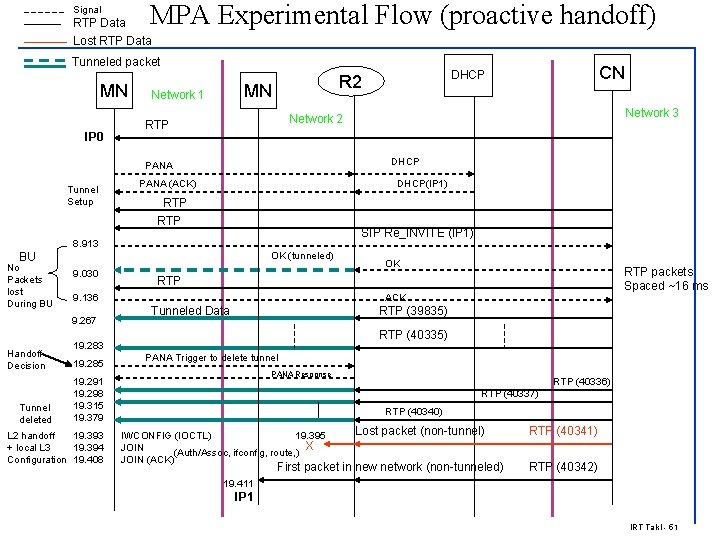
Signal RTP Data MPA Experimental Flow (proactive handoff) Lost RTP Data Tunneled packet MN IP 0 MN Network 1 DHCP PANA (ACK) DHCP(IP 1) RTP SIP Re_INVITE (IP 1) 8. 913 OK (tunneled) BU No Packets lost During BU 9. 030 Handoff Decision Tunnel deleted RTP (39835) RTP (40335) PANA Trigger to delete tunnel PANA Response 19. 291 19. 298 19. 315 19. 379 L 2 handoff 19. 393 + local L 3 19. 394 Configuration 19. 408 RTP packets Spaced ~16 ms ACK Tunneled Data 19. 283 19. 285 OK RTP 9. 136 9. 267 Network 3 Network 2 RTP PANA Tunnel Setup CN DHCP R 2 RTP (40336) RTP (40337) RTP (40340) IWCONFIG (IOCTL) 19. 395 X JOIN (Auth/Assoc, ifconfig, route, ) JOIN (ACK) Lost packet (non-tunnel) First packet in new network (non-tunneled) RTP (40341) RTP (40342) 19. 411 IP 1 IRT Talkl - 51
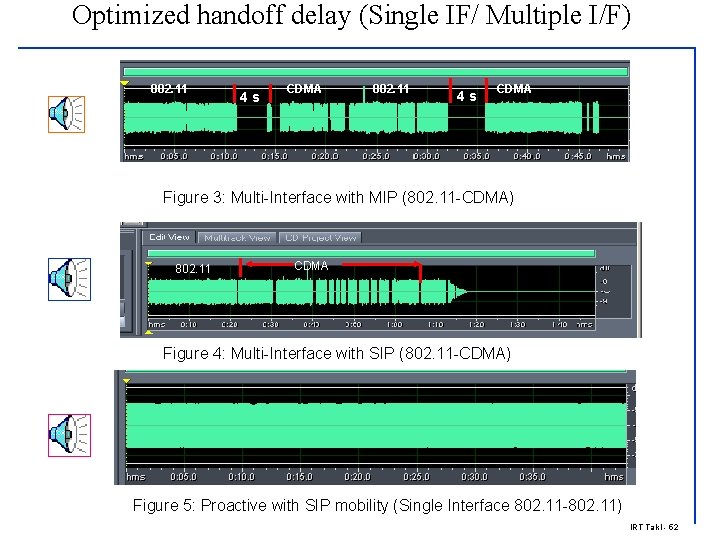
Optimized handoff delay (Single IF/ Multiple I/F) 802. 11 4 s CDMA Figure 3: Multi-Interface with MIP (802. 11 -CDMA) 802. 11 CDMA Figure 4: Multi-Interface with SIP (802. 11 -CDMA) Figure 5: Proactive with SIP mobility (Single Interface 802. 11 -802. 11) IRT Talkl - 52
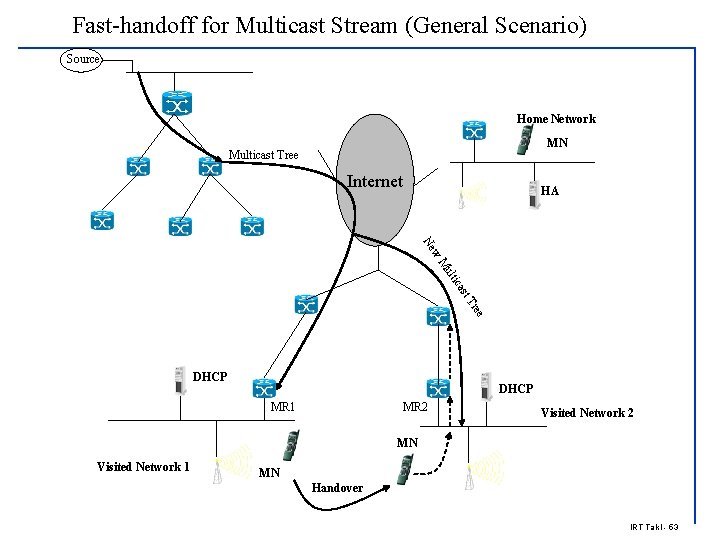
Fast-handoff for Multicast Stream (General Scenario) Source Home Network MN Multicast Tree Internet HA w Ne st ica ult M ee Tr DHCP MR 1 MR 2 Visited Network 2 MN Visited Network 1 MN Handover IRT Talkl - 53
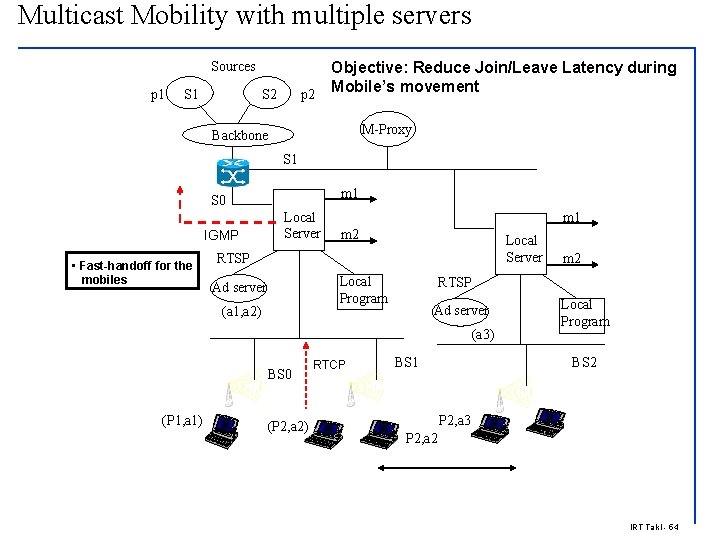
Multicast Mobility with multiple servers Sources p 1 S 2 p 2 Objective: Reduce Join/Leave Latency during Mobile’s movement M-Proxy Backbone S 1 m 1 S 0 IGMP • Fast-handoff for the mobiles Local Server m 1 m 2 Local Server RTSP Local Program Ad server (a 1, a 2) RTSP Ad server (a 3) BS 0 (P 1, a 1) (P 2, a 2) RTCP m 2 BS 1 Local Program BS 2 P 2, a 3 P 2, a 2 IRT Talkl - 54
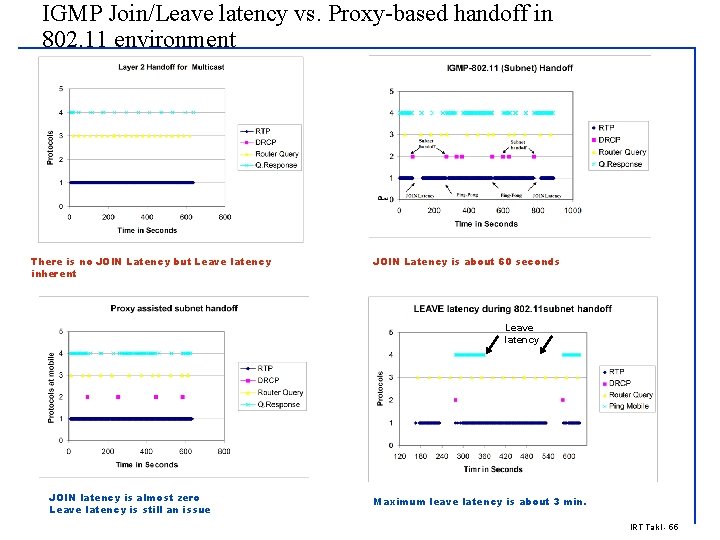
IGMP Join/Leave latency vs. Proxy-based handoff in 802. 11 environment There is no JOIN Latency but Leave latency inherent JOIN Latency is about 60 seconds Leave latency JOIN latency is almost zero Leave latency is still an issue Maximum leave latency is about 3 min. IRT Talkl - 55
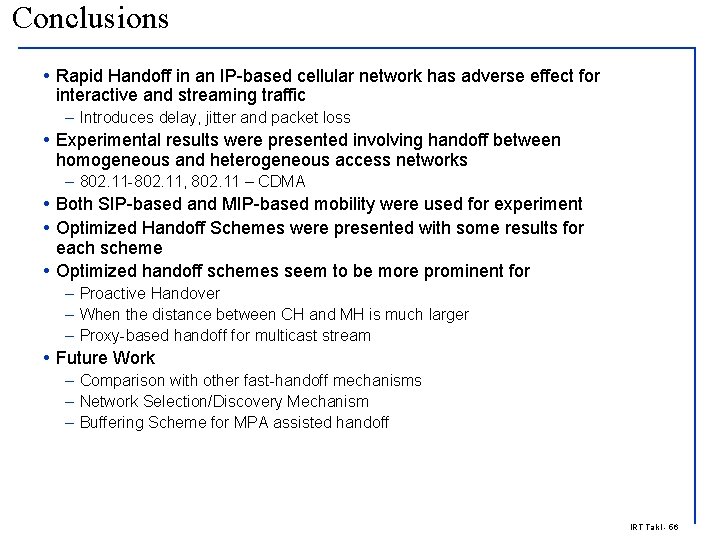
Conclusions Rapid Handoff in an IP-based cellular network has adverse effect for interactive and streaming traffic – Introduces delay, jitter and packet loss Experimental results were presented involving handoff between homogeneous and heterogeneous access networks – 802. 11 -802. 11, 802. 11 – CDMA Both SIP-based and MIP-based mobility were used for experiment Optimized Handoff Schemes were presented with some results for each scheme Optimized handoff schemes seem to be more prominent for – Proactive Handover – When the distance between CH and MH is much larger – Proxy-based handoff for multicast stream Future Work – Comparison with other fast-handoff mechanisms – Network Selection/Discovery Mechanism – Buffering Scheme for MPA assisted handoff IRT Talkl - 56